Hiring in the Netherlands: 2026 US Compliance Guide
By Joost Hubregtse, Director, ICS Staffing & Payroll
All blog posts are reviewed and fact checked by our labour law lawyer Zishan Hussain and our director. Editorial standards
Updated 6 August 2026 · 18 min read
By Joost Hubregtse, Director, ICS Staffing & Payroll B.V.
Reviewed for legal accuracy by Zishan Hussain, employment lawyer, and the director. Figures verified against Rijksoverheid, Belastingdienst, IND and UWV publications current at the date above.
The Dutch labour market has loosened considerably since its 2022 peak. In the second quarter of 2026 there were 95 open vacancies for every 100 unemployed people, down from 142 in the second quarter of 2022. Hiring is easier than it was, but the compliance framework around it has become substantially heavier, and 2027 brings the largest set of changes to Dutch flexible-work and staffing law in a decade.
For American firms, the difficulty was never finding Dutch talent. It is the distance between US at-will employment and a system built on the chain rule, 104 weeks of employer-funded sick pay, and, from 2027, a licensing regime for anyone who supplies labour to a third party. A single misjudgement on permanent establishment, sponsorship or equal-treatment obligations carries real financial exposure.
This guide sets out what actually applies in 2026, what changes on 31 December 2026, 1 January 2027 and 1 January 2028, and where an Employer of Record (EOR) genuinely helps, and where it does not.
Key Takeaways
- A US company can register directly with the Dutch tax authority as a withholding agent without incorporating a BV. An EOR is a speed and administration decision, not a legal necessity.
- An EOR does not eliminate permanent establishment risk. PE is determined by what your people do in the Netherlands, not by who signs their contract.
- Under Article 8a Waadi, a payroll or EOR employee is entitled to at least the same terms of employment as comparable staff at the client, plus an adequate pension. This is the single largest cost driver of the Dutch EOR model.
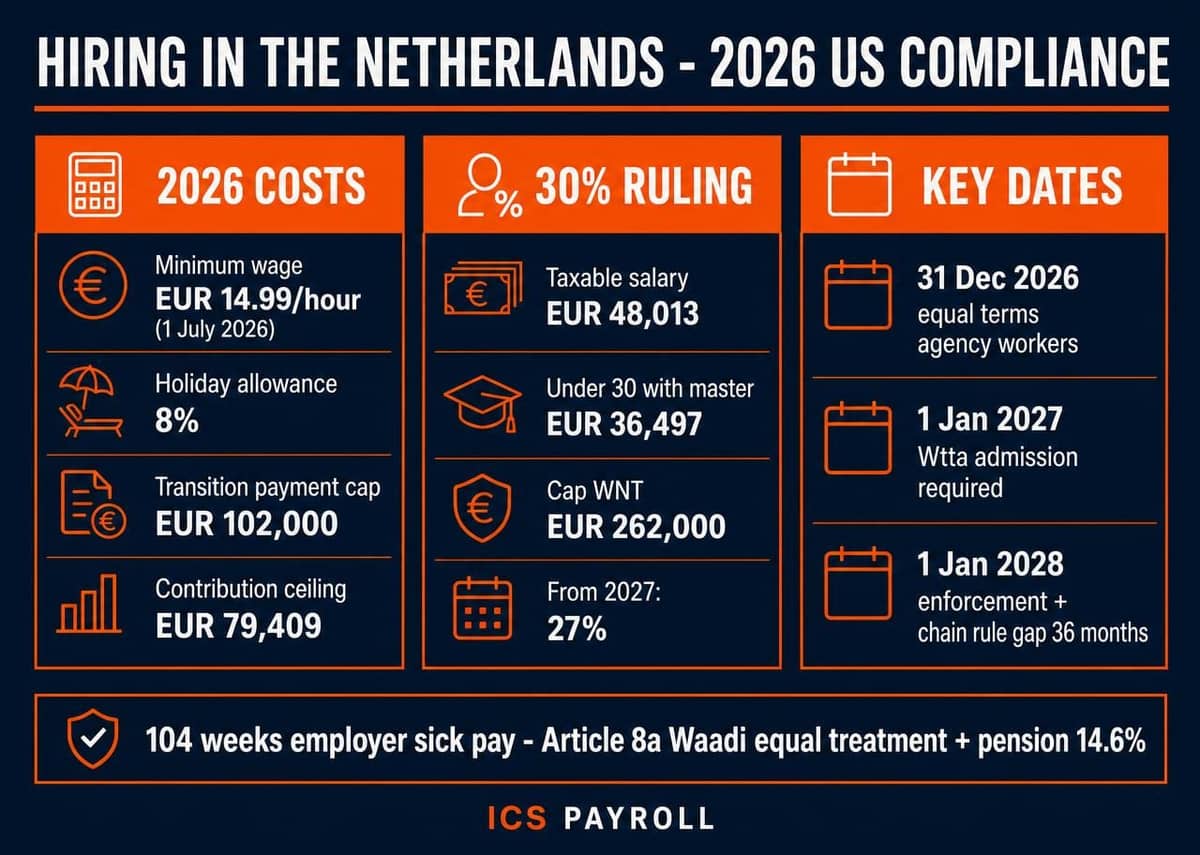
- 2026 figures: €14.99 statutory hourly minimum wage from 1 July 2026; 8% holiday allowance; 30% ruling threshold of €48,013 taxable salary; transition payment capped at €102,000.
- From 1 January 2027 anyone supplying labour in the Netherlands, including payroll and EOR providers, needs formal admission under the Wtta. Clients using non-admitted providers face penalties from 1 January 2028.
- For non-EU hires, the recognised sponsor must be the legal employer. Sponsorship cannot be split from employment.
Hiring in the Netherlands: Opportunities and Legal Hurdles for US Firms
The Netherlands remains a strong entry point into Europe: high English proficiency, a dense technical talent pool, and a stable regulatory environment, as a broad Dutch economic overview (primary source: CBS, Dutch labour market and wage statistics) confirms. The legal framework, however, differs from US practice in ways that are structural rather than cosmetic. Dismissal requires prior permission from UWV or a court. Sickness is an employer liability for two years. Successive fixed-term contracts convert to permanent by operation of law. A US-style offer letter will not survive contact with a Dutch court.
Do you legally need a Dutch entity?
No, and this is widely misstated in the market.
A company established outside the Netherlands with no Dutch permanent establishment is not automatically a withholding agent for Dutch wage tax. But it may elect to become one. The Belastingdienst provides for voluntary withholding-agent status: a foreign employer registers using the Aanmelding Onderneming buitenland form, sets up a Dutch payroll administration, and from then on operates Dutch payroll directly. Employers who take this route can also apply the expat scheme (30% ruling) for qualifying employees.
Separately, where an employee is covered by Dutch social insurance under EU Regulation 883/2004 or the Netherlands-US social security agreement, the foreign employer is required to register and pay employee-insurance premiums, regardless of whether it has an entity or a permanent establishment here.
The honest framing is therefore: direct registration is available and lawful, but it puts the full employer-law burden, contracts, sick pay, reintegration, dismissal, pension and record-keeping, on a US organisation with no local infrastructure. Most firms hiring one to five people choose an Employer of Record in the Netherlands because they do not want to build that capability, not because the law forbids the alternative.
Permanent establishment: what an EOR does and does not do
A Dutch BV is a separate legal entity and is not, in itself, a permanent establishment of its US parent. But a subsidiary can create a PE for the parent if it acts as a dependent agent.
More importantly: an EOR does not neutralise permanent establishment risk. Under Article 5 of the Netherlands-US tax treaty, a PE arises from a fixed place of business at the enterprise's disposal, or from a person in the Netherlands who habitually concludes contracts, or habitually plays the principal role leading to the conclusion of contracts, in the name of the enterprise. That test looks at what the individual does and on whose behalf. It does not ask who issues the payslip.
In practice this means:
- A Dutch-based engineer or support specialist working through an EOR, with no authority to bind the US company, is unlikely to create a PE.
- A Dutch-based salesperson negotiating and closing deals for the US company creates dependent-agent PE exposure whether or not an EOR is interposed.
Any provider telling you an EOR "ensures" no taxable presence is overstating. What an EOR genuinely does is remove the employer-law and payroll burden, and avoid the fixed-place-of-business element that comes with leasing your own Dutch office. The dependent-agent question needs a separate analysis of each role, ideally before the contract is signed.
Employer of Record vs. Dutch BV: Choosing the Right Path
Incorporating a BV means notary, Chamber of Commerce registration, UBO filing, bank onboarding, and then the ongoing apparatus of local payroll, accounting and HR. Realistically two to three months to operational status. An EOR can have a compliant Dutch employment contract in place in days once the service agreement is signed. Our detailed comparison of EOR versus a Dutch BV works through the decision in full.
When to Incorporate a Dutch BV
For teams of one to five, the overhead of a BV usually exceeds the value of the presence. Beyond roughly ten employees, or where you intend to conduct substantive commercial activity locally, incorporation generally becomes the better structure, for control, for cost per head, and because at that scale you are likely creating a taxable presence anyway.
The obligation most US buyers do not price in: Article 8a Waadi
This is the point that changes the cost comparison, and it is routinely omitted from EOR marketing.
Dutch law classifies the EOR model as payrolling. Under Article 8a of the Waadi (Allocation of Workers by Intermediaries Act):
- The payroll employee is entitled to at least the same terms of employment as employees in the same or equivalent roles at the client. If the client has no comparable employees, the benchmark is the sector in which the client operates.
- Terms means terms: salary scale, allowances, leave entitlements above statutory minimum, bonus schemes, expense arrangements.
- The payroll employer must provide an adequate pension scheme, either the client's own basic scheme, or a scheme meeting the criteria in the Baadi, which requires old-age and survivor's pension, no waiting or threshold period, and a total employer contribution of at least 14.6% of the pension base.
- The client has a statutory duty to disclose its applicable terms of employment to the payroll employer, and the payroll employer has an independent duty to investigate.
These provisions cannot be contracted away to the employee's detriment. For a US company with no Dutch staff, the sector benchmark applies, and the pension obligation is real money. Any EOR quotation that does not show a pension line is either incomplete or non-compliant. Ask for it explicitly.
Waadi registration and, from 2027, admission
Any business that supplies workers to third parties must be registered as such in the Dutch trade register. From 1 January 2027 a further requirement applies: formal admission under the Wtta. See the section on 2027 and 2028 below. This is a procurement question you should be asking providers now, not in 2027.
The Local EOR Advantage for US Clients
Global platforms offer breadth. Dutch-specific matters, such as Article 8a benchmarking, Poortwachter case management, CAO applicability and IND sponsorship mechanics, reward depth. Neither is universally right; the question is whether your Dutch headcount is incidental to a wider EMEA rollout or the substance of your European presence. Our multi-country EOR versus local EOR comparison sets out the trade-offs.
2026 Dutch Employment Standards: Statutory Benefits and Costs
Minimum wage
The Netherlands operates a statutory minimum hourly wage, adjusted twice yearly. It was €14.71 gross per hour from 1 January 2026 and rose to €14.99 gross per hour on 1 July 2026, an increase of 1.90%. Separate, lower hourly rates apply to workers aged 15 to 20. The next indexation takes effect on 1 January 2027. A collective labour agreement (CAO) may set a higher floor for your sector; check applicability before setting salary bands.
Holiday allowance (vakantiebijslag)
The statutory minimum is 8% of gross annual salary, most commonly paid as a lump sum in May, though monthly payment can be agreed in the employment contract.
Two qualifications matter for the salary levels typical of US-backed hires. First, the statutory entitlement is calculated up to three times the minimum wage, which on 2026 figures is roughly €93,000 per year. Second, for the portion of salary above that level, employer and employee may agree in writing to a reduced allowance or none at all.
Many employers pay the full 8% on total salary as a matter of market practice. That is a commercial choice, not a legal requirement, and it should be a deliberate one at senior salary levels.
Employer social security contributions (2026)
| Contribution | 2026 rate |
|---|---|
| AWf (unemployment), permanent contracts | 2.74% |
| AWf, fixed-term, on-call, non-written | 7.74% |
| Aof (disability), small employers | 6.27% |
| Aof, medium and large employers | 7.63% |
| Childcare surcharge on Aof | 0.50% |
| Whk (return-to-work fund) | Set per employer; 2026 average 1.52% |
| Zvw employer levy | 6.10% |
The maximum contribution base for employee insurances and the Zvw levy is €79,409 per year in 2026. The Whk premium is determined individually per employer by the tax authority and communicated by decision; new employers receive a sector-average rate. Any cost model that omits Whk and the childcare surcharge understates your true employer burden by roughly two percentage points. Payroll and tax records must be retained for at least seven years, as set out in our Dutch payroll administration reference guide.
Sick Pay and Disability Obligations
This is the largest single risk differential from US employment.
- The employer must continue paying wages for up to 104 weeks of incapacity.
- The statutory minimum is 70% of contractual wages, calculated on wage up to the statutory maximum daily wage.
- During the first 52 weeks, the amount paid must not fall below the applicable statutory minimum wage. That floor does not apply in the second year.
- Most CAOs and many contracts uplift the first year to 100%. That is contractual, not statutory.
The Wet verbetering poortwachter imposes a prescribed reintegration process: a company doctor's problem analysis, a written plan of action, periodic evaluations, second-track reintegration with another employer where return to the original role is not feasible, and a full reintegration file.
If UWV concludes at the two-year assessment that reintegration efforts were inadequate or the file incomplete, it can impose a loonsanctie, extending wage continuation by up to a further 52 weeks. The prohibition on dismissal is extended in parallel. Unless the contract or CAO says otherwise, the obligation during that third year is the statutory 70%.
A fixed-term contract that expires during sickness ends the wage-continuation obligation on its expiry date; the employee then moves to a Sickness Benefits Act claim, which can affect the employer's Whk rate. For US organisations, the practical point is that the exposure is not two years of salary. It is two years of salary, plus a managed medical and administrative process, plus a contingent third year if that process is run badly.
Fixed-term contracts and the chain rule
Under the current Ketenregeling, an employer may conclude a maximum of three consecutive fixed-term contracts within 36 months. A fourth contract, or exceeding 36 months in total, converts the relationship to permanent by operation of law. A gap of more than six months between contracts currently starts a new chain; a gap of six months or less does not. Limited derogation by CAO remains possible. This regime changes on 1 January 2028, as set out below.
Trial Periods and Termination Rules
Probationary periods are strictly regulated, must be agreed in writing, and must be identical for both parties:
| Contract | Maximum probation |
|---|---|
| Under 6 months | Not permitted |
| 6 months to under 2 years | 1 month |
| 2 years or more (fixed-term) | 2 months |
| Indefinite | 2 months |
An invalid probation clause is void, meaning no probationary dismissal is possible at all.
Where an employment relationship ends at the employer's initiative, including non-renewal of a fixed-term contract and including dismissal during probation, the employee is in principle entitled to a transition payment accruing from the first day of employment. The standard accrual is one third of a gross monthly salary per full year of service, pro-rated. The calculation base includes holiday allowance and fixed components such as a thirteenth month. For 2026 the transition payment is capped at €102,000, or one gross annual salary where that exceeds €102,000.
Outside probation, unilateral termination requires either UWV permission (redundancy, or long-term incapacity) or a court order on one of the statutory grounds. In practice most exits are settled by mutual termination agreement, where the transition payment cap does not apply and the negotiated figure is often higher.
Hiring Non-EU Talent: HSM Permits and the 30% Ruling
Highly skilled migrant salary criteria (2026)
Applications for a highly skilled migrant permit submitted on or after 1 January 2026 must meet:
| Category | Gross monthly salary |
|---|---|
| Highly skilled migrant / ICT, 30 and over | €5,942 |
| Highly skilled migrant / ICT, under 30 | €4,357 |
| Reduced criterion (recent graduates, post orientation year) | €3,122 |
All figures are excluding the 8% holiday allowance, which does not count toward the threshold. The salary must be fixed, contractually agreed, market-conform for the role, and paid monthly into a bank account in the migrant's own name. Bonuses, commission, overtime and benefits in kind do not count. The criterion applicable is the one in force on the date of application, or on the start date of a new employment relationship in the case of a change of employer. Further background is available via business.gov.nl.
Sponsorship: the employer must be the recognised sponsor
Since 2013 only an employer holding IND recognised sponsor (erkend referent) status can apply for a highly skilled migrant permit. This is a structural point that is frequently blurred in EOR marketing, so it is worth stating plainly: sponsorship cannot be separated from employment. The entity that holds recognised-sponsor status must be the entity that employs the migrant. It carries the accompanying duties to inform, to administer, and to exercise due care.
Consequently, where a highly skilled migrant is engaged through an intermediary, the intermediary is both the legal employer and the sponsor, and the client is the hirer. Recognised sponsors that are staffing or payroll intermediaries must additionally hold SNA registration under NEN 4400-1.
Two further points a US buyer should factor in. Recognised-sponsor status can be applied for directly by your own Dutch entity if you have one; processing takes time and carries a one-off IND fee, but it removes the intermediary from the immigration chain permanently. And the government has announced an intention to restrict recognised sponsors from commercially supplying highly skilled migrants to third parties, with limited temporary exceptions. This has not been implemented as at the date of this article, but it is a live policy direction and it goes to the durability of any intermediary-sponsored arrangement. Build that into a multi-year plan.
At ICS Payroll we are transparent about which entity performs which role in any given engagement, and we will tell you where direct recognised-sponsor status is the better long-term structure for you.
HSM Processing Times
For recognised sponsors, the IND aims to decide highly skilled migrant applications well inside the statutory decision period, and straightforward complete applications are commonly decided within two to three weeks. Add time for the MVV collection appointment at the relevant Dutch mission, biometrics, and municipal registration on arrival. Incomplete documentation is the dominant cause of delay: passports, diplomas, legalised or apostilled civil-status documents where family members are joining, and a signed contract meeting the salary norm.
The 30% Ruling in 2026
The facility is now formally called the expatregeling or expat scheme, although "30% ruling" remains the common term. It allows an employer to pay a portion of salary tax-free as compensation for extraterritorial costs. The 2026 conditions are:
- Maximum tax-free portion: 30%.
- Employee's taxable salary after the deduction must be at least €48,013.
- Reduced threshold of €36,497 for employees under 30 holding a qualifying master's degree.
- The benefit is capped by reference to the WNT norm of €262,000 for 2026. The transitional relief that shielded pre-2023 beneficiaries from this cap expired on 1 January 2026; affected employees should be informed before it appears on a payslip.
- Maximum duration five years, reduced by prior periods of residence or work in the Netherlands.
- The employee must have lived more than 150 kilometres from the Dutch border for at least 16 of the 24 months preceding the first working day.
Employer and employee apply jointly. If the application is filed within four months of the start date, the ruling applies retroactively from day one. If filed later, it applies from the first day of the month following the month of application. Employers must elect annually, in the first payroll period, between the fixed percentage and reimbursement of actual extraterritorial costs. The partial non-resident taxpayer status previously available to ruling holders was abolished with effect from 2025.
The IND salary criterion and the tax threshold are assessed separately and by different authorities. Meeting one does not establish the other.
Changes from 1 January 2027: for rulings first applied from 1 January 2025 onward, the tax-free percentage drops from 30% to 27%, and the salary norms rise to approximately €50,436 and €38,388 respectively, subject to annual indexation. Employees whose ruling was already applied in the final payroll period of 2023 retain 30% and the existing norms for the remainder of their term. If you are budgeting a hire that starts in late 2026, model the 2027 position, not the 2026 one. The net-pay conversation with the candidate is materially different.
What Changes in 2027 and 2028
Two pieces of legislation reshape the framework this article describes. Both are already adopted. Any EOR or staffing decision taken now should be tested against them.
Wtta: admission requirement for labour suppliers
The Act on the Admission of the Supply of Workers takes effect on 1 January 2027, with enforcement by the Netherlands Labour Authority from 1 January 2028.
- It applies to virtually all supply of labour to third parties, including temporary agency work, secondment, payroll and EOR arrangements, and onward supply.
- Suppliers must hold formal admission from the new admission authority. Requirements include a certificate of good conduct, a financial deposit, and demonstrated compliance with applicable legislation, with periodic re-verification.
- Clients are directly affected. Hirers may only use admitted suppliers and are expected to verify status in the public register. Using a non-admitted supplier is itself sanctionable.
- Existing suppliers wishing to rely on the transitional regime must register between 1 November 2026 and 1 January 2027.
Practical implication for a US buyer: when you select a Dutch EOR in 2026, ask in writing whether the provider will register within the transitional window, whether it holds SNA certification, and what happens to your contracts if admission is refused. This belongs in your provider due diligence now.
Wet meer zekerheid flexwerkers
Adopted by the Senate on 7 July 2026, with phased entry into force. From 31 December 2026, equal terms of employment apply to agency workers. This tightens and extends the equal-treatment principle already applicable to payroll workers, and increases the disclosure burden on hirers.
From 1 January 2028 (intended date):
- The chain-rule interruption period rises from six months to 36 months, ending revolving-door arrangements. The maximum of three fixed-term contracts remains. Shorter periods are retained for school and university students working limited hours, and for genuine seasonal work.
- The scope for CAO derogation from the chain rule is largely removed.
- Zero-hours and current min-max contracts are abolished and replaced by a bandwidth contract, in which the maximum may not exceed 130% of the agreed minimum.
- The agency-work phase system is shortened: phase A from 78 to 52 weeks, phase B from six contracts in four years to six contracts in two years.
Existing contracts generally remain governed by current law until they expire, with an exception for on-call contracts. If your Dutch hiring plan involves successive fixed-term contracts, seasonal patterns, or variable hours, the model that works in 2026 will not work in 2028. Design for the end state.
Working with ICSPayroll
ICSPayroll is the Employer of Record and Dutch payroll service of ICS Staffing & Payroll B.V., a subsidiary of Intercompany Solutions. We act as the legal employer under Dutch law: employment contracts, wage tax and social security filings, holiday allowance, pension, sick leave and reintegration management, and CAO compliance.
You receive a single monthly invoice covering gross wages, employer social security contributions, pension contributions where Article 8a Waadi requires them, mandatory insurances, and our fee. There is no need for a Dutch bank account or a local finance function.
We will also tell you when an EOR is the wrong answer. If you are hiring a commercial closer, if you are heading past ten Dutch employees, or if your immigration requirements point toward holding your own recognised-sponsor status, we will say so.
The ICSPayroll Onboarding Process
Step 1, quotation. You provide headcount, roles, salary levels and intended start dates. We return a full cost breakdown, including the Article 8a pension position, within one business day.
Step 2, documentation. We draft the service agreement and Dutch employment contracts, benchmarked against the applicable terms of employment and the applicable CAO where one applies.
Step 3, activation. Once the service agreement is signed and the employee's documentation is complete, onboarding of a Dutch resident is typically completed within five to ten business days. Non-EU hires follow the immigration timeline set out above, which is longer and driven by IND and consular scheduling rather than by us.
Expert Guidance from Joost Hubregtse
Every engagement is overseen by Joost Hubregtse, Director of ICS Staffing & Payroll B.V., who has twenty years of leadership experience in Dutch payroll and international employment. Contracts, sponsorship structures and Article 8a benchmarking are reviewed for legal accuracy by Zishan Hussain, employment lawyer. Where the compliant answer is not the commercially convenient one, we say so before you sign, not afterwards.
Securing Your Dutch Workforce for 2026 and Beyond
Hiring in the Netherlands in 2026 is a manageable exercise if you price the real obligations: Article 8a equal treatment and pension, 104 weeks of sick pay with a documented reintegration process, a transition payment that accrues from day one, and an immigration chain in which the sponsor must be the employer. The decisive variable is timing. The Wtta admission regime and the flexible-work reforms mean the arrangement you sign in 2026 must still be lawful in 2028. Request a quotation and we will model both years for you.
Frequently Asked Questions
Can a US company hire in the Netherlands without a local entity?
Yes, and by more than one route. A US company may register directly with the Dutch tax authority as a voluntary withholding agent, set up a Dutch payroll administration and employ staff itself. Alternatively it can engage an Employer of Record, which becomes the legal employer and assumes the employment-law obligations. The first route retains control and cost efficiency but requires local capability; the second transfers the burden. Neither requires incorporating a BV.
Does an Employer of Record protect us from permanent establishment?
Not by itself. Permanent establishment depends on the activities carried out in the Netherlands, whether the company has a fixed place of business at its disposal, or a person here who habitually concludes contracts or plays the principal role leading to their conclusion on the company's behalf. A support or engineering role without contracting authority is low risk. A sales role with negotiating authority creates exposure regardless of who employs the individual. This needs assessing role by role.
What is the minimum salary for the 30% ruling in 2026?
Taxable salary after the deduction must be at least €48,013, or €36,497 for employees under 30 with a qualifying master's degree. The benefit is capped by reference to the 2026 WNT norm of €262,000. From 1 January 2027 the percentage falls to 27% and the norms rise to approximately €50,436 and €38,388 for rulings first applied from 2025 onward.
What is the mandatory holiday allowance?
At least 8% of gross annual salary, payable as a lump sum, usually in May, or in monthly instalments if agreed in the contract. The statutory entitlement is calculated up to three times the minimum wage, approximately €93,000 in 2026; above that level a lower allowance or none at all can be agreed in writing.
Are US companies responsible for Dutch sick pay?
Where the employee is employed under Dutch law, yes. The employer pays at least 70% of wages for up to 104 weeks, with a statutory minimum wage floor during the first 52 weeks. The Wet verbetering poortwachter imposes a documented reintegration process, and inadequate reintegration can result in UWV extending the obligation by up to a further 52 weeks. Under an EOR arrangement this liability sits with the EOR as legal employer, and is priced into the service and its insurance cover.
What is the transition payment cap for 2026?
€102,000, or one gross annual salary if that is higher. It accrues from the first working day, at one third of a monthly salary per full year of service, and is due where the contract ends at the employer's initiative, including non-renewal of a fixed-term contract. Where the parties settle by mutual termination agreement, the statutory cap does not apply and the figure is negotiated.
Can an EOR sponsor a highly skilled migrant?
Only if the EOR itself holds IND recognised-sponsor status and is the employer. Sponsorship and employment cannot be separated: the recognised sponsor must be the legal employer and carries the statutory duties to inform, administer and exercise due care. Staffing and payroll intermediaries seeking recognised-sponsor status must also hold SNA registration under NEN 4400-1. Where we are not the sponsor for a given engagement, the sponsoring entity is the employer and we will identify it explicitly in the service agreement.
How many fixed-term contracts can I offer?
Currently a maximum of three consecutive fixed-term contracts within 36 months. A fourth contract, or exceeding 36 months, converts the relationship to permanent by operation of law. A gap of six months or less does not reset the count. From 1 January 2028 the interruption period is expected to rise to 36 months and the scope for CAO derogation is largely removed, so multi-year contracting strategies should be designed against the new rules rather than the current ones.
Do we need to check whether our provider is licensed?
From 1 January 2027, yes. Under the Wtta, businesses supplying workers, including payroll and EOR providers, require formal admission, and hirers may only use admitted suppliers. Enforcement begins 1 January 2028, and hirers as well as suppliers can be penalised. Ask any prospective provider now whether it will register in the transitional window opening 1 November 2026.
Sources and references
Every rule and figure above is traceable to the sources below: the exact statutory articles, the regulator pages that publish the amounts, the statistical datasets, and the specific court rulings that settle the point. Always check the current text for your own situation.
- Article 7:610 Dutch Civil Code, definition of the employment contract
- Article 7 Minimum Wage Act, entitlement to the statutory minimum wage
- Article 3 Corporate Income Tax Act 1969, foreign taxpayers with a Dutch permanent establishment
- KVK Netherlands Chamber of Commerce, registration and legal form requirements
- Belastingdienst, registering as an employer and obtaining a wage tax number
- IND, required gross monthly salary amounts for 2026 per permit category
- CBS, Compensation of employees and employment by economic activity (national accounts dataset 84165ENG)
- Eurostat, hourly labour cost levels by NACE activity (dataset lc_lci_lev), for cross-country comparison
- Supreme Court 24 March 2023, ECLI:NL:HR:2023:443 (Deliveroo): the test for qualifying a relationship as an employment contract under art. 7:610 BW
- Supreme Court 6 June 2025, ECLI:NL:HR:2025:850: profit attribution and permanent establishment under arts. 7 and 23 of the Netherlands-Belgium tax treaty

Article by
Joost Hubregtse
Joost Hubregtse is Director of ICS Staffing & Payroll B.V., the wholly owned subsidiary of Intercompany Solutions behind ICS Payroll. He is responsible for Employer of Record and Dutch payroll services: employment contracts, wage tax and social security filings, holiday allowance, pension, sick leave and CAO compliance, with onboarding possible within 48 hours.