
2026 Highly Skilled Migrant Netherlands Requirements: The Complete Employer Guide
By Joost Hubregtse, Director, ICS Staffing & Payroll
All blog posts are reviewed and fact checked by our labour law lawyer Zishan Hussain and our director. Editorial standards
Total immigration to the Netherlands fell for the third consecutive year in 2025, yet the demand for specialized international talent remains at a record high. Navigating the highly skilled migrant netherlands requirements in 2026 often feels like hitting a moving target. With salary thresholds indexed by approximately 4.5% and the Immigration and Naturalisation Service (IND) increasing scrutiny on employer compliance, the administrative burden can easily derail your growth plans. You likely feel the pressure of long processing times and the constant threat of non-compliance fines while trying to secure critical staff.
It's understandable to feel overwhelmed by the intersection of immigration law and Dutch labor regulations. This guide provides the clarity you need to master these complex requirements so you can hire international talent with confidence and speed. We'll outline the exact salary norms for 2026, explain how sponsorship is arranged via a licensed partner, and clarify the financial impact of the 30% ruling. By the end of this article, you'll understand how to reduce hiring timelines from months to weeks while ensuring 100% compliance with the latest Dutch regulations and tax standards.
Key Takeaways
- Identify the core 2026 highly skilled migrant netherlands requirements, including the mandatory IND sponsorship and newly indexed salary thresholds for international professionals.
- Master the specific 2026 taxable salary norms of EUR 48,013 for standard applicants and EUR 36,497 for those under 30 with a master's degree.
- Understand the interaction between the 30% ruling and payroll to ensure 100% compliance with the Belastingdienst while calculating the total cost of employment.
- Learn how to reduce immigration processing times to approximately three weeks by utilizing immigration sponsorship arranged via our licensed partner.
- Discover how the Employer of Record (EOR) model allows you to hire specialized talent immediately without the need to incorporate a local Dutch BV.
What is the Highly Skilled Migrant (HSM) Scheme in 2026?
The Highly Skilled Migrant (HSM) scheme, locally referred to as the Kennismigrant program, remains the most efficient pathway for Dutch companies to onboard non-EU and non-EEA professionals. It's specifically tailored for workers who bring specialized expertise that's difficult to source within the local labor market. The most significant administrative advantage is the exemption from the standard Work Permit (TWV) requirement. Normally, a TWV requires proof that no suitable Dutch or EU candidate was available. The HSM scheme bypasses this barrier entirely, allowing businesses to hire based on talent rather than local availability.
The employer's role as a sponsor is a pillar of this system. It involves a duty of care, an obligation to provide information to the IND, and a record-keeping requirement. This ensures that the migrant's stay is always linked to legitimate, high-value employment. By acting as the bridge between the foreign professional and the Dutch state, the sponsor facilitates a seamless transition for the employee while maintaining the integrity of the local labor market. For companies that don't hold their own status, immigration sponsorship is arranged via our licensed partner to ensure full legal compliance.
The Strategic Importance of the HSM Program
Accessing a global talent pool is a necessity for growth in sectors like tech, engineering, and finance. While total immigration to the Netherlands decreased to 309,000 arrivals in 2025, the competition for high-value talent remains intense. Utilizing the HSM route allows for significantly faster onboarding. Applications through a recognized sponsor typically resolve in two to four weeks, compared to the 90-day statutory period for non-recognized entities. Additionally, the ability to offer the 30% ruling tax benefit, governed by the Belastingdienst, makes the Netherlands a highly attractive destination for top-tier international specialists.
Who Qualifies as a Highly Skilled Migrant?
To meet the highly skilled migrant netherlands requirements, an individual must hold a nationality from outside the EU, EEA, or Switzerland. The candidate must possess an employment contract with a Dutch employer that meets specific salary and duration criteria. While educational background is often a factor, the IND primarily assesses eligibility based on the gross monthly salary. For 2026, these thresholds are indexed annually to reflect market wages. Meeting the highly skilled migrant netherlands requirements also necessitates that the employer is a recognized sponsor or works with an EOR provider that manages the sponsorship through a licensed partner. This ensures the employee's residence permit is processed with the speed required for modern business operations.
The 3 Core Requirements for Highly Skilled Migrants
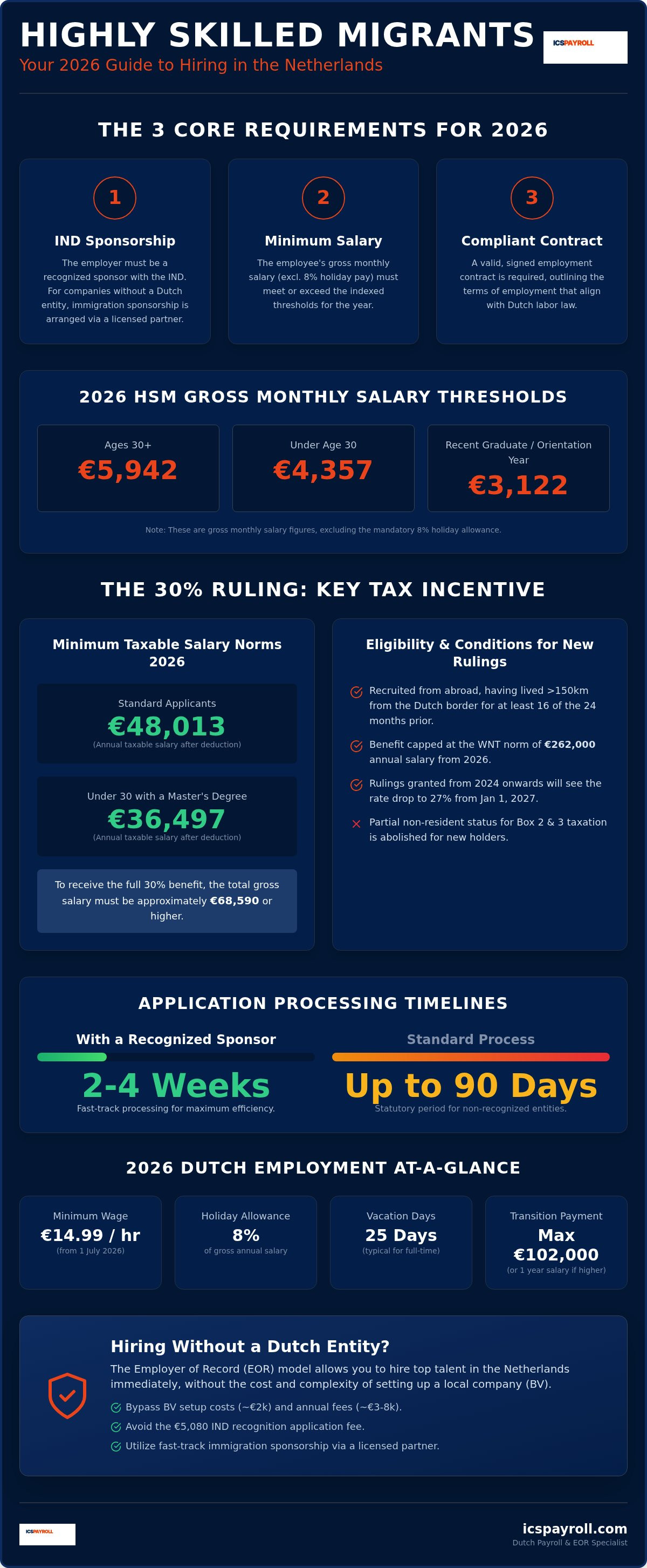
To successfully hire an international specialist, employers must align with three foundational pillars. These pillars ensure the employee maintains legal residency while the business remains compliant with the Official IND HSM Requirements. Failure to meet even one criterion can lead to application rejection or significant Wav fines, which are approximately EUR 8,000 per worker. Modern compliance requires a rigorous approach to documentation and payroll setup.
IND Recognized Sponsorship Explained
The first pillar is the employer's status as a recognized sponsor (erkend referent). This status is mandatory to utilize the HSM scheme. For many international firms, obtaining this status directly is a hurdle because it requires a Dutch legal entity and a clean track record of tax and labor compliance. If your company lacks a Dutch BV, you can still hire talent effectively. In these cases, immigration sponsorship is arranged via our licensed partner. This allows you to bypass the EUR 5,080 IND recognition fee and the lengthy administrative wait times associated with direct sponsorship.
The 2026 Salary Thresholds
Meeting the highly skilled migrant netherlands requirements regarding compensation is the second pillar. These thresholds are updated annually. For 2026, the gross monthly salary norms, excluding the 8% holiday allowance, are as follows:
- Migrants aged 30 and older: EUR 5,942 per month.
- Migrants under age 30: EUR 4,357 per month.
- Orientation Year or Recent Graduates: EUR 3,122 per month.
Compliance isn't just about meeting the minimum. The IND also checks for market conformity. If a salary is significantly lower than what a local professional would earn in the same role, the authorities may investigate the application to ensure it's not a case of wage displacement. Precision in these calculations is essential to avoid delays.
Dutch Employment Contract Compliance
A compliant contract serves as the third pillar. It must be written and include mandatory Dutch labor law provisions, such as the 8% holiday allowance and adherence to the chain rule (ketenregeling). In 2026, the statutory transition payment accrues from the first day of employment, including the probation period. This payment is capped at EUR 102,000 or one year's gross salary if higher. Ensuring your Dutch payroll administration is set up correctly from day one is vital for maintaining this compliance. The contract must also clearly state the role's duties to justify the specialized nature of the hire.
HSM Salary Requirements and the 30% Ruling Interaction
Understanding the financial mechanics of the 30% ruling is critical for any employer managing highly skilled migrant netherlands requirements. While the IND focuses on the gross salary to grant a residence permit, the Belastingdienst (Tax Administration) focuses on the taxable salary to grant tax relief. It's a common misconception that IND sponsor status automatically qualifies an employee for this benefit; they're two distinct legal processes managed by different authorities. To remain compliant, the employee must first meet the gross salary thresholds before any tax deductions are applied.
For 2026, the taxable salary norms are strictly defined. To utilize the full 30% benefit, the employee's taxable salary after the deduction cannot fall below EUR 48,013 for standard applicants. For those under 30 with a Master's degree, this threshold is EUR 36,497. If the salary is lower, the tax-free allowance is capped to ensure the taxable amount stays at these minimums. To provide a full 30% benefit, a gross salary of approximately EUR 68,590 is typically required. Precision in these calculations is vital to avoid underpayment of wage tax or potential audits.
Calculating the 30% Ruling Benefit in 2026
Eligibility requires the employee to be recruited from abroad and to have lived more than 150 km from the Dutch border for 16 of the 24 months prior to their start date. From 1 January 2026, the tax-free allowance is capped at the WNT norm of EUR 262,000. For rulings first granted from 2024 onwards, the rate drops to 27% from 1 January 2027. Pre-2024 holders keep the full 30%. Partial non-resident status is abolished for new holders; only pre-2024 holders keep it until 31 December 2026. Applications filed within four months of the start date are retroactive to day one; later filings only apply from the month following the application.
Total Cost of Employment (TCO) for HSMs
Calculating the total cost of employment requires looking beyond the base salary. Employers must factor in the mandatory 8% holiday allowance and typically a 15.2% pension contribution. In 2026, the statutory transition payment accrues from the first day of employment, including the probation period. This payment is capped at EUR 102,000 or one year's gross salary if higher. When hiring via an EOR, these variables are consolidated into a single payroll factor. This approach provides transparency and prevents unexpected financial liabilities from sick-pay obligations or employer premiums like the Zvw contribution of 6.10%.
The Application Process and Expected Timelines
The formal procedure begins long before the employee arrives in the Netherlands. While the highly skilled migrant netherlands requirements focus on eligibility, the application phase is a race against administrative timelines. The IND maintains a statutory decision period of 90 days for standard applications. Businesses operating in fast-paced sectors cannot afford a three-month vacancy. By leveraging specialized expertise, you can navigate the four critical steps of the procedure with precision.
Step 1 involves gathering legalized documentation, such as birth certificates and diplomas, and providing biometrics at a Dutch embassy or consulate in the employee's home country. Step 2 is the formal filing with the IND by the sponsor. Once approved, Step 3 requires the migrant to collect an entry visa (MVV), if applicable, and eventually their residence permit. Finally, Step 4 centers on BSN registration and the final payroll setup once they have landed on Dutch soil.
Expedited Processing via Licensed Partners
The most effective way to bypass the standard 90-day wait is through expedited processing. When immigration sponsorship is arranged via our licensed partner, the timeline typically shrinks to approximately three weeks. This speed is essential for maintaining momentum in your recruitment cycle. Ensuring all documentation is correct from the outset is vital for day one retroactivity.
If the 30% ruling application is filed within four months of the employee's start date, the tax benefits apply from their first day of work. If you miss this window, the benefit only applies from the first day of the month following the application. Correct filings prevent the IND from requesting additional information, which is the most common cause of avoidable delays. Our team ensures that every application is audit-ready before submission.
Post-Arrival Compliance Checklist
Arrival in the Netherlands triggers a new set of compliance duties that the employer must monitor. The employee must register at their local municipality (gemeente) to obtain a Burgerservicenummer (BSN). This number is required to finalize the Dutch payroll administration and ensure wage tax is withheld correctly. Without a BSN, you cannot process the employee through the standard payroll system, which can delay their first salary payment.
Depending on the migrant's nationality, a tuberculosis (TB) test at the local GGD may be a mandatory condition of the residence permit. This must be completed within three months of arrival. Finally, once the Belastingdienst issues the formal 30% ruling decision, the payroll records must be updated to reflect the tax-free allowance. Missing these steps can lead to compliance audits or the loss of retroactive tax benefits. To secure your international hires without the administrative burden, get a tailored quotation within 24 hours to start your onboarding process.
Hiring HSMs Without a Dutch Entity: The EOR Solution
Many businesses assume that incorporating a local Dutch BV is the only way to meet highly skilled migrant netherlands requirements. While establishing a BV involves a setup cost of approximately EUR 2,000 and ongoing maintenance between EUR 3,000 and EUR 8,000 per year, the administrative burden of IND recognition is often the greater hurdle. An Employer of Record (EOR) acts as a legal bridge, allowing you to hire specialized talent without a local entity. By using an EOR, the administrative and legal risks are transferred to a Dutch specialist, and immigration sponsorship is arranged via our licensed partner.
The EOR model relies on transparent pricing structured around a payroll factor. By multiplying the gross salary by this factor, you receive a single monthly invoice that covers all employer obligations, including social security, pension, and insurance. This setup is typically operational in weeks. It offers a significant speed advantage compared to the months required for entity incorporation and independent sponsor recognition.
Why a Local EOR Outperforms Global Providers
Generic global EOR firms often struggle with the granular precision required for Dutch payroll administration. A local partner directly manages the 30% ruling Netherlands application and ensures strict adherence to local labor statutes. For instance, Dutch sick pay obligations under art. 7:629 BW require employers to pay 70% of the salary for up to 104 weeks. We provide personalized HR support and a compliant employee handbook to mitigate these long-term liabilities while ensuring your staff feel supported.
Getting Started with ICSPayroll
You can receive a tailored quotation within 24 hours, providing immediate clarity on the total cost of employment. Once the quote is approved, we draft compliant employment contracts in days. This efficiency ensures that you can secure your international hires without the overhead of a dedicated local HR department. We manage the ongoing transition payment accruals and provide reintegration guidance under the Poortwachter act, ensuring your business remains 100% compliant while you focus on scaling your operations.
Secure Your International Growth Strategy for 2026
Successfully managing the highly skilled migrant netherlands requirements doesn't have to be a source of administrative friction. By aligning your payroll with the latest salary thresholds and ensuring your immigration sponsorship is arranged via a licensed partner, you protect your business from legal risks. The EOR model provides a compliant bridge for companies without a Dutch entity, allowing you to focus on talent rather than bureaucracy.
ICSPayroll provides the specialized expertise needed to navigate these complex regulations. Our partners ensure expedited HSM visa processing in approximately three weeks, and we manage your full Dutch compliance with clinical precision. You'll receive one clear monthly invoice with no surprise charges, giving you total transparency over your employment costs. This layered approach ensures that your international expansion remains both fast and legally secure.
Hire Highly Skilled Migrants in the Netherlands with Confidence
Expanding your team into the Dutch market is a bold strategic move. With the right local partner, you can onboard your next high-value hire with absolute certainty and speed.
Frequently Asked Questions
What is the minimum salary for a highly skilled migrant in the Netherlands in 2026?
The 2026 gross monthly salary thresholds, excluding the 8% holiday allowance, are €5,942 for migrants aged 30 and older and €4,357 for those under 30. Recent graduates in their orientation year must earn at least €3,122 per month. These figures are indexed annually to reflect current Dutch market wages. Meeting these specific highly skilled migrant netherlands requirements is essential for a successful IND application and ongoing compliance with Dutch labor standards.
How long does the highly skilled migrant visa process take?
The processing time for a highly skilled migrant visa typically takes approximately three weeks when immigration sponsorship is arranged via our licensed partner. While the statutory decision period for the IND is up to 90 days, recognized sponsors benefit from expedited handling. This accelerated route allows international companies to onboard their talent in weeks rather than months, provided all documentation is audit-ready and legalized before the formal submission occurs.
Can I hire a highly skilled migrant if I do not have a Dutch company?
You can hire a highly skilled migrant without a Dutch legal entity by using an Employer of Record (EOR) service. This model allows the EOR to act as the legal employer on your behalf, managing all local compliance, taxes, and insurance obligations. It's a strategic solution for businesses that want to start hiring immediately without the costs and time required to incorporate a Dutch BV or obtain IND recognized sponsor status directly.
What is the difference between the HSM visa and the 30% ruling?
The HSM visa is a residence permit granted by the IND for work purposes, whereas the 30% ruling is a tax advantage granted by the Belastingdienst. They are distinct legal processes with different criteria. A migrant must first meet the gross salary thresholds to secure the HSM permit. Only after this requirement is met can the employer apply for the 30% ruling to provide a tax-free allowance on the income.
Is the 30% ruling still 30% for new hires in 2026?
The 30% ruling remains at its full rate throughout 2026 for eligible employees. However, for rulings first granted from 1 January 2024, the tax-free allowance will decrease to 27% starting 1 January 2027. Pre-2024 holders are protected by transitional rules and retain the 30% rate. To qualify, the employee must be recruited from abroad and meet the taxable salary norm of €48,013 after the tax deduction is applied to their gross income.
What happens if the highly skilled migrant becomes sick for a long period?
If a highly skilled migrant becomes ill, Dutch labor law requires the employer to pay at least 70% of the salary for up to 104 weeks. During the first year, this payment cannot fall below the statutory minimum wage. The employer must also follow the Poortwachter reintegration process, which includes a problem analysis by week six and an action plan by week eight to support the employee's eventual return to work.
What are the costs associated with applying for an HSM permit?
The IND application fee for a highly skilled migrant permit is €423 as of September 2026. If a company chooses to apply for recognized sponsor status directly, the standard fee is €5,080. By utilizing an EOR service, these administrative costs and the associated recognition fees are typically consolidated into a single payroll factor, providing a more predictable and cost-effective way to meet the highly skilled migrant netherlands requirements for international employers.
Do I need to pay a transition allowance if an HSM contract ends?
Employers must pay a transition allowance if an HSM contract ends, as this benefit accrues from the first day of employment, including the probation period. For 2026, the maximum transition payment is capped at €102,000 or one year's gross salary if that amount is higher. This legal requirement applies to both fixed-term and indefinite contracts, ensuring that international professionals receive the same statutory protections as local Dutch employees under labor law.

Article by
Joost Hubregtse
Joost Hubregtse is Director of ICS Staffing & Payroll B.V., the wholly owned subsidiary of Intercompany Solutions behind ICS Payroll. He is responsible for Employer of Record and Dutch payroll services: employment contracts, wage tax and social security filings, holiday allowance, pension, sick leave and CAO compliance, with onboarding possible within 48 hours.
Frequently Asked Questions
To meet the highly skilled migrant netherlands requirements, an individual must hold a nationality from outside the EU, EEA, or Switzerland. The candidate must possess an employment contract with a Dutch employer that meets specific salary and duration criteria. While educational background is often a factor, the IND primarily assesses eligibility based on the gross monthly salary. For 2026, these thresholds are indexed annually to reflect market wages. Meeting the highly skilled migrant netherlands requirements also necessitates that the employer is a recognized sponsor or works with an EOR provider that manages the sponsorship through a licensed partner. This ensures the employee's residence permit is processed with the speed required for modern business operations. To successfully hire an international specialist, employers must align with three foundational pillars. These pillars ensure the employee maintains legal residency while the business remains compliant with the Official IND HSM Requirements. Failure to meet even one criterion can lead to application rejection or significant Wav fines, which are approximately EUR 8,000 per worker. Modern compliance requires a rigorous approach to documentation and payroll setup.
The 2026 gross monthly salary thresholds, excluding the 8% holiday allowance, are €5,942 for migrants aged 30 and older and €4,357 for those under 30. Recent graduates in their orientation year must earn at least €3,122 per month. These figures are indexed annually to reflect current Dutch market wages. Meeting these specific highly skilled migrant netherlands requirements is essential for a successful IND application and ongoing compliance with Dutch labor standards.
The processing time for a highly skilled migrant visa typically takes approximately three weeks when immigration sponsorship is arranged via our licensed partner. While the statutory decision period for the IND is up to 90 days, recognized sponsors benefit from expedited handling. This accelerated route allows international companies to onboard their talent in weeks rather than months, provided all documentation is audit-ready and legalized before the formal submission occurs.
You can hire a highly skilled migrant without a Dutch legal entity by using an Employer of Record (EOR) service. This model allows the EOR to act as the legal employer on your behalf, managing all local compliance, taxes, and insurance obligations. It's a strategic solution for businesses that want to start hiring immediately without the costs and time required to incorporate a Dutch BV or obtain IND recognized sponsor status directly.
The HSM visa is a residence permit granted by the IND for work purposes, whereas the 30% ruling is a tax advantage granted by the Belastingdienst. They are distinct legal processes with different criteria. A migrant must first meet the gross salary thresholds to secure the HSM permit. Only after this requirement is met can the employer apply for the 30% ruling to provide a tax-free allowance on the income.
The 30% ruling remains at its full rate throughout 2026 for eligible employees. However, for rulings first granted from 1 January 2024, the tax-free allowance will decrease to 27% starting 1 January 2027. Pre-2024 holders are protected by transitional rules and retain the 30% rate. To qualify, the employee must be recruited from abroad and meet the taxable salary norm of €48,013 after the tax deduction is applied to their gross income.
If a highly skilled migrant becomes ill, Dutch labor law requires the employer to pay at least 70% of the salary for up to 104 weeks. During the first year, this payment cannot fall below the statutory minimum wage. The employer must also follow the Poortwachter reintegration process, which includes a problem analysis by week six and an action plan by week eight to support the employee's eventual return to work.
The IND application fee for a highly skilled migrant permit is €423 as of September 2026. If a company chooses to apply for recognized sponsor status directly, the standard fee is €5,080. By utilizing an EOR service, these administrative costs and the associated recognition fees are typically consolidated into a single payroll factor, providing a more predictable and cost-effective way to meet the highly skilled migrant netherlands requirements for international employers.
Employers must pay a transition allowance if an HSM contract ends, as this benefit accrues from the first day of employment, including the probation period. For 2026, the maximum transition payment is capped at €102,000 or one year's gross salary if that amount is higher. This legal requirement applies to both fixed-term and indefinite contracts, ensuring that international professionals receive the same statutory protections as local Dutch employees under labor law.