EOR vs Own Entity in the Netherlands: The 2026 Strategic Comparison
By Joost Hubregtse, Director, ICS Staffing & Payroll
All blog posts are reviewed and fact checked by our labour law lawyer Zishan Hussain and our director. Editorial standards
Joost Hubregtse, Payroll Director
Joost Hubregtse is a recognized expert in Dutch labor law and international payroll compliance. With a career dedicated to navigating the complexities of the Belastingdienst and social security frameworks, he ensures that foreign enterprises achieve seamless entry into the Netherlands. As the Payroll Director at ICSPayroll, he manages strategic employment solutions and compliance audits for a global clientele.
Reviewed by Joost Hubregtse on September 18, 2026
What if your 2026 expansion strategy is being held back by a legal structure you don't actually need? Choosing between an EOR vs own entity Netherlands is a critical financial decision that dictates your speed of entry and long term compliance risk. You likely agree that the administrative burden of Dutch labor law, including the 104-week sickness obligation and the 30% ruling complexity, represents a significant hurdle for international firms. This strategic comparison provides the financial and legal frameworks to help you decide between incorporating a Dutch BV or utilizing an Employer of Record for your 2026 objectives. We'll preview the current regulatory landscape, including the €48,013 salary threshold for tax benefits and the strict enforcement of Wet DBA. By the end of this guide, you'll have a clear roadmap for compliant hiring that balances operational agility against the fixed costs of local incorporation.
Key Takeaways
- Identify the specific headcount threshold where the administrative costs of a Dutch BV outweigh the flexibility of an Employer of Record.
- Master the 2026 compliance landscape, including the €48,013 salary requirement for the 30% ruling and the €14.99 statutory minimum hourly wage.
- Evaluate the strategic trade-offs of EOR vs own entity Netherlands regarding speed of entry and the mitigation of permanent establishment risks.
- Secure your expansion by understanding the strict enforcement of Wet DBA and the rebuttable presumption of employment taking effect in late 2026.
- Access a detailed roadmap for managing transition payments, capped at €102,000 for 2026, and meeting mandatory Loonaangifte deadlines.
Understanding the Dutch Employment Landscape: EOR vs Entity
The decision between an EOR vs own entity Netherlands represents a choice between two distinct legal architectures. The Belastingdienst (Dutch Tax Administration) oversees both models, but the administrative burden shifts significantly depending on your selection. In the 2026 regulatory environment, compliance has become more complex for foreign firms. The Dutch government now actively enforces the Wet DBA to prevent false self-employment, and a new rebuttable presumption of employment for specific wage levels is set to take effect by December 31, 2026. These shifts mean that simply hiring a contractor is no longer a low-risk strategy; you must choose a formal employment structure that satisfies local authorities.
The Legal Framework of a Dutch BV
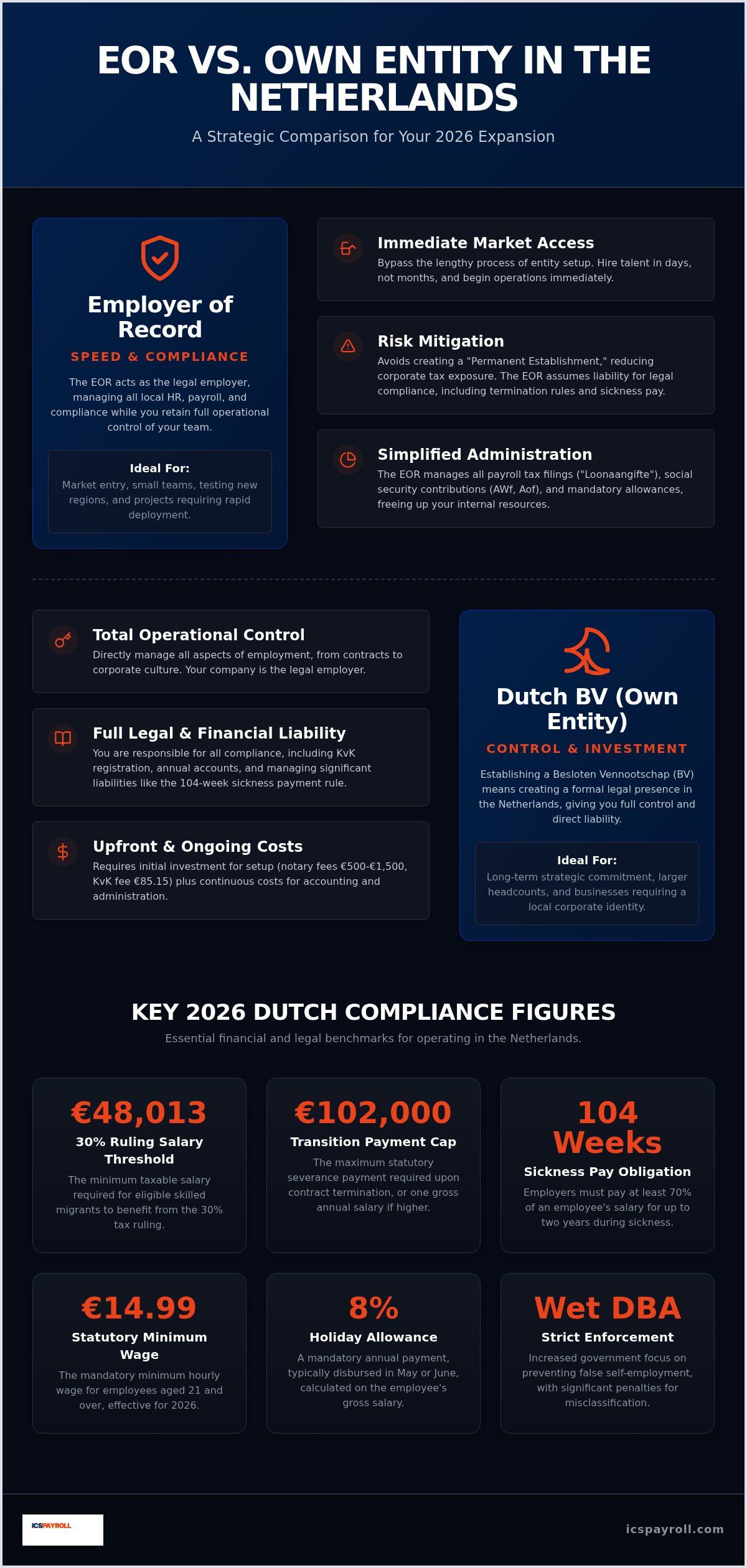
A Besloten Vennootschap (BV) is the standard Dutch private limited company. Establishing this entity requires a formal registration with the KvK (Chamber of Commerce) to obtain a unique RSIN number for tax purposes. This process typically involves notary fees and the appointment of a local director or a registered office address within the Netherlands. Once the BV is active, your organization assumes full responsibility for corporate tax filings and the mandatory publication of annual accounts. You must also manage direct "Loonaangifte" (payroll tax) filings by the last day of the month following the payroll period. This model offers total control but requires significant internal resources to manage the administrative precision demanded by Dutch law.
The EOR Alternative: Immediate Market Access
An Employer of Record (EOR) acts as the legal employer for tax and social security purposes while you maintain the daily functional relationship with your staff. This model allows you to hire talent without establishing a local "Permanent Establishment," which mitigates corporate tax risks and removes the need for KvK registration. The EOR handles all statutory requirements, including the 8% holiday allowance and social security premiums like the AWf and Aof. It's a localized solution that provides peace of mind by ensuring every contract meets the "Ketenregeling" (chain rule) for temporary agreements. By using this framework, you can bypass the lengthy incorporation process and focus on operational growth while your legal partner manages the meticulous details of Dutch compliance.
The Reality of Establishing a Dutch BV: Costs and Compliance
Establishing a Dutch BV involves a sequence of fixed and variable expenses that define your operational budget. While the official government portal for businesses outlines the registration steps, the financial reality includes notary fees ranging from €500 to €1,500 and a Chamber of Commerce (KVK) fee of €85.15. Beyond these startup costs, your organization must manage ongoing accounting, annual financial statement publication, and rigorous payroll administration. In 2026, the Belastingdienst has intensified its enforcement of the Wet DBA, imposing strict penalties for worker misclassification. This heightened regulatory focus makes the choice between EOR vs own entity Netherlands a matter of fiscal security.
Financial exposure extends to the termination of contracts. Under Dutch law, employees are entitled to a statutory transition payment upon dismissal or the non-renewal of a temporary contract. For 2026, the statutory transition payment cap is set at €102,000 gross, or one gross annual salary if the employee earns more. Managing these exit costs requires careful provision and legal oversight, which adds to the overhead of a direct entity. It's a significant liability that you must factor into your long term expansion costs.
Administrative Burdens of Direct Employment
Direct employment in the Netherlands carries heavy social obligations that go beyond the base salary. You must pay a mandatory 8% holiday allowance and typically contribute approximately 15.2% toward employee pensions. Most critically, Dutch law requires employers to continue paying at least 70% of a worker's salary for up to 104 weeks during long term illness. This sickness risk alone often drives companies toward a specialized partner. You also need a localized employee handbook that reflects current non-compete reforms and the "Ketenregeling" contract limits to ensure you don't fall foul of local labor courts.
Permanent Establishment and Tax Risks
Operating via a Dutch BV creates a "Permanent Establishment" (PE) for your business. This status triggers Dutch corporate tax obligations on all profits attributed to the local office. It also requires compliance with the Balkenende Norm salary cap of €262,000 for the 30% ruling application. Using an EOR allows you to hire talent without establishing a fixed place of business, which mitigates the risk of double taxation and complex fiscal nexus issues. If you need to scale quickly without the overhead of a legal entity, you can request a tailored quotation to see how a localized payroll model fits your budget.
Strategic Advantages of Using a Local Employer of Record
The primary strategic advantage of an EOR is the immediate compression of your market entry timeline. While establishing a BV involves notary delays and KVK registration, an EOR allows you to become operational in weeks. This agility is essential for capturing high-demand talent in a competitive market. By leveraging a localized partner, you bypass the need for local bank accounts and direct registrations with the Dutch Tax Administration. This efficiency is a core factor when evaluating EOR vs own entity Netherlands for immediate growth. You can focus on project milestones while your partner manages the complex administrative infrastructure required for Dutch compliance.
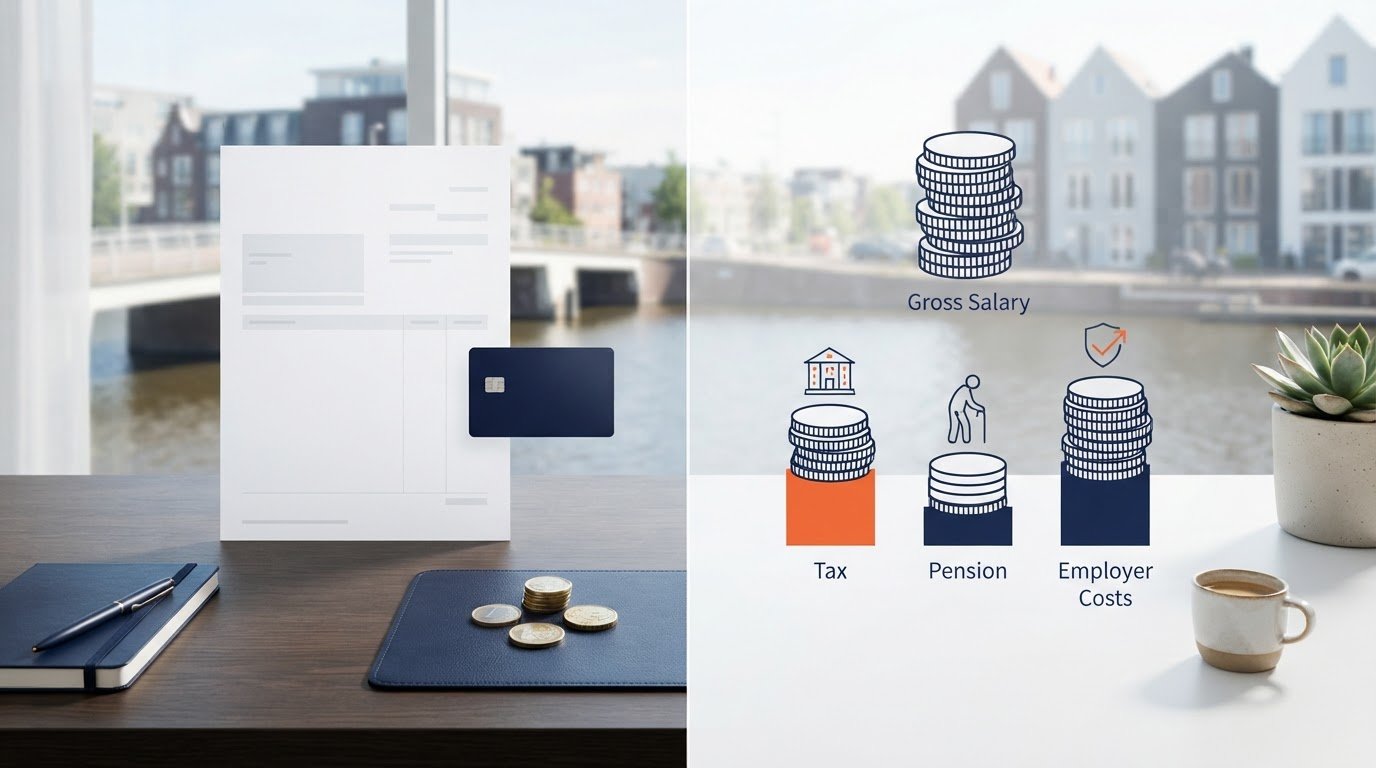
Financial transparency is achieved through a consolidated payroll factor. This single percentage covers the gross salary, the mandatory 8% holiday allowance, and the 15.2% pension contribution. It also incorporates social security premiums like the AWf and Aof. This model provides a predictable cost structure that protects your budget from administrative surprises. You can find more Dutch government information for entrepreneurs regarding the statutory requirements that this model handles on your behalf. It removes the volatility of separate billing items and provides a stabilized monthly spend.
Mastering the 30 Percent Ruling in 2026
The 30% ruling remains a vital tool for attracting international expertise. For 2026, the standard taxable salary threshold is €48,013. Employees under 30 with a qualifying Master's degree must meet the lower threshold of €36,497. Note the legislative shift to a 27% rate for rulings that began on or after January 1, 2024. Additionally, partial non-resident status was abolished for new applicants as of January 1, 2025. ICSPayroll manages these applications through licensed partners to ensure precision and compliance. This specialized tax benefit significantly increases the net income for your employees without increasing your gross salary costs, making your offer more competitive.
Expedited HSM Visa Processing
Securing a Highly Skilled Migrant (HSM) visa is often a prerequisite for international hires. A Dutch BV must first apply for recognized sponsor status with the IND, a process that can take several months. An EOR provides an immediate solution by arranging these services via licensed partners who already hold the necessary certifications. Expedited applications typically result in visa approval within approximately three weeks. This rapid turnaround allows you to onboard critical staff without the delays inherent in building your own corporate infrastructure. Choosing an EOR ensures that your recruitment timeline is dictated by talent availability rather than bureaucratic lead times. It provides the peace of mind that your non-Schengen staff are legally authorized to work from day one.
When to Transition: Calculating the Switch Point for Your Business
The decision to transition from an Employer of Record to a Dutch BV usually hinges on a tipping point where fixed administrative costs become lower than variable EOR fees. For most international firms, this threshold appears when the local headcount reaches between 5 and 10 full-time employees. Beyond this point, the economies of scale provided by an own entity may justify the overhead of local directors, specialized accounting, and legal counsel. However, your financial calculation must include the "Gebruikelijk loon" (customary salary) requirements for directors and the annual costs of maintaining a registered office. Evaluating EOR vs own entity Netherlands requires a clear-eyed look at these long term commitments.
Operational complexity also dictates the timing of your transition. If your expansion is a pilot project or a specific contract with a duration of less than 24 months, the flexibility of an EOR is superior. Incorporating a BV creates a permanent fiscal presence that is complex to dismantle. You must also consider whether your business requires a physical office for commercial reasons, such as local stock storage or client facing operations. If your team is fully remote, the administrative burden of an own entity often outweighs the benefits of direct control during the initial years of growth.
Headcount and Financial Benchmarks
Comparing EOR fees against the fixed overhead of a Dutch BV requires a granular analysis of your monthly spend. A BV necessitates a local payroll administrator to handle monthly "Loonaangifte" filings and a tax advisor to manage corporate tax returns. These professional services, combined with the cost of a local director, can exceed €15,000 annually before a single salary is paid. In contrast, an EOR provides a variable cost model that scales with your hiring. This makes it the safer choice for teams that are still testing the Dutch market's viability or those with fluctuating headcounts.
Operational Readiness for Direct Hiring
Operational readiness involves more than just budget; it requires the capacity to manage strict Dutch labor protections. Your internal HR team must be prepared to handle the mandatory sickness risk coverage, which lasts for 104 weeks under Dutch law. You're also legally obligated to comply with the seven-year record-keeping requirement for all payroll and business data. If your organization lacks a local HR specialist, these tasks can lead to non-compliance with the Belastingdienst. ICSPayroll supports businesses through this transition by providing expert Dutch payroll administration services once you decide to establish your own BV. This ensures your compliance remains intact as you move from an outsourced model to direct employment.
Compliant Hiring in the Netherlands with ICSPayroll
Choosing between an EOR vs own entity Netherlands is a decision that defines the speed and security of your international expansion. ICSPayroll serves as your local partner, removing the administrative friction of Dutch labor law while you focus on your core business objectives. We provide a comprehensive solution that manages the entire employment lifecycle, from initial contract drafting to the meticulous filing of monthly payroll taxes. By removing the need for a complex internal HR infrastructure, we ensure your business remains agile and fully compliant with the latest Belastingdienst regulations.
Our transparent payroll factor pricing model eliminates the guesswork associated with international hiring. This single, all-inclusive factor covers the mandatory 8% holiday allowance, pension contributions, and all employer social security premiums such as the AWf and Aof. You won't encounter hidden fees or unexpected administrative charges. We prioritize transparency in every invoice. Your employees also benefit from a modern online portal, providing them with direct access to their payslips, annual statements, and transition allowance management. This digital-first approach ensures a professional onboarding experience that mirrors the standards of a top-tier Dutch employer.
Our Local Expertise and Support
Working with ICSPayroll means you have direct access to a team of payroll specialists based in the Netherlands. We handle the details so you don't have to. Our experts manage the specific statutory requirements of the Dutch market, including the 2026 minimum wage of €14.99 per hour and the strict Ketenregeling contract limits. We provide compliant Dutch employment contracts and handbooks that reflect current legislative reforms, such as the modernization of non-compete clauses. It's a direct connection to local knowledge. Please note that while we facilitate these results, specialized services such as EOR licensing and HSM visa sponsorship are arranged via our network of licensed partners.
Getting Started with Your Dutch Team
The transition to a Dutch workforce can be remarkably swift. Once you provide the necessary employee details, we can finalize a service agreement and begin the onboarding process. In many cases, your first Dutch hire can be active and fully insured in a matter of days. This speed is a critical advantage when comparing EOR vs own entity Netherlands, as it allows you to secure talent before your competitors can navigate the incorporation process. We invite you to contact our team for a consultation on your hiring strategy. We provide tailored quotations within 24 hours, ensuring you have the exact financial data needed to move forward with confidence. Whether you are hiring a single specialist or building a larger team, our localized expertise provides the stabilized path through the complex Dutch bureaucracy.
Strategic Growth in the Dutch Market for 2026
Navigating the 2026 regulatory environment requires a balance between operational control and administrative efficiency. The choice between an EOR vs own entity Netherlands remains a question of scale and speed. For most firms, starting with an Employer of Record provides the agility to hire within weeks while bypassing the complex setup of a Dutch BV. This model ensures full compliance with the €14.99 minimum wage and strict sickness risk coverage. It also allows your business to avoid the permanent establishment risks that come with local incorporation until your team reaches the 5 to 10 employee threshold.
You can hire in the Netherlands with confidence by requesting a 24 hour quotation from ICSPayroll. We facilitate HSM visa processing in approximately three weeks and provide comprehensive 30% ruling support via our licensed partners. This localized approach removes the administrative burden from your internal team while ensuring every hire meets the rigorous standards of the Belastingdienst. Your expansion into the Dutch market is a significant milestone. We're here to provide the stabilized, compliant path for your long term success.
Frequently Asked Questions
Can I hire employees in the Netherlands without a local legal entity?
Yes, you can hire Dutch talent without a local entity by utilizing an Employer of Record (EOR). The EOR acts as the legal employer, managing all payroll, social security, and tax obligations on your behalf. This model allows your company to remain compliant with the Belastingdienst while you maintain the daily functional relationship with your staff. It is a secure way to test the market without incorporation.
What is the salary threshold for the 30 percent ruling in 2026?
The standard taxable salary threshold for the 30% ruling in 2026 is €48,013. For employees under the age of 30 who hold a qualifying Master's degree, the required taxable salary is €36,497. It is important to note that for rulings starting on or after January 1, 2024, the tax-free allowance will transition to a flat 27% rate in 2027. These applications are managed via licensed partners to ensure precision.
How long does it take to establish a Dutch BV compared to using an EOR?
Establishing a Dutch BV typically takes several months due to notary appointments and KVK registration requirements. In contrast, an EOR allows you to start hiring in weeks. Once employee details are provided, a service agreement and employment contract can be ready within days. This speed is a primary differentiator when comparing EOR vs own entity Netherlands for rapid market entry. HSM visa processing via licensed partners usually takes approximately three weeks.
What are the mandatory employer contributions in the Netherlands for 2026?
Mandatory contributions include an 8% holiday allowance and a 15.2% pension contribution. Employers must also pay social security premiums such as the AWf (unemployment) and Aof (disability). For 2026, the Zvw healthcare levy is 6.10%. These costs are consolidated into a single monthly invoice when using an EOR. This provides total transparency and protects your budget from the separate billing items associated with direct entity management.
How does an EOR handle Dutch sick leave and reintegration?
An EOR manages the entire 104-week sickness payment obligation required under Dutch labor law. This includes providing mandatory reintegration guidance and covering the risk of salary payments during long term illness. The EOR acts as the stabilized bridge between the employee and the UWV. This removes the heavy administrative burden from your internal HR team and ensures full compliance with statutory sickness regulations.
Is it possible to switch from an EOR to my own Dutch BV later?
Yes, you can transition your workforce to your own Dutch BV at any time. Many international firms choose to make this switch once their local headcount reaches between 5 and 10 employees. ICSPayroll supports this evolution by offering specialized Dutch payroll administration services for your new entity. This ensures that your tax filings and "Loonaangifte" deadlines remain secure as your business model moves toward direct employment.
What is the minimum hourly wage in the Netherlands for 2026?
The statutory minimum hourly wage for employees aged 21 and over is €14.99 gross as of July 1, 2026. This followed an earlier 2026 increase to €14.71. Since the Netherlands moved to a mandatory hourly minimum, you must calculate wages based on actual hours worked each period. This precision is essential for maintaining compliance with the Ministry of Social Affairs and Employment.
Does an EOR protect against permanent establishment risk?
Using an EOR significantly mitigates permanent establishment risk. Because the EOR is the legal employer, your foreign company avoids creating a fixed place of business that would trigger Dutch corporate tax obligations. This is a critical factor in the EOR vs own entity Netherlands debate for companies that do not yet require a physical office. It allows for compliant growth without the complex fiscal nexus issues of a local BV.

Article by
Joost Hubregtse
Joost Hubregtse is Director of ICS Staffing & Payroll B.V., the wholly owned subsidiary of Intercompany Solutions behind ICS Payroll. He is responsible for Employer of Record and Dutch payroll services: employment contracts, wage tax and social security filings, holiday allowance, pension, sick leave and CAO compliance, with onboarding possible within 48 hours.
Frequently Asked Questions
Yes, you can hire Dutch talent without a local entity by utilizing an Employer of Record (EOR). The EOR acts as the legal employer, managing all payroll, social security, and tax obligations on your behalf. This model allows your company to remain compliant with the Belastingdienst while you maintain the daily functional relationship with your staff. It is a secure way to test the market without incorporation.
The standard taxable salary threshold for the 30% ruling in 2026 is €48,013. For employees under the age of 30 who hold a qualifying Master's degree, the required taxable salary is €36,497. It is important to note that for rulings starting on or after January 1, 2024, the tax-free allowance will transition to a flat 27% rate in 2027. These applications are managed via licensed partners to ensure precision.
Establishing a Dutch BV typically takes several months due to notary appointments and KVK registration requirements. In contrast, an EOR allows you to start hiring in weeks. Once employee details are provided, a service agreement and employment contract can be ready within days. This speed is a primary differentiator when comparing EOR vs own entity Netherlands for rapid market entry. HSM visa processing via licensed partners usually takes approximately three weeks.
Mandatory contributions include an 8% holiday allowance and a 15.2% pension contribution. Employers must also pay social security premiums such as the AWf (unemployment) and Aof (disability). For 2026, the Zvw healthcare levy is 6.10%. These costs are consolidated into a single monthly invoice when using an EOR. This provides total transparency and protects your budget from the separate billing items associated with direct entity management.
An EOR manages the entire 104-week sickness payment obligation required under Dutch labor law. This includes providing mandatory reintegration guidance and covering the risk of salary payments during long term illness. The EOR acts as the stabilized bridge between the employee and the UWV. This removes the heavy administrative burden from your internal HR team and ensures full compliance with statutory sickness regulations.
Yes, you can transition your workforce to your own Dutch BV at any time. Many international firms choose to make this switch once their local headcount reaches between 5 and 10 employees. ICSPayroll supports this evolution by offering specialized Dutch payroll administration services for your new entity. This ensures that your tax filings and "Loonaangifte" deadlines remain secure as your business model moves toward direct employment.
The statutory minimum hourly wage for employees aged 21 and over is €14.99 gross as of July 1, 2026. This followed an earlier 2026 increase to €14.71. Since the Netherlands moved to a mandatory hourly minimum, you must calculate wages based on actual hours worked each period. This precision is essential for maintaining compliance with the Ministry of Social Affairs and Employment.
Using an EOR significantly mitigates permanent establishment risk. Because the EOR is the legal employer, your foreign company avoids creating a fixed place of business that would trigger Dutch corporate tax obligations. This is a critical factor in the EOR vs own entity Netherlands debate for companies that do not yet require a physical office. It allows for compliant growth without the complex fiscal nexus issues of a local BV.