
Netherlands Payroll Processing Fees: A Transparent Guide
By Joost Hubregtse, Director, ICS Staffing & Payroll
All blog posts are reviewed and fact checked by our labour law lawyer Zishan Hussain and our director. Editorial standards
By: Joost Hubregtse, Payroll Director
Reviewed by Joost Hubregtse on May 22, 2024
Joost Hubregtse is the Payroll Director at ICSPayroll and a certified Dutch payroll professional (VPD) specializing in cross-border compliance and international employment structures within the Dutch market.
Most international firms expanding into the Dutch market overlook nearly 30% of their total employment costs by focusing only on gross salaries. It's a common mistake that leads to significant budget overruns. You've likely realized that the complexity of local social security, pension premiums, and the 30% ruling often feels like a moving target. Understanding netherlands payroll processing fees requires a deep dive into the 2026 statutory landscape to ensure every hidden cost is accounted for before you issue your first contract.
This guide provides the clarity you need to master Dutch payroll pricing. You'll learn to navigate 2026 tax thresholds, including the EUR 48,013 salary requirement for the 30% ruling and the EUR 14.71 minimum hourly wage. We'll explain how ICSPayroll arranges services via licensed partners to ensure your business remains compliant with Dutch labor law without a local BV. We'll break down the payroll factor model to provide a predictable monthly cost per employee during your expansion.
Key Takeaways
- Learn to distinguish between administrative service charges and mandatory employer contributions to calculate accurate netherlands payroll processing fees for your 2026 budget.
- Ensure compliance with updated 2026 statutory benchmarks, including the EUR 14.71 minimum hourly wage and the mandatory 8 percent holiday allowance.
- Discover how the payroll factor model bundles pension, social security, and sickness risk into a single transparent coefficient to eliminate unexpected insurance invoices.
- Understand the financial impact of the Dutch two year sick pay obligation and how structured fee models mitigate these long term employment risks.
- Master the 2026 requirements for the 30 percent ruling, including the specific EUR 48,013 salary threshold, to attract international talent with technical precision.
Understanding the Components of Netherlands Payroll Processing Fees
Calculating netherlands payroll processing fees requires a precise division between service provider invoices and mandatory government contributions. Many international employers focus solely on the administrative fee per payslip. This narrow view ignores the substantial employer premiums that represent the true cost of employment. In the Dutch system, the service fee is merely the technical overhead; the statutory costs beneath the surface determine your actual budget.
Gross salary serves as the non-negotiable baseline for every calculation. It's not just the base amount; it must include the statutory 8% holiday allowance. This total figure acts as the basis for all social security and tax deductions. Traditional per-payslip models often hide these complexities. They provide a low entry price but leave the employer to manage complex insurance billings and premium fluctuations independently.
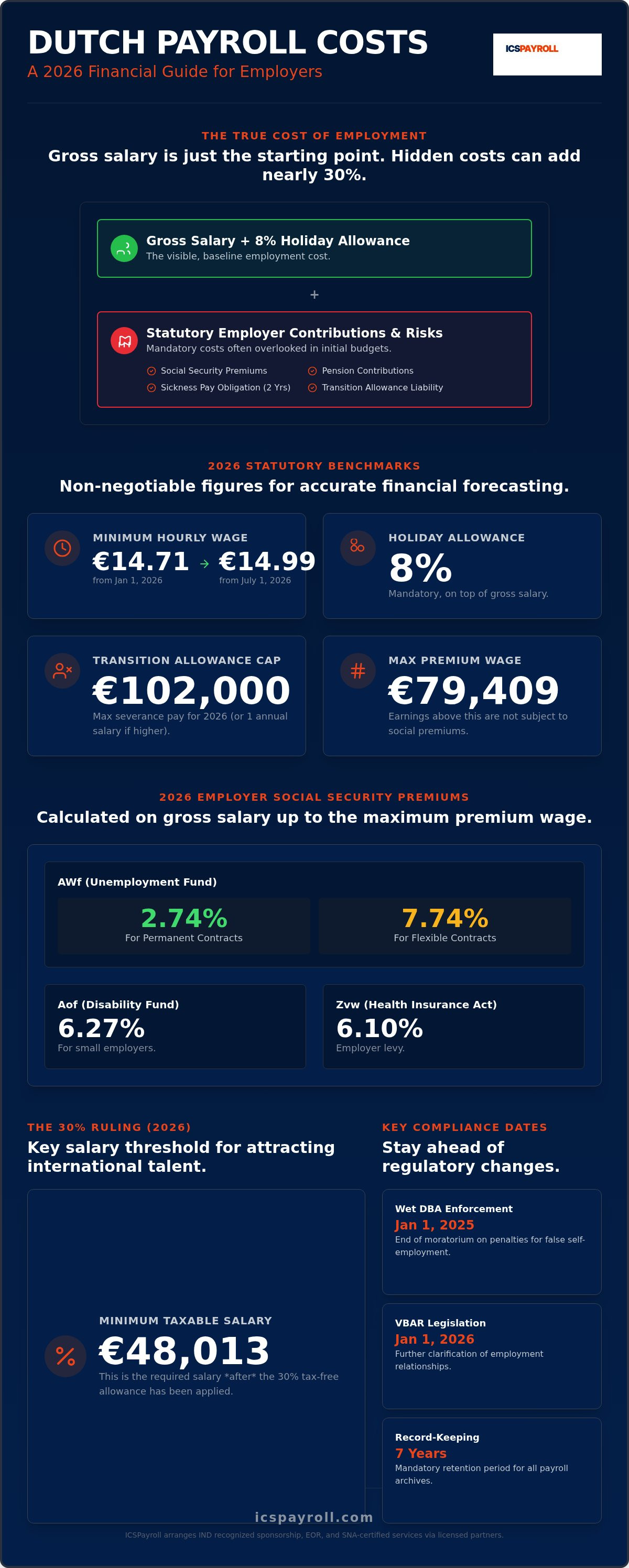
The social security system in the Netherlands is funded through specific employer-paid premiums. For 2026, these include the AWf (Unemployment Fund) at 2.74% for permanent contracts and 7.74% for flexible ones. You must also account for the Aof (Disability Fund) at 6.27% for small employers and the 6.10% Zvw (Health Insurance Act) levy. These percentages apply to all earnings up to the 2026 maximum premium wage of EUR 79,409. Understanding these benchmarks is vital for accurate financial forecasting.
Administrative Fees vs Statutory Contributions
The administrative portion of your fee covers the technical generation of payslips and the monthly "Loonaangifte" filing. This payroll tax return must be submitted to the Belastingdienst by the last day of the following month. Reliable providers include these filings and year-end statements in their base rate. Your fee also supports the mandatory seven-year record-keeping requirement. Dutch law is strict about data retention; you're legally obligated to maintain accessible payroll archives for nearly a decade to satisfy potential audits.
The Impact of the 2026 Dutch Labor Market Reforms
Legislative enforcement has added layers to the administrative process. The full enforcement of the Wet DBA resumes on January 1, 2025, ending the previous moratorium on penalties. Additionally, the VBAR legislation is scheduled for enforcement from January 1, 2026, to further clarify employment relationships. These shifts require more rigorous contract oversight to prevent false self-employment classifications. ICSPayroll arranges these compliance checks via licensed partners to ensure your contracts meet the latest standards. For a deeper look at these regulatory shifts, refer to our Dutch Payroll Administration Guide.
Statutory Employer Costs and 2026 Benchmarks
Understanding the specific benchmarks for 2026 is essential for accurate budgeting and preventing compliance failures. The Netherlands no longer uses a monthly minimum wage; instead, it enforces a strict hourly rate. As of January 1, 2026, the minimum hourly wage is EUR 14.71, which rises to EUR 14.99 on July 1, 2026. These rates form the base for calculating your overall netherlands payroll processing fees. Beyond the hourly pay, you must factor in the statutory 8% holiday allowance. This benefit is typically paid out in May, but the liability accrues monthly from the start of employment.
Pension contributions represent another significant cost layer. While rates vary by sector, a standard benchmark is 15.2% of the gross salary. Additionally, employers must account for the transition allowance, known as transitievergoeding. This payment is due upon the termination of most contracts and is capped at EUR 102,000 for 2026, or one gross annual salary if the employee's earnings exceed that amount. These figures are non-negotiable and must be integrated into your financial forecasting from day one.
The 30 Percent Ruling Administrative Costs
Applying for the 30% ruling involves specific administrative fees and strict salary criteria. For 2026, the standard taxable salary threshold is EUR 48,013 after the deduction. You should also prepare for the legislative shift; while the 30% rate applies through 2026, newer rulings will transition to a 27% rate starting in 2027. ICSPayroll arranges these applications via licensed partners to ensure your international hires receive their benefits without delay. Managing these thresholds accurately is vital to avoid retrospective tax corrections from the authorities.
Social Security and Premium Percentages
Employer premiums are calculated on income up to the maximum premium wage of EUR 79,409 for the 2026 tax year. The AWf (Unemployment Fund) is set at 2.74% for permanent roles, while flexible contracts incur a higher 7.74% charge. You must also pay the Aof (Disability Fund) at 6.27% for small employers and the Zvw (Health Insurance Act) levy at 6.10%. For the most current technical specifications, you can consult the official Belastingdienst guidance for individuals. To see how these benchmarks apply to your specific headcount, you can request a detailed quotation for your Dutch team.
Payroll Factor vs Per-Employee Fees: Which Is More Cost-Effective?
Choosing between a flat per-employee fee and a consolidated payroll factor is the most critical decision in managing your 2026 budget. A payroll factor is a single transparent coefficient applied to the gross salary of your employee. It bundles the base salary with all mandatory employer contributions into one predictable figure. While global providers often market a low fixed monthly fee, they frequently pass through insurance premiums and social security costs as variable expenses. This approach creates invoice shock when premiums for AWf or Zvw fluctuate. A local partner provides more stability by consolidating these elements into a single multiplier.
The total cost of ownership for a Dutch hire is often lower when using a local expert. Global EOR firms typically lack the infrastructure to manage Dutch specific risks like the two year sick pay obligation. They often add significant margins to cover their own lack of local presence. ICSPayroll arranges netherlands payroll processing fees via licensed partners who specialize in the Dutch market. This allows for a more efficient pricing model that accounts for local nuances like the 15.2% pension benchmark and the 8% holiday allowance without the overhead of a global middleman.
What is Included in a Professional Payroll Factor?
A professional payroll factor integrates several statutory and administrative costs into one monthly payment. It covers the mandatory 8% holiday pay and the standard 15.2% pension contribution. You also gain access to comprehensive HR administration and an online employee portal for payslip management. This model ensures that all employer premiums are paid on time to the Belastingdienst without requiring your direct intervention. For a detailed comparison of how these models function in a compliant hiring strategy, see our guide on EOR vs PEO Netherlands.
The Hidden Costs of Traditional Outsourcing
Traditional outsourcing models often hide expenses that are standard in a payroll factor model. You might face extra charges for HSM visa applications, which typically take approximately 3 weeks to process via our licensed partners. Support for the 30% ruling is another common "add on" that can inflate your final bill. Additionally, Dutch law requires every employer to have a contract with an Arbo service for occupational health. Traditional providers often leave you to manage these third party invoices and the complex sick leave reintegration process alone. Consolidating these requirements into one fee removes the administrative burden and ensures you remain fully compliant with Dutch labor law.
Managing Financial Risk: Sickness and Transition Allowances
Managing the financial risks inherent in Dutch labor law is a primary driver for choosing a comprehensive fee structure. While previous sections focused on monthly premiums and tax thresholds, the most significant potential costs lie in sickness and termination liabilities. In the Netherlands, an employer is legally obligated to continue paying at least 70% of an employee's salary for up to 104 weeks of illness. This two year obligation represents a massive financial exposure that many foreign entities fail to anticipate when reviewing netherlands payroll processing fees. Without proper insurance or a consolidated fee model, a single long term illness can destabilize an entire expansion budget.
Beyond the direct salary costs, you must also manage the administrative burden of the Poortwachter Act, or Gatekeeper Act. This legislation requires strict adherence to a reintegration timeline, including mandatory consultations with occupational health specialists and the creation of formal action plans. Failure to follow these steps can result in the UWV imposing a third year of mandatory salary payments as a penalty. A transparent payroll factor model mitigates this risk by bundling the necessary insurance and administrative oversight into one predictable monthly cost.
Sickness Risk Coverage Explained
Professional payroll fees typically incorporate specific insurance premiums to cover long term illness. This coverage ensures that the financial burden of the 104 week pay obligation is transferred to an insurer rather than remaining on your balance sheet. A critical component of this service is the connection to an Arbodienst, or occupational health service. These specialists provide the mandatory medical guidance required to reduce employer liability and accelerate the employee's return to work. For a detailed overview of these statutory requirements, you can consult the official UWV regulations for sickness and reintegration.
Termination and Transition Allowance Fees
The "transitievergoeding," or transition allowance, is a mandatory payment due to almost all employees upon termination, including those whose fixed term contracts are not renewed. This allowance accrues from the first day of employment and is calculated based on years of service. For 2026, the statutory maximum is EUR 102,000, or one gross annual salary if the employee's earnings are higher. Handling these terminations also involves administrative costs for settlement agreements and potential filings with the Dutch labor court. To ensure your termination procedures remain fully compliant, refer to our Employment Law Netherlands Guide. To mitigate these financial exposures with a fixed rate model, you can request a risk-inclusive quote from our local experts.
Optimizing Your Dutch Payroll Strategy with ICSPayroll
ICSPayroll serves as a specialized partner for international entities navigating the Dutch employment landscape. We provide a tailored quotation within 24 hours of receiving employee details; this allows your finance team to model expansion costs with clinical precision. By consolidating the diverse employer premiums and administrative costs discussed in previous sections into one clear monthly invoice, we eliminate the complexity of managing multiple local accounts. This transparency regarding netherlands payroll processing fees ensures that your budget remains stable even as regulatory requirements shift.
Our licensed partners facilitate expedited HSM visa processing for non-Schengen staff, with approvals typically granted in approximately 3 weeks. We maintain rigorous oversight of technical requirements, including the 2026 standard 30% salary threshold of EUR 48,013. Furthermore, we manage all administrative interactions with the Dutch Tax and Customs Administration to meet statutory Loonaangifte filing deadlines, which occur on the last day of the month following the wage period. This level of meticulousness protects your organization from late-filing penalties and retrospective tax audits.
The ICSPayroll Onboarding Process
The transition from a service agreement to a signed employment contract can be completed within days. This speed is critical for businesses that need to hire staff in the Netherlands before their local legal entity is established. ICSPayroll arranges these employment structures via licensed partners, allowing you to operate legally without a Dutch BV or a "Permanent Establishment." Our human-led support team provides direct interaction for 30% ruling applications, ensuring that complex expat tax benefits are managed with personalized care rather than automated systems.
Predictable Costs for Scaling Teams
The payroll factor model is an essential tool for forecasting expansion costs for tech startups. By applying a single coefficient to gross salaries, you can bypass the administrative burden of managing separate insurances or reintegration costs. For more information on scaling your workforce, see our guide on Dutch Payroll for Tech Startups. If you're ready to secure your 2026 strategy, contact Joost Hubregtse for a professional compliance audit to ensure your Dutch operations meet every legal standard.
Securing Your Dutch Expansion with Transparent Payroll
Navigating the transition from gross salary to a total cost of ownership model is the foundation of a successful entry into the Dutch market. You now understand that netherlands payroll processing fees encompass far more than administrative overhead. They include the critical management of the 2026 statutory benchmarks, such as the EUR 48,013 salary threshold for the 30% ruling and the mandatory 8% holiday allowance. By shifting to a consolidated payroll factor, you eliminate the financial uncertainty of separate insurance billings and the significant risk of the two year sick pay obligation.
ICSPayroll provides the local expertise needed to manage these complexities with clinical precision. We guarantee full 2026 Dutch compliance via our licensed partners and offer expedited HSM visa processing within approximately 3 weeks. You'll receive one clear monthly invoice with no surprise charges, ensuring your expansion remains on budget. Take the first step toward a seamless hiring experience today. Request a tailored Dutch payroll quotation within 24 hours and begin scaling your team with absolute confidence.
Frequently Asked Questions
What is the average payroll processing fee in the Netherlands for 2026?
Total netherlands payroll processing fees are typically calculated using a payroll factor rather than a flat service charge. This multiplier is applied to the gross salary to cover administrative tasks, social security, and insurance premiums. While standard administrative fees exist per payslip, a consolidated factor provides more budget certainty. It's a model that bundles mandatory costs like the 8% holiday allowance and pension into one predictable monthly invoice.
How is the Dutch holiday allowance calculated in payroll fees?
The statutory holiday allowance is calculated as exactly 8% of the employee's gross annual salary. In a professional payroll model, this amount accrues monthly to ensure the funds are available for the mandatory payout, which usually occurs in May. Our payroll factor incorporates this 8% accrual automatically. This ensures that the employer's monthly invoice remains consistent throughout the year, even during the months when the actual holiday bonus is distributed to the staff.
Does the payroll factor include the 30 percent ruling application fee?
Yes, the application for the 30% tax ruling is a standard component of our transparent payroll factor model. We don't charge separate administrative fees for this service. Our team manages the entire process via licensed partners to secure this tax advantage for eligible international hires. This inclusion ensures that your netherlands payroll processing fees remain flat and predictable, even when onboarding highly skilled migrants who require complex tax status applications during their first month.
What are the 2026 salary requirements for the 30 percent ruling?
For the 2026 tax year, the standard taxable salary threshold for the 30% ruling is EUR 48,013 after the deduction. Employees under the age of 30 who hold a recognized Master's degree qualify for a reduced threshold of EUR 36,497. It's vital to meet these specific benchmarks to maintain eligibility. We monitor these thresholds continuously through our licensed partners to ensure that all payroll filings remain compliant with the latest Belastingdienst requirements and legislative updates.
How long does it take to set up payroll for a new hire in the Netherlands?
You'll receive a tailored quotation for a new hire within 24 hours of providing the necessary employee details. Once you've approved the quote, we can have the service agreement and employment contract ready for signature within just a few days. If the hire requires a Highly Skilled Migrant visa, our licensed partners can typically secure the approval within approximately three weeks. It's a streamlined process that allows your business to start operations with maximum speed.
Are pension contributions mandatory in Dutch payroll processing?
While pension schemes aren't mandatory in every sector, they're included in most professional employment contracts in the Netherlands. Our payroll factor incorporates a standard pension contribution set at 15.2% of the gross salary. This ensures your benefits package remains competitive and compliant with industry norms. We'll manage all communication and payments to the pension funds on your behalf, consolidating these costs into your single monthly invoice for simplified administrative oversight.
What is the minimum hourly wage in the Netherlands for 2026?
The Dutch government has confirmed two specific minimum hourly wage increases for 2026. As of January 1, 2026, the statutory minimum is EUR 14.71 gross per hour. It'll increase to EUR 14.99 gross per hour on July 1, 2026. Since the Netherlands transitioned to a strictly hourly minimum wage system in 2024, an employee's monthly salary now depends entirely on their contracted hours rather than a fixed monthly statutory minimum.
Can I hire employees in the Netherlands without a local legal entity?
Yes, you can hire Dutch staff without establishing a local BV or permanent establishment by using an Employer of Record service. ICSPayroll arranges these services via licensed partners who act as the legal employer of your staff. This model handles all local tax, social security, and labor law obligations on your behalf. It's an approach that allows you to enter the Dutch market quickly while maintaining full compliance and avoiding the costs of direct entity incorporation.

Article by
Joost Hubregtse
Joost Hubregtse is Director of ICS Staffing & Payroll B.V., the wholly owned subsidiary of Intercompany Solutions behind ICS Payroll. He is responsible for Employer of Record and Dutch payroll services: employment contracts, wage tax and social security filings, holiday allowance, pension, sick leave and CAO compliance, with onboarding possible within 48 hours.
Frequently Asked Questions
A professional payroll factor integrates several statutory and administrative costs into one monthly payment. It covers the mandatory 8% holiday pay and the standard 15.2% pension contribution. You also gain access to comprehensive HR administration and an online employee portal for payslip management. This model ensures that all employer premiums are paid on time to the Belastingdienst without requiring your direct intervention. For a detailed comparison of how these models function in a compliant hiring strategy, see our guide on EOR vs PEO Netherlands.
Total netherlands payroll processing fees are typically calculated using a payroll factor rather than a flat service charge. This multiplier is applied to the gross salary to cover administrative tasks, social security, and insurance premiums. While standard administrative fees exist per payslip, a consolidated factor provides more budget certainty. It's a model that bundles mandatory costs like the 8% holiday allowance and pension into one predictable monthly invoice.
The statutory holiday allowance is calculated as exactly 8% of the employee's gross annual salary. In a professional payroll model, this amount accrues monthly to ensure the funds are available for the mandatory payout, which usually occurs in May. Our payroll factor incorporates this 8% accrual automatically. This ensures that the employer's monthly invoice remains consistent throughout the year, even during the months when the actual holiday bonus is distributed to the staff.
Yes, the application for the 30% tax ruling is a standard component of our transparent payroll factor model. We don't charge separate administrative fees for this service. Our team manages the entire process via licensed partners to secure this tax advantage for eligible international hires. This inclusion ensures that your netherlands payroll processing fees remain flat and predictable, even when onboarding highly skilled migrants who require complex tax status applications during their first month.
For the 2026 tax year, the standard taxable salary threshold for the 30% ruling is EUR 48,013 after the deduction. Employees under the age of 30 who hold a recognized Master's degree qualify for a reduced threshold of EUR 36,497. It's vital to meet these specific benchmarks to maintain eligibility. We monitor these thresholds continuously through our licensed partners to ensure that all payroll filings remain compliant with the latest Belastingdienst requirements and legislative updates.
You'll receive a tailored quotation for a new hire within 24 hours of providing the necessary employee details. Once you've approved the quote, we can have the service agreement and employment contract ready for signature within just a few days. If the hire requires a Highly Skilled Migrant visa, our licensed partners can typically secure the approval within approximately three weeks. It's a streamlined process that allows your business to start operations with maximum speed.
While pension schemes aren't mandatory in every sector, they're included in most professional employment contracts in the Netherlands. Our payroll factor incorporates a standard pension contribution set at 15.2% of the gross salary. This ensures your benefits package remains competitive and compliant with industry norms. We'll manage all communication and payments to the pension funds on your behalf, consolidating these costs into your single monthly invoice for simplified administrative oversight.
The Dutch government has confirmed two specific minimum hourly wage increases for 2026. As of January 1, 2026, the statutory minimum is EUR 14.71 gross per hour. It'll increase to EUR 14.99 gross per hour on July 1, 2026. Since the Netherlands transitioned to a strictly hourly minimum wage system in 2024, an employee's monthly salary now depends entirely on their contracted hours rather than a fixed monthly statutory minimum.
Yes, you can hire Dutch staff without establishing a local BV or permanent establishment by using an Employer of Record service. ICSPayroll arranges these services via licensed partners who act as the legal employer of your staff. This model handles all local tax, social security, and labor law obligations on your behalf. It's an approach that allows you to enter the Dutch market quickly while maintaining full compliance and avoiding the costs of direct entity incorporation.