
Dutch Social Security: 2026 Employer Compliance Guide
By Joost Hubregtse, Director, ICS Staffing & Payroll
All blog posts are reviewed and fact checked by our labour law lawyer Zishan Hussain and our director. Editorial standards
The hidden costs of a Dutch payroll mistake often outweigh the benefits of your international expansion if you aren't prepared for the regulatory shifts of 2026. Mastering dutch social security contributions for employers is a mandatory step for any business looking to maintain a compliant and stable presence in the Netherlands. It's common to feel frustrated by the technical terminology and the frequent adjustments to statutory premium rates that occur every year.
We understand that these administrative burdens can distract you from your strategic goals. This guide provides the clarity you need to move forward with confidence. We'll analyze the specific 2026 percentages for unemployment and disability funds, the impact of the updated EUR 48,013 salary threshold for the 30% ruling, and how to manage these liabilities through licensed partners. This ensures you maintain total compliance without the immediate need to establish a local Dutch entity.
Key Takeaways
- Identify the legal distinctions between national insurance and employee insurance to ensure accurate premium withholding and reporting.
- Calculate the total cost of dutch social security contributions for employers using the specific 2026 AWf and Aof premium rates.
- Navigate the 2026 30% ruling updates, including the mandatory EUR 48,013 salary threshold and the transition to the 27 percent rate.
- Protect your business from penalties by meeting strict Loonaangifte deadlines and following the latest worker classification guidelines under Wet DBA.
- Simplify your administrative burden by leveraging an Employer of Record partner to manage all statutory premiums and pension contributions through a single invoice.
Understanding Dutch Social Security Contributions for Employers in 2026
The Dutch social security system operates as a comprehensive dual framework designed to provide a robust safety net for everyone living or working in the Netherlands. For international businesses, mastering the specific dutch social security contributions for employers is a prerequisite for legal operation. This system is divided into two primary categories: national insurance and employee insurance. While both are mandatory, they cover different risks and are funded through different premium structures. Failing to distinguish between these tiers can lead to significant miscalculations in your total cost of employment.
The 2026 regulatory environment places a high premium on administrative precision. As the Dutch government continues to refine labor protections, international employers must adapt to updated contribution rates and reporting requirements. The Belastingdienst serves as the central authority for the collection and enforcement of these premiums. Your organization is responsible for the accurate withholding of employee portions and the timely payment of employer-paid premiums. Understanding these obligations is the first step toward maintaining a compliant and stable presence in the Dutch market.
The Scope of Employer Obligations
Employer obligations in the Netherlands are non-negotiable for any staff member appearing on a Dutch payroll. This mandate extends beyond traditional office-based roles. Remote employees residing and working within the Netherlands fall under these local rules, even if your corporate headquarters is located elsewhere. You're legally required to register as an employer and ensure that all statutory contributions are settled monthly. Compliance isn't just about payment; it's also about meticulous documentation. You must maintain all social security filings and payroll records for a minimum of seven years to satisfy statutory audit requirements. This rigorous record-keeping ensures that your business can prove total compliance during any retrospective review by the Dutch tax authorities.
National vs Employee Insurance
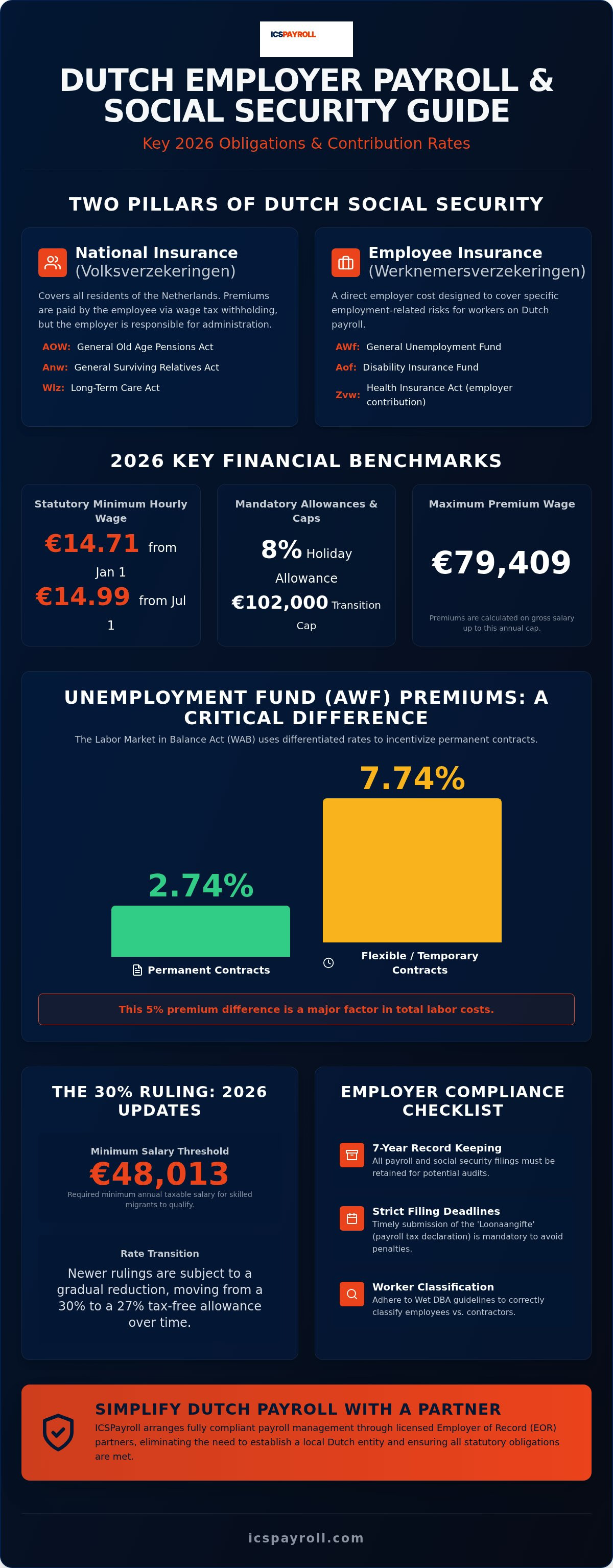
The distinction between national insurance (Volksverzekeringen) and employee insurance (Werknemersverzekeringen) is fundamental to Dutch labor law. National insurance provides coverage for all residents and includes three core pillars: AOW (General Old Age Pensions Act), Anw (General Surviving Relatives Act), and Wlz (Long-term Care Act). While employees pay the premiums for national insurance through wage tax deductions, the employer remains responsible for the administrative processing.
In contrast, employee insurance is a direct employer cost designed to cover specific employment-related risks. These premiums fund unemployment benefits and disability protections, ensuring workers are supported if they're unable to perform their duties. The Belastingdienst is the central authority for the collection of all social security premiums and wage taxes. By correctly classifying these contributions, you ensure that your employees receive their statutory protections while your business avoids the risk of underpayment penalties.
Statutory Employer Premiums and 2026 Contribution Rates
Calculating the total cost of employment in the Netherlands requires a precise understanding of the various insurance premiums mandated by law. These costs are not static; they change annually based on government budget updates and economic forecasts. For 2026, the dutch social security contributions for employers are structured to balance labor market flexibility with worker protection. Most of these premiums are calculated based on the employee's gross wage, up to a maximum premium wage of €79,409.
The 2026 Wage Benchmarks
The Dutch statutory minimum wage is now strictly an hourly figure, eliminating the previous fixed monthly minimums. Effective January 1, 2026, the minimum hourly wage is set at €14.71. This rate is scheduled to increase to €14.99 on July 1, 2026. Beyond the base salary, you must account for the mandatory 8% holiday allowance. This is typically calculated on the gross annual salary and paid out in May. If an employment relationship ends, you must also consider the transition allowance (Transitievergoeding). For 2026, this statutory severance payment is capped at €102,000, or one gross annual salary if the employee earns more than this limit.
AWf and Aof Premium Specifics
The General Unemployment Fund (AWf) uses a differentiated rate system to encourage permanent employment. Under the Labor Market in Balance Act (WAB), permanent contracts qualify for a low AWf premium of 2.74%. Flexible or temporary contracts are subject to a high rate of 7.74%. This 5% difference makes contract management a critical financial strategy for international firms.
The Disability Insurance Fund (Aof) is also differentiated, but the criteria depend on the size of the employer. For 2026, small employers pay a premium of 6.27%, while large employers contribute 7.63%. You can find the most recent official rate tables on the Belastingdienst website to verify these figures against your specific industry sector.
In addition to these funds, you're responsible for the Healthcare Insurance Act (Zvw) employer levy, which is 6.10% for 2026. The Work Resumption Fund (Whk) premium varies based on your company's specific risk profile and industry, with a national average of 1.52%. These layered costs can be difficult to track manually. If you want to streamline these obligations, you can request a tailored payroll quote to see how these premiums impact your specific budget. Managing these dutch social security contributions for employers through a consolidated model prevents the administrative errors that often lead to costly audits.
Managing Total Labor Costs: Pensions and the 30% Ruling Impact
The 30% ruling remains one of the most effective ways to manage the high costs of international recruitment. It functions as a tax-free reimbursement for the additional expenses incurred by highly skilled migrants moving to the Netherlands. This ruling doesn't just benefit the employee; it also directly impacts the dutch social security contributions for employers. Because the 30% allowance is deducted from the gross salary before taxes, the taxable base used to calculate social security premiums is reduced. This results in a lower overall premium burden for the business while increasing the employee's net take-home pay. It's a strategic tool that makes the Dutch labor market significantly more competitive for global talent.
The 30% Ruling Evolution in 2026
For 2026, the standard salary threshold to qualify for this tax advantage is EUR 48,013. If your employee is under 30 and holds a Master's degree, the threshold is adjusted to EUR 36,497. You must monitor the legislative landscape closely as the ruling is currently in a state of transition. While the 30% rate is applicable throughout 2026, a reduction to a flat 27% rate is scheduled to begin on January 1, 2027, for rulings that started on or after January 1, 2024. Another critical change you must account for is the abolition of the partial non-resident taxpayer status. This change means that employees can no longer claim exemptions for foreign-source income in Box 2 and Box 3 of their tax returns. You can find more details on these shifts in our guide on The 30% Ruling in the Netherlands.
Pension and Sickness Risk Coverage
Beyond statutory dutch social security contributions for employers, a competitive Dutch employment package almost always includes a private pension scheme. In the Dutch "three-pillar" system, the first pillar is the state pension (AOW), but the second pillar consists of occupational pensions managed by the employer. At ICSPayroll, we utilize a standard pension contribution of 15.2% of the gross salary. This is a significant cost that sits on top of the statutory premiums discussed in previous sections. It's essential to factor this 15.2% into your total cost of employment calculations from the start.
Employers also face substantial financial risks regarding employee health and long-term sickness. In the Netherlands, you're legally obligated to pay at least 70% of an employee's wages for up to two years if they fall ill. For the first year, many collective labor agreements (CAOs) even require 100% payment. This requirement can create unexpected cash flow strain for smaller entities. Many businesses mitigate this by taking out sickness risk insurance, which covers the wage payments during long-term absence. Managing these layers of cost requires a methodical approach to ensure your labor budget remains accurate and sustainable in the 2026 fiscal year.
Employer Compliance: Filings, Deadlines, and Statutory Risks
Compliance in the Netherlands is defined by strict deadlines and zero tolerance for administrative delays. The primary vehicle for reporting is the Loonaangifte, or wage tax return. You must file this return and settle the payment by the last day of the month following the pay period. For instance, your January 2026 filing is due by February 28. Missing this window triggers automatic penalties from the Belastingdienst. Accurate reporting ensures that all dutch social security contributions for employers are settled on time, protecting your business from unnecessary financial exposure.
Managing your workforce also involves correct worker classification. With the enforcement of Wet DBA and the introduction of the VBAR (Wet verduidelijking beoordeling arbeidsrelaties en rechtsvermoeden), the distinction between an independent contractor and an employee is strictly monitored. If the authorities determine a "fictitious employment" relationship exists, your company faces retroactive premium claims and substantial fines. This is particularly risky for foreign firms that don't have a local Dutch BV, as they may inadvertently create a "Permanent Establishment." This status subjects your foreign company to Dutch corporate tax and local social security laws without the benefit of a local legal shield.
Contractual precision is equally vital in 2026 due to significant reforms to non-compete clauses. New contracts must now specify a maximum duration of 12 months, define a precise geographical scope, and provide a compelling business justification. Failing to meet these specific criteria can render the clause void, leaving your intellectual property unprotected.
The Ketenregeling and Contract Limits
The "Ketenregeling" dictates the sequence of fixed term contracts allowed under Dutch law. You can offer a maximum of three consecutive contracts within a total period of 36 months. Once this limit is reached, or if the gap between contracts is six months or less, the next contract automatically becomes permanent. Navigating these limits is essential to avoid unintended long term liabilities. You can find more on these specific regulations in our guide on Employment Law in the Netherlands.
Compliance Audits and Record Keeping
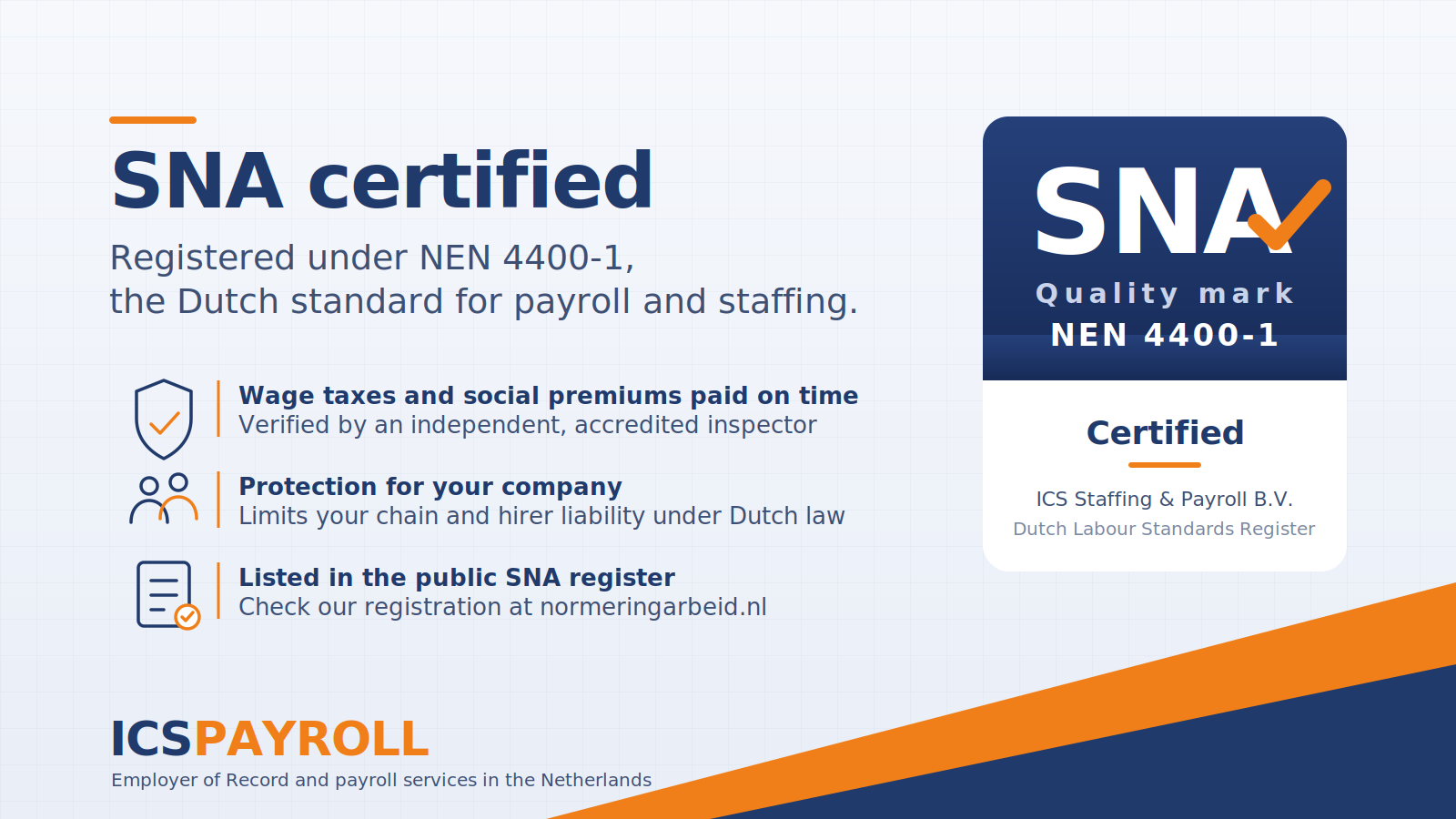
Maintaining a clean audit trail is the only way to ensure long term security. While the SNA (Stichting Normering Arbeid) certification is a hallmark of quality, ICSPayroll arranges these specific compliance standards via licensed and certified partners. This structure protects you from "Chain Liability" where a client can be held responsible for unpaid taxes. Every employee must have a valid BSN (Citizen Service Number) registered before their first payday. Remember that all payroll documentation must be retained for seven years to satisfy statutory requirements. If you're concerned about the legal complexities of local filings, contact ICSPayroll today to discuss our secure payroll administration solutions.
Simplifying Dutch Social Security with a Local EOR Partner
Establishing a local Dutch BV is a time-consuming and expensive process that often delays your entry into the market. An Employer of Record (EOR) provides a faster alternative by acting as the legal employer of your staff. This model ensures that all dutch social security contributions for employers are calculated, withheld, and paid with absolute precision. You retain daily management of your team while we manage the complex administrative framework of the Belastingdienst and the UWV. By leveraging our established infrastructure, you can begin operations in the Netherlands in a matter of weeks rather than months.
The ICSPayroll factor model replaces the uncertainty of variable labor costs with a single, consolidated monthly invoice. This model includes gross wages, statutory premiums, and pension contributions, providing you with a transparent view of your total expenditure. For companies hiring international talent, we arrange expedited Highly Skilled Migrant (HSM) visa processing through our licensed partners. This service often reduces the visa waiting period to just three weeks, allowing your new hires to integrate quickly into your operations. It's a secure way to manage dutch social security contributions for employers without the overhead of a local entity.
The ICSPayroll Advantage
Your employees benefit from a modern digital experience through our online portal. This interface provides 24/7 access to digital payslips, annual statements, and real-time holiday balances. Beyond software, we provide human-led support for the more sensitive aspects of Dutch employment. This includes comprehensive sickness reintegration guidance to help you manage the long-term illness risks discussed earlier. Our team is committed to speed; we provide tailored quotations within 24 hours to ensure your recruitment plans stay on schedule. This transparency allows you to forecast your labor costs with confidence.
Starting Your Dutch Journey
Our national hub of expertise provides the reassurance you need to navigate a foreign legal system. We take a bold but traditionalist approach to compliance, ensuring every detail meets the highest legal standards. This "no-nonsense" personality values transparency and prides itself on being a direct, human-led organization. As Joost Hubregtse, Payroll Director, states: "Local payroll precision is the only way to build a sustainable international team in the Netherlands. We act as your protective guardian in a complex regulatory landscape." By choosing a partner that understands the nuances of 2026 regulations, you remove the administrative barriers to your success.
Securing Your Dutch Market Entry in 2026
Mastering the 2026 regulatory framework is essential for any business scaling in the Netherlands. You must balance the 15.2% pension standard with the updated EUR 48,013 salary threshold to remain competitive and compliant. Precision in calculating dutch social security contributions for employers is the only way to safeguard your organization against retroactive audits and personal liability risks. It's vital to stay ahead of the transition to a 27% ruling rate and the new non-compete clause restrictions to maintain a stable workforce.
Our team acts as your protective guardian, managing every technical detail from Loonaangifte filings to sickness risk coverage. We provide full Dutch compliance for payroll and social security through a consolidated monthly invoice with no surprises. This approach removes the administrative friction of entering a new market while ensuring your staff is supported by local experts who understand the nuances of Dutch labor law.
Hire in the Netherlands with confidence: Request your 24-hour quote today
With expedited HSM visa processing in approximately three weeks, it's possible to build your Dutch team quickly and securely. We look forward to supporting your successful expansion into the Dutch market.
Frequently Asked Questions
What are the primary employer social security premiums in the Netherlands for 2026?
Primary premiums include the AWf (Unemployment), Aof (Disability), Whk (Return to Work), and the Zvw (Healthcare) levy. For 2026, the Zvw employer contribution is 6.10% of the wage up to a cap of €79,409. These dutch social security contributions for employers are strictly regulated. Compliance is non-negotiable. You can find the full list of statutory rates on the Belastingdienst website.
How does the 30% ruling affect employer social security contributions?
The 30% ruling allows you to pay a tax-free allowance to qualified expats. This reduces the taxable salary used to calculate dutch social security contributions for employers. Since the allowance is exempt from social security premiums, the total employer cost is significantly lower than for a standard hire. This benefit is a key factor in managing international labor costs while increasing the employee's net income.
What is the 2026 salary threshold for the highly skilled migrant ruling?
The 2026 salary threshold for standard highly skilled migrant applicants is EUR 48,013. For employees under 30 years old with a Master's degree, the required minimum taxable salary is EUR 36,497. Meeting these benchmarks is a legal requirement. These figures apply to both the HSM visa and the 30% ruling. Official guidance on these limits is available through the IND website.
Are employers required to provide a pension scheme in the Netherlands?
While there isn't a single national statute requiring pensions, most industries fall under mandatory sector-wide pension funds (Bpf). These requirements are defined in Collective Labor Agreements (CAO). ICSPayroll simplifies this by offering a standard pension scheme at 15.2% of the gross salary. This ensures your employees receive the second-pillar coverage expected in the Dutch market while your business remains fully compliant with industry standards.
What happens if an employer fails to file payroll taxes on time?
Late filings for Loonaangifte result in automatic fines from the Dutch tax authorities. You must file the return and complete the payment by the last day of the month following the pay period. Ensuring every employee has a valid BSN registered before their first payday is a critical step in this process. Reliable payroll administration is the only way to avoid penalties from the Belastingdienst.
Can a foreign company pay Dutch social security without a local entity?
You can hire in the Netherlands without a local entity by partnering with an Employer of Record (EOR). ICSPayroll acts as the legal employer, handling all local tax, insurance, and payroll obligations. This model works without a Dutch BV. It eliminates the risk of creating a Permanent Establishment. We manage all statutory requirements through our established local infrastructure and licensed partners.
What is the maximum transition allowance for an employee in 2026?
The maximum statutory transition payment for 2026 is EUR 102,000. If an employee's annual salary is higher than this cap, the severance payment is limited to one gross annual salary. This payment is mandatory for almost all contract terminations. Calculating this amount correctly is a standard part of our payroll service. You can find more on the official business.gov.nl page regarding statutory severance rules.
How long must an employer keep social security and payroll records?
Dutch law requires you to keep all payroll and social security records for a minimum of seven years. This retention period is mandatory for audits by the tax authorities or social security agencies. Records related to immovable property must be kept for ten years. Maintaining organized digital files ensures that your business can provide documentation quickly. Detailed rules for administrative retention are available on the Belastingdienst website.

Article by
Joost Hubregtse
Joost Hubregtse is Director of ICS Staffing & Payroll B.V., the wholly owned subsidiary of Intercompany Solutions behind ICS Payroll. He is responsible for Employer of Record and Dutch payroll services: employment contracts, wage tax and social security filings, holiday allowance, pension, sick leave and CAO compliance, with onboarding possible within 48 hours.
Frequently Asked Questions
Primary premiums include the AWf (Unemployment), Aof (Disability), Whk (Return to Work), and the Zvw (Healthcare) levy. For 2026, the Zvw employer contribution is 6.10% of the wage up to a cap of €79,409. These dutch social security contributions for employers are strictly regulated. Compliance is non-negotiable. You can find the full list of statutory rates on the Belastingdienst website.
The 30% ruling allows you to pay a tax-free allowance to qualified expats. This reduces the taxable salary used to calculate dutch social security contributions for employers. Since the allowance is exempt from social security premiums, the total employer cost is significantly lower than for a standard hire. This benefit is a key factor in managing international labor costs while increasing the employee's net income.
The 2026 salary threshold for standard highly skilled migrant applicants is EUR 48,013. For employees under 30 years old with a Master's degree, the required minimum taxable salary is EUR 36,497. Meeting these benchmarks is a legal requirement. These figures apply to both the HSM visa and the 30% ruling. Official guidance on these limits is available through the IND website.
While there isn't a single national statute requiring pensions, most industries fall under mandatory sector-wide pension funds (Bpf). These requirements are defined in Collective Labor Agreements (CAO). ICSPayroll simplifies this by offering a standard pension scheme at 15.2% of the gross salary. This ensures your employees receive the second-pillar coverage expected in the Dutch market while your business remains fully compliant with industry standards.
Late filings for Loonaangifte result in automatic fines from the Dutch tax authorities. You must file the return and complete the payment by the last day of the month following the pay period. Ensuring every employee has a valid BSN registered before their first payday is a critical step in this process. Reliable payroll administration is the only way to avoid penalties from the Belastingdienst.
You can hire in the Netherlands without a local entity by partnering with an Employer of Record (EOR). ICSPayroll acts as the legal employer, handling all local tax, insurance, and payroll obligations. This model works without a Dutch BV. It eliminates the risk of creating a Permanent Establishment. We manage all statutory requirements through our established local infrastructure and licensed partners.
The maximum statutory transition payment for 2026 is EUR 102,000. If an employee's annual salary is higher than this cap, the severance payment is limited to one gross annual salary. This payment is mandatory for almost all contract terminations. Calculating this amount correctly is a standard part of our payroll service. You can find more on the official business.gov.nl page regarding statutory severance rules.
Dutch law requires you to keep all payroll and social security records for a minimum of seven years. This retention period is mandatory for audits by the tax authorities or social security agencies. Records related to immovable property must be kept for ten years. Maintaining organized digital files ensures that your business can provide documentation quickly. Detailed rules for administrative retention are available on the Belastingdienst website.