
Dutch Payroll Tax Guide: 2026 Employer Compliance Requirements
By Joost Hubregtse, Director, ICS Staffing & Payroll
All blog posts are reviewed and fact checked by our labour law lawyer Zishan Hussain and our director. Editorial standards
A single administrative oversight in your Dutch payroll process doesn't just result in a warning; it triggers immediate financial penalties and complicates your relationship with the Belastingdienst. For international employers, the transition into 2026 brings a wave of new statutory requirements, including a minimum hourly wage that climbs to €14.99 by July and a revised 30% ruling salary threshold of €48,013. This dutch payroll tax guide provides the technical precision required to manage these shifts without the administrative burden.
You likely find that mastering Dutch social security and tax law is a daunting task, particularly with the tightening of the 30% ruling and the strict monthly Loonaangifte deadlines. This article serves as your definitive 2026 reference, promising to simplify complex wage tax and social security regulations into actionable steps. We provide a clear breakdown of employer costs, including the 6.10% Zvw levy and AWf premiums, while detailing the latest legislative changes to ensure your operations remain secure and compliant.
Key Takeaways
- Understand the Loonheffing system as a collective obligation to withhold wage tax and social security contributions at the source.
- Learn how to apply the 30% ruling using the standard 2026 salary threshold of EUR 48,013 as part of this definitive dutch payroll tax guide.
- Differentiate between national and employee insurance premiums while preparing for the 15.2% pension scheme contribution standard.
- Master the monthly Loonaangifte filing process and ensure your business adheres to the strict seven year record keeping requirement for all payroll data.
- Discover how an Employer of Record (EOR) managed via licensed partners allows you to hire compliant talent in the Netherlands without establishing a local Dutch BV.
Understanding the Dutch Payroll Tax (Loonheffing) System
The term Loonheffing represents a collective framework of taxes and premiums that every employer in the Netherlands must manage. It encompasses both wage tax (loonbelasting) and national insurance contributions (volksverzekeringen). Under the Dutch income tax system, employers carry the legal burden of withholding these amounts directly from an employee's gross salary at the source. This ensures that the state receives necessary funds before the net wage reaches the worker's bank account. This proactive withholding model is the cornerstone of fiscal compliance for any business operating within the jurisdiction.
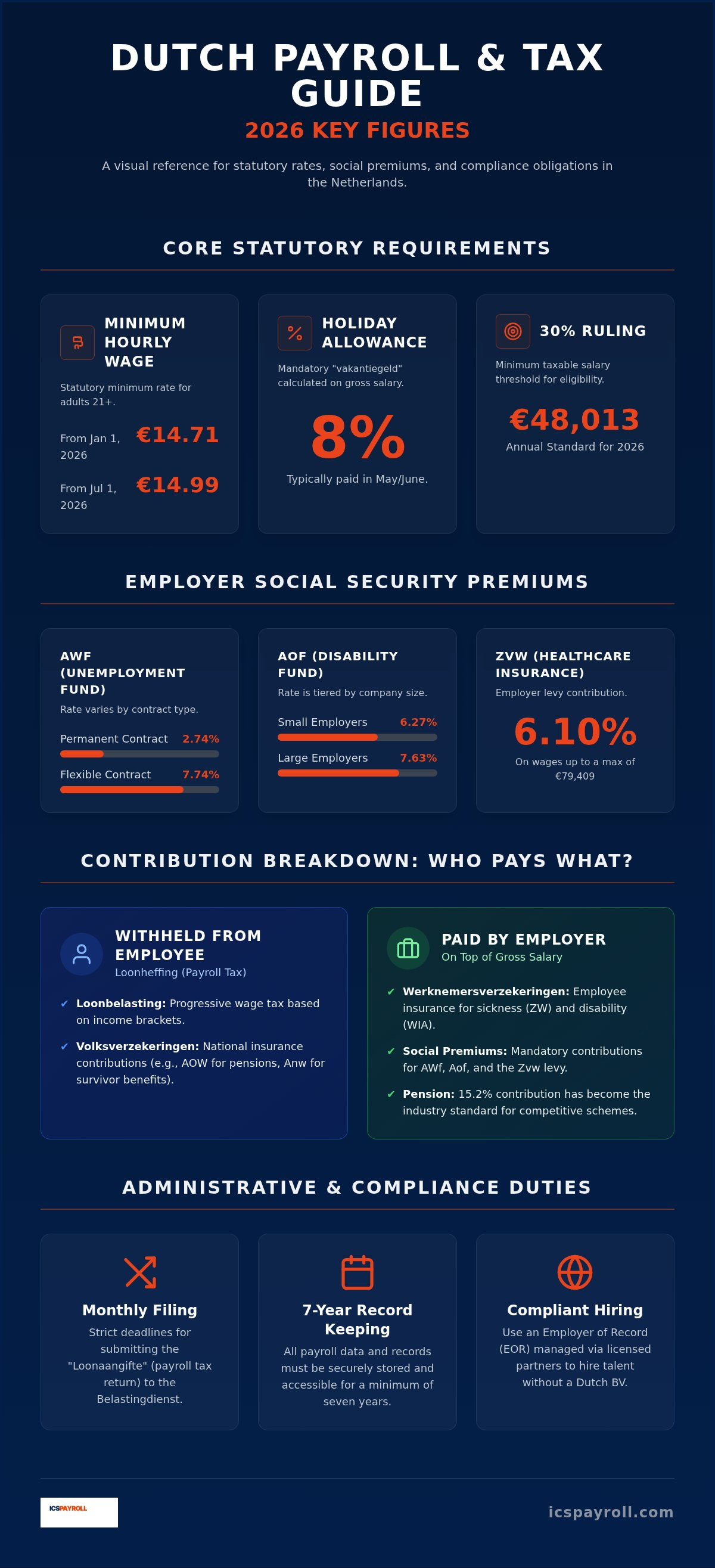
Compliance starts with adhering to the statutory minimum hourly wage. As of January 1, 2026, the minimum rate for adults aged 21 and over is EUR 14.71 per hour. This rate increases to EUR 14.99 per hour on July 1, 2026. Beyond the base salary, Dutch labor law mandates an 8% holiday allowance (vakantiegeld), which is typically paid in May or June. This dutch payroll tax guide emphasizes that these are non-negotiable statutory requirements. Failing to meet these benchmarks can lead to severe audits and retroactive payment orders from labor authorities.
The Role of the Belastingdienst
The Belastingdienst, or the Dutch Tax and Customs Administration, serves as the primary oversight body for payroll compliance. Before hiring your first employee, you must register as an employer to obtain a Dutch tax interest number. This identifier is essential for all monthly filings and correspondence. For precise calculations, you should consult the official tax tables provided by the Belastingdienst to ensure accurate withholding based on current tax brackets. The administration uses this data to track social security entitlements and individual tax liabilities throughout the fiscal year.
Statutory Employer Premiums for 2026
While Loonheffing is withheld from the employee, employers must also pay separate social insurance premiums. These contributions are vital for the Dutch social safety net. The AWf (Unemployment Fund) varies based on contract type: 2.74% for permanent roles and 7.74% for flexible arrangements. The Aof (Disability Fund) is tiered by company size, with small employers paying 6.27% and large entities paying 7.63%. Additionally, the Zvw (Healthcare Insurance Act) levy requires a 6.10% contribution on wages up to a maximum of EUR 79,409. Managing these specific percentages is a core component of Dutch payroll administration to avoid unexpected liabilities.
Key Components of Wage Tax and Social Insurance
The Dutch social security landscape is divided into two primary categories that dictate how premiums are withheld and paid. National insurance (volksverzekeringen) covers all residents, whereas employee insurance (werknemersverzekeringen) is reserved for those in active employment. This distinction is critical for maintaining compliance with the Dutch Tax and Customs Administration guidelines. This dutch payroll tax guide provides the necessary technical clarity to differentiate these obligations and ensure your financial reporting remains accurate.
National Insurance vs. Employee Insurance
National insurance includes the General Old Age Pensions Act (AOW) and the General Surviving Relatives Act (Anw). These are generally withheld from the employee's gross pay within the first tax bracket. Employee insurance, however, covers specific workplace risks such as sickness (ZW) and long-term disability (WIA). Unlike national insurance, these premiums are paid by the employer on top of the gross salary. Both categories are calculated as a percentage of the gross wage, up to the annual premium limit of EUR 79,409. This distinction ensures the social safety net is funded by both the individual and the hiring entity.
Mandatory Benefits and Allowances
The 8% holiday allowance is calculated on the total gross salary earned over the previous 12 months. Payment typically occurs in May, though some employers opt for monthly accrual to manage cash flow. For 2026, a 15.2% pension scheme contribution has become the industry standard for competitive and compliant hiring. This percentage is a significant component of the overall payroll factor and must be managed carefully. Employees can monitor these contributions and accruals through the online employee portal, which provides real-time access to payslips and contract details.
Employers also carry a substantial risk regarding employee health and contract termination. If an employee falls ill, the law requires the employer to pay at least 70% of the salary for a period of 104 weeks. This two year obligation includes mandatory reintegration steps to satisfy legal standards. The transition allowance (transitievergoeding) is a statutory payment due when a contract ends at the employer's initiative. For 2026, this payment is capped at EUR 102,000, or one annual salary if higher. Navigating these overlapping risks is simpler when you use expert Dutch payroll administration to manage your workforce.
Strategic Tax Advantages: The 30% Ruling in 2026
The 30% ruling remains a critical instrument for attracting international talent to the Netherlands. This facility allows employers to provide a tax-free allowance to cover extraterritorial costs associated with relocating. For 2026, the standard salary threshold is EUR 48,013. This figure represents the minimum taxable salary required after the allowance has been applied. This dutch payroll tax guide highlights that while the rate remains at 30% for 2026, a scheduled transition to a 27% rate begins on January 1, 2027, for rulings issued on or after January 1, 2024. This change reflects a broader legislative push to normalize tax benefits over time.
Another significant shift involves the abolition of partial non-resident status. As of January 1, 2025, new applicants can no longer opt for this status, which previously granted tax exemptions on Box 2 and Box 3 income. A transitional rule exists for those who already held the status in 2023, allowing them to continue using it until December 31, 2026. Understanding these nuances is essential for accurate long-term financial planning and maintaining transparent communication with your expatriate workforce regarding their net take-home pay.
Eligibility Criteria for International Hires
To qualify for the ruling, an employee must have lived more than 150 kilometers from the Dutch border for at least 16 of the 24 months prior to their first working day in the Netherlands. Specific exemptions exist for younger professionals to encourage the influx of specialized knowledge. Highly skilled migrants under the age of 30 who hold a recognized Master's degree face a reduced 2026 salary threshold of EUR 36,497. You can find more granular policy details and historical context in our guide to the 30 ruling netherlands.
Application and Compliance
Securing this tax advantage requires a joint application submitted by both the employer and the employee to the Belastingdienst. Accuracy in the initial filing is paramount. Retroactive applications are strictly limited to four months from the start of employment. For businesses recruiting from outside the EU, Highly Skilled Migrant (HSM) visa applications are often a prerequisite. These can be expedited to approximately three weeks when arranged via licensed partners. Official criteria for migrants and residency requirements are maintained by the ind.nl website. Maintaining compliance within this framework ensures that both the business and the expatriate maximize the available fiscal benefits while adhering to strict regulatory standards.
Administrative Deadlines and Statutory Reporting
The Belastingdienst maintains a zero tolerance policy regarding reporting timelines. Missing a deadline for the monthly payroll tax return (Loonaangifte) or the subsequent payment results in automatic financial penalties. This dutch payroll tax guide emphasizes that the return and the payment must be received by the tax authorities by the last day of the month following the pay period. For example, the January filing and payment must be completed by the end of February. Beyond these monthly cycles, employers must adhere to a strict seven year record keeping requirement for all Dutch payroll data. This includes contracts, identity documents, payslips, and tax withholding evidence. These records must be stored securely and remain readily available for potential audits to verify that all statutory premiums were calculated correctly.
The Monthly Payroll Cycle
Managing a compliant payroll involves a methodical three step process to ensure total accuracy. First, you must calculate the gross to net salary for each employee. This calculation must incorporate all 2026 statutory premiums, including the AWf, Aof, and Zvw levies discussed in previous sections of this guide. Second, you must submit the Loonaangifte electronically to the Belastingdienst. This submission serves as the formal declaration of your tax liabilities for that period. Accuracy is essential here, as corrections to previous filings can be administratively complex and may trigger unwanted scrutiny. Finally, you must distribute digital payslips. Using an online employee portal is the most efficient method for this distribution. It provides employees with immediate access to their financial records while ensuring the employer meets their legal obligation to provide a transparent breakdown of all withholdings and allowances.
Annual Reporting and Compliance Audits
As the fiscal year concludes, employers must issue a Year End statement, known as the Jaaropgaaf, to every employee by the end of February. This document summarizes the total wages earned and taxes withheld during the preceding calendar year. It's a critical component for the employee's personal income tax filing and must match the data submitted in the monthly Loonaangifte returns. Maintaining this level of administrative precision requires expert oversight. At ICSPayroll, Joost Hubregtse, Payroll Director, manages these compliance workflows to ensure every client remains in good standing with the authorities. Accurate reporting also relies on maintaining valid company registration details as outlined by the KVK (Chamber of Commerce). This dutch payroll tax guide ensures you understand that any changes in your business structure or address must be updated promptly to avoid communication gaps with the tax office. If you need assistance managing these recurring deadlines, you can outsource your Dutch payroll administration to our expert team for guaranteed accuracy.
Ensuring Compliance with a Local Payroll and EOR Partner
Entering the Dutch market requires a strategic choice between establishing a local legal entity or utilizing an Employer of Record (EOR). For many international businesses, an EOR acts as the legal employer of your Dutch workforce, assuming full responsibility for all tax withholdings and social security contributions. This structure allows you to hire talent in the Netherlands without the administrative burden of managing a Dutch BV or risking the legal complexities of a Permanent Establishment. By following this dutch payroll tax guide, you can leverage a partner's local expertise to ensure every contract and payslip meets the rigorous standards set by the Belastingdienst.
EOR vs. Direct Entity Incorporation
The primary advantage of an EOR is the speed of market entry. While forming a Dutch BV can take several months and requires significant legal and capital investment, an EOR setup is typically completed within a few weeks. This rapid deployment is essential for securing top talent in a competitive market. Additionally, using a compliant EOR structure mitigates the risk of creating a Permanent Establishment, which could otherwise expose your parent company to broader Dutch corporate tax liabilities. You can find a detailed analysis of these benefits in our comprehensive guide to Employer of Record Netherlands.
The ICSPayroll Advantage
ICSPayroll operates on a transparent payroll factor pricing model to provide businesses with absolute cost certainty. This single multiplier covers all statutory and mandatory employment costs, including the 15.2% pension contribution and the 8% holiday allowance. All these variables are consolidated into one clear monthly invoice, removing the need to track individual premium percentages like the AWf or Aof manually. This predictable cost structure is a fundamental part of our dutch payroll tax guide for 2026 budgeting.
Our service extends beyond basic payroll processing. We facilitate specialized administrative tasks, such as HSM visa applications and 30% ruling filings, which are arranged via licensed partners. These processes ensure that highly skilled migrants meet the EUR 48,013 salary threshold and other criteria without administrative delays. To receive a transparent breakdown of your projected employment costs in the Netherlands, you can request a tailored quotation from our team, which we typically provide within 24 hours.
Future-Proofing Your Dutch Employment Strategy
Maintaining compliance in the Netherlands requires vigilant attention to shifting statutory benchmarks. As this dutch payroll tax guide has detailed, employers must prepare for the mid-2026 minimum wage increase to EUR 14.99 per hour and the strict EUR 48,013 salary threshold for the 30% ruling. Managing these variables alongside mandatory 15.2% pension contributions and the 8% holiday allowance is essential to avoid Belastingdienst penalties and ensure operational stability. By distinguishing between national insurance and employer-paid premiums, you can accurately project your total cost of employment while protecting your international workforce.
Transitioning your hiring process to a professional EOR structure removes the administrative burden of local entity formation. We provide operational setup in weeks rather than months, ensuring your team is active and compliant without delay. You receive one clear monthly invoice with no surprise charges, providing total transparency for your global budget. Hire in the Netherlands with confidence: Get your 24-hour quote from ICSPayroll and secure your standing in the Dutch market today. We look forward to facilitating your successful expansion.
Frequently Asked Questions
What is the standard payroll tax rate in the Netherlands for 2026?
The Dutch payroll tax system uses a progressive bracket structure for 2026. Bracket 1 is 35.75% for income up to €38,883. Bracket 2 covers income up to €78,426 at a rate of 37.56%. The top marginal rate is 49.5% for income exceeding €78,426. These rates include national insurance contributions for the first bracket. This dutch payroll tax guide ensures you calculate these withholdings accurately to maintain compliance with the Belastingdienst.
How much is the mandatory holiday allowance in the Netherlands?
The mandatory holiday allowance in the Netherlands is 8% of the employee's gross annual salary. This statutory benefit is typically paid out as a lump sum in May or June. It applies to all employees regardless of their contract type or duration. Employers must account for this 8% on top of the base gross salary when calculating total labor costs. It is a non-negotiable requirement under Dutch labor law and must be clearly stated on the payslip.
What is the salary threshold for the 30% ruling in 2026?
The standard minimum taxable salary threshold for the 30% ruling in 2026 is EUR 48,013. This amount represents the 70% taxable portion of the salary after the tax-free allowance is applied. For employees under the age of 30 who hold a recognized Master's degree, a reduced threshold of EUR 36,497 applies. Applicants must also meet the 150km distance requirement from the Dutch border to qualify for this strategic tax advantage for highly skilled migrants.
Do I need a Dutch BV to hire employees in the Netherlands?
You don't need to incorporate a Dutch BV to hire employees in the Netherlands if you utilize an Employer of Record (EOR). An EOR acts as the legal employer, managing all payroll, tax, and social security obligations on your behalf. This allows your business to hire local talent or relocate expats quickly without the legal risks of a Permanent Establishment. It's an efficient solution for companies wanting to enter the Dutch market within weeks.
What are the employer social security contribution rates for 2026?
Employer social security contributions for 2026 consist of several specific premiums calculated on wages up to EUR 79,409. The AWf (Unemployment Fund) is 2.74% for permanent contracts and 7.74% for flexible ones. The Aof (Disability Fund) is 6.27% for small employers or 7.63% for large ones. Additionally, employers must pay a 6.10% Zvw (Healthcare Insurance Act) levy. These costs are paid by the employer and are separate from taxes withheld from the employee's salary.
How long must payroll records be kept in the Netherlands?
Employers must retain all payroll records for a minimum of seven years in the Netherlands. This statutory record-keeping requirement applies to all administrative data, including identity documents, employment contracts, payslips, and tax withholding evidence. The Belastingdienst may request these files during an audit to verify historical compliance. Maintaining a secure digital archive ensures your business can respond to official inquiries promptly and avoid penalties associated with incomplete or missing documentation.
What is the maximum transition allowance cap for 2026?
The statutory transition allowance (transitievergoeding) is capped at EUR 102,000 for 2026. If an employee's gross annual salary is higher than this amount, the cap is equal to one gross annual salary. This payment is mandatory when a contract is terminated or not renewed at the employer's initiative. The calculation is based on the duration of employment and the employee's monthly salary, serving as a financial bridge for the departing worker after their contract ends.
How quickly can an HSM visa be processed for a new hire?
Highly Skilled Migrant (HSM) visas are typically processed and granted within approximately three weeks when arranged via licensed partners. This expedited timeline allows international businesses to relocate specialized talent to the Netherlands quickly. The application requires the employer to be an IND recognized sponsor or use an EOR partner with that status. Ensuring the candidate meets the 2026 salary thresholds is a prerequisite for a successful and rapid approval process for your new hire.

Article by
Joost Hubregtse
Joost Hubregtse is Director of ICS Staffing & Payroll B.V., the wholly owned subsidiary of Intercompany Solutions behind ICS Payroll. He is responsible for Employer of Record and Dutch payroll services: employment contracts, wage tax and social security filings, holiday allowance, pension, sick leave and CAO compliance, with onboarding possible within 48 hours.
Frequently Asked Questions
The Dutch payroll tax system uses a progressive bracket structure for 2026. Bracket 1 is 35.75% for income up to €38,883. Bracket 2 covers income up to €78,426 at a rate of 37.56%. The top marginal rate is 49.5% for income exceeding €78,426. These rates include national insurance contributions for the first bracket. This dutch payroll tax guide ensures you calculate these withholdings accurately to maintain compliance with the Belastingdienst.
The mandatory holiday allowance in the Netherlands is 8% of the employee's gross annual salary. This statutory benefit is typically paid out as a lump sum in May or June. It applies to all employees regardless of their contract type or duration. Employers must account for this 8% on top of the base gross salary when calculating total labor costs. It is a non-negotiable requirement under Dutch labor law and must be clearly stated on the payslip.
The standard minimum taxable salary threshold for the 30% ruling in 2026 is EUR 48,013. This amount represents the 70% taxable portion of the salary after the tax-free allowance is applied. For employees under the age of 30 who hold a recognized Master's degree, a reduced threshold of EUR 36,497 applies. Applicants must also meet the 150km distance requirement from the Dutch border to qualify for this strategic tax advantage for highly skilled migrants.
You don't need to incorporate a Dutch BV to hire employees in the Netherlands if you utilize an Employer of Record (EOR). An EOR acts as the legal employer, managing all payroll, tax, and social security obligations on your behalf. This allows your business to hire local talent or relocate expats quickly without the legal risks of a Permanent Establishment. It's an efficient solution for companies wanting to enter the Dutch market within weeks.
Employer social security contributions for 2026 consist of several specific premiums calculated on wages up to EUR 79,409. The AWf (Unemployment Fund) is 2.74% for permanent contracts and 7.74% for flexible ones. The Aof (Disability Fund) is 6.27% for small employers or 7.63% for large ones. Additionally, employers must pay a 6.10% Zvw (Healthcare Insurance Act) levy. These costs are paid by the employer and are separate from taxes withheld from the employee's salary.
Employers must retain all payroll records for a minimum of seven years in the Netherlands. This statutory record-keeping requirement applies to all administrative data, including identity documents, employment contracts, payslips, and tax withholding evidence. The Belastingdienst may request these files during an audit to verify historical compliance. Maintaining a secure digital archive ensures your business can respond to official inquiries promptly and avoid penalties associated with incomplete or missing documentation.
The statutory transition allowance (transitievergoeding) is capped at EUR 102,000 for 2026. If an employee's gross annual salary is higher than this amount, the cap is equal to one gross annual salary. This payment is mandatory when a contract is terminated or not renewed at the employer's initiative. The calculation is based on the duration of employment and the employee's monthly salary, serving as a financial bridge for the departing worker after their contract ends.
Highly Skilled Migrant (HSM) visas are typically processed and granted within approximately three weeks when arranged via licensed partners. This expedited timeline allows international businesses to relocate specialized talent to the Netherlands quickly. The application requires the employer to be an IND recognized sponsor or use an EOR partner with that status. Ensuring the candidate meets the 2026 salary thresholds is a prerequisite for a successful and rapid approval process for your new hire.