Employer of Record Netherlands: The 2026 Guide to Compliant Hiring
By Joost Hubregtse, Director, ICS Staffing & Payroll
All blog posts are reviewed and fact checked by our labour law lawyer Zishan Hussain and our director. Editorial standards
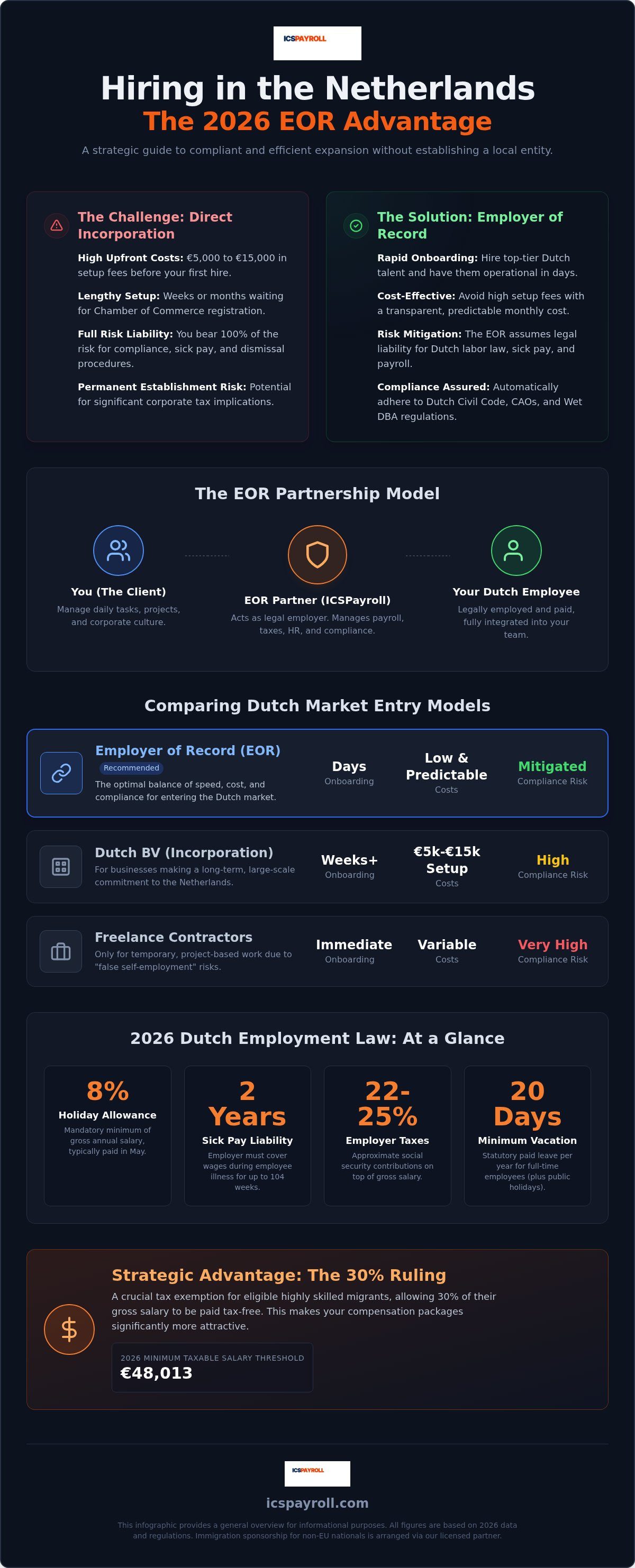
Hiring your first employee in the Netherlands does not require a Dutch legal entity. By partnering with an Employer of Record (EOR), you can put a fully compliant Dutch employment contract in place within days, while the EOR carries the legal obligations - payroll tax filings, the 8% holiday allowance, sick pay administration and pension enrolment - on your behalf.
This guide gives you the complete 2026 picture, including the rules that changed this year and the ones already legislated for later dates. Every key figure is linked to an official government source so you can verify it yourself. Last updated: 5 August 2026 (reflects the 1 July 2026 minimum wage indexation and the adoption, in June 2026, of the statutory presumption of employment for low-paid contractors, which enters into force on 31 December 2026).
Key Takeaways
- An EOR lets you hire Dutch talent in days without incorporating a BV, while you keep day-to-day direction of the work.
- The 30% ruling salary norms for 2026 are €48,013 (standard) and €36,497 (under-30 with a qualifying master's), and crucially these apply to the taxable wage after the deduction, meaning a gross salary of roughly €68,590 (or €52,139) is needed for the full 30% benefit.
- The ruling is capped at a salary of €262,000 in 2026 and drops to 27% from 1 January 2027 for rulings that started on or after 1 January 2024, with higher salary norms. Employees whose ruling started before 2024 keep 30% under transitional law. Budget accordingly now.
- Enforcement of false self-employment (schijnzelfstandigheid) resumed on 1 January 2025 and fines became possible in 2026. The broader VBAR bill was scrapped in early 2026, but its core survived: a statutory presumption of employment for contractors paid at or below roughly €38/hour was adopted in June 2026 and takes effect on 31 December 2026.
- Dutch EOR and payroll constructions are themselves regulated - Waadi registration, the inlenersbeloning, StiPP pension and the incoming WTTA admission system all apply. Ask any provider how they comply before you sign.
What is an Employer of Record (EOR) in the Netherlands?
An Employer of Record is a licensed local organisation that acts as the full legal employer of your Dutch-based staff. The EOR signs the employment contract, runs payroll, withholds wage tax (loonheffing), pays social security contributions and carries the statutory employer obligations, including the two-year sick pay duty. You, the client company, direct the employee's daily work and integrate them into your team.
Legally, a Dutch EOR arrangement is a form of making workers available (terbeschikkingstelling van arbeidskrachten). That matters, because it means the construction is governed by specific rules that a credible provider must be able to demonstrate compliance with.
The legal framework around Dutch EOR constructions
- Waadi registration. Any company that supplies labour in the Netherlands must be registered as such with the Chamber of Commerce (KvK). Hiring through an unregistered provider exposes both parties to fines.
- Inlenersbeloning (hirer's remuneration). Under the Balanced Labour Market Act (WAB) and the applicable collective agreements, workers supplied to your company must receive at least the same core pay and conditions as your own comparable employees would, including any applicable CAO wage scales.
- Pension. Agency and payroll workers are covered by mandatory pension arrangements (typically the StiPP fund for agency constructions, or an "adequate pension" requirement for payrolling under the WAB).
- WTTA. The Wet toelating terbeschikkingstelling van arbeidskrachten will replace the current self-regulation with a mandatory government admission system for labour providers. Providers should already be preparing for certification; ask yours about their status.
A provider that cannot answer questions on these four points is a compliance risk in itself.
Why businesses choose the EOR model
Speed and simplicity. Incorporating a Dutch BV is cheaper than often claimed: a straightforward incorporation via a notary typically costs €1,000 to €2,500 in deed, registration and administrative fees, since the minimum share capital is only €0.01. The real cost of a BV lies in what comes after: payroll administration, annual accounts, corporate income tax filings, a registered address, and directors' liability. With advisory support, first-year total costs commonly reach €5,000 to €15,000, but that is the all-in figure, not the incorporation fee. An EOR removes both the setup and the ongoing overhead, and onboarding can be completed in 24 to 48 hours.
Permanent establishment (PE) management. If your Dutch staff habitually conclude contracts or perform core business activities for your foreign entity, the Belastingdienst may deem you to have a taxable presence in the Netherlands. An EOR reduces, but does not automatically eliminate, this risk: PE is assessed on the facts of what your people actually do, not only on who employs them. A serious provider will discuss role design with you, not just promise the risk away.
Misclassification protection. With enforcement against false self-employment now fully active, converting contractors into properly employed staff via an EOR is the cleanest way to de-risk a Dutch engagement.
Dutch labour law and compliance in 2026
The Dutch Civil Code (Burgerlijk Wetboek, Book 7, Title 10) is the foundation of every employment contract, but in most sectors a Collective Labour Agreement (CAO) layers additional obligations on top: higher minimum wages, extra vacation days, mandatory pension participation and notice rules. Applying the wrong CAO, or none at all, can trigger retroactive wage claims going back five years. Identifying the correct CAO is step one of any compliant hire.
Wage tax and social security
Employers file monthly wage tax returns (loonaangifte) with the Belastingdienst. Employer-side contributions in 2026 typically total 18% to 25% of gross salary, depending on:
- the AWf (unemployment) premium, which has a low rate for permanent written contracts and a high rate five percentage points above it for flexible contracts, directly relevant when hiring through an EOR;
- the differentiated Aof premium (small vs. large employers);
- the sector-dependent Whk (return-to-work) premium; and
- the employer's ZVW healthcare contribution.
A single flat percentage is never accurate; ask your provider for a line-item cost simulation for your specific contract type.
Statutory minimum wage 2026
The Netherlands uses a purely hourly statutory minimum wage, indexed every 1 January and 1 July:
| Period | Minimum hourly wage (21+) |
|---|---|
| 1 January to 30 June 2026 | €14.71 gross |
| From 1 July 2026 | €14.99 gross |
Youth rates (ages 15 to 20) are set as percentages of the adult rate. Always check whether your CAO sets a higher floor. (Source: minimum wage increase per 1 July 2026 - business.gov.nl.)
Mandatory benefits
- Holiday allowance: at least 8% of gross annual wage, usually paid in May or June. For salaries above three times the minimum wage, deviation is possible by written agreement.
- Vacation: the statutory minimum is four times the weekly working hours, so 20 days for a full-time 40-hour week. Many CAOs grant 24 to 25.
- Pension: not universally mandatory by national law, but mandatory in most sectors via industry pension funds, and always mandatory in agency/payroll constructions (StiPP or an adequate equivalent).
The sick pay obligation: the number one risk for foreign employers
Dutch employers must continue paying at least 70% of salary for up to 104 weeks of illness (in the first year, never less than the statutory minimum wage; many CAOs require 100% in year one). Throughout those two years, the Gatekeeper Improvement Act (Wet verbetering poortwachter) imposes a strict reintegration timeline: a problem analysis by the company doctor by week 6, a reintegration action plan (plan van aanpak) agreed between employer and employee by week 8, a 42nd-week notification to the UWV, periodic evaluations with a certified company doctor, and a first-year evaluation. (Sources: sick pay obligations - business.gov.nl and reintegration obligations - business.gov.nl.)
If the UWV judges the reintegration effort insufficient at the end of the two years, it can impose a wage sanction extending the payment obligation into a third year. This is the most expensive mistake foreign employers make in the Netherlands, and it is the strongest single argument for using a partner who manages the Poortwachter file professionally from day one of any absence, as we do in our Dutch payroll administration.
EOR vs. freelancers vs. a Dutch BV
Freelancers (zzp'ers) carry the lowest visible cost and the highest regulatory risk in 2026. The facts of the relationship, not the contract label, determine whether someone is an employee.
The hidden risks of using freelancers (false self-employment)
The enforcement timeline you need to know:
- 1 January 2025: the enforcement moratorium under the Wet DBA ended. The Belastingdienst can impose retroactive wage tax and social security assessments back to this date.
- 2025: transition year, corrections without fines, except in cases of intent or gross negligence.
- 2026: fines are now possible. Enforcement is fully active.
- First half of 2026: the broader VBAR bill (Wet verduidelijking beoordeling arbeidsrelaties en rechtsvermoeden) was not enacted as planned. In March 2026, the government scrapped the "clarification" part of the bill; a new codification of the assessment criteria is expected via a separate future bill (the Zelfstandigenwet). Until then, the classification test remains the existing statutory framework (pay, work, authority) as interpreted in case law, including the Deliveroo and Uber judgments of the Hoge Raad, which the Belastingdienst applies in its enforcement.
- 18 June 2026: the surviving core of the VBAR was adopted as a standalone act: the Wet invoering rechtsvermoeden van arbeidsovereenkomst op basis van een uurtarief (Stb. 2026, 158). It introduces a rebuttable legal presumption of an employment contract where a worker is paid at or below a statutory hourly threshold. The statutory reference amount is €36, but it is indexed with the minimum wage; at the 1 January 2026 reference date the applicable rate works out to approximately €38 per hour (the exact first-application amount will be fixed by ministerial regulation).
- 31 December 2026: the presumption enters into force (entry-into-force decree, Stb. 2026, 207). From that date, a contractor paid at or below the threshold can invoke the presumption before their engager or the civil courts, and the burden of proof shifts to the company engaging the worker to show that no employment contract exists. Note that this is a civil-law presumption invoked by the worker (or, for example, a union or pension fund on their behalf); the Belastingdienst and UWV continue to assess relationships against the ordinary statutory criteria.
- From 2027: the last soft-landing elements of the DBA enforcement wind down. Model agreements approved by 6 September 2024 formally remain valid until the end of 2029, but they offer limited protection if actual working practice does not match the agreement.
If your Dutch contractor works under your direction, uses your tools, and does the same work as employees would, assume they are misclassified and regularise the relationship. An EOR contract is the fastest route, and with the €38/hour presumption arriving on 31 December 2026, low-rate contractor arrangements should be reviewed now, not next year.
When should you incorporate a Dutch BV?
A Dutch BV becomes worthwhile when you have roughly five to ten local staff, need to own local assets or IP, sign local customer contracts at scale, or want to build long-term enterprise value in the Netherlands. Until then, the recurring cost and administrative duties of an entity usually outweigh the benefits. A good EOR partner will help you transition your team into your own BV when the time comes: employment contracts transfer, and accrued rights travel with the employees.
The 30% ruling in 2026: get the math right
The 30% ruling (formally the expatregeling) allows an employer to pay up to 30% of an eligible international hire's salary as a tax-free allowance for up to five years. It remains one of Europe's strongest recruitment tools, but three technical points are routinely misstated, and getting them wrong costs your employee real money. (Official overview: the expat scheme - business.gov.nl.)
1. The salary norm applies to the taxable wage, not gross salary
In 2026 the taxable wage after the deduction must be at least:
- €48,013, the standard norm; or
- €36,497, for employees under 30 with a master's degree verified by IDW or pre-approved by the Belastingdienst.
Because the norm is tested after the 30% deduction, the gross salary needed for the full 30% benefit is approximately €68,590 (standard) or €52,139 (under-30 master's). Between the norm and those gross figures, only a partial deduction is possible. An employer who promises "the 30% ruling" on a €55,000 gross salary is promising something the payroll cannot deliver in full.
2. The ruling is capped, and 3. it changes on 1 January 2027
From 2026 the deduction only applies up to a salary of €262,000 (the WNT or "Balkenende" norm), giving a maximum tax-free allowance of €78,600 per year.
From 1 January 2027 the rate drops from 30% to 27% and the salary norms rise to approximately €50,436 and €38,338 (subject to final indexation), but only for employees whose ruling first applied on or after 1 January 2024. Under transitional law, employees who were already using the ruling before 2024 keep the full 30% and the lower (indexed) salary norms for the remainder of their term; seconded employees are the exception and move to 27% regardless of start date. If you are making offers now for hires starting late 2026 or in 2027, model both regimes: every new hire you make today will be in the 27% regime from 2027 onwards. The previously announced 30/20/10 phase-down was scrapped, so 27% flat is the stable end state for new arrivals.
Eligibility conditions in 2026
Other eligibility conditions remain unchanged: the employee must be recruited from abroad (keep a dated paper trail: job posting, first outreach, offer, contract signed before arrival), must have lived more than 150 km from the Dutch border for at least 16 of the 24 months before starting, and the employer and employee must apply jointly. The application must be filed within four months of the first working day for the ruling to apply retroactively from day one; file later and the benefit only starts from the month after the application.
Also note: the partial non-resident taxpayer status that ruling holders previously enjoyed was abolished per 1 January 2025. Anyone hired now no longer has access to it and is fully subject to Box 2 and Box 3 taxation on worldwide assets from day one. A transitional arrangement still lets employees who already applied the ruling in their December 2023 payroll use the status in 2025 and 2026, but that option disappears entirely on 1 January 2027. Advise your candidates accordingly, as it affects their net position beyond payroll. An EOR that holds IND recognised sponsor status can additionally sponsor the highly skilled migrant (kennismigrant) permit for non-EU hires and run the 30% ruling application as part of onboarding.
Choosing an EOR partner: the questions that matter
Rather than take any provider's marketing at face value, ours included, ask these six questions:
- Are you Waadi-registered, and what is your WTTA readiness status?
- Which CAO applies to my employee, and how do you apply the inlenersbeloning?
- Which pension scheme will my employee be enrolled in?
- Can you show me a line-item employer cost simulation, including the applicable AWf rate for this contract type?
- Who manages the Poortwachter process during sickness, and what does that cost?
- Do you hold IND recognised sponsor status for non-EU hires, and do you file 30% ruling applications within the four-month window as standard?
Local expertise vs. global generalists
ICS Staffing & Payroll answers all six in writing before you commit. We are a Dutch specialist, not a global platform reselling a local subcontractor, which means direct, in-house handling of Belastingdienst correspondence, CAO analysis, sick pay files and 30% ruling applications, with onboarding possible within 48 hours.
Your onboarding roadmap
- Step 1: Consultation and cost calculation. A transparent, line-item breakdown of all employer costs for your specific contract type.
- Step 2: Compliant contract generation. Drafted under the Dutch Civil Code and the correct CAO.
- Step 3: Onboarding, permit and 30% ruling assessment. Documentation collected and the application filed immediately, well inside the four-month window.
- Step 4: Ongoing payroll and compliance monitoring. Monthly wage tax filings, premium payments, and proactive alerts when the law changes, as it will again on 31 December 2026 (presumption of employment) and 1 January 2027 (27% ruling).
Sources and disclaimer
Key figures in this article link directly to official publications: business.gov.nl (minimum wage), business.gov.nl (30% ruling / expatregeling), business.gov.nl (sick pay and Poortwachter, based on UWV rules), and officielebekendmakingen.nl (Stb. 2026, 158 and Stb. 2026, 207 - the presumption-of-employment act and its entry-into-force decree). Further primary sources: belastingdienst.nl (expatregeling details, Wet DBA enforcement), wetten.overheid.nl (Civil Code, WML, Waadi, WAB), uwv.nl (Poortwachter, wage sanctions) and the Staatscourant (indexation decisions). Figures for 2027 reflect adopted legislation and announced indexation and may be adjusted in the final ministerial regulations.
This article is general information, not legal or tax advice. For decisions on a specific case, consult the Belastingdienst or a licensed Dutch employment lawyer. Want the numbers for your own case? Get a Customized Dutch Employment Cost Calculation and we will send a line-item simulation.
Sources and references
Every rule and figure above is traceable to the sources below: the exact statutory articles, the regulator pages that publish the amounts, the statistical datasets, and the specific court rulings that settle the point. Always check the current text for your own situation.
- Article 7:692 Dutch Civil Code, the statutory definition of payrolling
- Article 7:690 Dutch Civil Code, the agency work (uitzend) contract
- Article 8 Waadi, equal pay for hired-in workers (loonverhoudingsnorm)
- Stichting Normering Arbeid, the NEN 4400-1 register of audited payroll and staffing companies
- Belastingdienst, low and high AWf unemployment contribution rates and when each applies
- Netherlands Labour Authority, enforcement, inspections and penalty policy
- CBS, Compensation of employees and employment by economic activity (national accounts dataset 84165ENG)
- Eurostat, hourly labour cost levels by NACE activity (dataset lc_lci_lev), for cross-country comparison
- Supreme Court 11 April 2025, ECLI:NL:HR:2025:543: the agency work contract of art. 7:690 BW in a triangular platform-work relationship
- Supreme Court 21 November 2025, ECLI:NL:HR:2025:1733: misuse of successive agency contracts under art. 5(5) Directive 2008/104/EC and the Waadi

Article by
Joost Hubregtse
Joost Hubregtse is Director of ICS Staffing & Payroll B.V., the wholly owned subsidiary of Intercompany Solutions behind ICS Payroll. He is responsible for Employer of Record and Dutch payroll services: employment contracts, wage tax and social security filings, holiday allowance, pension, sick leave and CAO compliance, with onboarding possible within 48 hours. This article was reviewed by labour law lawyer Zishan Hussain.

Frequently Asked Questions
Yes. An EOR acts as the legal employer while you direct the work. Verify the provider's Waadi registration before signing.
€14.99 gross per hour from 1 July 2026 for employees 21+ (€14.71 from 1 January to 30 June 2026). Your CAO may set a higher rate.
Approximately €68,590 in 2026 (€52,139 for under-30s with a qualifying master's), because the €48,013 / €36,497 norms apply to the taxable wage after the deduction. From 2027 the rate is 27% for rulings starting from 2024 onwards, and the norms rise.
Typically 24 to 48 hours from candidate selection to signed contract, versus weeks for BV incorporation plus banking.
Gross salary + 8% holiday allowance + employer contributions of roughly 18 to 25% (contract-type dependent) + pension + the EOR service fee. Always request a line-item simulation.
The employer pays at least 70% of wages (often 100% in year one under CAOs) for up to 104 weeks and must run the Poortwachter reintegration process. Insufficient effort can trigger a UWV wage sanction extending the obligation into a third year.
Yes, there is no minimum headcount, and it is the standard way to test the Dutch market.
Only if the relationship genuinely reflects independent entrepreneurship. Enforcement has been active since 1 January 2025 and fines apply from 2026. From 31 December 2026, rates at or below approximately €38/hour carry a rebuttable legal presumption of employment that the contractor can invoke, with the burden of proof on you. When in doubt, employ.
Related articles