Employment Law in the Netherlands for Foreign Employers: 2026 Compliance Guide
By Joost Hubregtse, Director, ICS Staffing & Payroll
All blog posts are reviewed and fact checked by our labour law lawyer Zishan Hussain and our director. Editorial standards
The Netherlands maintains one of the most pro-employee legal frameworks in the world. A single oversight in a labor contract can lead to years of unintended financial liability. For international companies, the primary challenge isn't just finding talent; it's managing the complex landscape of employment law Netherlands for foreign employers without triggering a permanent establishment tax risk. You're likely concerned about the 104-week sick pay obligation or the strict dismissal laws that make operational flexibility feel out of reach.
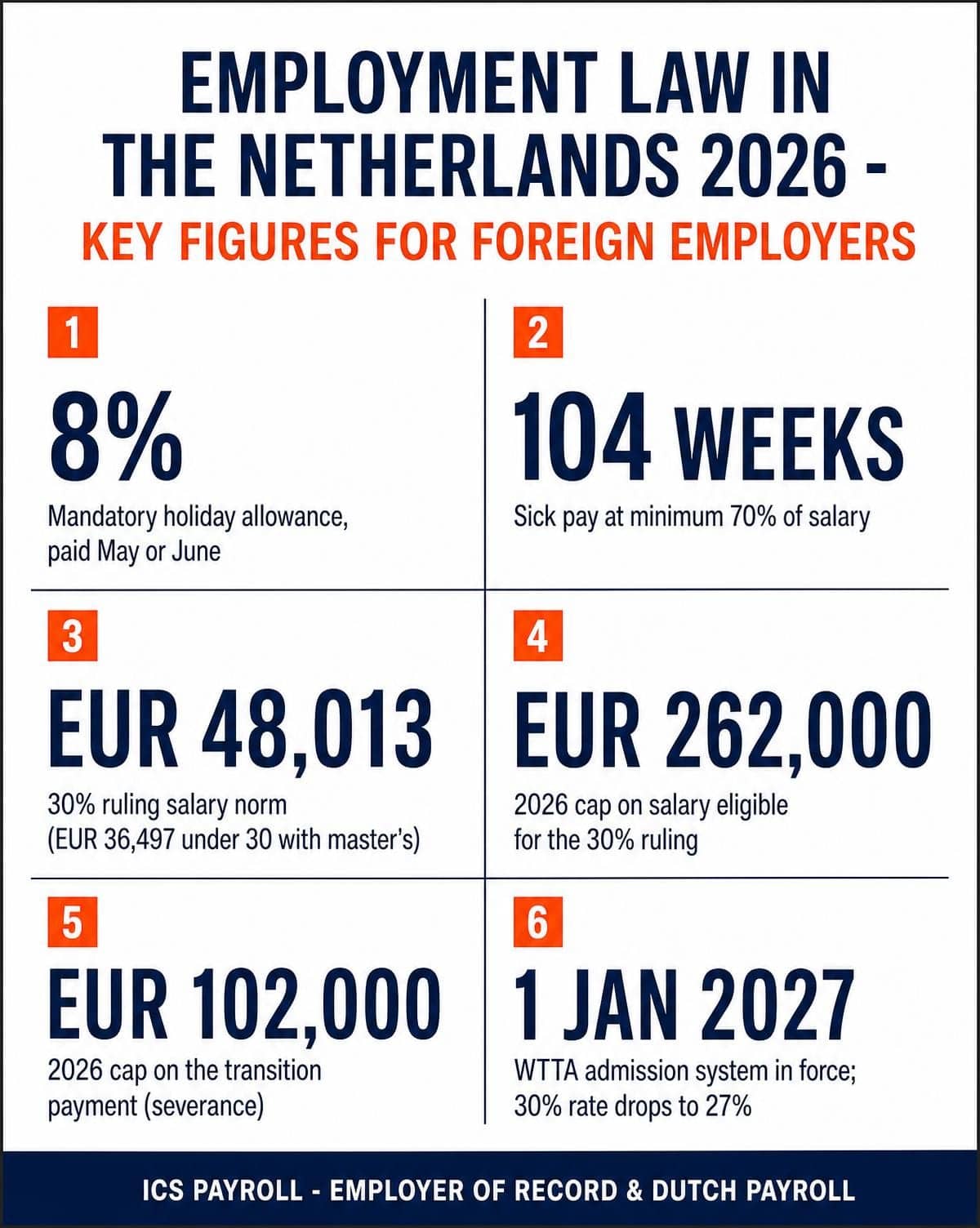
We understand that these administrative burdens can overshadow your expansion goals. This 2026 compliance guide provides the professional clarity you need to hire securely and cost-effectively. You'll learn how to leverage the 30% ruling to attract top-tier talent while maintaining total regulatory alignment. We'll break down the mandatory 8% holiday allowance, the current €48,013 salary threshold and the new €262,000 salary cap on the ruling, and the strategic benefits of hiring through an Employer of Record to bypass the need for local entity incorporation.
Key Takeaways
- Understand the Polder Model's influence on Dutch employment relations to manage a landscape built on consensus and employee protection.
- Learn to accurately calculate mandatory costs, including the 8% holiday allowance and the financial commitment required for the two-year sick pay rule.
- Identify eligibility for the 30% ruling, including the 2026 salary cap of €262,000, so it's easier to attract specialized international talent with tax-efficient compensation packages.
- Mitigate permanent establishment risks and bypass entity incorporation by leveraging employment law Netherlands for foreign employers through an Employer of Record.
- Prepare now for upcoming legislative changes, the WTTA admission system taking effect on 1 January 2027 and the pending non-compete reform bill, so your hiring process stays ahead of the curve.
Understanding the Dutch Labor Market: A Pro-Employee Landscape
The Dutch labor market operates on the "Polder Model," a philosophy centered on consensus between the government, employers, and labor unions. While this approach ensures long-term industrial stability, it creates a regulatory environment that is significantly more protective of workers than many foreign jurisdictions. Mastering employment law Netherlands for foreign employers means accepting that the legal system is designed to safeguard the employee's position. This protectionist stance is reflected in everything from stringent dismissal procedures to the mandatory 104-week sick pay obligation.
The landscape also continues to evolve. The Dutch Temporary Employment Reform (WTTA), adopted by the Senate in November 2025, introduces a mandatory admission (permit) system for staffing agencies and other labor providers. The system enters into force on 1 January 2027, with full enforcement by the Labour Inspectorate starting on 1 January 2028, which makes 2026 the preparation year. Providers are advised to secure SNA certification and use the pre-registration window at the end of 2026, and companies that hire in agency workers will only be allowed to work with admitted providers once the obligation applies. Foreign entities must recognize that compliance isn't a one-time setup but an ongoing operational requirement in this sophisticated market. Adhering to these standards is essential to avoid the heavy fines associated with non-compliance.
The Hierarchy of Dutch Employment Rules
Dutch employment regulations follow a strict hierarchy. Statutory law provides the foundational rights, but these are frequently superseded by Collective Labor Agreements (CAOs). These agreements are negotiated at an industry or company level and often contain more generous benefits than the legal minimums. If a CAO is declared "universally binding" for your sector, you must follow its terms even if you weren't a party to the negotiations. Individual employment contracts sit at the bottom of this hierarchy; they can only deviate from the CAO or statutory law if the change benefits the employee. The Labor Market in Balance Act (WAB) serves as the primary legislative framework that makes flexible labor more expensive and regulated to encourage the use of permanent employment contracts. Note that temporary agency workers are already entitled to the hirer's remuneration (equal pay with the hirer's own comparable staff) under existing rules; the WTTA will add active verification of this obligation as part of the admission process.
Common Surprises for Foreign HR Managers
International HR teams often encounter friction with the "Chain Rule," known locally as the Ketenregeling. This rule permits a maximum of three consecutive fixed-term contracts within a three-year period. Once this limit is reached, the contract automatically converts into a permanent arrangement. Another mandatory requirement is the 8% holiday allowance. This is a statutory payment calculated over the employee's gross wage, including overtime pay, and the statutory default is payout in June, although paying in May is common market practice and permitted by agreement. Standard working hours generally total 36 to 40 hours per week. While an "overtime culture" exists in some sectors, it's often compensated with time-off-in-lieu rather than simple cash payments.
Foreign employers should also monitor the pending reform of non-compete clauses. The government sent the Modernization of the Non-Compete Clause bill to the Council of State for advice in June 2026, with the aim of submitting it to Parliament at the end of 2026. The draft caps non-competes at twelve months, requires a written justification of compelling business interests and a defined geographic scope, and obliges the employer to pay the departing employee a monthly compensation of 50% of the last-earned salary for each month the clause is invoked. Until the bill is adopted and enters into force, the current rules remain fully applicable, but contracts drafted today should anticipate the new regime.
Mandatory Benefits and the Two-Year Sick Pay Obligation
In the Netherlands, compensation goes beyond the monthly base salary. The most prominent addition is the mandatory 8% holiday allowance (vakantiegeld). Employers calculate this over the gross salary earned in the reference year, typically running from June of the previous year through May of the current year, and pay it as a lump sum in May or June. While some high-income contracts allow for an "all-in" arrangement, most standard agreements require it as a separate line item. Beyond salary, employers contribute roughly 18% to 27% in social security premiums and related charges, covering unemployment, disability, and healthcare contributions; the exact percentage depends on the sector and contract type.
The most significant financial risk within employment law Netherlands for foreign employers is the two-year sick pay obligation. If an employee falls ill, you're legally required to pay at least 70% of their salary for 104 weeks. If that 70% falls below the statutory minimum wage, you must top it up to the minimum level during the first year. For reference, the statutory minimum wage is €14.99 gross per hour as of 1 July 2026 (up from €14.71 in the first half of the year), and it is indexed every 1 January and 1 July. Many Dutch employers choose to pay 100% in the first year to remain competitive. This obligation remains even if the illness is unrelated to work, making specialized "sick-pay insurance" a critical tool for risk mitigation.
Managing Long-Term Illness Compliance
Compliance during illness is governed by the Wet Verbetering Poortwachter (Gatekeeper Act). This legislation requires a proactive approach to reintegration. You must partner with a certified Arbodienst (Occupational Health Service) to monitor the employee's progress. The process follows a strict timeline: a problem analysis at week six, an action plan at week eight, and periodic evaluations. If the employee can't return to their original role, you must seek "internal placement" in a different position. If that's impossible, "external placement" with another employer becomes mandatory. Failure to document these steps can result in the UWV imposing a third year of mandatory wage payments. Utilizing a Dutch payroll administration partner ensures these administrative milestones are managed accurately.
Statutory Leave Entitlements in 2026
The statutory minimum for paid vacation is four times the number of weekly working hours. For a full-time employee, this is 20 days per year. However, the Dutch market standard is 25 days. Beyond vacation, the Netherlands has expanded its parental leave policies. Parents are entitled to nine weeks of partially paid leave during the child's first year, with the UWV compensating 70% of the daily wage up to the statutory cap. Partners also receive one week of fully paid leave and five weeks of additional leave at 70% pay. Employers must also account for emergency leave and short-term care leave, which provide necessary flexibility for employees facing urgent family matters.
The 30% Ruling: A Strategic Advantage for Foreign Employers
The 30% ruling (officially now called the expat scheme) remains the most effective recruitment tool within employment law Netherlands for foreign employers. This tax facility allows you to provide a tax-free allowance of up to 30% of an employee's gross salary to cover extraterritorial costs. For specialized roles, particularly in technology and engineering, this incentive often bridges the gap between a standard Dutch salary and the expectations of global talent.
Two important 2026 changes apply. First, the salary eligible for the ruling is now capped at €262,000 per year (the WNT or "Balkenende" norm), which limits the maximum tax-free allowance to €78,600 for a full year; income above the cap is fully taxed. Second, this is the last year of the flat 30% rate for newer entrants: for employees whose ruling started on or after 1 January 2024, the rate drops to 27% from 1 January 2027, and the minimum salary thresholds will rise sharply at the same time. Employees who already held the ruling before 2024 are grandfathered at 30% under the old salary criteria (indexed annually). If you're hiring in late 2026, factor the 2027 changes into your compensation planning from day one.
Eligibility depends on the "150km rule." To qualify, the employee must have lived more than 150 kilometers from the Dutch border for at least 16 out of the 24 months preceding their first day of work. This rule effectively excludes residents of Belgium and large portions of Germany and Luxembourg. Beyond geography, the employee must possess specific expertise that is scarce in the Dutch labor market. While the Belastingdienst (Dutch Tax Office) generally assumes scarcity if the salary thresholds are met, the employer must still submit a formal joint application to secure the benefit.
Securing this ruling isn't automatic; it requires meticulous administrative execution. The employer is responsible for initiating the application within four months of the employee's start date to ensure full retroactivity. If the application is filed late, the ruling only applies from the first day of the month following the application month. This delay can result in thousands of Euros in lost tax benefits for the employee, potentially damaging the employment relationship before it has fully matured.
Salary Requirements for 2026
To qualify for the 30% ruling in 2026, the employee's taxable salary must meet specific annual thresholds. For most professionals, the minimum taxable salary is €48,013. A reduced threshold of €36,497 applies to employees under the age of 30 who hold a qualifying Master's degree. These figures are the taxable amounts after the 30% deduction has been applied. Scientific researchers at designated institutions and doctors in specialist training are exempt from the salary minimum. Note that the previous option of partial non-resident taxpayer status (for Box 2 and Box 3) has been abolished for new cases: it is no longer available to employees granted the ruling from 2024 onward, and only employees who already held the ruling in 2023 retain it under transitional rules through 31 December 2026. New hires with foreign savings and investments should plan for full Dutch resident taxation on those assets.
Administrative Execution of the Ruling
Once approved, the ruling must be processed through the monthly payroll as a tax-free reimbursement. This impacts more than just the net take-home pay. Since the taxable base is lower, social security contributions and pension accrual are also calculated on the reduced amount. This can lead to lower future benefits, a detail that must be clearly communicated to the employee during the onboarding phase. Managing these nuances for remote or hybrid teams requires precision to ensure the "work performed" aligns with Dutch tax jurisdiction. ICSPayroll handles the entire 30% ruling application process, from initial eligibility screening to the final submission to the Tax Office, ensuring your international hires receive their benefits without administrative delays.
Dismissal Law and Permanent Establishment Risks
Dutch labor law operates on the principle of "preventive dismissal testing." Unlike at-will jurisdictions, an employer cannot unilaterally terminate a contract without a valid legal ground and prior approval from a government body. This is a fundamental pillar of employment law Netherlands for foreign employers. Depending on the reason for dismissal, you must either apply to the Employee Insurance Agency (UWV) for economic redundancies or petition the District Court for performance or behavioral issues. Termination without these approvals is generally considered void unless the employee agrees in writing.
Every employee is entitled to a statutory severance, known as the transition payment (Transitievergoeding), from their first day of employment. In 2026, this payment is capped at €102,000 gross, or one year's gross salary if that amount is higher. This obligation applies even if the employee is dismissed during their probationary period or if a fixed-term contract is not renewed. Understanding these exit costs is essential for accurate financial forecasting when building a Dutch team.
Compliant Termination Procedures
To avoid lengthy court battles or UWV applications, most employers opt for a Settlement Agreement (VSO). This allows for termination by mutual consent, where the employee waives their right to contest the dismissal in exchange for a negotiated severance and a notice period. If you choose to dismiss based on underperformance, you must provide a comprehensive "dossier" proving that you offered the employee a fair chance to improve through a formal Performance Improvement Plan (PIP). For redundancies, the "Reflection Principle" (afspiegelingsbeginsel) must be applied to ensure the selection process follows a strict age-based and seniority-based logic rather than personal preference.
Mitigating Corporate Tax and Legal Risks
A frequent oversight for remote-first companies is the "Permanent Establishment" (PE) risk. Hiring a Dutch employee who performs core business activities or holds the authority to sign contracts can inadvertently create a local tax nexus. This triggers Dutch corporate tax obligations on a portion of your company's global profits. Additionally, the "Right to Work" check is a mandatory administrative step that cannot be delegated lightly. Since February 2025, the Labour Inspectorate applies differentiated fines for illegal employment of non-EU workers ranging from €2,250 to €11,250 per worker, with a standard base fine of €6,000 per illegally employed person and the top of the range reserved for deliberate or aggravated violations. Utilizing a local Employer of Record (EOR) acts as a legal firewall. The EOR becomes the official employer on paper, which substantially reduces PE exposure while ensuring all local labor permits and "Right to Work" checks are strictly verified and maintained.
Hiring Without an Entity: The Employer of Record Solution
Establishing a local entity, such as a Dutch BV, is the traditional path for international expansion, but it's often inefficient for companies hiring a small or remote team. The administrative overhead of a BV involves notary fees, Chamber of Commerce registration, and the requirement for a local director. An Employer of Record (EOR) provides a faster, more flexible alternative. It allows you to delegate the legal complexities of employment law Netherlands for foreign employers to a local specialist while you maintain direct management of your team's daily activities. This model transforms a complex legal hurdle into a simple monthly service.
The EOR assumes all statutory responsibilities on your behalf. This includes calculating and filing payroll taxes, managing social security contributions, and securing mandatory insurances. The onboarding process is streamlined to ensure zero downtime. Once a service agreement is signed, the EOR issues a Dutch-compliant employment contract to the worker. Within days, the employee is registered with the tax authorities and ready to start. This eliminates the need for the foreign company to open a Dutch bank account or navigate the local tax system independently, providing immediate peace of mind. Bear in mind that from 1 January 2027, any party providing workers under the WTTA admission system, including EOR and staffing providers, must be admitted by the new Dutch Labour Market Authority (NAU), so choosing a provider that is preparing its admission during 2026 is a genuine due-diligence point.
The Operational Benefits of Local EOR
Speed is the most significant advantage of the EOR model. While entity incorporation can take months, an EOR allows you to hire in the Netherlands in less than a week. You avoid the high costs of local legal counsel and the ongoing burden of Dutch corporate tax filings. Because the EOR is the official employer, they handle the "Right to Work" checks and wage tax filings with clinical precision. This setup provides a secure bridge for foreign entities to enter the market without immediate long-term capital commitments or unnecessary permanent establishment exposure.
Why ICSPayroll is Your Compliance Partner
Many global EOR providers treat the Netherlands as just one of many regions in a vast portfolio. ICSPayroll maintains an exclusive focus on the Dutch market. This specialization ensures that our clients receive direct access to experts who understand the deep nuances of the 30% ruling and the complexities of the Gatekeeper Act. We pride ourselves on a human-centric approach; you'll speak with a dedicated professional rather than an automated ticketing system. Our transparent, no-nonsense communication style removes the guesswork from Dutch labor regulations and ensures your payroll is managed with clinical precision. Secure your Dutch compliance with ICSPayroll today.
Secure Your Dutch Expansion Strategy
Success in the Dutch market depends on more than just talent acquisition. It requires a precise understanding of the 104-week sick pay obligation and the strategic application of the 30% ruling, including the new 2026 salary cap and the changes arriving in 2027. Navigating employment law Netherlands for foreign employers is a technical challenge that demands local expertise to avoid permanent establishment risks and administrative fines. By prioritizing compliance from day one, you transform these rigid regulations into a competitive advantage for your international team. You'll ensure long-term stability for your workers and financial security for your organization.
ICSPayroll serves as your dedicated bridge to the Dutch market. We remove the burden of local entity incorporation while providing expert oversight of payroll taxes and the 30% ruling application. Our human-led support ensures you have direct access to local experts who fully grasp the 2026 regulatory landscape and the changes already legislated for 2027 and 2028. You can focus on scaling your operations while we handle the meticulous administrative details that keep your business protected. Schedule a compliance consultation with ICSPayroll to secure a risk-free hiring process for your Netherlands-based team.
Sources and references
Every rule and figure above is traceable to the sources below: the exact statutory articles, the regulator pages that publish the amounts, the statistical datasets, and the specific court rulings that settle the point. Always check the current text for your own situation.
- Article 7:668a Dutch Civil Code, the chain rule (ketenregeling): 3 contracts, 36 months, 6-month break
- Article 7:610 Dutch Civil Code, definition of the employment contract
- Article 15 Minimum Wage Act, the 8% holiday allowance (vakantiebijslag)
- Rijksoverheid, statutory minimum hourly wage amounts per 1 January 2026
- Netherlands Labour Authority, enforcement, inspections and penalty policy
- UWV, sickness, reintegration obligations and the WIA application in week 93
- CBS, Compensation of employees and employment by economic activity (national accounts dataset 84165ENG)
- CBS StatLine, the open statistical database behind the wage and employment figures cited here
- Supreme Court 21 February 2020, ECLI:NL:HR:2020:312: application of the chain rule of art. 7:668a BW to successive fixed-term contracts
- Supreme Court 28 November 2025, ECLI:NL:HR:2025:1808: the aggregation rule for the transition payment under art. 7:673(4) BW

Article by
Joost Hubregtse
Joost Hubregtse is Director of ICS Staffing & Payroll B.V., the wholly owned subsidiary of Intercompany Solutions behind ICS Payroll. He is responsible for Employer of Record and Dutch payroll services: employment contracts, wage tax and social security filings, holiday allowance, pension, sick leave and CAO compliance, with onboarding possible within 48 hours.

Frequently Asked Questions
You can hire employees in the Netherlands without incorporating a local entity by using an Employer of Record (EOR). The EOR acts as the legal employer, managing all payroll, tax, and social security obligations on your behalf. This allows foreign companies to enter the market quickly while remaining fully compliant with employment law Netherlands for foreign employers. It's the most efficient way to secure talent without the administrative burden of setting up a Dutch BV.
The mandatory holiday allowance is 8% of the employee's gross annual wage, including structural components such as overtime pay; profit distributions and most purely discretionary bonuses fall outside the statutory calculation base. The statutory default payout is in June, though a May payout is common market practice and permitted by agreement. Employers must ensure this is clearly stated in the employment contract to avoid disputes during the annual payout period.
Beyond the gross salary, you should budget roughly 18% to 27% on top for employer social security contributions and related charges. This percentage varies depending on the specific sector and the type of contract. You must also factor in the mandatory 8% holiday allowance and any secondary benefits such as pension contributions or travel allowances. These costs cover essential insurance for unemployment, disability, and healthcare contributions.
The 30% ruling is a tax incentive for highly skilled migrants that allows you to provide a 30% tax-free allowance on their gross salary. To apply, both the employer and employee must submit a joint application to the Dutch Tax Office (Belastingdienst) within four months of the start date. In 2026, the minimum taxable salary threshold is €48,013 for most professionals, or €36,497 for those under 30 with a qualifying Master's degree, and the eligible salary is capped at €262,000 per year. From 2027, the rate drops to 27% for rulings that started in or after 2024, and the thresholds rise significantly.
The maximum probationary period is two months for an indefinite contract or a fixed-term contract of two years or longer, and one month for fixed-term contracts longer than six months but shorter than two years. Contracts with a duration of six months or less cannot legally include a probationary period. During this window, either party can terminate the employment relationship immediately without providing a specific reason or observing a notice period.
If an employee falls ill, you're legally required to pay at least 70% of their salary for up to 104 weeks. During the first year of illness, this payment must not fall below the statutory minimum wage. You must also follow the Gatekeeper Improvement Act, which mandates a strict reintegration process in partnership with an occupational health service (Arbodienst). Failure to document these reintegration efforts can lead to the UWV imposing a third year of mandatory wage payments.
Terminating a contract is more complex in the Netherlands because at-will employment doesn't exist. You generally need a valid legal ground and permission from either the UWV or a District Court, unless the employee agrees to a Settlement Agreement (VSO). Most employers choose the VSO route to avoid lengthy legal proceedings. This agreement allows both parties to part ways on mutually agreed terms, including the statutory transition payment (capped at €102,000 in 2026, or one year's salary if higher) and notice period.
An EOR acts as the legal employer of your staff, assuming all legal risks and compliance responsibilities under employment law Netherlands for foreign employers. A payroll provider only handles the administrative tasks of calculating wages and filing taxes while you remain the legal employer. For companies without a Dutch entity, an EOR is the superior choice because it reduces permanent establishment risks and removes the need for local bank accounts or directors. From 2027, verify that your provider is admitted under the WTTA system.
Related articles