Outsource Payroll in the Netherlands: A 2026 Employer’s Guide
By Joost Hubregtse, Director, ICS Staffing & Payroll
All blog posts are reviewed and fact checked by our labour law lawyer Zishan Hussain and our director. Editorial standards
In the Netherlands, a single administrative oversight in your payroll filing can trigger penalties that far outweigh the cost of an entire year's operations. It's a high-stakes environment where the Dutch Tax Authority, the Belastingdienst, maintains an uncompromising stance on precision. If you've decided to outsource payroll in the Netherlands, you're likely looking for more than just a software solution; you need a compliance shield that protects your business from local legal risks.
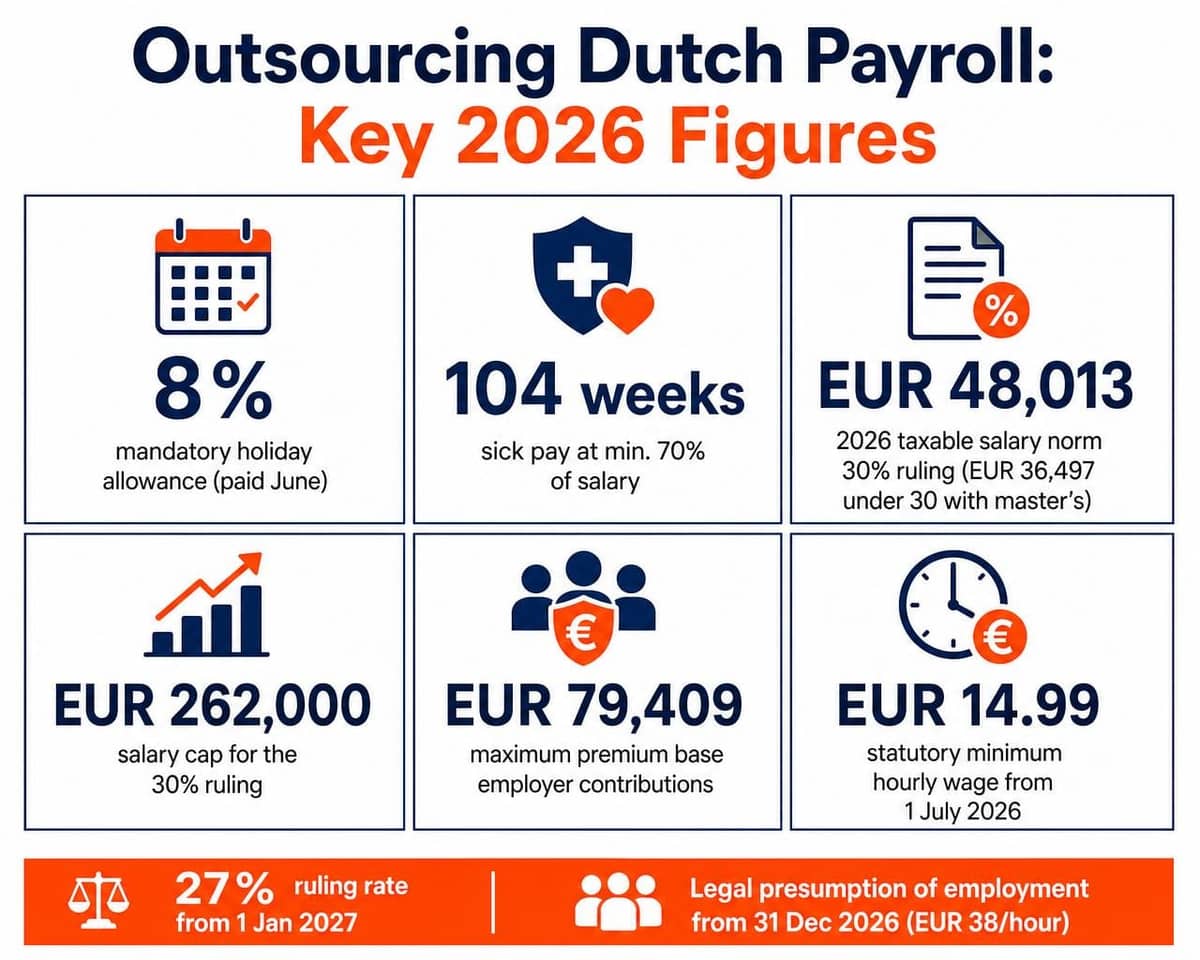
We understand that managing the nuances of the 30% ruling or calculating the mandatory 8% holiday allowance feels like a significant burden. You want to focus on your international strategy, not deciphering the €14.99 statutory minimum hourly wage or complex sick pay obligations. This guide will help you master these Dutch payroll complexities and discover how to streamline your operations with a specialized local partner. We'll examine the 2026 regulatory landscape, providing a clear roadmap to full compliance, reduced overhead, and accurate payments for your team.
Key Takeaways
- Master the rigid requirements of Dutch labor laws, including social security contributions and sector-specific pension obligations, to avoid costly Belastingdienst penalties.
- Understand how to correctly apply the 30% ruling in the 2026 fiscal year, including the taxable salary norms of €48,013 and €36,497, the €262,000 salary cap, and the rate reduction to 27% from 2027, and how to calculate the mandatory 8% holiday allowance.
- Determine whether a standard payroll bureau or a full Employer of Record (EOR) model is the most effective way to outsource your Dutch payroll operations.
- Learn the essential steps for a seamless transition, from auditing employee contract compliance to establishing direct communication with a local expert partner.
Navigating the Complexity of Dutch Payroll Compliance
The Netherlands maintains one of the most sophisticated and rigid labor markets in Europe. For international employers, payroll represents a complex intersection of tax law, social security mandates, and sector-specific pension requirements. Successfully managing these variables requires deep local knowledge that goes beyond simple salary calculations. A broader understanding of the Dutch economic landscape reveals a system designed to protect employees through extensive social safety nets, all funded by precise employer contributions. This environment leaves no room for error.
If you hire staff directly without a local legal entity or a dedicated partner, you face the risk of "Permanent Establishment." This status can lead to unexpected corporate tax liabilities and complex reporting duties. When businesses decide to outsource their Dutch payroll processes, they effectively build a defensive wall between their global strategy and local regulatory scrutiny. This approach provides a necessary buffer against the Belastingdienst and its stringent audit protocols.
The Risks of Local Non-Compliance
Incorrect wage tax filings lead to immediate financial penalties and interest charges. The Dutch authorities have sharpened their focus on employee misclassification since the enforcement moratorium under the DBA Act was lifted on 1 January 2025, allowing the Belastingdienst to resume full enforcement against bogus self-employment.
Employers should also prepare for the next step in this crackdown. The originally proposed Wet VBAR was reshaped during the parliamentary process: its "clarification" component was dropped, and the legal presumption of employment was carried forward in a standalone act, which parliament adopted in June 2026. From 31 December 2026, anyone performing work for a rate of €38 per hour or less (reference date 1 January 2026, indexed in step with the minimum wage) will be legally presumed to be an employee, shifting the burden of proof to the engaging company. Note that this presumption has civil-law effect only: it strengthens the worker's position toward the engaging party; the Belastingdienst and UWV continue to assess employment relationships under the existing statutory criteria of wages, work, and authority.
Additionally, many sectors are governed by Collective Labor Agreements (CAO). These agreements often mandate higher pay scales and more generous benefits than statutory minimums, making compliance a moving target for those without local expertise.
Why In-House Management Often Fails for Foreign Firms
Foreign firms struggle because Dutch tax regulations change annually. For instance, Box 1 income tax brackets and social security ceilings are adjusted every January. Managing this in-house requires a specialist who understands the nuances of the 35.75% first-bracket rate (applicable in 2026 to income up to €38,883) and the income-dependent phase-out of the general tax credit. Language barriers also present a significant hurdle. Most government portals and legal documents are in Dutch. Hiring a dedicated local expert is often prohibitively expensive for companies with smaller teams, making specialized outsourcing the most logical path to operational security.
Key Features of the Dutch Payroll System: What to Expect
Operating a business in the Netherlands requires an understanding of specific financial obligations that differ significantly from other European markets. The Dutch system is built on a foundation of social security and mandatory employee benefits. When you outsource your Dutch payroll, your provider must account for these variables with clinical precision to ensure both legality and employee satisfaction. Compliance is not just about avoiding fines; it's about maintaining the specialized standards embedded in Dutch payroll tax regulations.
The 30% Ruling: A Strategic Tax Advantage
The 30% ruling (officially the expat scheme) remains the most effective tool for attracting international talent to the Dutch market. It functions as a tax-free reimbursement for extraterritorial costs. For 2026, the qualifying employee's taxable salary, the portion remaining after the 30% allowance is applied, must be at least €48,013 per year, which in practice requires a gross salary of roughly €68,590 to use the full 30%. For employees under the age of 30 who hold a qualifying master's degree, the reduced taxable salary norm is €36,497 (roughly €52,139 gross). Scientific researchers at designated institutions and doctors in specialist training are exempt from the salary norm. This incentive allows employers to significantly increase an employee's net take-home pay without increasing total employment cost.
Two limits deserve attention. First, from 1 January 2026 the ruling applies only to salary up to €262,000 (the WNT norm), capping the maximum tax-free allowance at €78,600 per year; salary above the cap is taxed normally. Second, it's vital to plan for the upcoming rate change: the 30% rate applies throughout 2026, but drops to 27% from 1 January 2027 for employees who first started using the scheme on or after 1 January 2024. Employees whose ruling was already applied before 2024 retain the full 30% for the remainder of their term under transitional law. Managing these transitions requires proactive administrative updates. If you are hiring international staff, our team can streamline the process by managing your 30% ruling application directly.
Statutory Benefits and Dutch Labor Standards
Beyond the base salary, several statutory benefits are non-negotiable. The 8% holiday allowance (vakantiegeld) is a mandatory minimum calculated over the employee's gross wages. By statutory default it is paid out annually in June, covering the accrual year running from June to June, although employers may agree a different arrangement: monthly payment or a May payout are both common in practice.
Sick pay obligations are notably extensive. Employers are legally required to pay at least 70% of an employee's salary for up to 104 weeks of illness, and during the first 52 weeks the payment may not fall below the statutory minimum wage. In practice, many Collective Labor Agreements mandate 100% payment during the first year.
Pension requirements add another layer of complexity. The Netherlands has no universal statutory occupational pension; participation is mandatory only where a compulsory sector pension fund or CAO applies, which covers a large share of the Dutch workforce. Where a scheme applies, combined contributions commonly run in the range of 12% to 18% of pensionable salary, calculated under the scheme's own rules and its own fiscal salary ceiling.
Separately, you must account for mandatory employee insurance contributions for unemployment and occupational disability, plus the employer healthcare levy. These employer premiums are calculated over wages up to the maximum premium base of €79,409 for the 2026 fiscal year, a cap that applies to the employee insurance schemes and the healthcare levy, not to pension contributions. Ensuring these figures are calculated correctly is the primary reason businesses move away from in-house management toward specialized local experts.
Choosing Your Model: Payroll Service vs. Employer of Record (EOR)
Deciding how to outsource your Dutch payroll depends entirely on your current legal footprint. You must choose between a standard payroll administration service and a full Employer of Record (EOR) model. While both handle the mechanical aspects of salary distribution, they differ fundamentally in terms of legal liability and corporate structure requirements. This choice defines your relationship with the Dutch authorities and your speed of execution.
The EOR model serves as a comprehensive solution for companies without a Dutch legal entity. In this arrangement, the provider acts as the legal employer. They assume the day-to-day obligations under labor law, social security, and wage tax compliance. This model is particularly effective for businesses testing the Dutch market or hiring a small team of remote experts. It eliminates the need for a local BV, saving months of administrative effort and significant incorporation costs.
The EOR Advantage for International Expansion
Speed to market is the defining benefit of the EOR model. You can onboard employees in a matter of days rather than waiting for the completion of corporate registration. The EOR manages the entire employee lifecycle, from drafting compliant contracts to handling mandatory insurance. They also ensure operations meet the Waadi registration requirements that apply to supplying personnel, and account for any applicable sector rules, such as the mandatory pension fund for the staffing sector. This approach allows your HR team to focus on talent management while the local expert handles the bureaucratic execution and legal shielding.
Standard Payroll Administration for Established BVs
If you have already established a Dutch BV, you require a specialized payroll administration partner. This model focuses on the precise execution of monthly filings and tax statements. Your partner ensures that every loonaangifte (wage tax return) is filed and paid by the last day of the month following the wage period. They also manage the complexities of sector-specific Collective Labor Agreements, which often dictate specific pension contributions and overtime rates. This service integrates with your existing accounting software to provide a seamless flow of financial data and reporting.
The choice involves a strategic cost-benefit analysis. Establishing a local entity requires upfront investment in legal fees, tax advice, and ongoing corporate compliance. An EOR carries a service fee but removes these overheads entirely. For many international firms, outsourcing Dutch payroll through an EOR is the preferred vehicle for market entry because it provides immediate protection against local labor risks and the ability to scale without corporate restructuring.
How to Transition to a Dutch Payroll Partner
Moving your administrative burden to a local expert is a strategic shift that requires clinical precision. It is not just about moving spreadsheets. You are aligning your business with the Belastingdienst's rigid reporting cycle. When you outsource your Dutch payroll operations, the transition period is the most critical phase for long-term compliance. A structured approach ensures that no data is lost and no deadlines are missed.
The initial phase involves a comprehensive audit of current employee data and contract compliance. You must verify that every employment agreement aligns with Dutch labor standards and any applicable Collective Labor Agreement. This is the time to confirm the 30% ruling status for international staff and ensure personnel files are complete. Once the data is verified, you must establish a clear communication flow between your HR team and the local provider. This prevents delays when processing monthly changes such as sick leave, new hires, or bonus payments.
A successful transition relies on a fixed payroll calendar. This schedule must account for the loonaangifte deadline, which falls on the last day of the month following the wage period. Before the final go-live, execute a "shadow run": a parallel payroll execution where the new provider calculates a previous month's data to ensure their results match your historical records exactly. This step confirms that social security contributions and holiday allowance accruals are calculated with full accuracy.
Data Migration and GDPR Security Standards
Security is a non-negotiable priority during data migration. All sensitive employee information must be transferred via encrypted channels to meet EU and Dutch GDPR standards. Your provider must also demonstrate a robust system for record retention. Dutch law requires core payroll and administrative records to be kept for 7 years, while certain employee documents, such as payroll tax statements and copies of identity documents, must be retained for 5 years after the end of employment. Accurate historical data is your primary defense during a retrospective tax audit.
Setting Up Monthly Filing and Payment Cycles
Coordinating the loonheffingen (wage tax) cycle is the final step. Your partner will manage the flow of net salary payments to employees while ensuring the tax authority receives the correct amounts on time. This process also includes managing local travel allowances, such as the tax-free kilometer reimbursement, and expense claims. Transitioning to a local expert allows you to hand over the mechanical execution of Dutch payroll with confidence. Contact us today to start your transition to a compliant Dutch payroll model.
Strategic Payroll Management with ICSPayroll
Managing a Dutch workforce requires a level of specialized focus that generic global platforms often fail to provide. While automated systems handle basic calculations, they frequently lack the nuance required for the Belastingdienst's specific reporting demands. ICSPayroll provides the localized expertise necessary to act as the bridge between your international strategy and local execution. Our model prioritizes direct, human-led interaction, ensuring that your business receives precise advice based on current 2026 regulations rather than automated responses.
We act as a protective guardian for your Dutch operations. Our team manages the entire payroll lifecycle with clinical precision, from calculating the mandatory 8% holiday allowance to processing 30% ruling applications. By securing these specific tax advantages, we help you maximize employee retention and maintain a competitive edge in the local market. When you outsource your Dutch payroll operations to a dedicated local expert, you eliminate the administrative friction that often stalls international growth.
Local Expertise for International Growth
ICSPayroll serves as your boots on the ground for Dutch compliance. We provide international CFOs with transparent reporting and clear process visibility, which is essential for financial planning. This transparency is vital when transitioning international teams to the Dutch market for the first time. We've successfully managed numerous transitions, ensuring that each employee is integrated into the system without delay. Our dedicated account managers provide the continuity and accountability that large, faceless outsourcing firms simply cannot match.
Streamlined Compliance for Remote Teams
Managing a distributed workforce in the Netherlands requires constant attention to shifting labor standards. Every contract must align with the 2026 statutory requirements, including the minimum hourly wage of €14.99 that applies from 1 July 2026 for employees aged 21 and over (up from €14.71 in the first half of the year, with youth rates adjusted proportionally and the next indexation due on 1 January 2027). ICSPayroll ensures your staff are paid accurately and on time, regardless of where they're located. We handle the technical integration of local travel allowances and expense reimbursements, ensuring every payment is compliant with Dutch tax law.
Maintaining a secure and compliant presence in the Netherlands doesn't have to be an administrative burden. Our specialized focus provides the reliability your business needs to thrive in a complex regulatory environment. Optimize your Dutch payroll with ICSPayroll today to secure your operational future and provide your employees with the peace of mind they deserve.
Secure Your Dutch Operational Future
Mastering Dutch payroll requires more than administrative diligence; it demands a proactive approach to evolving labor laws, from the mandatory 8% holiday allowance to the legal presumption of employment taking effect on 31 December 2026. Accuracy is your primary defense against regulatory friction. By outsourcing your Dutch payroll operations, you secure a stabilized foundation for international growth while protecting your business from the complexities of the Belastingdienst.
ICSPayroll acts as your local expert and protective guardian in this high-stakes environment. Our team provides specialized EOR and payroll services designed to mitigate risk and remove administrative burdens. As 30% ruling application experts, we ensure your talent remains satisfied and your filings remain beyond reproach. We provide the human-led support that global, automated platforms simply cannot replicate.
Get a compliant Dutch payroll solution from ICSPayroll today. We look forward to helping you establish a seamless, professional presence in the Dutch market.
Sources and references
Every rule and figure above is traceable to the sources below: the exact statutory articles, the regulator pages that publish the amounts, the statistical datasets, and the specific court rulings that settle the point. Always check the current text for your own situation.
- Article 7:692 Dutch Civil Code, the statutory definition of payrolling
- Article 7:690 Dutch Civil Code, the agency work (uitzend) contract
- Article 8 Waadi, equal pay for hired-in workers (loonverhoudingsnorm)
- Stichting Normering Arbeid, the NEN 4400-1 register of audited payroll and staffing companies
- Belastingdienst, low and high AWf unemployment contribution rates and when each applies
- Netherlands Labour Authority, enforcement, inspections and penalty policy
- CBS, Compensation of employees and employment by economic activity (national accounts dataset 84165ENG)
- Eurostat, hourly labour cost levels by NACE activity (dataset lc_lci_lev), for cross-country comparison
- Supreme Court 11 April 2025, ECLI:NL:HR:2025:543: the agency work contract of art. 7:690 BW in a triangular platform-work relationship
- Supreme Court 21 November 2025, ECLI:NL:HR:2025:1733: misuse of successive agency contracts under art. 5(5) Directive 2008/104/EC and the Waadi

Frequently Asked Questions
The 30% ruling is a tax incentive that allows employers to provide up to 30% of a qualifying employee's salary as a tax-free allowance for extraterritorial costs. For the 2026 fiscal year, the employee's taxable salary after applying the allowance must be at least €48,013, or €36,497 for employees under 30 with a qualifying master's degree, in gross terms roughly €68,590 and €52,139 respectively. The allowance applies to salary up to €262,000, and the rate falls to 27% from 2027 for employees who first used the scheme in 2024 or later. The application is submitted jointly by employer and employee to the Belastingdienst, ideally within four months of the first working day, and our team manages the entire filing process to ensure all criteria are met.
You don't strictly need a Dutch bank account if you partner with a local provider that manages payments through their own SEPA-compliant infrastructure. SEPA accounts from other EU countries are legally accepted, but using a local partner simplifies the distribution of net salaries and tax payments. This approach ensures your business remains compliant without the administrative burden of opening a local legal entity.
Employers contribute to several funds, including the General Unemployment Fund (AWf) at 2.74% for qualifying permanent contracts (7.74% for flexible contracts) and the employer healthcare levy (Zvw) at 6.10%. The disability fund (Aof) premium is differentiated: 6.27% for smaller employers and 7.63% for larger employers, plus the individually set Whk premium and a 0.50% childcare surcharge. These employer contributions are calculated over wages up to the maximum premium base of €79,409 for 2026.
Dutch law requires employers to pay at least 70% of an employee's salary for up to 104 weeks during illness, and in the first 52 weeks the payment may not drop below the statutory minimum wage. In many industries, Collective Labor Agreements mandate 100% payment during the first year. When you outsource your Dutch payroll, your provider manages the necessary reporting to the occupational health service (arbodienst) and ensures all payments align with these statutory requirements.
Yes, hiring through an Employer of Record is the most efficient way to employ staff in the Netherlands without establishing a local legal entity. The EOR acts as the legal employer, assuming the administrative duties and employment-law obligations associated with Dutch labor law, including Waadi registration where personnel are supplied. This model allows you to outsource Dutch payroll management entirely while maintaining a compliant and professional presence in the market.
The 13th-month salary is not a statutory requirement in the Netherlands. It is a discretionary benefit often included in individual employment contracts or specific Collective Labor Agreements. When applicable, it is typically equivalent to one month's gross salary and is paid in December. Employers use this benefit as a strategic tool for talent retention and competitive compensation packages.
Onboarding a new hire typically takes between 1 to 3 business days once the underlying payroll infrastructure is established. If you are setting up an EOR arrangement for the first time, the initial implementation usually takes 1 to 2 weeks. This timeline includes drafting compliant contracts, verifying employee data, and ensuring all tax registrations are active with the Dutch authorities.
Non-compliance results in immediate financial penalties, including fines for late loonaangifte filings and interest charges on unpaid wage taxes. Since the DBA enforcement moratorium was lifted on 1 January 2025, the Belastingdienst also actively audits for bogus self-employment and can impose retroactive assessments. From 31 December 2026, the new legal presumption of employment for workers paid €38 per hour or less further raises the misclassification risk in civil proceedings. Incorrect classification can lead to retrospective wage tax and social security claims and significant legal costs, making local expertise a vital safeguard for your business.
Related articles