
Dutch Employment Compliance: The 2026 Employer Guide to Labor Law and Payroll
By Joost Hubregtse, Director, ICS Staffing & Payroll
All blog posts are reviewed and fact checked by our labour law lawyer Zishan Hussain and our director. Editorial standards
By Joost Hubregtse, Payroll Director
Expert in Dutch labor law and international payroll compliance.
Reviewed by Joost Hubregtse on September 12, 2026
The Dutch Tax Administration conducted over 800 company visits last year to investigate worker misclassification, leading to 237 immediate book audits. For international firms, maintaining dutch employment compliance in 2026 is a high stakes necessity to avoid serious fault penalties under the Wet DBA. You likely feel the pressure of shifting 30% ruling thresholds and the impending VBAR legislation that could reclassify your flexible workforce overnight. It's a technical precision game where local expertise is the only way to ensure security.
Managing payroll and labor law in the Netherlands often feels like tracking a moving target of statutory updates. This guide provides a clear roadmap to mastering these complexities, ensuring your team remains protected without the need to incorporate a Dutch BV. We will detail the exact 2026 costs, including the €14.99 statutory minimum hourly wage and the €48,013 salary threshold for the 30% ruling. You'll also learn how to manage the January 1 enforcement of Wet DBA penalties and arrange IND sponsorship through licensed partners for total legal protection.
Key Takeaways
- Identify mandatory labor costs for 2026, including the 8% holiday allowance and the statutory minimum hourly wage increase to EUR 14.99.
- Master the 30% ruling requirements for international staff, specifically the standard 2026 salary threshold of EUR 48,013.
- Mitigate financial risks by maintaining strict dutch employment compliance regarding Wet DBA enforcement and the upcoming VBAR legislation.
- Understand your legal obligations under the Wet Verbetering Poortwachter to manage long term sickness and reintegration costs effectively.
- Streamline your expansion by using a consolidated payroll model that arranges IND sponsorship via licensed partners without the need for a local BV.
Core Statutory Requirements for Dutch Employment in 2026
Establishing a workforce in the Netherlands requires a precise understanding of the Dutch Civil Law System. This legal framework is heavily weighted toward employee protection and leaves little room for administrative error. Maintaining dutch employment compliance begins with mastering the mandatory financial benchmarks and contract structures that define the 2026 labor market. Failure to adhere to these standards can result in significant backdated claims and oversight from the Netherlands Labour Authority.
Minimum Wage and Holiday Allowance Standards
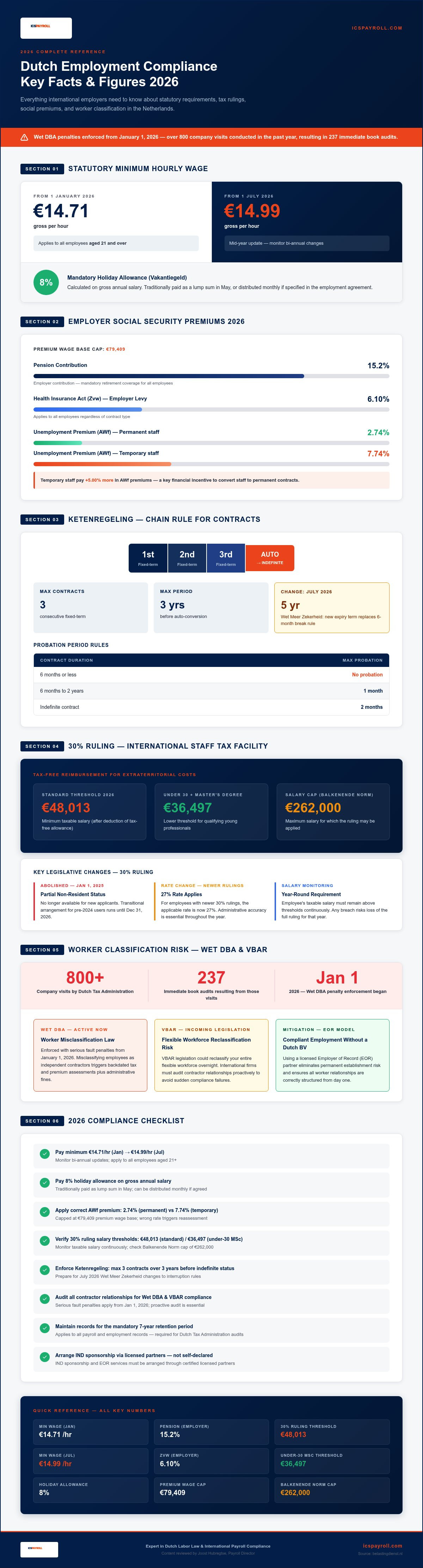
The Dutch government enforces a strict statutory minimum hourly wage that applies to all employees aged 21 and over. On January 1, 2026, this rate is €14.71 gross per hour. This figure increases to €14.99 gross per hour on July 1, 2026. Employers must monitor these bi-annual updates to ensure all payroll runs remain legal. In addition to the base salary, every employee is entitled to a mandatory 8% holiday allowance. This is calculated on the gross annual salary and is traditionally paid in a lump sum in May, though it can be distributed monthly if specified in the employment agreement. For exact withholding requirements and updated brackets, employers should consult the official wage tax tables at belastingdienst.nl.
The Chain Rule and Contract Limitations
The "Ketenregeling" or chain rule dictates the transition from flexible to permanent employment. Under current law, an employer can provide a maximum of three consecutive fixed term contracts over a period of three years. If the fourth contract is signed or the three year threshold is crossed, the contract automatically becomes indefinite. It's vital to note that the "Wet Meer Zekerheid Flexwerkers" is expected to introduce stricter limits in July 2026. This legislation aims to replace the current six month interruption period with a five year administrative expiry term to prevent the perpetual use of temporary staff. Probation periods also follow rigid rules. You cannot include a probation period for contracts of six months or less. For contracts between six months and two years, the limit is one month; for indefinite contracts, it is two months.
Pension and Social Security Premiums
Total labor costs in 2026 include mandatory pension contributions and social security premiums. Employers must account for a 15.2% pension contribution to ensure adequate retirement coverage for their team. Furthermore, the employer levy for the Health Insurance Act (Zvw) is set at 6.10% for 2026. Unemployment premiums (AWf) depend on the contract type: a low rate of 2.74% applies to permanent employees, while temporary staff incur a high rate of 7.74%. These percentages are capped at a maximum premium wage base of €79,409. Accurate calculation of these premiums is essential for dutch employment compliance and the prevention of costly audits.
The 30% Ruling and Tax Compliance for International Staff
The 30% ruling is a primary incentive for attracting global talent to the Netherlands. It functions as a tax free reimbursement for extraterritorial costs, allowing employers to pay out a portion of the gross salary without withholding tax. For businesses aiming for total dutch employment compliance, understanding the official 30% facility rules is mandatory. This facility isn't a static benefit; it requires precise salary monitoring and administrative accuracy to satisfy the Dutch Tax Administration.
In 2026, the standard taxable salary threshold is €48,013. For employees under age 30 with a Master's degree, the threshold is €36,497. These figures represent the taxable base after the deduction of the tax free allowance. It's also critical to observe the salary cap, known as the Balkenende Norm, which limits the application of the ruling to salaries up to €262,000. Employers must ensure that the employee's taxable salary remains above these thresholds throughout the year to maintain eligibility.
Significant legislative shifts have altered the compliance landscape for 2026. The partial non resident taxpayer status was abolished for new applicants as of January 1, 2025. For employees who utilized this status before 2024, a transitional arrangement remains in effect until December 31, 2026. Additionally, while the tax free percentage is scheduled to drop to 27% on January 1, 2027 for rulings that began after January 1, 2024, you must factor this transition into your 2026 payroll forecasting and contract negotiations.
Eligibility Criteria for Highly Skilled Migrants
To qualify, an employee must be recruited from abroad and have lived more than 150 kilometers from the Dutch border for at least 16 out of the 24 months prior to their start date. While the 30% ruling is a tax matter, it often coincides with the Highly Skilled Migrant (HSM) visa process. You can verify specific visa criteria at ind.nl. ICSPayroll assists with these applications through licensed partners to ensure a seamless onboarding experience for your international team.
Administrative Deadlines and Filing Requirements
Administrative precision is non negotiable. You must file the initial application within four months of the employee's start date to secure retroactive benefits. If you miss this window, the ruling only applies from the first day of the month following the application. Employers must also maintain Dutch payroll tax records for a minimum of seven years. This includes evidence of the employee's previous place of residence and specific salary calculations. Monthly Loonaangifte (wage tax) filings must reflect the ruling accurately to avoid penalties. If you need assistance with these complex filings, you can explore our Dutch payroll administration services.
Managing Mandatory Employee Benefits and Sickness Risk
The Dutch labor market carries substantial employer risks, particularly regarding long term illness and contract termination. Achieving total dutch employment compliance requires more than just timely salary payments. It demands a proactive approach to managing the financial liabilities associated with the Dutch social security system. Employers are legally obligated to pay at least 70% of an employee's salary during sickness for a period of 104 weeks. If this 70% falls below the statutory minimum wage, the employer must top up the payment to 100% of the minimum wage during the first year of illness.
Beyond salary continuation, the Wet Verbetering Poortwachter imposes strict reintegration duties. This legislation requires a structured collaboration between the employer, the employee, and a certified occupational health service. You must maintain a detailed reintegration file and follow a specific timeline of evaluations to avoid wage sanctions from the UWV. When a contract ends, you must also factor in the "transitievergoeding" or statutory transition allowance. In 2026, this payment is capped at €102,000 gross, or one gross annual salary if the employee earns more than this amount.
Sickness Pay and Reintegration Duties
Managing the first 104 weeks of illness is a critical administrative task. You must engage an Arbodienst (occupational health service) to monitor the employee's health and provide professional advice on their ability to return to work. For small to medium foreign enterprises, these obligations represent a significant financial and operational risk. Many businesses mitigate this by taking out "verzuimverzekering" or sick leave insurance, which covers the salary costs and provides support for the mandatory reintegration steps. It's a stabilizing force that protects your cash flow from the unpredictability of employee health issues.
Pension Schemes and Social Security Premiums
A compliant Dutch benefits package must include a pension scheme, with 15.2% of the gross salary serving as the standard industry benchmark. In addition to pension costs, employers are responsible for various social security premiums. For 2026, the employer levy for the Health Insurance Act (Zvw) is 6.10%. You must also account for the Aof (Disability Fund) premium, which is 6.27% for small employers and 7.63% for large entities. The AWf (General Unemployment Fund) premium remains bifurcated: a low rate of 2.74% applies to permanent contracts, while a high rate of 7.74% is mandatory for temporary agreements. For more information on your corporate obligations, you can consult the official resources for business registration and social duties. These premiums are capped at a maximum wage base of €79,409 for the 2026 tax year, ensuring that your dutch employment compliance strategy remains technically accurate and financially predictable.
Avoiding Permanent Establishment and Worker Classification Risks
Foreign entities entering the Netherlands face two primary legal hurdles: Permanent Establishment (PE) risk and worker misclassification. PE occurs when a company's activities in the Netherlands are significant enough to trigger corporate tax obligations, even without a local subsidiary. Hiring a senior manager or a sales team directly can create this tax nexus. To maintain dutch employment compliance, firms must decide between incorporating a Dutch BV or utilizing an Employer of Record (EOR) to isolate these liabilities. Choosing the wrong path can lead to retrospective corporate tax claims and complex legal disputes with the Dutch Tax Administration.
Wet DBA and VBAR Enforcement in 2026
The Dutch Tax Administration (Belastingdienst) has significantly increased its oversight of independent contractors. In 2025, they conducted over 800 company visits, resulting in 237 book audits. As of January 1, 2026, the authorities can impose serious fault penalties (vergrijpboetes) if they find evidence of false self employment. The Belastingdienst uses specific criteria to determine if a relationship of authority exists, such as whether the worker must follow direct instructions or is integrated into the company's hierarchy. If the worker is not truly independent, the employer is liable for unpaid social security premiums and wage taxes.
The VBAR legislation introduces a rebuttable presumption of an employment contract for workers with an hourly rate below €38. This specific rule is set to take effect on December 31, 2026. Employers should also monitor the non compete clause reforms. A proposal sent to the Council of State on June 29, 2026, suggests limiting these clauses to one year and requiring a 50% severance payment. While this is not yet enacted law, it signals a trend toward higher labor mobility. Ensuring your contracts reflect these shifting standards is a core component of dutch employment compliance.
Differentiating a Dutch BV from EOR Solutions
Setting up a Dutch BV provides full control but carries high administrative overhead and immediate tax nexus. For many international firms, the complexity of local tax filings and the risk of PE make this option less attractive. An EOR solution allows you to hire compliant staff without establishing a legal entity. This model ensures that the EOR partner handles all payroll taxes and social security contributions, effectively shielding your parent company from local tax authorities. You can read a detailed comparison in our guide on Employer of Record vs. Dutch BV.
If you are concerned about your current contractor arrangements or tax exposure, request a compliance audit from ICSPayroll to secure your Dutch operations.
Implementing a Compliant EOR Strategy with ICSPayroll
Achieving dutch employment compliance doesn't require months of legal setup or the risk of permanent establishment. ICSPayroll provides a streamlined path to hiring in the Netherlands through an Employer of Record (EOR) model. This structure allows foreign firms to engage local talent while delegating the administrative burden of tax withholding, social security contributions, and labor law adherence. Our approach focuses on transparency and speed, ensuring you can scale your team without navigating the bureaucracy of a local entity.
Central to our service is the payroll factor model. Instead of managing multiple vendors for insurance, pension, and payroll, you receive one consolidated monthly invoice. This invoice accounts for all statutory costs, including the €14.99 minimum hourly wage and the 8% holiday allowance. This model provides clear visibility into your total labor costs. It prevents the hidden fees often associated with global outsourcing firms. You can scale with confidence knowing every cent is accounted for.
Expedited Hiring and Visa Processing
For non-Schengen staff, the Highly Skilled Migrant (HSM) visa is the standard route for legal employment. ICSPayroll arranges IND sponsorship and HSM visa processing through our network of licensed partners. This collaboration allows us to secure visa approvals in a typical three week timeline. To facilitate rapid decision making, we provide tailored quotations within 24 hours of your request. This speed ensures you don't lose top tier candidates to local competitors. You can find more details on these timelines in our Employer of Record Netherlands: The 2026 Guide.
Consolidated Compliance and HR Administration
Our platform automates the complex accruals required by Dutch law. This includes the management of holiday balances and the statutory transition allowance, which is capped at €102,000 for 2026. Employees gain access to a secure online portal to view their payslips and employment contracts at any time. We also provide compliant employee handbooks that reflect current 2026 labor reforms, such as the Wet DBA and non compete standards. This human led support ensures that your dutch employment compliance strategy is both technologically advanced and legally robust. We act as your local expert, removing the administrative weight of expansion.
Ready to secure your Dutch workforce? Contact ICSPayroll today for a comprehensive compliance strategy and a quote within 24 hours.
Securing Your Dutch Expansion in 2026
Maintaining dutch employment compliance in 2026 requires meticulous attention to the bi-annual minimum wage increases and the evolving 30% ruling thresholds. You must account for the €14.99 hourly rate effective July 1 and ensure highly skilled migrants meet the €48,013 salary requirement. Beyond these figures, your strategy must mitigate the financial risks of the Wet Verbetering Poortwachter and the strict enforcement of Wet DBA contractor classification.
The Netherlands remains a premier destination for global growth, but the technical legal landscape demands a reliable local partner. ICSPayroll provides the security you need to scale without the administrative burden of setting up a local BV. We ensure full compliance with 2026 Dutch labor laws, protecting your business from the Netherlands Labour Authority and helping you manage complex pension and social security obligations with clinical precision.
Hire in the Netherlands with confidence with ICSPayroll. We provide tailored quotations within 24 hours and facilitate HSM visa processing through licensed partners in approximately three weeks. Your international team is ready to grow, and we're here to provide the stable foundation for your success.
Frequently Asked Questions
What is the standard salary threshold for the 30% ruling in 2026?
The standard gross taxable salary threshold for the 30% ruling in 2026 is €48,013 per year. For employees under the age of 30 who hold a Master's degree, the required threshold is reduced to €36,497. These figures are essential for maintaining dutch employment compliance when recruiting international talent. You can verify the latest requirements and specific salary cap information on the official 30% facility rules page.
Can I hire employees in the Netherlands without a local legal entity?
You can legally hire staff in the Netherlands without establishing a local legal entity by using an Employer of Record (EOR). ICSPayroll acts as the legal employer of your team, managing all payroll taxes, social security, and labor law obligations. This model allows you to start operations in weeks rather than months. It effectively shields your parent company from permanent establishment risks while ensuring full compliance with the Dutch Tax Administration.
What is the mandatory holiday allowance in the Netherlands?
The mandatory holiday allowance in the Netherlands is 8% of the employee's gross annual salary. This is a statutory requirement that employers typically pay as a lump sum in May. However, you can choose to distribute the allowance monthly if explicitly stated in the employment contract. This payment is separate from base salary and must be clearly itemized on the employee's payslip to meet national transparency standards for payroll administration.
How long does it take to process a Highly Skilled Migrant visa in 2026?
Processing a Highly Skilled Migrant (HSM) visa typically takes approximately three weeks when arranged through our licensed partners. This expedited timeline is available for non-Schengen staff recruited from abroad who meet the specific salary thresholds. We provide tailored quotations within 24 hours of receiving employee details to ensure your onboarding process remains efficient. Detailed criteria for these residency permits are available on the IND website.
What are the employer obligations for sick pay in the Netherlands?
Employers are legally obligated to pay at least 70% of an employee's salary during sickness for a period of 104 weeks. In the first year, this payment must not fall below the statutory minimum wage. You are also required to follow the Wet Verbetering Poortwachter, which involves structured reintegration steps and collaboration with an Arbodienst. These duties are essential for dutch employment compliance and help prevent wage sanctions from the UWV.
What is the minimum hourly wage in the Netherlands for 2026?
The statutory minimum hourly wage for employees aged 21 and over is set at €14.71 as of January 1, 2026. This rate is scheduled to increase to €14.99 on July 1, 2026. Employers must adjust their payroll systems bi-annually to remain compliant with the Minimum Wage Act. These figures apply to all sectors and are a foundational component of compliant Dutch payroll management. Official tables are available at government.nl.
What is the difference between a Dutch BV and an Employer of Record?
A Dutch BV is a private limited company that requires formal incorporation, local directors, and direct tax filings. An Employer of Record allows you to hire staff without this corporate overhead. While a BV gives you direct legal control, it also creates an immediate tax nexus in the Netherlands. The EOR model provides a faster route to market by delegating all legal employer liabilities and administrative burdens to a specialized local partner.
How many fixed-term contracts can I offer an employee in the Netherlands?
Under the "Ketenregeling" rule, you can offer a maximum of three consecutive fixed term contracts within a three year period. The fourth contract automatically becomes an indefinite agreement. This chain is only broken if there is an interruption of more than six months between contracts. It is important to note that pending legislation in 2026 may extend this interruption period to five years to provide more security for flexible workers.

Article by
Joost Hubregtse
Joost Hubregtse is Director of ICS Staffing & Payroll B.V., the wholly owned subsidiary of Intercompany Solutions behind ICS Payroll. He is responsible for Employer of Record and Dutch payroll services: employment contracts, wage tax and social security filings, holiday allowance, pension, sick leave and CAO compliance, with onboarding possible within 48 hours.
Frequently Asked Questions
The standard gross taxable salary threshold for the 30% ruling in 2026 is €48,013 per year. For employees under the age of 30 who hold a Master's degree, the required threshold is reduced to €36,497. These figures are essential for maintaining dutch employment compliance when recruiting international talent. You can verify the latest requirements and specific salary cap information on the official 30% facility rules page.
You can legally hire staff in the Netherlands without establishing a local legal entity by using an Employer of Record (EOR). ICSPayroll acts as the legal employer of your team, managing all payroll taxes, social security, and labor law obligations. This model allows you to start operations in weeks rather than months. It effectively shields your parent company from permanent establishment risks while ensuring full compliance with the Dutch Tax Administration.
The mandatory holiday allowance in the Netherlands is 8% of the employee's gross annual salary. This is a statutory requirement that employers typically pay as a lump sum in May. However, you can choose to distribute the allowance monthly if explicitly stated in the employment contract. This payment is separate from base salary and must be clearly itemized on the employee's payslip to meet national transparency standards for payroll administration.
Processing a Highly Skilled Migrant (HSM) visa typically takes approximately three weeks when arranged through our licensed partners. This expedited timeline is available for non-Schengen staff recruited from abroad who meet the specific salary thresholds. We provide tailored quotations within 24 hours of receiving employee details to ensure your onboarding process remains efficient. Detailed criteria for these residency permits are available on the IND website.
Employers are legally obligated to pay at least 70% of an employee's salary during sickness for a period of 104 weeks. In the first year, this payment must not fall below the statutory minimum wage. You are also required to follow the Wet Verbetering Poortwachter, which involves structured reintegration steps and collaboration with an Arbodienst. These duties are essential for dutch employment compliance and help prevent wage sanctions from the UWV.
The statutory minimum hourly wage for employees aged 21 and over is set at €14.71 as of January 1, 2026. This rate is scheduled to increase to €14.99 on July 1, 2026. Employers must adjust their payroll systems bi-annually to remain compliant with the Minimum Wage Act. These figures apply to all sectors and are a foundational component of compliant Dutch payroll management. Official tables are available at government.nl.
A Dutch BV is a private limited company that requires formal incorporation, local directors, and direct tax filings. An Employer of Record allows you to hire staff without this corporate overhead. While a BV gives you direct legal control, it also creates an immediate tax nexus in the Netherlands. The EOR model provides a faster route to market by delegating all legal employer liabilities and administrative burdens to a specialized local partner.
Under the "Ketenregeling" rule, you can offer a maximum of three consecutive fixed term contracts within a three year period. The fourth contract automatically becomes an indefinite agreement. This chain is only broken if there is an interruption of more than six months between contracts. It is important to note that pending legislation in 2026 may extend this interruption period to five years to provide more security for flexible workers.