
Common Payroll Mistakes in the Netherlands: A 2026 Compliance Guide
By Joost Hubregtse, Director, ICS Staffing & Payroll
All blog posts are reviewed and fact checked by our labour law lawyer Zishan Hussain and our director. Editorial standards
As of January 1, 2026, the Dutch Tax Administration has officially transitioned from a period of guidance to a phase of strict enforcement. Misclassifying a single worker or missing a statutory update can now result in immediate serious fault penalties and retroactive tax assessments. You understand that maintaining compliance for an international team is a complex, high stakes responsibility. The recent changes to the 30% ruling and the ongoing risk of creating a permanent establishment represent significant hurdles for even the most diligent global organizations.
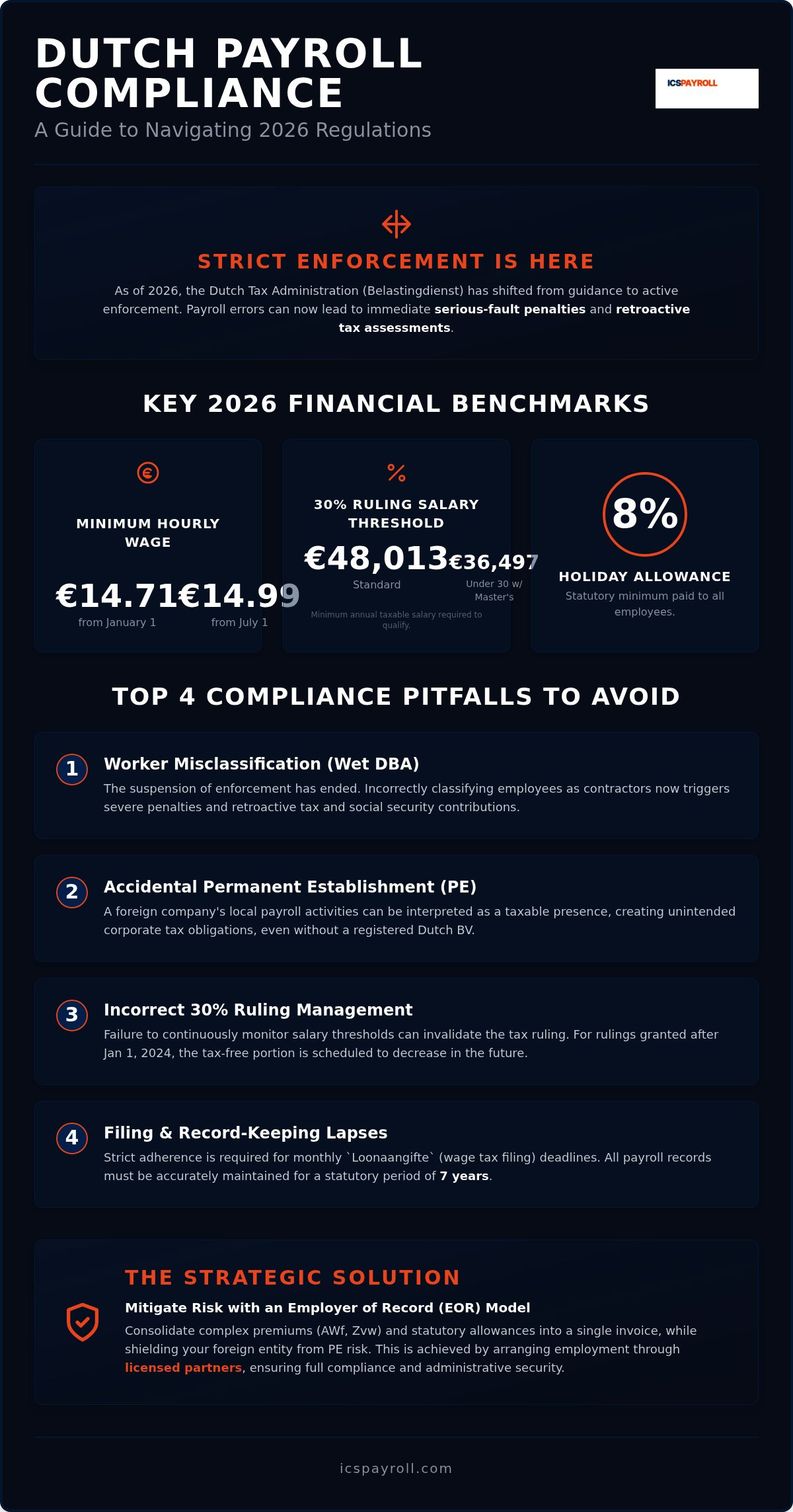
This guide identifies the most common payroll mistakes in the netherlands to ensure your business remains secure throughout 2026. We'll provide a clear checklist of compliance requirements, including the updated EUR 48,013 salary threshold for the 30% ruling and the July minimum wage increase to EUR 14.99 per hour. You'll gain a technical understanding of the latest legislative shifts, such as the abolition of partial non-resident status, and discover a reliable way to offload administrative risk while maintaining total precision in your Dutch operations.
Key Takeaways
- Identify the critical distinction between establishing a Dutch BV and creating a Permanent Establishment to avoid unforeseen corporate tax liabilities and regulatory complications.
- Apply the 2026 standard salary threshold of EUR 48,013 for the 30% ruling to prevent common payroll mistakes in the netherlands and ensure expatriate tax benefits remain valid.
- Navigate the strict enforcement of Wet DBA by correctly classifying workers as employees or contractors to avoid retroactive tax assessments and serious fault penalties.
- Maintain precise administrative records for the statutory seven year period and adhere to monthly Loonaangifte filing deadlines to ensure continuous operational compliance.
- Leverage a local Employer of Record model through licensed partners to consolidate complex premiums and statutory holiday allowances into a single, transparent monthly invoice.
Navigating the Complexity of Dutch Payroll Compliance in 2026
The Dutch regulatory environment has entered a period of unprecedented scrutiny. In 2026, the Belastingdienst has moved beyond simple observation to active enforcement of wage tax and social security regulations. International firms often fall into common payroll mistakes in the netherlands by underestimating the technical precision required for local compliance. Manual data entry and outdated software are no longer sufficient to manage the complex interplay of premiums and statutory allowances. Precision is the only safeguard against the financial liabilities associated with non-compliance.
The Dutch Tax Administration monitors cross-border payroll with high frequency. They focus on the accuracy of Loonaangifte (wage tax filing) submissions and the correct application of the Dutch income tax system. Errors in calculating the AWf (Unemployment Insurance) or Zvw (Healthcare Insurance) premiums lead to immediate audits. These systemic errors usually stem from a lack of local expertise or reliance on global payroll aggregators that lack deep Dutch integration. Relying on generic templates for complex Dutch social security contributions is a high-risk strategy.
The Risk of Permanent Establishment
A foreign company can inadvertently create a Permanent Establishment (PE) without ever incorporating a local Dutch BV. This occurs when the activities of local employees suggest a fixed place of business or a dependent agent authority. The Belastingdienst views local payroll processing as a primary indicator of a taxable presence. Creating a PE triggers corporate tax obligations and complex reporting requirements that many international businesses are unprepared to handle.
To mitigate this risk, companies often utilize an Employer of Record (EOR) model. By arranging employment via licensed partners, you ensure that the legal employer remains a Dutch entity. This effectively shields your foreign organization from unintended tax residency. It's a strategic move that separates your corporate entity from the local administrative burden while maintaining full operational control over your team.
Regulatory Shifts in 2026
This year marks a definitive shift in the Dutch Labor Code. As of January 1, 2026, the Belastingdienst can impose serious-fault penalties for worker misclassification under the Wet DBA. The suspension of enforcement is over. This makes technical accuracy in every wage tax filing a prerequisite for operational security. International businesses are a primary target for these compliance audits because their structures are inherently more complex.
Staying compliant requires a rigorous adherence to the 2026 financial benchmarks and statutory requirements. This includes the 30% ruling salary threshold of EUR 48,013 and the updated minimum hourly wages of EUR 14.71 (January) and EUR 14.99 (July). Any deviation from these figures can invalidate tax rulings or trigger labor law violations. Accuracy in these details is the foundation of a stable international presence in the Netherlands.
Miscalculating Statutory Benefits and the 30 Percent Tax Ruling
Precision in calculating statutory benefits is the difference between a compliant operation and a costly audit. One of the most common payroll mistakes in the netherlands involves the incorrect application of the 30% ruling. This tax incentive requires rigorous monthly monitoring to ensure the employee continues to meet specific salary requirements. If the taxable salary falls below the 2026 threshold, the ruling can be invalidated immediately. Retroactive corrections often trigger investigations by the Belastingdienst.
The 30 Percent Ruling: 2026 Thresholds and Rates
For 2026, the standard minimum taxable salary for the 30% ruling is EUR 48,013. Employees under age 30 with a qualifying Master's degree must meet a lower threshold of EUR 36,497. You must monitor these figures against the taxable wage, which is the gross salary after the tax-free allowance has been deducted. It's a frequent error to calculate the threshold based on the gross salary before the ruling is applied.
The legislative landscape is shifting. While the tax-free allowance remains at 30% for 2026, it's scheduled to decrease to a flat 27% starting January 1, 2027, for rulings that began on or after January 1, 2024. Additionally, 2026 is the final year for the transitional rule regarding partial non-resident status. After December 31, 2026, all employees will be subject to Dutch tax on their global Box 2 and Box 3 assets regardless of their ruling status. Managing these transitions requires expert 30% ruling application support to ensure your expatriate team remains fully optimized.
Statutory Allowances and Pension Schemes
The 8% holiday allowance is a mandatory statutory benefit. It must be calculated on the total gross salary earned during the previous year. Errors often occur when employers fail to include overtime or performance bonuses in the calculation base. Underpayment of this allowance can lead to claims for late payment interest and administrative fines. Ensuring this is paid out by June at the latest is a critical deadline for Dutch employers.
Pension contributions are another area where technical accuracy is non-negotiable. For 2026, these are standardized at 15.2% of the gross salary. You must apply this percentage to the correct base, accounting for the pension offset (franchise). Finally, when an employment contract ends, you must calculate the transitievergoeding correctly. The maximum statutory transition payment for 2026 is EUR 102,000, or one annual salary if that amount is higher. Miscalculating this final settlement is a frequent source of legal disputes.
The Risks of Misclassification under Wet DBA and VBAR
The moratorium on enforcement regarding worker classification has officially ended. As of January 1, 2026, the Dutch Tax Administration (Belastingdienst) is actively imposing serious-fault penalties (vergrijpboetes) on organizations that misclassify employees as independent contractors. This shift represents one of the most common payroll mistakes in the netherlands for international firms accustomed to more flexible labor markets. Relying on a signed model agreement is no longer a safe harbor. The authorities now prioritize the daily reality of the working relationship over the formal language of a contract.
The financial consequences of "false self-employment" (schijnzelfstandigheid) are severe. If the Belastingdienst determines an employment relationship exists, they will issue retroactive assessments for unpaid payroll taxes and social security premiums. This includes the employer-paid Zvw healthcare levy of 6.10% and the differentiated AWf unemployment premiums. For an international business, these backdated costs, coupled with interest and administrative fines, can jeopardize the viability of local operations.
Understanding the VBAR Criteria
Determining the status of a worker requires a technical analysis of three core pillars: authority, work performance, and pay. Under the current interpretation of the Wet DBA, authority is the most scrutinized factor. If your company dictates specific working hours, provides equipment, or integrates the worker into the organizational hierarchy, the relationship is likely an employment contract. This applies even to remote workers and digital nomads who may operate outside a traditional office environment.
Legislative updates in 2026 have further clarified these boundaries. While parts of the original VBAR bill were modified, a rebuttable legal presumption of an employment contract based on low hourly rates is moving forward. It's a mistake to assume that a contractor's preference for freelance status protects your company. The legal burden remains on the employer to prove independence, making technical accuracy in these classifications essential for 2026 compliance.
Transitioning Contractors to a Compliant EOR
Mitigating misclassification risk requires a proactive transition to a structured employment model. Utilizing an Employer of Record Netherlands solution, arranged via licensed partners, allows you to move international hires onto compliant Dutch employment contracts without the need for a local legal entity. This structure ensures that all statutory requirements, including the 8% holiday allowance and pension contributions, are managed with clinical precision.
The process of moving contractors to an EOR model provides a stable bridge for your international team. By centralizing social security premiums and tax filings through a local expert, you remove the administrative burden and the risk of Belastingdienst audits. This approach provides the peace of mind necessary to scale your Dutch workforce while adhering to the rigorous enforcement standards of the 2026 labor market.
Administrative Pitfalls: Filing Deadlines and Record-Keeping
Administrative precision is the backbone of compliant operations in the Netherlands. Many organizations overlook the technical requirements for document retention and filing timelines, which are common payroll mistakes in the netherlands. The Belastingdienst enforces a strict seven year record keeping requirement for all payroll related documents. This includes employment contracts, wage statements, and identity proofs. Failing to produce these documents during an audit can lead to significant administrative fines and the immediate invalidation of specific tax benefits.
Loonaangifte and Filing Deadlines
The payroll tax return, known as the Loonaangifte, follows a rigorous monthly cycle. You must file the return and ensure the total payment reaches the tax authorities by the last day of the month following the wage period. For example, the return for January 2026 must be finalized and paid by February 28, 2026. Late submissions trigger automatic penalties that scale with the duration of the delay. Technical accuracy is equally important for the Jaaropgaaf, the annual statement provided to employees, which must reflect all taxable wages and withheld premiums with clinical precision. For a deeper look at these requirements, consult our Dutch Payroll Administration reference guide.
Sick Leave and Reintegration Obligations
Dutch labor law imposes significant financial risks regarding sick leave that many international firms underestimate. As an employer, you're obligated to pay at least 70 percent of an employee's wages for the first two years of illness. If this 70 percent falls below the statutory minimum wage, you must top it up to the 2026 level of EUR 14.71 or EUR 14.99 per hour. You must also partner with a certified Arbodienst to manage the reintegration process under the Wet Verbetering Poortwachter. Neglecting these steps can result in the UWV imposing a third year of mandatory wage payments as a penalty.
The Ketenregeling further complicates long term planning by limiting you to a maximum of three fixed term contracts within a three year period. The fourth contract automatically becomes a permanent agreement. If an employment relationship ends after at least 24 months, you must calculate the transition payment accurately. For 2026, the transition payment cap is set at EUR 102,000. To ensure your administrative processes remain fully compliant with these evolving standards, you can outsource your Dutch payroll administration to a local specialist.
Mitigating Payroll Risk through a Local Employer of Record
Global Employer of Record providers often struggle with the granular technicalities of Dutch labor law. While they offer broad geographic coverage, they frequently overlook the specific tax and social security nuances that lead to common payroll mistakes in the netherlands. A local specialist provides a direct bridge to the Dutch system, ensuring every statutory premium and holiday allowance is calculated with absolute precision. By arranging employment via licensed partners, you gain access to expedited HSM visa processing within three weeks and specialized support for complex tax rulings.
Transparent Pricing and Consolidated Invoicing
Our payroll factor pricing model eliminates the uncertainty of hidden administrative costs. This model incorporates all employer premiums, such as the 6.10% Zvw healthcare contribution and the differentiated AWf rates, into a single, transparent monthly invoice. You receive a consolidated overview that simplifies your financial reporting and ensures total compliance with Dutch labor standards. This approach removes the complexity of managing multiple local vendors and insurance providers.
Managing records is a critical component of Dutch compliance. Our online employee portal serves as a central repository for all employment documentation, meeting the statutory seven year record keeping requirement. This digital infrastructure reduces your administrative burden, allowing your leadership team to focus on core business expansion. By centralizing HR administration and insurance management, you remove the operational friction associated with entering the Dutch market. You can scale your local team with the confidence that every administrative detail is handled by a dedicated expert.
Expert Assistance for the 30 Percent Ruling
Securing tax advantages for international talent requires a rigorous understanding of the 2026 eligibility criteria. The standard taxable salary threshold of EUR 48,013 must be maintained throughout the duration of the ruling to prevent immediate invalidation. Our team manages the entire application process, ensuring that both the employer and employee meet the strict requirements set by the Belastingdienst. This includes verifying the incoming employee's place of residence prior to their arrival and confirming their specific expertise.
We provide technical guidance on the transition to the 27% rate for newer rulings and the impact of the abolished partial non-resident status. Miscalculating these variables is one of the most persistent common payroll mistakes in the netherlands. For a detailed breakdown of these requirements, please consult our guide on The 30% Ruling Netherlands. This specialized assistance ensures your international team remains financially optimized while adhering to the latest regulatory shifts in the Dutch tax code.
Securing Your Dutch Operations for 2026
Navigating the 2026 Dutch labor market requires more than just administrative effort; it demands a rigorous commitment to technical precision. Avoiding common payroll mistakes in the netherlands starts with mastering the updated 30% ruling thresholds and ensuring absolute accuracy in worker classification under the Wet DBA. Missteps in these areas carry immediate financial consequences in the current high enforcement environment. By centralizing your payroll through a local expert, you eliminate the risk of retroactive tax assessments and administrative penalties.
ICSPayroll provides the stability your international team needs to thrive. We ensure full compliance with 2026 Dutch labor and tax regulations while offering transparent payroll factor pricing with no hidden charges. It's our priority to facilitate expedited HSM visa processing, which is typically granted within three weeks. This allows you to focus on strategic growth while we manage the complex administrative details of the local system.
Hire in the Netherlands with confidence: Get a tailored quotation within 24 hours. We look forward to supporting your successful expansion into the Dutch market.
Frequently Asked Questions
What is the minimum hourly wage in the Netherlands for 2026?
The statutory minimum hourly wage for employees aged 21 and over is EUR 14.71 as of January 1, 2026. This rate increases to EUR 14.99 on July 1, 2026. You must calculate payroll based on actual hours worked rather than monthly fixed rates. Failing to adjust for these indexed increases is one of the most common payroll mistakes in the netherlands. Accuracy ensures your organization remains compliant with Dutch labor laws.
What is the salary threshold for the 30% ruling in 2026?
For 2026, the standard minimum taxable salary required for the 30% ruling is EUR 48,013. Employees under the age of 30 who hold a qualifying Master's degree must meet a reduced threshold of EUR 36,497. These figures represent the taxable wage after the tax-free allowance has been applied. You must monitor these benchmarks monthly to ensure the ruling remains valid for your highly skilled migrants throughout the entire year.
How long must I keep payroll records in the Netherlands?
You're legally required to maintain all payroll and business records for a minimum period of seven years. This statutory retention period applies to employment contracts, wage statements, identity documents, and correspondence with the Belastingdienst. Records related to immovable property require a ten year retention period. Maintaining a centralized digital archive ensures you can produce necessary documentation during a compliance audit without facing administrative fines or complex legal complications.
Can I hire an employee in the Netherlands without a Dutch BV?
Yes, you can hire employees in the Netherlands without establishing a local legal entity by using an Employer of Record (EOR) service. This model allows a licensed partner to act as the legal employer, managing all local tax, social security, and insurance obligations. It's a strategic solution for international firms that need to secure talent quickly while avoiding the administrative burden of direct incorporation and unintended permanent establishment risks.
What are the penalties for misclassifying an employee as a freelancer?
Misclassifying an employee as a freelancer triggers significant financial liabilities, including retroactive payroll tax assessments and unpaid social security premiums. As of January 1, 2026, the Belastingdienst can also impose serious-fault penalties if they determine the relationship is an employment contract. These costs often include unpaid Zvw healthcare levies and differentiated AWf premiums. Correct classification is essential to avoid the common payroll mistakes in the netherlands that lead to aggressive audits.
How does the 2026 27% tax-free rate affect the 30% ruling?
The tax-free allowance remains 30% throughout 2026, but a flat rate of 27% is scheduled to take effect on January 1, 2027. This change applies to rulings that commenced on or after January 1, 2024. While your 2026 filings still utilize the 30% rate, you must prepare for this future reduction in tax benefits. Accurate long-term financial planning helps manage employee expectations regarding their future net take-home pay and overall compensation packages.
What is the holiday allowance requirement for Dutch employees?
Dutch law requires a mandatory holiday allowance of at least 8% of the employee's gross annual salary. This is typically paid as a lump sum in May or June, though you can agree to monthly accruals in the employment contract. You must include all fixed salary components, such as overtime and performance bonuses, in the calculation base. Underpayment of this statutory benefit can lead to legal claims for late payment interest and penalties.
What are the employer obligations for sick leave in the Netherlands?
Employers in the Netherlands must pay at least 70% of an employee's wages for up to two years during illness. If this amount falls below the statutory minimum wage, you're required to supplement the payment to the 2026 hourly minimum. You must also follow strict reintegration protocols under the Wet Verbetering Poortwachter. Partnering with a certified Arbodienst is necessary to manage these obligations and avoid the risk of extended wage payment sanctions.

Article by
Joost Hubregtse
Joost Hubregtse is Director of ICS Staffing & Payroll B.V., the wholly owned subsidiary of Intercompany Solutions behind ICS Payroll. He is responsible for Employer of Record and Dutch payroll services: employment contracts, wage tax and social security filings, holiday allowance, pension, sick leave and CAO compliance, with onboarding possible within 48 hours.
Frequently Asked Questions
The statutory minimum hourly wage for employees aged 21 and over is EUR 14.71 as of January 1, 2026. This rate increases to EUR 14.99 on July 1, 2026. You must calculate payroll based on actual hours worked rather than monthly fixed rates. Failing to adjust for these indexed increases is one of the most common payroll mistakes in the netherlands. Accuracy ensures your organization remains compliant with Dutch labor laws.
For 2026, the standard minimum taxable salary required for the 30% ruling is EUR 48,013. Employees under the age of 30 who hold a qualifying Master's degree must meet a reduced threshold of EUR 36,497. These figures represent the taxable wage after the tax-free allowance has been applied. You must monitor these benchmarks monthly to ensure the ruling remains valid for your highly skilled migrants throughout the entire year.
You're legally required to maintain all payroll and business records for a minimum period of seven years. This statutory retention period applies to employment contracts, wage statements, identity documents, and correspondence with the Belastingdienst. Records related to immovable property require a ten year retention period. Maintaining a centralized digital archive ensures you can produce necessary documentation during a compliance audit without facing administrative fines or complex legal complications.
Yes, you can hire employees in the Netherlands without establishing a local legal entity by using an Employer of Record (EOR) service. This model allows a licensed partner to act as the legal employer, managing all local tax, social security, and insurance obligations. It's a strategic solution for international firms that need to secure talent quickly while avoiding the administrative burden of direct incorporation and unintended permanent establishment risks.
Misclassifying an employee as a freelancer triggers significant financial liabilities, including retroactive payroll tax assessments and unpaid social security premiums. As of January 1, 2026, the Belastingdienst can also impose serious-fault penalties if they determine the relationship is an employment contract. These costs often include unpaid Zvw healthcare levies and differentiated AWf premiums. Correct classification is essential to avoid the common payroll mistakes in the netherlands that lead to aggressive audits.
The tax-free allowance remains 30% throughout 2026, but a flat rate of 27% is scheduled to take effect on January 1, 2027. This change applies to rulings that commenced on or after January 1, 2024. While your 2026 filings still utilize the 30% rate, you must prepare for this future reduction in tax benefits. Accurate long-term financial planning helps manage employee expectations regarding their future net take-home pay and overall compensation packages.
Dutch law requires a mandatory holiday allowance of at least 8% of the employee's gross annual salary. This is typically paid as a lump sum in May or June, though you can agree to monthly accruals in the employment contract. You must include all fixed salary components, such as overtime and performance bonuses, in the calculation base. Underpayment of this statutory benefit can lead to legal claims for late payment interest and penalties.
Employers in the Netherlands must pay at least 70% of an employee's wages for up to two years during illness. If this amount falls below the statutory minimum wage, you're required to supplement the payment to the 2026 hourly minimum. You must also follow strict reintegration protocols under the Wet Verbetering Poortwachter. Partnering with a certified Arbodienst is necessary to manage these obligations and avoid the risk of extended wage payment sanctions.