Hiring Compliance in the Netherlands: 2026 Employer Guide
By Joost Hubregtse, Director, ICS Staffing & Payroll
All blog posts are reviewed and fact checked by our labour law lawyer Zishan Hussain and our director. Editorial standards
Operating a business in the Netherlands in 2026 means navigating a regulatory environment where the cost of non-compliance now includes active enforcement penalties for contractor misclassification. For international firms, establishing a secure framework for compliance for hiring in netherlands is no longer optional. You recognize that while the Dutch market is lucrative, the complexities of the 30% tax ruling and the financial burden of mandatory sickness benefits present significant operational hurdles. This guide provides a clear roadmap to master Dutch labor regulations and tax requirements to ensure full compliance when hiring in the Netherlands in 2026.
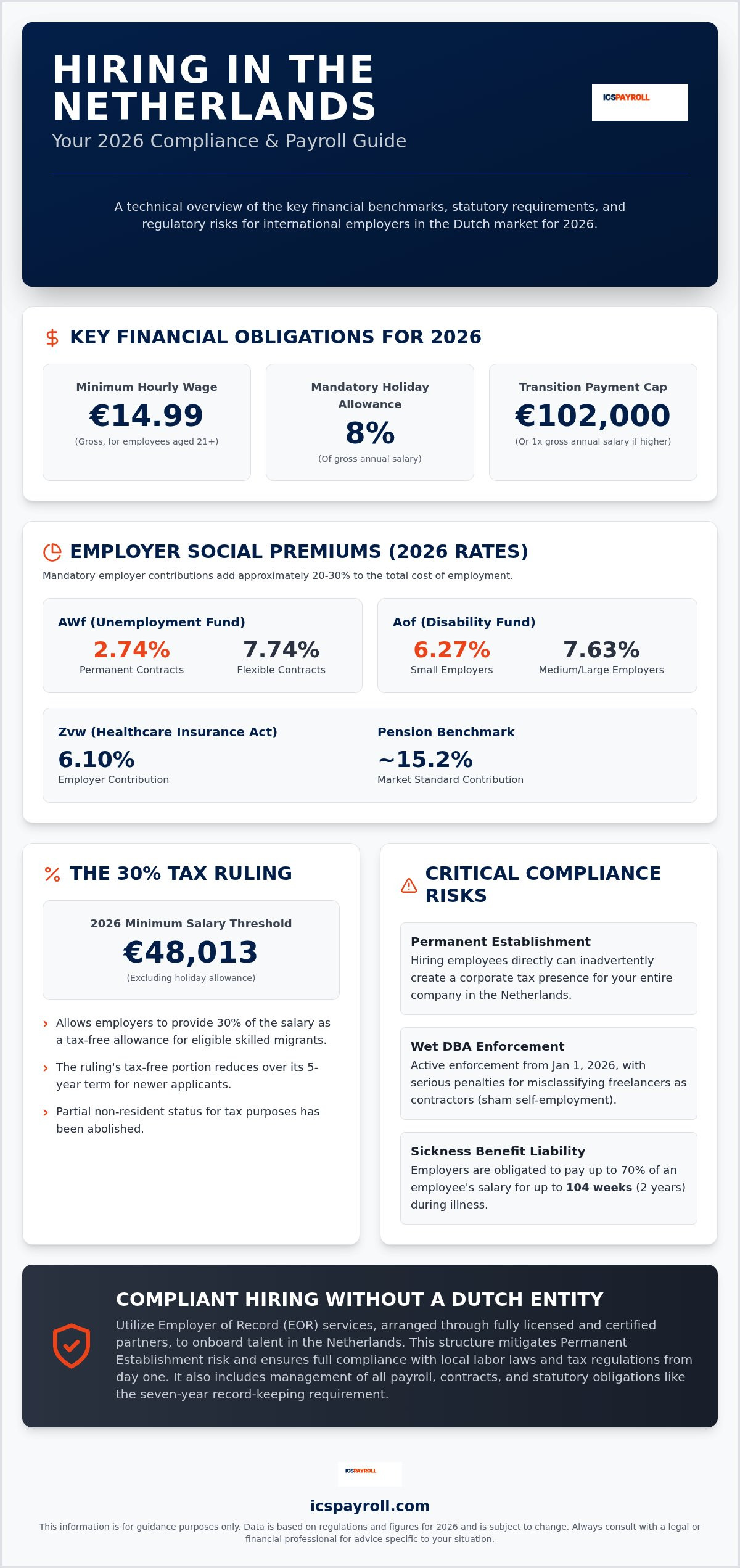
We'll provide the specific 2026 salary thresholds, such as the standard €48,013 requirement for tax advantages, and clarify the enforcement shifts under Wet DBA. You'll also learn how to deploy staff quickly through services arranged via licensed partners, allowing you to bypass the risks of permanent establishment and local entity incorporation. This overview prepares you to manage your Dutch payroll and employment obligations with absolute technical precision and peace of mind.
Key Takeaways
- Understand the 2026 regulatory environment and the active enforcement of Wet DBA to maintain full compliance for hiring in netherlands.
- Identify statutory financial obligations, such as the EUR 14.99 minimum hourly wage and the mandatory 8% holiday allowance for all employees.
- Apply the 2026 30% ruling requirements correctly by verifying the EUR 48,013 salary threshold and managing fixed term contract limits under the Ketenregeling.
- Reduce administrative risk by following the Gatekeeper Improvement Act and managing the 104 week sickness benefit requirement.
- Learn how to onboard talent in the Netherlands without a local entity by using EOR services arranged through licensed partners.
Navigating Dutch Employment Compliance in 2026
Establishing compliance for hiring in netherlands requires a dual focus on Dutch civil labor law and rigorous tax regulations. The Dutch Ministry of Social Affairs and Employment sets the primary standards for worker protections, while the Tax Administration oversees the financial obligations. In 2026, these two spheres are more integrated than ever. Foreign employers must realize that Dutch compliance is not merely a checkbox exercise. It's a continuous obligation that involves precise reporting and adherence to the "polder model" of labor relations. Failure to align with both civil and tax requirements can result in substantial back-tax assessments and legal injunctions.
The Role of Permanent Establishment Risk
Foreign enterprises often assume that hiring a remote worker in the Netherlands is a simple administrative task. However, doing so can inadvertently create a "Permanent Establishment." This status triggers a taxable presence for the entire corporation within the Dutch jurisdiction. To avoid this, companies must distinguish between a local Dutch BV and a Permanent Establishment. According to belastingdienst.nl, tax residency and liability are determined by where core business activities occur. Centralizing payroll through services arranged via licensed partners helps mitigate this exposure. This approach ensures all statutory contributions are handled without establishing a fixed place of business. Employers must also adhere to the seven-year record-keeping requirement for all administrative and payroll data. Official business registration guidelines are available at kvk.nl for those considering a formal presence.
Regulatory Enforcement Trends for 2026
The 2026 landscape is defined by the strict enforcement of the Wet DBA. The Dutch Tax Administration has moved beyond the previous "soft" enforcement period. Since January 1, 2026, authorities have the power to impose serious-fault penalties for the misclassification of freelancers. This shift follows the legislative developments surrounding the VBAR bill. While the broader clarification components of VBAR were scrapped in March 2026, a narrower bill creating a rebuttable presumption of employment takes effect on December 31, 2026. This specifically targets low hourly rates. The labor inspectorate is currently prioritizing audits of sham self-employment to ensure workers receive protections under Dutch law. Detailed updates on these labor law reforms and contract requirements can be found at rijksoverheid.nl. Companies should review their contractor relationships immediately to avoid being flagged during these targeted audits.
Statutory Wage and Benefit Requirements for Dutch Employees
Maintaining compliance for hiring in netherlands requires strict adherence to the statutory minimum wage standards. As of July 1, 2026, the statutory minimum hourly wage for employees aged 21 and over is set at €14.99 gross. This rate is adjusted bi-annually and applies to all sectors unless a Collective Labor Agreement (CAO) stipulates a higher amount. Employers must also factor in the mandatory 8% holiday allowance. This is typically paid in May or June and is calculated on the employee's gross annual salary. It's a non-negotiable benefit that ensures workers have the financial means for annual leave.
Pension provisions represent another critical component of the Dutch employment landscape. While not all sectors have a mandatory industry-wide fund, providing a compliant scheme is a standard market expectation to attract talent. A benchmark contribution of 15.2% is often used for high-quality, compliant pension plans. Additionally, employers must prepare for the financial impact of the transition allowance. If an employment contract is terminated at the employer's initiative, the employee is entitled to a "transitievergoeding." For 2026, this payment is capped at €102,000, or one gross annual salary if the employee earns more than this threshold. You can find detailed policy updates on the official website of the Ministry of Social Affairs and Employment.
Calculating the Total Cost of Employment
Total employment costs in the Netherlands typically exceed the gross salary by 20% to 30%. This is due to several mandatory employer premiums. For 2026, the AWf (Unemployment Fund) premium is 2.74% for permanent contracts and 7.74% for flexible arrangements. The Aof (Disability Fund) premium varies by company size; small employers pay 6.27% while medium and large entities pay 7.63%. Furthermore, the Zvw (Healthcare Insurance Act) requires a 6.10% employer contribution. Managing these variables is complex. Utilizing a "payroll factor" simplifies these diverse obligations into a single, predictable monthly invoice. For a clearer picture of your specific costs, you can request a tailored quotation to see how these premiums apply to your workforce.
Mandatory Leave and Working Hours
Dutch law guarantees a statutory minimum of 20 vacation days per year for full time employees, based on a 40-hour work week. However, providing 25 days is common practice in many professional sectors. The 2026 landscape also includes expanded protections for parental leave. Employees are entitled to various forms of leave, including birth leave and partially paid parental leave, which are designed to support work-life balance. Accurate benefit calculations and eligibility criteria for these social insurances are managed by the Employee Insurance Agency. You should consult the UWV website for the latest technical specifications regarding benefit distributions. Ensuring these leave entitlements are recorded correctly is essential for ongoing compliance for hiring in netherlands.
Employment Contracts and the 30% Ruling Framework
Dutch employment contracts must adhere to the "Ketenregeling" or chain rule. This regulation limits the number of fixed-term contracts an employer can offer before a permanent agreement is required. Under current law, an employee is entitled to a permanent contract after three consecutive fixed-term agreements or after a total period of three years. A gap of more than six months is necessary to break this chain. For a broader perspective on these regulations, you can consult ICLG's guide to Dutch employment law. Understanding these limits is a fundamental step in maintaining compliance for hiring in netherlands.
The 30% ruling remains the most significant tax incentive for attracting international talent. For applications initiated after January 1, 2024, the tax-free allowance is scheduled to reduce from 30% to 27% effective January 1, 2027. The 30% ruling is a tax facility for highly skilled migrants that requires a 2026 minimum taxable salary of EUR 48,013 to grant a tax-free allowance. This benefit significantly reduces the effective tax rate for eligible staff, making the Dutch labor market highly competitive for global specialists. Employers must ensure that the employment contract explicitly mentions the application for this ruling to avoid administrative rejection.
Highly Skilled Migrant (HSM) Visa Compliance
Non-EU employees require an HSM visa to work legally in the Netherlands. This process requires a recognized sponsor to submit the application to the Immigration and Naturalisation Service. ICSPayroll arranges these visa services through licensed partners to ensure all legal criteria are met. In 2026, expedited processing timelines allow for HSM applications to be completed in approximately three weeks. This speed is a critical differentiator for companies needing to scale their Dutch operations rapidly. You can find the latest visa requirements and sponsor obligations on the official IND website.
The 2026 Salary Thresholds for Tax Advantages
Eligibility for the 30% ruling depends on strict salary benchmarks that are adjusted annually. The standard threshold for 2026 is EUR 48,013 gross taxable salary, excluding the tax-free allowance itself. A reduced threshold of EUR 36,497 applies to employees under the age of 30 who hold a qualifying Master's degree. It's also critical to account for the abolition of partial non-resident taxpayer status. While a transitional rule allows those who used the status before 2024 to continue until December 31, 2026, new hires no longer have access to this benefit. Precision in these figures is vital for ensuring long-term compliance for hiring in netherlands.
Managing Sickness Risk and Labor Law Reforms
Dutch labor law places a heavy financial burden on employers regarding worker health. If an employee falls ill, you're legally required to pay at least 70% of their salary for up to 104 weeks. This two-year obligation is among the most extensive in Europe. Compliance for hiring in netherlands also involves adhering to the Gatekeeper Improvement Act (Wet Verbetering Poortwachter). This act mandates a strict timeline of reintegration steps, including regular consultations with an occupational health service. Failure to follow these steps can result in the UWV imposing a third year of mandatory salary payments as a penalty.
Contractual protections like probation periods and non-compete clauses are also strictly regulated. For indefinite contracts, the probation period is capped at two months. Fixed-term contracts of more than six months but less than two years allow for a maximum of one month, while contracts of six months or less cannot include a probation period. Legislative proposals submitted in June 2026 aim to modernize non-compete clauses. While these are not yet law, the expected reforms will require employers to define specific geographical boundaries and pay compensation to the employee if the clause is enforced after termination. These changes aim to increase labor mobility and prevent the unnecessary use of restrictive covenants.
Sickness Insurance and Reintegration Support
Given the 104-week liability, sickness risk coverage is essential for international businesses. This insurance protects your company from the long-term financial impact of a chronically ill employee. A dedicated occupational health service (Arbodienst) is a mandatory partner in this process. They provide the medical assessments required to validate sick leave and guide the reintegration plan. Your employee handbook should clearly outline the notification procedures and the support available during illness. To mitigate these risks effectively, you can secure comprehensive sickness management through our consolidated payroll solutions arranged via licensed partners.
Labor Reform: Wet DBA and VBAR Enforcement
The distinction between an employee and a contractor is a primary focus for the Tax Administration in 2026. Active enforcement of the Wet DBA means that misclassification can lead to immediate fines, known as "vergrijpboetes," and retroactive social security claims. A significant shift occurs on December 31, 2026, with the introduction of the "presumption of employment" for workers earning below a specific hourly rate. If a worker's rate is low, the law presumes they are an employee unless the employer proves otherwise. This makes technical accuracy in worker classification non-negotiable. You should review all external staff arrangements against the latest contractor audit guidelines on belastingdienst.nl to ensure your operations remain fully compliant for hiring in netherlands.
Compliant Hiring Without a Dutch Entity via ICSPayroll
Many international firms believe that incorporating a local BV is a prerequisite for entering the Dutch market. This is a common misconception that often leads to unnecessary delays and high administrative costs. Establishing a local entity involves significant lead times and ongoing legal obligations. Instead, companies can utilize an Employer of Record (EOR) to hire staff directly. ICSPayroll arranges these EOR services through licensed partners to provide a secure legal framework. This model ensures full compliance for hiring in netherlands without the risks associated with a permanent establishment or the complexities of local incorporation. It allows you to focus on your core business while we manage the operational details.
The "Payroll Factor" pricing model is designed for maximum transparency and simplicity. Rather than managing separate payments for social security, pension, and holiday allowances, you receive a single monthly invoice. This consolidated approach covers all statutory obligations, including the AWf and Aof premiums discussed in previous sections. It provides a predictable cost structure that eliminates the risk of hidden administrative fees. Most importantly, it allows you to onboard talent in weeks rather than the months typically required for entity setup. This speed is a critical advantage for businesses responding to rapid market changes in 2026.
The ICSPayroll Onboarding Process
Our onboarding workflow is optimized for speed and technical accuracy. Once you submit the necessary employee details, we provide a tailored quotation within 24 hours. Following approval, service agreements and Dutch employment contracts are drafted within days. This rapid turnaround is essential for securing top-tier talent in a competitive environment. Employees also gain access to a secure online portal. This interface allows them to view payslips, track holiday balances, and manage personal data in accordance with Dutch privacy standards. This human-centric approach ensures your staff feels supported from day one.
Consolidated Compliance Management
Managing the administrative lifecycle of an employee requires meticulous attention to detail. We handle all Loonaangifte filings with the Tax Administration and ensure that all social security premiums are paid on time. This includes the management of the 30% ruling application for eligible expat staff, ensuring they meet the standard EUR 48,013 threshold for 2026. For a deeper dive into these processes, consult our Dutch Payroll Administration Guide. By centralizing these tasks, we ensure that your compliance for hiring in netherlands remains robust and fully aligned with the latest regulatory updates.
Securing Your Dutch Workforce for 2026
Achieving compliance for hiring in netherlands requires a meticulous approach to the €14.99 statutory minimum wage and the technical €48,013 threshold for the 30% ruling. You must also account for the 104 week sickness benefit obligation and the active enforcement of Wet DBA regarding worker classification. Mastering these variables is essential for maintaining a stable and legally sound presence in the Dutch market. By prioritizing these benchmarks, you remove the administrative burdens that often hinder international growth.
You don't have to manage these complexities through a local entity or risk the delays of traditional incorporation. ICSPayroll simplifies your expansion by arranging EOR and payroll services via licensed partners. We provide full 2026 labor law compliance, expedited HSM visa processing in roughly three weeks, and a consolidated monthly invoice for all employment costs. Get a tailored Dutch hiring quotation within 24 hours to accelerate your entry into the Netherlands. We're ready to help you hire with speed and absolute certainty.
Frequently Asked Questions
What is the minimum wage in the Netherlands for 2026?
As of July 1, 2026, the statutory minimum hourly wage in the Netherlands is €14.99 for all employees aged 21 and over. This rate applies regardless of the industry unless a specific Collective Labor Agreement (CAO) dictates a higher baseline. Ensuring your payroll reflects these 2026 benchmarks is a core part of maintaining compliance for hiring in netherlands. Employers must monitor bi-annual adjustments to remain aligned with the latest government mandates.
Can I hire an employee in the Netherlands without a local legal entity?
You can hire employees in the Netherlands without establishing a local Dutch BV by using an Employer of Record (EOR). ICSPayroll arranges these services through licensed partners who act as the legal employer on your behalf. This model allows you to onboard talent in weeks rather than months. It effectively eliminates the need for direct legal entity incorporation while protecting you from permanent establishment risks and complex local administrative duties.
What are the 30% ruling salary requirements in 2026?
For 2026, the standard minimum taxable salary required for the 30% ruling is €48,013. Employees under the age of 30 with a qualifying Master’s degree benefit from a reduced threshold of €36,497. It's important to note that for rulings starting after January 1, 2024, the tax-free allowance will transition to a 27% rate starting in 2027. Precise salary calculations are vital to secure this significant tax advantage for your international staff.
How long does it take to get a Highly Skilled Migrant visa in the Netherlands?
Obtaining a Highly Skilled Migrant (HSM) visa typically takes approximately three weeks when using expedited processing. ICSPayroll arranges these visa applications through licensed partners who are recognized sponsors with the Immigration and Naturalisation Service (IND). This rapid timeline ensures that your non-EU talent can begin working legally without the long delays associated with standard immigration procedures. Operational setup for new hires can often be completed within days following visa approval.
What is the employer holiday allowance in the Netherlands?
The statutory minimum holiday allowance in the Netherlands is 8% of the employee's gross annual salary. This benefit is a mandatory requirement for all employment contracts and is usually paid as a lump sum in May or June. This allowance provides employees with the financial means for their annual leave. When calculating compliance for hiring in netherlands, you must ensure this 8% is factored into your total employment cost projections to avoid legal disputes.
What happens if a Dutch employee falls sick for a long period?
If a Dutch employee falls sick for an extended period, the employer is legally obligated to pay at least 70% of their salary for up to 104 weeks. You must also comply with the Gatekeeper Improvement Act, which requires specific reintegration steps and consultations with an occupational health service. Failure to meet these administrative milestones can lead to severe financial penalties. ICSPayroll manages these risks by providing sick-leave support and reintegration guidance through our specialized partners.
Is ICSPayroll an IND recognized sponsor?
ICSPayroll does not claim to be an IND recognized sponsor, EOR licensee, or SNA-certified entity directly. Instead, we arrange these essential services through our network of fully licensed and certified partners. This structure allows us to provide you with a secure and compliant hiring framework while maintaining strict adherence to Dutch legal standards. We act as your expert bridge to ensure all visa and employment requirements are met through authorized channels.
What is a payroll factor and how is it calculated?
A payroll factor is a transparent pricing model that consolidates all employer costs into a single multiplier applied to the gross salary. This factor includes the 8% holiday allowance, 15.2% pension contributions, social security premiums, and sickness risk coverage. By using this model, you receive one clear monthly invoice without separate or hidden charges. It simplifies your budgeting process and ensures that every statutory financial obligation is covered with technical precision.

Article by
Joost Hubregtse
Joost Hubregtse is Director of ICS Staffing & Payroll B.V., the wholly owned subsidiary of Intercompany Solutions behind ICS Payroll. He is responsible for Employer of Record and Dutch payroll services: employment contracts, wage tax and social security filings, holiday allowance, pension, sick leave and CAO compliance, with onboarding possible within 48 hours.
Frequently Asked Questions
As of July 1, 2026, the statutory minimum hourly wage in the Netherlands is €14.99 for all employees aged 21 and over. This rate applies regardless of the industry unless a specific Collective Labor Agreement (CAO) dictates a higher baseline. Ensuring your payroll reflects these 2026 benchmarks is a core part of maintaining compliance for hiring in netherlands. Employers must monitor bi-annual adjustments to remain aligned with the latest government mandates.
You can hire employees in the Netherlands without establishing a local Dutch BV by using an Employer of Record (EOR). ICSPayroll arranges these services through licensed partners who act as the legal employer on your behalf. This model allows you to onboard talent in weeks rather than months. It effectively eliminates the need for direct legal entity incorporation while protecting you from permanent establishment risks and complex local administrative duties.
For 2026, the standard minimum taxable salary required for the 30% ruling is €48,013. Employees under the age of 30 with a qualifying Master’s degree benefit from a reduced threshold of €36,497. It's important to note that for rulings starting after January 1, 2024, the tax-free allowance will transition to a 27% rate starting in 2027. Precise salary calculations are vital to secure this significant tax advantage for your international staff.
Obtaining a Highly Skilled Migrant (HSM) visa typically takes approximately three weeks when using expedited processing. ICSPayroll arranges these visa applications through licensed partners who are recognized sponsors with the Immigration and Naturalisation Service (IND). This rapid timeline ensures that your non-EU talent can begin working legally without the long delays associated with standard immigration procedures. Operational setup for new hires can often be completed within days following visa approval.
The statutory minimum holiday allowance in the Netherlands is 8% of the employee's gross annual salary. This benefit is a mandatory requirement for all employment contracts and is usually paid as a lump sum in May or June. This allowance provides employees with the financial means for their annual leave. When calculating compliance for hiring in netherlands, you must ensure this 8% is factored into your total employment cost projections to avoid legal disputes.
If a Dutch employee falls sick for an extended period, the employer is legally obligated to pay at least 70% of their salary for up to 104 weeks. You must also comply with the Gatekeeper Improvement Act, which requires specific reintegration steps and consultations with an occupational health service. Failure to meet these administrative milestones can lead to severe financial penalties. ICSPayroll manages these risks by providing sick-leave support and reintegration guidance through our specialized partners.
ICSPayroll does not claim to be an IND recognized sponsor, EOR licensee, or SNA-certified entity directly. Instead, we arrange these essential services through our network of fully licensed and certified partners. This structure allows us to provide you with a secure and compliant hiring framework while maintaining strict adherence to Dutch legal standards. We act as your expert bridge to ensure all visa and employment requirements are met through authorized channels.
A payroll factor is a transparent pricing model that consolidates all employer costs into a single multiplier applied to the gross salary. This factor includes the 8% holiday allowance, 15.2% pension contributions, social security premiums, and sickness risk coverage. By using this model, you receive one clear monthly invoice without separate or hidden charges. It simplifies your budgeting process and ensures that every statutory financial obligation is covered with technical precision.
Related articles