Expat Payroll in the Netherlands: An Employer’s Relocation Support Checklist for 2026
By Joost Hubregtse, Director, ICS Staffing & Payroll
All blog posts are reviewed and fact checked by our labour law lawyer Zishan Hussain and our director. Editorial standards
What if an international hire’s first payroll problem starts before they even arrive? Getting expat payroll netherlands right means coordinating immigration approval, the employment start date, payroll and tax setup, and the employee’s move as one process. When these steps are handled separately, decisions can be delayed or important details overlooked.
Employers need a clear sequence, particularly when work authorization and payroll preparation affect a new hire’s start. The 30% ruling also requires a separate eligibility and timing assessment. This checklist sets out the employer-side steps to take before and after relocation so you can prepare a compliant employment start.
By Joost Hubregtse, Payroll Director. Joost Hubregtse is Payroll Director at ICSPayroll, the Dutch payroll and EOR specialist of Intercompany Solutions. A career payroll specialist and former Head of Payroll, he oversees wage tax filings, 30% ruling applications, and employment compliance for international employers.
Reviewed by Joost Hubregtse, Payroll Director, on 14 October 2026.
Key Takeaways
- Sequence immigration, employment and payroll steps around the employee’s intended start date to reduce avoidable delays.
- Compare direct Dutch-entity payroll with EOR support to choose an employment route, including when your organisation doesn’t yet have a Dutch BV.
- Use the expat payroll netherlands checklist to prepare employee details, contract information, payroll setup and internal handoffs before the first pay run.
- Assess 30% ruling eligibility and application timing separately from immigration sponsorship. The Belastingdienst decides whether to grant the ruling.
- Understand how EOR, Dutch payroll administration and immigration support arranged via a licensed partner can coordinate key employment steps.
Expat payroll in the Netherlands: what relocation support should employers plan?
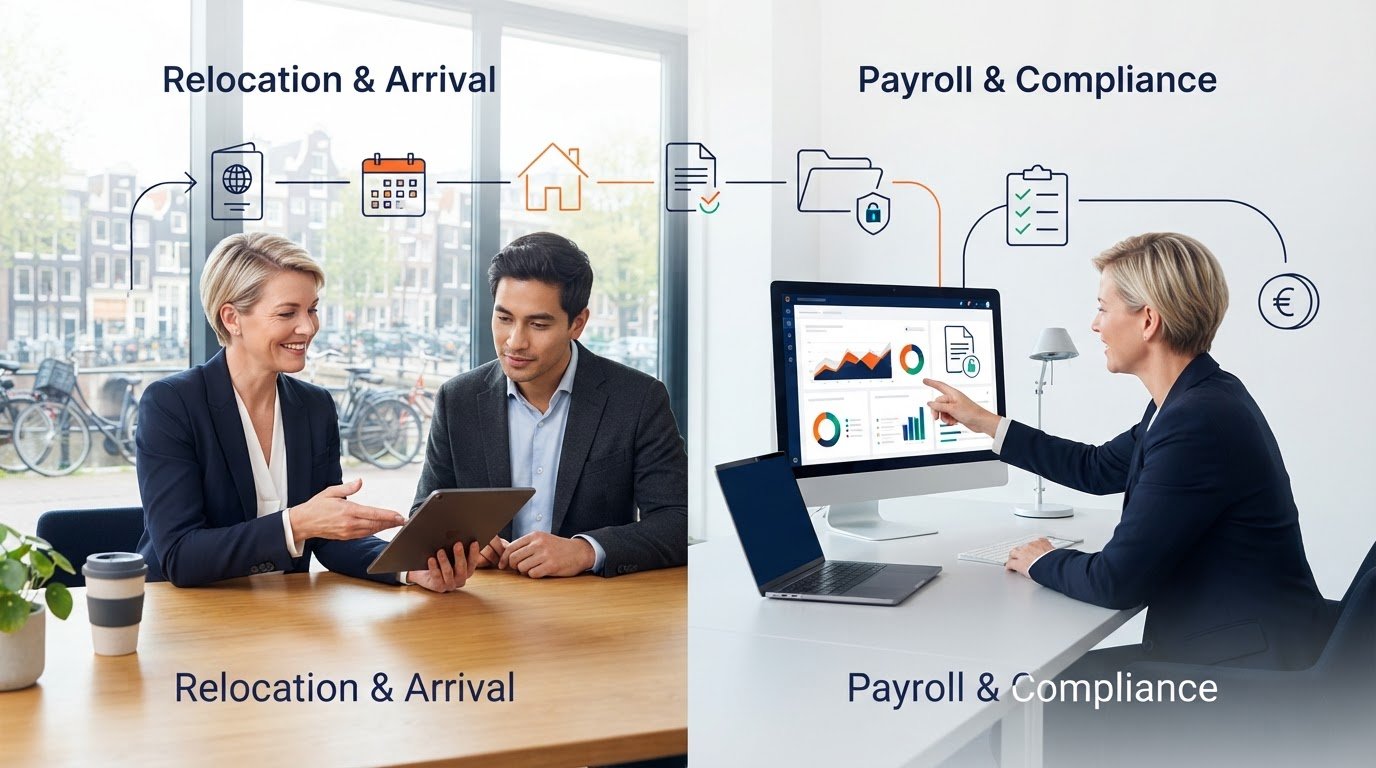
An international hire’s move involves several connected workstreams. The employer must align the role, immigration authorization, employment terms, payroll setup and tax administration. If one step is delayed or uses a different start date, the process becomes harder to coordinate. Effective expat payroll netherlands planning gives each task an owner and a place in the timeline.
Here, relocation support means coordinating the work-related steps that enable an international employee to join and be paid in the Netherlands. It does not mean providing personal moving services. An Expatriate may have personal arrangements to manage, while the employer focuses on employment and compliance.
Expat payroll is compliant local payroll for an internationally recruited employee, coordinated with the employment and tax steps that apply in the Netherlands.
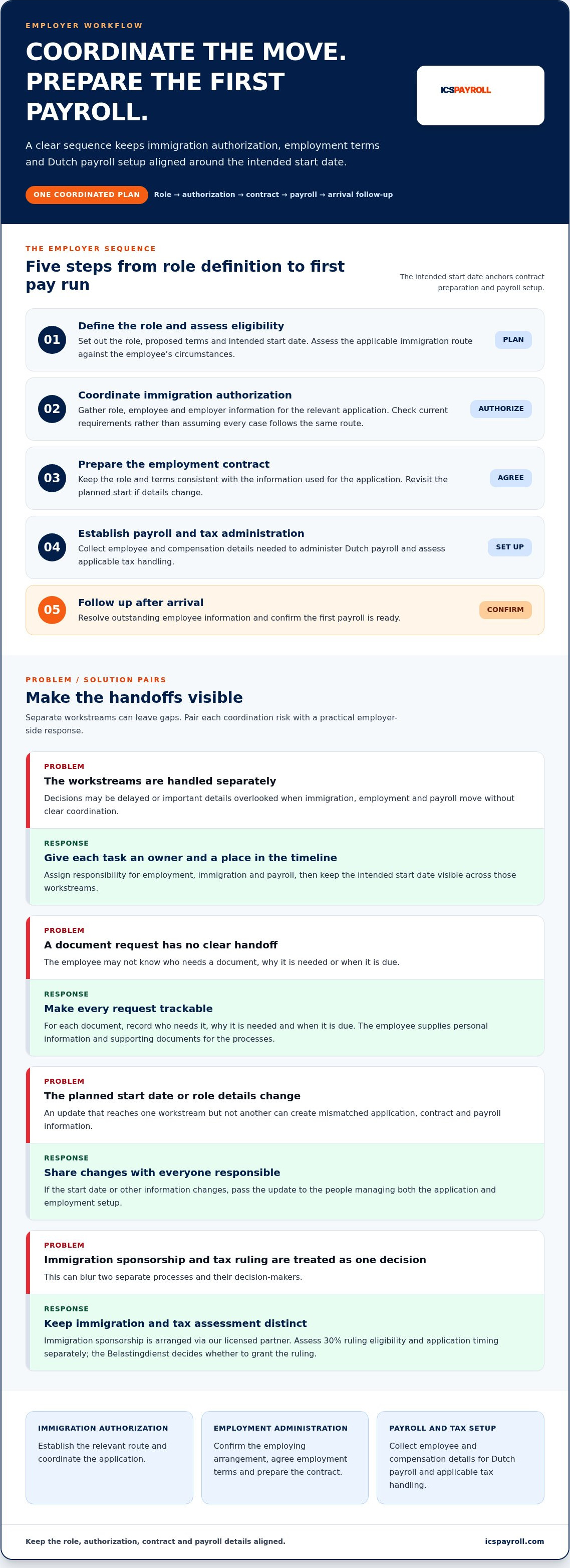
Use this sequence as a planning overview: define the role and assess eligibility, coordinate the relevant immigration authorization, prepare the employment contract, establish payroll administration, then follow up after arrival to resolve outstanding employee information and confirm the first payroll is ready.
Which relocation tasks sit with the employer?
Employer coordination starts with clear decisions and handoffs. Define the role, proposed terms and intended start date, then assign responsibility for employment, immigration and payroll. The employee supplies personal information and supporting documents needed for those processes. For each document request, record who needs it, why it is needed and when it is due.
Keep three categories distinct:
- Immigration authorization: establish the relevant route and coordinate the application. Immigration sponsorship is arranged via our licensed partner.
- Employment administration: confirm the employing arrangement, agree employment terms and prepare the contract for the intended start.
- Payroll and tax setup: collect the employee and compensation details needed to administer Dutch payroll and assess applicable tax handling.
Practical settling-in matters may affect the employee’s experience, but they are separate from payroll and work authorization. Keep this checklist focused on work-related coordination rather than housing or recruitment.
Why sequence matters before the employee’s first day
The intended start date anchors contract preparation and payroll setup. If it changes, tell everyone responsible for those workstreams. Treating the contract, authorization and payroll as parallel tasks without clear dependencies can leave the employer unsure whether the planned start is operationally ready.
Keep immigration sponsorship separate from tax ruling approval. Sponsorship relates to the immigration process; the Belastingdienst decides whether to grant the 30% ruling. One does not determine the other. Assess tax eligibility and application timing as a distinct workstream, with its own supporting information and decision.
Early coordination does not guarantee approval or a particular tax outcome. It does give the employer time to identify missing information, assign follow-up and reduce preventable gaps between authorization, the contract and the first payroll. That is the practical value of a sequenced checklist: each handoff is visible before the employee’s first day.
How to coordinate an HSM application, employment contract and start date
A Highly Skilled Migrant (HSM) application, employment contract and payroll setup depend on consistent role, employee and timing information. Treat them as linked workstreams, while keeping each decision distinct. Immigration sponsorship is arranged via our licensed partner. The IND’s English-language Highly Skilled Migrant guidance explains the permit route and requirements. Review it against the employee’s circumstances before setting a firm start date.
Immigration authorization determines whether the employee can work under the relevant route. It does not replace the employer’s separate responsibilities for employment administration, Dutch payroll and tax handling.
Prepare the HSM application and employment information
Start by collecting the information needed to assess the role and prepare an application. Exact document requirements depend on the case, so use current IND guidance rather than assuming every employee follows the same route. A non-Schengen employee may need the HSM route, but nationality and circumstances matter. Assess the applicable authorization before treating the planned start date as final.
- Role details: title, core duties, proposed employment terms and intended start date.
- Employee details: identity and contact information, plus the documents required for the applicable application.
- Employer information: the employing arrangement and the party coordinating the application and employment administration.
Check that the role and terms in the application align with the proposed contract. If information changes, pass the update to the people managing both the application and employment setup. Immigration sponsorship is arranged via our licensed partner, and HSM applications are typically processed and granted in approximately three weeks. This is an indicative timeline, not a guaranteed decision date.
Coordinate the contract, authorization and proposed start date
Once the key role and employee details are available, coordinate the service agreement, employment contract and application timeline. Service agreements and employment contracts can be prepared within days. Preparation does not itself grant work authorization, so distinguish drafting and signing arrangements from permission to begin work.
Use the intended start date as a planning point, then keep it under review while the application progresses. If authorization is not in place for the planned date, do not treat that date as permission to start work. Communicate any proposed change promptly so the contract and payroll setup can be aligned, rather than leaving conflicting dates across documents and internal records.
Make the handoff explicit: the person coordinating immigration tracks application progress, the employment administrator finalises the contract details, and payroll receives the confirmed terms and timing needed for setup. This gives the employer a clearer view of what is complete and what remains outstanding. For employers coordinating these steps without an established Dutch entity, Dutch employment and payroll support can form part of the planning process.
Compare expat payroll routes and assess the 30% ruling correctly
Choosing an expat payroll netherlands arrangement starts with a practical question: does your organisation already have a Dutch entity that will employ the hire, or do you need an employment route before establishing one? The route determines who is the legal employer and who handles Dutch payroll administration. It does not determine whether the employee qualifies for the 30% ruling, which requires a separate tax assessment.
Direct payroll or Employer of Record?
Compare responsibilities before deciding. In either arrangement, agree who owns each employment and payroll handoff so the employee’s terms and pay information stay consistent.
| Route | Employing entity | Payroll administration | Employer responsibilities |
|---|---|---|---|
| Direct Dutch-entity payroll | Your Dutch entity employs the employee. | Your organisation can administer payroll directly or arrange payroll administration. | Your entity remains responsible for its employment and employer obligations. |
| Employer of Record support | The EOR employs the employee in the Netherlands. | The EOR coordinates local employment administration and payroll. | Your organisation provides role and compensation details and coordinates its internal decisions with the employment arrangement. |
An EOR provides a way to employ staff before your organisation has a Dutch BV. ICSPayroll can employ staff through its EOR service without an existing Dutch BV. A Dutch-entity route may suit an organisation that already employs locally; EOR support offers an alternative when it does not. The choice concerns the employment model, not a transfer of every business decision or responsibility.
Check 30% ruling eligibility and timing
The 30% ruling is separate from immigration sponsorship. The employee must be recruited from abroad, have lived more than 150 km from the Dutch border for at least 16 of the 24 months before the first Dutch working day, and have Dutch payroll tax withheld. The ruling is not automatic: the Belastingdienst’s 30% facility guidance explains the conditions and application process. A written decision from the Belastingdienst is required.
For 2026, the minimum taxable salary after the deduction is €48,013, or €36,497 for an employee under 30 with a qualifying master’s degree. The 30% rate applies through 2026. For rulings first granted from 2024, the rate drops to 27% from 1 January 2027. Apply within four months of the employment start date for the ruling to be retroactive to day one; later applications lose that retroactive effect. Assess eligibility and timing early, and treat any ruling as subject to the Belastingdienst’s decision.
Use this pre-arrival and first-payroll checklist for an expat hire
A prepared first payroll depends on accurate employee data, agreed employment terms and clear handoffs between the people managing immigration, HR and payroll. Use the checklist to track what is ready, what remains outstanding and who owns the next action. This keeps expat payroll netherlands planning focused on employment administration, not general moving arrangements.
Before arrival: complete employer-side preparation
Confirm the intended start date and coordinate it with the employment documentation and immigration process. Keep the date provisional until the required authorization is in place. Then gather the information needed to prepare the employee record and calculate payroll correctly.
- Confirm the employing arrangement, agreed salary, working hours, benefits and contract details.
- Collect the employee’s legal name, address, date of birth, bank details and required payroll identification and tax information. Record missing items and assign follow-up to a named owner.
- Check that the contract, employee information and payroll instructions use consistent details, especially the start date and compensation terms.
- Coordinate payroll setup, including applicable tax and social security handling and employer premiums, with the party administering Dutch payroll.
- Identify whether the employee may qualify for 30% ruling assistance. Treat this as a separate assessment from immigration and plan the application handoff around the employment start date.
- Tell the employee what documents and information are needed, how to submit them and who will handle employment or payroll questions.
These checks turn separate requests into a clear pre-arrival handoff. For example, if the agreed salary changes after the contract is prepared, ensure payroll receives the update before the first calculation.
After arrival: prepare for payroll and employee administration
At the employment start, check for outstanding employee data and confirm that payroll has the final contract terms. The employee should know where to access employment records and how to raise a query. An online employee portal provides access to payslips, contracts and holiday balances, giving the employee and employer a consistent place to review key records.
- Confirm that the employee’s record is complete and the agreed terms are reflected in payroll.
- Review the payroll calculation and ensure holiday allowance and pension are handled in line with the employment arrangement. ICSPayroll’s payroll factor includes 8% holiday allowance and 15.2% pension.
- Explain how to report payroll changes or sickness absence, and identify who handles employer follow-up and related administration.
- Check that the employee can access the portal and knows where to find payslips, contract documents and holiday balances.
- After the first pay run, resolve discrepancies promptly and pass any necessary corrections through the established payroll handoff.
A documented process for tax handling, records and payroll submissions supports consistent administration. Dutch payroll administration helps employers coordinate these employment and payroll steps.
How ICSPayroll supports compliant expat employment in the Netherlands
Coordinating an international hire involves more than adding an employee to payroll. The employing arrangement, immigration process, contract, payroll administration and tax support need to work together. ICSPayroll connects these workstreams through its Netherlands Employer of Record (EOR) service, Dutch payroll administration and support for eligible employees applying for the 30% ruling.
One employment and payroll workflow
Through its Netherlands EOR service, ICSPayroll is the legal employer. This enables businesses to employ staff in the Netherlands before they have an established Dutch BV. Dutch payroll administration supports the employment arrangement, including payroll taxes, social security and employer premiums, alongside HR and employment administration.
Immigration sponsorship is arranged via our licensed partner. This is separate from tax ruling support. For an employee who may qualify for the 30% ruling, ICSPayroll can assist with the application, but eligibility and approval are determined by the Belastingdienst. Application support does not guarantee a tax outcome.
The aim is a clear operational handoff. Employment terms and employee details inform contract preparation and payroll setup; immigration progress is coordinated separately; and tax support is considered in light of the employee’s circumstances and timing. This connected approach helps employers see what information is needed and how each part of the hire fits into the wider process.
Transparent employment costs and administration
Employers receive one monthly invoice covering the stated employment costs. The payroll factor includes an 8% holiday allowance and 15.2% pension, as well as sickness risk coverage up to two years. A consolidated invoice gives the employer a single view of these costs within the employment arrangement, while individual tax and payroll treatment remains subject to the employee’s circumstances.
Employees can use the online portal to access employment documents and payroll information. It provides a consistent place to review key records. Employers can coordinate questions and updates through the relevant employment and payroll handoffs rather than managing disconnected information across separate processes.
What employers can expect when getting started
The process begins with employee details and the proposed Dutch employment arrangement. ICSPayroll provides a tailored quotation within 24 hours of receiving the employee details. Once the arrangement proceeds, the service agreement and employment contract are prepared within days. These steps give both parties a defined basis for coordinating employment and payroll administration.
Share the details of your Dutch hire to start planning the employment arrangement. Request a tailored quotation within 24 hours of providing employee details, with the service agreement and employment contract prepared within days.
Make your next Dutch hire easier to coordinate
Before confirming the next international hire, turn the relocation timeline into a shared working plan. Assign an owner to each handoff, record which decisions depend on immigration progress, and keep the intended start date aligned across employment and payroll records. A review before the hire begins can surface missing information while there is still time to address it.
A dependable expat payroll netherlands process is more than a set of forms. It gives your team a clear view of responsibilities and helps the employee understand what happens next. With the right employment and payroll arrangement in place, your organisation can focus on integrating its new colleague while keeping essential administration organised.
ICSPayroll supports Dutch employment through EOR, payroll administration, immigration application coordination via a licensed partner and 30% ruling assistance for eligible expats. Plan your Dutch hire with ICSPayroll and move forward with a clear, coordinated approach.
Frequently Asked Questions
Can an employee move to the Netherlands before work authorization is approved?
Physical relocation and permission to work are separate matters. Whether someone can enter or reside in the Netherlands before authorization depends on their nationality and circumstances, but they must not start work until the required authorization is in place. Check the IND’s Highly Skilled Migrant guidance for the relevant route, and align the planned employment start date with the application process.
How long does a Highly Skilled Migrant application take in the Netherlands?
HSM applications arranged through ICSPayroll’s licensed partner are typically processed and granted in approximately three weeks, but this is not guaranteed. Individual applications and decisions can vary, so do not treat an estimated timeframe as a confirmed start date. Review the IND’s current HSM process guidance and keep employment and payroll planning aligned with the application’s progress.
Is the 30% ruling automatic for expats in the Netherlands?
No. Eligibility conditions apply, and the Belastingdienst must issue a written decision before the ruling is applied. Help preparing or submitting an application is not approval. For a compliant expat payroll netherlands setup, the employer and employee should review the current criteria, supporting information and filing timing before relying on the benefit. See the Belastingdienst’s 30% facility guidance for current requirements.
What happens to the 30% ruling if an expat changes employer?
A change of employer can affect whether and how the ruling continues. It does not automatically transfer to the new employment, and a job change alone does not establish that it ends. The new employment situation must meet the applicable requirements. Before changing payroll treatment, review the employee’s written decision and circumstances against the Belastingdienst’s current guidance and confirm the appropriate application steps.
Can a non-EU employee bring family members when moving to the Netherlands?
Family members may be able to apply for residence permits, but requirements depend on their circumstances and the employee’s permit route. Approval is not automatic, and each family member’s situation should be assessed separately using the IND’s guidance on residence permits for family and partners. These immigration arrangements are separate from the employer’s payroll responsibilities for the employee.
Does an employer have to reimburse an expat’s relocation expenses?
Reimbursement and tax treatment depend on the expense and the applicable Dutch rules. Do not assume every moving or settling-in cost is tax-free. Ordinary relocation support is also distinct from the 30% ruling and the treatment of qualifying extraterritorial costs. Before processing a reimbursement, document the expense, the employer’s decision and the intended payroll treatment, then review the relevant Belastingdienst guidance.
What should an employer include in an expat’s first Dutch payslip?
The payslip should reflect the agreed employment terms and the payroll treatment applicable to the employee’s situation. Check that salary and any relevant deductions or allowances have been processed consistently with the contract and payroll records. A potential 30% ruling entitlement is not approval: apply the ruling only when the required decision is in place. The Dutch government’s payslip guidance for employers explains the information a payslip must show.

Article by
Joost Hubregtse
Joost Hubregtse is Director of ICS Staffing & Payroll B.V., the wholly owned subsidiary of Intercompany Solutions behind ICS Payroll. He is responsible for Employer of Record and Dutch payroll services: employment contracts, wage tax and social security filings, holiday allowance, pension, sick leave and CAO compliance, with onboarding possible within 48 hours.
Frequently Asked Questions
Employer coordination starts with clear decisions and handoffs. Define the role, proposed terms and intended start date, then assign responsibility for employment, immigration and payroll. The employee supplies personal information and supporting documents needed for those processes. For each document request, record who needs it, why it is needed and when it is due. Keep three categories distinct: Practical settling-in matters may affect the employee’s experience, but they are separate from payroll and work authorization. Keep this checklist focused on work-related coordination rather than housing or recruitment.
Compare responsibilities before deciding. In either arrangement, agree who owns each employment and payroll handoff so the employee’s terms and pay information stay consistent. An EOR provides a way to employ staff before your organisation has a Dutch BV. ICSPayroll can employ staff through its EOR service without an existing Dutch BV. A Dutch-entity route may suit an organisation that already employs locally; EOR support offers an alternative when it does not. The choice concerns the employment model, not a transfer of every business decision or responsibility.
Physical relocation and permission to work are separate matters. Whether someone can enter or reside in the Netherlands before authorization depends on their nationality and circumstances, but they must not start work until the required authorization is in place. Check the IND’s Highly Skilled Migrant guidance for the relevant route, and align the planned employment start date with the application process.
HSM applications arranged through ICSPayroll’s licensed partner are typically processed and granted in approximately three weeks, but this is not guaranteed. Individual applications and decisions can vary, so do not treat an estimated timeframe as a confirmed start date. Review the IND’s current HSM process guidance and keep employment and payroll planning aligned with the application’s progress.
No. Eligibility conditions apply, and the Belastingdienst must issue a written decision before the ruling is applied. Help preparing or submitting an application is not approval. For a compliant expat payroll netherlands setup, the employer and employee should review the current criteria, supporting information and filing timing before relying on the benefit. See the Belastingdienst’s 30% facility guidance for current requirements.
A change of employer can affect whether and how the ruling continues. It does not automatically transfer to the new employment, and a job change alone does not establish that it ends. The new employment situation must meet the applicable requirements. Before changing payroll treatment, review the employee’s written decision and circumstances against the Belastingdienst’s current guidance and confirm the appropriate application steps.
Family members may be able to apply for residence permits, but requirements depend on their circumstances and the employee’s permit route. Approval is not automatic, and each family member’s situation should be assessed separately using the IND’s guidance on residence permits for family and partners. These immigration arrangements are separate from the employer’s payroll responsibilities for the employee.
Reimbursement and tax treatment depend on the expense and the applicable Dutch rules. Do not assume every moving or settling-in cost is tax-free. Ordinary relocation support is also distinct from the 30% ruling and the treatment of qualifying extraterritorial costs. Before processing a reimbursement, document the expense, the employer’s decision and the intended payroll treatment, then review the relevant Belastingdienst guidance.
The payslip should reflect the agreed employment terms and the payroll treatment applicable to the employee’s situation. Check that salary and any relevant deductions or allowances have been processed consistently with the contract and payroll records. A potential 30% ruling entitlement is not approval: apply the ruling only when the required decision is in place. The Dutch government’s payslip guidance for employers explains the information a payslip must show.