
Dutch Employee Expectations for Benefits: What Employers Need to Know in 2026
By Joost Hubregtse, Director, ICS Staffing & Payroll
All blog posts are reviewed and fact checked by our labour law lawyer Zishan Hussain and our director. Editorial standards
A compliant benefits package may still leave candidates unconvinced if it reflects only the legal minimum. Understanding dutch employee expectations for benefits starts with separating statutory requirements from additional support employees may value when comparing offers.
Before setting terms, identify what the law or an applicable collective labour agreement (CAO) requires, what your company chooses to offer, and what matters to the employee. Then explain each item in practical terms: who qualifies, how it is calculated, when it is paid or provided, and where it appears in payroll records.
This guide covers the Dutch baseline for holiday allowance, leave, pension and sickness, then offers a framework for comparing and communicating benefits. These steps can help you create a clear package whether you are hiring locally or building a team in the Netherlands.
By Joost Hubregtse, Payroll Director. Joost Hubregtse is Payroll Director at ICSPayroll, the Dutch payroll and EOR specialist of Intercompany Solutions. A career payroll specialist and former Head of Payroll, he oversees wage tax filings, 30% ruling applications, and employment compliance for international employers.
Reviewed by Joost Hubregtse, Payroll Director, on 13 October 2026.
Key Takeaways
- Separate statutory entitlements and applicable CAO terms from benefits your company chooses to provide.
- Understand how holiday allowance, vacation leave, pension arrangements and sickness obligations shape the Dutch employment package.
- Compare each benefit by relevance, eligibility, clarity and how it will be administered.
- Document the terms and explain how employees access each benefit, including any conditions or employee contributions.
- Use dutch employee expectations for benefits to guide individual conversations, and align agreed terms with payroll administration.
Dutch employee benefits: separate legal entitlements from employer choices
Dutch employment benefits include statutory entitlements, terms required by an applicable collective labour agreement (CAO), and additional provisions an employer chooses to offer. The Dutch government’s guidance on employment terms explains key conditions employers must observe. Establish which rules apply to the role before describing an item as either a legal requirement or an extra benefit.
This distinction helps prevent two common misunderstandings: presenting a required entitlement as a special perk, or assuming that an optional benefit is standard across the Netherlands. Candidates also compare the whole offer, including pay, leave, pension arrangements and the clarity of the terms, rather than simply counting the extras.
What counts as a Dutch employment benefit?
Employment benefits can include salary and other pay elements, annual leave, holiday allowance, pension arrangements, sickness-related obligations and additional employer-provided support. The rules differ by category. Pension participation, for example, is not a universal statutory requirement for every employer, but an applicable CAO or industry pension fund may make it compulsory. Sickness-related duties also arise under Dutch employment law; additional support may be described in a contract or company policy.
For each provision, explain what the employee receives, who qualifies, how it is calculated and when it applies. Distinguish contractual leave from extra leave offered by the employer, and clarify whether an additional provision is guaranteed or discretionary. These details make the offer easier to compare and help prevent an optional benefit from being mistaken for an entitlement.
Applicability depends on the employment relationship and the rules covering it. Review the relevant law, CAO, pension requirements and contract before describing a provision as universal.
Why expectations differ between employees
Dutch employee expectations for benefits vary with the role, personal circumstances and the overall reward package. A local hire may want to compare the proposed terms with their current arrangement. An international employee may need a clearer explanation of Dutch pension arrangements, leave rules or payroll deductions. Neither perspective represents every candidate.
Personal circumstances can shape what an employee finds useful. Someone with caring responsibilities may want details about leave and scheduling. An employee working across borders may have questions about payroll and tax treatment. Treat these as possible discussion points, not assumptions about an individual’s priorities.
Ask which terms the employee wants clarified, then explain the available provisions consistently. One person may value flexibility; another may prefer predictable pay or a clearly documented pension arrangement. Present each benefit with its eligibility conditions and practical details, without implying that every option applies to everyone.
The Dutch benefits baseline: holiday allowance, leave, pension and sickness
Start by separating the minimum rules from additions you choose to offer. In the Netherlands, statutory provisions set minimum requirements for matters such as holiday allowance, annual leave and sick pay. Employers may provide additional benefits through contracts or policy, subject to the rules that apply.
Holiday allowance and paid vacation
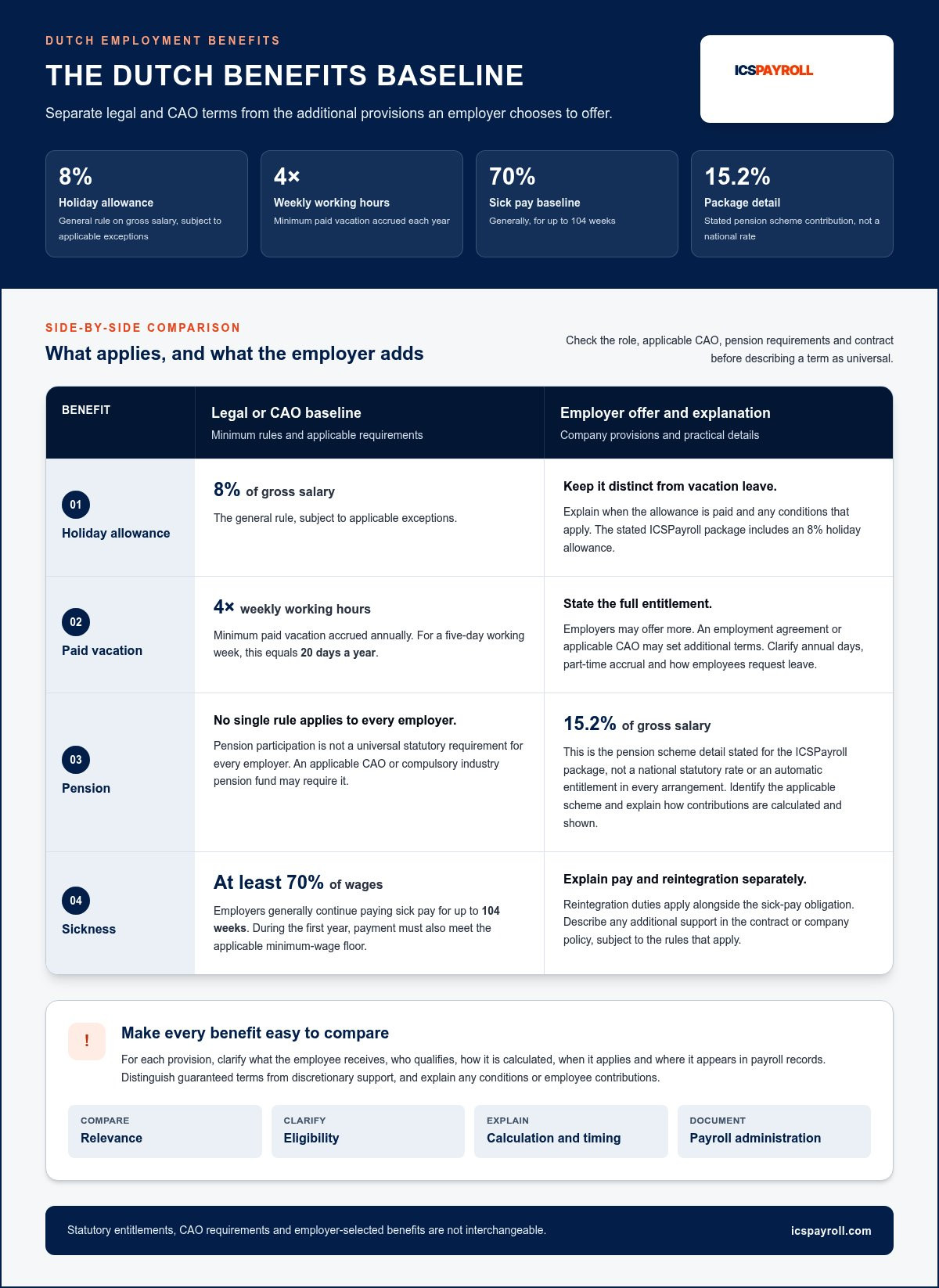
The Dutch government’s holiday allowance guidance sets out the general rule: holiday allowance is 8% of gross salary, subject to applicable exceptions. ICSPayroll’s stated package includes an 8% holiday allowance. This is a package detail that matches the general rate, and it is separate from paid vacation leave.
Under the Dutch government’s holiday entitlement rules, employees accrue at least four times their weekly working hours in paid vacation each year. For someone working five days a week, that is 20 days annually. Employers can offer more, and the employment agreement or applicable CAO may set additional terms. State the annual entitlement, how part-time accrual is calculated and how employees request leave. Do not describe extra days as the statutory minimum.
In practical terms, an employee may receive holiday allowance and take paid annual leave. They are not alternatives or two names for the same benefit. Explain the payment conditions separately from the employee’s vacation entitlement.
Pension and sickness-related provisions
Check which pension rules apply to the employee and employer. A scheme may be required under a CAO or a compulsory industry pension fund, but no single contribution rate applies universally. ICSPayroll’s stated package includes a pension scheme at 15.2% of gross salary. This is a package detail, not a national statutory rate or an automatic entitlement in every employment arrangement. Identify the applicable scheme and explain how contributions are calculated and shown.
Dutch government guidance on sick pay explains that employers generally continue paying at least 70% of wages for up to 104 weeks of sickness; during the first year, payment must also meet the applicable minimum-wage floor. Separately, employers and employees have reintegration duties to support a return to work. UWV Employer Information provides employer guidance on sickness-related administration. Explain the pay obligation in employment information and manage reintegration as a separate process.
For dutch employee expectations for benefits, accuracy starts with distinguishing the applicable legal minimum from optional provisions such as extra leave or additional support. Clear payroll records help employees understand what they receive and why. Employers using an EOR or payroll administration arrangement can review how Dutch benefits are administered through payroll.
How to compare benefit priorities without assuming every employee wants the same package
Begin with what applies by law, contract or CAO. Then separate those provisions from employer-selected benefits and the employee’s individual priorities. This turns a vague discussion about which benefits are attractive into a practical review of clarity, relevance, eligibility and administration.
| Category | Examples | What to assess |
|---|---|---|
| Required provisions | Applicable statutory rights and contractual or collective-agreement terms | Confirm the rule, who it covers, and how it is documented and administered. |
| Employer-selected benefits | Additional leave, pension provisions beyond applicable requirements, or other employer-funded support | Explain eligibility, value, conditions, and whether the provision is fixed or discretionary. |
| Employee-specific preferences | Interest in flexibility, particular support, or help understanding a tax application | Discuss individual relevance without assuming that one preference applies to the whole workforce. |
Compare benefits by employee need and employment context
Apply the same questions to every provision: Is it clear? Is it relevant to this employee? Who qualifies? How will it appear in employment documents and payroll? This makes gaps easier to spot without treating any benefit as universally preferred. Revisit the conversation during hiring and at suitable review points, because an employee’s role or circumstances may change.
International hires may ask about assistance with a 30% ruling application. Treat this as a separate tax application, not a benefit guaranteed by the employer. Eligibility conditions apply, and the Belastingdienst makes the decision. The 30% ruling employer guide covers eligibility and application details. Discuss whether the employee may be eligible without promising approval or a particular tax outcome.
Make the total package understandable
Present compensation as a connected package, while keeping each component distinct. Show salary alongside holiday allowance, applicable pension arrangements and any additional employer provisions. Explain payment timing, eligibility conditions, relevant employee contributions and where the employee can find the terms. The Dutch holiday allowance guide provides detailed rules and calculations; do not compress exceptions into a short offer summary.
Use plain language to explain whether a provision is employer-funded or deducted from salary, and whether eligibility depends on role, hours or another condition. Do not present an estimated tax effect as guaranteed net pay.
To understand dutch employee expectations for benefits, use a structured conversation rather than assumptions. Ask which package elements need clarification, record agreed terms accurately and review whether the promised provisions are delivered as described. This supports a credible offer while keeping obligations, optional benefits and personal preferences separate.
A practical framework for setting and communicating benefits in the Netherlands
A reliable benefits process connects compliance, documentation and employee communication. Keep an approved record of each provision, then use it to align employment terms, payroll setup and employee-facing information. For legal or tax statements in policies and offers, cite the relevant official source at first mention and check that the guidance is current. Review wider Dutch employment law compliance alongside the benefits package.
- Identify obligations. Map the rules that apply to the employment relationship, including relevant legislation, collective labour agreements and pension requirements. Separate confirmed obligations from employer choices. Do not present proposed changes or unverified market practices as current requirements.
- Define the package. Record each benefit, who qualifies, how it is calculated or accrued, and when it is provided. Include any conditions or employee contributions. This gives hiring teams a consistent basis for discussing the offer without suggesting every provision applies to every worker.
- Document the terms. Use clear language in employment contracts and supporting policy materials. State the applicable provisions, eligibility criteria, timing and process for access. Keep contracts, handbook materials and payroll instructions aligned so employees do not receive conflicting explanations.
- Explain access. Tell employees where to find their terms, how to submit a request and where to raise questions. Explain technical subjects in plain language, including the practical steps involved, without promising a particular tax result or treatment.
- Review administration. Check that payroll records reflect the agreed package and that changes are recorded and communicated consistently. Assign responsibility for updating employee information, confirming effective dates and answering questions. Review the process when terms or circumstances change.
Document benefits clearly in employment terms
Be precise about whether a provision is statutory, required by an applicable agreement, contractual or discretionary. Identify its start date and eligibility conditions. If a benefit changes, record the change and effective date, then update each relevant document and payroll instruction. This gives employees and administrators a consistent reference.
Do not treat proposed legislation or informal descriptions of market practice as binding rules. Verify legal and tax wording against official Dutch sources before including it in an offer or policy. A Dutch employment law compliance guide can support a wider review of employer responsibilities beyond benefits.
Administer changes and employee questions consistently
Use a defined process when an employee joins, changes working arrangements or becomes eligible for a provision. Confirm the approved terms, update the relevant records, and explain what has changed and when it takes effect. An employee portal can give staff access to payslips, contracts and holiday balances, helping them find key information without relying on informal explanations.
Payroll administration should follow the documented terms, while employee-facing records should make those terms understandable. For a consistent approach to Dutch benefits and payroll administration, review your Dutch payroll requirements with ICSPayroll.
How ICSPayroll supports clear Dutch benefits administration
After identifying applicable obligations and defining the package, employers need to administer agreed terms consistently. ICSPayroll’s Netherlands Employer of Record (EOR) service provides a local employment framework for hiring without first establishing a Dutch entity. Under the EOR arrangement, ICSPayroll acts as the legal employer and manages local compliance, tax and insurance obligations, connecting employment terms with Dutch payroll administration.
This gives international employers a coordinated route for Dutch employment administration, while employees receive clear information about their documented terms. The practical priorities are to explain the package, process it consistently and provide access to important employment records.
What the ICSPayroll service brings together
The Netherlands EOR service includes full-service Dutch payroll administration. ICSPayroll’s stated package includes an 8% holiday allowance and a pension scheme at 15.2% of gross salary. The pension scheme is a package detail, not a universal statutory contribution rate; its application depends on the relevant employment arrangement.
The package also includes sickness risk coverage for up to two years, sick-leave support and HR administration. These services support the administration of employment terms and sickness-related processes. Explain which terms apply to each employee and distinguish package provisions from legal obligations.
Payroll records connect the agreed package to the employee’s pay information. The online employee portal provides access to payslips, contracts and holiday balances, allowing employees to review key records in one place. A payroll factor consolidates employment costs into one clear monthly invoice. It covers items such as holiday allowance, pension, sickness risk, social security and employer premiums, transition allowance, HR administration, portal access, 30% ruling assistance where applicable, and sick-leave support.
A clear next step for international employers
With an EOR arrangement, an international employer can hire in the Netherlands before establishing a Dutch BV, or without a Dutch entity. This provides an employment route while the employer focuses on defining the role and agreeing clear terms with the employee. The EOR arrangement is for employment in the Netherlands.
Before hiring, prepare the role details and proposed employment terms, then establish which provisions apply and how to communicate them. ICSPayroll provides a tailored quotation within 24 hours. The service agreement and employment contract are ready within days, setting out the proposed arrangement and supporting clear documentation and payroll administration.
Building a credible offer means more than adding benefits. Explain their conditions and administer them consistently to address dutch employee expectations for benefits without treating individual preferences as universal. Discuss your Dutch hiring plans and benefits administration with ICSPayroll. Discuss Dutch employment administration.
Turn your benefits approach into a confident hiring plan
A benefits package should stay clear as your Dutch team grows and employment arrangements evolve. Treat it as an ongoing process, not a one-time hiring decision. Assign responsibility for reviewing terms, keeping employee information current and answering questions consistently. This helps dutch employee expectations for benefits inform real conversations without replacing individual assessment or legal review.
For international employers, a practical next step is to map hiring needs against the employment structure and administration required in the Netherlands. ICSPayroll can prepare a tailored quotation within 24 hours, giving you a clear starting point for planning the arrangement and its administration.
Discuss compliant Dutch hiring and benefits administration and take the next step with a clear plan for your team in the Netherlands.
Frequently Asked Questions
Is holiday allowance mandatory in the Netherlands?
Generally, employers must pay holiday allowance, subject to applicable exceptions and the employee’s employment terms. The Dutch government’s holiday allowance guidance explains the general rules. ICSPayroll’s stated package includes holiday allowance of 8% of gross salary. This allowance is separate from paid vacation days: one is additional pay, while the other is time off. Check the employment terms for the applicable calculation and payment arrangements.
Do all Dutch employers have to provide a pension scheme?
No single pension arrangement applies to every employer and employee. An obligation to participate may arise from a collective labour agreement or compulsory industry pension fund, so establish which rules cover the specific employment situation. ICSPayroll’s stated 15.2% pension scheme is a package detail, not a universal statutory rate. Keep that distinction clear in offers and employment documents, and verify applicable requirements with authoritative pension and employment guidance.
Can an employee receive holiday allowance monthly in the Netherlands?
Monthly payment may be possible where the applicable rules and employment terms allow it, but do not assume every arrangement uses that schedule. Payment timing is distinct from the allowance itself. State clearly in the employment terms and payroll information when it will be paid, and ensure the schedule follows the applicable rules. The Dutch government’s holiday allowance guidance provides information on payment arrangements.
Does the 30% ruling apply automatically to international employees?
No. Potential eligibility does not grant the ruling automatically. The Belastingdienst must issue a written decision, and eligibility and application timing conditions apply. Treat ruling assistance as a separate tax application, not a guaranteed employment benefit or promised tax outcome. Consult the dedicated 30% ruling guide for application steps and eligibility details, then explain that approval rests with the tax authority.
What happens to Dutch employee benefits when an employee is on sick leave?
Sick pay and reintegration are separate matters. Employers generally have a continued wage-payment obligation during sickness, while employers and employees also take steps to support a return to work. UWV Employer Information provides guidance for employers on sickness-related matters. Other package elements may be treated differently depending on applicable rules and employment terms, so review the contract and payroll records rather than assuming every benefit continues unchanged.
Can an international company offer Dutch benefits without setting up a Dutch BV?
Yes. ICSPayroll’s Netherlands Employer of Record service can employ staff before a Dutch BV is established or when the company has no Dutch entity. This is an employment and payroll arrangement that supports local employment administration. It is not recruitment or entity incorporation. The EOR guide explains the broader model and responsibilities, helping employers understand how the arrangement fits their Dutch hiring plans and agreed employee terms.

Article by
Joost Hubregtse
Joost Hubregtse is Director of ICS Staffing & Payroll B.V., the wholly owned subsidiary of Intercompany Solutions behind ICS Payroll. He is responsible for Employer of Record and Dutch payroll services: employment contracts, wage tax and social security filings, holiday allowance, pension, sick leave and CAO compliance, with onboarding possible within 48 hours.
Frequently Asked Questions
Employment benefits can include salary and other pay elements, annual leave, holiday allowance, pension arrangements, sickness-related obligations and additional employer-provided support. The rules differ by category. Pension participation, for example, is not a universal statutory requirement for every employer, but an applicable CAO or industry pension fund may make it compulsory. Sickness-related duties also arise under Dutch employment law; additional support may be described in a contract or company policy. For each provision, explain what the employee receives, who qualifies, how it is calculated and when it applies. Distinguish contractual leave from extra leave offered by the employer, and clarify whether an additional provision is guaranteed or discretionary. These details make the offer easier to compare and help prevent an optional benefit from being mistaken for an entitlement. Applicability depends on the employment relationship and the rules covering it. Review the relevant law, CAO, pension requirements and contract before describing a provision as universal.
Generally, employers must pay holiday allowance, subject to applicable exceptions and the employee’s employment terms. The Dutch government’s holiday allowance guidance explains the general rules. ICSPayroll’s stated package includes holiday allowance of 8% of gross salary. This allowance is separate from paid vacation days: one is additional pay, while the other is time off. Check the employment terms for the applicable calculation and payment arrangements.
No single pension arrangement applies to every employer and employee. An obligation to participate may arise from a collective labour agreement or compulsory industry pension fund, so establish which rules cover the specific employment situation. ICSPayroll’s stated 15.2% pension scheme is a package detail, not a universal statutory rate. Keep that distinction clear in offers and employment documents, and verify applicable requirements with authoritative pension and employment guidance.
Monthly payment may be possible where the applicable rules and employment terms allow it, but do not assume every arrangement uses that schedule. Payment timing is distinct from the allowance itself. State clearly in the employment terms and payroll information when it will be paid, and ensure the schedule follows the applicable rules. The Dutch government’s holiday allowance guidance provides information on payment arrangements.
No. Potential eligibility does not grant the ruling automatically. The Belastingdienst must issue a written decision, and eligibility and application timing conditions apply. Treat ruling assistance as a separate tax application, not a guaranteed employment benefit or promised tax outcome. Consult the dedicated 30% ruling guide for application steps and eligibility details, then explain that approval rests with the tax authority.
Sick pay and reintegration are separate matters. Employers generally have a continued wage-payment obligation during sickness, while employers and employees also take steps to support a return to work. UWV Employer Information provides guidance for employers on sickness-related matters. Other package elements may be treated differently depending on applicable rules and employment terms, so review the contract and payroll records rather than assuming every benefit continues unchanged.
Yes. ICSPayroll’s Netherlands Employer of Record service can employ staff before a Dutch BV is established or when the company has no Dutch entity. This is an employment and payroll arrangement that supports local employment administration. It is not recruitment or entity incorporation. The EOR guide explains the broader model and responsibilities, helping employers understand how the arrangement fits their Dutch hiring plans and agreed employee terms.