
How to Pay Employees in the Netherlands: A 2026 Payroll Guide
By Joost Hubregtse, Director, ICS Staffing & Payroll
All blog posts are reviewed and fact checked by our labour law lawyer Zishan Hussain and our director. Editorial standards
Paying a Dutch employee correctly starts before payday, and forming a local company isn’t always the first step. If you’re working out how to pay employees in the netherlands, the challenge goes beyond calculating net salary. You also need to understand which employer costs apply, what must be reported, and how to keep payroll on schedule.
Agreeing a gross salary is only the beginning. The payroll process must account for tax withholding, employer premiums, employee records, and filing and payment deadlines. The route you choose also affects who handles each responsibility, and whether you need a Dutch legal entity before hiring.
This guide sets out the steps from salary agreement to payment, explains the main Dutch payroll obligations, and compares employing staff through your own Dutch entity with using an Employer of Record. For international employers, an Employer of Record can make hiring possible before or without a Dutch BV. You’ll leave with a clearer view of the practical options and the controls that help keep salary payments accurate and compliant.
Key Takeaways
- Understand how payroll separates deductions from an employee’s gross salary, employer premiums, and the net pay they receive.
- Compare direct payroll through a Dutch entity with an Employer of Record arrangement to identify who manages employment and payroll obligations.
- Follow a clear payroll sequence, from checking employee details and pay changes to paying wages, filing, and retaining records.
- Learn how to pay employees in the netherlands with a process that keeps salary calculations and payroll administration on track.
- See how managed EOR and payroll administration can consolidate payroll-related employment costs into one monthly invoice.
Before the First Salary: What Paying Employees in the Netherlands Involves
Dutch payroll is the process of calculating an employee’s net wages, paying them, remitting required amounts and keeping the related records. The bank transfer is only one part of the process. A compliant payroll run connects the employment terms to accurate calculations, payslip information, reporting and recordkeeping.
For an international employer, deciding how to pay employees in the netherlands starts with establishing a compliant route before the first payroll run. Direct employment may involve Dutch payroll tax registration and ongoing administration. An Employer of Record (EOR) can provide a Dutch legal employer when your company wants to hire before or without establishing a Dutch entity.
What does it mean to pay an employee in the Netherlands?
Paying staff involves more than transferring the agreed salary. The employer calculates gross-to-net pay, provides a payslip, pays the employee, reports payroll information and remits the amounts due. Payroll records must also be maintained. These duties are connected: a change to salary or working arrangements can affect calculations, the payslip and reported figures.
The employment contract sets key terms, while an applicable collective labour agreement (CAO) may also affect pay arrangements. For current requirements, consult the Dutch government’s Business.gov.nl guidance on paying staff and wages. It provides a useful reference for checking employer obligations as you prepare payroll.
What should an international employer settle before payroll begins?
Set the employment relationship, agreed salary, start date and payroll responsibility before the first pay period. Then establish who will act as the Dutch employer and manage the related administration. If your company employs the worker directly, determine whether it must register for Dutch payroll taxes and prepare to manage its own payroll obligations. Alternatively, an EOR arrangement can act as the local employer and handle payroll administration.
These decisions affect the information needed to run payroll. Confirm the employee’s details, the agreed pay terms and which party will calculate wages, provide payslips, report payroll and maintain records. Resolve any uncertainty before the start date rather than treating registration or payroll setup as a task for payday.
Employment terms also shape the process. Clarify which pay arrangements apply, including any relevant CAO terms, and make sure the responsible payroll route has the information needed to apply them. Foreign employers assessing contract terms and responsibilities can refer to the guide Employment Law in the Netherlands for Foreign Employers: 2026 Compliance Guide. With the employer, terms and payroll responsibilities established, the first salary run can proceed on a clear basis.
How Dutch Payroll Turns Gross Salary into Net Pay
Gross salary is the starting point, not the amount an employee receives or the full amount an employer spends. Payroll separates deductions from the employee’s gross pay and costs the employer pays separately. Keeping those categories distinct helps employers explain the payslip and assess the full cost of an employment arrangement.
Which amounts affect an employee’s take-home pay?
Payroll starts with gross salary for the pay period. It then calculates wage tax withholding and any applicable employee deductions, such as an employee pension contribution. The remaining amount is net pay, which is transferred to the employee. The calculation depends on the individual employee’s circumstances and applicable arrangements, so a general estimate may not reflect a specific person’s take-home pay.
The payslip makes the calculation visible. It shows how gross pay, deductions and net pay relate to one another, allowing the employee to understand the amount received. Check that it reflects the agreed employment terms and any changes that apply to the period.
Which payroll costs sit on the employer side?
Employer-side costs are separate from amounts deducted from gross salary. They may include employer premiums, the employer’s share of a pension arrangement where applicable, and employment obligations such as holiday allowance and sick pay. Applicable premium rates and contribution bases depend on the relevant circumstances and payroll period. Check the current Dutch payroll tax guidance when preparing calculations.
Holiday allowance is generally 8% of gross salary and should be treated consistently with the employment terms. For sickness, wage continuation is a separate employer obligation. Use the Dutch government’s guidance on continued payment of wages during illness when reviewing the applicable treatment. Pension arrangements may divide contributions between employer and employee, so an employee pension deduction should not be counted as an employer premium.
- Wage tax withholding and applicable employee deductions
- Employee pension contribution, if applicable
- Net pay is the resulting amount transferred to the employee
- Employer premiums, calculated using the applicable rate and contribution base
- Employer pension contribution, where applicable
- Holiday allowance and other employment obligations
Net salary is not the employer’s total employment cost: it is the amount paid to the employee after applicable deductions, while employer premiums and other employment costs are separate. Review the relevant rates and contribution bases for each payroll period rather than relying on assumptions from an earlier calculation.
For more detail on payroll administration, consult the Dutch Payroll Administration: The 2026 Complete Reference Guide. Managed payroll administration can help keep employee pay and employer-side costs organised; ICSPayroll’s Dutch payroll administration supports that process.
Choose Your Dutch Payroll Route: Direct Payroll or an Employer of Record
The right payroll route depends on who will legally employ the worker and who will manage the Dutch obligations that follow. With direct payroll, your Dutch entity is the employer. With an Employer of Record (EOR), the EOR employs the worker locally and manages employment administration for your company. Both routes can support compliant pay, but they place responsibility and setup requirements in different hands.
- Your entity is the Dutch legal employer.
- Your company manages its Dutch employment and payroll obligations.
- You arrange payroll processes, filings, employee records and ongoing administration.
- This route fits companies prepared to operate as an employer in the Netherlands.
- The EOR is the worker’s legal employer in the Netherlands.
- The EOR manages local employment compliance and payroll administration.
- Your company provides the information needed to administer the employment and pays the agreed employment costs.
- This route can enable hiring before or without your own Dutch BV.
When does direct payroll through a Dutch entity fit?
Direct payroll suits a company that has a Dutch entity and is ready to take on the employer role. The company must manage its own payroll process, filings and employment administration, maintaining accurate employee and pay information as circumstances change. Payroll software can help calculate wages or organise tasks, but it doesn’t remove the company’s responsibilities as the employer.
When can an EOR simplify Dutch hiring?
An EOR can be useful when your company needs to employ Dutch-based staff but doesn’t yet have a Dutch BV, or prefers not to establish one before hiring. The EOR becomes the legal employer and manages local employment compliance, payroll administration and related records. Your company still directs its business activities and supplies accurate employment details, but it doesn’t run the Dutch payroll as the direct employer.
That role distinguishes an EOR from payroll software. Software is a tool for processing or organising payroll; it doesn’t become the employee’s legal employer. An EOR does. The arrangement therefore changes who holds the local employment relationship and carries out employer administration, rather than simply changing how salary calculations are produced.
To decide how to pay employees in the netherlands, consider whether your company is ready to act as the Dutch employer and manage the associated obligations itself. If it is, direct payroll through a Dutch entity may be appropriate. If you need a local employer without first establishing your own BV, an EOR offers another route. Companies considering that model can explore the existing guide, Employer of Record Netherlands: The 2026 Guide to Compliant Hiring, for more on compliant hiring through an EOR.
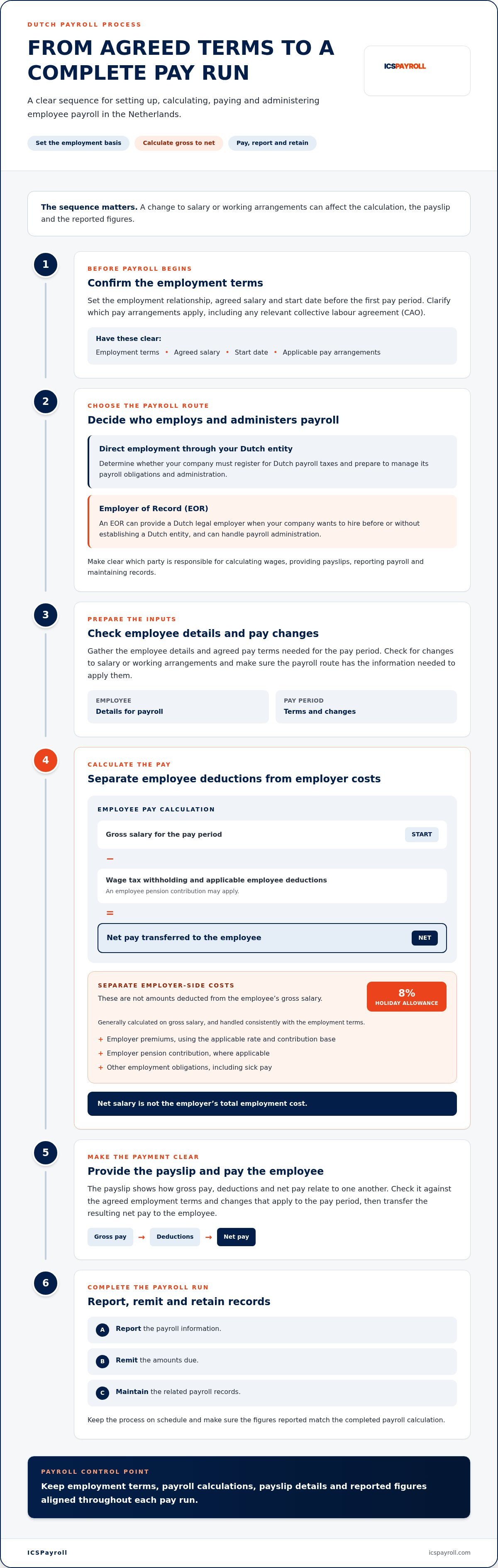
How to Pay Employees in the Netherlands: Run Each Payroll Step by Step
A consistent payroll run moves from checking employee changes to paying wages, filing payroll information and preserving records. Follow the same sequence each pay period, with a clear review before payment is authorised.
- Collect and validate changes. Confirm approved salary changes, working time, leave, applicable allowances and employee details. Check that the information reflects the employment terms and any relevant collective labour agreement.
- Prepare the calculation. Calculate gross pay for the period, then account for applicable deductions and employer-side amounts. Use the rates and contribution bases that apply to this payroll period, not assumptions carried over from an earlier run.
- Review the results. Compare the figures with agreed terms and approved changes. Check gross pay, deductions, employer premiums and payslip details. Investigate unexplained differences before authorising payment.
- Pay the wages. Transfer the employee’s net salary according to the agreed payment arrangements and provide a clear payslip showing the calculation.
- File the payroll tax return and pay amounts due. Submit the return and settle the reported amounts by the relevant deadline.
- Retain payroll records. Keep the calculation, supporting employee information, payslip and filing records organised so they can be retrieved when needed.
Prepare and review the payroll calculation
Start with approved source information rather than relying on the previous payroll file alone. Reconcile the contract and current salary with hours worked, leave taken, allowances and other changes for the period. Confirm that employee details are accurate. Then review deductions, employer premiums and payslip figures before approving the run. Apply any relevant collective labour agreement terms alongside current payroll rates.
Investigate differences from the previous period. A change may be correct, such as updated working hours or approved leave, but it should have a clear explanation and supporting information. This control helps identify missing changes and calculation errors before payment.
Pay wages, file, and retain records
Make payment according to the agreed employment terms and provide the employee with a payslip that clearly presents the calculation. Keep payment information and payroll calculations together so the employee’s payslip can be reconciled with the figures reported.
The payroll tax return, or loonaangifte, is due by the last day of the month following the payroll period. Payroll records must be retained for seven years. Include both obligations in the payroll calendar and follow the Belastingdienst payroll tax guidance for filing and recordkeeping requirements. A calendar reminder should identify the period covered and leave enough time to review the return before submission.
This workflow makes how to pay employees in the netherlands a repeatable control process: validate, calculate, review, pay, file and retain. For support managing Dutch payroll administration, use ICSPayroll’s managed payroll service.
Pay Dutch Employees with ICSPayroll’s Managed EOR and Payroll Service
International employers can use ICSPayroll’s Netherlands-focused Employer of Record (EOR) and full-service payroll administration to employ staff in the Netherlands while focusing on their business. With an EOR arrangement, ICSPayroll becomes the local legal employer and manages Dutch employment administration. Hiring can begin before a Dutch BV is established or without a Dutch entity.
What does ICSPayroll manage for an international employer?
The service brings key payroll and employment administration together. ICSPayroll manages payroll calculations and payslips, payroll filings, employer premiums, HR administration and employee portal access. Sick-leave support is also included, helping keep employment administration connected to the employee’s circumstances.
Employment costs are consolidated into one monthly invoice. The payroll factor is calculated by multiplying the employee’s gross salary by the applicable factor. This provides a single monthly amount for payroll-related employment costs, rather than requiring the employer to coordinate each payroll component separately. The factor reflects the applicable employment costs for the arrangement.
Immigration sponsorship is arranged via our licensed partner. This is separate from 30% ruling assistance: immigration sponsorship concerns immigration, while the 30% ruling is granted by the Belastingdienst. ICSPayroll can support eligible 30% ruling applications, but eligibility and approval are determined through the applicable process.
What happens after an employer is ready to proceed?
Once employee details are supplied, ICSPayroll provides a tailored quotation within 24 hours. After proceeding, the service agreement and employment contract are prepared within days. This gives the employer a defined route from sharing hiring details to setting up the employment arrangement and payroll administration.
For eligible employees, ICSPayroll can assist with a 30% ruling application. The application is subject to the relevant conditions and a decision by the Belastingdienst. For non-Schengen staff requiring Highly Skilled Migrant application support, expedited applications typically take about three weeks. This is a typical processing timeframe, not a promise of approval; immigration sponsorship is arranged via our licensed partner.
The managed arrangement is designed for companies that want a Dutch legal employer and local payroll administration without first establishing their own Dutch entity. It places employment administration, payroll processing and related records within a Netherlands-focused service, while the client remains focused on directing its business. The monthly invoice also brings payroll-related costs into a clear consolidated amount.
For international employers ready to put a Dutch hiring arrangement in place, start your Dutch EOR and payroll setup with ICSPayroll.
Make Your Dutch Hiring Plan Payroll-Ready
Your next step is to turn a hiring decision into a clear operating plan. Confirm who will employ the person, who will manage payroll administration, and how employee information and approvals will reach the people responsible for each pay run. Clear ownership from the outset helps keep payroll reliable as your Dutch team grows.
Choosing how to pay employees in the netherlands is ultimately about finding a workable way to meet local employment responsibilities while supporting your business plans. You can build that process internally or use a managed arrangement that places Dutch employment administration with a local specialist. The right choice gives your team a defined path from onboarding through ongoing payroll, without leaving essential responsibilities unclear.
Take the next step with a Netherlands-focused employment and payroll partner. Hire in the Netherlands with confidence and move forward with a clear plan for your team.
Frequently Asked Questions
What is the minimum wage in the Netherlands in 2026?
For employees aged 21 and over, the statutory hourly minimum wage is €14.71 from 1 January 2026 and €14.99 from 1 July 2026. Apply the rate that was in force on the date the hours were worked, including where a pay period spans both dates. Check the Dutch government’s minimum wage guidance before setting or reviewing pay, and update payroll settings for the effective date.
How much do employers pay in Dutch payroll contributions?
For 2026, stated employer rates include AWf at 2.74% or 7.74%, Aof at 6.27% or 7.63%, and employer Zvw at 6.10%. The maximum premium base is €79,409. The applicable rate depends on the contribution and relevant circumstances, so don’t apply one percentage to every employee or cost. Check the Belastingdienst’s payroll tax guidance and current official rates before calculating employment costs.
How much sick pay must an employer provide in the Netherlands?
Dutch employers generally continue paying 70% of wages for up to 104 weeks of illness, with a minimum-wage floor during the first year. This obligation is based on article 7:629 of the Dutch Civil Code. Wage continuation and reintegration are separate responsibilities: reintegration follows its own process and steps. The Dutch government explains wage continuation during illness in its official guidance.
Is holiday allowance mandatory in the Netherlands?
Holiday allowance is generally 8% of gross salary and should be accounted for in payroll. Make its calculation and payment approach clear to the employee, and check the employment terms and any applicable collective labour agreement. If an exception or adjustment may apply, verify the current official rules before changing payroll treatment. For example, make sure the allowance is handled consistently when reviewing salary changes or preparing a new employment arrangement.
How does the 30% ruling affect Dutch payroll?
If an employee qualifies and the Belastingdienst grants the ruling, the employer can apply the approved tax treatment through Dutch payroll. It isn’t automatic: eligibility, salary requirements and application timing matter. Confirm the employee’s circumstances and the current 2026 salary norms, cap and rate in Belastingdienst guidance before applying it. Immigration sponsor status does not determine eligibility for the ruling.
When is the Dutch payroll tax return due?
Under the 2026 Fact Sheet, the payroll tax return, or loonaangifte, is due by the last day of the month following the payroll period. Confirm the relevant period and current filing instructions in official guidance, and set a calendar reminder tied to each reporting period. Payroll records must be retained for seven years under the Fact Sheet, so keep filings and supporting records organised for retrieval.
What must a Dutch payslip show?
A Dutch payslip should clearly explain the employee’s pay calculation, including relevant gross wages, deductions and the net amount. It should also contain required employment and payroll details under current Dutch rules. Check official guidance for the precise information required, and reconcile the payslip with the payroll calculation before issuing it. Clear, consistent payslips help employees understand changes in their pay and give employers a useful record of each payment.

Article by
Joost Hubregtse
Joost Hubregtse is Director of ICS Staffing & Payroll B.V., the wholly owned subsidiary of Intercompany Solutions behind ICS Payroll. He is responsible for Employer of Record and Dutch payroll services: employment contracts, wage tax and social security filings, holiday allowance, pension, sick leave and CAO compliance, with onboarding possible within 48 hours.
Frequently Asked Questions
Paying staff involves more than transferring the agreed salary. The employer calculates gross-to-net pay, provides a payslip, pays the employee, reports payroll information and remits the amounts due. Payroll records must also be maintained. These duties are connected: a change to salary or working arrangements can affect calculations, the payslip and reported figures. The employment contract sets key terms, while an applicable collective labour agreement (CAO) may also affect pay arrangements. For current requirements, consult the Dutch government’s Business.gov.nl guidance on paying staff and wages. It provides a useful reference for checking employer obligations as you prepare payroll.
Set the employment relationship, agreed salary, start date and payroll responsibility before the first pay period. Then establish who will act as the Dutch employer and manage the related administration. If your company employs the worker directly, determine whether it must register for Dutch payroll taxes and prepare to manage its own payroll obligations. Alternatively, an EOR arrangement can act as the local employer and handle payroll administration. These decisions affect the information needed to run payroll. Confirm the employee’s details, the agreed pay terms and which party will calculate wages, provide payslips, report payroll and maintain records. Resolve any uncertainty before the start date rather than treating registration or payroll setup as a task for payday. Employment terms also shape the process. Clarify which pay arrangements apply, including any relevant CAO terms, and make sure the responsible payroll route has the information needed to apply them. Foreign employers assessing contract terms and responsibilities can refer to the guide Employment Law in the Netherlands for Foreign Employers: 2026 Compliance Guide. With the employer, terms and payroll responsibilities established, the first salary run can proceed on a clear basis. Gross salary is the starting point, not the amount an employee receives or the full amount an employer spends. Payroll separates deductions from the employee’s gross pay and costs the employer pays separately. Keeping those categories distinct helps employers explain the payslip and assess the full cost of an employment arrangement.
Payroll starts with gross salary for the pay period. It then calculates wage tax withholding and any applicable employee deductions, such as an employee pension contribution. The remaining amount is net pay, which is transferred to the employee. The calculation depends on the individual employee’s circumstances and applicable arrangements, so a general estimate may not reflect a specific person’s take-home pay. The payslip makes the calculation visible. It shows how gross pay, deductions and net pay relate to one another, allowing the employee to understand the amount received. Check that it reflects the agreed employment terms and any changes that apply to the period.
Employer-side costs are separate from amounts deducted from gross salary. They may include employer premiums, the employer’s share of a pension arrangement where applicable, and employment obligations such as holiday allowance and sick pay. Applicable premium rates and contribution bases depend on the relevant circumstances and payroll period. Check the current Dutch payroll tax guidance when preparing calculations. Holiday allowance is generally 8% of gross salary and should be treated consistently with the employment terms. For sickness, wage continuation is a separate employer obligation. Use the Dutch government’s guidance on continued payment of wages during illness when reviewing the applicable treatment. Pension arrangements may divide contributions between employer and employee, so an employee pension deduction should not be counted as an employer premium. Net salary is not the employer’s total employment cost: it is the amount paid to the employee after applicable deductions, while employer premiums and other employment costs are separate. Review the relevant rates and contribution bases for each payroll period rather than relying on assumptions from an earlier calculation. For more detail on payroll administration, consult the Dutch Payroll Administration: The 2026 Complete Reference Guide. Managed payroll administration can help keep employee pay and employer-side costs organised; ICSPayroll’s Dutch payroll administration supports that process. The right payroll route depends on who will legally employ the worker and who will manage the Dutch obligations that follow. With direct payroll, your Dutch entity is the employer. With an Employer of Record (EOR), the EOR employs the worker locally and manages employment administration for your company. Both routes can support compliant pay, but they place responsibility and setup requirements in different hands.
Direct payroll suits a company that has a Dutch entity and is ready to take on the employer role. The company must manage its own payroll process, filings and employment administration, maintaining accurate employee and pay information as circumstances change. Payroll software can help calculate wages or organise tasks, but it doesn’t remove the company’s responsibilities as the employer.
An EOR can be useful when your company needs to employ Dutch-based staff but doesn’t yet have a Dutch BV, or prefers not to establish one before hiring. The EOR becomes the legal employer and manages local employment compliance, payroll administration and related records. Your company still directs its business activities and supplies accurate employment details, but it doesn’t run the Dutch payroll as the direct employer. That role distinguishes an EOR from payroll software. Software is a tool for processing or organising payroll; it doesn’t become the employee’s legal employer. An EOR does. The arrangement therefore changes who holds the local employment relationship and carries out employer administration, rather than simply changing how salary calculations are produced. To decide how to pay employees in the netherlands, consider whether your company is ready to act as the Dutch employer and manage the associated obligations itself. If it is, direct payroll through a Dutch entity may be appropriate. If you need a local employer without first establishing your own BV, an EOR offers another route. Companies considering that model can explore the existing guide, Employer of Record Netherlands: The 2026 Guide to Compliant Hiring, for more on compliant hiring through an EOR. A consistent payroll run moves from checking employee changes to paying wages, filing payroll information and preserving records. Follow the same sequence each pay period, with a clear review before payment is authorised.
The service brings key payroll and employment administration together. ICSPayroll manages payroll calculations and payslips, payroll filings, employer premiums, HR administration and employee portal access. Sick-leave support is also included, helping keep employment administration connected to the employee’s circumstances. Employment costs are consolidated into one monthly invoice. The payroll factor is calculated by multiplying the employee’s gross salary by the applicable factor. This provides a single monthly amount for payroll-related employment costs, rather than requiring the employer to coordinate each payroll component separately. The factor reflects the applicable employment costs for the arrangement. Immigration sponsorship is arranged via our licensed partner. This is separate from 30% ruling assistance: immigration sponsorship concerns immigration, while the 30% ruling is granted by the Belastingdienst. ICSPayroll can support eligible 30% ruling applications, but eligibility and approval are determined through the applicable process.
Once employee details are supplied, ICSPayroll provides a tailored quotation within 24 hours. After proceeding, the service agreement and employment contract are prepared within days. This gives the employer a defined route from sharing hiring details to setting up the employment arrangement and payroll administration. For eligible employees, ICSPayroll can assist with a 30% ruling application. The application is subject to the relevant conditions and a decision by the Belastingdienst. For non-Schengen staff requiring Highly Skilled Migrant application support, expedited applications typically take about three weeks. This is a typical processing timeframe, not a promise of approval; immigration sponsorship is arranged via our licensed partner. The managed arrangement is designed for companies that want a Dutch legal employer and local payroll administration without first establishing their own Dutch entity. It places employment administration, payroll processing and related records within a Netherlands-focused service, while the client remains focused on directing its business. The monthly invoice also brings payroll-related costs into a clear consolidated amount. For international employers ready to put a Dutch hiring arrangement in place, start your Dutch EOR and payroll setup with ICSPayroll. Your next step is to turn a hiring decision into a clear operating plan. Confirm who will employ the person, who will manage payroll administration, and how employee information and approvals will reach the people responsible for each pay run. Clear ownership from the outset helps keep payroll reliable as your Dutch team grows. Choosing how to pay employees in the netherlands is ultimately about finding a workable way to meet local employment responsibilities while supporting your business plans. You can build that process internally or use a managed arrangement that places Dutch employment administration with a local specialist. The right choice gives your team a defined path from onboarding through ongoing payroll, without leaving essential responsibilities unclear. Take the next step with a Netherlands-focused employment and payroll partner. Hire in the Netherlands with confidence and move forward with a clear plan for your team.
For employees aged 21 and over, the statutory hourly minimum wage is €14.71 from 1 January 2026 and €14.99 from 1 July 2026. Apply the rate that was in force on the date the hours were worked, including where a pay period spans both dates. Check the Dutch government’s minimum wage guidance before setting or reviewing pay, and update payroll settings for the effective date.
For 2026, stated employer rates include AWf at 2.74% or 7.74%, Aof at 6.27% or 7.63%, and employer Zvw at 6.10%. The maximum premium base is €79,409. The applicable rate depends on the contribution and relevant circumstances, so don’t apply one percentage to every employee or cost. Check the Belastingdienst’s payroll tax guidance and current official rates before calculating employment costs.
Dutch employers generally continue paying 70% of wages for up to 104 weeks of illness, with a minimum-wage floor during the first year. This obligation is based on article 7:629 of the Dutch Civil Code. Wage continuation and reintegration are separate responsibilities: reintegration follows its own process and steps. The Dutch government explains wage continuation during illness in its official guidance.
Holiday allowance is generally 8% of gross salary and should be accounted for in payroll. Make its calculation and payment approach clear to the employee, and check the employment terms and any applicable collective labour agreement. If an exception or adjustment may apply, verify the current official rules before changing payroll treatment. For example, make sure the allowance is handled consistently when reviewing salary changes or preparing a new employment arrangement.
If an employee qualifies and the Belastingdienst grants the ruling, the employer can apply the approved tax treatment through Dutch payroll. It isn’t automatic: eligibility, salary requirements and application timing matter. Confirm the employee’s circumstances and the current 2026 salary norms, cap and rate in Belastingdienst guidance before applying it. Immigration sponsor status does not determine eligibility for the ruling.
Under the 2026 Fact Sheet, the payroll tax return, or loonaangifte, is due by the last day of the month following the payroll period. Confirm the relevant period and current filing instructions in official guidance, and set a calendar reminder tied to each reporting period. Payroll records must be retained for seven years under the Fact Sheet, so keep filings and supporting records organised for retrieval.
A Dutch payslip should clearly explain the employee’s pay calculation, including relevant gross wages, deductions and the net amount. It should also contain required employment and payroll details under current Dutch rules. Check official guidance for the precise information required, and reconcile the payslip with the payroll calculation before issuing it. Clear, consistent payslips help employees understand changes in their pay and give employers a useful record of each payment.