
Hiring a Dutch Contractor vs Employee: How to Choose in 2026
By Joost Hubregtse, Director, ICS Staffing & Payroll
All blog posts are reviewed and fact checked by our labour law lawyer Zishan Hussain and our director. Editorial standards
By Joost Hubregtse, Payroll Director. Joost Hubregtse is Payroll Director at ICSPayroll, the Dutch payroll and EOR specialist of Intercompany Solutions. A career payroll specialist and former Head of Payroll, he oversees wage tax filings, 30% ruling applications, and employment compliance for international employers.
When considering hiring a dutch contractor vs employee, the contract label is only part of the picture. The key question is how the role works day to day: who directs the work, how independently it is performed, and whether the arrangement reflects genuine self-employment. That distinction matters since the Wet DBA enforcement moratorium ended on 1 January 2025.
It is understandable to weigh contractor flexibility against the payroll, social security, and employment responsibilities that come with hiring an employee. But using a contractor agreement for a role that operates like employment can create compliance risks. Assess the working relationship first, then choose the arrangement that fits.
This guide compares the legal and operational implications of hiring a Dutch contractor versus an employee, including factors that can indicate employment and the obligations that follow. It also explains how an Employer of Record can help international businesses employ Dutch-based staff without first establishing a Dutch BV. You will find a practical basis for choosing a compliant route that suits the role and your operating needs.
Key Takeaways
- Assess the actual working relationship, including direction, personal service, and remuneration, rather than relying on the contract title.
- Genuine contractors may suit independent, defined assignments; a continuing role integrated into your team may call for employee status.
- Use a four-step decision process: define the work, assess independence, review day-to-day practice, and select the appropriate route.
- When hiring a Dutch contractor vs employee, compare not only flexibility but also payroll administration and the responsibilities attached to employment.
- A Dutch Employer of Record can enable your business to employ Dutch-based staff without first establishing a Dutch BV.
Dutch contractor vs employee: what is the real difference for employers?
For an international employer, the choice is not simply between a flexible contract and payroll administration. It is whether the person will provide services as an independent business or perform work within an employment relationship. The right arrangement depends on the actual role and how the parties work together. Neither contractors nor employees are universally preferable.
What does each hiring arrangement mean in practice?
An independent contractor provides services under a commercial agreement. The engagement may focus on a defined project, specialist service, or agreed deliverable. The contractor carries out the work independently rather than filling a continuing position managed as part of the client’s regular team.
An employee works for an employer within an employment relationship. The role may be ongoing and integrated into business operations, with the employer responsible for applicable payroll administration and employment obligations. The employee’s work forms part of the organization’s operations rather than a separate external service supplied on commercial terms.
The distinction is practical, not just a matter of wording. A consultant independently delivering a specified report may fit a contractor arrangement. Someone doing continuing work alongside the team under the company’s day-to-day direction may function more like an employee, even if the agreement calls them a freelancer.
Why does classification matter to an international employer?
Classification affects how you administer the relationship. A contractor engagement is managed as a commercial arrangement, while employment brings payroll responsibilities and employee protections. Choosing the wrong route can leave an employer with obligations that the paperwork does not reflect.
Dutch employment guidance is relevant when assessing relationships involving people working in the Netherlands. An international company should assess the role and actual working arrangements before deciding how to engage someone. The contract matters, but it cannot by itself turn an employment relationship into independent contracting.
In short: the contract records what the parties call the arrangement; the working relationship shows how it operates in practice.
The central question in hiring a dutch contractor vs employee is whether the person independently supplies a service or carries out a role as part of your business. Review the duties, level of integration, and how the work is organized. A contractor may be appropriate for genuinely independent services. Where the role operates as employment, an employment route aligns the hiring structure with the work being done.
How Dutch law assesses contractor status and employment in 2026
Dutch classification depends on the substance of the working relationship, not only on the document the parties sign. The assessment considers the work performed, remuneration, and authority exercised over the worker. The agreement is relevant, but it must be compared with how the engagement works in practice. Official Dutch government guidance on employment relationships explains the distinction between employment and working as a self-employed professional.
Review the actual working relationship
Assess the arrangement as it functions day to day. Start with these questions:
- Direction: Who decides how, when, and where the work is done? Detailed instructions and ongoing supervision may point toward an employment relationship.
- Integration: Is the person filling a continuing role within ordinary operations, or delivering a defined service as an independent provider?
- Consistency: Do actual routines match the contract’s description of the relationship?
Consider the full picture. A contract may describe a project-based service while the person’s daily work follows the company’s schedule, direction, and internal processes. Conversely, working with a client over time does not by itself establish employment if the person genuinely provides services independently. No single indicator guarantees a particular classification.
Wet DBA enforcement and the VBAR bill
The Wet DBA enforcement moratorium ended on 1 January 2025. The Dutch Tax Administration can assess payroll tax obligations retroactively from that date. A soft-landing approach remains in place through 2026 and ends on 1 January 2027. Assess the working relationship rather than assuming the contract label determines its status. See the official Dutch government guidance on hiring self-employed professionals and model agreements.
The VBAR bill is not yet in force. The Dutch Senate passed a reduced version on 16 June 2026. Its remaining provision is a legal presumption of employment for contractors earning below €38 per hour. Entry into force is pending, so this presumption is not current law. Check the Dutch Senate’s VBAR bill information for its official status. If enacted, the presumption would give a qualifying worker a route to claim employee status; it would not automatically reclassify every contractor below that rate.
Document the intended service, compare it with actual working practices, and revisit the assessment if the role changes. If the review indicates employee status, an Employer of Record can provide an employment route for an international company hiring in the Netherlands.
Contractor vs employee in the Netherlands: compare obligations and trade-offs
The practical difference is who provides the service and who handles employment administration. A contractor may suit a genuinely independent, defined assignment. If the person performs an ongoing role under your business’s direction, assess employment instead. Neither route is automatically less costly: compare the full responsibilities and operational fit, not just the contract or invoice.
| Area | Independent contractor | Employee |
|---|---|---|
| Relationship | Commercial engagement to provide services, potentially for a defined project or deliverable. | Employment relationship for work carried out as part of the employer’s operations. |
| Administration | Manage the commercial agreement and service arrangement. | Set up and maintain employment and HR administration. |
| Payroll handling | Payment follows the commercial arrangement. This label alone does not settle legal status. | Employer handles payroll processing, wage tax withholding, social security, and applicable employer premiums. |
| Operational flexibility | Can fit independent work with an agreed scope and deliverable. | Provides a structure for a continuing position within the team, with the employer managing the relationship. |
Employee responsibilities and payroll components
Hiring an employee means accounting for payroll and employment administration, including wage tax, social security, and applicable employer premiums. The employer also manages employment terms and related HR processes. Include these responsibilities in workforce planning rather than treating them as optional additions to salary.
Allowances and pension arrangements need clear context. In ICSPayroll’s stated payroll factor, employment costs include an 8% holiday allowance and a 15.2% pension scheme. These figures describe the service’s stated cost components; they are not a universal statement that every Dutch employer has an identical pension scheme.
When a contractor arrangement may fit
A contractor can be appropriate for independent, project-based work, such as delivering a defined technical assessment without taking on a continuing internal position. The commercial agreement should describe the actual service, scope, and working arrangement. Those terms must also match how the work is performed in practice.
Flexibility does not determine classification. Nor does calling someone a contractor or paying against invoices. If the business directs the person’s ongoing work as part of its operations, the arrangement’s reality may point toward employment. When comparing hiring a dutch contractor vs employee, assess the relationship first, then compare the administration and operational consequences of the route that fits.
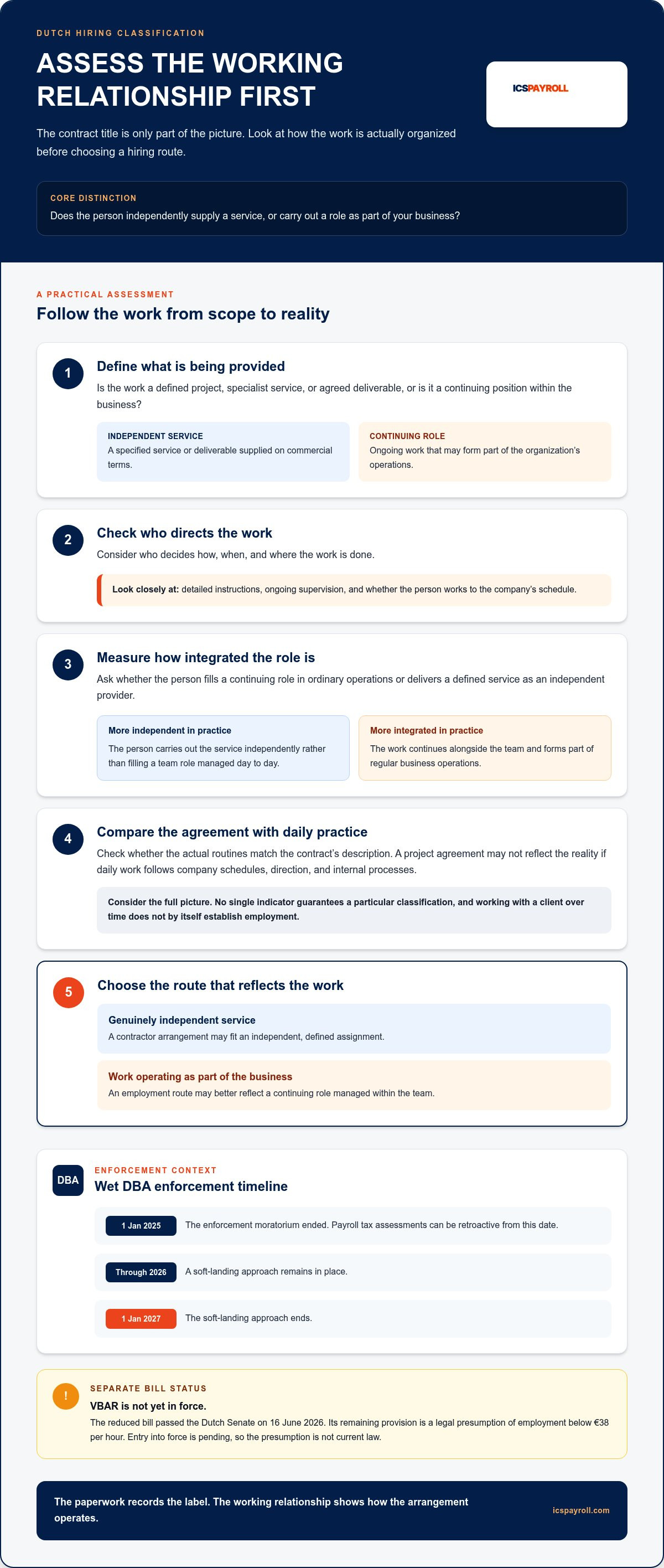
How to decide between a Dutch contractor and employee for your role
Use a structured review before agreeing on the arrangement. Match the hiring route to how the work will actually be performed, rather than selecting a contract label first and adapting the role around it.
- Define the work. Write down the expected output, responsibilities, and duration. A separate service provider engaged to deliver a defined project is different from a person expected to fill an ongoing position in your team.
- Assess independence. Consider who will set priorities, methods, schedules, and performance expectations. If your business needs to direct the person’s regular work, assess whether the role should be employment.
- Review actual practice. Compare the proposed agreement with how the work is expected to happen day to day. Identify who assigns tasks, how closely the person works with the team, and whether the scope remains an external service or develops into an internal role.
- Select the route. Choose a contractor arrangement only where the relationship is genuinely independent. If the role functions as employment, plan for an employment relationship and its associated administration.
Questions to resolve before agreeing the arrangement
Be specific. Who decides how work is carried out? Who sets the schedule and changes priorities? Is the business buying a particular service, or does it need a continuing team member whose work is directed as business needs evolve? Do the written terms accurately describe those expected practices? Clear answers can expose a mismatch before the engagement starts.
Keep a record of the role’s scope, responsibilities, and operating arrangements. Review it if duties, supervision, or working practices change. A relationship that starts as a limited external assignment may develop into something different, so do not treat the initial classification as permanent if the role changes. For broader context, consult a guide to employment law in the Netherlands for foreign employers.
When the role points toward employment
If the working relationship calls for employee status, use an employment route and include Dutch payroll and HR administration in your operational planning. International companies can employ Dutch-based staff through an Employer of Record without first establishing a Dutch BV. A Dutch payroll administration guide can explain the payroll responsibilities involved.
For hiring a dutch contractor vs employee, the decision should follow the role’s reality. Explore Dutch EOR employment support for hiring in the Netherlands without a Dutch entity.
Hire a Dutch employee through an EOR without setting up a BV first
If your assessment points to employee status, an Employer of Record (EOR) offers an employment route without requiring your international company to establish a Dutch BV first. ICSPayroll acts as the legal employer in the Netherlands, while your business engages the employee for the role. This lets you hire in the Netherlands without setting up a local entity before employment begins.
The choice between an employee and contractor should follow the actual working relationship. An EOR is relevant when the role calls for employment, not as a way to relabel an independent contractor arrangement. For international businesses weighing hiring a dutch contractor vs employee, it connects the classification decision with a practical employment route.
What Dutch EOR support covers after choosing employment
Employment brings local payroll and HR administration. Through its EOR service, ICSPayroll supports the employment relationship with payroll processing, social security and employer premium handling, HR administration, and employee portal access. A consolidated payroll factor brings employment costs together in one monthly invoice, helping your business manage the administration through a single arrangement.
The service also includes sick-leave support. Applicable employment obligations, including any transition-payment responsibilities, should be considered as part of the overall employment arrangement. For a broader explanation of the model, read the Employer of Record Netherlands guide.
A clear next step for hiring in the Netherlands
Once you have identified the role and shared the employee details, ICSPayroll provides a tailored quotation within 24 hours. The service agreement and employment contract are prepared within days. This gives your business a defined process from the hiring decision through employment documentation and payroll setup.
For international companies without a Dutch entity, this route makes employment possible without waiting to establish a BV. It also brings payroll and HR administration into the hiring plan from the outset, rather than leaving those responsibilities to be resolved after the employee starts.
Discuss Dutch EOR employment for your hire and move forward with a compliant structure, so you can hire in the Netherlands with confidence and focus on your business.
Make your Dutch hiring decision with confidence
The right choice depends on the real working relationship. A contractor may fit a genuinely independent, defined service, while a continuing role directed and integrated into your team may call for employment. When hiring a dutch contractor vs employee, assess the work and day-to-day practice before relying on the contract label.
If employment is the appropriate route, an Employer of Record can help your business hire Dutch-based staff without first establishing a Dutch BV. ICSPayroll consolidates employment and payroll costs into one clear monthly invoice. After you provide employee details, you will receive a tailored quotation within 24 hours, and the service agreement and employment contract are prepared within days.
Discuss your Dutch hiring requirements with ICSPayroll and take the next step toward hiring in the Netherlands with confidence while keeping your focus on the business.
Frequently Asked Questions
Can I hire a Dutch contractor without setting up a Dutch BV?
Yes. Engaging a contractor and employing staff are different arrangements, but using a contractor does not automatically remove Dutch compliance obligations. The actual working relationship and applicable rules matter. If the role calls for employment, ICSPayroll’s Employer of Record service enables your company to hire an employee in the Netherlands without first establishing a Dutch BV. Assess the role before choosing a route rather than treating contracting as a way to avoid local obligations.
Is a contractor agreement enough to establish independent contractor status in the Netherlands?
No. The agreement is relevant, but its label alone does not determine whether someone is genuinely self-employed. The Dutch government’s guidance on employment relationships explains that the nature of the working relationship matters. Compare the written terms with day-to-day practices, including how the work is organized. These considerations help assess the arrangement, but no checklist or single contractual clause guarantees independent status.
What happens if a Dutch contractor is treated as an employee in practice?
The relationship may be assessed according to its actual characteristics, potentially resulting in employment-related obligations. The Wet DBA enforcement moratorium ended on 1 January 2025, and assessments may be retroactive to that date. Outcomes depend on the facts of the individual case, so do not assume a specific penalty or result. Review the Dutch government’s guidance on hiring self-employed professionals and model agreements when reviewing an engagement.
How does the Wet DBA affect hiring a Dutch contractor in 2026?
The Dutch government’s Wet DBA guidance reflects that the enforcement moratorium ended on 1 January 2025. Assessments may be retroactive to that date, and the soft-landing period ends on 1 January 2027. Assess the genuine working relationship and keep actual practices consistent with the agreement. Revisit the assessment if duties, supervision, or the way work is organized changes.
Is the VBAR bill already in force in the Netherlands?
No. The Dutch Senate passed a stripped version of the VBAR bill on 16 June 2026, but its entry into force is pending. The remaining provision is a proposed legal presumption of employment for work paid below €38 per hour. It is not current law. Check the Dutch Senate’s VBAR bill page for its latest status before relying on the proposed measure.
When should an international company hire a Dutch employee instead of a contractor?
Employment may be appropriate when the role is ongoing and the actual working relationship reflects employment rather than independent services. No single feature decides classification, so assess the arrangement as a whole. If employee status fits but your company does not yet have a Dutch BV, an Employer of Record can support hiring in the Netherlands by acting as the local legal employer and managing local employment administration.
What does a Dutch EOR manage when hiring an employee?
A Dutch Employer of Record acts as the legal employer and manages local employment administration. ICSPayroll’s support includes Dutch payroll administration, payroll tax and social security handling, employer premiums, and HR administration. Its payroll factor consolidates employment costs into one clear monthly invoice. This gives companies a route to employ staff in the Netherlands without first establishing a Dutch entity, while keeping payroll administration organized.

Article by
Joost Hubregtse
Joost Hubregtse is Director of ICS Staffing & Payroll B.V., the wholly owned subsidiary of Intercompany Solutions behind ICS Payroll. He is responsible for Employer of Record and Dutch payroll services: employment contracts, wage tax and social security filings, holiday allowance, pension, sick leave and CAO compliance, with onboarding possible within 48 hours.
Frequently Asked Questions
An independent contractor provides services under a commercial agreement. The engagement may focus on a defined project, specialist service, or agreed deliverable. The contractor carries out the work independently rather than filling a continuing position managed as part of the client’s regular team. An employee works for an employer within an employment relationship. The role may be ongoing and integrated into business operations, with the employer responsible for applicable payroll administration and employment obligations. The employee’s work forms part of the organization’s operations rather than a separate external service supplied on commercial terms. The distinction is practical, not just a matter of wording. A consultant independently delivering a specified report may fit a contractor arrangement. Someone doing continuing work alongside the team under the company’s day-to-day direction may function more like an employee, even if the agreement calls them a freelancer.
Classification affects how you administer the relationship. A contractor engagement is managed as a commercial arrangement, while employment brings payroll responsibilities and employee protections. Choosing the wrong route can leave an employer with obligations that the paperwork does not reflect. Dutch employment guidance is relevant when assessing relationships involving people working in the Netherlands. An international company should assess the role and actual working arrangements before deciding how to engage someone. The contract matters, but it cannot by itself turn an employment relationship into independent contracting. In short: the contract records what the parties call the arrangement; the working relationship shows how it operates in practice. The central question in hiring a dutch contractor vs employee is whether the person independently supplies a service or carries out a role as part of your business. Review the duties, level of integration, and how the work is organized. A contractor may be appropriate for genuinely independent services. Where the role operates as employment, an employment route aligns the hiring structure with the work being done. Dutch classification depends on the substance of the working relationship, not only on the document the parties sign. The assessment considers the work performed, remuneration, and authority exercised over the worker. The agreement is relevant, but it must be compared with how the engagement works in practice. Official Dutch government guidance on employment relationships explains the distinction between employment and working as a self-employed professional.
Yes. Engaging a contractor and employing staff are different arrangements, but using a contractor does not automatically remove Dutch compliance obligations. The actual working relationship and applicable rules matter. If the role calls for employment, ICSPayroll’s Employer of Record service enables your company to hire an employee in the Netherlands without first establishing a Dutch BV. Assess the role before choosing a route rather than treating contracting as a way to avoid local obligations.
No. The agreement is relevant, but its label alone does not determine whether someone is genuinely self-employed. The Dutch government’s guidance on employment relationships explains that the nature of the working relationship matters. Compare the written terms with day-to-day practices, including how the work is organized. These considerations help assess the arrangement, but no checklist or single contractual clause guarantees independent status.
The relationship may be assessed according to its actual characteristics, potentially resulting in employment-related obligations. The Wet DBA enforcement moratorium ended on 1 January 2025, and assessments may be retroactive to that date. Outcomes depend on the facts of the individual case, so do not assume a specific penalty or result. Review the Dutch government’s guidance on hiring self-employed professionals and model agreements when reviewing an engagement.
The Dutch government’s Wet DBA guidance reflects that the enforcement moratorium ended on 1 January 2025. Assessments may be retroactive to that date, and the soft-landing period ends on 1 January 2027. Assess the genuine working relationship and keep actual practices consistent with the agreement. Revisit the assessment if duties, supervision, or the way work is organized changes.
No. The Dutch Senate passed a stripped version of the VBAR bill on 16 June 2026, but its entry into force is pending. The remaining provision is a proposed legal presumption of employment for work paid below €38 per hour. It is not current law. Check the Dutch Senate’s VBAR bill page for its latest status before relying on the proposed measure.
Employment may be appropriate when the role is ongoing and the actual working relationship reflects employment rather than independent services. No single feature decides classification, so assess the arrangement as a whole. If employee status fits but your company does not yet have a Dutch BV, an Employer of Record can support hiring in the Netherlands by acting as the local legal employer and managing local employment administration.
A Dutch Employer of Record acts as the legal employer and manages local employment administration. ICSPayroll’s support includes Dutch payroll administration, payroll tax and social security handling, employer premiums, and HR administration. Its payroll factor consolidates employment costs into one clear monthly invoice. This gives companies a route to employ staff in the Netherlands without first establishing a Dutch entity, while keeping payroll administration organized.