
How to Determine the Applicable CAO for a Business in the Netherlands
By Joost Hubregtse, Director, ICS Staffing & Payroll
All blog posts are reviewed and fact checked by our labour law lawyer Zishan Hussain and our director. Editorial standards
The CAO that seems to fit your industry may not be the one that applies to your business. To determine applicable CAO for a business, compare its actual activities with relevant scope clauses and establish how each agreement could bind the employer.
That assessment can be complicated. A sector label or registration code is a useful starting point, but it may not resolve questions about your business’s activities, employees, or the difference between a sectoral and a company-specific CAO. Applying outdated or incorrect terms can also create compliance risks.
This guide explains how to investigate possible coverage, review scope and status, and document your reasoning. You’ll learn how to distinguish sectoral and company CAOs, assess possible grounds for coverage, and revisit your decision when circumstances change.
By Joost Hubregtse, Payroll Director.
Joost Hubregtse is Payroll Director at ICSPayroll, the Dutch payroll and EOR specialist of Intercompany Solutions. A career payroll specialist and former Head of Payroll, he oversees wage tax filings, 30% ruling applications, and employment compliance for international employers.
Reviewed by Joost Hubregtse, Payroll Director, on 6 October 2026.
Key Takeaways
- To assess which CAO may apply, start with the legal employer and the work the business actually performs, not just its industry label.
- Compare relevant CAO scope wording with your activities, workforce, employer membership, and any applicable declaration. Multiple business lines may need separate analysis.
- Keep a record of the employer details, activity description, agreement text, scope analysis, and official records that support your decision.
- Check CAO effective dates and amendments, and revisit your assessment when business activities or employment arrangements change.
- Once coverage is assessed, use the applicable employment terms to inform contract preparation and payroll processes. EOR and payroll administration support implementation but do not replace the coverage assessment.
What an applicable CAO means for a business in the Netherlands
A collective labour agreement, known in the Netherlands as a CAO, sets employment terms for the employers and employees it covers. Depending on its provisions, it may affect pay, working hours, leave, and other employment conditions. Whether a CAO applies matters for employment contracts and payroll administration: terms need to be assessed and processed consistently with the agreement that covers the employer and relevant employees.
There is no single CAO that automatically applies to every Dutch business. Coverage depends on the agreement’s scope and the employer’s circumstances. A CAO may bind an employer through membership of a negotiating employers’ organisation, a generally binding declaration for a sector, a company-specific agreement, or incorporation into employment contracts. These are distinct routes. Establish which, if any, applies rather than inferring coverage from an industry label.
Sectoral CAO or company CAO: what is the difference?
A sectoral CAO sets terms for employers within the activities and other boundaries described in its scope clause. A company CAO is connected to a particular employer or organisation. Neither type should be assumed to apply without checking its wording and current status. The Dutch government CAO information portal provides information on agreements and generally binding declarations. Read the relevant agreement itself to assess its coverage.
The distinction matters in practice. A company operating in a sector with a CAO still needs to assess whether its actual activities fall within that agreement’s defined scope. An organisation-specific CAO, meanwhile, should not be treated as a sector-wide rule for unrelated employers.
Why a business should not rely on a job title alone
CAO coverage is an employer-level question as well as an employee-level one. The employer’s activities, circumstances, and the agreement’s wording help determine whether the business is within scope; an employee’s job title alone does not establish the answer. For example, calling a role “consultant” cannot by itself show whether the employer falls under a particular sectoral CAO.
Once you have assessed employer coverage, consider the agreement’s terms for the employees it covers. Keep the questions separate: first assess the employer against the agreement’s scope, then review how its provisions relate to individual employment terms. If your conclusion rests only on a company label or job title, treat it as unverified and examine the agreement’s coverage language and current status. This distinction is the foundation for determining which CAO applies to a business.
How to determine which CAO may apply: a step-by-step process
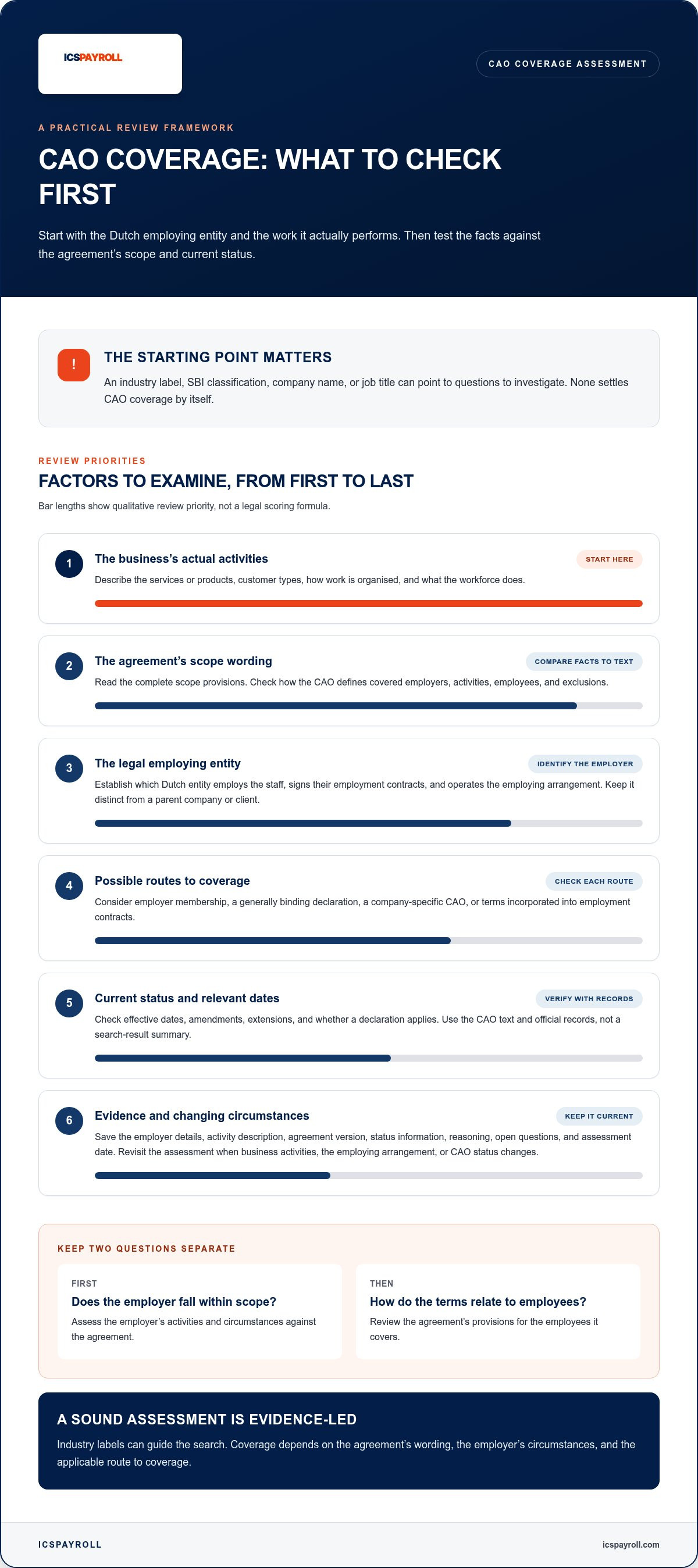
A reliable assessment starts with the employer and the agreement’s actual scope, not a sector label or a search-result snippet. Use these steps to build a reasoned view of possible CAO coverage. They help structure the investigation, but complex or conflicting scope language may require specialist interpretation.
Start with the employer and its actual business activities
First, identify the legal entity that employs staff in the Netherlands. Keep it distinct from a parent company, client, or other organisation involved in the work. Record how the Dutch employing arrangement operates, including which entity signs employment contracts and employs the people concerned.
Next, describe what the business actually does. Include its services or products, customer types, how work is organised, and the workforce’s activities. For example, a company may describe itself publicly as a technology business while its Dutch operation performs several distinct services. A label alone won’t capture those details.
An SBI classification can help you identify agreements to investigate, but it is a starting clue, not a decision about CAO coverage.
Read the agreement’s scope and check its status
Search for potentially relevant sectoral CAOs and any company-specific CAO connected to the employer. For each candidate, read the complete scope provisions. Check how the agreement defines covered employers, activities, employees, and exclusions, then compare those terms with the facts you documented. A similar industry name does not prove that the scope matches.
Verify the agreement’s current status and relevant dates, including whether it has been extended or declared generally binding for a sector. The Dutch government CAO information portal provides information on agreements and declarations. Use the agreement text and official records to support your assessment, rather than relying on a search summary.
- Check possible routes to coverage: Consider whether employer membership, a generally binding declaration, a company CAO, or terms incorporated into employment contracts may be relevant.
- Compare facts with wording: Note which scope provisions fit the business and which remain uncertain.
- Record your reasoning: Save the employer identity, activity description, agreement version, official status information, conclusion, open questions, and assessment date.
Revisit the file if the business activities, employing arrangement, agreement text, or declaration status changes. If the scope remains unclear, obtain specialist review before relying on a conclusion. Once coverage has been assessed, Dutch payroll administration can support the employment processes that follow. This evidence-led method gives businesses a practical basis for determining which CAO may apply.
How to assess multiple activities, employer membership, and CAO coverage
A business may perform work that appears to fit more than one sector. Assess each possible route to CAO coverage separately: compare actual activities with the agreement’s scope, establish whether the employer belongs to an organisation that concluded the agreement, and check whether a generally binding declaration applies. These factors can point in different directions, so a potential match is not yet a verified conclusion.
When a business operates across more than one sector
List the business’s activities separately and compare each with the relevant scope clauses. Record what work generates revenue for the business and how employees’ duties relate to each activity. For instance, an organisation might provide both technical services and training. That description can help identify agreements to examine, but it does not settle coverage by itself.
Don’t apply a universal dominant-activity test. The relevant agreement’s wording and the employer’s circumstances matter. If scope clauses overlap, or it is unclear how an activity fits their definitions, document the uncertainty for qualified legal interpretation.
How membership and generally binding status affect the assessment
Check whether the legal employer, rather than a related company, is a member of an employers’ organisation that concluded a potentially relevant CAO. Separately, look up whether a generally binding declaration (AVV) extends the agreement’s reach to employers within its defined scope, and confirm the declaration’s effective period. Don’t assume membership or sector similarity without checking the records.
The Dutch government CAO information portal can help identify agreements and AVV information. Use official records and the agreement text to confirm current status and legal effect. A search result or directory entry can identify a candidate, but it does not establish that the employer is covered.
| Evidence to collect | What it may indicate | What remains unresolved |
|---|---|---|
| Activity descriptions, customer types, operating model, and employee duties | Which scope clauses may be relevant | Whether the agreement’s definitions include the employer’s actual work |
| Employer membership records and the organisation’s CAO | A possible membership-based connection to the agreement | Whether the membership and agreement apply to this legal employer and situation |
| Official AVV information and effective dates | Whether a declaration may extend coverage within a defined scope and period | Whether the employer and activities fall within that scope for the period in question |
Record each factor independently, cite the document or official record reviewed, and state what is established versus uncertain. This comparison helps turn research into a reasoned assessment of possible CAO coverage without treating an initial match as a final legal conclusion.
How to verify a CAO decision and keep the evidence current
A CAO assessment is more useful when another person can follow how you reached the conclusion. Keep a dated record of the employer facts, agreement provisions, official status information, and reasoning. This creates a reviewable basis for applying employment terms and updating the assessment when circumstances change.
What evidence should the CAO assessment file contain?
Organise the file so it connects the employer’s circumstances to the agreement’s scope. Include:
- Employer and workforce details: the employing entity, the Dutch employing arrangement, a description of business activities, and the employee groups considered.
- Agreement documents: the CAO version reviewed, relevant scope provisions, and any terms or exclusions that informed the assessment.
- Status records: official information on the agreement’s dates, amendments, extensions, or any generally binding declaration. The Dutch government CAO information portal is a starting point for checking agreement and declaration information.
- Assessment notes: the date, conclusion, evidence supporting it, and any unresolved interpretation. If a specialist reviewed the question, note what prompted the review and retain the resulting advice.
Make the reasoning explicit. Identify the scope wording you relied on and explain how the employer’s documented activities relate to it. Distinguish confirmed facts from assumptions so it is easier to see whether a later change affects the conclusion.
When should a business review its CAO assessment?
Revisit the file when the business changes what it does, restructures its employing arrangement, or changes how staff are employed. Also check for revised agreement terms, expiry dates, extensions, and changes to declaration status before applying terms or communicating a conclusion to employees. Confirm that each source is current at the time of review.
Don’t carry an old decision forward automatically. A conclusion may have been reasonable based on earlier activities or an earlier agreement version, but those supporting facts can change. Record the review date, what was checked, and whether the conclusion remains valid or needs further analysis. This makes the process for assessing CAO coverage repeatable rather than a one-time search.
Once the applicable employment terms have been assessed, explore Dutch payroll administration support for the related employment processes.
How Dutch EOR and payroll support fit after CAO applicability is assessed
Establishing whether a CAO applies is separate from putting its employment terms into practice. An EOR or payroll administrator can support employment operations, but the service does not replace the assessment of which agreement, if any, covers the employer and its employees. Ground the coverage decision in the relevant agreement and current authoritative information.
What to prepare before implementing employment terms
Organise the documents and information that connect the assessment to employment administration. A clear handover helps keep contract and payroll setup aligned with the terms you have established.
- Employer details: identify the entity and Dutch employing arrangement relevant to the staff.
- Role information: describe each employee’s role, responsibilities, and proposed employment terms.
- CAO assessment record: include the agreement version, scope analysis, relevant status evidence, conclusion, and any unresolved points.
- Payroll considerations: identify which applicable terms need to be reflected in payroll processes, such as pay elements, hours, leave, or allowances where relevant.
Before communicating terms or implementing them, confirm that the assessment relates to the current agreement and the right employee group. If interpretation remains uncertain, resolve that issue through appropriate specialist review rather than treating payroll setup as proof of coverage.
How an EOR and payroll partner can support Dutch hiring
For international employers, ICSPayroll’s Employer of Record service enables hiring employees in the Netherlands without an existing Dutch BV. Once the applicable employment terms have been assessed, those terms can inform employment administration. Full-service Dutch payroll administration includes payslips, filings, and employer premiums, helping coordinate recurring payroll processes connected to local employment.
The sequence matters: assess CAO coverage first, then use the established terms to guide contract preparation and payroll administration. The EOR arrangement does not determine whether a CAO applies. That question depends on the agreement’s scope and the employer’s circumstances, as documented in the assessment.
To prepare for a focused compliance discussion, organise the employing entity details, a description of Dutch business activities, relevant role information, and the CAO assessment record. This creates a practical starting point and helps distinguish confirmed conclusions from questions that still need review. For support implementing Dutch employment and payroll processes after assessment, discuss Dutch EOR and payroll support.
Turn your CAO assessment into a clear employment process
A sound CAO decision starts with the legal employer and its actual activities, then compares those facts with agreement scope, membership, and any applicable declaration. A sector label or job title alone isn’t enough. Keep the agreement version, evidence, reasoning, and review date on file, and revisit the assessment when the business or agreement changes.
Once coverage has been assessed, the applicable terms can inform employment contracts and payroll processes. For international employers, ICSPayroll provides a Netherlands-focused Employer of Record service, so hiring can begin before a Dutch BV is established. Full-service payroll administration covers payslips, filings, and employer premiums, supporting the implementation of employment arrangements. These services support administration, but they don’t determine CAO coverage.
If you’re ready to organise Dutch hiring and payroll around your documented assessment, discuss Dutch EOR and payroll support. With a clear record and implementation support, you can move forward with greater confidence.
Frequently Asked Questions
How do I find out which CAO applies to my business?
Start by identifying the legal employer and describing its actual Dutch business activities and workforce. Then compare those facts with the scope provisions of potentially relevant sectoral and company CAOs. Check employer membership, any generally binding declaration, and whether employment contracts incorporate a CAO. Use the Dutch government CAO information portal to identify agreements and status information, then record the evidence, conclusion, and assessment date. Specialist review can help where scope is unclear.
Does every business in the Netherlands have to follow a CAO?
No. A CAO doesn’t automatically apply to every Dutch business. Depending on the circumstances, coverage may arise through an employer organisation’s membership, a generally binding declaration that covers the employer’s activities, a company-specific agreement, or incorporation of CAO terms into employment contracts. The agreement’s scope and current status matter. Assess these factors against the business’s circumstances rather than assuming that operating in a particular sector settles the question.
Can an SBI code determine which CAO applies?
No. An SBI code can help identify sectors and agreements to investigate, but it doesn’t by itself establish CAO coverage. Compare the employer’s actual activities, operating model, and workforce with the agreement’s scope wording. A code may be broad or may not fully describe what the Dutch operation does. Treat it as a research clue, then document how the relevant agreement’s definitions fit, or do not fit, the employer’s facts.
Does an employer’s membership of an industry association mean a CAO applies?
Not necessarily. Check whether the legal employer is a member of the specific employers’ organisation that concluded the relevant CAO, rather than assuming that membership of any industry association has the same effect. Then review the agreement’s scope, membership records, and the terms governing the organisation’s agreement. Membership is one factor in the assessment, alongside any generally binding declaration and other applicable bases. Keep the evidence supporting the conclusion.
What happens if a business operates in more than one sector?
List each business activity separately and compare it with the scope provisions of potentially relevant CAOs. Consider how employees’ work relates to those activities and which legal entity employs them. Multiple activities may create overlapping or unclear scope questions, so don’t assume one sector or a single dominant-activity test decides every case. Record the evidence and uncertainties, then obtain qualified legal interpretation if the agreement wording doesn’t produce a clear result.
Can an employment contract make a CAO apply?
An employment contract can incorporate terms from a named CAO, creating a contractual basis for applying those terms as agreed. That does not necessarily answer whether the employer is independently covered by the CAO through its scope, membership, or a generally binding declaration. Review the contract wording and the agreement together, including any reference to a specific version or provisions. Distinguish contractual adoption from other legal routes to CAO coverage.
How often should a business review which CAO applies?
Review the assessment whenever relevant facts change, such as the employer’s activities, structure, workforce arrangements, or the entity employing staff. Also check for changes to the CAO, its effective dates, extensions, and any generally binding declaration. Don’t rely on an old conclusion without confirming that its evidence remains current. Record the review date, sources checked, and whether the conclusion still holds or needs further analysis.

Article by
Joost Hubregtse
Joost Hubregtse is Director of ICS Staffing & Payroll B.V., the wholly owned subsidiary of Intercompany Solutions behind ICS Payroll. He is responsible for Employer of Record and Dutch payroll services: employment contracts, wage tax and social security filings, holiday allowance, pension, sick leave and CAO compliance, with onboarding possible within 48 hours.
Frequently Asked Questions
A sectoral CAO sets terms for employers within the activities and other boundaries described in its scope clause. A company CAO is connected to a particular employer or organisation. Neither type should be assumed to apply without checking its wording and current status. The Dutch government CAO information portal provides information on agreements and generally binding declarations. Read the relevant agreement itself to assess its coverage. The distinction matters in practice. A company operating in a sector with a CAO still needs to assess whether its actual activities fall within that agreement’s defined scope. An organisation-specific CAO, meanwhile, should not be treated as a sector-wide rule for unrelated employers.
Organise the file so it connects the employer’s circumstances to the agreement’s scope. Include: Make the reasoning explicit. Identify the scope wording you relied on and explain how the employer’s documented activities relate to it. Distinguish confirmed facts from assumptions so it is easier to see whether a later change affects the conclusion.
Revisit the file when the business changes what it does, restructures its employing arrangement, or changes how staff are employed. Also check for revised agreement terms, expiry dates, extensions, and changes to declaration status before applying terms or communicating a conclusion to employees. Confirm that each source is current at the time of review. Don’t carry an old decision forward automatically. A conclusion may have been reasonable based on earlier activities or an earlier agreement version, but those supporting facts can change. Record the review date, what was checked, and whether the conclusion remains valid or needs further analysis. This makes the process for assessing CAO coverage repeatable rather than a one-time search. Once the applicable employment terms have been assessed, explore Dutch payroll administration support for the related employment processes. Establishing whether a CAO applies is separate from putting its employment terms into practice. An EOR or payroll administrator can support employment operations, but the service does not replace the assessment of which agreement, if any, covers the employer and its employees. Ground the coverage decision in the relevant agreement and current authoritative information.
Start by identifying the legal employer and describing its actual Dutch business activities and workforce. Then compare those facts with the scope provisions of potentially relevant sectoral and company CAOs. Check employer membership, any generally binding declaration, and whether employment contracts incorporate a CAO. Use the Dutch government CAO information portal to identify agreements and status information, then record the evidence, conclusion, and assessment date. Specialist review can help where scope is unclear.
No. A CAO doesn’t automatically apply to every Dutch business. Depending on the circumstances, coverage may arise through an employer organisation’s membership, a generally binding declaration that covers the employer’s activities, a company-specific agreement, or incorporation of CAO terms into employment contracts. The agreement’s scope and current status matter. Assess these factors against the business’s circumstances rather than assuming that operating in a particular sector settles the question.
No. An SBI code can help identify sectors and agreements to investigate, but it doesn’t by itself establish CAO coverage. Compare the employer’s actual activities, operating model, and workforce with the agreement’s scope wording. A code may be broad or may not fully describe what the Dutch operation does. Treat it as a research clue, then document how the relevant agreement’s definitions fit, or do not fit, the employer’s facts.
Not necessarily. Check whether the legal employer is a member of the specific employers’ organisation that concluded the relevant CAO, rather than assuming that membership of any industry association has the same effect. Then review the agreement’s scope, membership records, and the terms governing the organisation’s agreement. Membership is one factor in the assessment, alongside any generally binding declaration and other applicable bases. Keep the evidence supporting the conclusion.
List each business activity separately and compare it with the scope provisions of potentially relevant CAOs. Consider how employees’ work relates to those activities and which legal entity employs them. Multiple activities may create overlapping or unclear scope questions, so don’t assume one sector or a single dominant-activity test decides every case. Record the evidence and uncertainties, then obtain qualified legal interpretation if the agreement wording doesn’t produce a clear result.
An employment contract can incorporate terms from a named CAO, creating a contractual basis for applying those terms as agreed. That does not necessarily answer whether the employer is independently covered by the CAO through its scope, membership, or a generally binding declaration. Review the contract wording and the agreement together, including any reference to a specific version or provisions. Distinguish contractual adoption from other legal routes to CAO coverage.
Review the assessment whenever relevant facts change, such as the employer’s activities, structure, workforce arrangements, or the entity employing staff. Also check for changes to the CAO, its effective dates, extensions, and any generally binding declaration. Don’t rely on an old conclusion without confirming that its evidence remains current. Record the review date, sources checked, and whether the conclusion still holds or needs further analysis.