
Managing Payroll in the Netherlands: A Practical 2026 Guide
By Joost Hubregtse, Director, ICS Staffing & Payroll
All blog posts are reviewed and fact checked by our labour law lawyer Zishan Hussain and our director. Editorial standards
Reliable Dutch payroll depends on a controlled monthly cycle, not a last-minute calculation. For companies managing payroll in the netherlands, the challenge is coordinating accurate employee data, timely approvals, tax and social security obligations, payslips, and payments while keeping ownership clear at every step.
That complexity is real, especially when local requirements are unfamiliar or employee information arrives from multiple teams. A repeatable process makes payroll easier to manage and helps reduce avoidable errors. This guide sets out a practical workflow for Dutch employees, from gathering and checking payroll changes to processing pay and keeping organized records.
You’ll learn how to assign responsibilities, build a payroll calendar around recurring tasks and deadlines, and manage the records that support each pay run. The guide also explains when Dutch payroll administration or an Employer of Record can take on local employment and payroll tasks, including for companies without a Dutch entity. With clear ownership and reliable checks, monthly payroll becomes a consistent process rather than a recurring scramble.
By Joost Hubregtse, Payroll Director. View Joost Hubregtse on LinkedIn.
Joost Hubregtse is Payroll Director at ICSPayroll, the Dutch payroll and EOR specialist of Intercompany Solutions. A career payroll specialist and former Head of Payroll, he oversees wage tax filings, 30% ruling applications, and employment compliance for international employers.
Reviewed by Joost Hubregtse, Payroll Director, on 4 October 2026.
Key Takeaways
- Managing payroll in the netherlands works best as a defined monthly workflow, with clear ownership for data, review, payments, filings, and records.
- Use a consistent sequence to collect employee changes, validate information, process payroll, review payslips, pay employees, file returns, and archive records.
- Build deadlines and approval checks into the payroll calendar so missing or incorrect information can be identified before processing is complete.
- As your team grows, compare internal administration, outsourced payroll, and an Employer of Record based on who employs the worker and who handles each task.
- A payroll factor can consolidate covered employment costs into one monthly invoice, making payroll costs easier to track.
Managing payroll in the Netherlands starts with clear ownership
Managing payroll in the Netherlands means coordinating a connected process, not simply calculating salaries. Employee information feeds into gross-to-net calculations, review and approval, payment, wage tax filings, payslips, and recordkeeping. If one step is late or based on incorrect data, errors can carry through the rest of the cycle.
The employer remains accountable for ensuring its payroll arrangements meet its obligations, but that doesn’t mean every task has to be performed internally. A payroll administrator can handle calculations and filings, for example, while the employer keeps decision-making authority and assigns someone to coordinate information and approvals. Dutch payroll rules apply nationally, so build your process around the applicable Dutch requirements rather than assumptions from another country.
What does Dutch payroll management cover?
Recurring payroll operations include collecting employee and pay changes, calculating gross and net pay, preparing payslips, handling wage tax filings, and managing employer premiums. Accurate employee and payroll records support these activities, including the correct handling of social security obligations. Keep source information and approvals traceable to the relevant employee and payroll period.
Keep monthly processing distinct from one-off hiring administration. Recruitment decisions, employment contract preparation, and initial employee setup happen around a hire or a change in employment. Once an employee is on payroll, recurring operations continue each pay period and require a reliable flow of updates, checks, and approvals. General accounting may use payroll figures, but it is not a substitute for payroll processing or employee-level records.
Who owns each part of the payroll process?
Assign one internal payroll coordinator to manage deadlines, gather submissions, resolve missing information, and route outputs for approval. This person need not perform every task. Clear ownership prevents employee updates, finance approvals, or administrator questions from sitting between teams.
| Task | Owner | Reviewer | Evidence |
|---|---|---|---|
| Submit personal, hours, and pay changes | Employee and HR | Internal payroll coordinator | Approved change record |
| Calculate payroll and prepare payslips | Payroll administrator | Finance or payroll coordinator | Payroll register and payslips |
| Approve payroll totals and payment | Finance | Authorized employer representative | Approval record and payment confirmation |
| Submit filings and retain payroll records | Payroll administrator or assigned employer team | Internal payroll coordinator | Filing confirmation and archived records |
The employer, HR, finance, employees, and payroll administrator each contribute different information or checks. Documenting who submits, reviews, and retains each item makes responsibility visible, whether payroll is managed in-house or supported externally.
The Dutch monthly payroll cycle, from employee data to payslips
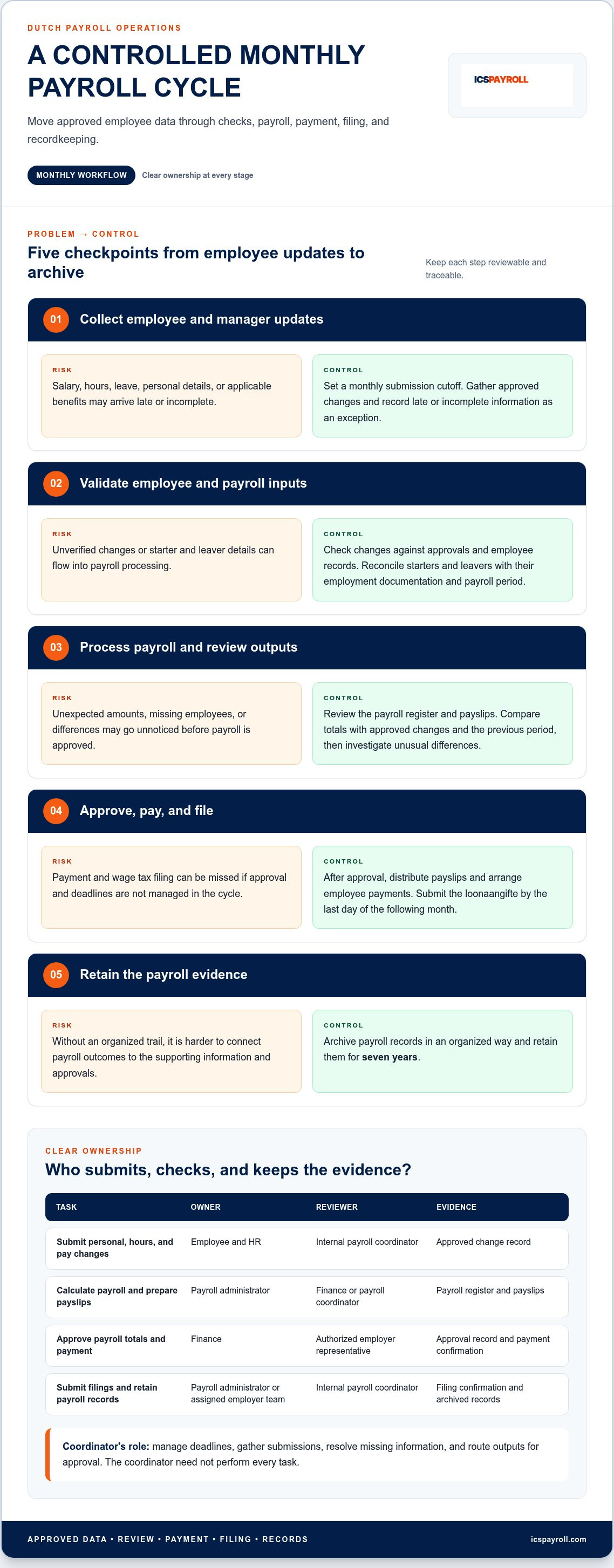
A reliable payroll month follows a fixed sequence: collect changes, validate inputs, process payroll, review outputs, pay employees, file the wage tax return, and archive the records. The monthly payroll cycle is the controlled movement of approved employee data through calculation, review, payment, filing, and retention. Managing payroll in the Netherlands becomes more predictable when each stage has a cutoff, an approver, and an evidence trail.
Prepare and validate payroll inputs
Set a monthly cutoff for employee and manager submissions. Gather approved changes to salary, working hours, leave, personal details, and applicable benefits. Record late or incomplete information as an exception rather than allowing it to pass into processing without review.
Before payroll is calculated, reconcile starters and leavers against their employment documentation and the payroll period they belong to. Check that changes are supported by an approval and that the data matches the employee record. This early validation helps prevent avoidable corrections after payslips are prepared.
Review, pay, file, and retain records
Review the payroll register and payslips before payment. Compare totals with approved changes and the previous period, then investigate unusual differences, missing employees, or unexpected amounts. Once approved, distribute payslips and arrange employee payments. The employer’s payroll tax return, known as the loonaangifte, is due by the last day of the following month, according to the Dutch government’s payroll tax return guidance. Use the filing process to handle the related payroll tax and contribution amounts.
Retain payroll records for seven years. The Dutch Tax Administration’s recordkeeping guidance explains employer record obligations. Store the payroll register, approvals, filing confirmations, payment evidence, and relevant employee changes together in an organized, access-controlled archive.
| Timing | Payroll control | Evidence to retain |
|---|---|---|
| Before processing | Close input submissions and validate changes | Approved changes and exception list |
| Before payment | Review payroll outputs and approve totals | Payroll register and approval record |
| Pay date | Distribute payslips and make employee payments | Payslips and payment confirmation |
| By the last day of the following month | Submit the wage tax return and handle related amounts | Filing confirmation and payment record |
| After processing | Archive payroll records | Organized payroll file |
A defined calendar turns recurring deadlines into routine controls. For organizations that want local support with processing, payslips, filings, and payroll records, Dutch payroll administration support can help coordinate the monthly workflow.
Payroll controls that reduce errors and protect Dutch compliance
Reliable controls make payroll errors easier to detect, investigate, and correct before they affect payments or filings. They also create a clear record of how decisions were made. The aim isn’t to add unnecessary approvals to every routine task. Focus review where changes or unusual results could materially affect payroll.
Build review and approval checks into payroll
Require a second review for material changes, such as a salary adjustment, and for results that differ unexpectedly from the approved inputs or prior payroll period. Record the correction, reason, approver, and affected pay period. An exception log gives the payroll coordinator a single place to track unresolved items and confirm when each is closed.
Use a repeatable review checklist. It can prompt the responsible people to verify completeness, check calculations against approved changes, confirm payment instructions, track filing status, and communicate relevant outcomes to employees. Keep the supporting evidence with the payroll record, rather than relying on informal messages that may be difficult to retrieve later.
- Change records: Capture what changed, when it takes effect, and who approved it.
- Exception log: Note the issue, owner, resolution, and closure date.
- Reconciliation: Compare payroll outputs with approved inputs and investigate unexplained differences.
- Approval evidence: Retain a record of the review and authorization before payroll is finalized.
These are practical process controls, not a substitute for checking the rules that apply to a specific employee or payment. For the wider operational framework, consult the Dutch Payroll Administration guide alongside your documented procedures.
Handle tax, benefits, and international employee exceptions
Pause and route changes in work status, compensation, or benefit eligibility for review before they enter payroll. This is particularly useful when an employee’s circumstances may affect the tax treatment of pay. Keep the decision, supporting information, and effective payroll period together so the reason for the treatment remains clear.
For an eligible employee, the 30% ruling may affect how remuneration is processed. The Belastingdienst guidance on the 30% facility explains the scheme; the Belastingdienst decides whether it applies. Payroll support with an application is distinct from that decision. Immigration sponsorship is also separate and is arranged via our licensed partner. Do not treat immigration sponsorship as determining tax-ruling eligibility.
When managing payroll in the Netherlands, consistent records and targeted review help teams handle exceptions without disrupting the entire monthly process. Assign each flagged item to a named reviewer and close it with documented evidence.
How to make Dutch payroll manageable as your team grows
As a team expands, payroll ownership can shift without changing the need for clear handoffs. Internal administration keeps tasks with your own staff. Outsourced payroll administration moves processing work to a specialist while your business remains the employer. An Employer of Record (EOR) is different: the EOR is the legal employer in the Netherlands and manages local employment and payroll administration under that arrangement.
| Operating model | Entity needs | Employment responsibility | Payroll tasks | Internal coordination |
|---|---|---|---|---|
| Internal administration | Your business has its Dutch employing arrangements in place | Your business is the employer | Your team manages calculations, payslips, filings, and records | HR and finance coordinate inputs, reviews, and payment |
| Outsourced payroll administration | Your business retains its employing arrangements | Your business remains the employer | A payroll administrator supports processing and administration | An internal owner submits changes and approves outputs |
| Employer of Record | Can support hiring without your own established Dutch BV | The EOR is the legal employer in the Netherlands | The EOR manages local employment and payroll administration | Your business coordinates employee information and work-related approvals |
When does payroll outsourcing fit the operating model?
Outsourcing suits companies that want specialist help with payroll processing while retaining their employer role. It doesn’t remove the need for internal coordination. Set input deadlines, appoint an approver, and agree how corrections or late changes are handled. For more detail on this division of responsibilities, see our guide to outsourcing payroll in the Netherlands.
When can an Employer of Record simplify Dutch hiring?
An EOR can be a practical option for an international business hiring in the Netherlands before establishing a Dutch BV. The EOR employs the local staff and takes responsibility for the agreed employment and payroll administration, while the client coordinates day-to-day work. ICSPayroll provides Dutch EOR and payroll support. Read our Employer of Record Netherlands guide for a broader explanation of the model.
Choose the model by identifying who will employ the worker and who will own each recurring task. For Dutch payroll support or EOR arrangements, explore ICSPayroll’s Netherlands payroll and EOR support.
Manage Dutch payroll with ICSPayroll support
For companies hiring in the Netherlands, ICSPayroll combines Dutch Employer of Record (EOR) support with full-service payroll administration. This supports businesses with an established Dutch entity and international employers hiring Dutch-based employees without a Dutch BV. The appropriate model depends on who employs the worker and which local employment and payroll responsibilities need to be handled.
Payroll costs are calculated using a payroll factor: gross salary multiplied by the agreed factor. Covered employment costs are consolidated into one monthly invoice, giving the business a single view of those costs. The factor includes an 8% holiday allowance, a pension component of 15.2% of gross salary, sickness risk coverage, social security and employer premiums, transition allowance, HR administration, online portal access, 30% ruling assistance where applicable, and sick-leave support.
What ICSPayroll manages in the Dutch payroll process
Payroll administration includes processing payroll, preparing payslips, handling filings and employer premiums, supporting social security administration, and providing HR administration and employee portal access. This brings recurring tasks into a coordinated process, while giving employees a place to access payslips, contracts, and holiday balances.
For eligible employees, ICSPayroll supports 30% ruling applications. The ruling is decided by the Belastingdienst, not by the payroll administrator; see the Belastingdienst guidance on the 30% facility. Immigration sponsorship is separate from the tax ruling and is arranged via our licensed partner. For non-Schengen employees, highly skilled migrant application support is also arranged via that partner. Applications are typically processed and granted in approximately three weeks, though this is not a guaranteed outcome.
Start a compliant Dutch payroll arrangement
Getting started follows a defined sequence. After employee details are provided, ICSPayroll supplies a tailored quotation within 24 hours. The service agreement and employment contract are prepared within days. These are process timings, not a promise about decisions made by authorities or other parties.
With the arrangement defined, payroll responsibilities, employee information, and recurring administration can be coordinated through a Netherlands-focused service. For businesses managing payroll in the Netherlands, this can reduce the burden of handling local processing and employment administration alone.
Discuss Dutch hiring and payroll support for your team.
Build a payroll process your team can rely on
Managing payroll in the Netherlands becomes more predictable when every monthly task has a clear owner, deadline, review step, and record. Collect and validate employee changes, check payroll outputs before approval, then coordinate payments, filings, and recordkeeping through a repeatable calendar. These controls help your team spot exceptions early and keep responsibilities clear as hiring grows.
The right operating model depends on who employs your Dutch staff and how much administration your team wants to handle. Internal processing, outsourced payroll administration, and an Employer of Record each assign responsibilities differently. ICSPayroll supports Dutch payroll administration and EOR arrangements, with covered employment costs consolidated into one monthly invoice. After employee details are provided, you can receive a tailored quotation within 24 hours, with the service agreement and employment contract prepared within days.
Put a consistent workflow in place, or bring in local support to coordinate the operational load. Discuss Dutch payroll and hiring with ICSPayroll and take the next step toward a clear, dependable process for your team.
Frequently Asked Questions
How do you manage payroll in the Netherlands?
Managing payroll in the Netherlands means collecting and validating employee changes, processing pay, reviewing results, paying employees, filing wage tax returns, and retaining records. Assign an owner and review step to each stage. Your team can manage the workflow internally or work with a Dutch payroll specialist. This is a practical overview, not legal advice. Confirm current filing dates and recordkeeping duties with the relevant Dutch authorities.
What is included in Dutch payroll administration?
Dutch payroll administration can include payroll processing, payslips, tax filings, employer premiums, and social security handling. The scope depends on the arrangement. ICSPayroll also provides HR administration and employee portal access. Its payroll factor is applied to gross salary, with covered employment costs consolidated into one monthly invoice. Review the agreed scope to understand which tasks and costs are included.
When is the Dutch payroll tax return due?
The wage tax return deadline is the last day of the following month, as described in current Dutch government payroll tax guidance. Add the applicable deadline to your payroll calendar, assign responsibility for submission, and retain evidence of filing. This deadline applies to the payroll tax return and should not be assumed to apply to other tax filings.
Can a company manage Dutch payroll without a Dutch BV?
Yes. ICSPayroll’s Netherlands Employer of Record service can employ staff before your Dutch BV is established or when your business has no Dutch entity. The EOR becomes the legal employer in the Netherlands and handles local employment and payroll administration. See the guide to hiring in the Netherlands without a local legal entity for more context.
What happens if payroll information is submitted late or is incorrect?
Flag missing or incorrect information as soon as it is identified. Record the correction, its reason, the affected payroll period, and the approval, then assess whether payroll needs adjustment or a filing correction. These are sound internal process controls, not a statement of a specific statutory correction procedure. The appropriate action and any legal or tax consequences depend on the circumstances, so consult current official guidance for those requirements.
How does the 30% ruling affect Dutch payroll?
The 30% ruling can affect payroll tax treatment when the employee and employer meet current conditions and the Belastingdienst issues a written decision. The tax authority decides eligibility, while payroll must apply the ruling according to that decision. Immigration sponsorship is separate and does not establish eligibility. Consult the dedicated 30% ruling guide and verify current thresholds and transitional rules with the Belastingdienst before applying the scheme.
Can an Employer of Record manage payroll for Dutch employees?
Yes. ICSPayroll acts as the legal employer in the Netherlands for its EOR clients and manages local employment and payroll administration. This differs from payroll administration for a business that already employs staff, where the business remains the employer and a payroll administrator supports processing. ICSPayroll’s EOR service is focused on the Netherlands. Immigration sponsorship is arranged via our licensed partner, separately from payroll and employment administration.

Article by
Joost Hubregtse
Joost Hubregtse is Director of ICS Staffing & Payroll B.V., the wholly owned subsidiary of Intercompany Solutions behind ICS Payroll. He is responsible for Employer of Record and Dutch payroll services: employment contracts, wage tax and social security filings, holiday allowance, pension, sick leave and CAO compliance, with onboarding possible within 48 hours.
Frequently Asked Questions
Recurring payroll operations include collecting employee and pay changes, calculating gross and net pay, preparing payslips, handling wage tax filings, and managing employer premiums. Accurate employee and payroll records support these activities, including the correct handling of social security obligations. Keep source information and approvals traceable to the relevant employee and payroll period. Keep monthly processing distinct from one-off hiring administration. Recruitment decisions, employment contract preparation, and initial employee setup happen around a hire or a change in employment. Once an employee is on payroll, recurring operations continue each pay period and require a reliable flow of updates, checks, and approvals. General accounting may use payroll figures, but it is not a substitute for payroll processing or employee-level records.
Assign one internal payroll coordinator to manage deadlines, gather submissions, resolve missing information, and route outputs for approval. This person need not perform every task. Clear ownership prevents employee updates, finance approvals, or administrator questions from sitting between teams. The employer, HR, finance, employees, and payroll administrator each contribute different information or checks. Documenting who submits, reviews, and retains each item makes responsibility visible, whether payroll is managed in-house or supported externally. A reliable payroll month follows a fixed sequence: collect changes, validate inputs, process payroll, review outputs, pay employees, file the wage tax return, and archive the records. The monthly payroll cycle is the controlled movement of approved employee data through calculation, review, payment, filing, and retention. Managing payroll in the Netherlands becomes more predictable when each stage has a cutoff, an approver, and an evidence trail.
Outsourcing suits companies that want specialist help with payroll processing while retaining their employer role. It doesn’t remove the need for internal coordination. Set input deadlines, appoint an approver, and agree how corrections or late changes are handled. For more detail on this division of responsibilities, see our guide to outsourcing payroll in the Netherlands.
An EOR can be a practical option for an international business hiring in the Netherlands before establishing a Dutch BV. The EOR employs the local staff and takes responsibility for the agreed employment and payroll administration, while the client coordinates day-to-day work. ICSPayroll provides Dutch EOR and payroll support. Read our Employer of Record Netherlands guide for a broader explanation of the model. Choose the model by identifying who will employ the worker and who will own each recurring task. For Dutch payroll support or EOR arrangements, explore ICSPayroll’s Netherlands payroll and EOR support. For companies hiring in the Netherlands, ICSPayroll combines Dutch Employer of Record (EOR) support with full-service payroll administration. This supports businesses with an established Dutch entity and international employers hiring Dutch-based employees without a Dutch BV. The appropriate model depends on who employs the worker and which local employment and payroll responsibilities need to be handled. Payroll costs are calculated using a payroll factor: gross salary multiplied by the agreed factor. Covered employment costs are consolidated into one monthly invoice, giving the business a single view of those costs. The factor includes an 8% holiday allowance, a pension component of 15.2% of gross salary, sickness risk coverage, social security and employer premiums, transition allowance, HR administration, online portal access, 30% ruling assistance where applicable, and sick-leave support.
Managing payroll in the Netherlands means collecting and validating employee changes, processing pay, reviewing results, paying employees, filing wage tax returns, and retaining records. Assign an owner and review step to each stage. Your team can manage the workflow internally or work with a Dutch payroll specialist. This is a practical overview, not legal advice. Confirm current filing dates and recordkeeping duties with the relevant Dutch authorities.
Dutch payroll administration can include payroll processing, payslips, tax filings, employer premiums, and social security handling. The scope depends on the arrangement. ICSPayroll also provides HR administration and employee portal access. Its payroll factor is applied to gross salary, with covered employment costs consolidated into one monthly invoice. Review the agreed scope to understand which tasks and costs are included.
The wage tax return deadline is the last day of the following month, as described in current Dutch government payroll tax guidance. Add the applicable deadline to your payroll calendar, assign responsibility for submission, and retain evidence of filing. This deadline applies to the payroll tax return and should not be assumed to apply to other tax filings.
Yes. ICSPayroll’s Netherlands Employer of Record service can employ staff before your Dutch BV is established or when your business has no Dutch entity. The EOR becomes the legal employer in the Netherlands and handles local employment and payroll administration. See the guide to hiring in the Netherlands without a local legal entity for more context.
Flag missing or incorrect information as soon as it is identified. Record the correction, its reason, the affected payroll period, and the approval, then assess whether payroll needs adjustment or a filing correction. These are sound internal process controls, not a statement of a specific statutory correction procedure. The appropriate action and any legal or tax consequences depend on the circumstances, so consult current official guidance for those requirements.
The 30% ruling can affect payroll tax treatment when the employee and employer meet current conditions and the Belastingdienst issues a written decision. The tax authority decides eligibility, while payroll must apply the ruling according to that decision. Immigration sponsorship is separate and does not establish eligibility. Consult the dedicated 30% ruling guide and verify current thresholds and transitional rules with the Belastingdienst before applying the scheme.
Yes. ICSPayroll acts as the legal employer in the Netherlands for its EOR clients and manages local employment and payroll administration. This differs from payroll administration for a business that already employs staff, where the business remains the employer and a payroll administrator supports processing. ICSPayroll’s EOR service is focused on the Netherlands. Immigration sponsorship is arranged via our licensed partner, separately from payroll and employment administration.