
Dutch CAO Explained: 2026 Guide for Employers
By Joost Hubregtse, Director, ICS Staffing & Payroll
All blog posts are reviewed and fact checked by our labour law lawyer Zishan Hussain and our director. Editorial standards
A payroll setup can be accurate on paper and still overlook the employment terms that apply to a Dutch workforce. For employers searching for “dutch collective labor agreement explained,” the first step is checking whether a CAO applies to the business and its employees. An employee working remotely from the Netherlands is not, by that fact alone, outside a CAO’s scope.
Sector coverage, wage scales, leave and other benefits can all affect payroll. Identifying the applicable agreement helps employers understand which terms to reflect in employment contracts and payroll processes.
This 2026 guide explains how company and sectoral CAOs work, what can make an agreement binding, and how to check its requirements. It covers wage scales and employment benefits so you can assess your obligations and plan a compliant Dutch payroll setup.
By Joost Hubregtse, Payroll Director.
Reviewed by Joost Hubregtse, Payroll Director, on 1 October 2026.
Joost Hubregtse is Payroll Director at ICSPayroll, the Dutch payroll and EOR specialist of Intercompany Solutions. A career payroll specialist and former Head of Payroll, he oversees wage tax filings, 30% ruling applications, and employment compliance for international employers.
Key Takeaways
- Learn what a Dutch CAO covers and how employers and trade unions set employment terms.
- Use the “dutch collective labor agreement explained” guide to check whether employer-organisation membership or an AVV makes a CAO applicable to your workforce.
- Identify how CAOs can affect wage scales, working hours, overtime and other payroll requirements in 2026.
- Understand how CAO terms interact with statutory minimums and individual employment contracts.
- See how Dutch payroll administration or an Employer of Record can help manage CAO-related compliance and employment costs.
What is a Dutch Collective Labor Agreement (CAO)?
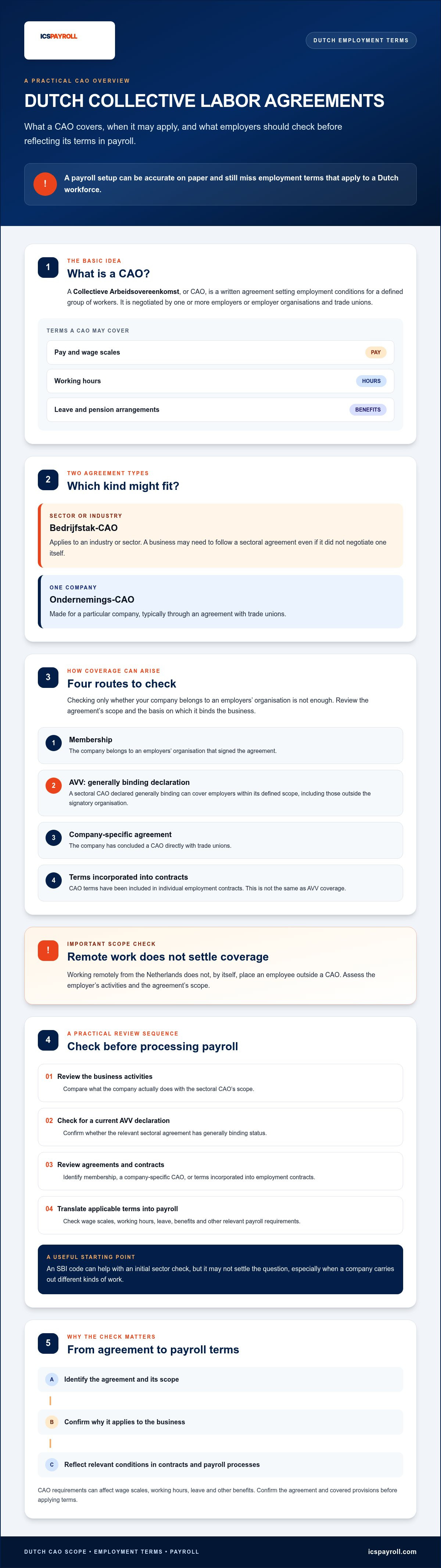
A Collectieve Arbeidsovereenkomst, or CAO, is a written agreement that sets employment conditions for a defined group of workers. It is the Dutch form of a Collective bargaining agreement, negotiated by one or more employers or employer organisations and trade unions. A CAO may cover pay, working hours, leave and pension arrangements. For international employers, an employee’s remote working location does not by itself determine which CAO applies. The employer’s activities and the agreement’s scope also need to be assessed.
There are two main types. A Bedrijfstak-CAO applies to an industry or sector, while an Ondernemings-CAO is made for a particular company. The distinction matters because a business may have to follow a sectoral agreement even if it did not negotiate one itself.
The legal status of CAOs in the Netherlands
The Collective Agreements Act (Wet op de collectieve arbeidsovereenkomst) sets the legal framework for collective agreements between employers and trade unions, including when their terms bind the parties and covered employees. Separately, the Act on the Extension of Collective Labour Agreements provides for the Minister of Social Affairs and Employment to declare a sectoral CAO generally binding. This can extend the agreement’s provisions to employers and employees within its scope who were not represented in the negotiations.
CAOs are an established part of Dutch employment relations, but there is not one agreement that automatically applies to every employer. Businesses need to identify the agreement relevant to their sector or company.
Mandatory and voluntary adherence
AVV stands for Algemeen Verbindend Verklaard, meaning generally binding. When a sectoral CAO has AVV status, employers within its defined scope generally have to apply it, whether or not they belong to a signatory employers’ organisation. An employer may also be bound through membership of a signatory organisation, by concluding a CAO directly with trade unions, or by incorporating CAO terms into employment contracts. Voluntary adoption is not the same as AVV coverage, so check the agreement and contract wording.
To assess whether a sectoral agreement applies, compare your company’s actual activities with the CAO’s scope and check whether it has a current AVV declaration. Start with the Dutch government’s CAO guidance and follow its links to relevant agreements and official information. This scope check helps you identify which employment terms to reflect in payroll.
When Does a CAO Apply to Your Employees?
A CAO can apply through several routes, so checking only whether your company belongs to a Dutch employers’ organisation is not enough. You also need to check the agreement’s scope and the basis on which it binds your business. A CAO may apply when:
- Your company belongs to an employers’ organisation that signed the agreement.
- Your business falls within the scope of a sectoral CAO declared generally binding, known as AVV.
- Your company has concluded a company-specific CAO with trade unions.
- You have incorporated CAO terms into employment contracts.
These routes have different legal bases. For example, voluntarily including terms in a contract is not the same as being covered by a sectoral agreement through AVV. Before applying CAO terms in payroll, review the agreement and employment documents to confirm which provisions apply.
Universally binding agreements (AVV)
The Dutch Act on the Extension of Collective Labour Agreements provides for the Minister of Social Affairs and Employment to declare a sectoral CAO generally binding within its defined scope. Employers covered by an AVV must apply the relevant provisions even if they did not join a signatory employers’ organisation. If an employer misses applicable terms, employees may seek the wages or benefits they are owed under the agreement. Check the agreement’s scope and AVV dates using the Dutch government’s CAO and AVV guidance.
Sectoral scope and job grading
Sector coverage depends on the agreement’s scope and the employer’s actual business activities. An SBI code can help with an initial check, but it may not settle the question, particularly if the company carries out different kinds of work. Compare the CAO’s scope provisions with the business’s activities in practice.
Next, assess each role using the CAO’s functiewaardering, or job-grading system, if one applies. Duties and responsibility levels can affect the appropriate function group and wage scale. Keep role descriptions current and record how classifications were decided.
For employees working remotely in the Netherlands, do not assume their home location alone determines CAO coverage. Check the employing arrangement, the employer’s activities and the agreement’s scope. Using an Employer of Record does not remove the need to identify applicable employment terms. For guidance on reflecting confirmed CAO rules in payroll, see this Dutch payroll administration guide.
For information about ICSPayroll’s Netherlands payroll administration, explore its Dutch payroll services.
Key Provisions Found in 2026 Dutch CAOs
A CAO can set terms above the statutory minimum, so the legal floor may not be the full payroll requirement. In 2026, the statutory hourly minimum wage for employees aged 21 and over is EUR 14.71 from 1 January and EUR 14.99 from 1 July. A CAO may set higher wage scales. Check the applicable agreement’s scale and job classification, then compare the rate with the statutory minimum for the relevant period.
CAOs can also set practical employment conditions, including standard working hours, overtime rates, additional leave and rules for bonuses such as a dertiende maand, or 13th-month payment. That bonus is not automatically due under every CAO. Confirm whether the agreement provides for it, who qualifies and how it is calculated. Holiday allowance is generally at least 8% of gross salary. Check the CAO and contract for how it is accrued and paid.
Notice periods and probation rules need separate checks. A CAO may include provisions on notice, but probation is governed by statutory limits: it can be up to two months for an indefinite contract, one month for a fixed-term contract lasting six to 24 months, and is not permitted for a fixed-term contract of six months or less. The chain rule, or ketenregeling, is a separate rule on successive fixed-term contracts. In 2026, the general limit is three contracts over 36 months, subject to applicable rules and exceptions.
The 30% ruling and CAO salary requirements
The 2026 standard salary norm for the 30% ruling is EUR 48,013 in taxable salary after the tax-free deduction, not a gross salary figure. Check this tax norm separately from the CAO wage scale: the ruling does not reduce an employee’s contractual entitlement under an applicable CAO. For rulings first granted from 2024, the ruling rate drops from 30% to 27% on 1 January 2027, while pre-2024 holders keep 30%. Review CAO pay and tax treatment together, using the 2026 Dutch 30% ruling guide for further detail.
Pension, social security, and sickness obligations
Some sectors have a mandatory industry pension fund. Confirm whether the CAO or sector rules require participation before finalising employment costs. Pension contributions vary by arrangement. ICSPayroll’s provided cost information lists a 15.2% pension contribution, which is a specific cost input, not a universal rate for every Dutch employee.
Employers must also account for statutory sick-pay and reintegration obligations. Sick pay is generally 70% for up to 104 weeks, with a minimum-wage floor in the first year. A CAO may provide more generous terms. Include the applicable pay provision and reintegration responsibilities in your compliance review. This is how dutch collective labor agreement explained becomes a practical payroll check, not just a review of contract wording.
CAO vs. Statutory Law: The Hierarchy of Norms
Dutch employment terms are not governed by a simple rule that every individual contract can override a CAO. Start with statutory law, which sets legal minimums and mandatory requirements. Then identify the applicable CAO and check whether it allows flexibility. Finally, review the employment contract. It can provide better terms where permitted, but a less favourable contract clause generally cannot displace a binding CAO provision.
This is the practical meaning of the “most favourable principle,” but it is not a blanket permission to choose whichever term benefits the employee. The outcome depends on the wording and legal status of the CAO. A minimum CAO may allow better individual terms; a standard CAO generally does not permit deviations. Statutory law can also allow specific alternatives, but they must meet the law’s conditions.
For example, an individual contract may offer more leave than the applicable CAO minimum if the agreement permits that improvement. By contrast, a contract cannot simply reduce a statutory entitlement. Holiday allowance is generally at least 8% of gross salary, subject to statutory rules and applicable exceptions. Review each provision separately rather than assuming the entire contract or CAO always takes precedence.
Contractual compliance for remote workers
For an employee working remotely from the Netherlands, document the employing arrangement, applicable CAO, wage terms, hours, leave and any permitted deviations. Remote working does not remove Dutch employment obligations. A foreign company without a Dutch entity should establish how employment and payroll responsibilities are arranged, including whether it uses an Employer of Record. The employment law guide for foreign employers offers further context. The Dutch Chamber of Commerce also provides business guidance relevant to employment contracts.
Transition allowance and termination rules
The statutory transition payment generally accrues from the first day of employment, including probation. In 2026, its cap is EUR 102,000, or one year’s gross salary if that is higher. A CAO does not automatically replace this statutory entitlement with a different calculation. A collective agreement may provide an alternative arrangement in specific circumstances, such as certain redundancies, only when legal conditions are met. Check the applicable rules before relying on a CAO provision.
Termination procedures also depend on the reason for dismissal. The UWV handles certain routes, including economic dismissal and long-term incapacity; other dismissal cases may go to the subdistrict court. A CAO may set additional employment terms, but it does not remove the need to follow the applicable statutory procedure.
For context on Dutch payroll and EOR support, see ICSPayroll’s services.
Managing CAO Compliance via an Employer of Record (EOR)
An Employer of Record can provide a way to hire in the Netherlands without setting up your own local employing entity. ICSPayroll acts as the legal employer for staff in the Netherlands and handles local compliance, tax and insurance obligations. The arrangement does not remove the need to identify the applicable CAO. Relevant wage scales, benefits and other employment terms still need to be reflected in payroll and contracts.
Clarity on costs matters. ICSPayroll uses a payroll factor and a consolidated monthly invoice for employment costs. Its cost information specifies a 15.2% pension contribution, but that figure should not be treated as a universal pension rate. The applicable fund and CAO obligations depend on the employment arrangement. Check how costs such as holiday allowance and any CAO-specific requirements are included in the service and invoice.
For international hires, ICSPayroll provides 30% ruling assistance and Highly Skilled Migrant visa application support. HSM visa processing is typically around three weeks. The 30% ruling is for eligible employees, and the employer and employee must meet the relevant criteria. An EOR arrangement also does not automatically settle whether a foreign company has a permanent establishment. That assessment depends on the company’s circumstances, so treat the employment model and corporate tax position as separate questions.
Transparent payroll and filing responsibilities
Ask how the payroll calculation accounts for employer premiums and CAO requirements, and whether costs such as pension and holiday allowance are itemised or included in a consolidated invoice. Confirm who prepares and submits the Dutch payroll tax return, or loonaangifte, and how filing deadlines are tracked. A clear allocation of responsibilities makes it easier to reconcile payroll records, CAO terms and invoices each pay cycle.
A Dutch payroll provider can also help assess sector-specific CAO rules that may be missed in a general cross-border process. ICSPayroll’s online employee portal provides access to payslips, contracts and holiday balances, helping employers and employees keep key information accessible. For more detail on the arrangement, see this Employer of Record in the Netherlands guide.
Use this dutch collective labor agreement explained framework to identify the applicable agreement, confirm payroll responsibilities and review cost treatment before hiring. Find information about ICSPayroll’s Dutch EOR and payroll support.
Put Your Dutch CAO Knowledge into Practice
Accurate CAO compliance starts with identifying which agreement applies to your business and workforce. Check sector coverage and any AVV declaration, then reflect the applicable wage scales, benefits and other terms in contracts and payroll. Keep the relationship between statutory protections, CAO provisions and individual employment terms clear. That is the practical value of having a dutch collective labor agreement explained in operational terms.
For international employers, local support can help turn those requirements into a workable hiring and payroll process. ICSPayroll provides Dutch payroll administration and EOR services, with a payroll factor and a consolidated monthly invoice for employment costs. It also assists with HSM visa applications and 30% ruling applications for eligible employees.
Share your hiring requirements with ICSPayroll to request a tailored EOR quote within 24 hours. Hire in the Netherlands with confidence and get your tailored EOR quote.
Frequently Asked Questions
Is a CAO mandatory for every company in the Netherlands?
No. A CAO applies when a company is bound through membership of a signatory employers’ organisation, a generally binding sectoral agreement, a CAO concluded directly with trade unions, or terms incorporated into employment contracts. Start by checking the agreement’s scope and whether it has an active AVV declaration. A business should not assume it is exempt simply because it did not negotiate the CAO itself.
Where can I find which CAO applies to my business sector?
Check the Dutch government’s CAO information and register, then review the scope and validity dates of any agreement that may cover your business. Compare its coverage criteria with your actual activities, not only your registered business code. If your company performs several types of work, or the scope is unclear, get advice before deciding which wage scales and employment terms to apply.
What happens if the employment contract contradicts the CAO?
A contract term that is less favourable than a binding CAO provision generally cannot override it. The conflicting term may be ineffective, and the employee could seek unpaid wages or benefits. Check whether the CAO sets minimum terms or is a standard agreement that restricts deviations. A contract may offer more favourable conditions where the agreement and applicable law allow it.
Do remote employees working from home in the Netherlands fall under a CAO?
They may. Working remotely from home does not automatically exclude an employee from a CAO or determine which agreement applies. Assess the employer’s activities, the agreement’s sectoral scope and the employment arrangement. For staff employed through an Employer of Record, confirm which entity employs the worker and how the applicable CAO terms are reflected in the contract and payroll.
Can I negotiate a lower salary than the CAO scale if the employee agrees?
Not if the applicable CAO requires a higher wage for that employee’s role and classification. An employee’s agreement does not by itself make a lower rate compliant. First verify the job grading, wage scale and whether the CAO permits any flexibility. Also check statutory minimum-wage requirements. Where an agreement allows discretion, document the basis for the rate and apply the rules consistently.
How does the 30% ruling affect CAO salary requirements in 2026?
The 30% ruling does not reduce the wage an employee is entitled to under an applicable CAO. In 2026, the standard ruling norm is EUR 48,013 in taxable salary after the tax-free deduction, not gross salary. Assess eligibility for the ruling separately from CAO wage-scale compliance. Payroll must account for both the employee’s contractual pay and the relevant tax treatment.
What are the risks of ignoring a universally binding (AVV) CAO?
If an AVV CAO covers your business, failing to apply it can lead to claims for unpaid wages or benefits. Trade unions may take legal action, and individual employees can bring claims for underpayment, including claims reaching back up to five years. Check the agreement’s sectoral scope and AVV dates, then review payroll and employment terms for any shortfalls.
Does an Employer of Record handle all CAO-related pension contributions?
An Employer of Record can manage pension obligations as part of the Dutch employment and payroll arrangement, but do not assume every pension cost is automatically covered. Confirm whether the employee falls under a mandatory sector pension fund, what the applicable CAO requires and which contributions are included in the service agreement and invoice. ICSPayroll’s stated pension contribution is 15.2% of gross salary, but requirements depend on the arrangement.

Article by
Joost Hubregtse
Joost Hubregtse is Director of ICS Staffing & Payroll B.V., the wholly owned subsidiary of Intercompany Solutions behind ICS Payroll. He is responsible for Employer of Record and Dutch payroll services: employment contracts, wage tax and social security filings, holiday allowance, pension, sick leave and CAO compliance, with onboarding possible within 48 hours.
Frequently Asked Questions
No. A CAO applies when a company is bound through membership of a signatory employers’ organisation, a generally binding sectoral agreement, a CAO concluded directly with trade unions, or terms incorporated into employment contracts. Start by checking the agreement’s scope and whether it has an active AVV declaration. A business should not assume it is exempt simply because it did not negotiate the CAO itself.
Check the Dutch government’s CAO information and register, then review the scope and validity dates of any agreement that may cover your business. Compare its coverage criteria with your actual activities, not only your registered business code. If your company performs several types of work, or the scope is unclear, get advice before deciding which wage scales and employment terms to apply.
A contract term that is less favourable than a binding CAO provision generally cannot override it. The conflicting term may be ineffective, and the employee could seek unpaid wages or benefits. Check whether the CAO sets minimum terms or is a standard agreement that restricts deviations. A contract may offer more favourable conditions where the agreement and applicable law allow it.
They may. Working remotely from home does not automatically exclude an employee from a CAO or determine which agreement applies. Assess the employer’s activities, the agreement’s sectoral scope and the employment arrangement. For staff employed through an Employer of Record, confirm which entity employs the worker and how the applicable CAO terms are reflected in the contract and payroll.
Not if the applicable CAO requires a higher wage for that employee’s role and classification. An employee’s agreement does not by itself make a lower rate compliant. First verify the job grading, wage scale and whether the CAO permits any flexibility. Also check statutory minimum-wage requirements. Where an agreement allows discretion, document the basis for the rate and apply the rules consistently.
The 30% ruling does not reduce the wage an employee is entitled to under an applicable CAO. In 2026, the standard ruling norm is EUR 48,013 in taxable salary after the tax-free deduction, not gross salary. Assess eligibility for the ruling separately from CAO wage-scale compliance. Payroll must account for both the employee’s contractual pay and the relevant tax treatment.
If an AVV CAO covers your business, failing to apply it can lead to claims for unpaid wages or benefits. Trade unions may take legal action, and individual employees can bring claims for underpayment, including claims reaching back up to five years. Check the agreement’s sectoral scope and AVV dates, then review payroll and employment terms for any shortfalls.
An Employer of Record can manage pension obligations as part of the Dutch employment and payroll arrangement, but do not assume every pension cost is automatically covered. Confirm whether the employee falls under a mandatory sector pension fund, what the applicable CAO requires and which contributions are included in the service agreement and invoice. ICSPayroll’s stated pension contribution is 15.2% of gross salary, but requirements depend on the arrangement.