
Netherlands Employee Onboarding Checklist: 2026 Employer Guide
By Joost Hubregtse, Director, ICS Staffing & Payroll
All blog posts are reviewed and fact checked by our labour law lawyer Zishan Hussain and our director. Editorial standards
A signed contract is only the beginning of a compliant Dutch hire. A netherlands employee onboarding checklist should connect employment terms, payroll setup, immigration requirements, and first-day preparations, with an owner assigned to every step.
It’s reasonable to feel uncertain. Employee details must be collected accurately, payroll and statutory administration need to be ready, and international hires may have immigration steps alongside separate tax applications. A missed handoff can leave a new employee waiting or create avoidable compliance work.
This practical 2026 guide sets out a sequence from hiring preparation through the employee’s first working day. It covers the information to gather, preparations for the employment contract and payroll, and how to manage immigration sponsorship and a potential 30% ruling application as separate processes. Use the checklist to assign administrative responsibilities, coordinate tasks before the start date, and prepare a clear first day, whether your company employs directly or uses an Employer of Record.
By Joost Hubregtse, Payroll Director. Joost Hubregtse is Payroll Director at ICSPayroll, the Dutch payroll and EOR specialist of Intercompany Solutions. A career payroll specialist and former Head of Payroll, he oversees wage tax filings, 30% ruling applications, and employment compliance for international employers. Reviewed by Joost Hubregtse, Payroll Director, on 28 September 2026.
Key Takeaways
- Use the netherlands employee onboarding checklist to assign an owner to each task, from confirming role details to preparing for the start date.
- Capture employment terms and employee information accurately so contract records and payroll instructions match.
- Check how the 8% holiday allowance and other applicable arrangements should be reflected in payroll.
- Keep immigration steps separate from 30% ruling eligibility. Immigration sponsorship is arranged via our licensed partner.
- Prepare a clear first-day handover, including employee contacts, system access, and guidance on ongoing HR support.
Netherlands employee onboarding checklist: map the process before the start date
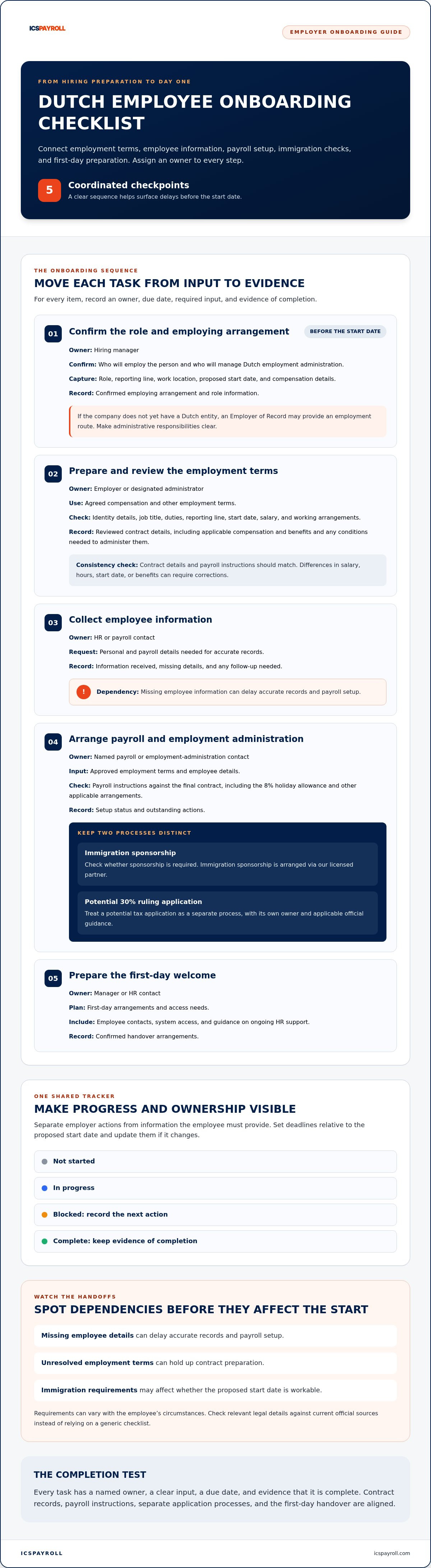
A reliable netherlands employee onboarding checklist coordinates people, documents, payroll, and start-date readiness in a clear sequence. Confirm the role, prepare employment terms, collect employee details, arrange employment administration, and plan the welcome. For each task, record an owner, due date, required input, and completion evidence. This makes delays visible before they affect the contract, payroll setup, or planned start date.
Before confirming the employment start date
First, confirm who will employ the person and who will manage Dutch employment administration. If your company doesn’t yet have a Dutch entity, an Employer of Record may provide an employment route. Agree clearly who is responsible for each administrative task. Then document the role, reporting line, work location, proposed start date, and compensation details. These agreed inputs help keep the contract and payroll records aligned.
Check the employee’s circumstances early. Determine whether immigration sponsorship is required and whether a separate tax-relief application may be relevant. Immigration sponsorship is arranged via our licensed partner. A potential tax application is a separate process, so assign it its own owner and follow the applicable official guidance. For general policy background, see the Dutch Ministry of Social Affairs and Employment. Verify current employment requirements against official Dutch sources before acting.
Build a practical onboarding tracker
Use one tracker to show progress and responsibility. Separate employer actions from information the employee must provide, and record what counts as evidence of completion. Set deadlines relative to the proposed start date, then update them if the date changes.
- Confirm role and employing arrangement: owner, hiring manager; input, approved role and reporting details; record, confirmed arrangement and role information.
- Prepare employment terms: owner, employer or designated administrator; input, agreed compensation and other terms; record, reviewed contract details.
- Collect employee information: owner, HR or payroll contact; input, requested personal and payroll details; record, information received and any gaps.
- Arrange administration: owner, named payroll or employment-administration contact; input, approved terms and employee details; record, setup status and outstanding actions.
- Prepare the welcome: owner, manager or HR contact; input, first-day plan and access needs; record, confirmed handover arrangements.
Track dependencies rather than treating every task as independent. Missing employee information can delay accurate records, unresolved terms can hold up contract preparation, and immigration requirements may affect whether the proposed start date is workable. Mark each item as not started, in progress, blocked, or complete. For anything blocked, record the next action. Requirements can vary with the employee’s circumstances, so check relevant legal details against current official sources instead of relying on a generic checklist.
Prepare the Dutch employment contract and collect essential employee information
Once the role and employing arrangement are clear, use the agreed terms to prepare consistent employment and payroll records. The contract is a reference point for payroll instructions. A difference in salary, hours, start date, or benefits can lead to avoidable corrections. In your netherlands employee onboarding checklist, assign someone to compare the final contract details with the payroll information before processing begins.
Details to confirm for the employment agreement
Check that the draft reflects what the parties have agreed. Confirm the employee’s identity details, job title, duties, reporting line, start date, salary, and working arrangements. Record applicable compensation and benefits clearly, including any conditions needed to administer them. Confirm whether the contract is fixed-term or indefinite, and review any proposed probation terms against current Dutch guidance before issuing it.
For legal background, consult the Dutch Employment & Labour Laws overview and verify current requirements with official Dutch sources. You can also consult the existing guide, Employment Law in the Netherlands for Foreign Employers, for broader context. A general guide is not a substitute for checking the rules that apply to the specific employee and contract.
Employee documents and records to request
Request the information needed to identify the employee and create accurate employment and payroll records. Tell the employee what you need, who will use it, and how to provide it securely. Keep employer-prepared documents separate from information the employee must supply, and track missing items so they don’t get lost in an email chain.
- Identity and contact details: request the information needed to match the employee to their records.
- Payroll inputs: confirm the details needed to set up payroll in line with the agreed contract.
- Role and terms: retain the approved job, working-arrangement, salary, and benefit information.
- Immigration documents: establish whether work authorization or a Highly Skilled Migrant process applies, and identify the responsible contact.
Limit access to contracts and personal information to authorized personnel, and store records in an appropriate secure system. If immigration sponsorship is required, it is arranged via our licensed partner. Keep this process distinct from any tax-relief application, which has its own eligibility checks and administration.
If your organization needs a clear owner for contract and payroll administration, review Dutch payroll administration support as one way to coordinate the handoff.
Set up Dutch payroll, benefits, and employee administration before the first payslip
Start payroll setup with the approved employment terms, not assumptions or an earlier draft. Transfer the confirmed salary, working hours, start date, and applicable benefits into the payroll instructions, then compare them with the contract before the first payroll run. This check can catch mismatches before they affect the employee’s pay or the employer’s monthly processing.
Payroll information and first-cycle checks
Collect the employee’s payment details and the information required to process salary. Assign a named payroll owner to check that the employee record, contract, and payroll inputs agree. Build the employer’s monthly processing and filing schedule around current requirements, and confirm applicable deadlines with the responsible payroll administrator. Before the first run, resolve missing or conflicting details with the contract owner.
Review the salary basis and applicable allowances against the signed terms. Make the handoff clear: HR confirms the agreed terms, the employee supplies requested information, and payroll checks the data and manages the regular cycle.
Benefits, records, and employee access
Confirm how each applicable item will be treated in payroll and administration. Dutch government guidance describes the rules for holiday allowance in the Netherlands. ICSPayroll’s stated payroll factor includes an 8% holiday allowance. Confirm the arrangement that applies to the employee and reflect it accurately in payroll documentation. Also confirm pension arrangements, social security and employer premium handling, and who will manage sick-leave administration. Base these checks on the agreed employment terms, not a generic setup.
- Holiday allowance: confirm the applicable calculation and payroll treatment.
- Pension and premiums: identify the arrangements and make sure the payroll owner knows how they are handled.
- Sick leave: assign responsibility for recording and administering relevant employee information.
- Employee records: check that contract and payroll details are stored consistently and access is appropriately managed.
ICSPayroll’s stated payroll factor consolidates employment costs into one monthly invoice and includes a 15.2% pension scheme. Confirm which applicable items are included in the arrangement and how they appear in payroll documentation. The employee portal provides access to payslips, contracts, and holiday balances.
For a broader explanation of the service and its administration, consult the existing Dutch Payroll Administration guide. Make every recurring task visible, assign it to an owner, and keep a clear record of completion.
Check immigration steps and 30% ruling eligibility separately
Immigration permission and tax relief are separate workstreams. Keep them as distinct items in the netherlands employee onboarding checklist, with separate owners, evidence, and deadlines. IND sponsorship status concerns immigration only. It does not determine whether an employee qualifies for the 30% ruling, which is decided by the Belastingdienst.
For employees who may need Highly Skilled Migrant sponsorship
Confirm the employee’s nationality and establish whether they need a Dutch immigration application before work can begin. Check the relevant permit requirements with the IND’s Highly Skilled Migrant guidance, then coordinate required documents and timing with the licensed immigration partner. Keep the planned start date provisional until the responsible parties confirm the application status and any required authorization.
Immigration sponsorship is arranged via our licensed partner. ICSPayroll states that Highly Skilled Migrant applications are typically processed and granted in approximately three weeks. Treat this as an indicative timeframe, not a guaranteed outcome or a substitute for checking current IND processing information. Assign someone to track the application and communicate status changes to the employee and hiring manager.
For employees who may qualify for the 30% ruling
Assess the tax application independently. Under the 2026 criteria, the employee must have been recruited from abroad and lived more than 150 kilometres from the Dutch border for at least 16 of the 24 months before their first workday. Dutch payroll tax must be withheld, and the ruling requires a written decision from the Belastingdienst. Confirm current eligibility rules and salary requirements in the Belastingdienst guidance on the 30% facility.
For 2026, the salary norms are €48,013 for the standard criterion and €36,497 for qualifying employees under 30 with a master’s degree. These are taxable salary amounts after the deduction, not gross salary figures. For rulings first granted from 2024, the rate is scheduled to reduce to 27% from 1 January 2027. Check the terms that apply to the employee’s situation rather than assuming the current rate continues.
Timing matters. An application filed within four months of the start date can be retroactive to day one; a later application applies from the month after filing. Assign the application a named owner and track its submission and decision separately from immigration milestones. The existing 30% ruling guide can provide further context. For support with a potential application, review ICSPayroll’s 30% ruling application support.
Complete the first-day welcome and establish ongoing Dutch HR support
The first day should make the employee’s next steps clear, not leave them searching for basic information. Use the final stage of your netherlands employee onboarding checklist to confirm the welcome plan, key contacts, and access to the tools and records the employee needs.
First-day tasks for the employer and employee
Introduce the employee to their manager and team contacts, explain role expectations, and confirm the agreed work arrangements. Provide an employee handbook that explains relevant internal processes and where to direct HR or payroll questions. A consistent point of contact helps prevent requests from being passed between teams without an owner.
- Confirm contacts: share the manager’s details and identify the appropriate HR and payroll contacts.
- Check access: confirm the employee can access the employee portal and find their contract, payslips, and holiday balance information.
- Explain processes: show the employee where to find the handbook and how to raise an administrative question.
- Close the handover: confirm any outstanding documents or setup tasks, who owns them, and when they will be followed up.
After the start, schedule a brief review with the employee and relevant administrator. Check that payroll inputs still match the agreed employment details, the employee can access the information provided, and any outstanding documents or actions have an owner and next step. This creates an early opportunity to correct an administrative gap before it affects later processing.
Ongoing support and a clear next step
Onboarding responsibilities continue beyond day one. Name the contact who will handle payroll changes, employee-record updates, and sick-leave support, and explain how the employee should report a change or request assistance. Clear ownership gives the employee a reliable route for questions and helps updates reach the right administrator.
If your company has not yet established a Dutch BV, an Employer of Record (EOR) can provide an employment route and coordinate Dutch employment and payroll administration. ICSPayroll states that it provides a tailored quotation within 24 hours of receiving employee details. According to the company’s stated process, the service agreement and employment contract are prepared within days.
To coordinate Dutch employment administration, discuss your Dutch hiring requirements and whether an EOR or Dutch payroll administration fits your situation.
Put your Netherlands onboarding plan into action
A strong netherlands employee onboarding checklist gives every step an owner, from confirming employment terms and collecting employee information to preparing payroll and welcoming the new hire. Keep immigration sponsorship and any 30% ruling application on separate tracks, and check requirements against current official guidance.
After the start date, check that payroll inputs are accurate, outstanding documents have an owner, and the employee knows where to direct HR and payroll questions. Clear responsibilities make onboarding a consistent process rather than a series of last-minute handoffs.
ICSPayroll provides a tailored quotation within 24 hours after receiving employee details. The service agreement and employment contract are prepared within days, and the payroll factor consolidates listed employment costs into one monthly invoice. Discuss your Netherlands hiring plans with ICSPayroll to identify a practical route for your next hire.
With the right preparation and clear ownership, you can welcome your employee with confidence and keep administration on track.
Frequently Asked Questions
What should be included in a Netherlands employee onboarding checklist?
A Netherlands employee onboarding checklist should cover agreed employment terms, employee information, payroll setup, benefits and records, relevant immigration steps, and first-day arrangements. Assign an owner and due date to each task, and record what evidence confirms completion. Requirements vary with the employee’s circumstances and hiring arrangement. Use the checklist to organize the process, then verify legal and tax details against current official Dutch sources rather than treating a general checklist as legal advice.
Can I hire an employee in the Netherlands before setting up a Dutch BV?
Yes, ICSPayroll states that its Employer of Record service can support hiring before your company establishes a Dutch BV or has its own Dutch entity. Under an EOR arrangement, the service provider acts as the local employer, so confirm the employment structure, responsibilities, service agreement, and employee details before agreeing on a start date. Using an EOR does not mean your company has formed or established its own Dutch legal entity.
When should payroll setup be completed for a new Dutch employee?
Complete payroll preparation before the first payroll cycle, using the agreed employment terms and verified employee information. Confirm salary and payment details, applicable holiday allowance, pension arrangements, and how employer premiums will be handled. Check that payroll inputs match the employment contract, and confirm current filing deadlines with the payroll administrator or official guidance. Before the first payslip, make sure the employee knows how to access it and their relevant employment records.
Does every international employee need a Highly Skilled Migrant application?
No. Whether an employee needs immigration authorization depends on their circumstances, including nationality and existing work status. Check current IND guidance and confirm the appropriate route with the relevant immigration partner before setting a start date. For applicable cases, Keep this process separate from payroll setup and any 30% ruling application, which is a distinct tax process assessed by the Belastingdienst.
How soon should an employer apply for the Dutch 30% ruling?
To qualify for retroactive application from the employee’s first workday, file within four months of the start date. A later application applies from the month after filing, so assign an owner and track the deadline. The employee must meet the applicable eligibility and salary requirements, and not every international hire qualifies. Check current Belastingdienst guidance and obtain the required written decision before treating the ruling as approved for payroll.
What is included in an ICSPayroll monthly invoice?
ICSPayroll describes a payroll factor applied to gross salary, with one monthly invoice covering the listed employment costs. These include 8% holiday allowance, a 15.2% pension scheme, sickness risk coverage, social security and employer premiums, transition allowance, HR administration, portal access, 30% ruling assistance where applicable, and sick-leave support. Check the tailored quotation and service agreement for the specific hire to understand which items apply to that arrangement.
How long does a Highly Skilled Migrant application take?
ICSPayroll states that Highly Skilled Migrant applications arranged through its licensed partner are typically processed and granted in approximately three weeks. Treat this as an indicative timeframe, not a guaranteed decision date. Timing can depend on the employee’s circumstances and application requirements. Confirm the documents needed, partner arrangements, and current processing expectations before communicating a firm start date or timeline to the employee or hiring manager.

Article by
Joost Hubregtse
Joost Hubregtse is Director of ICS Staffing & Payroll B.V., the wholly owned subsidiary of Intercompany Solutions behind ICS Payroll. He is responsible for Employer of Record and Dutch payroll services: employment contracts, wage tax and social security filings, holiday allowance, pension, sick leave and CAO compliance, with onboarding possible within 48 hours.
Frequently Asked Questions
A Netherlands employee onboarding checklist should cover agreed employment terms, employee information, payroll setup, benefits and records, relevant immigration steps, and first-day arrangements. Assign an owner and due date to each task, and record what evidence confirms completion. Requirements vary with the employee’s circumstances and hiring arrangement. Use the checklist to organize the process, then verify legal and tax details against current official Dutch sources rather than treating a general checklist as legal advice.
Yes, ICSPayroll states that its Employer of Record service can support hiring before your company establishes a Dutch BV or has its own Dutch entity. Under an EOR arrangement, the service provider acts as the local employer, so confirm the employment structure, responsibilities, service agreement, and employee details before agreeing on a start date. Using an EOR does not mean your company has formed or established its own Dutch legal entity.
Complete payroll preparation before the first payroll cycle, using the agreed employment terms and verified employee information. Confirm salary and payment details, applicable holiday allowance, pension arrangements, and how employer premiums will be handled. Check that payroll inputs match the employment contract, and confirm current filing deadlines with the payroll administrator or official guidance. Before the first payslip, make sure the employee knows how to access it and their relevant employment records.
No. Whether an employee needs immigration authorization depends on their circumstances, including nationality and existing work status. Check current IND guidance and confirm the appropriate route with the relevant immigration partner before setting a start date. For applicable cases, immigration sponsorship is arranged via our licensed partner. Keep this process separate from payroll setup and any 30% ruling application, which is a distinct tax process assessed by the Belastingdienst.
To qualify for retroactive application from the employee’s first workday, file within four months of the start date. A later application applies from the month after filing, so assign an owner and track the deadline. The employee must meet the applicable eligibility and salary requirements, and not every international hire qualifies. Check current Belastingdienst guidance and obtain the required written decision before treating the ruling as approved for payroll.
ICSPayroll describes a payroll factor applied to gross salary, with one monthly invoice covering the listed employment costs. These include 8% holiday allowance, a 15.2% pension scheme, sickness risk coverage, social security and employer premiums, transition allowance, HR administration, portal access, 30% ruling assistance where applicable, and sick-leave support. Check the tailored quotation and service agreement for the specific hire to understand which items apply to that arrangement.
ICSPayroll states that Highly Skilled Migrant applications arranged through its licensed partner are typically processed and granted in approximately three weeks. Treat this as an indicative timeframe, not a guaranteed decision date. Timing can depend on the employee’s circumstances and application requirements. Confirm the documents needed, partner arrangements, and current processing expectations before communicating a firm start date or timeline to the employee or hiring manager.