
EOR vs Payroll Provider in the Netherlands: Which Model Fits?
By Joost Hubregtse, Director, ICS Staffing & Payroll
All blog posts are reviewed and fact checked by our labour law lawyer Zishan Hussain and our director. Editorial standards
Byline: By Joost Hubregtse, Payroll Director.
Joost Hubregtse is Payroll Director at ICSPayroll, the Dutch payroll and EOR specialist of Intercompany Solutions. A career payroll specialist and former Head of Payroll, he oversees wage tax filings, 30% ruling applications, and employment compliance for international employers.
Reviewed by Joost Hubregtse, Payroll Director, on 26 September 2026.
The payroll option that looks simpler may leave your company responsible for the employment relationship. That distinction is central to the eor vs payroll provider netherlands decision: a payroll provider can process wages for your employees, while an Employer of Record (EOR) employs the worker in the Netherlands on your behalf.
It’s easy to assume both services cover the same administration, but their legal scope can differ. That affects who manages employment obligations, what your company needs in place, and which costs should appear in a proposal. An EOR can support hiring before your company establishes a Dutch BV. Payroll administration is often the relevant comparison when you already employ staff through your own Dutch entity.
This guide compares the models by legal-employer responsibility, payroll scope, compliance exposure, entity requirements, and cost transparency. You’ll find practical questions to ask about employment and payroll responsibilities, plus ways to assess a proposal without assuming every provider includes the same services.
Key Takeaways
- In the eor vs payroll provider netherlands comparison, start by identifying who legally employs the worker, not just who processes payroll.
- Check the service agreement to confirm who signs the employment contract and handles payroll filings, benefits, and employee support.
- Assess your Dutch entity status and the employment structure you want before deciding which service model fits.
- Compare the full service scope and cost breakdown in each proposal, since provider responsibilities and inclusions can vary.
- ICSPayroll offers Dutch EOR hiring before a Dutch BV is established or without a Dutch entity, alongside Dutch payroll administration.
EOR vs payroll provider in the Netherlands: what is the difference?
The core difference is who employs the worker under the agreed arrangement. An Employer of Record (EOR) employs the worker in the Netherlands, while a payroll provider may process wages for a worker employed by your company. A provider’s title alone doesn’t define its responsibilities. Check the employment contract and service agreement to confirm who the employer is and which tasks the provider has agreed to handle.
In a typical arrangement, the international client directs the employee’s business activities. The employee performs the work, and either the EOR or the client’s Dutch entity is identified as the employer in the relevant employment arrangement. A payroll provider may handle administrative tasks without becoming the employer. The Dutch government’s guidance on payroll taxes explains payroll tax responsibilities. For your specific arrangement, confirm in writing which party handles filings and related administration.
This comparison covers hiring in the Netherlands, not recruitment or global EOR services. Provider contracts and service scopes vary, so use the agreement, not the service label, to identify the actual division of responsibilities.
What does an Employer of Record do?
An EOR acts as the employer under its Dutch employment arrangement with the worker. Its agreed services may include employment administration, payroll, and related tax and insurance handling. The client typically directs the worker’s day-to-day business activities, while the EOR carries out the employer role set out in the contract. Review the agreement to confirm each party’s specific responsibilities.
What does a payroll provider do?
A payroll provider processes payroll as a service. That work does not, by itself, make the provider the worker’s employer. Your company or Dutch entity may remain the employer, while the provider handles the payroll tasks listed in its agreement. The practical distinction is simple: payroll administration supports an employer, while an EOR employs the worker under its employment arrangement. Check who signs the employment contract and which duties are included.
How EOR and Dutch payroll services divide employment responsibilities
Compare the tasks in the proposal with the role named in the employment contract. The table below is a practical review tool, not a claim that every EOR or payroll provider follows the same allocation. The Dutch government’s payroll tax guidance for employers is relevant to payroll tax duties. Check the specific agreement and employment arrangement for other responsibilities.
Who employs the worker and signs the employment contract?
In an EOR arrangement, the EOR is identified as the employer under its employment arrangement with the worker. In payroll administration for a client’s employee, the client or its Dutch entity may remain the employer. Confirm the named employer in the employment contract, then compare it with the service agreement. Don’t infer employment status from a provider’s “payroll” label.
Which payroll and HR services may be included?
Providers may agree to process payroll, prepare payslips, submit specified filings, or provide HR administration and employee support. The precise division depends on the service model and contract. Ask the provider to list benefits, holiday allowance, pension arrangements, and employee portal access as explicit inclusions rather than assuming they are covered. Administrative processing also doesn’t mean every task or decision has transferred away from the employer or client.
Use this responsibility matrix to identify unanswered questions before signing:
| Area | EOR arrangement | Payroll administration |
|---|---|---|
| Legal employer | The EOR is named as employer in its employment arrangement. | Often the client or its Dutch entity; verify the arrangement. |
| Employment contract | Confirm whether the EOR signs with the worker. | Confirm whether the client signs and who prepares the contract. |
| Payroll and payslips | Confirm the EOR’s payroll tasks and delivery process. | Confirm which calculations and payslips the provider processes. |
| Filings | Specify who prepares, submits, funds, and corrects each filing. | Confirm which filings the provider handles and which remain with the employer. |
| Benefits and employee support | List covered benefits and support channels in the agreement. | Confirm whether these are included or handled by the employer. |
Request written answers for every item that depends on the provider. For a review of ICSPayroll’s Dutch EOR and payroll administration scope, see the Dutch EOR and payroll service information.
EOR vs payroll provider: compare entity requirements, risk, and total scope
Entity status is a useful starting point, but it doesn’t determine the answer by itself. An EOR can employ a worker through its Dutch employment arrangement, while payroll-only services commonly support employees already hired through the client’s own structure. This doesn’t mean every payroll provider requires a Dutch BV, or that using an EOR removes every legal or operational risk. Confirm the actual arrangement and division of responsibilities before choosing.
| Decision point | EOR | Payroll administration |
|---|---|---|
| Dutch entity | May allow hiring without the client first establishing a Dutch BV; confirm the provider’s arrangement. | Often linked to the client’s own employment structure; check whether the provider requires a Dutch entity. |
| Legal employer | The EOR employs the worker under the agreed model. | Typically the client or its entity, but verify the contract and provider scope. |
| Service scope | May include employment administration alongside payroll. | May focus on payroll processing, with other services specified separately. |
| Responsibility and risk | Employer responsibilities are allocated by the arrangement; the client still needs to understand its own obligations. | The client generally retains the employer role when the service is payroll-only. |
When do you need a Dutch entity to hire?
The available route depends on who employs the worker and how the provider structures its service. Don’t assume the same entity requirement applies to every provider or model. ICSPayroll supports hiring before a Dutch BV is established or without a Dutch entity through its Dutch EOR service. A guide to hiring in the Netherlands without a local entity can help you assess that route alongside your own structure.
How should you compare service scope and employment costs?
Compare proposals line by line, not by headline fee alone. Check whether the quoted scope specifies payroll taxes, social security, pension, holiday allowance, and support during sickness. Clarify what is excluded, how additional items are charged, and which responsibilities remain with your company. These details affect the total cost and the administration your team may still need to manage.
ICSPayroll’s documented payroll-factor model calculates the amount using gross salary multiplied by the agreed payroll factor, with specified employment costs consolidated into one monthly invoice. The documented factor includes an 8% holiday allowance and a 15.2% pension scheme. Check the exact inclusions in your proposal rather than treating these figures as universal terms or assuming the factor covers every possible employment cost. For the eor vs payroll provider netherlands decision, a clear written breakdown makes the entity, service scope, and responsibility allocation easier to compare.
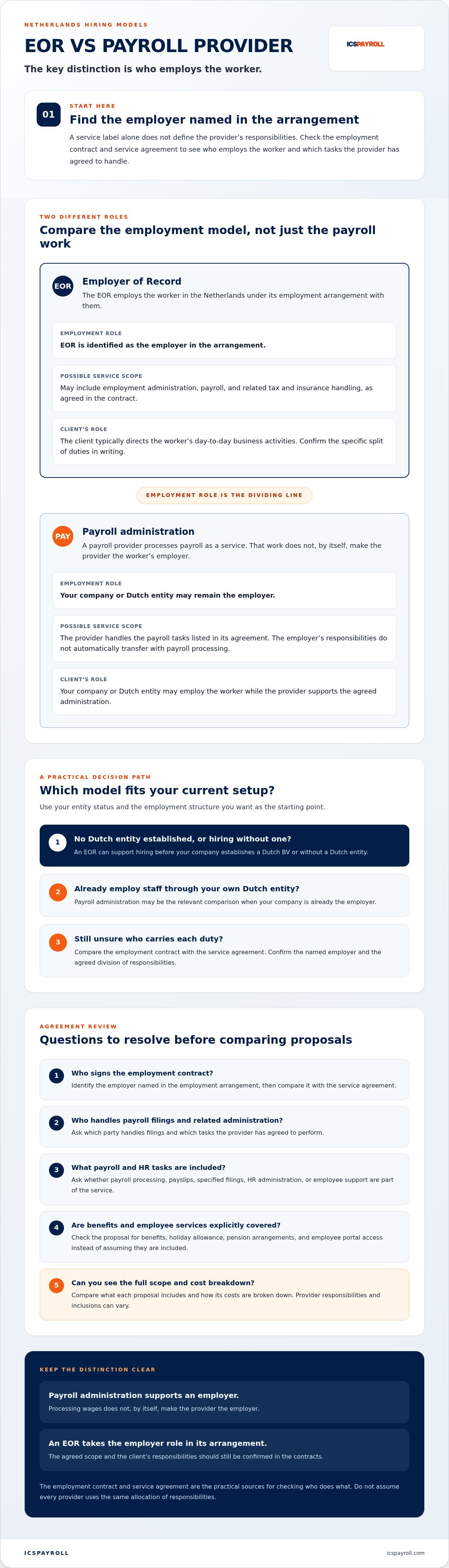
How to choose between an EOR and payroll provider for a Dutch hire
Use the decision process below to match your hiring plan to the right service model. Start with your entity and intended employer arrangement, then compare the support and costs each proposal actually includes. This makes the eor vs payroll provider netherlands decision clearer than comparing service labels alone.
- Confirm your entity status. Identify whether your company has a Dutch entity and whether it will employ the worker. If it doesn’t, ask which hiring arrangements the provider can support and who would be the legal employer.
- Choose the employer model you need. Decide whether your company intends to employ the person directly or wants an EOR to employ them under its Dutch arrangement. Confirm who signs the employment contract.
- Define the required service scope. List the tasks you want handled, such as payroll processing, filings, HR administration, pension arrangements, employee support, and portal access. Mark which services are essential and which are optional.
- Review the full proposal. Check benefits, sickness support, payroll-factor calculations, and each monthly invoice inclusion. Ask what remains your responsibility and request an itemised explanation before comparing proposals.
Use this checklist before requesting proposals
- Record whether your business has a Dutch entity and which party would employ the worker.
- Specify the services needed, including payroll, HR administration, pension, employee portal access, and ongoing employee support.
- For a hire from outside the Schengen area, ask how immigration support is handled. Immigration sponsorship is arranged via our licensed partner.
Questions to ask each Dutch provider
Get direct answers in writing. Ask who the legal employer is, who signs the contract, who handles payroll filings, and which responsibilities remain with your company. Ask how contract preparation, onboarding, and ongoing employee support work. If the proposal uses a payroll factor, request an itemised explanation of how it is calculated and what the monthly invoice includes. Confirm how pension, holiday allowance, and support during sickness are handled instead of assuming they are included.
Use the same checklist for every proposal. If you’re assessing a Dutch EOR alongside payroll administration, request a Dutch EOR and payroll proposal and compare its documented scope with your requirements.
How ICSPayroll combines Dutch EOR and payroll administration
ICSPayroll focuses on hiring and payroll in the Netherlands. Its services include Dutch Employer of Record (EOR) and full-service payroll administration. Under its EOR arrangement, ICSPayroll employs the worker, allowing a client to hire before establishing a Dutch BV or without a Dutch entity. The right route depends on your preferred employer model and the responsibilities set out in the service agreement.
What ICSPayroll's Dutch EOR service includes
The documented EOR scope brings employment administration and payroll together. It covers employment contracts, payroll administration, filings, employer premiums, and HR administration. Employees can use an online portal to access payslips, contracts, and holiday balances, while the client focuses on its business operations.
ICSPayroll’s payroll-factor model consolidates specified employment costs into one monthly invoice. Its documented factor includes an 8% holiday allowance and a 15.2% pension scheme. Confirm the agreed factor and its inclusions in your proposal so you can see how the invoice relates to the employment arrangement. These figures describe ICSPayroll’s documented model, not standard terms for every Dutch provider.
For eligible expats, ICSPayroll also assists with the 30% ruling application. Eligibility and approval are determined by the applicable rules and a written decision from the Belastingdienst. This tax ruling is separate from immigration sponsorship, which is arranged via our licensed partner.
What happens after you request a proposal?
To compare the eor vs payroll provider netherlands options against your hiring needs, share the employee details required for a tailored quotation. ICSPayroll provides that quotation within 24 hours of receiving the details. The service agreement and employment contract are prepared within days. Review the proposed employer arrangement, payroll-factor inclusions, and assigned responsibilities before proceeding.
Discuss your Dutch hiring requirement with ICSPayroll to review whether Dutch EOR or payroll administration better fits your entity status and preferred employment model.
Make your Dutch hiring model clear before you proceed
The right choice depends on who will legally employ your hire, whether your company has a Dutch entity, and how much employment administration you want included. An EOR can employ the worker on your behalf, while payroll administration may process wages for an employee of your own entity. In either case, check the contract and proposal to confirm responsibilities, inclusions, and any work your team must handle.
That’s the practical takeaway from the eor vs payroll provider netherlands decision: compare the actual employer arrangement and service scope, not just the service label. ICSPayroll provides a tailored quotation within 24 hours of receiving employee details, with the service agreement and employment contract prepared within days. Its documented payroll-factor inclusions are consolidated into one clear monthly invoice, so you can compare the proposal with your hiring requirements.
Request a tailored Dutch hiring quotation from ICSPayroll and clarify which arrangement fits your company. With responsibilities and scope set out clearly, you can move forward with greater confidence.
Frequently Asked Questions
Is an EOR the same as a payroll provider?
No. An EOR acts as the legal employer under its Dutch employment arrangement, while a payroll provider may process payroll for an employer without becoming the employer. Payroll processing alone doesn’t transfer employer status. For the eor vs payroll provider netherlands decision, check the employment contract and service agreement to confirm who employs the worker, who signs the contract, and which party handles each responsibility.
Can I use a Dutch payroll provider without setting up a Dutch BV?
It depends on the provider’s services and the proposed employment arrangement. Payroll administration may support an existing employer, while an EOR can offer a hiring route without your company having its own Dutch entity. Confirm the provider’s entity requirements and who will be the legal employer. ICSPayroll supports hiring before a Dutch BV is established or without one through its Dutch EOR service.
Does an EOR handle payroll taxes and social security in the Netherlands?
An EOR service may include Dutch payroll administration, tax filings, and social security handling, but the agreement defines the provider’s actual responsibilities. Ask who submits filings, arranges funding for payments, and addresses corrections, and clarify which tasks remain with your company. ICSPayroll describes its service as including Dutch payroll administration, social security, and employer premium handling. Request a written responsibility breakdown before signing.
How much does an EOR or payroll provider cost in the Netherlands?
There’s no single price that applies to every provider or hiring arrangement. Compare written proposals by reviewing payroll administration, benefits, HR support, and any separately billed items. ICSPayroll describes a payroll factor applied to gross salary, with specified employment costs consolidated into one monthly invoice. Ask for the factor’s inclusions and exclusions, and request a tailored quotation based on your employee details.
Can an EOR help with a Highly Skilled Migrant visa in the Netherlands?
An EOR arrangement may support international hiring, but confirm exactly how immigration assistance and sponsorship are arranged. For ICSPayroll, immigration sponsorship is arranged via a licensed partner. Its business information states that Highly Skilled Migrant applications are typically processed and granted in approximately three weeks, but individual timelines can vary. Confirm eligibility, required documents, and current processing expectations with the relevant parties.
What happens if my company already has a Dutch BV?
A Dutch BV can be part of a direct-employment arrangement supported by payroll administration, or you can compare that structure with an EOR model. The key decision is which party should employ the worker and which responsibilities you want the provider to handle. Review the proposed contract, service scope, and invoice inclusions. For questions specific to your company’s legal or tax position, seek professional advice.

Article by
Joost Hubregtse
Joost Hubregtse is Director of ICS Staffing & Payroll B.V., the wholly owned subsidiary of Intercompany Solutions behind ICS Payroll. He is responsible for Employer of Record and Dutch payroll services: employment contracts, wage tax and social security filings, holiday allowance, pension, sick leave and CAO compliance, with onboarding possible within 48 hours.
Frequently Asked Questions
An EOR acts as the employer under its Dutch employment arrangement with the worker. Its agreed services may include employment administration, payroll, and related tax and insurance handling. The client typically directs the worker’s day-to-day business activities, while the EOR carries out the employer role set out in the contract. Review the agreement to confirm each party’s specific responsibilities.
A payroll provider processes payroll as a service. That work does not, by itself, make the provider the worker’s employer. Your company or Dutch entity may remain the employer, while the provider handles the payroll tasks listed in its agreement. The practical distinction is simple: payroll administration supports an employer, while an EOR employs the worker under its employment arrangement. Check who signs the employment contract and which duties are included. Compare the tasks in the proposal with the role named in the employment contract. The table below is a practical review tool, not a claim that every EOR or payroll provider follows the same allocation. The Dutch government’s payroll tax guidance for employers is relevant to payroll tax duties. Check the specific agreement and employment arrangement for other responsibilities.
In an EOR arrangement, the EOR is identified as the employer under its employment arrangement with the worker. In payroll administration for a client’s employee, the client or its Dutch entity may remain the employer. Confirm the named employer in the employment contract, then compare it with the service agreement. Don’t infer employment status from a provider’s “payroll” label.
Providers may agree to process payroll, prepare payslips, submit specified filings, or provide HR administration and employee support. The precise division depends on the service model and contract. Ask the provider to list benefits, holiday allowance, pension arrangements, and employee portal access as explicit inclusions rather than assuming they are covered. Administrative processing also doesn’t mean every task or decision has transferred away from the employer or client. Use this responsibility matrix to identify unanswered questions before signing: Request written answers for every item that depends on the provider. For a review of ICSPayroll’s Dutch EOR and payroll administration scope, see the Dutch EOR and payroll service information. Entity status is a useful starting point, but it doesn’t determine the answer by itself. An EOR can employ a worker through its Dutch employment arrangement, while payroll-only services commonly support employees already hired through the client’s own structure. This doesn’t mean every payroll provider requires a Dutch BV, or that using an EOR removes every legal or operational risk. Confirm the actual arrangement and division of responsibilities before choosing.
The available route depends on who employs the worker and how the provider structures its service. Don’t assume the same entity requirement applies to every provider or model. ICSPayroll supports hiring before a Dutch BV is established or without a Dutch entity through its Dutch EOR service. A guide to hiring in the Netherlands without a local entity can help you assess that route alongside your own structure.
Compare proposals line by line, not by headline fee alone. Check whether the quoted scope specifies payroll taxes, social security, pension, holiday allowance, and support during sickness. Clarify what is excluded, how additional items are charged, and which responsibilities remain with your company. These details affect the total cost and the administration your team may still need to manage. ICSPayroll’s documented payroll-factor model calculates the amount using gross salary multiplied by the agreed payroll factor, with specified employment costs consolidated into one monthly invoice. The documented factor includes an 8% holiday allowance and a 15.2% pension scheme. Check the exact inclusions in your proposal rather than treating these figures as universal terms or assuming the factor covers every possible employment cost. For the eor vs payroll provider netherlands decision, a clear written breakdown makes the entity, service scope, and responsibility allocation easier to compare. Use the decision process below to match your hiring plan to the right service model. Start with your entity and intended employer arrangement, then compare the support and costs each proposal actually includes. This makes the eor vs payroll provider netherlands decision clearer than comparing service labels alone.
To compare the eor vs payroll provider netherlands options against your hiring needs, share the employee details required for a tailored quotation. ICSPayroll provides that quotation within 24 hours of receiving the details. The service agreement and employment contract are prepared within days. Review the proposed employer arrangement, payroll-factor inclusions, and assigned responsibilities before proceeding. Discuss your Dutch hiring requirement with ICSPayroll to review whether Dutch EOR or payroll administration better fits your entity status and preferred employment model. The right choice depends on who will legally employ your hire, whether your company has a Dutch entity, and how much employment administration you want included. An EOR can employ the worker on your behalf, while payroll administration may process wages for an employee of your own entity. In either case, check the contract and proposal to confirm responsibilities, inclusions, and any work your team must handle. That’s the practical takeaway from the eor vs payroll provider netherlands decision: compare the actual employer arrangement and service scope, not just the service label. ICSPayroll provides a tailored quotation within 24 hours of receiving employee details, with the service agreement and employment contract prepared within days. Its documented payroll-factor inclusions are consolidated into one clear monthly invoice, so you can compare the proposal with your hiring requirements. Request a tailored Dutch hiring quotation from ICSPayroll and clarify which arrangement fits your company. With responsibilities and scope set out clearly, you can move forward with greater confidence.
No. An EOR acts as the legal employer under its Dutch employment arrangement, while a payroll provider may process payroll for an employer without becoming the employer. Payroll processing alone doesn’t transfer employer status. For the eor vs payroll provider netherlands decision, check the employment contract and service agreement to confirm who employs the worker, who signs the contract, and which party handles each responsibility.
It depends on the provider’s services and the proposed employment arrangement. Payroll administration may support an existing employer, while an EOR can offer a hiring route without your company having its own Dutch entity. Confirm the provider’s entity requirements and who will be the legal employer. ICSPayroll supports hiring before a Dutch BV is established or without one through its Dutch EOR service.
An EOR service may include Dutch payroll administration, tax filings, and social security handling, but the agreement defines the provider’s actual responsibilities. Ask who submits filings, arranges funding for payments, and addresses corrections, and clarify which tasks remain with your company. ICSPayroll describes its service as including Dutch payroll administration, social security, and employer premium handling. Request a written responsibility breakdown before signing.
There’s no single price that applies to every provider or hiring arrangement. Compare written proposals by reviewing payroll administration, benefits, HR support, and any separately billed items. ICSPayroll describes a payroll factor applied to gross salary, with specified employment costs consolidated into one monthly invoice. Ask for the factor’s inclusions and exclusions, and request a tailored quotation based on your employee details.
An EOR arrangement may support international hiring, but confirm exactly how immigration assistance and sponsorship are arranged. For ICSPayroll, immigration sponsorship is arranged via a licensed partner. Its business information states that Highly Skilled Migrant applications are typically processed and granted in approximately three weeks, but individual timelines can vary. Confirm eligibility, required documents, and current processing expectations with the relevant parties.
A Dutch BV can be part of a direct-employment arrangement supported by payroll administration, or you can compare that structure with an EOR model. The key decision is which party should employ the worker and which responsibilities you want the provider to handle. Review the proposed contract, service scope, and invoice inclusions. For questions specific to your company’s legal or tax position, seek professional advice.