
Payroll Klein Bedrijf: The 2026 Guide to Small Business Payroll in the Netherlands
By Joost Hubregtse, Director, ICS Staffing & Payroll
All blog posts are reviewed and fact checked by our labour law lawyer Zishan Hussain and our director. Editorial standards
Dutch payroll is not administrative data entry; it is active risk mitigation. For an expanding team, setting up a compliant payroll klein bedrijf (small business payroll) in the Netherlands carries legal liabilities that can quickly overwhelm your daily operations. If you feel burdened by monthly wage tax filings, the lifted Wet DBA enforcement moratorium, and mandatory two-year sick pay obligations under Article 7:629 BW, you aren't alone. Losing core business hours to administrative bureaucracy drains the momentum you need to scale revenue.
You don't have to handle these statutory demands without a clear roadmap. In this 2026 guide, you will discover how Dutch small business payroll works, compare the most efficient administration models, and eliminate costly compliance exposures for your growing workforce. We examine mandatory Belastingdienst withholdings, break down employer premium obligations, and provide the exact framework required to protect your company from unexpected labor penalties.
Key Takeaways
- Understand the statutory mechanics of payroll klein bedrijf in the Netherlands, including strict monthly loonaangifte reporting deadlines with the Belastingdienst.
- Compare the four primary Dutch payroll administration models to determine the optimal balance between internal operational overhead, outsourced administration, and legal protection.
- Evaluate critical employer liabilities, including mandatory two-year sick pay obligations under Article 7:629 BW and post-moratorium Wet DBA classification rules.
- Calculate your true employment costs by factoring in mandatory arbodienst contracts, absenteeism coverage, and differentiated statutory social security premiums.
- Learn how an Employer of Record model legally insulates your enterprise from labor liabilities while ensuring comprehensive regulatory compliance from day one.
What Does Payroll Klein Bedrijf Entail in the Netherlands?
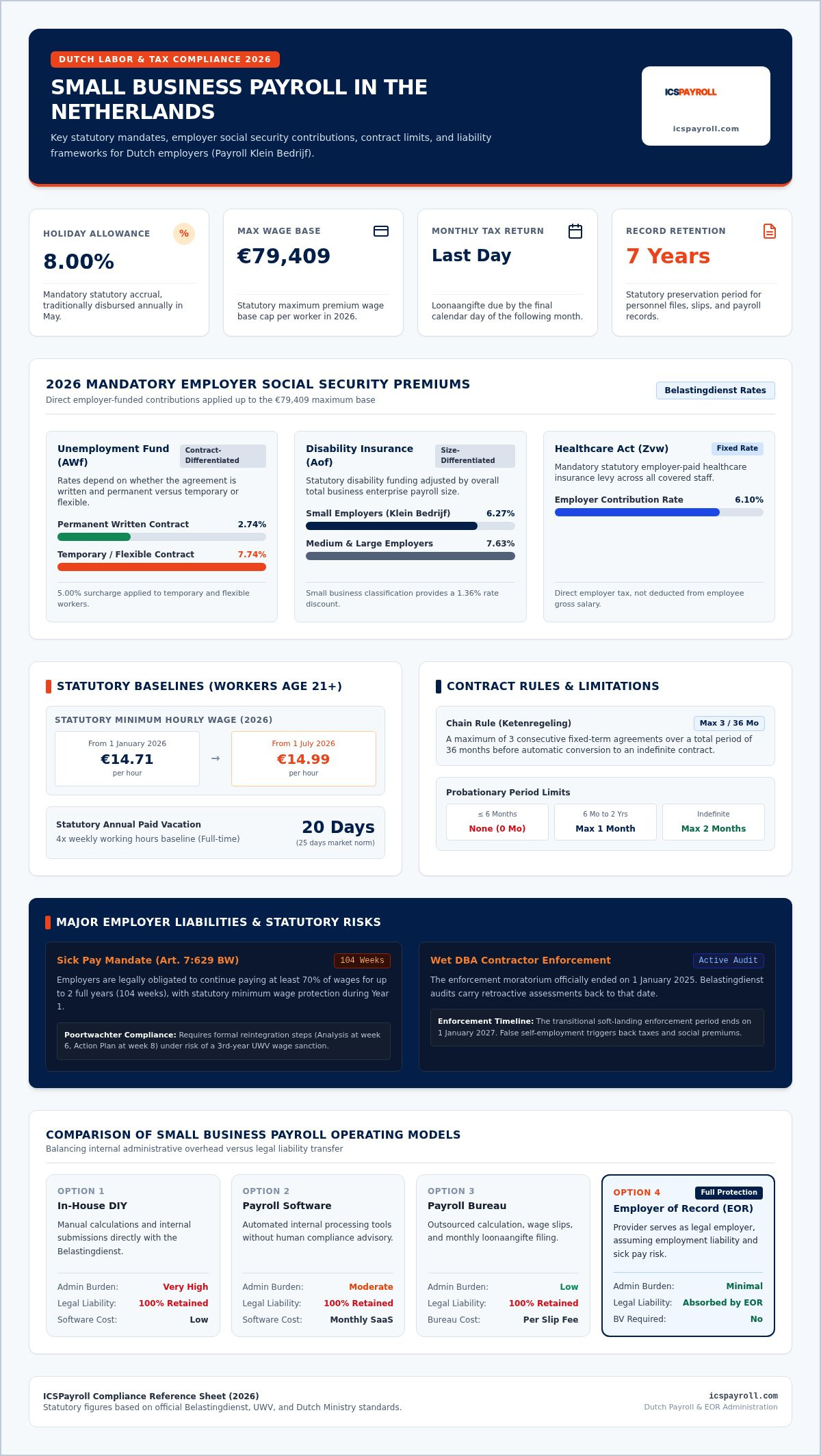
At its core, the standard definition of payroll refers to the process of calculating wages and distributing net payments. In the Netherlands, however, running a payroll klein bedrijf involves strict statutory liability. Operating as a registered Dutch employer requires calculating gross-to-net salaries, withholding wage taxes (loonheffing), deducting national insurance contributions, and submitting a monthly wage tax return (loonaangifte) to the Belastingdienst by the final calendar day of the following month.
Statutory employer mandates demand careful financial planning well beyond basic monthly pay. Employers must accrue and pay out an 8% statutory holiday allowance, traditionally disbursed each May. In addition, Dutch law mandates that all personnel files, wage slips, and administrative records be preserved for at least 7 years. Missing a monthly filing deadline or miscalculating withholdings triggers automated penalties and increases your risk of an operational audit.
Core Employer Contributions and Statutory Premiums in 2026
Dutch employers must fund mandatory social security programs directly from company funds. In 2026, social security premium calculations apply up to a statutory maximum premium wage base (maximumpremieloon) of €79,409 per employee:
- Unemployment Fund (AWf): Differentiated by contract type, set at 2.74% for permanent written agreements and 7.74% for temporary or flexible arrangements.
- Disability Insurance (Aof): Differentiated by enterprise size, fixed at 6.27% for small employers and 7.63% for medium and large companies.
- Health Insurance Act (Zvw): An employer-paid statutory healthcare contribution capped at 6.10% across covered payroll.
Mandatory Employee Rights and Working Conditions
Dutch employment law protects staff through non-negotiable statutory baselines. According to statutory rates outlined on business.gov.nl, the statutory minimum hourly wage for workers aged 21 and older is €14.71, increasing to €14.99 as of 1 July 2026. Full-time personnel are legally entitled to statutory paid leave equal to four times their weekly working hours, providing a baseline of 20 vacation days annually.
Contract drafting requires strict procedural discipline. Under the chain rule (ketenregeling), employers can offer a maximum of 3 consecutive fixed-term agreements over a 36-month period before the contract automatically converts to indefinite status. Probationary clauses are equally restricted: indefinite agreements allow a 2-month trial period, fixed contracts between 6 months and 2 years permit 1 month, and contracts of 6 months or less cannot contain any probation clause at all.
Comparing Payroll Options for Small Businesses in the Netherlands
Managing a payroll klein bedrijf is primarily a question of risk allocation rather than bookkeeping. Small enterprises in the Netherlands typically choose between four operational paths: internal DIY processing, specialized payroll software, external payroll accounting bureaus, or an Employer of Record (EOR). Selecting the wrong structure exposes your business to unexpected operational overhead, administrative bottlenecks, and regulatory exposure with the Belastingdienst.
In-House Administration vs. Payroll Accounting Bureaus
Handling payroll internally using dedicated software eliminates external administration markups, but it demands continuous monitoring of complex labor legislation and shifting tax scales. Any reporting discrepancy in your monthly submissions triggers immediate tax authority scrutiny. Traditional accounting bureaus mitigate calculation errors by generating payslips and filing returns on your behalf. However, they don't assume underlying employment liabilities; your enterprise remains exclusively liable for all statutory compliance failures and resulting penalties.
Payroll Bureau Outsourcing vs. Employer of Record (EOR)
While standard payroll bureaus handle monthly gross-to-net calculations, they leave workplace liabilities, long-term sick pay exposure, and complex dismissal procedures on your desk. An Employer of Record takes a fundamentally different operational approach. Under an EOR model, the provider acts as the registered legal employer, absorbing statutory employment risks, issuing compliant contracts, and managing wage tax withholding end to end.
This operational model is particularly valuable for growing companies and international founders seeking fast market access. Forming a local Dutch BV typically requires around €2,000 in setup costs alongside €3,000 to €8,000 in annual corporate accounting and filing fees. An EOR bypasses this corporate burden entirely by placing your local hires on an existing, fully compliant infrastructure. Review our detailed structural breakdown in Employer of Record Netherlands: The 2026 Guide.
If your priority is eliminating administrative drag while establishing ironclad legal protection for your team, partnering with ICSPayroll delivers the institutional stability needed to scale your business safely.
Statutory Sickness, Dismissal, and Contractor Compliance Risks
Dutch labor law prioritizes worker protection over employer flexibility. For small teams, a single long-term illness or regulatory misclassification can quickly destabilize operational cash flow. Running a payroll klein bedrijf means assuming direct legal accountability for these statutory liabilities unless you intentionally structure your operations to mitigate them.
The 104-Week Sick Pay Burden and Wet Poortwachter
Under Article 7:629 BW, employers must pay at least 70% of an incapacitated worker's salary for up to 104 weeks. During the first 52 weeks, this payment cannot dip below the statutory minimum wage floor. Alongside this wage obligation, the Wet verbetering poortwachter enforces strict procedural reintegration milestones. Employers must conduct a formal problem analysis by week 6, establish a mutual action plan by week 8, and pursue second-track external job placement if internal reintegration fails. If the UWV determines your administrative efforts were insufficient, they can enforce an administrative penalty requiring a third full year of sick pay. For an exhaustive operational breakdown, review our detailed resource on Dutch Payroll Administration.
Transition Payments and Termination Protocols in 2026
Ending an employment agreement in the Netherlands requires verified statutory grounds, necessitating either formal dismissal approval from the UWV or contract dissolution through a subdistrict court. Departing personnel are legally entitled to a statutory transition payment (transitievergoeding), which begins accruing from their first day of work, including probationary periods. For 2026, this compensation is capped at €102,000, or one full year's gross salary if that figure is higher. Small enterprises with fewer than 25 workers retain access to UWV compensation for statutory transition costs following two years of employee illness, whereas companies with 25 or more workers lose this compensation from 1 July 2026.
Independent Contractor Scrutiny Under Wet DBA and VBAR
Using freelancers (zzp'ers) to circumvent payroll duties exposes your business to aggressive enforcement. The Belastingdienst officially ended the Wet DBA enforcement moratorium on 1 January 2025, which allows tax authorities to impose corrective assessments retroactively to that date. The current enforcement soft landing concludes on 1 January 2027, leaving zero margin for misclassification errors. Legislative scrutiny is tightening as well: on 16 June 2026, the Dutch Senate passed the stripped VBAR bill, establishing a legal presumption of employment for independent workers billing under roughly €38 per hour. While this measure is not yet in force, its expected enactment by 31 December 2026 makes independent contractor arrangements increasingly hazardous for small businesses.
How Small Businesses Can Choose the Right Payroll Model
Selecting an employment setup requires matching your operational capacity with your tolerance for legal exposure. A sound framework for payroll klein bedrijf balances administrative time against the total cost of risk. Before committing to in-house management or basic software subscriptions, audit your internal HR bandwidth, contractual complexities, and long-term hiring roadmap.
Step 1: Evaluate Team Headcount and Sickness Exposure
Enterprises with fewer than 10 workers face acute vulnerability when an employee falls ill. Meeting statutory obligations requires contracting an occupational health service (arbodienst) and often purchasing private sickness absenteeism insurance (verzuimverzekering). Retainers, mandatory medical assessments, and escalating insurance premiums add substantial overhead to base salaries. Comparing these piecemeal administrative expenses against a consolidated outsourced payroll factor often reveals that offloading statutory employer liabilities provides superior cost predictability.
Step 2: Account for Cross-Border Talent and the 30% Ruling
Securing specialized international professionals introduces distinct fiscal and immigration workflows. For qualified expatriates, employers can apply to the Belastingdienst for the 30% tax facility. In 2026, the statutory taxable salary threshold after deduction is €48,013 (or €36,497 for employees under 30 holding a qualifying master's degree), requiring approximately €68,590 in gross annual pay to access the maximum benefit. If you are hiring non-Schengen talent, note that immigration sponsorship is arranged via our licensed partner. Learn how this integrated structure functions in our guide on PEO Services in the Netherlands.
Step 3: Analyze Entity Requirements and Corporate Overhead
Deciding between direct employment and an Employer of Record often hinges on your legal footprint. Incorporating a Dutch BV involves roughly €2,000 in formation expenses, accompanied by €3,000 to €8,000 annually in corporate accounting, tax filings, and entity upkeep. If your immediate objective is building a local team rather than establishing a full corporate presence, an EOR eliminates these structural expenditures entirely by employing your team locally on compliant existing infrastructure.
Ready to safeguard your enterprise against statutory labor liabilities? Request a tailored payroll proposal from ICSPayroll to establish an efficient, compliant employment framework today.
Streamline Small Business Payroll with ICSPayroll
Modern workforce expansion requires rapid execution without legal liabilities. ICSPayroll operates as your dedicated Employer of Record (EOR) and Dutch payroll specialist, absorbing the statutory responsibilities of a payroll klein bedrijf so your management team can concentrate on commercial execution. We act as the local employer on paper, running compliant contracts and administrative operations while you retain complete day-to-day oversight of your staff.
Operational agility is built into our service delivery. While establishing a standalone corporate infrastructure takes months, our onboarding workflow enables you to launch employment agreements within weeks. Tailored quotations are delivered within 24 hours of receiving basic compensation details, giving you immediate financial visibility. A single, consolidated monthly invoice covers every statutory element, eliminating unexpected reconciliations and unbudgeted consulting charges.
Complete Employment Protection Under One Transparent Payroll Factor
Our consolidated billing model utilizes a clear payroll factor that aggregates every statutory baseline into one predictable monthly figure. You receive total institutional protection backed by dedicated human support:
- All-Inclusive Compensation: Consolidates base gross wages, the mandatory 8% holiday allowance, and 15.2% industry-standard pension management into scheduled disbursements.
- Statutory Premium Coverage: Accurately calculates and pays national employee insurances, Zvw healthcare levies, and sector-specific fund remittances.
- Direct Sickness Absorption: Shields your enterprise from the catastrophic financial strain of Article 7:629 BW by absorbing sickness risk for up to two years.
- HR and Reintegration Support: Covers statutory transition payments, contractual revisions, and strict medical reintegration protocols under professional guidance.
- Digital Self-Service: Provides workers and managers access to a centralized online portal for tracking leave accruals, reviewing monthly payslips, and managing records.
Fast Setup and Cross-Border Recruitment Support
Scaling a business often requires sourcing specialized talent from outside the Netherlands. Through our EOR framework, companies can secure cross-border expertise immediately without incurring the corporate overhead of a Dutch entity. When international mobility is required, immigration sponsorship is arranged via our licensed partner, enabling rapid Highly Skilled Migrant visa approvals in weeks. We also handle the preparation and formal submission of 30% tax facility applications to the Belastingdienst for all eligible international candidates.
Eliminate local compliance friction and protect your business from day one. Speak with our payroll specialists today to implement a resilient, compliant payroll structure tailored to your enterprise.
Secure Your Dutch Employment Framework for 2026 and Beyond
Running a compliant payroll klein bedrijf shouldn't stall your commercial momentum. Managing payroll internally introduces severe operational friction, from strict Belastingdienst monthly deadlines to mandatory two-year sick pay obligations under Article 7:629 BW and tightened Wet DBA scrutiny. Choosing the right employment structure transforms these complex statutory hurdles into a stable foundation for expansion.
Partnering with ICSPayroll eliminates employer liability while keeping your hiring agile. We deliver a tailored quotation within 24 hours of your request and complete your operational setup in weeks rather than months. Every statutory obligation, including pension contributions, holiday allowances, and full sickness protection, is consolidated into one transparent monthly invoice without hidden overhead. You maintain day-to-day managerial control over your workforce while we absorb the local legal risk.
Hire in the Netherlands with confidence using ICSPayroll and keep your team focused entirely on scaling commercial revenue.
Frequently Asked Questions
Can a small business in the Netherlands run payroll without establishing a Dutch BV?
Yes, an international enterprise or growing business can hire local personnel without forming a Dutch BV by partnering with an Employer of Record (EOR). The EOR acts as the legal employer of record on paper, registering the employees and filing statutory wage taxes with the Belastingdienst. This model bypasses typical BV incorporation costs of roughly €2,000 and ongoing annual administrative accounting overhead ranging from €3,000 to €8,000.
How much does a small business have to pay a sick employee under Dutch labor law?
Under Article 7:629 BW, employers must pay at least 70% of an incapacitated employee's gross wages for up to 104 weeks. During the first year of absence, this payment cannot legally fall below the statutory minimum wage. Alongside wage continuation, employers must actively manage mandatory reintegration protocols under the Wet verbetering poortwachter to avoid punitive third-year wage penalties issued directly by the UWV.
What happens if a small business makes a mistake on the monthly loonaangifte filing?
Submitting an incorrect or late monthly wage tax return (loonaangifte) triggers administrative notices, automatic penalty assessments, and interest charges from the Belastingdienst. Correcting errors requires filing a formal corrective return (correctiebericht). For companies managing payroll klein bedrijf in-house, repeated discrepancies elevate corporate audit risks and can result in significant default surcharges (verzuimboetes) alongside statutory back-tax liabilities.
Is outsourcing payroll to an Employer of Record compliant with the Belastingdienst?
Yes, utilizing an Employer of Record is fully recognized and compliant under Dutch tax and labor legislation. The EOR registers as the withholding agent with the Belastingdienst, deducting mandatory wage taxes, national insurance contributions, and employee premiums directly from payroll. The arrangement gives small businesses complete operational use of local workers while transferring statutory employer responsibilities and compliance exposure to an established Dutch entity.
How does the lifting of the Wet DBA enforcement moratorium impact small employers?
The lifting of the Wet DBA enforcement moratorium on 1 January 2025 means the Belastingdienst can issue corrective payroll tax assessments retroactively to that date. While a transitional soft-landing policy remains in place until 1 January 2027, inspectors actively scrutinize contractor relationships. Small businesses misclassifying true employees as independent contractors face immediate claims for unpaid wage taxes, social premiums, and retroactive holiday allowances.
Can small businesses apply for the 30% ruling on behalf of international hires?
Yes, small businesses can utilize the Dutch 30% facility provided the employee meets statutory eligibility criteria, including recruitment from abroad and reaching the 2026 taxable salary threshold of €48,013 (or €36,497 for qualifying candidates under 30 with a master's degree). When expanding via an EOR, the provider submits the application directly to the Belastingdienst, while non-Schengen immigration sponsorship is arranged via our licensed partner.
What is included in an all-in payroll factor invoice for small business staff?
A transparent payroll factor consolidates all mandatory employer overhead into one monthly invoice for your payroll klein bedrijf. This invoice covers gross base salary, the statutory 8% holiday allowance, standard 15.2% pension accruals, and mandatory social security contributions. Crucially, it absorbs long-term sickness risk under Article 7:629 BW for up to two years, covers statutory transition pay management, and includes complete HR portal access.

Article by
Joost Hubregtse
Joost Hubregtse is Director of ICS Staffing & Payroll B.V., the wholly owned subsidiary of Intercompany Solutions behind ICS Payroll. He is responsible for Employer of Record and Dutch payroll services: employment contracts, wage tax and social security filings, holiday allowance, pension, sick leave and CAO compliance, with onboarding possible within 48 hours.
Frequently Asked Questions
Yes, an international enterprise or growing business can hire local personnel without forming a Dutch BV by partnering with an Employer of Record (EOR). The EOR acts as the legal employer of record on paper, registering the employees and filing statutory wage taxes with the Belastingdienst. This model bypasses typical BV incorporation costs of roughly €2,000 and ongoing annual administrative accounting overhead ranging from €3,000 to €8,000.
Under Article 7:629 BW, employers must pay at least 70% of an incapacitated employee's gross wages for up to 104 weeks. During the first year of absence, this payment cannot legally fall below the statutory minimum wage. Alongside wage continuation, employers must actively manage mandatory reintegration protocols under the Wet verbetering poortwachter to avoid punitive third-year wage penalties issued directly by the UWV.
Submitting an incorrect or late monthly wage tax return (loonaangifte) triggers administrative notices, automatic penalty assessments, and interest charges from the Belastingdienst. Correcting errors requires filing a formal corrective return (correctiebericht). For companies managing payroll klein bedrijf in-house, repeated discrepancies elevate corporate audit risks and can result in significant default surcharges (verzuimboetes) alongside statutory back-tax liabilities.
Yes, utilizing an Employer of Record is fully recognized and compliant under Dutch tax and labor legislation. The EOR registers as the withholding agent with the Belastingdienst, deducting mandatory wage taxes, national insurance contributions, and employee premiums directly from payroll. The arrangement gives small businesses complete operational use of local workers while transferring statutory employer responsibilities and compliance exposure to an established Dutch entity.
The lifting of the Wet DBA enforcement moratorium on 1 January 2025 means the Belastingdienst can issue corrective payroll tax assessments retroactively to that date. While a transitional soft-landing policy remains in place until 1 January 2027, inspectors actively scrutinize contractor relationships. Small businesses misclassifying true employees as independent contractors face immediate claims for unpaid wage taxes, social premiums, and retroactive holiday allowances.
Yes, small businesses can utilize the Dutch 30% facility provided the employee meets statutory eligibility criteria, including recruitment from abroad and reaching the 2026 taxable salary threshold of €48,013 (or €36,497 for qualifying candidates under 30 with a master's degree). When expanding via an EOR, the provider submits the application directly to the Belastingdienst, while non-Schengen immigration sponsorship is arranged via our licensed partner.
A transparent payroll factor consolidates all mandatory employer overhead into one monthly invoice for your payroll klein bedrijf. This invoice covers gross base salary, the statutory 8% holiday allowance, standard 15.2% pension accruals, and mandatory social security contributions. Crucially, it absorbs long-term sickness risk under Article 7:629 BW for up to two years, covers statutory transition pay management, and includes complete HR portal access.