
Netherlands Foreign Payroll: 2026 Compliance Guide
By Joost Hubregtse, Director, ICS Staffing & Payroll
All blog posts are reviewed and fact checked by our labour law lawyer Zishan Hussain and our director. Editorial standards
By Joost Hubregtse, Payroll Director
Joost Hubregtse is Payroll Director at ICSPayroll, the Dutch payroll and EOR specialist of Intercompany Solutions. A career payroll specialist and former Head of Payroll, he oversees wage tax filings, 30% ruling applications, and employment compliance for international employers.
The era of the "soft landing" for Dutch labor compliance is ending, and foreign employers who fail to adapt by 2027 face significant financial risks. Managing a payroll buitenlandse werkgever used to be a matter of simple tax registration. In 2026, the landscape has shifted toward stricter enforcement of the Wet DBA and complex new thresholds for the 30% ruling. You likely understand that the Netherlands offers a world class talent pool, yet the administrative burden of Permanent Establishment risks and evolving labor laws can feel like a barrier to entry.
This guide ensures your expansion remains secure and efficient. You'll learn how to compliantly manage Dutch payroll as a foreign entity by leveraging an Employer of Record (EOR) and local expertise. We provide a methodical breakdown of the 2026 labor law reforms, including the latest 30% ruling salary norms of €48,013 and the VBAR legal presumptions. By following this framework, you can achieve a compliant payroll setup in weeks, protect your business from tax audits, and ensure your international employees receive their full tax benefits without the need for immediate BV incorporation.
Key Takeaways
- Understand the strategic differences between direct registration and an EOR model to manage your payroll buitenlandse werkgever with full compliance and minimal risk.
- Learn how to bypass €2,000 in setup costs and €3,000 to €8,000 in annual BV accounting fees by deploying talent through a localized payroll infrastructure in just weeks.
- Identify the operational risks associated with the Wet DBA enforcement and the pending VBAR legislation that establishes a legal presumption of employment for rates under €38 per hour.
- Apply the correct 2026 salary thresholds for the 30% ruling, ensuring international hires meet the €48,013 standard or the €36,497 norm for master's degree holders under 30.
- Accelerate your expansion with expedited HSM visa processing via licensed partners and a consolidated monthly invoice that covers all mandatory Dutch social premiums, pensions, and holiday allowances.
Payroll Options for Foreign Employers in Netherlands
Foreign entities expanding into the Dutch market often begin with a single remote hire. This creates a specific legal scenario: a foreign employer with Dutch based staff. While the employee resides and works locally, the corporate entity remains abroad. This requires a robust payroll buitenlandse werkgever strategy to manage local wage tax and social security obligations from day one.
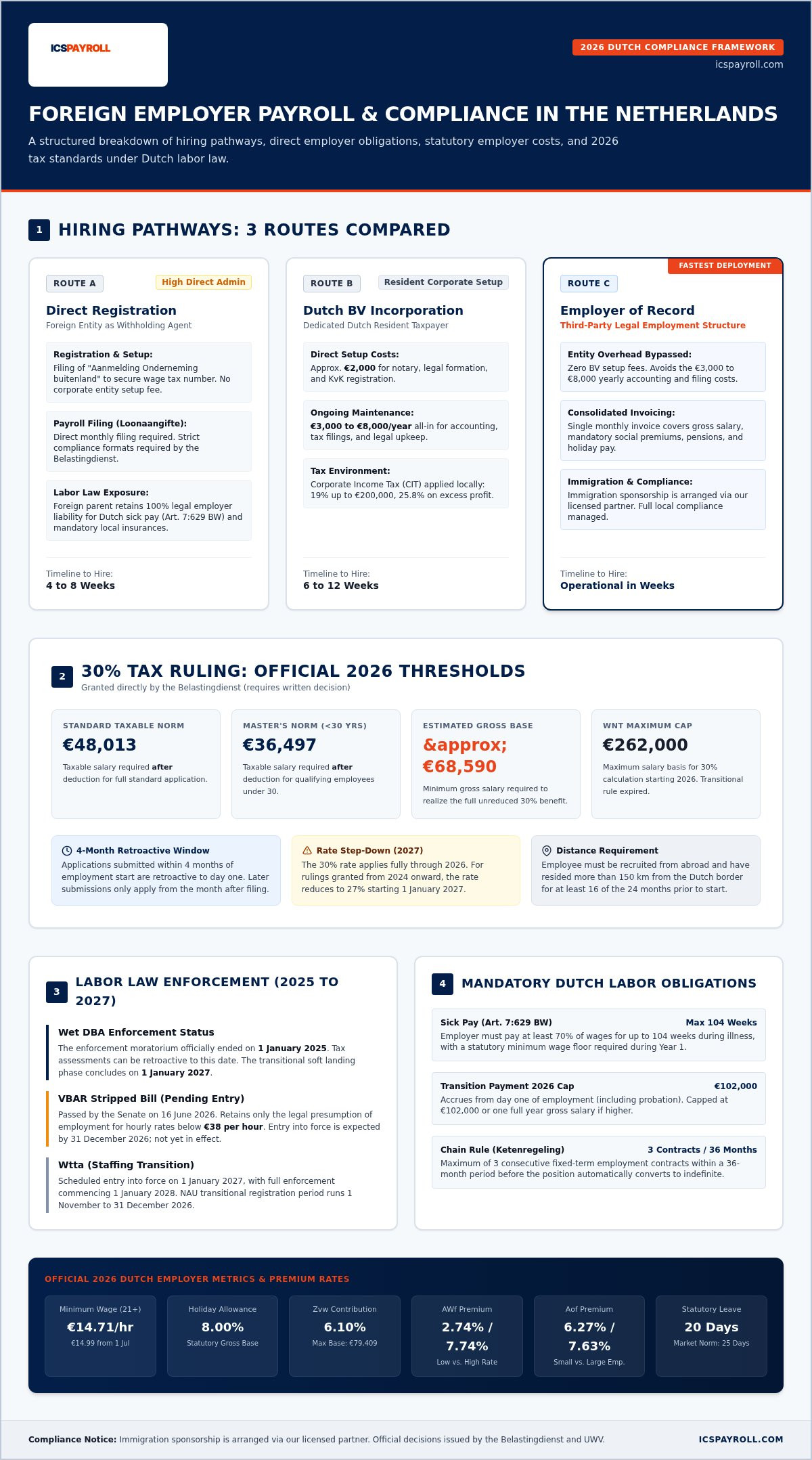
Management must carefully evaluate the risk of Permanent Establishment (PE). If your Dutch staff performs revenue generating activities or has the authority to sign contracts, the Belastingdienst may determine your company has a taxable presence. Establishing a Dutch BV is a common solution to mitigate this, as a BV is a resident taxpayer and not a PE. However, with setup costs of €2,000 and annual filing fees typically between €3,000 and €8,000, a BV is often not the most efficient starting point for a small or growing team. Instead, businesses choose between direct registration or a third party model.
Direct Payroll Registration as a Non-Resident Employer
A foreign business can choose to register directly as a withholding agent without incorporating a local entity. You must file the form "Aanmelding Onderneming buitenland" to obtain a Dutch payroll tax number. This allows you to withhold wage tax and social security premiums directly. However, this route carries significant administrative burdens. You remain fully liable for complex Dutch labor laws, including the obligation to pay at least 70% of wages for up to 104 weeks during employee illness under art. 7:629 BW.
Managing local insurance (Arbodienst) and mandatory pension fund participation from abroad is notoriously difficult. Foreign entities often struggle with the technical requirements of the monthly loonaangifte (wage tax return). Most foreign banks cannot facilitate the specific payment formats required by Dutch authorities, which can lead to late filings and avoidable penalties.
The Local Employer of Record (EOR) Model
The EOR model provides a secure bridge between your foreign entity and the local system. In this arrangement, the EOR acts as the legal employer on paper while you retain daily management of the employee. This is the preferred choice for companies requiring full compliance without the overhead of a local entity. It ensures that mandatory pension contributions and holiday allowances are handled automatically through a consolidated monthly invoice.
For a deeper look at how this functions, see our Employer of Record Netherlands: The 2026 Guide to Compliant Hiring. This model allows for an operational setup in just weeks. It provides the security of a local expert who assumes the administrative burden, including the management of 30% ruling applications and employment contracts that adhere to the latest 2026 labor standards.
EOR vs. Direct Registration: A Strategic Comparison for 2026
Choosing between direct registration and an Employer of Record (EOR) determines your operational speed and risk profile in the Netherlands. A payroll buitenlandse werkgever registration allows you to remain the primary employer, but it leaves your business responsible for every technical filing and local labor risk. In contrast, an EOR assumes the legal employer role. This structure provides a professional liability shield, ensuring your business remains compliant without the months of delay typically required for BV incorporation.
Cost and Time Efficiency
Establishing a Dutch BV involves approximately €2,000 in initial setup costs. Beyond this, you must budget between €3,000 and €8,000 annually for mandatory corporate accounting, legal filings, and annual compliance. EOR onboarding bypasses these hurdles. It moves your team from recruitment to operational status in weeks rather than months. We utilize a transparent "payroll factor" model to simplify your financial planning. This model bundles the gross salary, the mandatory 8% holiday allowance, and the 15.2% pension contribution into one predictable monthly invoice. If you need immediate clarity on these figures, you can request a tailored quotation within 24 hours to see exactly how the costs align with your expansion budget.
Compliance and Liability Shielding
The EOR model protects your foreign entity from the intricate complexities of Dutch dismissal law. In 2026, the statutory transition payment is capped at €102,000 or one year's gross salary if higher. An EOR manages these accruals and ensures that every employment contract includes necessary local provisions, such as valid probation periods and specific non-compete clauses. This administrative precision extends to employee handbooks and local HR standards, which removes the risk of UWV sanctions for non-compliance.
Managing these variables from abroad often leads to administrative gaps. By using a local expert, you ensure that mandatory social security deductions (such as the 6.10% Zvw levy) and monthly loonaangifte filings are handled with clinical precision. For companies seeking a broader administrative partnership, exploring PEO Services in the Netherlands: The 2026 Guide to Compliant Hiring clarifies how these solutions integrate with your long term strategy. This approach allows you to focus on talent management while we handle the technical legal standards of the Dutch market.
Dutch Labor Law Compliance: Navigating the 2026 Reforms
Reviewed by Joost Hubregtse, Payroll Director, on September 15, 2026.
The regulatory environment in the Netherlands is currently undergoing a period of intense transition. For a payroll buitenlandse werkgever, the most critical shift is the end of the Wet DBA enforcement moratorium. While a "soft landing" window remains open until 1 January 2027, the Belastingdienst has resumed audits and can enforce tax assessments retroactively to 1 January 2025. This means foreign businesses can no longer assume that contractor relationships are exempt from scrutiny. If an audit determines a "fictitious employment" relationship exists, the foreign entity is liable for back taxes and social premiums.
The VBAR and Legal Presumption of Employment
The Senate passed a stripped-down version of the VBAR bill on 16 June 2026. This legislation introduces a legal presumption of employment for any worker earning below €38 per hour. If your Dutch staff falls under this threshold, the burden of proof shifts to the employer to demonstrate that the relationship isn't one of traditional employment. Foreign entities often rely on freelance contracts to avoid local payroll, but this strategy is increasingly fragile. You can find a detailed breakdown of these risks in our Employment Law in the Netherlands for Foreign Employers: 2026 Compliance Guide. While the bill isn't yet in force, it's expected by 31 December 2026, making it essential to transition vulnerable roles to a formal payroll structure now.
Dutch law requires employers to pay at least 70% of an employee's gross salary for 104 weeks during illness. A major change occurred on 1 July 2026 regarding the statutory transition payment, which is currently capped at €102,000. Previously, the UWV compensated employers for this payment if a contract was terminated after two years of sickness. As of July 2026, employers with 25 or more staff members have lost this right to compensation. Only small employers retain this financial safety net. This makes the management of long-term illness a significant financial liability for mid-sized and large international firms operating in the Netherlands.
Poortwachter and Sick Leave Obligations
Compliance isn't just about payment; it's about active reintegration. The Poortwachter framework requires a specific timeline of actions. A company doctor must conduct a problem analysis by week 6 of the illness. By week 8, the employer and employee must establish a formal Plan of Action (Plan van Aanpak). Failure to follow these steps can lead to the UWV imposing a third-year wage penalty, extending your pay obligation to 156 weeks. Poortwachter is the statutory framework for Dutch illness reintegration. Our EOR model assumes these risks, ensuring every step is documented to protect your organization from these heavy administrative sanctions.
Maximizing the 30% Tax Ruling for International Talent
Reviewed by Joost Hubregtse, Payroll Director, on September 15, 2026.
The 30% ruling remains a premier tool for a payroll buitenlandse werkgever seeking to attract top tier talent to the Netherlands. This tax incentive allows employers to provide a tax free reimbursement of up to 30% of an employee's gross salary to cover extraterritorial costs. However, for 2026 hires, the landscape has changed. It's no longer a flat 30% benefit for the full five year duration. For rulings first granted on or after 1 January 2024, the tax free rate steps down to 27% effective 1 January 2027. Only those who held the ruling prior to 2024 are grandfathered into the original 30% rate for their full term.
The 2026 Salary and Cap Requirements
Eligibility for the ruling depends strictly on taxable salary thresholds, which are updated annually by the Belastingdienst. For 2026, the standard annual taxable salary threshold after the deduction is €48,013. For employees under the age of 30 who hold a scientific master's degree, the threshold is lower at €36,497. It's a common misconception that these figures represent the gross salary. To utilize the full tax free benefit, an employee generally requires a gross salary of approximately €68,590. Additionally, the benefit is now capped at the WNT top income standard, known as the Balkenende norm, which is €262,000 for 2026. Any salary exceeding this cap is ineligible for the tax free reimbursement. For a deep dive into these calculations, read The 30% Ruling in the Netherlands: A Comprehensive 2026 Employer Guide.
Changes to Partial Non-Resident Status
The structural benefits of the 30% ruling have also been narrowed regarding wealth tax. The partial non resident status, which allowed holders to be treated as non residents for Box 2 and Box 3 taxation, has been abolished for all new holders. Only individuals who held the ruling prior to 1 January 2024 retain this entitlement, and even then, the transitional arrangement expires definitively on 31 December 2026. It's also vital to distinguish between immigration and tax benefits. While immigration sponsorship is arranged via our licensed partner, having IND recognized sponsor status doesn't impact the 30% ruling application. The ruling is a purely fiscal decision granted solely by the Dutch tax authorities.
To qualify, the employee must be recruited from abroad and have lived more than 150 km from the Dutch border for at least 16 of the 24 months preceding their start date. Timing is everything: applications filed within 4 months of the start date are retroactive to day one. If you miss this window, the ruling only applies from the first day of the month following the submission. You can secure your employee's 30% ruling application today to ensure full retroactivity and maximize their net take home pay.
Hire in the Netherlands with Confidence via ICSPayroll
Expanding into a new territory requires a partner that acts as a protective guardian for your business interests. ICSPayroll enables you to hire Dutch talent in weeks without the €2,000 setup costs or the €3,000 to €8,000 annual accounting fees of a local BV. For a payroll buitenlandse werkgever, this means immediate market entry with zero administrative friction. If you need to recruit non-EU talent, we facilitate expedited Highly Skilled Migrant (HSM) visa processing in approximately 3 weeks via our licensed partners. This allows your team to reach full productivity while we handle the technical complexities of Dutch labor law.
Our "one invoice" promise is the foundation of our service. We consolidate every mandatory contribution into a single, transparent monthly billing line. This includes social security premiums, mandatory pension contributions, and accrued holiday allowances. Your finance team receives a predictable document that simplifies global budgeting and removes the need for multiple local bank transfers. This level of consolidation is essential for maintaining clean financial records and ensuring that every local obligation is met with clinical precision. Our service provides a comprehensive payroll buitenlandse werkgever solution that integrates seamlessly with your existing global operations.
The Payroll Factor: Transparent Pricing
We utilize a specific "payroll factor" model to ensure total financial transparency. This single multiplier covers all employer premiums and our comprehensive HR administration services. It includes the mandatory 15.2% pension contribution and the statutory 8% holiday allowance. There are no hidden costs or surprise year-end adjustments. This model creates a stabilizing force for international businesses, allowing for accurate long-term forecasting. To see exactly how this fits your expansion strategy, we provide a tailored quotation service with a 24-hour turnaround time.
Expert Support for Foreign Employers
Compliance is a human-led process supported by modern technology. Your employees gain access to a secure online portal where they can view payslips, download contracts, and manage holiday balances. This professional interface reflects your company's commitment to a high-quality employee experience while ensuring all data is stored according to the mandatory 7-year record retention rule. It removes the burden of manual document management from your internal HR team.
Beyond the digital tools, our team provides direct guidance on sensitive issues like transition allowances, which are capped at €102,000 in 2026, and the complex Poortwachter reintegration steps. We act as the bridge between your foreign entity and the local system, removing the administrative weight from your shoulders. We ensure your business remains fully protected against the risks of the Wet DBA and the evolving 30% ruling norms. For a compliant Dutch setup tailored to your specific needs, contact Joost Hubregtse and our specialist team to start your expansion with confidence.
Strategize Your Dutch Market Entry with Compliance and Speed
The 2026 regulatory environment requires more than just administrative registration. With the end of the Wet DBA moratorium and the introduction of the VBAR legal presumption for rates under €38 per hour, the risks of misclassification are higher than ever. Managing a payroll buitenlandse werkgever successfully now depends on proactive compliance and expert local management. You've seen how the 30% ruling thresholds of €48,013 and €36,497 require precise gross to net calculations to ensure your international talent remains satisfied and legally protected.
ICSPayroll provides the stability your business needs to grow. We offer an operational set up in weeks and a single, transparent monthly invoice that covers every local obligation from pension to holiday allowance. Our team handles the technical burden of 30% ruling applications and sick leave management, allowing you to focus on your core objectives. Hire in the Netherlands with confidence - Get a tailored quote within 24 hours. We look forward to becoming your reliable partner in the Dutch market.
Frequently Asked Questions
Can I run payroll for a Dutch employee if my company is based abroad?
Yes, you can register as a foreign withholding agent by filing form "Aanmelding Onderneming buitenland" with the Belastingdienst. This allows you to manage a payroll buitenlandse werkgever directly from your home country. While it grants a payroll tax number, it doesn't provide the ability to sponsor non-EU staff. You also remain responsible for managing complex Dutch sick pay and pension fund participation without local administrative support or a resident legal presence.
How much does it cost to set up a Dutch payroll for a foreign employer?
Incorporating a Dutch BV typically costs €2,000 for the initial setup, followed by €3,000 to €8,000 per year for mandatory accounting and legal filings. Choosing an Employer of Record model bypasses these fixed incorporation costs. Instead, you pay a single monthly invoice based on a transparent payroll factor. This factor covers everything from the 15.2% pension contribution to the 8% holiday allowance, providing predictable budgeting for international expansion.
What are the 2026 salary requirements for the 30% ruling?
For 2026, the standard taxable salary threshold is €48,013 after the 30% deduction. Employees under 30 with a scientific master's degree must meet a lower taxable threshold of €36,497. To utilize the full 30% benefit, the gross salary must be approximately €68,590. The benefit is now capped at the WNT norm of €262,000, and partial non-resident tax status is no longer available for new holders starting after 1 January 2024.
How quickly can I start hiring in the Netherlands without a BV?
You can begin hiring in weeks rather than months by utilizing a localized Employer of Record. We provide tailored quotations within 24 hours of receiving employee details, with service agreements ready in just days. If your candidate requires an HSM visa, the process typically takes around 3 weeks via our licensed partners. This speed allows your company to secure top Dutch talent immediately without waiting for the lengthy incorporation of a local legal entity.
What happens if my Dutch employee becomes long-term ill?
Employers must pay at least 70% of the gross salary for up to 104 weeks under Article 7:629 of the Dutch Civil Code. You must also follow the Poortwachter reintegration roadmap, starting with a problem analysis at week 6 and a plan of action by week 8. As of 1 July 2026, employers with 25 or more employees no longer receive UWV compensation for transition payments paid after two years of illness.
Do I need a Dutch bank account to pay my Dutch employees?
You don't technically need a Dutch bank account, but foreign banks often fail to process the specific XML formats required for Dutch wage tax filings. This frequently leads to late payments and penalties from the Belastingdienst. An EOR solution eliminates this technical hurdle entirely. We handle all local payments and filings on your behalf, consolidating your total employment costs into one clear monthly invoice that you can pay from your existing corporate accounts.
Is the transition payment mandatory for foreign employers in 2026?
The transition payment is a statutory requirement for all employers, including foreign entities. It accrues from the first day of employment, even during the probationary period. In 2026, this payment is capped at €102,000 or one year's gross salary if that amount is higher. Managing these reserves is a standard part of our payroll buitenlandse werkgever service, ensuring you have no unexpected financial liabilities when an employment contract ends.
How does the VBAR bill affect hiring remote workers in the Netherlands?
The VBAR bill, passed by the Senate on 16 June 2026, introduces a legal presumption of employment for anyone earning below €38 per hour. While not yet in force, it's expected to be gazetted by 31 December 2026. This means foreign employers can no longer safely use freelance contracts for full-time Dutch roles. Transitioning these workers to a formal payroll structure is the only way to avoid retroactive social security and tax assessments.

Article by
Joost Hubregtse
Joost Hubregtse is Director of ICS Staffing & Payroll B.V., the wholly owned subsidiary of Intercompany Solutions behind ICS Payroll. He is responsible for Employer of Record and Dutch payroll services: employment contracts, wage tax and social security filings, holiday allowance, pension, sick leave and CAO compliance, with onboarding possible within 48 hours.
Frequently Asked Questions
Yes, you can register as a foreign withholding agent by filing form "Aanmelding Onderneming buitenland" with the Belastingdienst. This allows you to manage a payroll buitenlandse werkgever directly from your home country. While it grants a payroll tax number, it doesn't provide the ability to sponsor non-EU staff. You also remain responsible for managing complex Dutch sick pay and pension fund participation without local administrative support or a resident legal presence.
Incorporating a Dutch BV typically costs €2,000 for the initial setup, followed by €3,000 to €8,000 per year for mandatory accounting and legal filings. Choosing an Employer of Record model bypasses these fixed incorporation costs. Instead, you pay a single monthly invoice based on a transparent payroll factor. This factor covers everything from the 15.2% pension contribution to the 8% holiday allowance, providing predictable budgeting for international expansion.
For 2026, the standard taxable salary threshold is €48,013 after the 30% deduction. Employees under 30 with a scientific master's degree must meet a lower taxable threshold of €36,497. To utilize the full 30% benefit, the gross salary must be approximately €68,590. The benefit is now capped at the WNT norm of €262,000, and partial non-resident tax status is no longer available for new holders starting after 1 January 2024.
You can begin hiring in weeks rather than months by utilizing a localized Employer of Record. We provide tailored quotations within 24 hours of receiving employee details, with service agreements ready in just days. If your candidate requires an HSM visa, the process typically takes around 3 weeks via our licensed partners. This speed allows your company to secure top Dutch talent immediately without waiting for the lengthy incorporation of a local legal entity.
Employers must pay at least 70% of the gross salary for up to 104 weeks under Article 7:629 of the Dutch Civil Code. You must also follow the Poortwachter reintegration roadmap, starting with a problem analysis at week 6 and a plan of action by week 8. As of 1 July 2026, employers with 25 or more employees no longer receive UWV compensation for transition payments paid after two years of illness.
You don't technically need a Dutch bank account, but foreign banks often fail to process the specific XML formats required for Dutch wage tax filings. This frequently leads to late payments and penalties from the Belastingdienst. An EOR solution eliminates this technical hurdle entirely. We handle all local payments and filings on your behalf, consolidating your total employment costs into one clear monthly invoice that you can pay from your existing corporate accounts.
The transition payment is a statutory requirement for all employers, including foreign entities. It accrues from the first day of employment, even during the probationary period. In 2026, this payment is capped at €102,000 or one year's gross salary if that amount is higher. Managing these reserves is a standard part of our payroll buitenlandse werkgever service, ensuring you have no unexpected financial liabilities when an employment contract ends.
The VBAR bill, passed by the Senate on 16 June 2026, introduces a legal presumption of employment for anyone earning below €38 per hour. While not yet in force, it's expected to be gazetted by 31 December 2026. This means foreign employers can no longer safely use freelance contracts for full-time Dutch roles. Transitioning these workers to a formal payroll structure is the only way to avoid retroactive social security and tax assessments.