
Netherlands Payroll Compliance: 2026 Employer Guide
By Joost Hubregtse, Director, ICS Staffing & Payroll
All blog posts are reviewed and fact checked by our labour law lawyer Zishan Hussain and our director. Editorial standards
By Joost Hubregtse, Payroll Director.
Reviewed by Joost Hubregtse, Payroll Director, on June 12, 2025.
In 2026, a single miscalculation in Dutch social security premiums or a misunderstood 30% ruling threshold can trigger administrative penalties that far outweigh the initial cost of expert oversight. Expanding into the Dutch market offers immense potential, but the administrative burden of managing mandatory holiday allowances, complex pension schemes, and shifting labor laws often feels like a barrier to growth. Maintaining total netherlands payroll compliance requires more than just processing salaries. It's a process that demands a deep understanding of the evolving statutory landscape and the precise taxable thresholds, such as the EUR 48,013 standard for the 30% ruling.
You'll find a clear path through this complexity so you can focus on scaling your operations. This guide provides a definitive roadmap to ensure your Dutch operations remain fully compliant with the 2026 statutory requirements. We'll examine the updated tax thresholds, clarify the mandatory costs of employment including holiday pay and insurance premiums, and provide a checklist for the efficient handling of HSM visas and contractor classifications under the latest enforcement standards.
Key Takeaways
- Update your financial planning to reflect the 2026 minimum wage of EUR 14.71 per hour and the mandatory 8% holiday allowance for all employees.
- Verify eligibility for the 30% ruling using the standard taxable threshold of EUR 48,013 to maintain competitive and compliant international compensation packages.
- Strengthen your netherlands payroll compliance by adhering to the Ketenregeling limits of three consecutive contracts over a 36 month period.
- Mitigate Permanent Establishment risks by utilizing an Employer of Record model to facilitate legal hiring without the immediate need for a local Dutch BV.
- Prepare for the EUR 102,000 transition payment cap and the conclusion of the Wet DBA soft landing phase to avoid administrative penalties.
Navigating the Netherlands Payroll Compliance Landscape in 2026
The Dutch regulatory environment is characterized by its digital precision and strict filing deadlines. At the center of this framework is the Loonaangifte, the monthly payroll tax return that every employer must submit to the authorities. This filing is the primary mechanism through which the Belastingdienst (Dutch Tax and Customs Administration) monitors wage tax deductions, national insurance contributions, and employee insurance premiums. Accuracy in these submissions is non-negotiable. Errors don't just lead to administrative corrections; they often trigger audits and significant financial penalties. For international firms, maintaining netherlands payroll compliance requires a proactive approach to these recurring obligations.
The Belastingdienst acts as the central guardian of the Dutch wage withholding and income tax system. Their oversight ensures that social security funds are consistently replenished and that employee rights are protected through correct premium allocations. 2026 stands as a pivotal year for employers because it serves as the final preparation window before major enforcement shifts. The "soft landing" phase for Wet DBA enforcement is scheduled to end on January 1, 2027, making 2026 the critical period for businesses to audit their contractor relationships and ensure correct classification. This guide follows rigorous Your Money Your Life (YMYL) standards, providing only verified data to protect your financial and legal standing in the Dutch market.
Official Source of Truth: The 2026 Fact Sheet
To ensure netherlands payroll compliance, employers must rely on the most current data. All calculations in this guide are derived from the official 2026 Fact Sheet, which serves as the definitive source for minimum wage rates, social security percentages, and tax brackets. It's essential to distinguish between current law and pending legislation. For instance, while reforms to non-compete clauses are expected, they aren't yet active law in early 2026. For the most reliable updates on wage tax and ruling thresholds, employers should consult the official portal at belastingdienst.nl. Relying on outdated or third party summaries can lead to costly miscalculations in your annual budget.
Byline and Regulatory Oversight
By Joost Hubregtse, Payroll Director.
Joost Hubregtse is Payroll Director at ICSPayroll, the Dutch payroll and EOR specialist of Intercompany Solutions. A career payroll specialist and former Head of Payroll, he oversees wage tax filings, 30% ruling applications, and employment compliance for international employers.
Reviewed by Joost Hubregtse, Payroll Director, on June 12, 2025.
ICSPayroll operates as a professional bridge for international businesses. We provide expert payroll administration and 30% ruling application services directly. For specialized requirements such as Employer of Record (EOR) services or IND recognized sponsorship, immigration sponsorship is arranged via our licensed partner. This structure ensures that every aspect of your workforce management adheres to the highest legal standards while maintaining operational speed.
Core Statutory Requirements and 2026 Financial Benchmarks
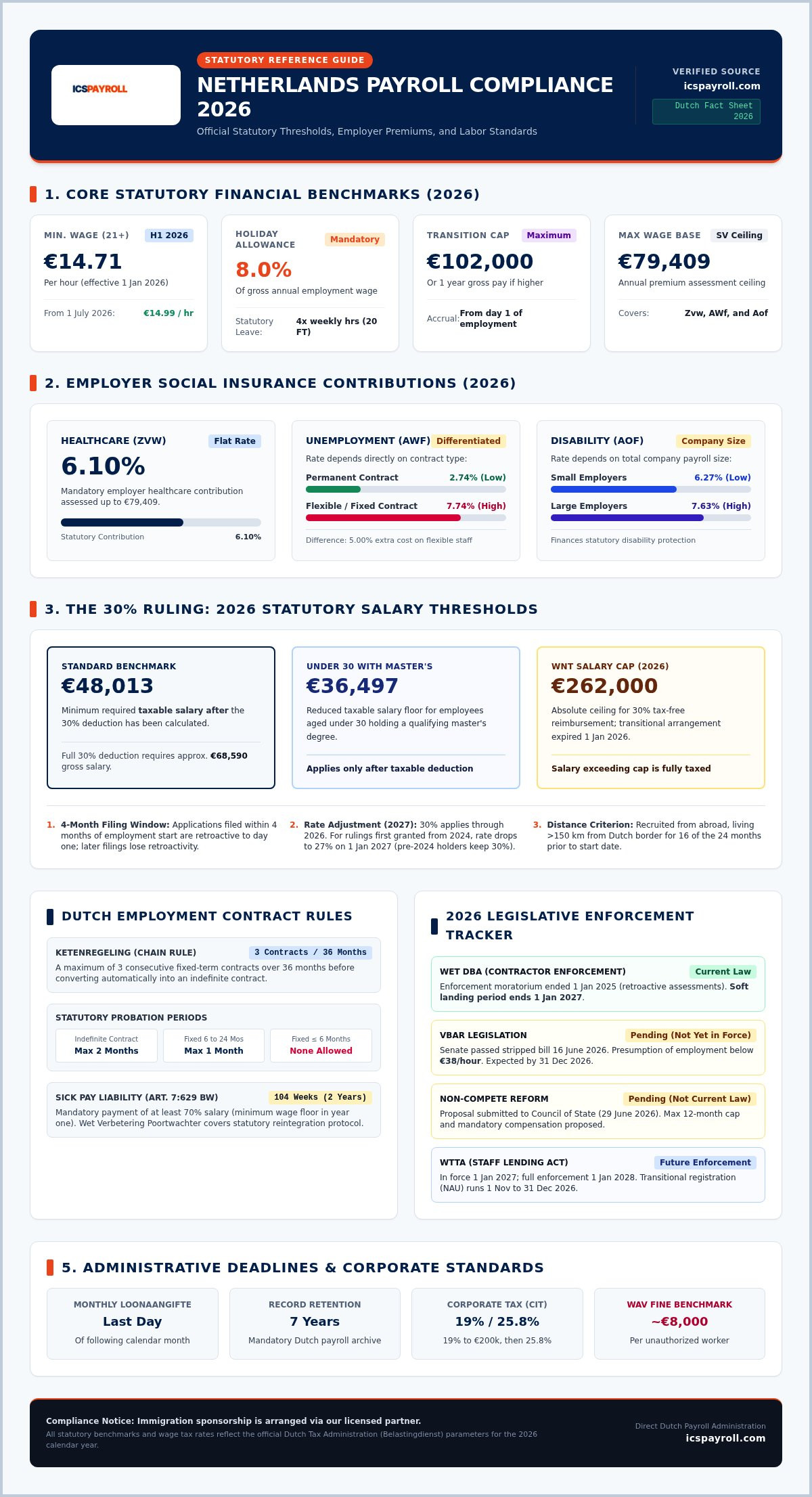
Success in the Dutch market depends on using accurate, current year financial data rather than outdated estimates. As of January 1, 2026, the statutory minimum hourly wage for employees aged 21 and over is EUR 14.71. This rate is set to rise to EUR 14.99 on July 1, 2026. Beyond this hourly base, employers are legally required to pay an 8% holiday allowance, calculated on the employee's gross annual salary. Failing to budget for these benchmarks compromises your netherlands payroll compliance and can lead to labor disputes or regulatory intervention.
Social security premiums represent a significant portion of the total labor cost. For the 2026 fiscal year, the employer's contribution for the General Healthcare Insurance (Zvw) is 6.10%, applicable up to a maximum premium base of EUR 79,409. The Disability Fund (Aof) premiums are tiered at 6.27% for small employers and 7.63% for larger entities. For unemployment insurance (AWf), you'll pay 2.74% for employees on permanent contracts and 7.74% for those on flexible or fixed-term agreements. Integrating these Dutch payrolling compliance rules into your financial strategy is the only way to ensure cost transparency.
2026 Wage Tax Brackets and Deductions
The Dutch tax system uses a progressive structure where higher income brackets attract higher tax rates. Employers must calculate and withhold these taxes accurately every month. The Loonaangifte must be submitted to the tax authorities by the final day of the month following the payment period. To remain audit-ready, you must maintain all payroll records for a minimum of seven years. If managing these deadlines feels overwhelming, ICSPayroll offers expert administration to handle every filing on your behalf.
Employer Premium Calculations
The "payroll factor" is the most effective tool for understanding the true cost of a Dutch employee. It bundles the gross wage with social security, the 8% holiday pay, and pension contributions, which typically benchmark at 15.2% for the employer's share. You also carry a significant sickness risk. Dutch law requires you to pay at least 70% of an employee's salary for up to 104 weeks if they fall ill. To manage smaller fringe benefits, you're able to use the Work-Related Costs Scheme (WKR), which provides a tax-free "free space" for allowances like gym memberships or home office equipment in 2026.
The 2026 Dutch Employment Compliance Checklist
Establishing a compliant presence begins with understanding your tax status. If you hire staff directly from abroad without a local entity, you risk creating a Permanent Establishment (PE), which subjects your business to complex corporate tax obligations. Incorporating a Dutch BV changes this status, as the BV is a resident taxpayer. Ensuring netherlands payroll compliance requires you to account for the transitievergoeding (transition payment), which is capped at EUR 102,000 for 2026. This payment accrues from the first day of employment, including the probation period, and applies to both fixed-term and indefinite contracts.
Operational standards also include the provision of a clear employee handbook. This document should outline mandatory social security contributions and workplace policies. You must also adhere to the Ketenregeling, which restricts employers to a maximum of three consecutive fixed-term contracts over a 36 month period. If a fourth contract is signed or the 36 month limit is exceeded, the arrangement automatically becomes an indefinite contract. For official guidance on withholding, consult the government portal regarding Dutch salaries tax and social insurance contributions to ensure your records meet statutory audit requirements.
Pre-Onboarding Compliance Steps
Before an employee starts, you must complete your RSIN and KVK registrations. Your employment contracts must reflect 2026 probation standards. For indefinite contracts, a two month probation is permitted. Fixed-term contracts between 6 and 24 months are limited to a one month probation, while contracts of 6 months or less cannot include a probation period at all. It's also vital to monitor the status of non-compete reforms. Currently, the bill is at the Council of State and hasn't yet become active law, but you should draft agreements with specific geographic scopes to prepare for future enforcement.
Employment Status and Enforcement
2026 is a definitive year for auditing your workforce classification. The Wet DBA enforcement moratorium ended on January 1, 2025, and tax authorities are now actively assessing contractor relationships for "disguised employment." The VBAR bill, which introduces a legal presumption of employment for roles paying below EUR 38 per hour, is expected to enter force by December 31, 2026. It isn't yet current law, but staying ahead of this threshold is critical for netherlands payroll compliance. If you're managing a mixed workforce, review our Employment Law in the Netherlands for Foreign Employers: 2026 Compliance Guide to verify your status.
Specialized Compliance for Highly Skilled Migrants and the 30% Ruling
Managing international talent requires precise coordination between immigration status and tax withholding. For many employers, the 30% ruling is the primary tool for attracting specialized workers, but its application is governed by strict thresholds that change annually. Maintaining netherlands payroll compliance means ensuring that your migrants meet the 2026 standard taxable salary threshold of EUR 48,013. This figure represents the salary after the tax-free deduction. To provide the full 30% benefit to an employee, the gross salary typically needs to be approximately EUR 68,590. From 2026, the benefit is also capped at the WNT norm of EUR 262,000, as the previous transitional arrangements have now expired.
Managing the 30% Ruling Application
Eligibility for this tax advantage is strictly monitored by the Belastingdienst. The employee must have been recruited from abroad and resided more than 150 kilometers from the Dutch border for at least 16 of the 24 months preceding their first day of work. You should also prepare for structural changes in the coming months. For rulings first granted from 2024 onward, the tax-free rate will drop from 30% to 27% starting January 1, 2027. Additionally, the partial non-resident taxpayer status, which allowed holders to avoid Dutch tax on Box 2 and Box 3 assets, is abolished for new applicants. Only those who held the ruling before 2024 can maintain this status until December 31, 2026. Review our The 30% Ruling in the Netherlands: A Comprehensive 2026 Employer Guide for a detailed breakdown of these transition rules.
HSM Visa and IND Requirements
Hiring non-Schengen staff requires Highly Skilled Migrant (HSM) status, which is managed through the Immigration and Naturalisation Service. You can find specific document requirements for non-Schengen staff on the official IND portal. While obtaining recognized sponsor status directly can be time-consuming, immigration sponsorship is arranged via our licensed partner to streamline the process. This partnership allows for expedited HSM visa processing in approximately three weeks. This speed is a critical component of effective netherlands payroll compliance, as it ensures your staff are legally permitted to work before the first payroll run. If you need to secure a visa for a new hire quickly, you can apply for the 30% ruling and HSM sponsorship through our specialized team today.
Strategic Payroll Management via the EOR Model
Hiring in a foreign jurisdiction often presents a catch-22: you need local staff to grow, but you need a local entity to hire staff. The Employer of Record (EOR) model provides a direct solution to this challenge. By acting as the legal employer of your Dutch workforce, an EOR eliminates the risk of creating a Permanent Establishment (PE). This protection is vital for netherlands payroll compliance, as it prevents your foreign parent company from being pulled into the Dutch corporate tax net. You retain control over the employee's daily tasks while the EOR manages the complex administrative and legal requirements.
The "payroll factor" serves as the foundation for this relationship's transparency. It's a comprehensive multiplier that accounts for the gross salary, social security premiums, the mandatory 8% holiday allowance, and pension contributions. Instead of managing multiple vendors for insurance, pensions, and tax filings, you receive one clear monthly invoice covering all employment costs. This model transforms a variable and often unpredictable administrative burden into a fixed, manageable expense. While traditional entity setup can take months of legal coordination, an EOR operational set-up is typically completed within weeks.
EOR vs Traditional Payroll Administration
Choosing an EOR allows you to begin operations immediately without the upfront costs of a Dutch BV establishment. This is particularly advantageous for testing the market or hiring a single key account manager. Beyond basic salary processing, the EOR handles the heavy lifting of Dutch labor law, such as managing sick-leave support and reintegration guidance. Under Article 7:629 of the Dutch Civil Code, employers are responsible for two years of salary during illness. An EOR manages the required Poortwachter (Gatekeeper) protocols, ensuring you remain compliant without needing an in-house HR expert. For a deeper dive into these structures, read our Employer of Record Netherlands: The 2026 Guide to Compliant Hiring.
Next Steps for 2026 Compliance
Securing your workforce in the Netherlands doesn't have to be a bureaucratic ordeal. You can request a tailored quotation based on your specific headcount and salary levels, which we provide within 24 hours. Once the service agreement is finalized, we can move from initial contact to signed employment contracts within days. This speed allows you to secure top talent before they're hired by competitors. If you're ready to simplify your netherlands payroll compliance and scale your Dutch team, contact ICSPayroll at +31 10 307 0665 or email us at payroll@intercompanysolutions.com to begin the process.
Securing Your Growth in the Dutch Market for 2026
Mastering the 2026 financial benchmarks and evolving tax thresholds is essential for any business expanding into the Netherlands. You must integrate the EUR 14.71 minimum hourly wage and the EUR 48,013 taxable threshold for the 30% ruling into your strategic planning. These figures aren't just administrative details; they're the foundation of a stable and legally sound workforce. By adhering to the Ketenregeling contract limits and auditing your contractor classifications before the Wet DBA soft landing ends, you protect your company from significant financial risk.
Maintaining netherlands payroll compliance doesn't have to be a bottleneck for your expansion. ICSPayroll acts as your local expert, providing a stabilizing force through an operational set-up that takes weeks rather than months. We consolidate all employment costs into one clear monthly invoice with no surprises, while providing full assistance with 30% ruling applications. Hire in the Netherlands with confidence by requesting a 24-hour tailored quotation from ICSPayroll. Your journey into this vibrant market is a bold step, and with the right partner, it's one you can take with total certainty.
Frequently Asked Questions
What is the standard salary threshold for the 30% ruling in 2026?
The standard taxable salary threshold for the 30% ruling in 2026 is EUR 48,013. For employees under the age of 30 who hold a master's degree, the required taxable threshold is reduced to EUR 36,497. These figures represent the salary remaining after the tax-free deduction is applied. It's important to note that these specific norms apply through 2026, while the benefit rate for new rulings will adjust to 27% starting in 2027.
How long are employers required to keep payroll records in the Netherlands?
Employers in the Netherlands are legally required to maintain all payroll and personnel records for a minimum of seven years. This statutory rule ensures that the Belastingdienst can audit wage tax filings and social security contributions if necessary. Records must be stored securely and remain accessible for inspection. Maintaining organized documentation is a core component of your strategy for netherlands payroll compliance, as it prevents administrative disputes during official tax reviews.
Can I hire employees in the Netherlands without a local legal entity?
You can hire staff in the Netherlands without establishing a local legal entity by utilizing an Employer of Record (EOR) model. This service allows you to employ Dutch-based talent while the EOR handles all legal, tax, and insurance obligations on your behalf. This approach eliminates Permanent Establishment risks and allows for an operational set-up within weeks. It's an ideal solution for businesses testing the market or those who aren't ready for direct incorporation.
What is the mandatory holiday allowance in the Netherlands for 2026?
The mandatory holiday allowance for 2026 remains 8% of the employee's gross annual salary. This payment is typically made in May or June, though alternative schedules can be agreed upon in the employment contract. This allowance is a statutory requirement for all employees and must be factored into your total cost of employment. Failing to pay this allowance is a violation of Dutch labor law and can lead to significant legal claims from the workforce.
How quickly can a Highly Skilled Migrant visa be processed?
A Highly Skilled Migrant (HSM) visa is typically processed and granted within approximately three weeks when arranged via our licensed partners. This expedited timeline is significantly faster than the standard application route, allowing your international staff to begin work without lengthy delays. All necessary immigration sponsorship is coordinated through professional channels to ensure full legal compliance. You can find more details on document requirements for non-Schengen staff on the official IND portal.
What are the penalties for payroll non-compliance in the Netherlands?
Penalties for payroll non-compliance can be severe, including fines of approximately EUR 8,000 per worker for violations of the Foreign Nationals Employment Act (Wav). Additionally, the tax authorities can impose administrative fines for late or incorrect Loonaangifte filings. Beyond financial costs, non-compliance can lead to the loss of recognized sponsor status or legal action from employees. Ensuring robust netherlands payroll compliance is the only way to safeguard your business from these avoidable regulatory and financial risks.
Is the 13th-month bonus mandatory under Dutch law?
A 13th-month bonus is not a statutory requirement under Dutch law. While many companies offer this as a competitive benefit or it may be required by a specific Collective Labor Agreement (CAO), it isn't a legal obligation for all employers. If you choose to provide this bonus, it must be clearly defined in the employment contract. Most employers focus on the mandatory 8% holiday allowance as the primary additional salary component required by law.
What is the transition allowance cap for 2026?
The transition allowance (transitievergoeding) is capped at EUR 102,000 for the 2026 calendar year. If an employee's annual gross salary exceeds this amount, the cap is set at one year's gross salary if higher. This payment accrues from the first day of employment, including the probation period, and is mandatory for most contract terminations initiated by the employer. You can verify these rules on the UWV website for current termination standards.

Article by
Joost Hubregtse
Joost Hubregtse is Director of ICS Staffing & Payroll B.V., the wholly owned subsidiary of Intercompany Solutions behind ICS Payroll. He is responsible for Employer of Record and Dutch payroll services: employment contracts, wage tax and social security filings, holiday allowance, pension, sick leave and CAO compliance, with onboarding possible within 48 hours.
Frequently Asked Questions
The standard taxable salary threshold for the 30% ruling in 2026 is EUR 48,013. For employees under the age of 30 who hold a master's degree, the required taxable threshold is reduced to EUR 36,497. These figures represent the salary remaining after the tax-free deduction is applied. It's important to note that these specific norms apply through 2026, while the benefit rate for new rulings will adjust to 27% starting in 2027.
Employers in the Netherlands are legally required to maintain all payroll and personnel records for a minimum of seven years. This statutory rule ensures that the Belastingdienst can audit wage tax filings and social security contributions if necessary. Records must be stored securely and remain accessible for inspection. Maintaining organized documentation is a core component of your strategy for netherlands payroll compliance, as it prevents administrative disputes during official tax reviews.
You can hire staff in the Netherlands without establishing a local legal entity by utilizing an Employer of Record (EOR) model. This service allows you to employ Dutch-based talent while the EOR handles all legal, tax, and insurance obligations on your behalf. This approach eliminates Permanent Establishment risks and allows for an operational set-up within weeks. It's an ideal solution for businesses testing the market or those who aren't ready for direct incorporation.
The mandatory holiday allowance for 2026 remains 8% of the employee's gross annual salary. This payment is typically made in May or June, though alternative schedules can be agreed upon in the employment contract. This allowance is a statutory requirement for all employees and must be factored into your total cost of employment. Failing to pay this allowance is a violation of Dutch labor law and can lead to significant legal claims from the workforce.
A Highly Skilled Migrant (HSM) visa is typically processed and granted within approximately three weeks when arranged via our licensed partners. This expedited timeline is significantly faster than the standard application route, allowing your international staff to begin work without lengthy delays. All necessary immigration sponsorship is coordinated through professional channels to ensure full legal compliance. You can find more details on document requirements for non-Schengen staff on the official IND portal.
Penalties for payroll non-compliance can be severe, including fines of approximately EUR 8,000 per worker for violations of the Foreign Nationals Employment Act (Wav). Additionally, the tax authorities can impose administrative fines for late or incorrect Loonaangifte filings. Beyond financial costs, non-compliance can lead to the loss of recognized sponsor status or legal action from employees. Ensuring robust netherlands payroll compliance is the only way to safeguard your business from these avoidable regulatory and financial risks.
A 13th-month bonus is not a statutory requirement under Dutch law. While many companies offer this as a competitive benefit or it may be required by a specific Collective Labor Agreement (CAO), it isn't a legal obligation for all employers. If you choose to provide this bonus, it must be clearly defined in the employment contract. Most employers focus on the mandatory 8% holiday allowance as the primary additional salary component required by law.
The transition allowance (transitievergoeding) is capped at EUR 102,000 for the 2026 calendar year. If an employee's annual gross salary exceeds this amount, the cap is set at one year's gross salary if higher. This payment accrues from the first day of employment, including the probation period, and is mandatory for most contract terminations initiated by the employer. You can verify these rules on the UWV website for current termination standards.