
Working from Home Allowance in the Netherlands: The 2026 Employer Guide
By Joost Hubregtse, Director, ICS Staffing & Payroll
All blog posts are reviewed and fact checked by our labour law lawyer Zishan Hussain and our director. Editorial standards
By Joost Hubregtse, Payroll Director
Reviewed by Joost Hubregtse, Payroll Director, on May 22, 2024
A single administrative error in your Dutch payroll can trigger years of retroactive tax assessments from the Belastingdienst. You likely understand that implementing a compliant working from home allowance netherlands strategy is essential for attracting top talent, yet the complexities of the local tax system often make compliance feel like a moving target.
Managing remote expenses requires a precise understanding of the latest tax-free thresholds set by the Belastingdienst and strict record-keeping standards. This guide empowers you to master the 2026 tax-free rates and legal requirements, ensuring your remote team receives sound benefits without exposing your business to financial risk.
We'll examine the specific 2026 reimbursement limits, explain how to manage these costs without the overhead of a local Dutch BV, and provide a clear framework for administrative compliance to reduce your internal workload. By the end of this guide, you'll have a roadmap for providing competitive, legally sound benefits that protect your organization's bottom line.
Key Takeaways
- Identify which specific home office expenses, such as heating and electricity, qualify for tax-free reimbursement under current Dutch regulations.
- Master the updated 2026 daily rates for the working from home allowance netherlands to maintain a competitive and legally compliant benefits package.
- Understand the mandatory "either or" rule that prevents employees from receiving both a commuting allowance and a home office reimbursement for the same day.
- Learn how to balance remote work benefits with the 2026 salary floors required to maintain eligibility for the 30% ruling.
- Discover how consolidating payroll and benefits into a single administrative process reduces the risk of retroactive tax assessments from the Belastingdienst.
Understanding the Dutch Working from Home Allowance (Thuiswerkkostenvergoeding)
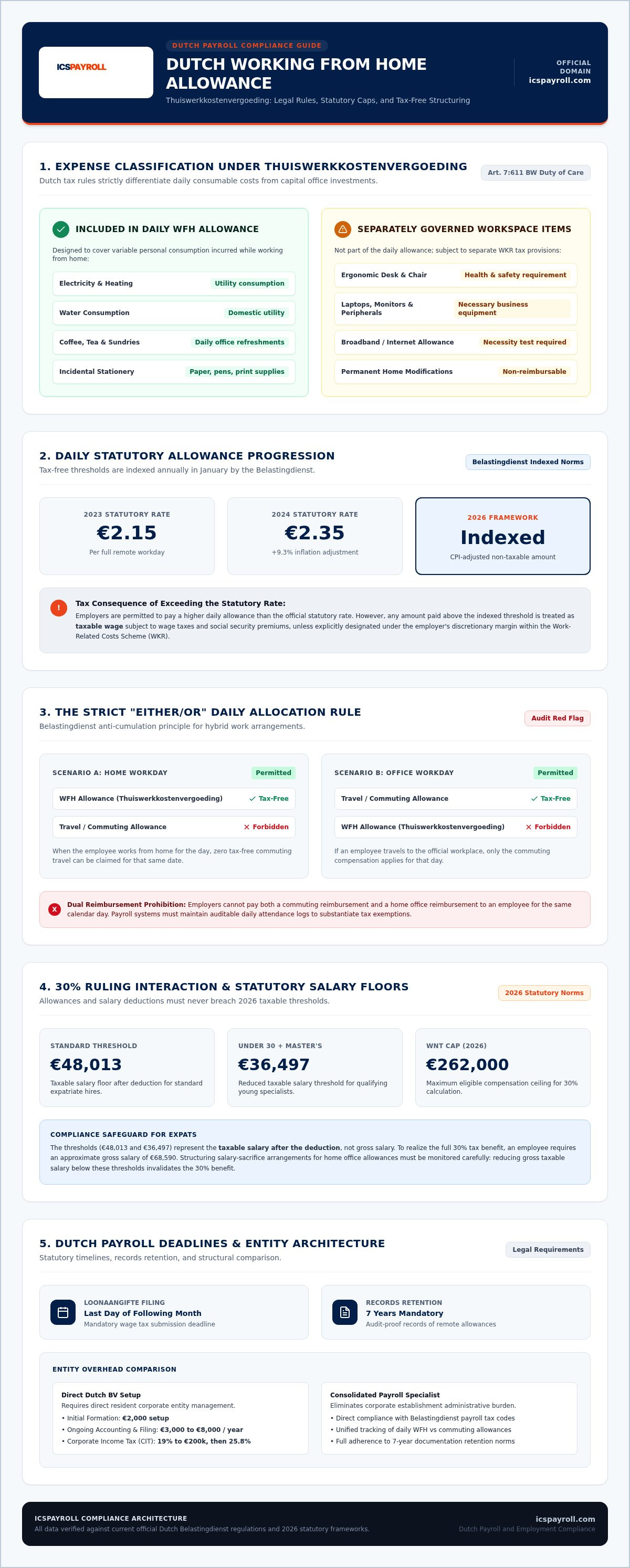
The Dutch tax authority, the Belastingdienst, permits employers to provide a tax-free reimbursement to cover the specific costs associated with working from a private residence. This payment, known as the Thuiswerkkostenvergoeding, is designed to offset the additional expenses an employee incurs when they don't use the central office. It focuses on variable costs such as electricity, heating, and water usage, along with incidental supplies like coffee, tea, and stationery. Providing a working from home allowance netherlands ensures that the employee's net income isn't eroded by the operational costs of their home office.
This allowance is distinct from larger investments, such as office furniture or computer equipment, which fall under separate tax rules. The reimbursement specifically targets the daily consumption costs that rise when an individual spends their full working day at home. By utilizing this tax-free threshold, you provide a tangible benefit that supports various remote work models while maintaining a lean tax profile. For 2026, the Belastingdienst continues to index this rate to reflect inflation and rising utility prices, making it a critical component of a modern Dutch compensation package. It's a practical solution for businesses that want to support a distributed workforce without triggering unnecessary social security premiums or wage tax liabilities.
Is the WFH Allowance Mandatory in the Netherlands?
Dutch statutory law doesn't currently mandate a specific WFH payment for all employees. Instead, the obligation usually arises from a Collective Labour Agreement (CAO) or the individual employment contract. In the 2026 talent market, however, offering this allowance is a standard practice for professional organizations. It functions as a vital tool for recruitment and retention, signaling that your company values the flexibility and well-being of its staff. You should clearly document the agreed amount and the conditions for payment within the employment contract to prevent future disputes or administrative confusion. Failure to define these terms can lead to inconsistencies in how benefits are applied across your team.
The Legal Basis: Art. 7:611 BW and Duty of Care
While the allowance itself might be discretionary, employers must adhere to the general duty of care outlined in Article 7:611 of the Dutch Civil Code (BW). This principle requires you to act as a "good employer," which includes ensuring that staff have access to a safe and appropriately equipped workspace. You can find more detail on these obligations in our guide on employment law Netherlands for foreign employers. The Work-Related Costs Scheme (WKR) serves as the primary mechanism for delivering these tax-free benefits within the Dutch payroll system.
Tax-Free Allowances and Statutory Rates for 2026
The Belastingdienst adjusts the tax-free daily rate for the working from home allowance netherlands every January to account for inflation and rising utility costs. In 2026, this daily reimbursement remains a fixed, non-taxable amount that employers can pay without withholding wage tax or social security premiums. This rate is designed to cover the small, recurring costs of working remotely, such as heating, water, and electricity consumption. Employers must ensure they apply the correct indexed figure to avoid underpaying staff or triggering tax liabilities. You should consult the official Dutch home working regulations to confirm the finalized 2026 daily amount before updating your payroll systems.
Indexation trends show a steady increase in this allowance over the last few years. The rate rose from €2.15 in 2023 to €2.35 in 2024, reflecting the government's commitment to supporting remote and hybrid work models. For 2026, the trend continues to follow the consumer price index. While you can choose to pay more than the statutory tax-free rate, any excess amount is treated as taxable salary unless it's specifically designated within your discretionary margin. This makes precise tracking of the daily rate essential for maintaining a cost-effective benefits strategy.
Hybrid work arrangements require careful tracking to remain compliant. You cannot provide both the WFH allowance and a commuting reimbursement for the same day. If an employee works at the office for part of the day and at home for the rest, you must choose which allowance to apply. Most employers default to the commuting allowance if the employee travels to the office at all during that 24 hour period. Maintaining accurate records of these working days is essential for audit purposes and ensures your working from home allowance netherlands remains fully exempt from taxes.
Calculating the Monthly WFH Reimbursement
Employers often prefer a fixed monthly amount over daily expense claims to reduce administrative friction. The formula involves multiplying the number of fixed home working days per week by the daily rate, then applying the "214-day rule" to account for holidays, weekends, and short-term illness. This result is then divided by 12 to provide a consistent monthly payment. If an employee works part-time or changes their schedule, you must adjust this fixed amount proportionally. This 2026 allowance remains tax-free only when paid alongside a compliant Dutch payroll administration process that correctly identifies these payments as tax-exempt reimbursements.
The 2026 WKR Discretionary Margin (Vrije Ruimte)
The Work-Related Costs Scheme (WKR) governs all non-taxable benefits in the Netherlands. It provides a discretionary margin, or "vrije ruimte," calculated as a percentage of your total taxable wage bill. If the total value of your WFH allowances and other benefits exceeds this limit in 2026, the employer must pay an 80% final levy on the excess. This levy is a significant financial penalty and is not deductible for corporate income tax purposes. Professional management helps you monitor this margin in real time to prevent unexpected tax bills at the end of the fiscal year. You can request a tailored quotation to see how our payroll specialists manage these thresholds for your team.
Balancing WFH Allowances with Commuting and Internet Reimbursements
The Belastingdienst enforces a strict "either/or" protocol for daily reimbursements. An employee cannot legally receive both a travel allowance and a working from home allowance netherlands for the same calendar day. If a hybrid worker visits the office for a morning meeting and finishes the work day at home, the employer must select one reimbursement type. Most businesses prioritize the travel allowance in these scenarios, as the 2026 tax-free commuting rate of €0.23 per kilometre often provides a higher net benefit than the flat WFH daily rate. This selection process must be consistent and transparent within your payroll records to avoid double-dipping assessments during a tax audit.
Unlike the daily WFH rate, certain expenses like high-speed internet and mobile phone subscriptions are handled as separate targeted exemptions within the work-related costs scheme (WKR). For these to remain tax-free, the employer must demonstrate that the service is necessary for the performance of the job. If the employee already has a private internet connection, you can reimburse the cost tax-free, provided it's used for business purposes. This distinction allows hybrid teams to maximize their net benefits by layering specific utility reimbursements on top of their standard daily allowances without exhausting the discretionary margin.
Internet and Home Office Equipment
Providing physical equipment such as ergonomic chairs, desks, and monitors is a requirement under Dutch health and safety (Arbo) laws. These items are generally tax-free for the employer if they meet specific ergonomic standards and are necessary for a safe workspace. To maintain this tax-exempt status, the equipment should technically remain the property of the company. If you gift the equipment to the employee, its fair market value must be deducted from your discretionary WKR margin or treated as taxable salary. Ensuring your team has the right tools isn't just about comfort; it's a legal safeguard against long-term health claims and administrative penalties.
Managing Commuting Costs in 2026
For office days, you can choose between actual kilometre tracking or a fixed monthly travel allowance based on the 214-day rule. Public transport users often benefit more from a direct reimbursement of NS (Dutch Railways) costs or a company-provided business card, which are also tax-free under Dutch law. Tracking these hybrid schedules accurately is the most effective way to maintain Dutch labor law compliance while optimizing your tax bill. By categorizing office visits and remote days with precision, you ensure that every working from home allowance netherlands payment is justified and every travel claim is verifiable.
Compliance Risks and the 30% Ruling Interaction
Incorrectly classifying a working from home allowance netherlands can jeopardize a highly skilled migrant's tax status. The Belastingdienst maintains strict distinctions between taxable salary and tax-free reimbursements. Because a WFH allowance is a reimbursement for specific costs, it doesn't count toward the minimum taxable salary required to maintain the 30% ruling. If an employer reduces the base salary to provide a higher allowance, they risk falling below the statutory floor, which results in the immediate loss of the tax benefit for the employee.
For 2026, the salary norms are precisely defined. The standard annual taxable salary norm is EUR 48,013, while employees under 30 with a recognized Master’s degree must meet a norm of EUR 36,497. These figures represent the taxable amount after the 30% deduction has been applied. Misunderstanding this interaction is a common compliance pitfall for international firms. You must ensure that the base salary remains high enough to support the 30% ruling in the Netherlands while layering the WFH allowance on top as a separate, non-taxable line item on the payslip.
Salary Requirements for 2026 Hires
Hiring remote talent in 2026 requires a sophisticated approach to gross salary calculations. To provide the maximum 30% tax-free benefit, an employee generally needs a gross salary of approximately EUR 68,590. This ensures the remaining 70% stays above the EUR 48,013 threshold. It's also vital to communicate the upcoming legislative changes to your team. For rulings first granted from 2024 onward, the tax-free rate will drop from 30% to 27% on 1 January 2027. Proper payroll planning today prevents future financial surprises for your international staff and maintains your reputation as a compliant employer.
Permanent Establishment and Remote Work Risks
Foreign firms often worry about creating a Permanent Establishment (PE) when hiring remote workers in the Netherlands. It's a common misconception that a Dutch BV constitutes a PE; in reality, a BV is a Dutch resident taxpayer. PE risks typically apply to foreign entities that operate in the Netherlands without a local legal structure. By utilizing an Employer of Record Netherlands, you transfer the legal employer responsibilities to a local expert. This structure mitigates PE risks and ensures that every working from home allowance netherlands is administered according to local standards. If you need to verify your current compliance standing, you can contact our specialists for a compliance review.
Strategic Payroll: How ICSPayroll Manages Remote Work Benefits
ICSPayroll simplifies the complexities of the Dutch tax system through our "Payroll Factor" model. This approach consolidates gross salary, the working from home allowance netherlands, and all employer premiums into a single, transparent monthly invoice. We provide total clarity on costs; this ensures you never face hidden fees or administrative surprises. Our system includes automated monitoring of 30% ruling salary floors to prevent compliance breaches before they occur. By automating these checks, we protect your business from the risk of retroactive tax assessments from the Belastingdienst.
Employees gain access to a secure online portal designed for the modern hybrid workforce. Here, they can track their WFH days, view digital payslips, and manage holiday balances with ease. While our technology streamlines the daily process, we remain a human-led organization. You receive direct support from experts who understand the nuances of Dutch sick leave and reintegration requirements. We guide you through the mandatory steps of the Wet Verbetering Poortwachter, ensuring you meet your duty of care obligations without the administrative burden.
Why a Local EOR Outperforms Global Platforms
Deep niche expertise is the foundation of our service. Unlike global platforms that operate as multi-country generalists, we focus exclusively on the Netherlands. We directly manage mandatory Dutch pension contributions, which typically average 15.2% of gross salary, and the statutory 8% holiday allowance. Our local focus means we understand the specific requirements of Dutch Collective Labour Agreements (CAOs) that generalists often overlook. This precision allows us to set up your operational hiring within weeks. We ensure every working from home allowance netherlands is processed correctly to maintain your status as a reliable and compliant employer.
Getting Started with ICSPayroll
Transitioning to a compliant Dutch payroll is a straightforward process. We provide tailored quotations within 24 hours of your initial request, allowing you to move at the speed of your business. For international talent, immigration sponsorship is arranged via our licensed partner, with expedited HSM visa processing typically completed in three weeks. This rapid turnaround ensures your team is ready to work without legal delays or permit issues. Our team handles the entire lifecycle of employment, from the initial 30% ruling application to the final transition payment calculations. Contact Joost Hubregtse and the team for a compliant Dutch payroll solution to secure your organization's presence in the Dutch market today.
Securing Your Dutch Remote Strategy for 2026
Providing a compliant working from home allowance netherlands requires more than just paying a daily rate. It demands a precise balance between tax-free reimbursements and the strict salary floors mandated for the 30% ruling. As you've seen, mastering the 2026 indexation and the "either or" rule for commuting costs is essential to avoid retroactive tax assessments. By centralizing these processes, you protect your business and provide the reliability your international team expects.
ICSPayroll acts as your local guardian in this complex landscape. We provide full Dutch compliance with 2026 tax and labor laws through a single monthly invoice covering all employment costs. Our licensed partners offer expedited HSM visa processing in approximately three weeks, allowing you to scale your team without administrative delays. Don't let bureaucracy slow your expansion into the Dutch market.
Hire in the Netherlands with confidence, get a quote in 24 hours. We are ready to help you build a stable, compliant, and thriving remote workforce.
Frequently Asked Questions
What is the maximum tax-free working from home allowance in 2026?
The Belastingdienst indexes the daily tax-free rate annually to account for inflation and utility costs. While the rate was €2.35 per day in 2024, you must verify the specific 2026 indexed amount before updating your payroll systems. This allowance remains a targeted exemption within the work-related costs scheme. It covers incidental costs like electricity and water without triggering wage tax or social security premiums for the employer.
Is the working from home allowance mandatory under Dutch law?
Dutch statutory law doesn't mandate a specific working from home allowance netherlands payment for all employees. However, many Collective Labour Agreements (CAOs) require employers to provide this reimbursement. Even without a CAO, most professional firms include it in the employment contract to remain competitive. It also helps fulfill the employer's general duty of care under Article 7:611 of the Dutch Civil Code regarding safe remote working conditions.
Can I pay both a commuting allowance and a WFH allowance to the same employee?
You can't legally pay both a commuting allowance and a tax-free WFH allowance for the same calendar day. The Belastingdienst requires a choice between the two for every 24 hour period. If an employee visits the office for any part of the day, employers typically prioritize the travel reimbursement. This maintains compliance and ensures that targeted exemptions aren't used twice for the same employee on a single working day.
How does the WFH allowance affect the 30% ruling salary floor?
Tax-free allowances don't count toward the minimum taxable salary required for the 30% ruling. For 2026, the standard taxable salary norm is EUR 48,013 after the 30% deduction has been applied. If you reduce base pay to provide a higher allowance, you risk falling below this statutory floor. This error leads to the immediate loss of the ruling, making precise payroll calculations essential for your international hires.
Do I need a Dutch BV to pay tax-free allowances to employees in the Netherlands?
You don't need a local Dutch BV to provide compliant tax-free allowances to your staff. Using an Employer of Record (EOR) allows you to hire and pay employees through an existing legal structure in the Netherlands. ICSPayroll manages all Dutch payroll administration, including 30% ruling applications and WFH reimbursements. This model removes the administrative burden of entity incorporation while ensuring full compliance with local tax and labor regulations.
What office equipment can I provide tax-free to remote workers in 2026?
Employers can provide ergonomic office equipment tax-free if it's necessary for a safe workspace under Dutch Arbo health and safety standards. This includes items like adjustable desks, ergonomic chairs, and computer monitors. To remain tax-exempt, the equipment should technically remain the property of the employer. If the employee takes ownership, the fair market value must be deducted from your discretionary WKR margin or treated as taxable salary.
Is the WFH allowance pro-rated for part-time employees?
The working from home allowance netherlands is pro-rated based on the actual number of days the employee works from home rather than their total contract hours. A part-time employee working two days from home receives the same daily rate as a full-time employee for those specific days. Many employers use the 214-day rule to calculate a fixed monthly amount. This provides a consistent payment that accounts for holidays and short-term illness.
What are the consequences of exceeding the WKR discretionary margin in 2026?
If your total tax-free benefits exceed the discretionary margin in 2026, the employer must pay an 80% final levy on the excess. This levy is a non-deductible expense for corporate income tax purposes. It applies to all non-exempt benefits provided throughout the fiscal year. Professional payroll monitoring is vital to track this margin in real time, ensuring you don't face unexpected and expensive tax bills at the end of the year.

Article by
Joost Hubregtse
Joost Hubregtse is Director of ICS Staffing & Payroll B.V., the wholly owned subsidiary of Intercompany Solutions behind ICS Payroll. He is responsible for Employer of Record and Dutch payroll services: employment contracts, wage tax and social security filings, holiday allowance, pension, sick leave and CAO compliance, with onboarding possible within 48 hours.
Frequently Asked Questions
Dutch statutory law doesn't currently mandate a specific WFH payment for all employees. Instead, the obligation usually arises from a Collective Labour Agreement (CAO) or the individual employment contract. In the 2026 talent market, however, offering this allowance is a standard practice for professional organizations. It functions as a vital tool for recruitment and retention, signaling that your company values the flexibility and well-being of its staff. You should clearly document the agreed amount and the conditions for payment within the employment contract to prevent future disputes or administrative confusion. Failure to define these terms can lead to inconsistencies in how benefits are applied across your team.
The Belastingdienst indexes the daily tax-free rate annually to account for inflation and utility costs. While the rate was €2.35 per day in 2024, you must verify the specific 2026 indexed amount before updating your payroll systems. This allowance remains a targeted exemption within the work-related costs scheme. It covers incidental costs like electricity and water without triggering wage tax or social security premiums for the employer.
Dutch statutory law doesn't mandate a specific working from home allowance netherlands payment for all employees. However, many Collective Labour Agreements (CAOs) require employers to provide this reimbursement. Even without a CAO, most professional firms include it in the employment contract to remain competitive. It also helps fulfill the employer's general duty of care under Article 7:611 of the Dutch Civil Code regarding safe remote working conditions.
You can't legally pay both a commuting allowance and a tax-free WFH allowance for the same calendar day. The Belastingdienst requires a choice between the two for every 24 hour period. If an employee visits the office for any part of the day, employers typically prioritize the travel reimbursement. This maintains compliance and ensures that targeted exemptions aren't used twice for the same employee on a single working day.
Tax-free allowances don't count toward the minimum taxable salary required for the 30% ruling. For 2026, the standard taxable salary norm is EUR 48,013 after the 30% deduction has been applied. If you reduce base pay to provide a higher allowance, you risk falling below this statutory floor. This error leads to the immediate loss of the ruling, making precise payroll calculations essential for your international hires.
You don't need a local Dutch BV to provide compliant tax-free allowances to your staff. Using an Employer of Record (EOR) allows you to hire and pay employees through an existing legal structure in the Netherlands. ICSPayroll manages all Dutch payroll administration, including 30% ruling applications and WFH reimbursements. This model removes the administrative burden of entity incorporation while ensuring full compliance with local tax and labor regulations.
Employers can provide ergonomic office equipment tax-free if it's necessary for a safe workspace under Dutch Arbo health and safety standards. This includes items like adjustable desks, ergonomic chairs, and computer monitors. To remain tax-exempt, the equipment should technically remain the property of the employer. If the employee takes ownership, the fair market value must be deducted from your discretionary WKR margin or treated as taxable salary.
The working from home allowance netherlands is pro-rated based on the actual number of days the employee works from home rather than their total contract hours. A part-time employee working two days from home receives the same daily rate as a full-time employee for those specific days. Many employers use the 214-day rule to calculate a fixed monthly amount. This provides a consistent payment that accounts for holidays and short-term illness.
If your total tax-free benefits exceed the discretionary margin in 2026, the employer must pay an 80% final levy on the excess. This levy is a non-deductible expense for corporate income tax purposes. It applies to all non-exempt benefits provided throughout the fiscal year. Professional payroll monitoring is vital to track this margin in real time, ensuring you don't face unexpected and expensive tax bills at the end of the year.