
Hiring in the Netherlands Without an Entity: A 2026 Compliance Guide
By Joost Hubregtse, Director, ICS Staffing & Payroll
All blog posts are reviewed and fact checked by our labour law lawyer Zishan Hussain and our director. Editorial standards
Setting up a Dutch BV requires a €2,000 initial investment and often exceeds €8,000 in annual accounting costs, yet many international firms realize too late that this complexity was entirely avoidable. If you are looking into hiring in the netherlands without an entity, you likely recognize the value of the local talent pool but feel hesitant due to the intricacies of mandatory sick pay or the fear of creating a permanent establishment tax risk. It is a common frustration; the administrative weight of local compliance can quickly overshadow the benefits of market entry.
This guide reveals how you can legally onboard Dutch employees in just a few weeks without the burden of local incorporation. You will discover how to provide your staff with the 30% ruling tax advantage, provided they meet the 2026 taxable salary threshold of €48,013. We will examine the latest 2026 labor regulations, including the transition payment caps and the updated minimum wage of €14.99 per hour, to ensure your expansion is both compliant and cost-effective. By the end of this article, you will have a clear, risk-free path to securing Dutch talent with predictable monthly costs.
Key Takeaways
- Learn how hiring in the netherlands without an entity allows you to onboard local talent in weeks; it's a strategic way to avoid the €2,000 setup fee and high annual maintenance of a Dutch BV.
- Understand the 2026 salary requirements for the 30% ruling, including the €48,013 standard taxable threshold and the cap on salaries exceeding €262,000.
- Navigate complex Dutch labor laws, such as the mandatory 104 weeks of sick pay and the 2026 transition payment cap of €102,000.
- Discover how to secure Highly Skilled Migrant (HSM) visas for international talent through a licensed partner in approximately three weeks.
- Simplify your international accounting with a single monthly invoice that covers all Dutch payroll taxes, premiums, and administrative filings.
Can You Hire in the Netherlands Without a Local Entity?
The short answer is yes. Many international enterprises assume that a local subsidiary is the only way to tap into the Dutch labor market, but this is a common misconception. While the traditional route involves incorporating a Besloten Vennootschap (BV), this path is often slow and prohibitively expensive for companies testing the market or hiring a small remote team. Choosing hiring in the netherlands without an entity allows you to focus on talent acquisition rather than administrative setup. It is a strategic move for businesses that require agility without the long term commitment of a local corporate structure.
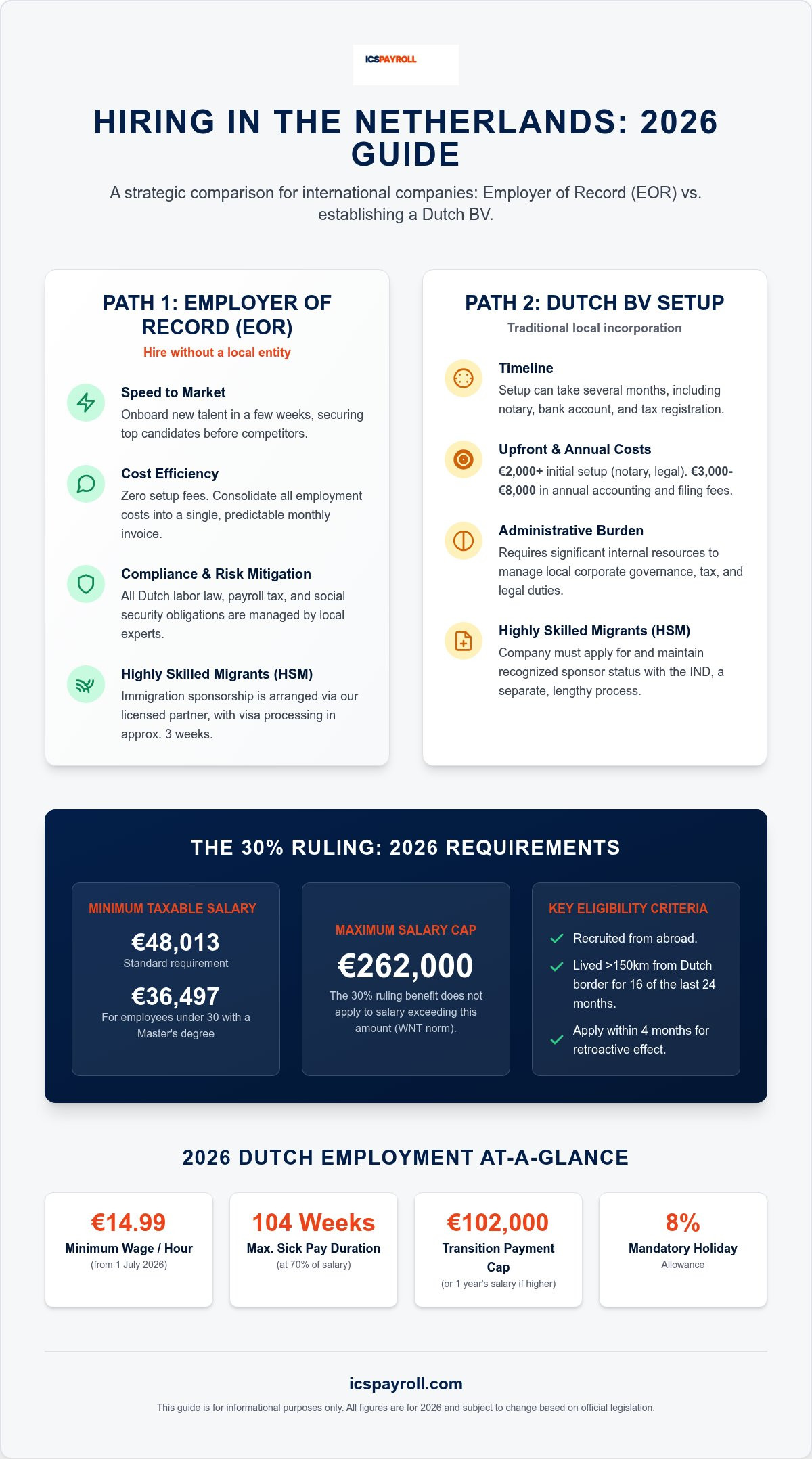
Establishing a Dutch BV involves significant financial and administrative hurdles. Beyond the €85.15 KVK registration fee, you must account for notary fees and legal advice, which typically start at €2,000. Once active, the maintenance costs are substantial. Annual accounting, mandatory tax filings, and corporate secretarial duties generally cost between €3,000 and €8,000 every year. These figures don't include the time your internal teams must spend managing a local entity. By contrast, an Employer of Record (EOR) structure eliminates these overheads while ensuring full compliance with Dutch labor standards.
The Legal Basis for Hiring Without a BV
Dutch labor law is structured to permit the use of a third party as the legal employer. This arrangement, which explains How the Dutch Employer of Record (EOR) Model Works, involves the EOR assuming all statutory responsibilities for the worker. They handle the precise calculation of wage taxes, social security contributions, and pension payments. Crucially, the foreign company retains complete day to day management of the employee. This structure also helps mitigate permanent establishment tax risks. While a Dutch BV is a resident taxpayer, a foreign entity operating without a local structure must ensure its activities don't trigger corporate tax obligations; an EOR provides a protective barrier by acting as the local employer of record.
Why Speed Matters in the Dutch Talent Market
The Dutch talent market is exceptionally fast paced and competitive. Top tier candidates often receive multiple offers and expect a compliant, local contract within days of a successful interview. Establishing a BV can take several months when you factor in bank account openings and tax office registrations. In contrast, hiring in the netherlands without an entity via an EOR allows for onboarding in just a few weeks. ICSPayroll streamlines this further by providing customized service agreements and employment contracts within days of your initial request. This speed ensures you don't lose high value talent to local competitors who can offer immediate contract security.
How the Dutch Employer of Record (EOR) Model Works
The EOR model creates a functional separation between legal and operational duties. While you maintain direct control over your team's tasks, performance, and daily workflow, ICSPayroll assumes the role of the legal employer. This structure is the most efficient method for hiring in the netherlands without an entity. It shifts the burden of local compliance, tax withholding, and employment liability away from your headquarters and onto a local specialist. You manage the talent; we manage the bureaucracy.
The Role of the Legal Employer
As the legal employer, we ensure every aspect of the employment relationship adheres to current regulations. This includes managing complex 30% ruling applications with the Belastingdienst and ensuring all mandatory social security premiums are withheld and paid. If your talent requires a residency permit, immigration sponsorship is arranged via our licensed partner for HSM Visas. This process generally takes around three weeks. We also provide a localized employee handbook to ensure your staff understands their rights and obligations under Dutch law from day one.
Understanding the Payroll Factor Pricing
Transparency is central to our service. Instead of unpredictable hourly fees or hidden administrative charges, we use a "payroll factor" to consolidate all employment costs into one monthly invoice. This factor covers the gross salary plus all statutory requirements. For 2026, this includes the mandatory 8% holiday allowance and the standard 15.2% employer pension contribution. It also accounts for the accrual of the transition payment, which is capped at €102,000 in 2026, and covers the financial risk associated with the mandatory 70% sick pay requirements. By using this model for hiring in the netherlands without an entity, your finance team receives a single, predictable figure that simplifies international budgeting.
Managing a remote team is more effective when documentation is centralized. Our service includes a secure digital portal where employees can access their monthly payslips, download annual tax statements, and review their contracts. This human centric approach ensures your Dutch team feels supported by local experts while working for your global brand. If you're ready to see how these costs look for your specific team, you can request a tailored quotation and receive a response within 24 hours.
Employer of Record vs. Setting Up a Dutch BV
Deciding between incorporating a local subsidiary and hiring in the netherlands without an entity is a pivotal choice for your expansion strategy. A Dutch BV is a distinct legal person and a Dutch resident taxpayer; it is not a permanent establishment. While this structure offers full corporate control, it carries significant overhead. You must account for an initial setup cost of approximately €2,000, covering notary fees and the mandatory KVK registration. Beyond the start-up, you'll face annual accounting and filing obligations that typically range from €3,000 to €8,000. For firms hiring their first few employees or testing market viability, these fixed costs often outweigh the benefits of direct incorporation.
Cost and Time Comparison for 2026
Time is often the most critical factor. Establishing a BV, opening a local bank account, and securing a Dutch tax ID can take between four and eight weeks. This timeline can be even longer if there are delays in the banking sector's KYC processes. In contrast, the EOR model allows for onboarding in one to two weeks. Because the EOR already holds the necessary tax registrations and infrastructure, you don't need a local bank account. ICSPayroll consolidates this entire ecosystem into a single monthly invoice. This replaces the need to manage separate contracts with accountants, tax advisors, and legal counsel, making hiring in the netherlands without an entity the most efficient route for rapid deployment.
Administrative Burden and Risk Management
The Dutch regulatory environment places a heavy burden on the legal employer, particularly regarding long term illness. Under the Poortwachter Act, employers must manage a rigorous reintegration process. This includes a mandatory problem analysis at week six and a detailed action plan by week eight. Failure to follow these steps can lead to the UWV imposing a third year of mandatory salary payments as a sanction. If you operate via a BV, your team must manage these steps directly. EOR providers assume this risk and the associated administrative workload. ICSPayroll provides comprehensive sickness risk coverage and reintegration guidance for the full 104 week period required by Dutch law. This ensures that your business stays protected from the financial and legal consequences of non-compliance while maintaining a lean operational footprint.
Key Compliance Factors: 30% Ruling and HSM Visas
The 30% ruling is the most significant tax incentive for international talent moving to the Netherlands. For businesses hiring in the netherlands without an entity, offering this benefit is essential to remain competitive with local Dutch firms. This facility allows employers to provide 30% of an employee's gross salary tax-free as compensation for extraterritorial costs. However, the regulatory landscape for 2026 includes strict salary thresholds and a new cap that all international employers must navigate to remain compliant.
Eligibility Criteria for the 30% Ruling
To qualify for the 30% ruling in 2026, the Belastingdienst requires a minimum taxable salary of €48,013. For employees under the age of 30 who hold a master's degree, this threshold is reduced to €36,497. These figures represent the taxable amount after the 30% deduction has been applied. It's also vital to note that from 1 January 2026, the benefit is capped at the WNT norm of €262,000. Any salary earned above this amount is fully taxable. Additionally, for rulings first granted on or after 1 January 2024, the tax-free percentage will drop from 30% to 27% effective 1 January 2027.
The 150 km rule is a non-negotiable requirement. The employee must have been recruited from abroad and lived more than 150 kilometers from the Dutch border for at least 16 out of the 24 months prior to their first working day. Applications filed within four months of the start date are retroactive to day one. If the filing occurs after this window, the benefit only applies from the month following the application. You must have a written decision from the Belastingdienst before you can safely apply the deduction to the payroll.
Expedited HSM Visa Processing
Securing the right to work for non-Schengen staff is a separate but parallel requirement. While ICSPayroll does not hold IND recognized sponsor status directly, immigration sponsorship is arranged via our licensed partner. This collaborative approach allows for expedited processing of HSM Visas, with most permits granted in approximately three weeks. The Highly Skilled Migrant visa is strictly an immigration requirement and has no legal impact on the 30% ruling, which is governed by the tax authorities.
Because the visa process is independent of the tax ruling, we manage both workstreams simultaneously to ensure a seamless transition for your staff. This rapid onboarding is a major advantage when hiring in the netherlands without an entity, as it allows your new hires to begin their roles without months of administrative delays. If you need to verify the eligibility of a specific candidate for these benefits, you can contact our compliance team for a detailed assessment of your 2026 hiring plans.
Navigating Dutch Labor Law: Sick Pay and Pensions
Dutch labor law is famously protective of employees, particularly regarding long term illness and termination. When hiring in the netherlands without an entity, you must navigate Article 7:629 of the Dutch Civil Code. This requires employers to pay at least 70% of an employee's wages for up to 104 weeks during illness. This obligation is coupled with strict reintegration duties under the Poortwachter Act. Failure to comply can result in significant financial sanctions from the UWV, including the possibility of a third year of mandatory salary payments.
A critical regulatory shift occurs on 1 July 2026. From this date, employers with 25 or more staff members will lose the ability to claim UWV compensation for transition payments made after two years of illness. Only smaller employers will retain this benefit. This makes the risk management provided by an EOR even more vital for mid-sized international firms. Additionally, the statutory transition payment cap for 2026 is set at €102,000, or one year's gross salary if that amount is higher. Accrual begins on the first day of employment, including the probation period.
Mandatory Benefits and Holiday Allowance
The Dutch compensation package extends beyond the base salary. All employees are entitled to a statutory 8% holiday allowance, calculated on their gross annual salary. While the legal minimum for vacation days is four times the weekly working hours, which equals 20 days for full time staff, the Dutch market standard is 25 days. You must also adhere to the Ketenregeling. This rule limits fixed term employment to a maximum of three consecutive contracts over a 36 month period. Exceeding these limits automatically converts the arrangement into an indefinite contract, regardless of the original intent.
The ICSPayroll Advantage for International Employers
Success in the Dutch market requires local precision. ICSPayroll manages the mandatory 15.2% pension scheme contributions and all social security filings, ensuring your team receives full local benefits without administrative friction. By hiring in the netherlands without an entity through our platform, you consolidate these complex obligations into one transparent monthly invoice. This model removes the need for multiple service providers and simplifies your international accounting while ensuring you remain fully compliant with the latest 2026 standards.
Our specialized national team, led by Payroll Director Joost Hubregtse, provides the expert guidance necessary to navigate these shifting regulations. We act as your local guardian, allowing you to start hiring in weeks while maintaining total compliance with the Dutch labor landscape. This human led approach ensures that while the technology is fast, the legal foundation remains meticulous and secure. We provide the stability your business needs to enter the Netherlands with absolute confidence.
Accelerate Your Entry Into the Dutch Market
Successfully hiring in the netherlands without an entity allows your business to remain agile while accessing world-class talent. You skip the months of delay associated with BV incorporation and avoid the €3,000 to €8,000 in annual maintenance fees. This approach ensures full compliance with the 2026 taxable salary thresholds for the 30% ruling and provides your employees with robust local pension and social security benefits.
ICSPayroll provides the security and transparency you need to manage an international team. We deliver expedited HSM visa processing in approximately three weeks and replace complex accounting with one clear monthly invoice. There are no surprises. Our Dutch labor law experts handle the technicalities of Dutch labor law so you can focus on your core business objectives.
Hire in the Netherlands with confidence - Get your tailored quote within 24 hours
Entering the Netherlands is a strategic milestone for your organization. We're here to ensure your expansion is seamless, legal, and ready for the future.
Frequently Asked Questions
Can I hire in the Netherlands without a Dutch BV?
You can legally hire Dutch staff without a local BV by using an Employer of Record. This model allows you to tap into the talent pool without the €2,000 setup fee or the €3,000 to €8,000 in annual maintenance costs. The EOR acts as the legal employer, managing all payroll and tax duties. It's the most efficient way of hiring in the netherlands without an entity while maintaining full compliance.
What are the 2026 salary requirements for the 30% ruling?
For 2026, the standard taxable salary threshold is €48,013. If the employee is under 30 and holds a master's degree, the requirement drops to €36,497. These figures represent the salary after the deduction. The ruling is now capped at the WNT norm of €262,000. Keep in mind that for rulings granted from 2024, the tax-free rate will decrease to 27% starting on 1 January 2027.
How quickly can I onboard a new employee via an EOR?
Onboarding typically takes just a few weeks. We provide a tailored quotation within 24 hours of receiving employee details. Service agreements and employment contracts are usually ready within days. This speed is a major advantage over traditional incorporation, which can take up to eight weeks due to banking and registration delays. Our process ensures your new hire can start their role without unnecessary administrative waiting periods.
What is included in the ICSPayroll monthly invoice?
Our monthly invoice uses a transparent payroll factor to consolidate all employment costs. It covers the gross salary, 8% holiday allowance, and the mandatory 15.2% pension contribution. It also includes social security premiums, sickness risk coverage, and transition allowance accrual. You won't find any hidden fees or separate charges. This single invoice model simplifies your international accounting and provides your finance team with predictable, all-inclusive monthly costs.
How long does it take to get a Highly Skilled Migrant visa?
Highly Skilled Migrant visas are usually granted within approximately three weeks. We arrange this immigration sponsorship through our licensed partner to ensure expedited processing for HSM Visas. This timeline allows non-Schengen staff to relocate and begin work quickly. The process is handled professionally to ensure all IND requirements are met, though it's important to remember that visa approval is separate from the 30% ruling tax application.
What are the employer obligations for sick pay in the Netherlands?
Dutch law requires employers to pay 70% of wages for up to 104 weeks of illness. During the first year, this payment cannot fall below the statutory minimum wage. Employers must also follow the Poortwachter Act's strict reintegration steps, including a week-six analysis and week-eight plan. ICSPayroll assumes this risk and provides the necessary guidance to ensure your business remains compliant throughout the entire two-year period.
Can I hire an employee before my Dutch BV is established?
Yes, you can begin hiring immediately even if your BV isn't yet established. Our EOR service acts as the legal employer in the meantime, allowing you to secure top talent without waiting for corporate registration. This flexibility is essential for hiring in the netherlands without an entity during a market test. If you decide to incorporate later, we can facilitate a smooth transition of your staff to your new local entity.
Is the 30% ruling retroactive to the employee's start date?
The 30% ruling is retroactive to the first day of employment if the application is filed within four months of the start date. If you miss this four-month window, the tax advantage only applies from the first day of the month following the application. It's vital to submit the request to the tax authorities promptly. We manage this entire process to ensure your eligible employees receive their full tax benefits.

Article by
Joost Hubregtse
Joost Hubregtse is Director of ICS Staffing & Payroll B.V., the wholly owned subsidiary of Intercompany Solutions behind ICS Payroll. He is responsible for Employer of Record and Dutch payroll services: employment contracts, wage tax and social security filings, holiday allowance, pension, sick leave and CAO compliance, with onboarding possible within 48 hours.
Frequently Asked Questions
You can legally hire Dutch staff without a local BV by using an Employer of Record. This model allows you to tap into the talent pool without the €2,000 setup fee or the €3,000 to €8,000 in annual maintenance costs. The EOR acts as the legal employer, managing all payroll and tax duties. It's the most efficient way of hiring in the netherlands without an entity while maintaining full compliance.
For 2026, the standard taxable salary threshold is €48,013. If the employee is under 30 and holds a master's degree, the requirement drops to €36,497. These figures represent the salary after the deduction. The ruling is now capped at the WNT norm of €262,000. Keep in mind that for rulings granted from 2024, the tax-free rate will decrease to 27% starting on 1 January 2027.
Onboarding typically takes just a few weeks. We provide a tailored quotation within 24 hours of receiving employee details. Service agreements and employment contracts are usually ready within days. This speed is a major advantage over traditional incorporation, which can take up to eight weeks due to banking and registration delays. Our process ensures your new hire can start their role without unnecessary administrative waiting periods.
Our monthly invoice uses a transparent payroll factor to consolidate all employment costs. It covers the gross salary, 8% holiday allowance, and the mandatory 15.2% pension contribution. It also includes social security premiums, sickness risk coverage, and transition allowance accrual. You won't find any hidden fees or separate charges. This single invoice model simplifies your international accounting and provides your finance team with predictable, all-inclusive monthly costs.
Highly Skilled Migrant visas are usually granted within approximately three weeks. We arrange this immigration sponsorship through our licensed partner to ensure expedited processing for HSM Visas. This timeline allows non-Schengen staff to relocate and begin work quickly. The process is handled professionally to ensure all IND requirements are met, though it's important to remember that visa approval is separate from the 30% ruling tax application.
Dutch law requires employers to pay 70% of wages for up to 104 weeks of illness. During the first year, this payment cannot fall below the statutory minimum wage. Employers must also follow the Poortwachter Act's strict reintegration steps, including a week-six analysis and week-eight plan. ICSPayroll assumes this risk and provides the necessary guidance to ensure your business remains compliant throughout the entire two-year period.
Yes, you can begin hiring immediately even if your BV isn't yet established. Our EOR service acts as the legal employer in the meantime, allowing you to secure top talent without waiting for corporate registration. This flexibility is essential for hiring in the netherlands without an entity during a market test. If you decide to incorporate later, we can facilitate a smooth transition of your staff to your new local entity.
The 30% ruling is retroactive to the first day of employment if the application is filed within four months of the start date. If you miss this four-month window, the tax advantage only applies from the first day of the month following the application. It's vital to submit the request to the tax authorities promptly. We manage this entire process to ensure your eligible employees receive their full tax benefits.