Netherlands EOR Services: 2026 Startup Compliance Guide
By Joost Hubregtse, Director, ICS Staffing & Payroll
All blog posts are reviewed and fact checked by our labour law lawyer Zishan Hussain and our director. Editorial standards
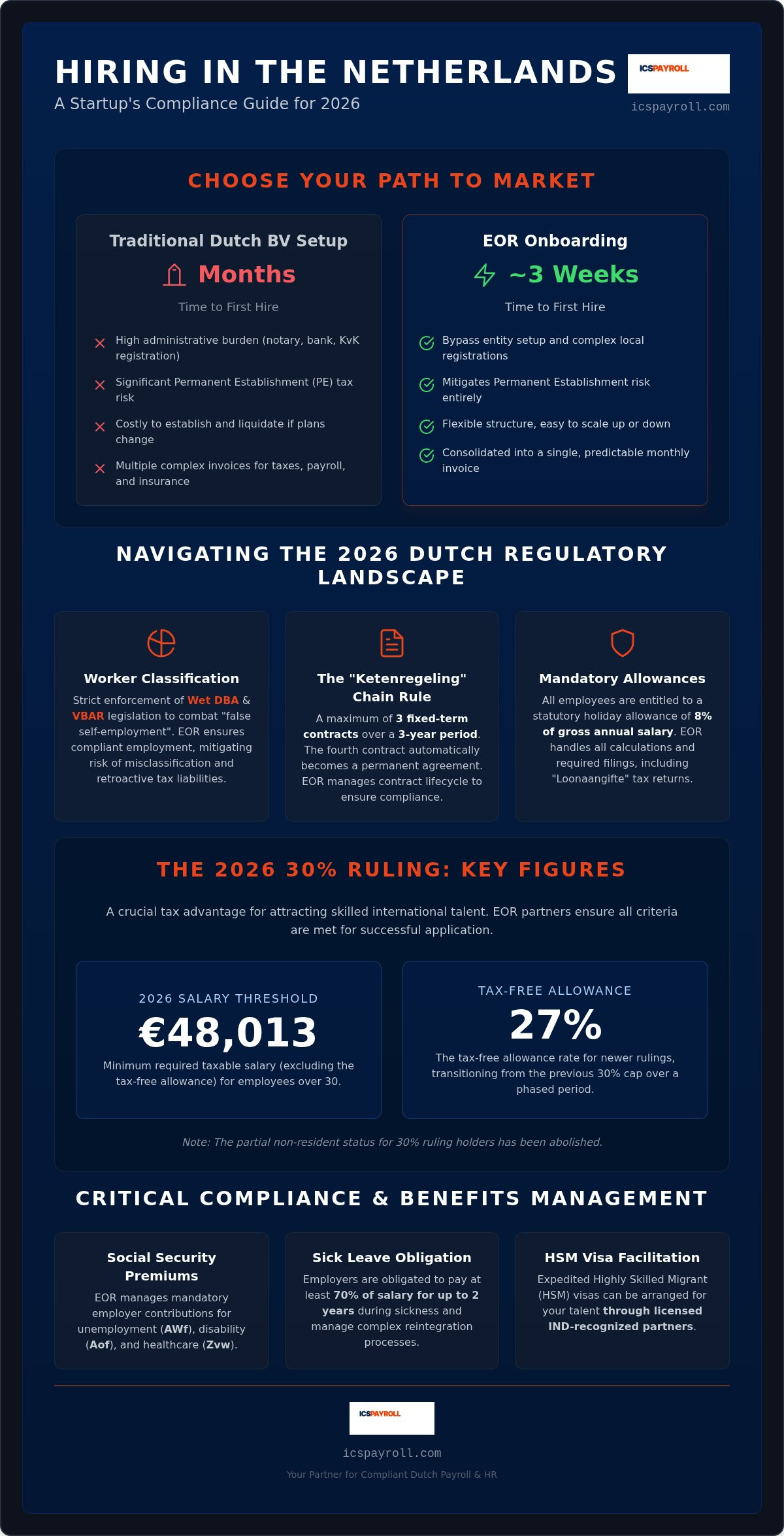
The traditional route of incorporating a Dutch BV just to hire international talent has become a strategic bottleneck for modern startups. By utilizing professional eor services for startups netherlands, you can bypass the administrative weight of maintaining a local entity that frequently distracts from core product development. You are likely concerned about the 2026 30% ruling reforms and the looming enforcement of the VBAR legislation. It's difficult to manage the new EUR 48,013 salary threshold and the transition to a 27% tax-free rate without dedicated local expertise.
This guide demonstrates how to onboard Dutch talent in as little as three weeks while ensuring full compliance with 2026 labor laws. We will detail the exact steps to navigate the 2026 tax changes, mitigate Permanent Establishment risks, and facilitate expedited HSM visas through licensed partners. You'll gain the clarity needed to simplify your payroll into a single monthly invoice and hire with confidence in one of Europe's most competitive talent markets.
Key Takeaways
- Learn why choosing eor services for startups netherlands allows you to hire top talent in weeks without the administrative burden of establishing a local BV.
- Understand the critical impact of 2026 labor reforms, including the VBAR legislation and the strict enforcement of Wet DBA for independent contractors.
- Navigate the updated 30% ruling requirements, including the mandatory EUR 48,013 salary threshold for 2026 and the transition to a 27% tax-free allowance.
- Discover why a local specialist provides superior compliance security compared to global platforms, particularly regarding Dutch sick-leave and mandatory reintegration.
- Streamline your international expansion with a single monthly invoice and digital portals that manage contracts, payslips, and holiday balances.
Understanding EOR Services for Startups in the Netherlands
An Employer of Record (EOR) acts as the legal employer for your Dutch workforce. While you manage the daily tasks and output of your team, the EOR handles the technicalities of the Dutch payroll system. For international companies, using eor services for startups netherlands eliminates the need to register a local branch or subsidiary. This setup is particularly effective for removing the risk of "Permanent Establishment." Without an EOR, a foreign company hiring directly in the Netherlands might inadvertently create a taxable presence, triggering complex corporate tax obligations with the Belastingdienst. ICSPayroll manages the employment contracts, ensuring they align with local standards while you focus on scaling your operations.
EOR vs. Direct Entity Incorporation
Setting up a Dutch BV typically requires months of preparation. You must secure a local bank account, visit a notary, and register with the Chamber of Commerce (KvK). For a startup, this timeline is often prohibitive. EOR services offer a faster alternative, allowing you to onboard talent in as little as three weeks. This flexibility is vital for startups testing the Dutch market. If the business model shifts, you aren't tied to a local legal structure that is costly to liquidate. Instead, you maintain a lean operation with a single monthly invoice that covers all employer costs, insurance premiums, and taxes. To further optimize your overhead, you can discover Expense To Profit to understand how reducing non-labor expenses can facilitate your growth.
The Legal Framework for Dutch EOR
The Dutch legal landscape is shifting rapidly. By 2026, the enforcement of the VBAR and Wet DBA will place stricter scrutiny on how companies classify workers. ICSPayroll acts as the legal employer, assuming the responsibility for compliance with these evolving labor laws. We ensure that your staff are employed under valid Dutch contracts that respect the "Ketenregeling" (chain rule) for fixed-term agreements. Our local expertise becomes critical when managing the 2026 30% ruling reforms. We help you meet the standard 2026 salary threshold of EUR 48,013, ensuring your international hires receive their tax benefits without administrative errors. By using eor services for startups netherlands, you transfer the burden of local tax filings (Loonaangifte) and statutory insurance premiums to a partner that understands the intricacies of the Dutch system.
Navigating the 2026 Dutch Regulatory Landscape
The 2026 regulatory environment in the Netherlands introduces stringent oversight for startups relying on flexible workforces. Central to this shift is the full enforcement of the Wet DBA and the introduction of the VBAR legislation. These laws aim to eliminate "false self-employment" by clarifying the criteria for an employment relationship. For many international entities, using eor services for startups netherlands provides a safety net against the misclassification of contractors. If the Dutch authorities determine a worker is an employee rather than a freelancer, the company faces significant retroactive tax liabilities and social security assessments.
Startup hiring is also affected by the 2026 statutory minimum wage requirements. For employees aged 21 and over, the minimum hourly rate is set at EUR 14.71 or 14.99, depending on the specific industry sector. New reforms to non-compete clauses further protect employee mobility, requiring employers to provide a "compelling business interest" to enforce such restrictions. These changes make it harder for startups to lock in talent through restrictive contracts, emphasizing the need for competitive benefits and legal precision.
Labor Law Compliance for Startups
Compliance begins with the "Ketenregeling," or the chain rule for employment contracts. Under Dutch labor law, you can offer a maximum of three fixed-term contracts over a three-year period. The fourth contract automatically becomes an indefinite agreement. Additionally, probation periods are strictly regulated; they are limited to one month for contracts between six months and two years, and two months for indefinite roles. Every employee is entitled to a statutory holiday allowance of 8% of their gross annual salary, which is typically paid out in May. Partnering with an expert for Dutch payroll administration ensures these calculations and contract limits are managed without error.
Employee Benefits and Social Security
The Dutch social security system is comprehensive and requires precise premium management. Employers are responsible for contributions toward the AWf (unemployment fund), Aof (disability fund), and Zvw (healthcare insurance). Startups must also account for mandatory pension schemes, which often average 15.2% of the gross salary. Sickness risk is another significant factor in the Netherlands. Employers have a two-year obligation to pay at least 70% of an employee's wages during illness, alongside mandatory reintegration efforts. By utilizing eor services for startups netherlands, these financial risks are mitigated through collective insurance and professional absence management, protecting your startup from unexpected labor costs.
Maximizing Startup Talent with the 30% Ruling
The 30% ruling remains a primary incentive for startups to attract high-level international engineers and executives to the Dutch market. By utilizing eor services for startups netherlands, you can offer this significant tax advantage without managing the complex application process yourself. For 2026, the tax-free allowance for new rulings has transitioned to a 27% rate. This change reflects recent legislative updates aimed at balancing the facility's benefits with broader fiscal goals. It's a powerful recruitment tool that effectively increases a candidate's net take-home pay without raising your startup's gross salary costs.
Startups must ensure their hires meet the specific 2026 salary requirements to qualify. The standard annual taxable salary threshold is EUR 48,013. For employees under 30 with a Master's degree, a lower threshold of EUR 36,449 applies. It's critical to monitor these figures throughout the year. Falling below these limits, even temporarily, can result in the immediate and permanent loss of the ruling. 2026 also marks the abolition of partial non-resident status. This means employees can no longer opt to be treated as non-residents for tax purposes regarding their global savings and investments in Box 3. This change requires international staff to report their global assets to the Belastingdienst, which often necessitates professional tax planning.
Highly Skilled Migrant (HSM) Visas
Hiring from outside the Schengen area requires a formal sponsorship. While ICSPayroll is not an IND recognized sponsor, we coordinate expedited HSM visa processing through our network of licensed partners. This collaboration typically secures a visa grant within a benchmark of three weeks. Eligibility depends on the employee meeting the salary thresholds mentioned above and the role being considered "highly skilled" by the Immigration and Naturalisation Service (IND). This streamlined approach allows your startup to access global talent pools without the months-long wait associated with direct IND sponsorship applications.
Applying for the 30% Ruling
The application must be submitted within four months of the employee's start date to ensure the benefit is retroactive. If you miss this window, the tax break only applies from the first day of the month following the application. Ongoing compliance is mandatory, as the tax authorities require precise reporting in the monthly "Loonaangifte" filings. For a deeper dive into these requirements, read The 30% Ruling in the Netherlands: A Comprehensive 2026 Employer Guide. Using professional eor services for startups netherlands ensures that these deadlines are met and that all data provided to tax authorities, including proof of the 150km distance requirement, is verified and accurate.
Local vs. Global EOR: Why Startups Need a Dutch Specialist
Global EOR platforms often prioritize scale over local precision. While they cover dozens of markets, they typically rely on automated support systems that lack depth in Dutch labor law. Choosing specialized eor services for startups netherlands provides access to experts who understand the specific requirements of the Belastingdienst and the Chamber of Commerce (KVK). A major differentiator is the management of long-term illness. In the Netherlands, the "Wet Verbetering Poortwachter" requires a strictly documented reintegration process. Generic global providers often struggle with these administrative nuances, leaving startups vulnerable to wage sanctions from the UWV. Local specialists maintain direct relationships with Dutch authorities. This proximity ensures that your startup remains compliant with local tax filings and social security audits.
We use a transparent "payroll factor" model. This approach eliminates the hidden fees and seat costs often found in global platform subscriptions. It ensures your budgeting remains predictable as you scale. Unlike faceless platforms, a local partner acts as a stabilizing force, removing administrative burdens so you can focus on product-market fit. This expertise is vital for navigating the 2026 transition to a 27% tax-free allowance for the 30% ruling, where precise reporting is mandatory.
Speed and Responsiveness
Startups operate on tight timelines. We provide tailored quotations within 24 hours. Service agreements and employment contracts are typically ready within days. You gain direct access to payroll experts like Joost Hubregtse, rather than a generic support ticket system. This human-led approach ensures that complex questions regarding 2026 labor reforms are answered with clinical precision. Rapid onboarding allows you to secure top-tier talent before they sign with a competitor, a critical advantage in the competitive Dutch tech landscape.
The Single Invoice Advantage
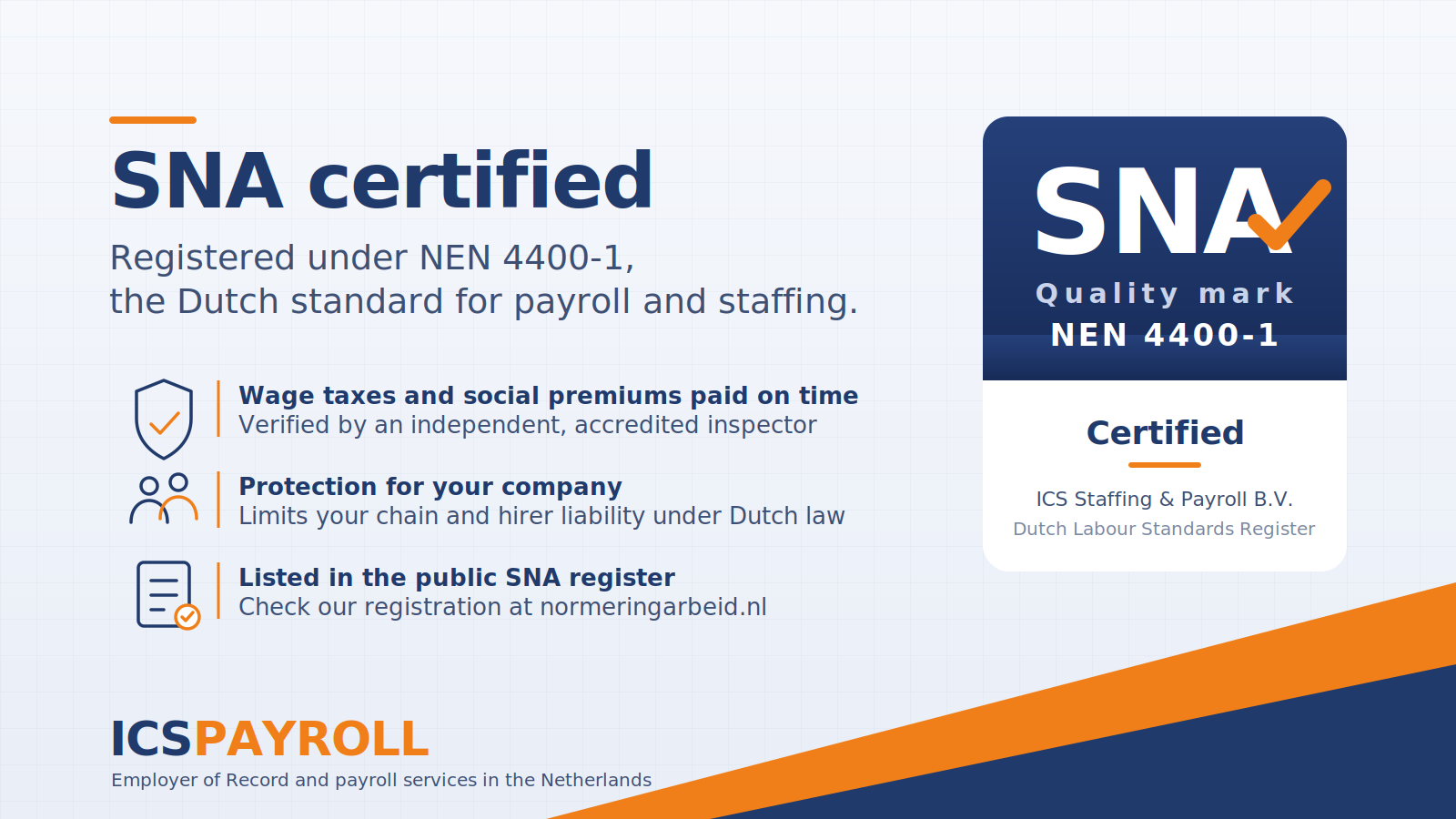
Managing multiple vendors for pension, insurance, and payroll creates administrative friction. We consolidate all employer costs into a single monthly invoice. This includes statutory social security contributions (AWf, Aof, Zvw), pension premiums, and HR administration fees. It provides early-stage startups with a clear overview of their total cost of employment. You don't have to worry about separate filings or surprise charges. To see how this transparent model fits your growth plans, you can request a detailed quotation for your specific hiring needs. This consolidation simplifies your accounting and ensures that all 2026 statutory requirements are met through one reliable channel.
Scaling Your Startup with ICSPayroll
Scaling a startup requires a partner that manages the administrative complexity of a growing headcount with clinical precision. By utilizing eor services for startups netherlands, you can focus on recruitment and product development while we handle the legal infrastructure. As your team expands, managing the "Transitievergoeding" (transition payment) becomes a critical financial consideration. For 2026, the statutory transition payment is capped at EUR 102,000, or one annual salary if the employee's salary exceeds this amount. We ensure these accruals are tracked accurately from day one. Long-term stability also depends on rigorous record-keeping. The Belastingdienst requires employment records to be maintained for seven years. ICSPayroll provides a secure digital archive for all contracts and tax filings, protecting your startup during potential future compliance audits.
The Onboarding Process
Our onboarding workflow is designed for speed and clarity. First, you provide basic employee details to receive a tailored quotation within 24 hours. Second, we finalize the service agreement and prepare it for signature within a few business days. Finally, we issue a Dutch-compliant employment contract and, if required, coordinate an expedited HSM visa filing through our licensed partners. This structured approach moves your hires from offer accepted to onboarded in as little as three weeks. It's a reliable bridge for international startups entering the Dutch market for the first time without a local BV.
Ongoing Payroll and HR Support
Once your team is active, we manage the monthly "Loonaangifte" filings to ensure all tax payments and social security premiums are submitted before the strict legal deadlines. Employees gain access to a dedicated online portal where they can view payslips and manage holiday balances. This self-service functionality significantly reduces the HR burden on your internal operations. We also provide expert guidance for sickness management, helping you navigate the two-year reintegration requirements defined by the Dutch government. For more technical insights on managing a growing workforce, see Dutch Payroll for Tech Startups: Scaling in the 2026 Regulatory Landscape. Our human-led support ensures that your startup remains compliant as labor laws evolve throughout 2026.
Accelerating Your Dutch Market Entry in 2026
Entering the Dutch market in 2026 requires more than just a recruitment strategy; it demands a rigorous commitment to local labor laws and tax reforms. You've seen how the VBAR legislation and the updated 30% ruling salary thresholds of EUR 48,013 create a complex environment for international entities. By selecting specialized eor services for startups netherlands, you ensure your business is built on a foundation of regulatory precision. This allows you to avoid the months-long process of direct entity incorporation while maintaining full compliance with the Belastingdienst and IND.
Speed and security are the hallmarks of a successful expansion. We provide the technical expertise needed to manage mandatory sickness reintegration and transition payments without the overhead of a local BV. Hire in the Netherlands with confidence: Get your 24-hour quote from ICSPayroll. Our team guarantees a tailored quotation within 24 hours and coordinates expedited HSM visa processing through licensed partners. Your startup deserves a partner that treats your compliance as a priority so you can focus on building your team and your product. We're ready to help you thrive in the Dutch ecosystem.
Frequently Asked Questions
How quickly can a startup start hiring in the Netherlands using an EOR?
Hiring can begin in weeks, not months. Once you provide employee details, you receive a tailored quotation within 24 hours. Service agreements and employment contracts are typically finalized within days. This speed is a primary benefit of using eor services for startups netherlands, as it allows you to secure talent quickly. You don't have to wait for the lengthy process of registering a local entity or opening a Dutch business bank account.
What is the 2026 salary requirement for the Dutch 30% ruling?
The standard annual salary threshold for the 30% ruling in 2026 is EUR 48,013 of taxable income. For employees under 30 who hold a recognized Master's degree, a reduced threshold of EUR 36,449 applies. These figures are updated annually by the Belastingdienst. Maintaining these salary levels is mandatory to retain the tax benefit, which transitioned to a 27% tax-free rate for new applications starting in 2024.
Can I hire employees in the Netherlands before my Dutch BV is established?
Yes, you can hire Dutch employees before or instead of establishing a Dutch BV. An EOR acts as the legal employer, meaning your company does not need a local registration or a "Permanent Establishment" in the Netherlands. This setup is ideal for startups testing the market or those that prefer to remain lean. It bypasses the administrative burden of visiting a notary and registering with the Chamber of Commerce (KvK).
What is included in the ICSPayroll monthly invoice?
The ICSPayroll monthly invoice consolidates all employment costs into a single, transparent payment based on a "payroll factor." It includes the gross salary, the 8% statutory holiday allowance, and a 15.2% pension contribution. The invoice also covers social security premiums (AWf, Aof, Zvw), sickness risk insurance, and transition allowance accruals. Additionally, it encompasses HR administration, access to the online employee portal, and support for 30% ruling applications and sick-leave reintegration.
How long does the Highly Skilled Migrant (HSM) visa process take in 2026?
The Highly Skilled Migrant (HSM) visa process typically takes approximately three weeks when arranged via our licensed partners. This expedited timeline is much faster than the standard several-month wait for direct IND sponsorship. To qualify, the employee must meet the 2026 salary requirements set by the Immigration and Naturalisation Service (IND). We coordinate the entire filing process to ensure your international talent can relocate and begin work quickly.
What are the employer obligations for sick pay in the Netherlands?
Employers in the Netherlands are legally obligated to pay at least 70% of an employee's wages for up to two years during illness. In many sectors, this is increased to 100% in the first year. Beyond salary, you must follow strict reintegration steps under the "Wet Verbetering Poortwachter." Using eor services for startups netherlands mitigates this risk, as the EOR manages the insurance and the mandatory reintegration process with the UWV.
Is a startup required to provide a pension scheme in the Netherlands?
While not every industry has a mandatory sector-wide pension, providing a scheme is standard practice to remain competitive. ICSPayroll includes a pension contribution of 15.2% of the gross salary as part of our standard service. This ensures your employees have proper retirement provisions while keeping your startup compliant with modern Dutch labor expectations. Managing these contributions through an EOR simplifies your accounting and removes the need to negotiate with individual pension funds.
What is the difference between an EOR and a PEO in the Netherlands?
The primary difference lies in legal responsibility. An EOR acts as the sole legal employer, allowing you to hire without a local Dutch entity. In contrast, a PEO often operates under a co-employment model, which typically requires the client to have a registered Dutch BV. ICSPayroll provides EOR services, assuming all risks related to payroll taxes, social security, and labor law compliance. This is the most efficient path for startups entering the Dutch market.

Article by
Joost Hubregtse
Joost Hubregtse is Director of ICS Staffing & Payroll B.V., the wholly owned subsidiary of Intercompany Solutions behind ICS Payroll. He is responsible for Employer of Record and Dutch payroll services: employment contracts, wage tax and social security filings, holiday allowance, pension, sick leave and CAO compliance, with onboarding possible within 48 hours.
Frequently Asked Questions
Hiring can begin in weeks, not months. Once you provide employee details, you receive a tailored quotation within 24 hours. Service agreements and employment contracts are typically finalized within days. This speed is a primary benefit of using eor services for startups netherlands, as it allows you to secure talent quickly. You don't have to wait for the lengthy process of registering a local entity or opening a Dutch business bank account.
The standard annual salary threshold for the 30% ruling in 2026 is EUR 48,013 of taxable income. For employees under 30 who hold a recognized Master's degree, a reduced threshold of EUR 36,449 applies. These figures are updated annually by the Belastingdienst. Maintaining these salary levels is mandatory to retain the tax benefit, which transitioned to a 27% tax-free rate for new applications starting in 2024.
Yes, you can hire Dutch employees before or instead of establishing a Dutch BV. An EOR acts as the legal employer, meaning your company does not need a local registration or a "Permanent Establishment" in the Netherlands. This setup is ideal for startups testing the market or those that prefer to remain lean. It bypasses the administrative burden of visiting a notary and registering with the Chamber of Commerce (KvK).
The ICSPayroll monthly invoice consolidates all employment costs into a single, transparent payment based on a "payroll factor." It includes the gross salary, the 8% statutory holiday allowance, and a 15.2% pension contribution. The invoice also covers social security premiums (AWf, Aof, Zvw), sickness risk insurance, and transition allowance accruals. Additionally, it encompasses HR administration, access to the online employee portal, and support for 30% ruling applications and sick-leave reintegration.
The Highly Skilled Migrant (HSM) visa process typically takes approximately three weeks when arranged via our licensed partners. This expedited timeline is much faster than the standard several-month wait for direct IND sponsorship. To qualify, the employee must meet the 2026 salary requirements set by the Immigration and Naturalisation Service (IND). We coordinate the entire filing process to ensure your international talent can relocate and begin work quickly.
Employers in the Netherlands are legally obligated to pay at least 70% of an employee's wages for up to two years during illness. In many sectors, this is increased to 100% in the first year. Beyond salary, you must follow strict reintegration steps under the "Wet Verbetering Poortwachter." Using eor services for startups netherlands mitigates this risk, as the EOR manages the insurance and the mandatory reintegration process with the UWV.
While not every industry has a mandatory sector-wide pension, providing a scheme is standard practice to remain competitive. ICSPayroll includes a pension contribution of 15.2% of the gross salary as part of our standard service. This ensures your employees have proper retirement provisions while keeping your startup compliant with modern Dutch labor expectations. Managing these contributions through an EOR simplifies your accounting and removes the need to negotiate with individual pension funds.
The primary difference lies in legal responsibility. An EOR acts as the sole legal employer, allowing you to hire without a local Dutch entity. In contrast, a PEO often operates under a co-employment model, which typically requires the client to have a registered Dutch BV. ICSPayroll provides EOR services, assuming all risks related to payroll taxes, social security, and labor law compliance. This is the most efficient path for startups entering the Dutch market.