Strategic Benefits of Outsourcing Payroll in the Netherlands for 2026
By Joost Hubregtse, Director, ICS Staffing & Payroll
All blog posts are reviewed and fact checked by our labour law lawyer Zishan Hussain and our director. Editorial standards
In 2026, a single administrative oversight in Dutch social security filings can trigger financial penalties that far exceed the cost of professional management. You already understand that the Netherlands offers a world-class talent pool, but the regulatory environment is increasingly unforgiving for international employers. Between the shifting thresholds of the 30% ruling and the active enforcement of Wet DBA, the administrative burden of entry has never been higher.
One of the most significant benefits of outsourcing payroll in the Netherlands is the ability to offload these complexities to a local expert who acts as a protective guardian for your business. This article outlines how specialized outsourcing ensures your operations remain fully compliant with 2026 labor laws while securing critical advantages like the EUR 48,013 salary threshold for the 30% ruling. You'll discover how to eliminate the risks associated with permanent establishment and manage mandatory 8% holiday allowances with total cost transparency. We provide a clear roadmap for navigating mandatory pension contributions and expedited HSM visa processing through licensed partners, allowing you to focus on growth rather than bureaucracy.
Key Takeaways
- Understand the 2026 Dutch landscape where mandatory employer contributions include an 8 percent holiday allowance and specific pension requirements.
- One of the primary benefits of outsourcing payroll in the Netherlands is the mitigation of Permanent Establishment risks while ensuring full compliance with the 2026 Wet DBA enforcement.
- Secure the 30% ruling for highly skilled migrants by meeting the 2026 salary threshold of EUR 48,013 through applications managed by licensed specialists.
- Simplify complex labor costs into a single monthly invoice using a payroll factor model that covers social security premiums and sickness risk.
- Expedite your market entry by moving from quotation to active hiring in weeks instead of months without the need for a local Dutch BV.
Understanding the 2026 Dutch Payroll Landscape
The Netherlands consistently ranks as one of the most complex jurisdictions for payroll compliance in Europe. For international employers, the challenge isn't merely calculating a net salary. It's the accurate management of social security, sector-specific pension funds, and strict tax filing protocols. One of the primary benefits of outsourcing payroll in the Netherlands is the ability to bypass the lengthy process of incorporating a local Dutch BV. This allows your firm to hire talent immediately while a specialized partner manages the legal and financial risks.
The Complexity of Dutch Statutory Benefits
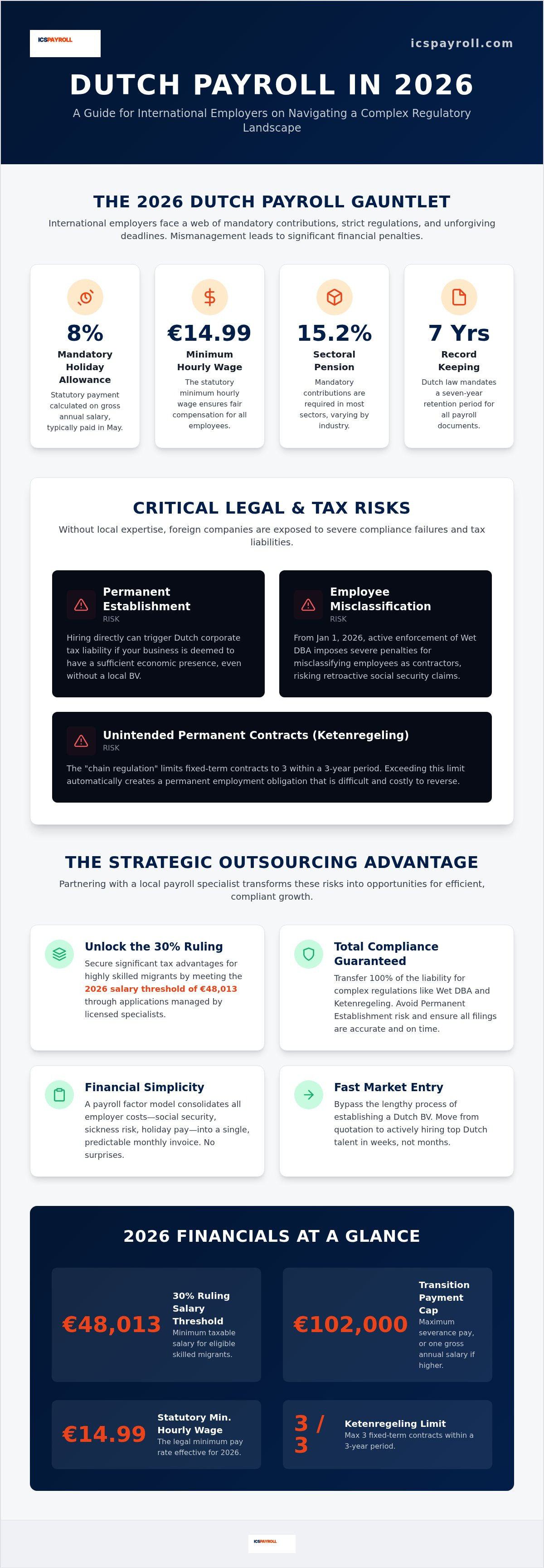
Compliance in the Dutch market requires a precise understanding of mandatory employee benefits. Every employee is entitled to a statutory holiday allowance of 8 percent. This is calculated on the gross annual salary and is typically paid out in May. Additionally, most sectors require a mandatory pension contribution of 15.2 percent. Employers must also account for the 30% ruling, which provides significant tax advantages for highly skilled migrants meeting the 2026 salary threshold of EUR 48,013. If an employment contract ends, you must calculate the transition allowance, or transitievergoeding. For 2026, this payment is capped at EUR 102,000 or one gross annual salary if that amount is higher.
Administrative Burden vs Strategic Outsourcing
Managing payroll in house places a significant administrative strain on international HR departments. The Dutch Tax Administration, or Belastingdienst, enforces strict monthly deadlines for Loonaangifte filings. Missing these windows results in immediate financial penalties. Dutch law also mandates a seven year record keeping requirement for all payroll related documents. This includes payslips, employment contracts, and tax statements.
Using an online portal through a specialized partner provides centralized access to these records. It ensures that holiday balances and salary specifications are always transparent and accessible. This approach converts a complex administrative burden into a streamlined, predictable monthly cost while highlighting the long term benefits of outsourcing payroll in the Netherlands. You gain the security of professional oversight without the overhead of a dedicated local HR team and ensure compliance with the 2026 statutory minimum hourly wage of EUR 14.99.
Mitigating Legal and Tax Risks via Specialized Partners
Dutch payroll outsourcing involves the strategic delegation of tax, social security, and labor law obligations to local specialists. It is a critical move to ensure that your business operates within the strict parameters set by the Dutch authorities. One of the core benefits of outsourcing payroll in the Netherlands is the transfer of liability for complex regulatory frameworks to a partner with local expertise. This includes managing the Ketenregeling, which limits the number of fixed term contracts an employee can receive to three within a three year period before a permanent contract is mandatory. Failure to monitor these contract cycles can result in unintended permanent employment obligations that are difficult to reverse under Dutch law.
VBAR and Wet DBA Enforcement in 2026
The legal landscape for hiring in the Netherlands is shifting rapidly. As of January 1, 2025, the Dutch Tax Administration, or Belastingdienst, resumed active enforcement of the Wet DBA to combat disguised employment. By January 1, 2026, the authorities began imposing serious fault penalties on companies that misclassify employees as independent contractors. This risk is further heightened by the VBAR legislation. While the broader clarification component was scrapped, a critical element remains: a rebuttable legal presumption of an employment contract for workers below specific hourly rate thresholds. This is set to take effect on December 31, 2026. Using EOR services arranged via licensed partners removes this misclassification risk entirely. It ensures that every worker is correctly categorized according to the latest 2026 standards, protecting your firm from retroactive social security claims.
Avoiding Permanent Establishment Risk
Foreign companies often face the risk of Permanent Establishment when hiring directly in a new market. This occurs when the Belastingdienst determines that your business has a sufficient physical or economic presence to be liable for Dutch corporate tax. Distinguishing a Dutch BV from a Permanent Establishment is critical for long term tax planning. A Permanent Establishment triggers corporate income tax obligations that many international firms are not prepared to manage during their initial phase of expansion. By using a payroll administration partner, you avoid creating a taxable nexus. This structure allows you to maintain a team without the fiscal complexities of a local entity. For a deeper look at these requirements, see our Employment Law in the Netherlands for Foreign Employers guide.
Expert guidance is no longer optional; it is a requirement for secure market entry. If you are ready to secure your Dutch operations, you can request a payroll consultation to review your specific needs. This proactive approach ensures you maximize the benefits of outsourcing payroll in the Netherlands while maintaining full compliance with the 2026 transition payment caps of EUR 102,000. You gain the security of a protective guardian that manages the technical logistics of the Dutch system on your behalf, allowing you to focus on growth rather than litigation risks.
Maximizing Talent Value with the 30% Ruling
The 30% ruling remains the most powerful tool for attracting international talent to the Dutch market. It allows employers to provide up to 30 percent of an employee's gross salary as a tax free allowance. This fiscal benefit significantly increases the net take home pay for highly skilled migrants without increasing the gross cost for the employer. One of the key benefits of outsourcing payroll in the Netherlands is ensuring that these complex applications are filed with the technical precision required by the Belastingdienst. Precision is vital because errors in the application can lead to retroactive tax liabilities for both the employee and the firm.
2026 Eligibility and Salary Thresholds
Eligibility criteria for the tax facility are strictly enforced and updated annually. For 2026, the standard taxable salary threshold is EUR 48,013. Employees under the age of 30 who possess a qualifying Master's degree benefit from a reduced threshold of EUR 36,497. It's also critical to account for the abolition of partial non resident status, which ended for new applicants on January 1, 2025. While a transitional arrangement allows those using the status as of December 31, 2023, to continue until the end of 2026, new hires must plan for full Dutch tax liability on global assets. Additionally, newer rulings are subject to a legislative transition where the tax free percentage will drop to 27 percent starting in 2027. We facilitate these applications via licensed partners to ensure your staff meets every requirement from day one.
Expedited HSM Visa Processing
Hiring non Schengen staff requires a Highly Skilled Migrant visa, a process that can be daunting for foreign entities. Managing this in house often takes months and requires recognized sponsor status with the IND. By using a specialized provider, you access expedited processing through licensed partners. This often results in visa approval within approximately three weeks. Rapid onboarding is one of the practical benefits of outsourcing payroll in the Netherlands, as it allows you to secure top tier talent before they are hired by competitors. For a deeper analysis of these regulations, refer to The 30% Ruling in the Netherlands Pillar. This guide details the specific administrative steps necessary to maintain compliance while maximizing the value of your international recruitment efforts.
The Efficiency of the Payroll Factor Model
The Dutch payroll system involves numerous variable percentages that change based on sector, contract type, and annual salary caps. Managing these line items individually often leads to administrative friction and unpredictable monthly costs for foreign entities. One of the primary benefits of outsourcing payroll in the Netherlands is the implementation of a payroll factor model. This model consolidates all employer obligations into a single, transparent multiplier applied to the gross salary of your employees. It represents a shift from reactive accounting to proactive financial management, providing a stabilized cost structure for international expansion.
What is Included in the Payroll Factor?
A comprehensive payroll factor bundles all mandatory and voluntary employer costs into one predictable figure. This includes the statutory 8 percent holiday allowance and the 15.2 percent pension contribution mentioned earlier in this guide. It also incorporates essential social security premiums such as the 6.10 percent Health Insurance Act (Zvw) contribution. The multiplier covers the Unemployment Insurance (AWf) premium, which is 2.74 percent for permanent contracts in 2026. It also accounts for the Disability Insurance (Aof) premium, set at 6.27 percent for small employers. By consolidating these variables, the model also covers HR administration and secure online portal access.
Financial Predictability for International CFOs
Traditional accounting models often rely on variable hourly billing or separate fees for insurance and HR support. This creates unpredictable overhead and complicates the budgeting process for foreign headquarters. The payroll factor model eliminates these surprise charges by establishing a fixed multiplier at the start of the engagement. This approach is particularly effective for managing the financial risks of long term sick leave, as the model includes the necessary insurance and legal compliance for the Wet Verbetering Poortwachter. It also simplifies the management of the EUR 79,409 maximum premium wage, ensuring that contributions are capped correctly without manual intervention. For a detailed breakdown of these administrative requirements, you should consult our Dutch Payroll Administration Guide.
Transparency in pricing ensures that your expansion into the Dutch market remains within its financial parameters. You won't need to manually track the administrative nuances of sector specific filings. If you're ready to simplify your international operations, you can get a tailored payroll factor quotation within 24 hours. This streamlined financial structure allows you to focus on your core business objectives while your local specialist, working via licensed partners, handles the technical logistics of the Dutch fiscal system. This ensures you maximize the benefits of outsourcing payroll in the Netherlands while maintaining a lean administrative footprint.
Scaling Your Dutch Team with ICSPayroll
Speed is a critical advantage. Traditional market entry often involves waiting months for a Dutch BV incorporation and bank account activation. One of the core benefits of outsourcing payroll in the Netherlands is the ability to bypass these delays entirely. We provide a path to start hiring in weeks rather than months. Once you provide basic employee details, you'll receive a tailored quotation within 24 hours. This rapid response allows you to make informed budgetary decisions without the friction of long waiting periods.
A Solution Focused Onboarding Process
Our onboarding process is designed for efficiency and legal precision. It follows a structured three-step logic:
- Step 1: Provide basic employee details to receive a tailored payroll factor quote.
- Step 2: Review the service agreement and compliant employment contracts, which are typically ready within days.
- Step 3: Begin your operations while all technical tax and social security filings are handled on your behalf.
Precision is no longer optional. This methodical approach ensures that your employment contracts are fully compliant with 2026 labor laws. It includes specific provisions for sick leave management and the mandatory reintegration steps required by the Dutch authorities. You gain the security of a protective guardian that manages the administrative burden while you focus on scaling your local team.
Why a Local Specialist Outperforms Global Aggregators
Global aggregators often rely on automated ticketing systems and generic support models that lack depth in local regulations. We prioritize human centric support. This provides direct access to experts who understand the nuances of the Dutch labor market. This is particularly important when managing the Ketenregeling or ensuring that 2026 transition payment caps of EUR 102,000 are correctly applied. While an aggregator might offer a broad platform, a local specialist provides the technical accuracy necessary to navigate the active enforcement of Wet DBA and VBAR legislation.
Working with a local expert ensures that every aspect of your payroll is integrated seamlessly into the Dutch fiscal system. This includes managing the 30% ruling and ensuring all Loonaangifte filings meet strict Belastingdienst deadlines. Beyond the speed of entry, the long term benefits of outsourcing payroll in the Netherlands include ongoing expert support for Dutch labor market compliance. If you're ready to expand your footprint, Hire in the Netherlands with confidence today. This partnership provides the stability and speed required to thrive in one of Europe's most complex administrative environments.
Securing Your Dutch Market Entry for 2026
Navigating the 2026 Dutch labor market requires more than just administrative effort; it demands technical precision and local expertise. By leveraging the benefits of outsourcing payroll in the Netherlands, international firms can bypass the complexities of local entity setup while ensuring full compliance with evolving statutory requirements. From meeting the EUR 48,013 salary threshold for the 30% ruling to managing the 8 percent holiday allowance, a specialized partner provides the stability your business needs to thrive. This structure eliminates the risk of permanent establishment and converts variable social security costs into a predictable payroll factor.
Speed is your competitive advantage in a tight talent market. You can access expedited HSM visa processing in approximately three weeks through licensed partners. This allows you to secure top-tier talent without the administrative delays of traditional incorporation. If you're ready to scale your team with a partner that values transparency and legal meticulousness, we're here to help. Hire in the Netherlands with confidence — Get your quote in 24 hours. We look forward to supporting your successful expansion into the Dutch market.
Frequently Asked Questions
What are the main benefits of outsourcing payroll in the Netherlands in 2026?
Risk mitigation and operational speed are the primary advantages for international firms. Outsourcing allows companies to hire talent without a local BV while ensuring compliance with complex 2026 labor laws like the Wet DBA. One of the key benefits of outsourcing payroll in the Netherlands is the consolidation of all employment costs into a single invoice. This removes the administrative burden of managing mandatory holiday allowances and pension contributions while securing expert 30% ruling assistance.
How does the 30% ruling application process work for employers?
The process involves submitting a joint application to the Belastingdienst to prove the employee meets specific scarcity and salary criteria. Employers must verify the employee was recruited from abroad and meets the minimum taxable salary requirements. Applications are handled via licensed partners to guarantee technical accuracy. This ensures the 30% tax free allowance is applied correctly, protecting the firm from retroactive tax liabilities or non-compliance issues with the Dutch tax authorities.
Can I hire employees in the Netherlands without a local legal entity?
Yes, you can hire Dutch staff without a local BV by using an Employer of Record (EOR) service. The EOR acts as the legal employer for your staff and manages all tax, social security, and labor law obligations. This allows international firms to start operations in weeks rather than months. According to the KVK, this structure provides a secure bridge for market entry without the fiscal risks of a Permanent Establishment.
What is the standard salary threshold for the 30% ruling in 2026?
The standard taxable salary threshold for the 30% ruling in 2026 is EUR 48,013. For employees under the age of 30 who hold a qualifying Master's degree, a reduced threshold of EUR 36,497 applies. These figures are strictly enforced by the Dutch Tax Administration. It's critical to note that the partial non-resident status was abolished for new applicants in 2025, making professional guidance essential for 2026 fiscal planning and maintaining compliance with current Dutch tax law.
How quickly can I onboard a new employee using an EOR service?
Onboarding can typically be completed in weeks rather than months. Once you provide basic employee details, a tailored quotation is delivered within 24 hours. Service agreements and compliant employment contracts are usually ready within days. For non-Schengen staff, expedited Highly Skilled Migrant visa processing through licensed partners generally takes about three weeks. This speed allows your business to secure top talent and begin Dutch operations with full legal security almost immediately.
What is included in the payroll factor pricing model?
The payroll factor is a comprehensive multiplier that covers all employer costs in a single monthly invoice. It includes the 8% holiday allowance, 15.2% pension contributions, and all employee insurance premiums like AWf (2.74%) and Aof (6.27%). The model also incorporates sickness risk coverage, HR administration, and online portal access. By bundling these variables, it provides CFOs with total cost transparency and eliminates hidden fees often associated with separate professional Dutch payroll administration line items.
How are sick leave and reintegration handled when outsourcing payroll?
Sick leave is managed according to the strict requirements of the Wet Verbetering Poortwachter. The service includes sickness risk coverage for up to two years and professional reintegration guidance. Specialized partners handle the administrative interaction with the occupational health service and ensure all legal documentation is filed on time. This protective oversight minimizes the financial and legal risks typically associated with long term employee illness in the Dutch labor market and ensures statutory compliance.
What is the maximum transition allowance for Dutch employees in 2026?
The maximum statutory transition allowance is capped at EUR 102,000 gross in 2026. If an employee's annual salary exceeds this cap, the allowance is limited to one gross annual salary. This payment is mandatory for most contract terminations initiated by the employer. Professional payroll management ensures these calculations are accurate and that the necessary accruals are accounted for within your monthly payroll factor to prevent unexpected liabilities during the termination of employment contracts.

Article by
Joost Hubregtse
Joost Hubregtse is Director of ICS Staffing & Payroll B.V., the wholly owned subsidiary of Intercompany Solutions behind ICS Payroll. He is responsible for Employer of Record and Dutch payroll services: employment contracts, wage tax and social security filings, holiday allowance, pension, sick leave and CAO compliance, with onboarding possible within 48 hours.
Frequently Asked Questions
A comprehensive payroll factor bundles all mandatory and voluntary employer costs into one predictable figure. This includes the statutory 8 percent holiday allowance and the 15.2 percent pension contribution mentioned earlier in this guide. It also incorporates essential social security premiums such as the 6.10 percent Health Insurance Act (Zvw) contribution. The multiplier covers the Unemployment Insurance (AWf) premium, which is 2.74 percent for permanent contracts in 2026. It also accounts for the Disability Insurance (Aof) premium, set at 6.27 percent for small employers. By consolidating these variables, the model also covers HR administration and secure online portal access.
Risk mitigation and operational speed are the primary advantages for international firms. Outsourcing allows companies to hire talent without a local BV while ensuring compliance with complex 2026 labor laws like the Wet DBA. One of the key benefits of outsourcing payroll in the Netherlands is the consolidation of all employment costs into a single invoice. This removes the administrative burden of managing mandatory holiday allowances and pension contributions while securing expert 30% ruling assistance.
The process involves submitting a joint application to the Belastingdienst to prove the employee meets specific scarcity and salary criteria. Employers must verify the employee was recruited from abroad and meets the minimum taxable salary requirements. Applications are handled via licensed partners to guarantee technical accuracy. This ensures the 30% tax free allowance is applied correctly, protecting the firm from retroactive tax liabilities or non-compliance issues with the Dutch tax authorities.
Yes, you can hire Dutch staff without a local BV by using an Employer of Record (EOR) service. The EOR acts as the legal employer for your staff and manages all tax, social security, and labor law obligations. This allows international firms to start operations in weeks rather than months. According to the KVK, this structure provides a secure bridge for market entry without the fiscal risks of a Permanent Establishment.
The standard taxable salary threshold for the 30% ruling in 2026 is EUR 48,013. For employees under the age of 30 who hold a qualifying Master's degree, a reduced threshold of EUR 36,497 applies. These figures are strictly enforced by the Dutch Tax Administration. It's critical to note that the partial non-resident status was abolished for new applicants in 2025, making professional guidance essential for 2026 fiscal planning and maintaining compliance with current Dutch tax law.
Onboarding can typically be completed in weeks rather than months. Once you provide basic employee details, a tailored quotation is delivered within 24 hours. Service agreements and compliant employment contracts are usually ready within days. For non-Schengen staff, expedited Highly Skilled Migrant visa processing through licensed partners generally takes about three weeks. This speed allows your business to secure top talent and begin Dutch operations with full legal security almost immediately.
The payroll factor is a comprehensive multiplier that covers all employer costs in a single monthly invoice. It includes the 8% holiday allowance, 15.2% pension contributions, and all employee insurance premiums like AWf (2.74%) and Aof (6.27%). The model also incorporates sickness risk coverage, HR administration, and online portal access. By bundling these variables, it provides CFOs with total cost transparency and eliminates hidden fees often associated with separate professional Dutch payroll administration line items.
Sick leave is managed according to the strict requirements of the Wet Verbetering Poortwachter. The service includes sickness risk coverage for up to two years and professional reintegration guidance. Specialized partners handle the administrative interaction with the occupational health service and ensure all legal documentation is filed on time. This protective oversight minimizes the financial and legal risks typically associated with long term employee illness in the Dutch labor market and ensures statutory compliance.
The maximum statutory transition allowance is capped at EUR 102,000 gross in 2026. If an employee's annual salary exceeds this cap, the allowance is limited to one gross annual salary. This payment is mandatory for most contract terminations initiated by the employer. Professional payroll management ensures these calculations are accurate and that the necessary accruals are accounted for within your monthly payroll factor to prevent unexpected liabilities during the termination of employment contracts.