Dutch Payroll Administration: The 2026 Complete Reference Guide
By Joost Hubregtse, Director, ICS Staffing & Payroll
All blog posts are reviewed and fact checked by our labour law lawyer Zishan Hussain and our director. Editorial standards
This guide is general information about Dutch employment, wage tax and social security law. It is not legal or tax advice and cannot be relied on for a specific case. Statutory amounts are indexed at least annually; verify current figures before acting.
An unexpected wage-tax audit can undo years of expansion work. For foreign employers, Dutch payroll administration is not a back-office task but a compliance framework in which a misapplied expat regime or a misunderstood sickness liability produces retroactive assessments and penalties. Navigating 2026 requires a technical understanding of the statutory position as it stands today, and a clear separation between what is already in force and what has merely been announced.
The Netherlands runs one of the more demanding regulatory environments in Europe, and 2026 is an unusually busy year: two major acts have completed their parliamentary passage, a third is still at advisory stage, and enforcement on contractor misclassification has entered a new phase. This guide sets out the 2026 statutory requirements, explains the Ketenregeling as it currently operates and how it will change, and flags the reforms that are coming so you can plan against dates rather than headlines.
Key Takeaways
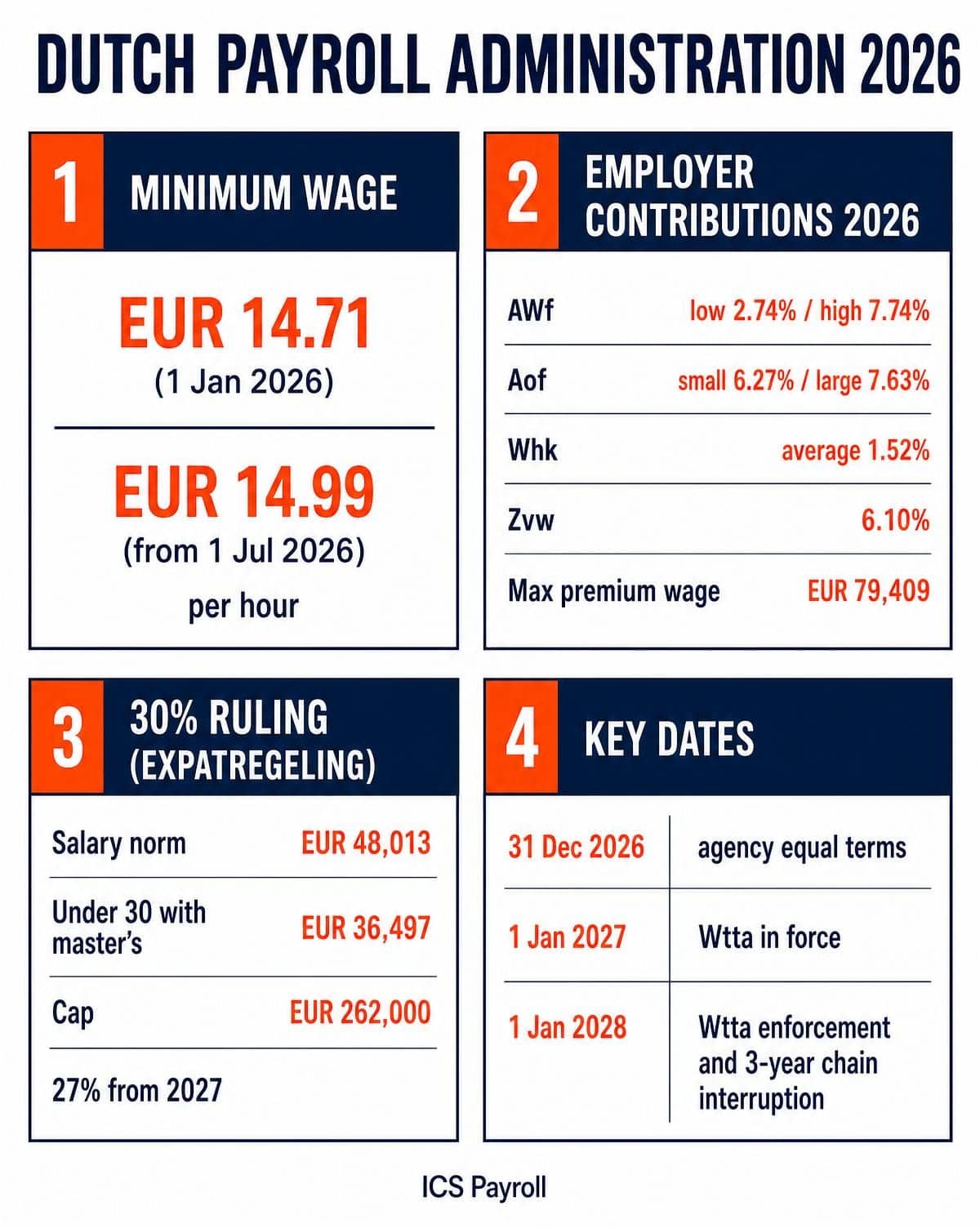
- The statutory minimum hourly wage is EUR 14.99 from 1 July 2026 (it was EUR 14.71 from 1 January 2026). The rate depends on age, not on sector.
- 2026 employer contributions: AWf 2.74% / 7.74%, Aof 6.27% (small) / 7.63% (large), Zvw employer levy 6.10%, with a maximum premium wage of EUR 79,409.
- The Ketenregeling currently permits three fixed-term contracts over 36 months with a six-month interruption; from 1 January 2028 the interruption period becomes three years under the Wet meer zekerheid flexwerkers.
- The 30% ruling (officially the expatregeling) requires taxable salary exceeding EUR 48,013 in 2026, or EUR 36,497 for employees under 30 with a qualifying master's degree. The regime drops to 27% from 2027.
- The Wtta admission regime for lenders of labour takes effect 1 January 2027, with enforcement, and a hiring prohibition for clients, from 1 January 2028.
Foundations of Dutch Payroll Administration in 2026
Dutch payroll administration is the technical interface between an employer and the Dutch state: a tax and reporting framework ensuring wage tax and social security contributions are calculated and remitted correctly. Two bodies matter most. The Belastingdienst (Tax Administration) collects wage tax and, importantly, also collects the employee insurance premiums. The UWV (Employee Insurance Agency) administers the resulting benefits and assesses reintegration efforts. Confusing the two is a common source of misdirected correspondence.
Record-keeping is strict. The wage-tax administration (payslips, wage statements, employment contracts, identity documentation) must be retained for seven years under the general fiscal retention period. Separate periods apply elsewhere: records supporting an IND sponsorship must be kept for five years after the employment ends, and general HR data are subject to the data-minimisation principle under the GDPR, which cuts against retaining everything for seven years by default.
A point of terminology worth getting right. A Dutch BV is a separate legal entity, and a subsidiary is not automatically a permanent establishment of its foreign parent. That said, "BV" and "permanent establishment" are not mutually exclusive concepts: a subsidiary can constitute a dependent-agent PE of its parent in specific circumstances, and a foreign company can hold a Dutch PE without incorporating anything. Which one you have determines your wage-tax withholding position, so the question should be answered on the facts rather than assumed from the corporate form.
The Legal Framework: WAB, and What Replaces It
The Wet arbeidsmarkt in balans (WAB), in force since 2020, remains the operative framework for 2026. It creates a financial incentive for indefinite contracts through differentiated unemployment insurance (AWf) rates and equalises the position of payroll employees.
It is, however, being progressively superseded. The Wet meer zekerheid flexwerkers was approved by the Eerste Kamer on 7 July 2026. Most of its provisions take effect on 1 January 2028, but the requirement that agency workers receive equivalent terms and conditions, not merely equivalent pay, applies from 31 December 2026. Employers using agency labour should treat that as a 2026 deadline, not a 2028 one.
Under the WAB as it currently stands, payroll employees are entitled to the same primary and secondary terms and conditions as employees hired directly by the client, with a separate regime governing pension (an adequate pension scheme rather than strict equivalence). Payroll employment and agency work (uitzenden) are distinct legal categories with different rules; the distinction is not cosmetic.
On liability, two separate doctrines are routinely conflated. Ketenaansprakelijkheid applies to chains of subcontracted work. Inlenersaansprakelijkheid applies where you hire in labour, which is the doctrine relevant to anyone using an EOR, payroll company or agency. It makes the hirer liable for wage tax and social security contributions the lender fails to remit. The mechanics of these levies are set out in more detail in our guide to Dutch payroll tax rates.
Administrative Requirements for Foreign Employers
A foreign entity that becomes liable to withhold Dutch wage tax must register with the Belastingdienst and obtain a wage tax number. Note that this obligation is not automatic: a company without a Dutch permanent establishment is generally not a withholding agent for wage tax unless it opts in, although social security obligations may still arise where the employee is insured in the Netherlands. Establishing which regime applies is the first step, not an afterthought.
For risk mitigation when hiring in labour, the SNA quality mark (based on NEN 4400) is relevant but frequently misdescribed. Certification alone does not indemnify you. The statutory indemnity against inlenersaansprakelijkheid requires the lender to be SNA-certified and the hirer to pay the prescribed percentage of the invoice into the lender's blocked g-rekening, correctly referenced. Certification without the g-account payment leaves the exposure intact.
SNA is also on a path to being superseded. Under the Wtta (see the final section), admission by the Nederlandse Autoriteit Uitleenmarkt replaces certification as the operative test from 2027. If you are unsure which regime applies to your own arrangements, it is worth consulting with a local payroll specialist before signing.
Finally, on Director-Major Shareholder (DGA) status: exclusion from mandatory employee insurance is not determined by a share percentage in isolation. Under the Regeling aanwijzing DGA 2016 it turns on whether the individual can effectively prevent their own dismissal, through voting power, through an equal-shareholdings structure, or through the family-relationship rule. Where that control exists, the individual falls outside employee insurance, which materially changes the payroll calculation.
Statutory Contributions and 2026 Tax Rates
The Minimum Wage
The Netherlands has operated a statutory minimum hourly wage since 1 January 2024; there are no longer minimum monthly, weekly or daily wages. The rate is indexed twice a year, on 1 January and 1 July. For employees aged 21 and over:
| Period | Minimum hourly wage |
|---|---|
| 1 January - 30 June 2026 | EUR 14.71 |
| From 1 July 2026 | EUR 14.99 |
Lower minimum youth wages apply to employees aged 15 to 20, derived as fixed percentages of the adult rate, and separate scales apply to BBL apprentices aged 18 to 20.
Two corrections to a common misconception. First, the statutory rate depends on age, not on industry sector. Second, a CAO may prescribe a higher floor than the statutory minimum, and where it does, the CAO rate is the one you must pay. That is a collective agreement obligation, not a variation in the statutory minimum wage. Because the wage is set per hour, a full-time monthly salary depends entirely on contractual hours; a 40-hour week costs more per month than a 36-hour week at the same hourly rate.
Holiday Allowance and Wage Tax
Every employee is entitled to holiday allowance of at least 8% of the wage earned. It is conventionally accrued through the year and paid as a lump sum in May or June. Monthly payment is permitted where it is agreed in writing, subject to the constraint under the Minimum Wage Act that the allowance is paid at least once per year and, at minimum-wage level, that the arrangement does not depress the wage below the statutory floor.
Wage tax (loonheffing) is withheld by the employer under progressive brackets set annually. Accurate withholding matters at the individual level: under-withholding produces a year-end liability for the employee and, where structural, an assessment against the employer.
Employer Social Security Obligations
The 2026 employer contribution rates are as follows.
| Contribution | 2026 rate |
|---|---|
| AWf (unemployment), low | 2.74% |
| AWf (unemployment), high | 7.74% |
| Aof (disability), small employers | 6.27% |
| Aof (disability), large employers | 7.63% |
| Whk (average rekenpremie) | 1.52% |
| Zvw employer levy | 6.10% |
| Maximum premium wage | EUR 79,409 |
The low AWf rate applies only where three conditions are met simultaneously: the contract is for an indefinite period, it is in writing, and it is not an on-call agreement. Fail any one and the high rate applies, a five-percentage-point difference. The payslip must state whether the contract is fixed or flexible so UWV can verify the correct rate.
The Aof differentiation turns on employer size, measured against the fiscal wage bill. The Whk is set individually per employer by decision of the Belastingdienst and varies by sector and by the employer's own WGA and ZW claims history; the figure above is the average calculation premium, not your rate.
Mandatory Insurance and Pension Schemes
The two-year wage continuation obligation on sickness (set out in the next section) represents the single largest uninsured exposure in a Dutch payroll, which is why most international employers take out sickness absence insurance and, where relevant, WGA cover.
Many sectors are subject to mandatory participation in an industry-wide pension fund (Bpf) under a sector decree. Whether your activities fall within a decree is a legal question determined by the fund's scope description, not by your own classification, and mandatory participation applies retroactively where it is later established, with the arrears falling on the employer.
Dutch Labor Law: Contracts and Compliance
The Ketenregeling As It Stands
Under article 7:668a of the Dutch Civil Code, the chain rule currently permits a maximum of three consecutive fixed-term contracts over a cumulative period of 36 months. Exceed either limit and the relationship converts to an indefinite contract by operation of law. An interruption of more than six months breaks the chain; a gap of six months or less does not.
This changes. Under the Wet meer zekerheid flexwerkers, approved by the Eerste Kamer on 7 July 2026, the interruption period is extended from six months to three years, with effect expected on 1 January 2028. The three-contract and 36-month limits themselves are unchanged. A shorter interruption period is retained for students and school pupils with side jobs of up to 16 hours per week, and exceptions are provided for seasonal work. The same act extends the interruption period between agency contracts on the same basis.
The practical consequence: the "rehire after seven months" pattern stops working from 2028. Employers who rely on it should map their returning workers now. The same act abolishes zero-hours contracts for most employers and replaces on-call and min-max arrangements with a bandbreedtecontract, in which a minimum and maximum number of hours are agreed and the maximum may not exceed 130% of the minimum. Exceptions apply for students, school pupils and those who have reached state pension age. These provisions also take effect on 1 January 2028.
Probation Periods
Probation clauses are governed by article 7:652 BW and are void if they exceed the statutory maximum:
| Contract | Maximum probation |
|---|---|
| Fixed-term of six months or less | No probation permitted |
| Fixed-term longer than six months but shorter than two years | 1 month |
| Fixed-term of two years or longer | 2 months |
| Fixed-term with no calendar end date | 1 month |
| Indefinite | 2 months |
A clause exceeding the maximum is null and void in its entirety; it does not shrink to the lawful period. Termination in reliance on an invalid clause is therefore an unlawful termination.
Non-Competition Clauses: The Current Position
There is a widely repeated claim that stricter non-compete rules apply from 2026. They do not. The Wetsvoorstel modernisering concurrentiebeding was sent to the Raad van State for advice on 29 June 2026, with the government aiming to submit it to the Tweede Kamer at the end of 2026. It is not law, and the existing framework continues to apply until it is enacted and enters into force.
What applies today, under article 7:653 BW: a non-compete clause must be in writing and agreed with an adult employee. In a fixed-term contract it is valid only if the employer sets out in writing the compelling business interests (zwaarwegende bedrijfs- of dienstbelangen) requiring it; in an indefinite contract no written motivation is required. There is no statutory maximum duration and no statutory geographic-scope requirement. Courts moderate scope and duration case by case, and in practice a clause materially wider than the interest it protects is likely to be limited or set aside.
The bill, if enacted in its current shape, would introduce a twelve-month maximum, a mandatory written geographic scope, a motivation requirement for all contracts, and compensation of 50% of the last monthly salary for each month the employer invokes the clause. Employers should draft with that direction of travel in mind while applying the law as it currently stands.
Sick Pay and Reintegration Requirements
Under article 7:629 BW, an employee unable to work through illness retains the right to 70% of wage for up to 104 weeks. Three qualifications are essential. In the first 52 weeks, the amount must be topped up to at least the applicable statutory minimum wage if 70% falls below it. In the second year no top-up is required; the employee may apply to UWV for a supplement if household income falls below the social minimum. And the 70% is calculated on wage capped at the maximum daily wage; the employer is not obliged to continue 70% of an uncapped salary. Many CAOs and contracts provide more, commonly 100% in year one, and up to two waiting days may be agreed.
The Wet verbetering poortwachter governs the process. You must maintain a reintegration file documenting consultations with the company doctor, the problem analysis, the plan of action, periodic evaluations and efforts to provide modified or alternative work. Where UWV judges the reintegration effort inadequate at the WIA assessment, it can impose a loonsanctie extending the wage obligation by up to 52 weeks. In practice this often runs to a full additional year, but the sanction is capped at 52 weeks and can be lifted early once the deficiency is repaired.
Dismissal and Termination Procedures
Dutch law requires a valid statutory ground and a prescribed route. UWV handles dismissal permits for economic redundancy and for long-term incapacity (after two years). The kantonrechter (subdistrict court) handles all personal grounds: underperformance, culpable conduct, a damaged working relationship, and the composite ground. A Mutual Termination Agreement (VSO) allows the parties to end the contract by consent, avoiding both routes; the employee has a statutory reflection period of 14 days (21 days if not notified of the right).
The transition payment (transitievergoeding) accrues from the first day of employment, including during probation, and is calculated at one-third of a gross monthly salary per full year of service, pro rata for part years. For 2026 it is capped at EUR 102,000, or one gross annual salary where that is higher.
One correction to a claim frequently made in this area: the transition payment is not payable in every termination scenario short of serious misconduct. There is no statutory entitlement where the contract ends by mutual termination agreement; any payment in a VSO is a negotiated severance, and is commonly set at or above the statutory figure precisely because the statutory right does not apply. Nor is it payable where the employee resigns, unless the resignation follows seriously culpable conduct by the employer. It is not payable on summary dismissal for urgent cause attributable to the employee.
Notice periods for the employer scale with length of service: one month under five years, two months from five to ten, three months from ten to fifteen, and four months at fifteen years or more. The employee's notice period is one month. Deviation is possible only within the limits set by article 7:672 BW, and lengthening the employee's notice requires a corresponding adjustment to the employer's.
The 30% Ruling and International Mobility
The 30% ruling, now formally the expatregeling, remains the principal tax incentive for attracting international talent. It permits the employer to designate up to 30% of wage, including the reimbursement, as a targeted exemption for extraterritorial costs without substantiating actual expenses.
An incoming employee qualifies where all of the following are met: the employee was recruited from abroad or seconded to the Netherlands; in the 24 months before starting work, the employee lived more than 150 kilometres from the Dutch border for more than 16 of those months; the employer is registered in the Netherlands as a withholding agent; and the employee holds specific expertise, which is demonstrated by meeting the salary norm. The 150-kilometre test is the most frequently failed condition and it disqualifies most candidates already resident in Belgium or western Germany. If you need help with the application, you can apply for the 30% ruling through our specialist team.
The 2026 salary norms, measured on taxable wage excluding the exemption:
| Category | 2026 annual taxable salary |
|---|---|
| Standard | more than EUR 48,013 |
| Under 30 with a qualifying master's degree | more than EUR 36,497 |
The reduced norm applies up to and including the month in which the employee turns 30; from the following month the standard norm applies. A foreign master's degree must be evaluated as equivalent, typically through the Dutch credential evaluation body, or pre-approved by the Belastingdienst.
The regime is capped: application is limited to salary up to the WNT norm of EUR 262,000 in 2026, giving a maximum tax-free reimbursement of EUR 78,600 for a full year at or above that salary. The maximum duration of the ruling is five years, reduced by prior periods of Dutch residence or work. Testing is continuous: if wage in a given year falls below the indexed norm, the regime lapses retroactively to 1 January of that year and prior returns must be corrected. Salary sacrifice, unpaid leave and part-time transitions are the usual causes.
From 1 January 2027 the flat exemption reduces from 30% to 27%, for both incoming and outgoing employees. The income norms rise correspondingly to at least EUR 50,436 and, for the under-30 master's category, at least EUR 38,338. Transitional relief applies: employees for whom the regime was already applied in 2024 remain on the old percentage and the previously applicable (annually indexed) salary criteria. 2026 is also the final year of the transitional partial non-resident taxpayer status. Budgeting for 2027 hires on 2026 assumptions is a common and expensive error.
Managing Expat Payroll Benefits
The exemption reduces gross taxable wage, which in turn reduces the base for social security accruals and pension contributions. Employees frequently do not appreciate this trade-off until a pension statement arrives; it should be explained at onboarding and, where the pension scheme allows, compensated for contractually.
Remote workers can qualify provided they are physically resident and working in the Netherlands and meet the 150-kilometre and salary conditions. Working predominantly from another country puts both the ruling and the withholding position at risk.
Visa Processing and Compliance
Recruiting non-EU/EEA talent generally runs through the highly skilled migrant (kennismigrant) route. The 2026 salary criteria, gross per month excluding 8% holiday allowance:
| Category | 2026 monthly gross |
|---|---|
| Aged 30 and over | EUR 5,942 |
| Under 30 | EUR 4,357 |
| Reduced criterion (recent graduates, orientation year) | EUR 3,122 |
Only fixed, contractually agreed cash salary counts. Bonuses, overtime and variable pay do not. Fixed allowances count only where they are in the contract and paid monthly into an account in the migrant's own name. The salary must also be market-conform for the role, assessed separately.
An important structural point that is often glossed over: the highly skilled migrant must hold an employment contract with the recognised sponsor (erkend referent). The sponsor and the legal employer must be the same entity. Where a payroll company or EOR acts as legal employer, that entity must itself hold recognised sponsor status; sponsorship cannot be outsourced to a third party while employment sits elsewhere. Any structure that separates the two will not withstand IND scrutiny.
Recognised sponsors carry three continuing duties: an information duty (report relevant changes within four weeks), an administration duty (retain the file for five years after employment ends), and a duty of care. Breach can result in fines or withdrawal of recognition. On timelines, the IND's statutory decision period for a highly skilled migrant application is 90 days. In practice, complete applications from recognised sponsors are frequently decided considerably faster, but no processing time should be represented to a candidate as guaranteed.
Optimizing Dutch Payroll: EOR vs. In-House Administration
Choosing between incorporating a Dutch entity and using an Employer of Record (EOR) is a structural decision with tax, immigration and liability consequences. Incorporating a BV brings notary costs, Chamber of Commerce registration, corporate income tax filings, annual accounts and a standalone payroll administration, but also full control, direct sponsorship capability, and no third-party dependency.
An EOR removes the entity requirement: the provider is the legal employer and consolidates gross salary, employer charges and social security into a single monthly invoice, so there is no need to manage separate payments to the Belastingdienst and various pension funds. That model suits pilot market entries, small headcounts and companies without a Dutch finance function. It also introduces dependencies that should be assessed deliberately, including whether the provider holds recognised sponsor status where non-EU hires are contemplated, and whether it will be admitted under the Wtta. Our guide to Employer of Record Netherlands sets out the model in full.
Why Local Expertise Matters
The Wet toelating terbeschikkingstelling van arbeidskrachten (Wtta) was passed by the Eerste Kamer on 11 November 2025 and introduces a mandatory admission regime for anyone who makes labour available to a third party: agencies, secondment firms, payroll companies and foreign lenders operating in the Netherlands. The timeline:
| Date | Event |
|---|---|
| 1 Nov - 31 Dec 2026 | Registration with the NAU for the transitional arrangement |
| 1 January 2027 | Act enters into force; the standards framework applies |
| 1 May - 30 June 2027 | Window to submit the full admission application |
| 1 January 2028 | Arbeidsinspectie enforcement begins |
Admission requires, among other things, a certificate of conduct (VOG), a security deposit, and demonstrated compliance with the standards framework. From 1 January 2028 two prohibitions bite: lenders may not supply labour without admission, and, critically for anyone reading this as a client, hirers may not engage labour from a lender that is not on the public register. The penalty applies to the hirer as well as the lender. If you are selecting a Dutch payroll or EOR partner in 2026, admission readiness is the question to ask. A provider that will not clear the Wtta is a 2028 liability, not a 2027 one.
Contractor classification is the second area where local knowledge decides the outcome. The enforcement moratorium under the Wet DBA ended on 1 January 2025, from which point the Belastingdienst can impose retrospective wage tax and premium assessments, but only for work performed on or after 1 January 2025. Throughout 2025 a "soft landing" applied under which no penalties were imposed. For 2026, the soft landing has been partially extended: no verzuimboetes are imposed, but vergrijpboetes are available where there is intent or gross negligence, and assessments remain fully in play.
On legislation, the position changed materially in the first quarter of 2026. The coalition agreement of 30 January 2026 confirmed that the Wet VBAR will not proceed in its original form; the clarification component, which was to codify the assessment of employment relationships, has been dropped, and a separate Zelfstandigenwet is intended to replace it, not expected before 2027. Only the rechtsvermoeden van werknemerschap (a rebuttable presumption of employment below a specified hourly rate) is being taken forward as standalone legislation. Until new legislation is in force, classification is assessed under article 7:610 BW and the criteria set out by the Hoge Raad in the Deliveroo judgment: the holistic weighing of the nature of the work, remuneration, embedding in the organisation, commercial risk and entrepreneurship. Contracts described as freelance but performed as employment will be reclassified regardless of the paperwork. Engaging staff through a compliant employment structure removes the exposure entirely.
Getting Started with ICSPayroll
We provide costed quotations covering gross salary, employer charges and the expatregeling effect, so that total employment cost and residual employer liability are clear before a contract is signed. Onboarding timelines depend on the route: a straightforward EU hire moves quickly; a highly skilled migrant hire is governed by IND processing and cannot be compressed by the employer. We maintain the statutory administration for the required seven-year period, so an audit years later meets a complete file rather than a reconstruction.
Securing Your Dutch Compliance Framework for 2026
The distinguishing feature of 2026 is not the indexation of familiar numbers but the volume of change already legislated and scheduled. Three dates should be in every planning calendar: 31 December 2026 for equivalent terms and conditions for agency workers, 1 January 2027 for the Wtta and the reduction of the expat regime to 27%, and 1 January 2028 for the extended chain-rule interruption, the end of zero-hours contracts and Wtta enforcement against hirers.
Against that, the day-to-day discipline is unchanged: pay at least the current statutory minimum hourly wage, apply the correct AWf rate, test the expat salary norm every year, run reintegration properly from week one, and keep the administration for seven years.
Get a tailored Dutch payroll quotation within 24 hours and build a compliant future for your international team. We are here to bridge the gap between your global plans and local Dutch requirements.
Frequently Asked Questions
What is the minimum wage in the Netherlands in 2026?
The statutory minimum hourly wage for employees aged 21 and over is EUR 14.99 from 1 July 2026; it was EUR 14.71 from 1 January 2026. Lower minimum youth wages apply from age 15 to 20. The rate depends on age, not on sector, although a CAO may prescribe a higher rate that you must then pay.
How much is the mandatory holiday allowance?
At least 8% of the wage earned, usually paid as a lump sum in May or June. Monthly payment is possible where agreed in writing, subject to the statutory requirement that it is paid at least annually.
What are the salary requirements for the 30% ruling in 2026?
Taxable salary excluding the exemption must exceed EUR 48,013, or EUR 36,497 for employees under 30 holding a qualifying master's degree. The regime is capped at the WNT norm of EUR 262,000, giving a maximum exemption of EUR 78,600. From 2027 the percentage falls to 27% and the norms rise.
Can I hire employees in the Netherlands without a local legal entity?
Yes, through an Employer of Record, which becomes the legal employer and assumes the wage tax and social security obligations. Where non-EU nationals are involved, the EOR must itself hold IND recognised sponsor status, because the sponsor and the employer must be the same entity.
What is the maximum duration of a fixed-term contract?
Currently a maximum of three consecutive fixed-term contracts over 36 months; exceeding either limit converts the relationship to an indefinite contract. An interruption of more than six months resets the chain today, but from 1 January 2028 that interruption period becomes three years.
How long must payroll records be retained?
Seven years for the wage-tax administration. Records supporting IND sponsorship must be kept for five years after the employment ends, and general HR data are subject to GDPR minimisation.
What is the transition payment cap for 2026?
EUR 102,000, or one gross annual salary where that is higher. It accrues from the first day of employment. It is not payable where the contract ends by mutual termination agreement, where the employee resigns without serious culpability on the employer's side, or on summary dismissal for urgent cause.
Does the 30% ruling apply to remote employees living in the Netherlands?
Yes, provided they are physically resident and working in the Netherlands, were recruited from abroad, meet the 150-kilometre condition, and satisfy the salary norm. Predominantly working from abroad puts both the ruling and the Dutch withholding position at risk.
Do the stricter non-compete rules apply now?
No. The modernisation bill was sent to the Raad van State on 29 June 2026 and is not law. Under current law, written motivation of compelling business interests is required only in fixed-term contracts, and there is no statutory duration or geographic-scope requirement.
Sources and references
Every rule and figure above is traceable to the sources below: the exact statutory articles, the regulator pages that publish the amounts, the statistical datasets, and the specific court rulings that settle the point. Always check the current text for your own situation.
- Article 52 General Tax Act, the 7-year payroll record-keeping obligation
- Article 20a Wage Tax Act 1964, the wage tax bracket rates
- Article 9 Wfsv, employer-paid social insurance contributions
- Belastingdienst, filing the payroll tax return (aangifte loonheffingen) and its deadlines
- Belastingdienst, payroll tax tables 2026 (white and green tables with the actual withholding percentages)
- Belastingdienst, registering as an employer and obtaining a wage tax number
- CBS, Compensation of employees and employment by economic activity (national accounts dataset 84165ENG)
- CBS StatLine, the open statistical database behind the wage and employment figures cited here
- Supreme Court 18 February 2022, ECLI:NL:HR:2022:282: qualification of a management agreement and the resulting employee insurance contribution liability
- Supreme Court 24 March 2023, ECLI:NL:HR:2023:443 (Deliveroo): the test for qualifying a relationship as an employment contract under art. 7:610 BW

Frequently Asked Questions
The statutory minimum hourly wage for employees aged 21 and over is EUR 14.99 from 1 July 2026; it was EUR 14.71 from 1 January 2026. Lower minimum youth wages apply from age 15 to 20. The rate depends on age, not on sector, although a CAO may prescribe a higher rate that you must then pay.
At least 8% of the wage earned, usually paid as a lump sum in May or June. Monthly payment is possible where agreed in writing, subject to the statutory requirement that it is paid at least annually.
Taxable salary excluding the exemption must exceed EUR 48,013, or EUR 36,497 for employees under 30 holding a qualifying master's degree. The regime is capped at the WNT norm of EUR 262,000, giving a maximum exemption of EUR 78,600. From 2027 the percentage falls to 27% and the norms rise.
Yes, through an Employer of Record, which becomes the legal employer and assumes the wage tax and social security obligations. Where non-EU nationals are involved, the EOR must itself hold IND recognised sponsor status, because the sponsor and the employer must be the same entity.
Currently a maximum of three consecutive fixed-term contracts over 36 months; exceeding either limit converts the relationship to an indefinite contract. An interruption of more than six months resets the chain today, but from 1 January 2028 that interruption period becomes three years.
Seven years for the wage-tax administration. Records supporting IND sponsorship must be kept for five years after the employment ends, and general HR data are subject to GDPR minimisation.
EUR 102,000, or one gross annual salary where that is higher. It accrues from the first day of employment. It is not payable where the contract ends by mutual termination agreement, where the employee resigns without serious culpability on the employer's side, or on summary dismissal for urgent cause.
Yes, provided they are physically resident and working in the Netherlands, were recruited from abroad, meet the 150-kilometre condition, and satisfy the salary norm. Predominantly working from abroad puts both the ruling and the Dutch withholding position at risk.
No. The modernisation bill was sent to the Raad van State on 29 June 2026 and is not law. Under current law, written motivation of compelling business interests is required only in fixed-term contracts, and there is no statutory duration or geographic-scope requirement.