Dutch Payroll Tax Rates: The 2026 Employer Compliance Guide
By Joost Hubregtse, Director, ICS Staffing & Payroll
All blog posts are reviewed and fact checked by our labour law lawyer Zishan Hussain and our director. Editorial standards
Did you know that the total cost of employing a professional in the Netherlands typically runs 25-30% above their gross salary once mandatory employer contributions, the statutory holiday allowance, and pension obligations are added together? Managing Dutch payroll tax rates requires more than a basic calculator; it demands a working understanding of the "Box 1" system and the specific 2026 thresholds that define your bottom line. You likely find the distinction between wage tax and national insurance confusing, especially when trying to forecast the impact of the expat scheme (the 30% ruling) on your international talent.
We understand that administrative precision is the only way to achieve peace of mind in a strictly regulated market. This guide will help you master the 2026 wage tax brackets and employer-paid premiums like the Healthcare Insurance Act (Zvw). We'll provide a clinical breakdown of employee insurance schemes and the latest salary requirements for tax-free allowances, including the 2026 standard threshold of €48,013 for the 30% ruling. By the end of this article, you'll have a clear roadmap for legal cost optimization and 2026 compliance for your Netherlands-based team, including what changes on 1 January 2027.
Key Takeaways
- Identify the 2026 Box 1 income thresholds (35.75%, 37.56% and 49.50%) to accurately forecast your organization's Dutch payroll tax rates and employee net take-home pay.
- Account for the mandatory employer contributions, including Zvw, AWf, Aof and the differentiated Whk premium, which together with the 8% holiday allowance typically add 25-30% to the base gross salary.
- Leverage the 30% ruling to attract international talent by meeting the 2026 taxable salary norm of €48,013, and prepare for the reduction to 27% and higher salary norms from 1 January 2027.
- Mitigate legal risks by observing the fiscal retention period of 7 years for your payroll administration (and at least 5 years after the end of employment for identity documents) and adhering to strict monthly filing cycles.
Understanding the Dutch Payroll Tax Framework in 2026
In the Netherlands, "payroll tax" (loonheffingen) functions as a collective term rather than a single levy. It encompasses wage tax and various national insurance contributions that employers must withhold from an employee's gross salary, plus employee insurance and healthcare contributions that are payable by the employer on top of gross pay. This structure ensures the Dutch tax system remains efficient by placing the administrative burden on the employer rather than the individual. As a withholding agent for the Belastingdienst (Dutch Tax Administration), your company is legally responsible for the accurate calculation, deduction, and timely payment of these funds.
The foundation of this process is the "Uniform Wage Concept" (Uniform Loonbegrip). This framework creates a consistent base for calculating wage tax, national insurance, and employee insurance contributions. By using a standardized definition of what constitutes "wage", the Dutch government reduces complexity for international businesses. However, calculating the exact Dutch payroll tax rates still requires precision. Specific benefits or reimbursements may affect the taxable base differently under the Work-Related Expenses Scheme (WKR), and you must ensure every component is coded correctly in your payroll software.
Compliance extends beyond mere calculation. Under the fiscal retention obligation, the basic records of your payroll administration must be kept for 7 years. Note that a separate rule applies to two specific document types: the wage tax data statement (opgaaf gegevens voor de loonheffingen) and a clear copy of the employee's passport or ID card (front and back, on file from the first day of employment) must be retained for at least 5 calendar years after the end of the employment relationship, a clock that can run longer than the general 7-year term. If you don't maintain these records, your company faces significant liability during a retrospective audit by the tax authorities, including a possible reversal of the burden of proof.
The Three Components of Dutch Withholding
To manage your payroll effectively, you must distinguish between the three primary layers:
- Wage tax (loonbelasting): a direct tax on the employee's income, acting as an advance levy on their final annual income tax liability.
- National insurance (volksverzekeringen): mandatory contributions for everyone living or working in the Netherlands, funding the state pension (AOW), surviving relatives' benefits (Anw) and long-term care (Wlz). These are withheld from the employee, together with wage tax, over the first bracket only.
- Employee insurance (werknemersverzekeringen): unlike national insurance, these are tied to the employment relationship and are paid by the employer on top of gross salary. They cover unemployment (WW) and disability (WIA/WGA), administered through the UWV.
Key 2026 Compliance Deadlines
The Dutch tax system operates on a rigid monthly cycle. You must submit your wage tax return (loonaangifte) and ensure payment reaches the Belastingdienst within one month following the end of the wage period. For example, the filing and payment for May must reach the Belastingdienst by 30 June. Automated penalties apply if these deadlines are missed, and interest accrues on late payments. Additionally, you're required to provide each employee with an annual statement (jaaropgaaf) within a reasonable period after year-end; in practice virtually all employers issue it in January or February, since employees need it for their income tax return, but the law does not set a fixed calendar deadline.
The 2026 Dutch Income Tax Brackets (Box 1)
The Netherlands uses a progressive model for income from employment, categorized under "Box 1". Higher earners contribute a larger percentage, while lower brackets provide relief. The Dutch model applies each percentage only to the portion of income falling within that range. For 2026, the government has indexed the thresholds, making it vital for employers to update their forecasting models.
The 2026 bracket structure for individuals below state pension age has three tiers:
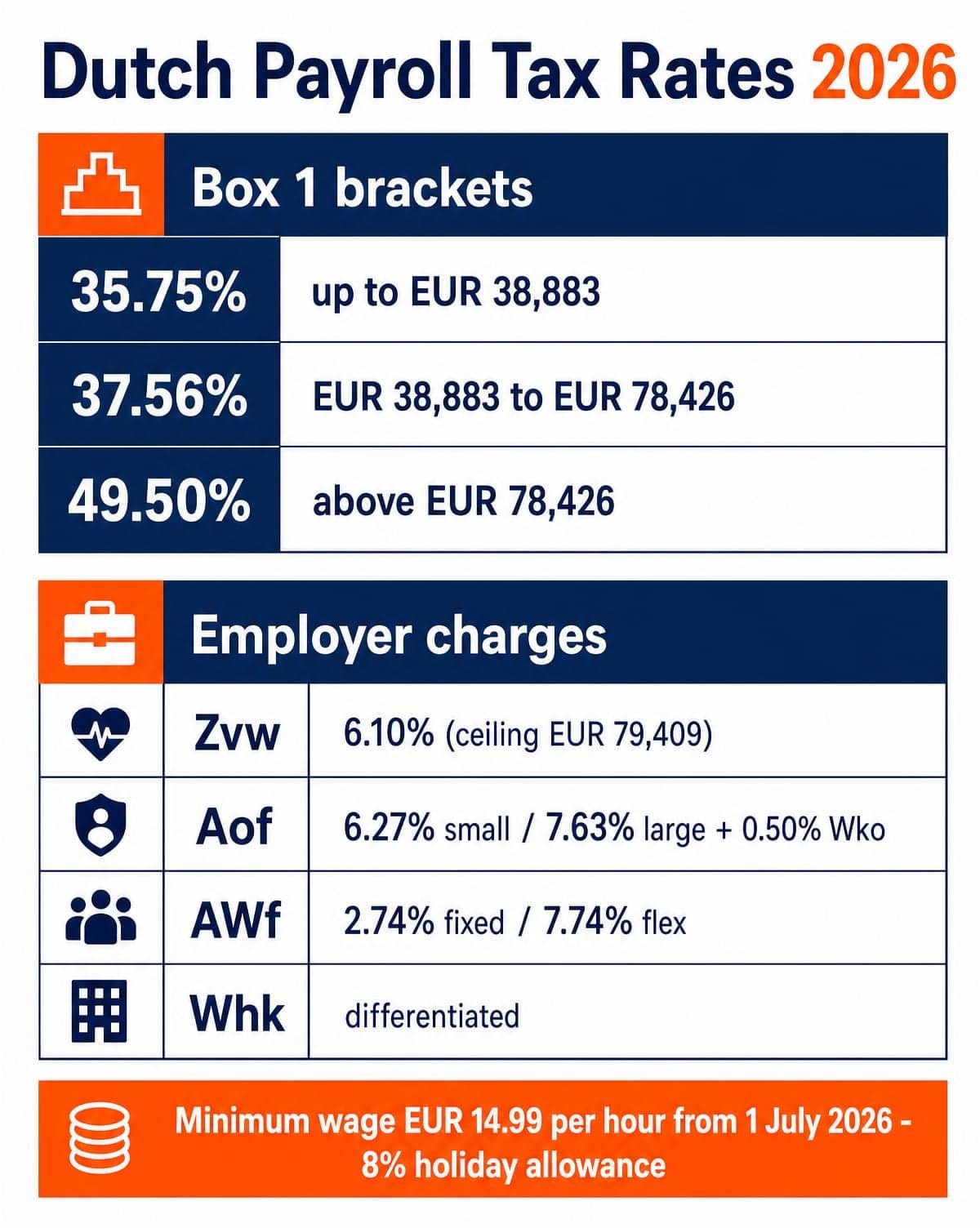
- Bracket 1: 35.75% on taxable income up to and including €38,883.
- Bracket 2: 37.56% on taxable income between €38,883 and €78,426.
- Bracket 3: a top marginal rate of 49.50% on all taxable income above €78,426.
When calculating Dutch payroll tax rates, remember that the first-bracket percentage represents the combined total of wage tax and national insurance contributions. The jump into Bracket 3 is particularly significant for high-earning professionals and skilled migrants. Accurate bracket placement, combined with the general tax credit and the labour tax credit, determines an employee's net salary.
Calculating Rates for 2026
The composition of the rates changes as income rises. In Bracket 1, the 35.75% rate consists of 8.10% wage tax plus 27.65% national insurance contributions (17.90% AOW, 0.10% Anw, 9.65% Wlz). These contributions are levied only over income in the first bracket: once an employee's income passes €38,883, no further national insurance is due. In Brackets 2 and 3, the withheld amount consists entirely of wage tax. This explains why the step from Bracket 1 (35.75%) to Bracket 2 (37.56%) is relatively small: the national insurance component drops away and only a higher pure tax rate remains.
Special Rates and the State Pension Age
Dutch payroll tax rates change significantly once an employee reaches the statutory state pension age. These individuals no longer pay AOW contributions, which reduces their Bracket 1 rate to 17.85%. They remain liable for Anw and Wlz. For employees born in 1945 or earlier, an extended first bracket up to €41,123 applies. This demographic distinction requires precise payroll software configuration for 2026 to avoid over-withholding. Managing these calculations manually often leads to errors; many international firms find that a professional Dutch payroll administration partner ensures every bracket is applied with absolute precision.
Employer-Paid Social Security and Contributions
Understanding your total cost of employment requires looking beyond the gross salary offered to a candidate. In the Netherlands, the "employer markup" represents a significant commitment on top of base pay. Depending on sector and contract type, mandatory employer premiums alone typically amount to roughly 16-20% of the gross wage (up to the premium ceiling); once the statutory 8% holiday allowance and any pension obligations are included, the total employment cost commonly lands 25-30% above the base gross salary. While the employee sees Dutch payroll tax rates reflected as deductions on their payslip, these employer-paid premiums are separate liabilities that you remit to the Belastingdienst.
The Healthcare Insurance Act (Zvw) is a primary component of this overhead. For 2026, the employer levy is 6.10% of the gross wage, subject to a maximum contribution base of €79,409 per year. Salary above this ceiling is exempt from Zvw. This employer levy is distinct from the private health insurance premiums employees pay themselves; it is a collective employer contribution to the national healthcare system.
You also need to manage the Work Disability Fund (Aof), which uses differentiated rates by employer size. For 2026, small employers pay 6.27% and medium/large employers 7.63% (plus a 0.50% childcare surcharge, the Opslag Wko, payable by all employers). Your classification depends on your total premium wage bill two years earlier: for 2026, a small employer is one whose 2024 premium wage bill did not exceed €1,082,500 (25 times the average premium wage of €43,300); above €4,330,000 you are a large employer. Precise classification is necessary to apply the correct rates in each monthly filing cycle.
In addition, every employer pays a differentiated Return-to-Work Fund premium (Whk), covering WGA and ZW-flex risk. For small employers this follows fixed sector rates, which vary widely, from under 1% in low-risk sectors to 6.63% for temporary employment agencies (sector 52) in 2026, while medium and large employers receive an individually differentiated rate by decision of the Belastingdienst. For any staffing, payroll or EOR structure, the Whk premium is a material cost line that must not be overlooked.
Differentiated AWf Rates for 2026
The General Unemployment Fund (AWf) uses a two-tier system to encourage stable employment. For 2026, the low AWf rate of 2.74% applies to written indefinite contracts with fixed hours; the high rate of 7.74%, 5 percentage points above the low rate, applies to flexible and fixed-term contracts. This financial incentive is a core part of Dutch labour market policy, designed to reduce reliance on flexible arrangements. Employers must ensure the contract type is correctly registered in the payroll system; retroactive corrections apply, for example, when an "indefinite" employee leaves within short-tenure conditions defined by law.
The 8% Holiday Allowance Requirement
Beyond social security, the most significant additional cost is the statutory holiday allowance. You're legally required to pay at least 8% of the gross wage earned in the reference year as holiday allowance. Most Dutch companies pay this as a lump sum in May or June, though it must accrue monthly on your balance sheet from the first day of employment. For employees earning more than three times the statutory minimum wage, deviating arrangements may be agreed in writing over the excess. Failure to pay on time can lead to claims including the statutory increase (wettelijke verhoging) of up to 50% plus interest.
The Statutory Minimum Wage in 2026
The Netherlands works exclusively with a statutory minimum hourly wage, indexed twice a year. From 1 January 2026 the rate for employees aged 21 and over was €14.71 gross per hour; from 1 July 2026 it is €14.99 gross per hour. Lower age-based rates apply to employees aged 15-20, and separate rates apply to BBL apprentices. These amounts exclude the 8% holiday allowance. Note that a collective labour agreement (CAO) may set higher wage floors than the statutory minimum, so always check the applicable CAO. Ensure all contracts at or near the wage floor were adjusted per 1 July 2026 to avoid underpayment claims and enforcement action by the Netherlands Labour Authority, as set out in our 2026 employment law guide.
Reducing Effective Tax Rates with the 30% Ruling
The 30% ruling, officially the expat scheme (expatregeling), is a specialized tax facility designed to attract international talent to the Netherlands. It allows employers to designate up to 30% of an employee's wage as a tax-free allowance for extraterritorial costs, without proof of actual expenses. This facility significantly lowers the effective Dutch payroll tax rates applied to a professional's income. For the 2026 fiscal year, the standard salary norm requires a minimum taxable salary of €48,013 after the 30% deduction is applied, meaning the total gross package must be high enough that the remaining taxable 70% meets this threshold. The ruling may be applied for a maximum of 5 years.
Two limits deserve special attention in 2026:
- The salary cap. The tax-free allowance may only be calculated over salary up to the WNT norm, which is €262,000 for 2026 (a maximum tax-free reimbursement of €78,600). As of 1 January 2026, this cap also applies to employees who were using the ruling before 2023, as the transitional exemption has ended.
- The 2027 changes. From 1 January 2027, the maximum tax-free percentage drops from 30% to 27% for employees who first started using the ruling on or after 1 January 2024, and the salary norms increase (to €50,436 and €38,338 at 2024 price levels, indexed annually). Employees who were already using the ruling before 1 January 2024 keep the full 30% for their remaining term under transitional law. Employers should model 2027 compensation packages now.
Note that the 30% ruling is a tax facility and stands apart from immigration law: eligibility does not depend on holding a residence permit, and EU/EEA nationals can qualify. Where non-EU highly skilled migrants are involved, the employing entity must be a recognised sponsor with the IND (or the employment must be structured through one); the IND's 2026 salary thresholds for highly skilled migrants apply separately from the tax norms.
Eligibility Criteria for 2026
To qualify, the employee must meet criteria set by law. The individual must be recruited from abroad and must have lived more than 150 kilometres from the Dutch border for more than 16 of the 24 months preceding the first working day in the Netherlands. This rule effectively excludes candidates from Belgium, Luxembourg and adjacent parts of Germany and France.
The employee must possess expertise that is scarce on the Dutch labour market; the salary norm serves as the primary test of this specific expertise. Professionals under 30 holding a qualifying master's degree benefit from a lower taxable salary threshold of €36,497 for 2026. The salary norm must be met continuously: if the taxable wage drops below it, the ruling lapses. You and the employee jointly apply for a decision (beschikking) from the Belastingdienst; if the request is filed within 4 months of the first working day, the ruling applies retroactively from the start of employment. File later, and it only applies from the first day of the month following the month of application.
The Impact on Total Employment Cost
The 30% ruling remains the most effective way to optimize Dutch payroll costs for international hires. In sectors like tech and finance, the high headline Dutch payroll tax rates can deter global experts. By applying the ruling, you deliver a significantly higher net take-home pay while your employer-paid contributions remain broadly stable. This makes your offers more competitive in the global market. If you're looking to hire international talent without the administrative burden, you can request a tailored 30% ruling application quote to streamline the process.
Managing Dutch Payroll Compliance with ICSPayroll
Managing international teams involves navigating a dense regulatory environment where errors lead to significant financial liabilities. ICSPayroll provides a "zero compliance hassle" solution designed for foreign employers who prioritize reliability. We handle 2026 wage tax filings, social security payments, and pension administration, including mandatory sector pension participation where applicable, such as the StiPP scheme for the staffing sector, with clinical precision. By consolidating these obligations into a single monthly invoice, we remove the administrative weight from your internal HR teams.
Our technology-driven approach ensures that you retain full control over your workforce data. Through our secure online portal, both employers and employees can manage payslips and labour contracts in real time. We ensure every deduction and employer contribution remains consistent with the latest Dutch payroll tax rates and labour law reforms, including sick pay, under which the employer must continue paying at least 70% of wages for up to 104 weeks of illness, with the statutory minimum wage as the floor during the first 52 weeks.
Employer of Record (EOR) vs. Payroll Administration
Choosing the right service model depends on your corporate structure. Our Employer of Record (EOR) service allows you to hire local or international talent without establishing a Dutch BV, often the most efficient route for rapid market entry. Our payroll administration service is ideal for organizations that already have a registered legal entity and require expert oversight of their monthly cycles.
Employers using an EOR or staffing construction should also prepare for the Wtta (Wet toelating terbeschikkingstelling van arbeidskrachten). This admission regime for labour providers, including payroll and EOR providers, enters into force on 1 January 2027, with full enforcement by the Netherlands Labour Authority from 1 January 2028. Existing providers with an SNA registration can use the transitional route by registering between 1 November 2026 and 1 January 2027. From 2028, clients may only work with admitted providers listed in the public register, making your provider's admission status a direct compliance issue for you as a client.
Expert Guidance from Joost Hubregtse
Our operations are led by Joost Hubregtse, Payroll Director, who ensures every calculation adheres to our central 2026 Fact Sheet, updated at each statutory indexation moment (1 January and 1 July). This oversight is essential for managing complex variables like the 30% ruling, the Whk sector premium, and the retention mandates. We provide tailored quotations within 24 hours to assist with your financial planning. Contact us today to ensure your outsourced Dutch payroll strategy is fully compliant with the 2026, and upcoming 2027, regulatory landscape. We handle the technical details. You scale your business.
Securing Your 2026 Compliance Strategy
Mastering the 2026 fiscal landscape requires a proactive approach to indexation and administrative precision. You now have a clear understanding of how the 2026 Box 1 brackets (35.75% / 37.56% / 49.50%) and employer contributions impact your total cost of employment. Leveraging the 30% ruling remains the most effective method to optimize Dutch payroll tax rates while attracting top-tier international talent. By meeting the €48,013 taxable salary threshold, respecting the €262,000 cap, retaining payroll records for the statutory periods, and paying at least €14.99 per hour from 1 July 2026, your organization maintains a robust legal standing, and by planning now for the 27% regime and the Wtta, you stay ahead of 2027.
ICSPayroll acts as your local expert in the Netherlands. We remove the administrative burden through transparent monthly invoicing and expert support for 30% ruling applications. Immigration sponsorship for highly skilled migrants is arranged in full compliance with IND recognised-sponsor requirements. You can get a tailored Dutch payroll quotation within 24 hours to finalize your expansion budget.
This article provides general information, current as at July 2026, and does not constitute tax or legal advice for a specific case.
Frequently Asked Questions
What are the Dutch payroll tax brackets for 2026?
The 2026 Box 1 system has three progressive tiers for individuals below state pension age. The first bracket applies a combined rate of 35.75% (8.10% wage tax plus 27.65% national insurance) on taxable income up to €38,883. The second bracket covers income from €38,883 to €78,426 at 37.56%. Taxable income above €78,426 is subject to the top marginal rate of 49.50%. The thresholds are indexed annually.
How much is the employer-paid healthcare contribution (Zvw) in 2026?
Employers pay a 6.10% levy under the Healthcare Insurance Act (Zvw) in 2026, calculated on the employee's gross wage up to a maximum contribution base of €79,409 per year. Income above this ceiling is exempt from further Zvw levy, allowing precise forecasting of employment costs for high earners.
What is the minimum wage in the Netherlands for 2026?
The statutory minimum hourly wage for employees aged 21 and over is €14.99 gross per hour from 1 July 2026 (it was €14.71 from 1 January to 30 June 2026). Lower rates apply to employees aged 15-20 and to BBL apprentices. These figures exclude the mandatory 8% holiday allowance. A CAO may set higher wage floors; the statutory rate is a minimum, adjusted every 1 January and 1 July.
How does the 30% ruling affect payroll tax calculations?
The 30% ruling functions as a tax-free reimbursement for extraterritorial costs incurred by employees recruited from abroad. It allows you to pay up to 30% of the wage tax-free, provided all eligibility criteria are met, subject to the salary norm (€48,013 in 2026) and a cap of €262,000 in eligible salary. From 1 January 2027 the percentage drops to 27% for employees who started using the ruling on or after 1 January 2024, and the salary norms increase.
Are there penalties for late wage tax filings in the Netherlands?
Yes. The Belastingdienst enforces penalties for late payroll tax returns and payments. You must submit your loonaangifte and ensure funds reach the tax office by the last day of the month following the reporting period, so May's obligations must be settled by 30 June. Late filing triggers a default penalty; late payment results in a payment penalty plus interest.
Do foreign companies need a Dutch bank account to pay payroll taxes?
No, payments can be made via the SEPA network. However, the Belastingdienst requires specific payment references that some international banking interfaces format incorrectly. Most international businesses use a Dutch payroll administration partner to handle these transactional logistics and ensure payments are correctly identified within the monthly deadlines.
What is the 2026 salary requirement for the 30% ruling?
For 2026, the standard taxable salary norm is €48,013, the taxable portion remaining after the tax-free allowance is applied. Professionals under 30 holding a qualifying master's degree benefit from a reduced threshold of €36,497. The employee's taxable salary must remain above the applicable threshold throughout the entire term of the ruling; from 2027 the norms increase for new-regime cases.
How long must I keep payroll records in the Netherlands?
The basic records of your payroll administration fall under the fiscal retention obligation of 7 years. In addition, the wage tax data statement and a clear copy of the employee's identity document must be retained for at least 5 calendar years after the end of the calendar year in which the employment ended. Records must remain accessible for retrospective audits by the Belastingdienst or UWV; gaps can lead to a reversal of the burden of proof during an inspection.
Sources and references
Every rule and figure above is traceable to the sources below: the exact statutory articles, the regulator pages that publish the amounts, the statistical datasets, and the specific court rulings that settle the point. Always check the current text for your own situation.
- Article 31a Wage Tax Act 1964, extraterritorial costs and the 30% ruling (now capped at 27%)
- Article 20a Wage Tax Act 1964, the wage tax bracket rates
- Article 52 General Tax Act, the 7-year payroll record-keeping obligation
- Belastingdienst, payroll tax tables 2026 (white and green tables with the actual withholding percentages)
- Belastingdienst, low and high AWf unemployment contribution rates and when each applies
- Belastingdienst, filing the payroll tax return (aangifte loonheffingen) and its deadlines
- CBS, Compensation of employees and employment by economic activity (national accounts dataset 84165ENG)
- CBS StatLine, the open statistical database behind the wage and employment figures cited here
- Supreme Court 18 February 2022, ECLI:NL:HR:2022:282: qualification of a management agreement and the resulting employee insurance contribution liability
- Supreme Court 13 February 2026, ECLI:NL:HR:2026:247: art. 31a Wage Tax Act and the transitional rules on shortening the 30% ruling

Article by
Joost Hubregtse
Joost Hubregtse is Director of ICS Staffing & Payroll B.V., the wholly owned subsidiary of Intercompany Solutions behind ICS Payroll. He is responsible for Employer of Record and Dutch payroll services: employment contracts, wage tax and social security filings, holiday allowance, pension, sick leave and CAO compliance, with onboarding possible within 48 hours.

Frequently Asked Questions
The 2026 Box 1 system has three progressive tiers for individuals below state pension age. The first bracket applies a combined rate of 35.75% (8.10% wage tax plus 27.65% national insurance) on taxable income up to €38,883. The second bracket covers income from €38,883 to €78,426 at 37.56%. Taxable income above €78,426 is subject to the top marginal rate of 49.50%. The thresholds are indexed annually.
Employers pay a 6.10% levy under the Healthcare Insurance Act (Zvw) in 2026, calculated on the employee's gross wage up to a maximum contribution base of €79,409 per year. Income above this ceiling is exempt from further Zvw levy, allowing precise forecasting of employment costs for high earners.
The statutory minimum hourly wage for employees aged 21 and over is €14.99 gross per hour from 1 July 2026 (it was €14.71 from 1 January to 30 June 2026). Lower rates apply to employees aged 15-20 and to BBL apprentices. These figures exclude the mandatory 8% holiday allowance. A CAO may set higher wage floors; the statutory rate is a minimum, adjusted every 1 January and 1 July.
The 30% ruling functions as a tax-free reimbursement for extraterritorial costs incurred by employees recruited from abroad. It allows you to pay up to 30% of the wage tax-free, provided all eligibility criteria are met, subject to the salary norm (€48,013 in 2026) and a cap of €262,000 in eligible salary. From 1 January 2027 the percentage drops to 27% for employees who started using the ruling on or after 1 January 2024, and the salary norms increase.
Yes. The Belastingdienst enforces penalties for late payroll tax returns and payments. You must submit your loonaangifte and ensure funds reach the tax office by the last day of the month following the reporting period, so May's obligations must be settled by 30 June. Late filing triggers a default penalty; late payment results in a payment penalty plus interest.
No, payments can be made via the SEPA network. However, the Belastingdienst requires specific payment references that some international banking interfaces format incorrectly. Most international businesses use a Dutch payroll administration partner to handle these transactional logistics and ensure payments are correctly identified within the monthly deadlines.
For 2026, the standard taxable salary norm is €48,013, the taxable portion remaining after the tax-free allowance is applied. Professionals under 30 holding a qualifying master's degree benefit from a reduced threshold of €36,497. The employee's taxable salary must remain above the applicable threshold throughout the entire term of the ruling; from 2027 the norms increase for new-regime cases.
The basic records of your payroll administration fall under the fiscal retention obligation of 7 years. In addition, the wage tax data statement and a clear copy of the employee's identity document must be retained for at least 5 calendar years after the end of the calendar year in which the employment ended. Records must remain accessible for retrospective audits by the Belastingdienst or UWV; gaps can lead to a reversal of the burden of proof during an inspection.