Outsource Payroll in the Netherlands: The 2026 Setup and Compliance Template
By Joost Hubregtse, Director, ICS Staffing & Payroll
All blog posts are reviewed and fact checked by our labour law lawyer Zishan Hussain and our director. Editorial standards
The Dutch labor market in 2026 presents a high-stakes environment where minor administrative errors often lead to severe financial repercussions. For international employers, the decision to outsource payroll in the Netherlands is no longer just about convenience; it's a strategic way to manage the strict 2026 salary norms and the complexities of the Ketenregeling. Managing these legal requirements from abroad often results in excessive overhead and significant risk to your reputation with the Belastingdienst.
You likely understand that compliance is non-negotiable, yet the evolving 30% ruling (officially the "expatregeling") and shifting tax percentages can feel like a moving target. This guide provides an authoritative 2026 setup template designed to bring your operations into full alignment within weeks. We'll examine the specific 2026 requirements, including the €48,013 taxable salary norm for the 30% ruling and the €14.99 statutory hourly minimum wage that applies since 1 July 2026. This template ensures accurate applications for your expats and provides a clear roadmap for zero-hassle monthly tax filings.
Key Takeaways
- Learn why outsourcing payroll in the Netherlands provides a secure bridge for managing complex local regulations without a Dutch BV.
- Apply the 2026 30% ruling criteria accurately by verifying that the taxable salary, after the tax-free allowance is applied, meets the €48,013 norm (€36,497 for employees under 30 with a qualifying master's degree). Note that this tax norm is separate from the IND salary thresholds for highly skilled migrants, which in 2026 are €5,942 gross per month (age 30 and over) and €4,357 (under 30), excluding holiday allowance.
- Navigate the Ketenregeling by adhering to the limit of three fixed-term contracts within a maximum period of 36 months.
- Reduce administrative overhead through a single invoice model that covers Dutch taxes, insurance, and social security contributions.
- Ensure data integrity by following a structured verification process for the Burgerservicenummer (BSN) and identification documents.
The Complexity of Netherlands Payroll Setup in 2026
Becoming an employer in the Netherlands transforms your organization into a withholding agent (inhoudingsplichtige). This status requires you to deduct wage tax and social contributions directly from employee wages. The Dutch tax system is rigorous, demanding absolute precision in these calculations to avoid audit triggers. Many international firms choose to outsource payroll in the Netherlands to mitigate the risk of administrative errors during this transition. You don't need a local Dutch BV to establish this setup; foreign entities can register as employers directly with the tax authorities. Payroll administration records must generally be retained for seven years; copies of identification documents and wage tax statements (loonbelastingverklaringen) must be kept for at least five years after the end of the calendar year in which the employment ended. This ensures you're prepared for any retroactive inspections by the authorities.
The 2026 Minimum Wage and Statutory Costs
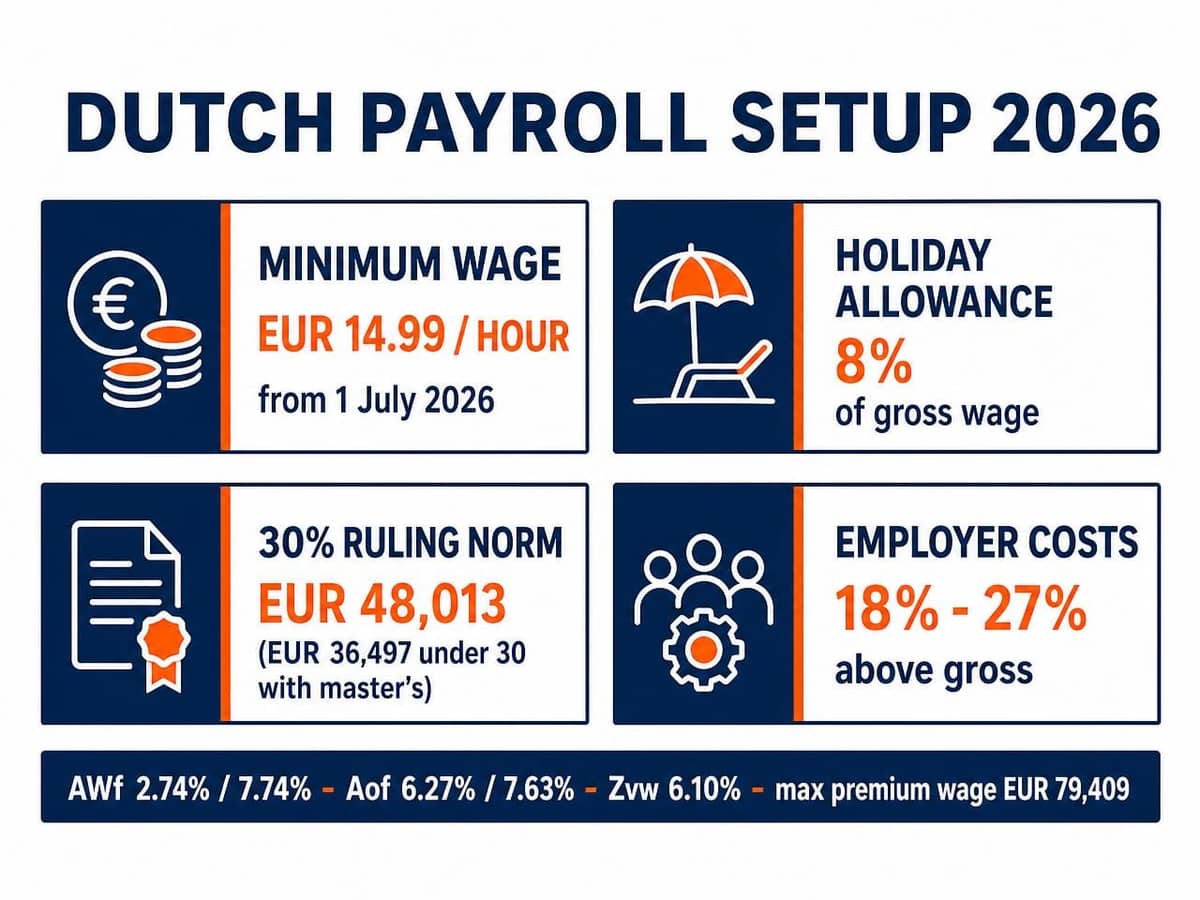
As of 1 July 2026, the statutory minimum wage for employees aged 21 and over is €14.99 gross per hour (it was €14.71 from 1 January to 30 June 2026). Since the introduction of the statutory minimum hourly wage in 2024, there are no longer fixed minimum day, week, or month amounts: pay depends on hours actually worked, which ensures pay equity across 36-, 38-, and 40-hour work weeks. Lower youth rates apply to employees under 21. Beyond the base salary, you're legally required to provide a holiday allowance (vakantiegeld) of at least 8% of gross wages, typically paid in May or June.
Employer costs also include mandatory contributions. For 2026: the AWf (unemployment) premium is 2.74% for permanent written contracts with fixed hours and 7.74% for flexible contracts; the Aof (disability) premium is 6.27% for small employers and 7.63% for medium and large employers; and the employer's Zvw (healthcare) levy is 6.10%. These premiums are calculated over the wage up to the maximum premium wage, which is €79,409 for 2026. On top of these come the differentiated Whk premium (WGA and Ziektewet) and a 0.50% childcare surcharge, so contributions represent a significant portion of total labor cost.
Withholding Agent Obligations
Registering with the Belastingdienst to obtain a payroll tax number is the foundation of your compliance. Once registered, you must submit a wage tax return (loonaangifte) for every pay period. Both the filing and the corresponding payment are due by the deadline stated in your tax return letter, for monthly filers generally the last day of the month following the pay period. Missing these deadlines leads to fines.
It's also vital to ensure your contract structures align with Dutch rules on worker classification, as set out in our guide to employment law in the Netherlands for foreign employers. Since 1 January 2025, the Belastingdienst has resumed full enforcement of the rules against false self-employment under the Wet DBA, meaning misclassifying contractors as employees carries real financial risk, including retroactive payroll tax assessments. The proposed VBAR legislation, which would further clarify the assessment of working relationships, is still pending in Parliament and is not yet law, but enforcement under the existing framework is already active, so classification discipline cannot wait. Even if you have no active payments in a specific month, you must still file a zero return to maintain your standing.
Key Pillars of a Compliant Dutch Payroll System
Compliance in the Netherlands requires a deep understanding of the Ketenregeling and the mandatory transition allowance. The Ketenregeling limits a sequence of fixed-term contracts to a maximum of three agreements within a total duration of 36 months (with breaks of six months or less counting toward the chain). Exceeding either limit automatically converts the arrangement into an indefinite contract, unless a collective agreement provides otherwise. Additionally, the transition allowance (transitievergoeding) accrues from the very first day of employment at one-third of a gross monthly salary per year of service. For 2026, this payment is capped at €102,000 gross, or one annual salary if that is higher. Understanding these costs is critical when you outsource payroll in the Netherlands, as local experts integrate these accruals into your monthly financial forecasting. Beyond statutory taxes, certain industries require contributions to sector-specific pension funds, such as StiPP for personnel services, which must be calculated with absolute accuracy.
The 30% Ruling: 2026 Salary Standards
The 30% ruling, officially renamed the expatregeling, remains a vital tool for attracting international talent, but the 2026 norms are strict. To qualify, an employee's taxable salary must be at least €48,013 after the tax-free allowance is applied. For employees under 30 who hold a qualifying (verified) academic master's degree, a reduced norm of €36,497 applies; certain scientific researchers are exempt from the salary norm entirely. If the taxable salary falls below the norm, for instance due to unpaid leave or part-time work, the benefit must be reduced or is lost. The tax-free allowance is also capped: it may only be calculated over salary up to the WNT norm, which is €262,000 for 2026.
Two further points deserve attention. First, the 30% ruling salary norm should not be confused with the IND salary thresholds for a highly skilled migrant residence permit, which are set separately and amount to €5,942 gross per month (30 and over) and €4,357 (under 30) in 2026, excluding holiday allowance. An employee can meet one threshold and fail the other. Second, plan ahead: from 1 January 2027 the ruling becomes a flat 27% and the salary norms rise substantially (to at least €50,436 and €38,338 respectively) for employees who first applied the ruling in 2024 or later; transitional rules protect employees who already used the ruling in 2023. Immigration sponsorship is arranged via our licensed partner to ensure full compliance with IND standards. If you need assistance with these calculations, you can request a tailored quotation within 24 hours.
Employment Contract Compliance
Standard employment contracts must reflect current legal standards on probation and restrictive covenants. For indefinite contracts and fixed-term contracts of two years or longer, the maximum probation period is two months. Fixed-term contracts of more than six months but shorter than two years are limited to a one-month probation. No probation period is allowed for contracts of six months or less. Every contract should clearly reflect the statutory holiday allowance of at least 8%.
On non-compete clauses, the current law (Article 7:653 of the Dutch Civil Code) is as follows: a non-compete clause must be agreed in writing with an adult employee, and in fixed-term contracts it is only valid if the employer includes a written justification showing compelling business interests. For indefinite contracts, no written justification is currently required by statute, though courts increasingly scrutinize broad clauses and can annul or limit them. Be aware that the government is preparing the Wet modernisering concurrentiebeding, a bill that would cap non-competes at twelve months, require written motivation and a defined geographical scope for all contracts, and oblige employers to pay compensation when invoking the clause. This bill was sent to the Council of State in mid-2026 and has not yet been submitted to Parliament: it is not yet law, but future-proof contract drafting should anticipate it. Using a localized, regularly updated template ensures these mandates are met without the burden of manual legal reviews.
Outsource Payroll in the Netherlands: Evaluating Your Strategy
Selecting a partner to outsource payroll in the Netherlands requires a critical look at the operational structure of the provider. Many global payroll firms operate as aggregators. They pass your data to a third-party local provider while adding a layer of management fees. This often results in "shadow payroll," where the global entity lacks direct access to the Dutch Tax and Customs Administration. A local specialist provides a direct link to Dutch payroll tax practice. This ensures every filing is handled by professionals who understand the nuances of the 2026 tax environment.
Local Specialists vs. Global Aggregators
Local expertise is vital for managing the 30% ruling. Global firms often overlook the 2026 taxable salary requirement of €48,013, or confuse it with the separate IND salary thresholds, leading to rejected applications and dissatisfied employees. By utilizing Employer of Record services in the Netherlands, international companies hire staff without incorporating a local entity. It's a common misconception that a local BV is required for compliance. An EOR model allows you to operate legally while all statutory obligations are managed locally. Immigration sponsorship is arranged via our licensed partner, providing a secure path for highly skilled migrants without the administrative burden on your home office.
Cost Management and Transparency
True cost management depends on understanding the Total Cost of Employment. In the Dutch market, employer costs typically range from roughly 18% to 27% above gross salary, depending on company size, contract type, and sector. A compliant strategy utilizes a "One Invoice" model, consolidating social security, pension contributions, and insurances into a single monthly transaction. This transparency prevents hidden fees often found in multi-country contracts. Evaluating service speed is equally important. A 24-hour turnaround for tailored quotations keeps your hiring timeline on track, and for recognized sponsors the IND aims to decide highly skilled migrant applications within about two weeks, with the full process typically completed within two to three weeks. Clear, upfront pricing allows you to forecast labor costs with precision.
2026 Payroll Setup Template: A Step-by-Step Guide
Implementation requires a chronological approach to satisfy the strict requirements of the Dutch Tax and Customs Administration. Choosing to outsource payroll in the Netherlands allows you to implement this template without internal administrative strain.
- Step 1: Collect employee data and verify identity using original identification documents; record the Burgerservicenummer (BSN) once available.
- Step 2: Draft a contract that complies with Dutch employment law for foreign employers, including the statutory 8% holiday allowance and correct probation and chain-rule terms.
- Step 3: Register as an employer with the Belastingdienst and enroll in any mandatory sector pension fund.
- Step 4: Submit the 30% ruling (expatregeling) application for eligible employees meeting the 2026 taxable salary norm, ideally within four months of the start of employment so the ruling applies retroactively from day one.
- Step 5: Execute the monthly payroll run and distribute digital payslips through a secure, GDPR-compliant portal.
Onboarding and Data Verification
Your onboarding process must include collection of the wage tax statement (loonbelastingverklaring or the employee's payroll data form), which determines the correct application of tax credits. You're required to keep your payroll administration for seven years, and copies of identification and wage tax statements for at least five years after the end of the year in which employment ended; signed employment agreements should be archived alongside these. For non-EU staff, immigration sponsorship is arranged via our licensed partner, ensuring highly skilled migrant status is verified and maintained throughout the employment term, including the ongoing requirement that the salary remains at market level and meets the applicable IND threshold. Accurate data entry at this stage prevents retroactive tax corrections that often trigger audits.
The Monthly Payroll Cycle
The monthly cycle involves calculating gross-to-net payments based on at least the statutory minimum wage, €14.99 per hour since 1 July 2026, and any higher sectoral (CAO) minimums that apply. You must account for the 8% holiday allowance accrual in every pay period. Once calculations are finalized, you submit the loonaangifte to the tax office, with return and payment due by the deadline in your tax return letter, generally the last day of the following month. Managing sickness risk is a critical component of the Dutch system: employers must pay at least 70% of the employee's salary (capped at the maximum daily wage) for up to two years of sickness, and in the first year this may not fall below the statutory minimum wage. Many CAOs require more, commonly 100% in the first year. You can secure your compliance today by partnering with a local specialist to manage these recurring obligations.
Why ICSPayroll is Your Partner for Dutch Compliance
ICSPayroll operates as the protective guardian for your Dutch operations. When you outsource payroll in the Netherlands, you gain a partner that functions as a direct bridge to local authorities. Our team manages the entire administrative lifecycle, from drafting compliant contracts to handling monthly tax filings. This eliminates the high overhead typically associated with managing foreign labor laws from a distance. We specialize in supporting tech startups and established international firms that require rapid market entry without local entity incorporation. Expert oversight is provided by Joost Hubregtse, our Payroll Director, ensuring every calculation adheres to the figures officially published for 2026.
Speed and Reliability
We understand that business momentum depends on rapid onboarding. You'll receive a tailored quotation for your Dutch team within 24 hours of your initial inquiry. If your strategy involves hiring non-EU talent, immigration sponsorship is arranged via our licensed partner; through the recognized sponsor route, highly skilled migrant approvals are typically obtained within two to three weeks. Our process is methodical, prioritizing speed while maintaining the meticulousness Dutch immigration authorities require.
Our Technology and Support
Transparency is a core value of our service. Your employees gain access to a secure online portal for viewing digital payslips, managing contracts, and tracking holiday allowance. This centralized system simplifies HR administration and ensures all records are stored for the applicable statutory retention periods. We provide dedicated support for the 30% ruling, verifying that your expats meet the 2026 taxable salary norm of €48,013 and preparing them for the 2027 changes. You won't deal with automated ticketing systems or faceless aggregators: you have direct communication with our specialists. Our model also helps international firms manage Permanent Establishment risk: operating through compliant local employment structures reduces the chance that a foreign company's activities in the Netherlands are deemed to create a taxable presence here.
Secure Your Dutch Market Entry with Expert Payroll Compliance
Managing the 2026 Dutch labor landscape requires more than administrative software; it demands a current understanding of tax norms, contract law, and the legislative pipeline. When you outsource payroll in the Netherlands, your organization bypasses the risks associated with the Ketenregeling, the €48,013 salary norm for the 30% ruling, and the resumed enforcement against false self-employment. You've now seen the template for success, from identity verification to the final distribution of digital payslips. Take the first step toward a simplified, secure payroll infrastructure today.
Get a Tailored Dutch Payroll Quotation Within 24 Hours and focus on your core growth while we handle the local complexity.
Frequently Asked Questions
How long does it take to set up payroll in the Netherlands?
Setting up a compliant payroll system typically takes two to four weeks, with the timeline driven primarily by obtaining a payroll tax number from the Belastingdienst. Outsourcing expedites this through established registration channels. For companies hiring highly skilled migrants via a recognized sponsor, the IND aims to decide within about two weeks, with the overall process typically completed within two to three weeks.
What is the minimum wage in the Netherlands for 2026?
The statutory minimum wage since 1 July 2026 is €14.99 gross per hour for employees aged 21 and over (€14.71 applied from 1 January to 30 June 2026). The rate is adjusted semi-annually on 1 January and 1 July. Lower youth rates apply under 21, and your CAO may prescribe a higher minimum.
What are the employer costs for payroll in the Netherlands?
Employer costs generally range from roughly 18% to 27% on top of gross salary. These include the AWf premium (2.74% low rate / 7.74% high rate), the Aof premium (6.27% for small employers / 7.63% for others), the 6.10% Zvw employer levy, the differentiated Whk premium, a 0.50% childcare surcharge, and the statutory 8% holiday allowance. Premiums are calculated up to the 2026 maximum premium wage of €79,409.
Can I hire in the Netherlands without a local legal entity?
Yes. Foreign companies can register directly as employers with the Dutch Tax and Customs Administration or use an Employer of Record. Note that employing staff locally can, depending on the nature of the activities, create a Permanent Establishment for corporate tax purposes, a risk that compliant local employment structures help you assess and manage.
How does the 30% ruling impact payroll setup?
The 30% ruling (expatregeling) allows eligible incoming employees to receive part of their salary as a tax-free allowance, provided their taxable salary, after the allowance, meets the 2026 norm of €48,013 (€36,497 for under-30s with a qualifying master's degree), with the allowance capped at salary up to €262,000. Applications must be precise, and employers should prepare now for the 27% regime and higher norms taking effect in 2027.
What is the mandatory holiday allowance in the Netherlands?
All employees are entitled to a holiday allowance of at least 8% of gross annual salary, typically accrued year-round and paid in May or June. It applies to fixed-term and part-time staff alike. Contracts and payslips should clearly reflect it.
What are the data retention requirements for Dutch payroll?
Your payroll and financial administration must be retained for seven years. Copies of identification documents and wage tax statements must be kept for at least five years after the end of the calendar year in which the employment ended. Failure to produce records during a Belastingdienst inspection can result in significant penalties.
How do I manage sick pay for Dutch employees?
Employers must pay at least 70% of a sick employee's salary (up to the maximum daily wage) for up to two years; in the first year this may not fall below the statutory minimum wage, and many CAOs require 100% in year one. This is a significant financial risk that many companies mitigate through absenteeism insurance. Strict adherence to the Gatekeeper Improvement Act (Wet verbetering poortwachter) is required to avoid UWV-imposed extended payment sanctions of up to one additional year.
Employers in the Netherlands are obligated to pay at least 70% of an employee's salary for up to two years of sickness. This represents a significant financial risk for international employers. Many companies mitigate this risk through specialized absenteeism insurance. Managing this process requires strict adherence to the Gatekeeper Improvement Act to ensure proper reintegration and to avoid extended payment penalties from the UWV.
Sources and references
Every rule and figure above is traceable to the sources below: the exact statutory articles, the regulator pages that publish the amounts, the statistical datasets, and the specific court rulings that settle the point. Always check the current text for your own situation.
- Article 7:692 Dutch Civil Code, the statutory definition of payrolling
- Article 7:690 Dutch Civil Code, the agency work (uitzend) contract
- Article 8 Waadi, equal pay for hired-in workers (loonverhoudingsnorm)
- Stichting Normering Arbeid, the NEN 4400-1 register of audited payroll and staffing companies
- Belastingdienst, low and high AWf unemployment contribution rates and when each applies
- Netherlands Labour Authority, enforcement, inspections and penalty policy
- CBS, Compensation of employees and employment by economic activity (national accounts dataset 84165ENG)
- Eurostat, hourly labour cost levels by NACE activity (dataset lc_lci_lev), for cross-country comparison
- Supreme Court 11 April 2025, ECLI:NL:HR:2025:543: the agency work contract of art. 7:690 BW in a triangular platform-work relationship
- Supreme Court 21 November 2025, ECLI:NL:HR:2025:1733: misuse of successive agency contracts under art. 5(5) Directive 2008/104/EC and the Waadi

Frequently Asked Questions
Setting up a compliant payroll system typically takes two to four weeks, with the timeline driven primarily by obtaining a payroll tax number from the Belastingdienst. Outsourcing expedites this through established registration channels. For companies hiring highly skilled migrants via a recognized sponsor, the IND aims to decide within about two weeks, with the overall process typically completed within two to three weeks.
The statutory minimum wage since 1 July 2026 is €14.99 gross per hour for employees aged 21 and over (€14.71 applied from 1 January to 30 June 2026). The rate is adjusted semi-annually on 1 January and 1 July. Lower youth rates apply under 21, and your CAO may prescribe a higher minimum.
Employer costs generally range from roughly 18% to 27% on top of gross salary. These include the AWf premium (2.74% low rate / 7.74% high rate), the Aof premium (6.27% for small employers / 7.63% for others), the 6.10% Zvw employer levy, the differentiated Whk premium, a 0.50% childcare surcharge, and the statutory 8% holiday allowance. Premiums are calculated up to the 2026 maximum premium wage of €79,409.
Yes. Foreign companies can register directly as employers with the Dutch Tax and Customs Administration or use an Employer of Record. Note that employing staff locally can, depending on the nature of the activities, create a Permanent Establishment for corporate tax purposes, a risk that compliant local employment structures help you assess and manage.
The 30% ruling (expatregeling) allows eligible incoming employees to receive part of their salary as a tax-free allowance, provided their taxable salary, after the allowance, meets the 2026 norm of €48,013 (€36,497 for under-30s with a qualifying master's degree), with the allowance capped at salary up to €262,000. Applications must be precise, and employers should prepare now for the 27% regime and higher norms taking effect in 2027.
All employees are entitled to a holiday allowance of at least 8% of gross annual salary, typically accrued year-round and paid in May or June. It applies to fixed-term and part-time staff alike. Contracts and payslips should clearly reflect it.
Your payroll and financial administration must be retained for seven years. Copies of identification documents and wage tax statements must be kept for at least five years after the end of the calendar year in which the employment ended. Failure to produce records during a Belastingdienst inspection can result in significant penalties.
Employers must pay at least 70% of a sick employee's salary (up to the maximum daily wage) for up to two years; in the first year this may not fall below the statutory minimum wage, and many CAOs require 100% in year one. This is a significant financial risk that many companies mitigate through absenteeism insurance. Strict adherence to the Gatekeeper Improvement Act (Wet verbetering poortwachter) is required to avoid UWV-imposed extended payment sanctions of up to one additional year.