
Netherlands Employee Benefits Requirements: The 2026 Employer Guide
By Joost Hubregtse, Director, ICS Staffing & Payroll
All blog posts are reviewed and fact checked by our labour law lawyer Zishan Hussain and our director. Editorial standards
The era of lenient enforcement for Dutch employment compliance ended on January 1, 2025; by 2026, international employers face a landscape where administrative oversight triggers immediate financial penalties. With the Tax Authority now issuing formal fines for freelancer misclassification and the 30% ruling undergoing structural shifts, the cost of an uninformed approach is unsustainable. You likely recognize the immense value of the Dutch talent pool, yet the complexity of local labor laws often creates a significant barrier to expansion.
This comprehensive guide provides total clarity on 2026 netherlands employee benefits requirements, ensuring your organization masters statutory compliance while maintaining a predictable cost model. We've consolidated the latest regulatory updates into a clear, actionable framework for your HR and finance teams. You'll gain a precise understanding of the mandatory 8% holiday allowance, the new €48,013 salary threshold for the 30% ruling, and the statutory minimum hourly wage increases scheduled for January and July. From transition payment caps to sick leave obligations, this guide serves as your definitive roadmap for secure and efficient hiring in the Netherlands.
Key Takeaways
- Identify the 2026 statutory minimum hourly wage requirements of EUR 14.71 to EUR 14.99 and the specific Ketenregeling limits for fixed-term employment contracts.
- Master the mandatory 8% holiday allowance and the updated EUR 48,013 salary threshold for the 30% ruling to satisfy all netherlands employee benefits requirements.
- Calculate employer obligations for national insurance premiums, including the 6.10% Zvw healthcare contribution and mandatory AOW pension contributions.
- Prepare for the extensive two-year sick leave salary continuation mandate and the associated reintegration responsibilities required by the Dutch Tax Authority.
- Streamline compliance by using an Employer of Record model to consolidate all statutory benefit costs into a single, predictable monthly invoice.
Statutory Minimums: Mandatory Wages and Working Conditions
The Dutch labor market operates on a foundation of strict statutory protections. Employers must understand that meeting netherlands employee benefits requirements is not optional. It's a legal prerequisite for operating within the jurisdiction. The most fundamental shift in recent years is the move away from monthly minimum salaries toward a mandatory statutory hourly wage. This ensures pay equity across different workweeks, regardless of whether your company uses a 36 or 40-hour standard.
Minimum Wage Standards for 2026
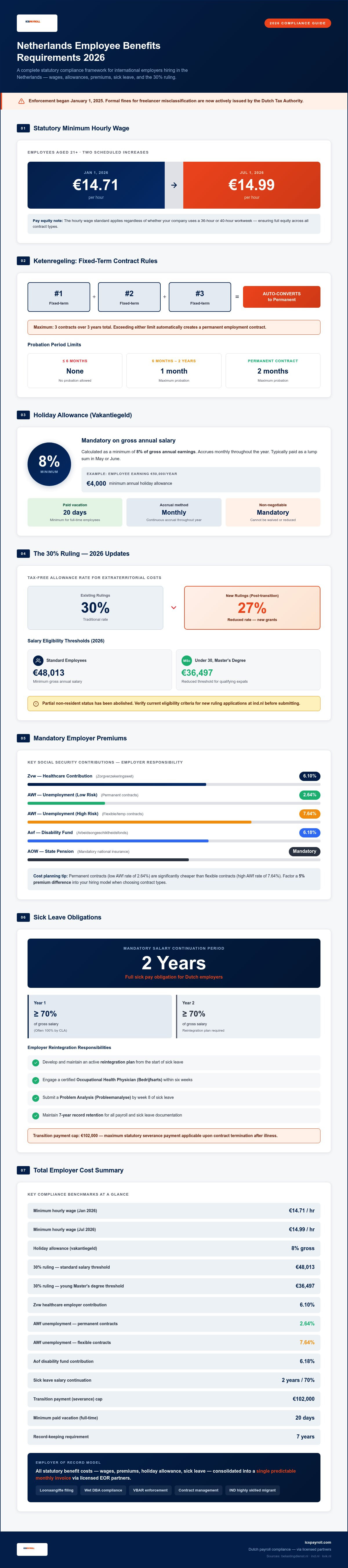
Effective January 1, 2026, the statutory minimum hourly wage for employees aged 21 and older is EUR 14.71. This rate is scheduled to increase to EUR 14.99 on July 1, 2026. These figures represent the absolute floor for compensation. You must ensure all gross salary calculations align with these benchmarks to avoid non-compliance penalties. Detailed guidelines on wage tax and employer obligations are available via the official belastingdienst.nl portal.
Managing these shifting rates requires administrative precision. ICSPayroll simplifies this by providing a consolidated monthly invoice. This covers all gross wages and employer premiums in a single document. This model provides a predictable cost structure for international firms. It's particularly vital when navigating the complex social security system in the Netherlands, which relies on accurate wage reporting for national insurance schemes.
Probation Periods and Contract Duration
The "Ketenregeling" regulates the sequence of employment contracts to prevent the perpetual use of temporary staff. You may offer a maximum of three fixed-term contracts over a total period of three years. If a fourth contract is issued or the three-year threshold is exceeded, the agreement automatically converts into a permanent contract. This is a critical component of the netherlands employee benefits requirements that protects employee stability.
Probation periods are strictly defined by law. For contracts longer than six months but shorter than two years, the probation period is capped at one month. Permanent contracts allow for a two-month probation period. Contracts of six months or less cannot legally include a probation clause. To ensure these conditions are met, ICSPayroll provides a standard employee handbook and manages all documentation via a dedicated online portal. This includes tracking the mandatory 20 days of paid vacation for full-time employees. By arranging these services through licensed partners, you ensure every contract adheres to the latest 2026 legal standards.
Financial Benefits: Holiday Allowance and the 30% Ruling
Dutch employment law mandates specific financial supplements that extend well beyond the base hourly wage. These netherlands employee benefits requirements are designed to provide employees with additional liquidity for leisure and to attract international expertise. Employers must budget for these costs with precision to avoid unexpected liabilities at the end of the fiscal year. Two primary pillars define this financial landscape: the statutory holiday allowance and the fiscal incentives for highly skilled migrants.
The holiday allowance, known locally as "vakantiegeld," is a non-negotiable requirement. It's calculated as a minimum of 8% of the employee's gross annual salary. While most organizations distribute this as a lump sum in May or June, the accrual happens monthly. This obligation is a significant factor in the total cost of employment. According to the OECD report on Dutch wage and benefit taxation, these mandatory contributions create a unique fiscal environment that requires careful administrative management.
The 2026 30% Ruling Landscape
The 30% ruling remains the most effective tool for recruiting international talent. It allows employers to provide a tax-free allowance for extraterritorial costs. As of 2026, the standard salary threshold for this ruling is EUR 48,013. For employees under the age of 30 who hold a Master's degree, a reduced threshold of EUR 36,497 applies. You should verify the latest highly skilled migrant criteria on the official ind.nl website to ensure eligibility.
Recent legislative reforms have introduced structural changes to this incentive. New rulings granted after the transition period now follow a 27% rate rather than the traditional 30%. The Dutch government has also abolished the partial non-resident status for tax purposes. This means that beneficiaries of the ruling are now treated as residents for all tax boxes, impacting how global assets are reported. To navigate these complexities, ICSPayroll provides comprehensive 30% ruling application services arranged via licensed partners.
Calculating Holiday Pay and Timing
Timing is critical for compliance. Most employees expect their holiday pay in May to fund summer vacations. If an employee leaves service before this period, the accrued amount must be settled in the final paycheck. Failure to pay this allowance can lead to legal disputes and significant fines from the Labor Authority.
The ICSPayroll "payroll factor" model incorporates this 8% cost upfront. Our transparent pricing also includes a 15.2% pension scheme contribution. This ensures that every monthly invoice reflects the true cost of hiring without hidden year-end surprises. By consolidating these mandatory financial benefits into a single predictable model, you can focus on scaling your operations while we manage the technicalities of Dutch statutory compliance.
Social Security and Mandatory Employer Premiums
The Dutch social security system comprises both national insurance (volksverzekeringen) and employee insurance (werknemersverzekeringen). Employers are legally required to calculate and remit these contributions accurately to avoid administrative sanctions. These funds provide the financial basis for the AOW old age pension and the ANW survivor benefits. You can find a detailed breakdown of these schemes in this overview of the Social security system in the Netherlands. For 2026, the maximum premium wage is capped at €79,409. All contributions are calculated against this threshold to ensure fiscal compliance.
The Zvw, or Healthcare Insurance Act, requires a specific employer contribution that is separate from the employee's private insurance costs. For the 2026 fiscal year, this rate is set at 6.10% of the employee's gross income. This is an employer-paid levy and is not deducted from the employee's net pay. You must ensure your business registration is complete via the kvk.nl portal to correctly file these monthly returns. This registration is a prerequisite for obtaining the necessary tax identifiers to fulfill your netherlands employee benefits requirements.
Unemployment and disability funds are managed through the AWf and Aof premiums. The AWf (General Unemployment Fund) uses differentiated rates to encourage long-term employment stability. For 2026, the premium is 2.74% for permanent contracts and 7.74% for flexible or fixed-term agreements. Similarly, the Aof (Disability Fund) rate is 6.27% for small employers and 7.63% for large entities. You can verify these specific percentages on the Dutch Tax Administration's overview of social security contributions. Accurate classification of your workforce is essential to ensure the correct rates are applied to your payroll.
Managing these technical details requires constant monitoring of legislative updates and specific deadlines for Loonaangifte filings. ICSPayroll handles all social security filings and employer premium processing to ensure your operations remain secure. These services are arranged via licensed partners to provide a robust compliance framework. Our consolidated monthly invoice provides full transparency. It details every contribution made to the Dutch social security system. This proactive management allows you to focus on your business goals while we secure your standing with the local authorities. It's a reliable method for managing the technical demands of the Dutch social safety net.
Sick Leave Obligations and Employee Reintegration
The Dutch approach to illness is a cornerstone of the national labor market. It places a significant financial and administrative burden on the employer. Unlike many jurisdictions where social security takes over immediately, the Netherlands requires employers to continue salary payments for up to 104 weeks. This two-year obligation is a critical component of netherlands employee benefits requirements. You must pay at least 70% of the employee's salary during this period. In practice, many collective labor agreements mandate a top-up to 100% during the first year of illness. Our system provides stability.
Managing Long-Term Illness
The administrative process for illness is governed by the Gatekeeper Improvement Act, or Wet Verbetering Poortwachter. This law requires a proactive approach to reintegration. You must engage a certified company doctor, known as an Arbodienst, within the first week of reported illness. There are strict deadlines for creating a problem analysis and a formal action plan for recovery. Failure to follow these steps can result in the Tax Authority extending your salary payment obligation by a third year as a penalty. It's a high-stakes process that demands meticulous record-keeping.
ICSPayroll mitigates these risks by providing sick-leave support and reintegration guidance. Our EOR solutions, arranged via licensed partners, include insurance coverage for sickness risk. This means the financial impact of a long-term illness is managed through your monthly fee rather than becoming an unpredictable liability. We coordinate with licensed partners to ensure all reporting deadlines are met with clinical precision. This removes the administrative burden from your internal HR teams.
The Transition Allowance (Transitievergoeding)
Employment termination in the Netherlands usually triggers a mandatory severance payment. This is known as the transition allowance. Employees are entitled to this payment from their very first day of employment, regardless of whether the contract is fixed-term or permanent. For 2026, the transition allowance is capped at EUR 102,000. If an employee's annual salary exceeds this amount, the cap is set at one gross annual salary. You can verify the latest statutory caps on the official Dutch government guidelines on the transition allowance.
Calculating this payment requires an accurate assessment of the employee's years of service and gross monthly salary, including the 8% holiday allowance. You can find more detail on these specific calculations in our guide to employment law Netherlands for foreign employers. Managing these obligations correctly is essential for maintaining a compliant and predictable operation. If you need assistance navigating these technical requirements, contact ICSPayroll for a tailored quotation.
Compliant Implementation: Managing Benefits via EOR
For international organizations, the primary obstacle to meeting netherlands employee benefits requirements is the absence of a local legal entity. Establishing a Dutch BV is a resource-intensive process that often delays market entry by months. An Employer of Record (EOR) serves as the legal bridge. It allows you to hire talent in the Netherlands without a local incorporation. This model ensures that every statutory obligation, from pension contributions to holiday pay, is handled with local expertise. All EOR services provided are arranged via licensed partners to maintain the highest standards of legal protection.
Compliance in the Netherlands requires meticulous administrative precision. For example, the Tax Authority mandates a seven-year record-keeping requirement for all payroll and employment-related documentation. ICSPayroll manages this burden on your behalf. We ensure that every contract and payslip is archived according to statutory standards. By arranging SNA and IND services via licensed partners, we provide a secure environment for your international expansion.
Hiring in Weeks, Not Months
Speed is a critical factor in the 2026 recruitment landscape. Our operational flow is designed for rapid deployment. You can receive a tailored quotation for your specific hiring needs within 24 hours. Once the service agreement is finalized, employment contracts are typically ready within days. For companies recruiting from outside the EU, we coordinate expedited HSM visa processing through licensed partners. This process generally takes approximately three weeks. This rapid turnaround allows your team to begin productive work while we handle the technicalities of the Dutch immigration and labor systems.
Administrative Efficiency and Transparency
Transparency is the core of our "payroll factor" model. We provide a single, consolidated monthly invoice that covers all gross wages, employer premiums, and mandatory benefits. This "no surprise" pricing model eliminates the risk of unpredictable employment costs. It allows for accurate financial forecasting and simplifies your accounts payable process. You don't have to manage separate payments for the 6.10% Zvw contribution or the 8% holiday allowance; it's all integrated into one predictable figure.
Employees also benefit from this structured approach. They gain access to a secure online portal to view payslips and track their mandatory 20 days of paid vacation in real time. This digital interface provides clarity for the workforce while reducing the administrative load on your internal HR team. For a more detailed technical breakdown of these processes, you can review our Dutch payroll administration guide. We prioritize direct interaction to ensure every technical requirement is met with clinical precision.
Secure Your Dutch Expansion with Statutory Precision
Mastering the 2026 hourly wage benchmarks and the updated 30% ruling thresholds is essential for fiscal transparency. These netherlands employee benefits requirements form the backbone of a compliant and sustainable presence in the Dutch market. By anticipating costs like the 8% holiday allowance and the transition payment cap, you ensure your business remains resilient against regulatory shifts. This guide is reviewed by Joost Hubregtse, Payroll Director, to provide the technical accuracy your HR team needs.
Scaling your international workforce doesn't have to be stalled by administrative complexity. We facilitate expedited 3-week HSM visa processing and manage all statutory filings through one clear invoice with no surprise charges. These services are arranged via licensed partners to guarantee full adherence to Dutch labor standards. You can now focus on acquiring top-tier talent while we secure your legal standing. We look forward to supporting your successful entry into this vibrant market.
Hire in the Netherlands with confidence: Request your 24-hour quote
Frequently Asked Questions
What is the mandatory holiday allowance in the Netherlands for 2026?
The mandatory holiday allowance is set at a minimum of 8% of the employee's gross annual salary. This payment is typically distributed as a lump sum in May or June; however, it accrues monthly throughout the year. It's a critical component of netherlands employee benefits requirements that applies to all employees regardless of their contract type. If an employee terminates their contract before the annual payment date, the accrued balance must be settled in the final paycheck.
How much is the Dutch minimum wage per hour in 2026?
Effective January 1, 2026, the statutory minimum hourly wage for employees aged 21 and older is EUR 14.71 gross. This rate is scheduled to increase to EUR 14.99 gross on July 1, 2026. Employers must ensure that all salary calculations are based on these hourly benchmarks rather than a fixed monthly minimum. This shift ensures pay transparency across different standard workweeks, whether your organization operates on a 36 or 40-hour schedule.
What are the 30% ruling salary requirements for 2026?
For 2026, the standard taxable salary threshold for the 30% ruling is EUR 48,013. A reduced threshold of EUR 36,497 applies to employees under the age of 30 who hold a recognized Master's degree. These figures represent the minimum taxable salary required after the tax-free allowance is applied. Meeting these netherlands employee benefits requirements is essential for securing the ruling, which our team manages through applications arranged via licensed partners to ensure full compliance.
Is pension a mandatory employee benefit in the Netherlands?
While the state pension (AOW) is funded through social security premiums, supplemental employer-sponsored pensions are often mandatory under Collective Labor Agreements (CAO). ICSPayroll provides a robust pension scheme as part of our standard offering, which includes a 15.2% contribution of the gross salary. This ensures your employees receive competitive retirement benefits while your organization remains fully compliant with industry-specific standards. These arrangements are handled securely via our licensed partners.
How long must an employer pay an employee who is on sick leave?
Dutch law requires employers to continue paying a sick employee for a period of up to 104 weeks, which equals two full years. During this time, the employer must pay at least 70% of the employee's gross salary. In many sectors, it's customary to top this up to 100% during the first year of illness. This obligation includes strict reintegration requirements under the Gatekeeper Improvement Act, which we manage through specialized sick-leave support.
What is the transition allowance cap for 2026?
The transition allowance (transitievergoeding) is capped at EUR 102,000 for the 2026 fiscal year. If an employee's gross annual salary is higher than this benchmark, the cap is adjusted to equal one full annual salary. This mandatory severance payment applies from the first day of employment for all contract types. Accurate calculation of this allowance is vital during contract termination to prevent legal disputes with the Dutch Labor Authority and ensure compliance.
Can I hire employees in the Netherlands without a local legal entity?
You can hire staff in the Netherlands without establishing a local BV by utilizing an Employer of Record (EOR) service. This solution, which ICSPayroll facilitates via licensed partners, allows you to employ local talent legally while we handle all payroll, tax, and insurance obligations. It's the most efficient route for international firms to enter the market. You receive one consolidated monthly invoice that covers all statutory costs and employer premiums.
What is the record-keeping requirement for Dutch payroll documents?
The Dutch Tax Authority mandates a strict seven-year record-keeping requirement for all payroll and employment-related administration. This includes documents such as signed employment contracts, payslips, annual statements, and 30% ruling approvals. Maintaining these records is a foundational part of Dutch compliance. Our online employee portal ensures that all necessary documentation is archived securely and remains accessible for the duration of the statutory period required by law, protecting your business from audit risks.

Article by
Joost Hubregtse
Joost Hubregtse is Director of ICS Staffing & Payroll B.V., the wholly owned subsidiary of Intercompany Solutions behind ICS Payroll. He is responsible for Employer of Record and Dutch payroll services: employment contracts, wage tax and social security filings, holiday allowance, pension, sick leave and CAO compliance, with onboarding possible within 48 hours.
Frequently Asked Questions
The mandatory holiday allowance is set at a minimum of 8% of the employee's gross annual salary. This payment is typically distributed as a lump sum in May or June; however, it accrues monthly throughout the year. It's a critical component of netherlands employee benefits requirements that applies to all employees regardless of their contract type. If an employee terminates their contract before the annual payment date, the accrued balance must be settled in the final paycheck.
Effective January 1, 2026, the statutory minimum hourly wage for employees aged 21 and older is EUR 14.71 gross. This rate is scheduled to increase to EUR 14.99 gross on July 1, 2026. Employers must ensure that all salary calculations are based on these hourly benchmarks rather than a fixed monthly minimum. This shift ensures pay transparency across different standard workweeks, whether your organization operates on a 36 or 40-hour schedule.
For 2026, the standard taxable salary threshold for the 30% ruling is EUR 48,013. A reduced threshold of EUR 36,497 applies to employees under the age of 30 who hold a recognized Master's degree. These figures represent the minimum taxable salary required after the tax-free allowance is applied. Meeting these netherlands employee benefits requirements is essential for securing the ruling, which our team manages through applications arranged via licensed partners to ensure full compliance.
While the state pension (AOW) is funded through social security premiums, supplemental employer-sponsored pensions are often mandatory under Collective Labor Agreements (CAO). ICSPayroll provides a robust pension scheme as part of our standard offering, which includes a 15.2% contribution of the gross salary. This ensures your employees receive competitive retirement benefits while your organization remains fully compliant with industry-specific standards. These arrangements are handled securely via our licensed partners.
Dutch law requires employers to continue paying a sick employee for a period of up to 104 weeks, which equals two full years. During this time, the employer must pay at least 70% of the employee's gross salary. In many sectors, it's customary to top this up to 100% during the first year of illness. This obligation includes strict reintegration requirements under the Gatekeeper Improvement Act, which we manage through specialized sick-leave support.
The transition allowance (transitievergoeding) is capped at EUR 102,000 for the 2026 fiscal year. If an employee's gross annual salary is higher than this benchmark, the cap is adjusted to equal one full annual salary. This mandatory severance payment applies from the first day of employment for all contract types. Accurate calculation of this allowance is vital during contract termination to prevent legal disputes with the Dutch Labor Authority and ensure compliance.
You can hire staff in the Netherlands without establishing a local BV by utilizing an Employer of Record (EOR) service. This solution, which ICSPayroll facilitates via licensed partners, allows you to employ local talent legally while we handle all payroll, tax, and insurance obligations. It's the most efficient route for international firms to enter the market. You receive one consolidated monthly invoice that covers all statutory costs and employer premiums.
The Dutch Tax Authority mandates a strict seven-year record-keeping requirement for all payroll and employment-related administration. This includes documents such as signed employment contracts, payslips, annual statements, and 30% ruling approvals. Maintaining these records is a foundational part of Dutch compliance. Our online employee portal ensures that all necessary documentation is archived securely and remains accessible for the duration of the statutory period required by law, protecting your business from audit risks.