
Employee Benefits in the Netherlands: The 2026 Employer Compliance Guide
By Joost Hubregtse, Director, ICS Staffing & Payroll
All blog posts are reviewed and fact checked by our labour law lawyer Zishan Hussain and our director. Editorial standards
By Joost Hubregtse, Payroll Director.
Joost Hubregtse is Payroll Director at ICSPayroll, the Dutch payroll and EOR specialist of Intercompany Solutions. A career payroll specialist and former Head of Payroll, he oversees wage tax filings, 30% ruling applications, and employment compliance for international employers.
Reviewed by Joost Hubregtse, Payroll Director, on June 15, 2026.
Hiring in the Netherlands in 2026 means navigating a landscape where a single compliance error regarding employee benefits in the netherlands can result in significant financial penalties from the Belastingdienst. You likely recognize that the Dutch labor market is one of the most regulated in Europe, and keeping up with shifting social security thresholds often feels like a moving target.
This guide provides the clarity you need to master these complexities, ensuring every contract meets the latest standards while protecting your bottom line. We'll break down mandatory statutory obligations, the specific 2026 salary requirements for the 30% ruling, and how to manage long term sick pay liabilities without the administrative burden of a local BV. From the July 2026 minimum wage update of €14.99 per hour to the €102,000 transition payment cap, you'll gain a comprehensive understanding of the total cost of employment and a clear path to compliant growth.
Key Takeaways
- Identify the 2026 legal minimums for Dutch employment, including the July minimum wage increase to €14.99 per hour and mandatory holiday allowances.
- Calculate the total cost of employee benefits in the netherlands by understanding the 2026 social security premium base capped at €79,409.
- Master the updated 30% ruling salary thresholds and compliance requirements to provide competitive, tax efficient packages for international hires.
- Manage mandatory sick pay and transition payment obligations, including the 2026 cap of €102,000, to avoid unexpected liabilities.
- Evaluate the financial and administrative benefits of using an Employer of Record versus establishing a local BV for rapid market entry.
Mandatory Statutory Benefits in the Netherlands for 2026
Statutory benefits represent the legal floor for any employment relationship in the Dutch market. These are the non-negotiable minimums established by Dutch labor law. Understanding these requirements is the first step in building a compliant package for employee benefits in the netherlands. Employers who neglect these standards face scrutiny from the Netherlands Labour Authority and potential retroactive wage claims. It is essential to distinguish between these legal requirements and optional perks used for talent attraction.
Minimum Wage and Holiday Allowance Calculations
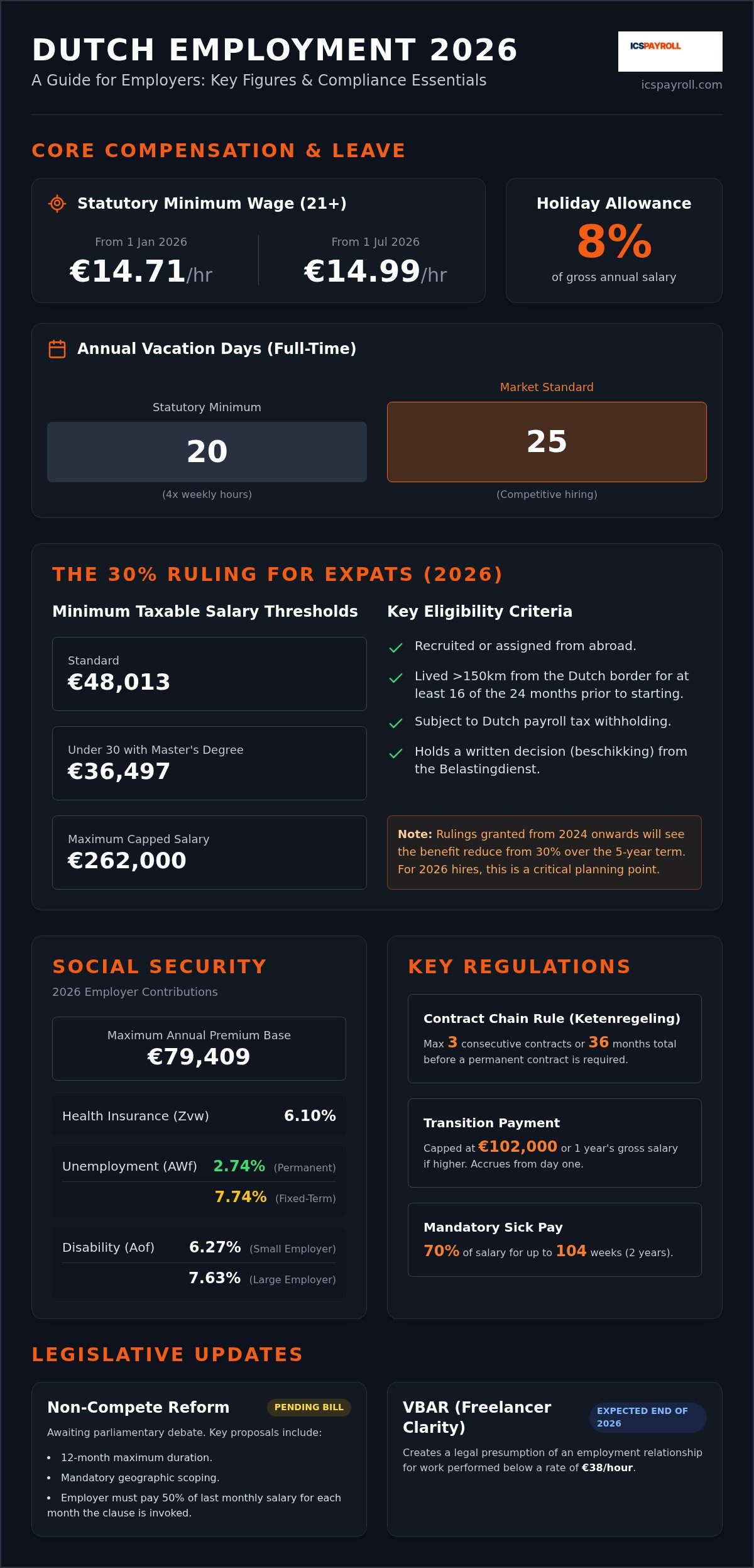
The Netherlands uses a statutory hourly minimum wage rather than a monthly rate to ensure fairness across different working schedules. On January 1, 2026, the rate for adults aged 21 and over is €14.71 per hour. This figure rises to €14.99 per hour on July 1, 2026. You must apply these rates to all hours worked, including overtime if specified in the contract. It's a fundamental requirement that applies to every worker, regardless of their nationality or the duration of their assignment.
In addition to the base wage, you must pay a mandatory holiday allowance of 8% of the gross annual salary. This is a separate benefit designed to cover vacation expenses. While most employers distribute this as a lump sum in May or June, you can choose to pay it monthly if you document this clearly in the employment agreement. Accurate reporting is essential. Refer to our Dutch payroll administration guide for precise filing timelines and tax treatment details.
Vacation Days and Public Holiday Rules
Every employee is entitled to statutory vacation leave equal to at least four times their weekly working hours. For a standard 40-hour work week, this translates to 20 days per year. While this is the legal minimum, the competitive market standard in the Netherlands is typically 25 days. Offering this higher amount is often necessary to attract high-level talent. Statutory days carry a strict expiration date; they must be used within six months of the end of the year in which they were accrued. Above-statutory days remain valid for five years.
The Dutch pension system and leave policies often intersect with public holiday obligations. In 2026, official holidays include New Year's Day, Easter Monday, King's Day (April 27), Ascension Day, and Christmas. It's important to realize that Dutch law doesn't strictly mandate that employees receive a paid day off on these dates. This obligation usually stems from a Collective Labour Agreement (CAO) or the individual employment contract. Clear communication in the contract prevents confusion and ensures your business remains fully compliant with local customs.
Social Security and Pension Obligations in 2026
Social security contributions form a significant portion of the total cost of employment. In 2026, the maximum annual salary subject to these premiums is capped at €79,409. This cap ensures that employer costs remain predictable for high earners, which is a key consideration when structuring employee benefits in the netherlands. Accurate calculation at the start of the year prevents unexpected budget variances later on.
Employer Social Security Contributions
The Dutch system uses several specific funds to provide a safety net for workers. The AWf (General Unemployment Fund) rate depends strictly on the contract type. You pay a low rate of 2.74% for permanent contracts and a high rate of 7.74% for flexible or fixed-term agreements. This 5% difference serves as a financial incentive to offer indefinite employment. Additionally, the Aof (Disability Fund) is set at 6.27% for small employers and 7.63% for large entities. The Zvw (Health Insurance Act) contribution remains at 6.10% for 2026. This is an employer-paid levy that does not reduce the employee’s gross salary but is essential for their national health coverage.
Understanding these nuances is critical for accurate budgeting. The "Ketenregeling" rules also dictate how these benefits accrue. This regulation limits you to three consecutive fixed-term contracts over a maximum period of 36 months before a permanent contract is legally required. For a deeper look at contract compliance and these specific timelines, see our guide on employment law in the Netherlands.
Dutch Pension Schemes: Statutory vs. Supplementary
While the state provides a basic AOW pension, most professional roles in the private sector require a supplementary scheme. Many sectors operate under mandatory industry-wide funds. For example, Stipp handles flexible workers, while ABP covers government and education employees. If your business does not fall under a mandatory fund, you must still consider a competitive private option to remain an attractive employer.
At ICSPayroll, we typically implement a standard 15.2% of gross salary pension contribution model. This structure is highly attractive to international talent who expect robust long-term security. Strategic employers often pair these contributions with the 30% facility for incoming employees to optimize the total net package. This combination reduces the overall tax burden while maintaining high-quality coverage. If you need a clear breakdown of these costs for your specific headcount, you can request a tailored quotation to see how these premiums fit into a single, transparent payroll factor.
The 30% Ruling: A Strategic Benefit for International Hires
The 30% ruling remains the most powerful tool for attracting global talent to the Dutch market. This facility allows employers to provide up to 30% of an employee's gross salary as a tax-free allowance. It's intended to cover the extra-territorial costs associated with moving to and working in a new country. For 2026, the benefit is capped at the WNT norm of €262,000. Any salary earned above this threshold is subject to standard progressive tax rates without the 30% deduction. Incorporating this ruling into your strategy for employee benefits in the netherlands significantly increases the net take-home pay for eligible staff without increasing your gross wage costs.
2026 Eligibility and Salary Requirements
Eligibility for the facility depends on specific criteria regarding both the employee's background and their compensation level. The candidate must be recruited from abroad and must've lived more than 150 kilometers from the Dutch border for at least 16 of the 24 months prior to their first day of work. For 2026, the minimum taxable salary requirement is €48,013. For employees under the age of 30 who hold a qualifying Master's degree, this requirement is reduced to €36,497.
It's critical to understand that these figures represent the taxable salary after the 30% deduction has been applied. To utilize the full 30% benefit, an employee typically needs a gross annual salary of approximately €68,590. If the salary falls between the threshold and this amount, the ruling can only be applied partially. Applications filed with the Belastingdienst within four months of the employment start date are retroactive to day one. Filings made after this window only apply from the first day of the month following the application. You can find detailed checklists for these submissions in our 30% ruling guide.
The 2027 Rate Change and Transitional Rules
The landscape for expat taxation is shifting. While 2026 hires can initially receive the full 30% deduction, the rate is scheduled to drop to 27% on January 1, 2027, for all rulings first granted from 2024 onwards. This reduction is a permanent legislative change you must account for in long-term financial planning. The partial non-resident status, which previously allowed expat employees to be treated as non-residents for Box 2 and Box 3 tax purposes, is abolished for all new ruling holders. Only those who held the ruling prior to 2024 retain this benefit through the end of 2026.
You can't apply the deduction to your payroll until you receive a formal, written decision from the Belastingdienst. Operating on the assumption of approval creates a risk of significant retroactive tax liabilities if the application is denied. Our team manages the entire submission process to ensure your payroll remains compliant with these evolving standards. This proactive approach removes the administrative burden from your internal HR teams while providing total security for your international workforce.
Managing Sick Pay and Transition Allowances
Statutory sick pay is one of the most substantial components of employee benefits in the netherlands. Under Art. 7:629 BW, employers must pay at least 70% of an employee's salary for up to 104 weeks. During the first year of illness, this payment must not fall below the statutory minimum wage. This two-year liability represents a significant financial risk for any business entering the Dutch market. You must account for this potential cost when calculating your total employer burden.
Sick Leave Compliance and Reintegration
Compliance involves more than just processing payments. The Wet Verbetering Poortwachter mandates a strict reintegration schedule that both parties must follow. You're required to complete a formal problem analysis by week six and establish a detailed action plan by week eight. If the employee remains unable to work, you must explore a "second track" option, which involves finding suitable employment with a different employer.
The consequences of non-compliance are severe. If the UWV determines your reintegration efforts were insufficient, they can impose a third-year wage sanction. This forces you to pay an additional 52 weeks of salary beyond the initial two-year period. ICSPayroll manages this risk by coordinating sickness risk coverage and providing professional reintegration support. We ensure that every administrative milestone is met to protect you from preventable sanctions.
Transition Payments and 2026 Regulatory Changes
The transition allowance (transitievergoeding) is a mandatory severance payment due when an employment contract ends at the employer's initiative. It accrues from the first day of employment, including the probation period. The standard calculation is 1/3 of a month's gross salary for each full year of service. For 2026, the transition payment cap is €102,000 or one year's gross salary if that figure is higher. This applies to both fixed-term and indefinite contracts.
A critical shift occurs on July 1, 2026. Employers with 25 or more staff will lose the ability to claim UWV compensation for transition payments paid after two years of illness. Only small employers retain this reimbursement. This change places the full financial burden of long-term illness terminations on larger organizations. Managing these liabilities requires meticulous HR administration and a clear understanding of termination law. If you want to offload these risks and ensure your business remains fully compliant, you can outsource your Dutch payroll administration to our local experts.
Implementing a Compliant Benefits Strategy via an EOR
Establishing a local legal entity isn't always the most efficient path for international expansion. A Dutch BV requires a setup cost of approximately €2000 and ongoing annual accounting and filing fees typically ranging from €3,000 to €8,000. For businesses hiring small to mid-sized teams, an Employer of Record (EOR) offers a faster, more cost-effective alternative. You can onboard talent in weeks instead of months, bypassing the bureaucratic hurdles of direct incorporation while ensuring total compliance with employee benefits in the netherlands. This model allows you to test the market without long term capital commitments.
The EOR Advantage for International Employers
Foreign entities operating without a local entity often face permanent establishment risk. This can lead to complex tax liabilities and legal disputes with the Dutch tax authorities. An EOR acts as the legal employer on your behalf, mitigating these risks entirely. We use a transparent "Payroll Factor" model that consolidates all employment costs into a single monthly invoice. This includes gross salary, employer social security premiums, pension contributions, and our service fee. You gain absolute clarity on your total cost of employment without managing multiple local vendors. For a detailed breakdown of the setup process, consult our Employer of Record Netherlands guide.
Scaling with ICSPayroll
Managing a remote workforce requires reliable digital infrastructure. Our clients gain access to a secure online employee portal where staff can view payslips, sign contracts, and manage holiday balances in real time. This level of transparency builds trust and improves the employee experience. If you're recruiting from outside the EU, we facilitate the necessary permits. While we don't hold the status directly, immigration sponsorship is arranged via our licensed partner to ensure your Highly Skilled Migrant (HSM) visas are processed efficiently, typically within three weeks. This partnership ensures that your global mobility strategy remains robust and legally sound.
Our approach combines advanced technology with human-led support. You won't deal with automated ticketing systems; instead, you'll have direct access to local experts who understand the nuances of the Dutch labor market. This ensures that your strategy for employee benefits in the netherlands remains agile and compliant as regulations change throughout 2026. You focus on your core business goals while we handle the administrative precision required for local success. Hire in the Netherlands with confidence today and secure a tailored quotation within 24 hours.
Future-Proof Your Dutch Employment Strategy
Hiring in the Netherlands requires meticulous attention to detail, especially with the 2026 shifts in the 30% ruling and the July minimum wage increase. You now have the essential checklist to manage employee benefits in the netherlands; from statutory holiday allowances to complex sick pay liabilities under the Poortwachter act. While these regulations are dense, they shouldn't stall your international growth.
Our team provides a stabilized path through this bureaucracy. We consolidate all employment costs into one clear monthly invoice, ensuring you never face hidden fees or administrative surprises. If you're recruiting from abroad, we facilitate expedited HSM visa processing in approximately three weeks via our licensed partner. Joost Hubregtse and his team handle the full scope of Dutch compliance, allowing you to focus on scaling your core operations.
Start hiring in the Netherlands with a tailored quotation in 24 hours. We look forward to supporting your successful expansion into the Dutch market.
Frequently Asked Questions
What are the mandatory employee benefits in the Netherlands for 2026?
Mandatory employee benefits in the netherlands for 2026 include the statutory minimum wage, which is €14.71 per hour from January and increases to €14.99 from July. You must also provide an 8% holiday allowance and a minimum of 20 vacation days for full time staff. These requirements form the legal baseline for all employment contracts. Failure to meet these standards can lead to significant penalties from the Labour Authority during compliance audits.
How much is the Dutch holiday allowance and when is it paid?
The Dutch holiday allowance is exactly 8% of the employee's gross annual salary. Most employers pay this as a lump sum in May or June, although you can choose to distribute it monthly if clearly stated in the employment contract. This benefit is a non-negotiable statutory requirement designed to cover vacation costs. It applies to all contract types, including fixed term and flexible agreements, ensuring every worker receives additional funds for their annual leave.
What is the maximum transition payment in the Netherlands for 2026?
The maximum transition payment for 2026 is capped at €102,000 or one gross annual salary if the employee's earnings exceed that amount. This payment is mandatory when an employment contract is terminated at the employer's initiative, including at the end of a fixed term contract. It accrues from the first day of employment. Calculating this accurately is vital for budgeting terminations, especially as rules for UWV compensation for sick leave payments change in July 2026.
Does the 30% ruling apply to all international employees in 2026?
The 30% ruling doesn't apply automatically; it's a tax facility for eligible international employees recruited from abroad. For 2026, the standard taxable salary threshold is €48,013, or €36,497 for those under 30 with a Master's degree. Candidates must have lived over 150 kilometers from the Dutch border for 16 of the 24 months before starting. Applications must be filed with the Belastingdienst within four months of the start date to be retroactive to day one.
How long must an employer pay sick leave in the Netherlands?
Employers are legally obligated to pay sick leave for a maximum of 104 weeks, which is two full years. Under Dutch law, you must pay at least 70% of the employee's salary, ensuring it doesn't fall below the minimum wage during the first year of illness. You're also required to follow strict reintegration steps under the Poortwachter Act. If these efforts are deemed insufficient by the UWV, you may face a sanction requiring a third year of payment.
Can I hire employees in the Netherlands without a local legal entity?
You can hire staff in the Netherlands without establishing a local legal entity by using an Employer of Record (EOR). This service allows you to onboard employees in weeks rather than months by utilizing our existing compliant infrastructure. We handle all payroll, tax filings, and insurance obligations on your behalf. This approach eliminates the setup costs and administrative burdens of a Dutch BV while ensuring your company remains fully compliant with all local labor regulations.
What are the employer social security contribution rates in 2026?
Employer social security rates for 2026 include the AWf at 2.74% for permanent contracts or 7.74% for flexible ones. The Aof rate is 6.27% for small employers and 7.63% for large entities, while the Zvw contribution is 6.10%. These premiums are calculated on a maximum salary base of €79,409. Understanding these specific fund contributions is essential for calculating the total cost of employment and maintaining accurate payroll records for the tax authorities.
Is a pension scheme mandatory for all Dutch employees?
A supplementary pension scheme is mandatory if your business falls under a sector specific Collective Labour Agreement (CAO). While the state provides a basic AOW pension, most professional employers offer a private scheme to attract talent. ICSPayroll implements a standard pension model of 15.2% of the gross salary. This ensures your employee benefits in the netherlands remain competitive and provide long term security, even if your specific industry doesn't have a mandatory fund requirement.

Article by
Joost Hubregtse
Joost Hubregtse is Director of ICS Staffing & Payroll B.V., the wholly owned subsidiary of Intercompany Solutions behind ICS Payroll. He is responsible for Employer of Record and Dutch payroll services: employment contracts, wage tax and social security filings, holiday allowance, pension, sick leave and CAO compliance, with onboarding possible within 48 hours.
Frequently Asked Questions
Mandatory employee benefits in the netherlands for 2026 include the statutory minimum wage, which is €14.71 per hour from January and increases to €14.99 from July. You must also provide an 8% holiday allowance and a minimum of 20 vacation days for full time staff. These requirements form the legal baseline for all employment contracts. Failure to meet these standards can lead to significant penalties from the Labour Authority during compliance audits.
The Dutch holiday allowance is exactly 8% of the employee's gross annual salary. Most employers pay this as a lump sum in May or June, although you can choose to distribute it monthly if clearly stated in the employment contract. This benefit is a non-negotiable statutory requirement designed to cover vacation costs. It applies to all contract types, including fixed term and flexible agreements, ensuring every worker receives additional funds for their annual leave.
The maximum transition payment for 2026 is capped at €102,000 or one gross annual salary if the employee's earnings exceed that amount. This payment is mandatory when an employment contract is terminated at the employer's initiative, including at the end of a fixed term contract. It accrues from the first day of employment. Calculating this accurately is vital for budgeting terminations, especially as rules for UWV compensation for sick leave payments change in July 2026.
The 30% ruling doesn't apply automatically; it's a tax facility for eligible international employees recruited from abroad. For 2026, the standard taxable salary threshold is €48,013, or €36,497 for those under 30 with a Master's degree. Candidates must have lived over 150 kilometers from the Dutch border for 16 of the 24 months before starting. Applications must be filed with the Belastingdienst within four months of the start date to be retroactive to day one.
Employers are legally obligated to pay sick leave for a maximum of 104 weeks, which is two full years. Under Dutch law, you must pay at least 70% of the employee's salary, ensuring it doesn't fall below the minimum wage during the first year of illness. You're also required to follow strict reintegration steps under the Poortwachter Act. If these efforts are deemed insufficient by the UWV, you may face a sanction requiring a third year of payment.
You can hire staff in the Netherlands without establishing a local legal entity by using an Employer of Record (EOR). This service allows you to onboard employees in weeks rather than months by utilizing our existing compliant infrastructure. We handle all payroll, tax filings, and insurance obligations on your behalf. This approach eliminates the setup costs and administrative burdens of a Dutch BV while ensuring your company remains fully compliant with all local labor regulations.
Employer social security rates for 2026 include the AWf at 2.74% for permanent contracts or 7.74% for flexible ones. The Aof rate is 6.27% for small employers and 7.63% for large entities, while the Zvw contribution is 6.10%. These premiums are calculated on a maximum salary base of €79,409. Understanding these specific fund contributions is essential for calculating the total cost of employment and maintaining accurate payroll records for the tax authorities.
A supplementary pension scheme is mandatory if your business falls under a sector specific Collective Labour Agreement (CAO). While the state provides a basic AOW pension, most professional employers offer a private scheme to attract talent. ICSPayroll implements a standard pension model of 15.2% of the gross salary. This ensures your employee benefits in the netherlands remain competitive and provide long term security, even if your specific industry doesn't have a mandatory fund requirement.