
The 30% Ruling in the Netherlands: A Comprehensive 2026 Employer Guide
By Joost Hubregtse, Director, ICS Staffing & Payroll
All blog posts are reviewed and fact checked by our labour law lawyer Zishan Hussain and our director. Editorial standards
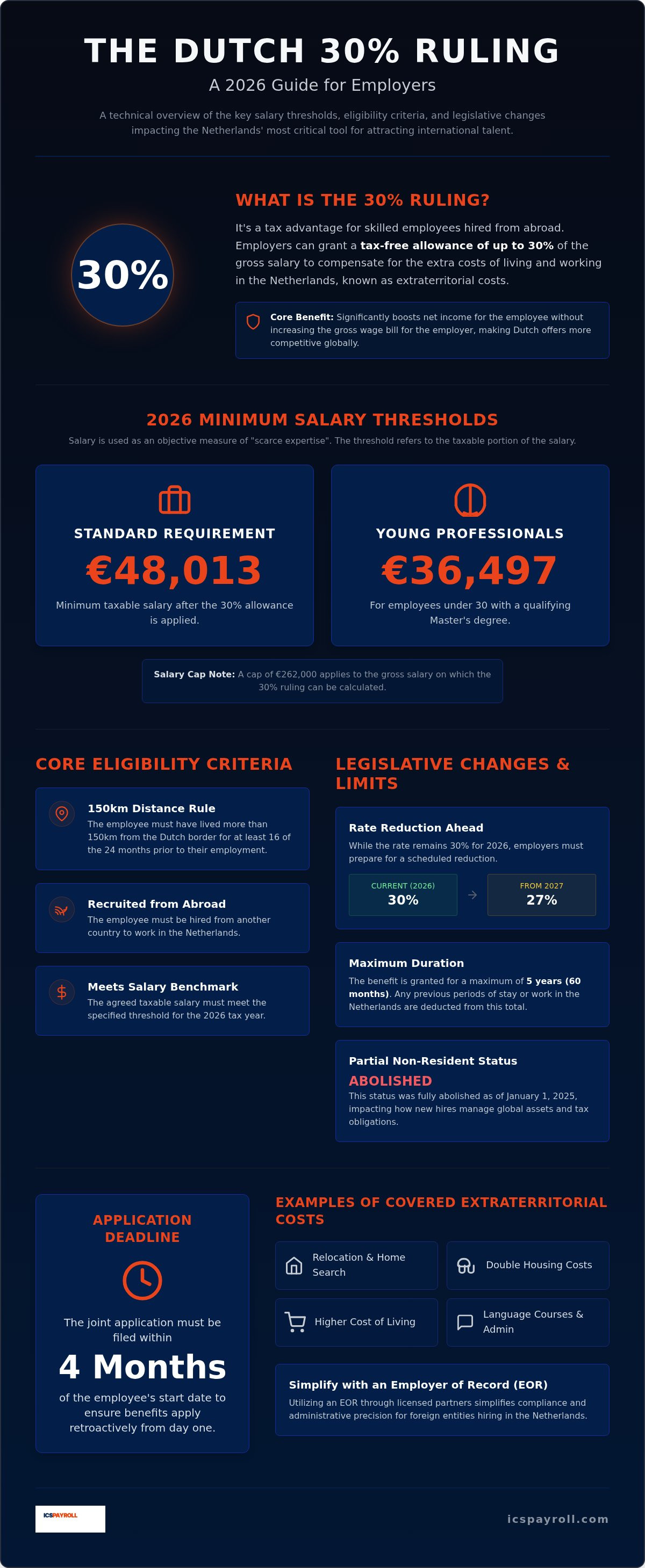
The most effective tool for attracting international talent to the Netherlands is currently undergoing its most significant transformation in a decade. While the 30 ruling netherlands remains a cornerstone of Dutch expat compensation, the window for securing the full 30 percent tax-free allowance is narrowing as the 2027 reduction to a 27 percent rate approaches. For employers, 2026 is a critical bridge year that requires absolute precision in salary benchmarking and contract structuring.
Managing international payroll is often a source of administrative anxiety, especially with the recent abolition of partial non-resident status and the rigid enforcement of the 150km residency rule. You're likely aware that one compliance error can lead to significant retroactive tax liabilities and damaged employee trust. This guide provides the technical clarity needed to master these complexities, ensuring your business meets the 2026 standard salary threshold of EUR 48,013 while maintaining predictable employment costs. We'll examine the specific eligibility criteria for younger professionals with a Master's degree, the impact of the EUR 262,000 salary cap, and the operational steps to ensure a compliant application process through licensed partners.
Key Takeaways
- Identify the specific 2026 salary thresholds, including the standard EUR 48,013 requirement and the reduced threshold for young professionals with a Master's degree.
- Prepare for legislative shifts by understanding the transition to a 27 percent rate and the total abolition of partial non-resident status.
- Master the application requirements for the 30 ruling netherlands to attract high level international expertise to your Dutch operations.
- Adhere to the strict four month filing window to ensure tax benefits apply retroactively from the employee's start date.
- Discover how utilizing an Employer of Record (EOR) through licensed partners simplifies compliance and administrative precision for foreign entities.
Understanding the 30% Ruling: The Dutch Expat Scheme in 2026
The 30 ruling netherlands is an essential mechanism within the Dutch income tax system. It allows employers to provide a tax free allowance to employees recruited from abroad. This allowance compensates for the specific expenses incurred during their relocation and initial years in the country. The Dutch Tax Administration officially refers to this as the 30% facility or the expat scheme.
Eligible staff receive a portion of their gross salary tax free. This significantly boosts their net income without increasing the employer's gross wage bill. In a competitive global market, this incentive is a vital tool for attracting highly skilled migrants. For the 2026 tax year, the standard salary threshold is set at EUR 48,013. This ensures the benefit is reserved for professionals with scarce expertise. Employers must also prepare for the scheduled reduction in 2027. While the allowance remains at 30 percent for 2026, it's set to decrease to 27 percent on January 1, 2027. Additionally, the partial non-resident status was abolished as of January 1, 2025, which impacts how new hires manage their global assets.
What are Extraterritorial Costs?
Extraterritorial costs are the additional expenses an employee faces when moving to the Netherlands. These costs are often substantial and can deter top talent if not addressed. The ruling simplifies this by providing a flat rate reimbursement rather than requiring the employee to prove every individual expense. Common examples include:
- Costs associated with searching for a home and relocating personal belongings to a new Dutch residence.
- Double housing costs during the initial transition period when the employee still maintains a home in their country of origin.
- The generally higher cost of living in the Netherlands compared to the employee's home country.
- Expenses for language courses or administrative procedures like obtaining a residence permit.
The Duration of the Benefit
The ruling is granted for a maximum duration of five years. It's a fixed period designed to support the employee's integration into the local economy. However, the total duration isn't always a full sixty months. Any previous periods of stay or work in the Netherlands are deducted from this total. This includes time spent as a student or frequent business traveler. Employers must verify these history details during the application process to avoid compliance risks. Detailed guidelines on these calculations and the application process are available on the belastingdienst.nl website. Precise record keeping is mandatory to ensure compliance with these duration limits throughout the employment contract.
Eligibility and Salary Requirements for 2026
The 30 ruling netherlands is reserved for employees who possess specific expertise that's difficult to find within the local labor market. This scarcity isn't a subjective measure. Instead, the Dutch Tax Administration uses specific salary levels as an objective proxy for expertise. Before making an offer to an international candidate, you should review the 30 percent ruling eligibility criteria to ensure your hire meets every legal prerequisite. Accessing the 30 ruling netherlands requires a precise understanding of these financial benchmarks to maintain compliance.
2026 Salary Thresholds
For the 2026 tax year, the minimum taxable salary required for the standard ruling is EUR 48, 013. This figure represents the taxable income after the tax-free allowance has been deducted. If the gross salary is lower, the ruling can't be applied in full. There's a significant exception for younger professionals. If an employee is under the age of 30 and holds a Dutch academic master degree or a recognized international equivalent, the threshold is reduced to EUR 36,497. You can find a complete breakdown of these figures in our 30% ruling salary requirements guide. It's vital to calculate these figures correctly to avoid non-compliance during a tax audit.
The 150km Distance Requirement
The location of the employee's residence prior to hiring is just as critical as their salary. The candidate must have lived more than 150 kilometers from the Dutch border for at least 16 out of the 24 months preceding their first day of work. This distance is measured as the crow flies from the nearest point on the Dutch border. Consequently, professionals residing in Belgium, Luxembourg, or the border regions of Germany and France typically don't qualify for the scheme. You'll need to verify that the employee was recruited from abroad and didn't already reside in the Netherlands for other purposes.
Documentation is the foundation of a successful application. You must collect evidence of the employee's previous residency, such as utility bills, rental agreements, or bank statements from their home country. If you're unsure about a candidate's status, consulting with a payroll expert can clarify their eligibility before you finalize the employment contract. Precise record keeping is required, as the Tax Administration may request this proof years after the initial hiring date. Failure to provide this evidence can result in the retroactive withdrawal of the ruling.
The Transition from 30% to 27% and Legislative Reforms
The legislative landscape for the 30 ruling netherlands is currently in a state of significant transition. While the allowance remains at 30 percent for the 2026 tax year, a scheduled reduction will take effect on January 1, 2027. On that date, the maximum tax free reimbursement will drop to 27 percent for all employees who began using the ruling on or after January 1, 2024. Employers finalizing contracts in 2026 must account for this shift in their long term payroll budgeting. Failing to communicate this upcoming reduction to new hires can lead to unexpected net salary drops and potential labor disputes in 2027.
Another critical reform is the total abolition of the partial non-resident taxpayer status for new applicants. This change, which became effective on January 1, 2025, fundamentally alters the tax burden for international professionals. Under previous rules, expats could choose to be treated as non-residents for tax purposes regarding their global assets. Now, new hires are taxed on their global Box 2 and Box 3 assets much earlier. This includes foreign shareholdings and savings that were previously exempt. For high net worth individuals, this change significantly impacts the overall financial attractiveness of a move to the Netherlands.
Transitional Arrangements for Existing Rulings
Employees who were already utilizing the 30 ruling netherlands before January 1, 2024, are generally protected by transitional law. These individuals may continue to benefit from the full 30 percent rate for their original duration. However, all rulings are now subject to the Balkenende Norm, also known as the WNT limit. For 2026, this caps the maximum gross salary over which the tax free allowance can be applied at EUR 262,000. Any income exceeding this threshold is taxed at standard rates. You should monitor kvk.nl updates for specific details on how these caps apply to your existing workforce.
Impact on Remote and Highly Skilled Migrants
Highly skilled migrants remain the primary group benefiting from these incentives, but the administrative burden on employers is increasing. Contract drafting must be exceptionally precise to ensure the ruling survives changes in job titles or internal transfers. If an employee moves to a new employer, they must still meet all scarcity and salary requirements to transfer the ruling. Utilizing an EOR and 30% ruling netherlands solution through licensed partners can help mitigate these risks. This approach ensures that all legislative changes are reflected in the payroll process immediately, protecting both the employer's compliance and the employee's net income.
The 30% Ruling Application Process for Employers
Timing is the most critical factor when applying for the 30 ruling netherlands. The application must reach the Tax Administration within exactly four months of the employee's first working day. This period is a strict legal deadline. If you submit the request within this window, the ruling applies retroactively from the very first day of employment. This allows the employee to benefit from the tax free allowance immediately. If the submission happens after this four month threshold, the ruling only takes effect from the first day of the month following the application date. Missing this window results in a permanent loss of the tax advantage for the initial months of the contract.
Required Documentation
A successful 30% ruling application process requires a comprehensive dossier of evidence. The burden of proof lies with the employer to demonstrate that the hire meets all legislative criteria. You must include a copy of the signed employment contract. This contract must explicitly state that both the employer and employee agree to apply the 30% facility. Additionally, you must provide proof of residency. This includes utility bills or bank statements showing the employee lived more than 150km from the Dutch border for 16 of the 24 months before hiring. Evidence of expertise is also mandatory. You should provide diplomas and a CV that clearly illustrates the unique skills the employee brings to the Dutch market. You must maintain these records for at least seven years to comply with Dutch administrative standards.
Managing the Choice: Real Costs vs. Fixed Percentage
Employers have the option to reimburse actual extraterritorial costs or provide a fixed tax free percentage. While reimbursing actual costs might seem precise, the fixed percentage is the industry standard due to its administrative efficiency. It removes the burden of collecting, verifying, and storing individual receipts for relocation expenses or language courses. You must make this choice at the start of each calendar year. It's essential to document this decision clearly in your payroll records. If an employee's situation changes, you can adjust the method for the following year, provided the new choice is documented before the first payroll run in January.
Managing these deadlines and documentation requirements requires significant administrative focus. To protect your business from compliance risks and ensure a seamless experience for your international hires, you can outsource your 30% ruling management to an expert partner. This ensures every application is submitted correctly and on time while you focus on your core business operations.
Facilitating the 30% Ruling via an Employer of Record (EOR)
International companies often face a significant hurdle when expanding into the Dutch market: the requirement for a local legal entity. Establishing a Dutch BV is a time-consuming process that can delay your talent acquisition strategy by months. By utilizing an Employer of Record Netherlands, arranged via our licensed partners, you can hire staff and apply for the 30 ruling netherlands without establishing a local branch or permanent establishment. The EOR acts as the legal employer of your staff. This structure ensures full compliance with Dutch labor law and tax regulations from the very first day of employment.
The ICSPayroll Advantage
Our operational setup is designed for speed and transparency. We can move from a tailored quotation, provided within 24 hours, to an active payroll in weeks rather than months. This rapid market entry is essential for businesses that need to secure top talent before competitors do. We offer a transparent payroll factor where the 30 ruling netherlands application and management are fully integrated. You won't face hidden fees or administrative surcharges. Instead, you'll receive one clear monthly invoice that covers all employer premiums, social security contributions, and salary payments. This consolidated approach simplifies your financial forecasting and removes the burden of managing multiple local vendors.
Ensuring Compliance and Speed
Securing a Highly Skilled Migrant (HSM) visa is often a complex administrative task for foreign entities. We arrange these applications via licensed partners who benefit from expedited processing with the IND. This typically results in a visa approval in approximately 3 weeks. We also provide comprehensive HR support, including compliant employee handbooks and professional onboarding experiences. ICSPayroll facilitates the employment through our licensed partners so your management team can focus entirely on your business growth and market strategy. This partnership ensures that your 2026 hiring remains compliant with the EUR 48,013 salary threshold and the upcoming transition to the 27 percent rate. Every detail of the 30 ruling netherlands is handled with technical precision, from the initial eligibility check to the final submission to the Tax Administration.
By removing the administrative barriers of local incorporation, we act as the bridge between your global goals and the Dutch regulatory system. You can scale your team in the Netherlands with the peace of mind that all payroll taxes, 30% ruling filings, and labor law requirements are managed by local experts. This allows you to offer competitive, tax-efficient packages to international candidates while maintaining a lean and efficient corporate structure.
Securing Your International Talent Strategy for 2026
Navigating the 30 ruling netherlands requires a proactive approach to compliance and financial planning. As the standard salary threshold reaches EUR 48,013 in 2026 and the transition to a 27 percent rate approaches in 2027, precision in payroll administration is more critical than ever. The abolition of partial non-resident status further complicates the tax landscape for new hires; this makes expert guidance essential for maintaining a competitive edge in a tightening labor market.
ICSPayroll provides the stabilization your business needs to enter the Dutch market without the burden of local entity incorporation. We deliver tailored quotations within 24 hours and arrange expedited HSM visa processing in approximately 3 weeks via our licensed partners. Our transparent payroll factor pricing consolidates all costs into a single monthly invoice, ensuring your employment expenses remain predictable and fully compliant from day one.
Hire in the Netherlands with confidence and secure the 30% ruling for your team to ensure your international expansion is both seamless and secure. We are ready to help you build a successful Dutch workforce with technical excellence.
Frequently Asked Questions
What is the 2026 salary threshold for the 30% ruling?
The standard annual taxable salary threshold for the 30 ruling netherlands in 2026 is EUR 48,013. This amount excludes the tax-free allowance itself. For employees under the age of 30 who hold a qualifying Master's degree, a reduced threshold of EUR 36,497 applies. These figures are strictly enforced by the Dutch Tax Administration. Precise calculations are necessary during the recruitment phase to ensure the employment contract meets these mandatory financial benchmarks.
How does the 150km rule affect 30% ruling eligibility?
The 150km rule requires that an employee lived more than 150 kilometers from the Dutch border for at least 16 out of the 24 months prior to their first working day. This distance is measured as the crow flies. It effectively disqualifies residents from Belgium, Luxembourg, and specific border regions of Germany and France. You must collect verifiable documentation, such as rental agreements or utility bills, to prove the candidate was recruited from a qualifying distance.
Can I apply for the 30% ruling retroactively?
You can apply for the ruling retroactively if the application is submitted within four months of the employee's start date. When this deadline is met, the tax benefit applies from the first day of work. If the application is submitted after this four month window, the ruling only takes effect from the first day of the month following the submission. Missing this deadline results in a permanent loss of tax benefits for the initial employment period.
What happens to the 30% ruling if an employee changes jobs?
The ruling remains valid during a job change if the new employment contract is signed within three months of the previous contract's termination. The employee must continue to meet the specific expertise and salary requirements with the new employer. Both parties must submit a new application to the Belastingdienst. This ensures the 30 ruling netherlands continues without interruption. Precise timing is essential to avoid a gap in the tax-free allowance.
Is the 30% ruling changing to 27% in the Netherlands?
The tax-free allowance is scheduled to reduce from 30 percent to 27 percent starting January 1, 2027. For the duration of 2026, the rate remains at 30 percent. This legislative change primarily affects expats who began using the ruling on or after January 1, 2024. Employers should account for this reduction in their long term payroll budgeting and clearly communicate the shift to affected staff. Transitional rules apply for those who held the ruling before 2024.
Can remote workers in the Netherlands qualify for the 30% ruling?
Remote workers based in the Netherlands can qualify for the 30 ruling netherlands provided they are recruited from abroad and meet all standard eligibility criteria. They must be employed by a Dutch entity or an Employer of Record and meet the 2026 salary threshold of EUR 48,013. The 150km residency rule still applies regardless of their remote status. The employment contract must be governed by Dutch labor law to facilitate a compliant application to the tax office.
What are the employer obligations for the 30% facility?
Employers must document the agreement to apply the 30% facility in a written employment contract or addendum. You are responsible for maintaining a comprehensive administrative file for at least seven years. This file must include proof of the employee's previous residency and expertise. Additionally, you must ensure that the "Loonaangifte" filings correctly reflect the tax-free reimbursement. Compliance is monitored via official government audits to prevent retroactive tax liabilities.
How long does the 30% ruling application take to process?
The Dutch Tax Administration typically processes applications within eight to ten weeks. However, the timeline can vary based on the complexity of the file and current administrative backlogs. ICSPayroll facilitates this process via licensed partners to ensure all documentation is complete and compliant before submission. While the processing continues, you can already apply the ruling in the payroll if you are confident the employee meets all criteria, provided you account for potential corrections later.

Article by
Joost Hubregtse
Joost Hubregtse is Director of ICS Staffing & Payroll B.V., the wholly owned subsidiary of Intercompany Solutions behind ICS Payroll. He is responsible for Employer of Record and Dutch payroll services: employment contracts, wage tax and social security filings, holiday allowance, pension, sick leave and CAO compliance, with onboarding possible within 48 hours.
Frequently Asked Questions
The standard annual taxable salary threshold for the 30 ruling netherlands in 2026 is EUR 48,013. This amount excludes the tax-free allowance itself. For employees under the age of 30 who hold a qualifying Master's degree, a reduced threshold of EUR 36,497 applies. These figures are strictly enforced by the Dutch Tax Administration. Precise calculations are necessary during the recruitment phase to ensure the employment contract meets these mandatory financial benchmarks.
The 150km rule requires that an employee lived more than 150 kilometers from the Dutch border for at least 16 out of the 24 months prior to their first working day. This distance is measured as the crow flies. It effectively disqualifies residents from Belgium, Luxembourg, and specific border regions of Germany and France. You must collect verifiable documentation, such as rental agreements or utility bills, to prove the candidate was recruited from a qualifying distance.
You can apply for the ruling retroactively if the application is submitted within four months of the employee's start date. When this deadline is met, the tax benefit applies from the first day of work. If the application is submitted after this four month window, the ruling only takes effect from the first day of the month following the submission. Missing this deadline results in a permanent loss of tax benefits for the initial employment period.
The ruling remains valid during a job change if the new employment contract is signed within three months of the previous contract's termination. The employee must continue to meet the specific expertise and salary requirements with the new employer. Both parties must submit a new application to the Belastingdienst. This ensures the 30 ruling netherlands continues without interruption. Precise timing is essential to avoid a gap in the tax-free allowance.
The tax-free allowance is scheduled to reduce from 30 percent to 27 percent starting January 1, 2027. For the duration of 2026, the rate remains at 30 percent. This legislative change primarily affects expats who began using the ruling on or after January 1, 2024. Employers should account for this reduction in their long term payroll budgeting and clearly communicate the shift to affected staff. Transitional rules apply for those who held the ruling before 2024.
Remote workers based in the Netherlands can qualify for the 30 ruling netherlands provided they are recruited from abroad and meet all standard eligibility criteria. They must be employed by a Dutch entity or an Employer of Record and meet the 2026 salary threshold of EUR 48,013. The 150km residency rule still applies regardless of their remote status. The employment contract must be governed by Dutch labor law to facilitate a compliant application to the tax office.
Employers must document the agreement to apply the 30% facility in a written employment contract or addendum. You are responsible for maintaining a comprehensive administrative file for at least seven years. This file must include proof of the employee's previous residency and expertise. Additionally, you must ensure that the "Loonaangifte" filings correctly reflect the tax-free reimbursement. Compliance is monitored via official government audits to prevent retroactive tax liabilities.
The Dutch Tax Administration typically processes applications within eight to ten weeks. However, the timeline can vary based on the complexity of the file and current administrative backlogs. ICSPayroll facilitates this process via licensed partners to ensure all documentation is complete and compliant before submission. While the processing continues, you can already apply the ruling in the payroll if you are confident the employee meets all criteria, provided you account for potential corrections later.