
Highly Skilled Migrant 30% Ruling: The 2026 Employer FAQ Guide
By Joost Hubregtse, Director, ICS Staffing & Payroll
All blog posts are reviewed and fact checked by our labour law lawyer Zishan Hussain and our director. Editorial standards
By Joost Hubregtse, Payroll Director
Securing a Highly Skilled Migrant visa in 2026 requires more than just meeting a salary floor; it demands a precise alignment with evolving tax regulations and rigorous new documentation standards. You likely understand that the Dutch labor market remains tight, yet the administrative burden of onboarding international talent feels increasingly heavy. Between the 2026 salary indexation and the looming transition to a 27% tax-free rate, managing payroll for expats has become a high-stakes calculation. It's often difficult to balance competitive offers with the fear of IND non-compliance.
This guide provides the clarity you need to master the 2026 salary thresholds and ensure your organization remains fully compliant with the latest requirements. We'll explore how leveraging an EOR and 30% ruling netherlands partnership can simplify these complexities, allowing you to hire with confidence before you've established a local entity. From the €48,013 general threshold to the new bank statement retention rules, we break down exactly what employers must do to secure and maintain these vital tax benefits.
Key Takeaways
- Learn the updated 2026 salary thresholds, including the €48,013 standard and the reduced rate for younger specialists with a Master degree.
- Understand the legislative shift from a 30% tax-free allowance to the new 27% rate and how it impacts your Dutch payroll strategy.
- Master the critical four-month application window to ensure retroactive tax benefits for your international hires.
- Discover how using an EOR and 30% ruling netherlands partnership facilitates rapid onboarding and compliance without a local legal entity.
- Identify the new administrative requirements for 2026, such as mandatory bank statement retention for audit readiness.
Understanding the 30% Ruling for Highly Skilled Migrants in 2026
The 30% ruling serves as a vital fiscal incentive for Dutch companies seeking to attract specialized talent from abroad. It functions as a tax facility designed to compensate for extraterritorial costs incurred by expats when they relocate to the Netherlands. This scheme allows eligible employees to receive a specific percentage of their gross salary as a tax-free allowance; this effectively covers the significant cost-of-living differences between their home country and the Dutch market. Managing an EOR and 30% ruling netherlands arrangement allows companies to simplify this process while maintaining full compliance with local tax laws. The facility acts as a primary recruitment tool for securing expertise that is currently scarce in the local labor market.
Employers should understand that this benefit is strictly limited to a maximum duration of five years. Understanding the 30% ruling basics is essential for any firm planning to expand its workforce with international specialists. It's a structured process that requires precise payroll administration to remain compliant with the Dutch Tax Administration (Belastingdienst). Failure to adhere to the strict timelines or salary thresholds can lead to the immediate loss of the benefit for the employee, creating significant financial friction.
The Purpose of the Expat Scheme
The primary objective of the scheme is to bolster the competitive position of Dutch companies in global sectors like tech, data science, and engineering. By increasing a candidate's net take-home pay without raising the employer's total gross salary costs, the ruling makes the Netherlands a highly attractive destination for top-tier professionals. It specifically addresses the financial burden of relocation. This includes moving expenses and the costs of maintaining double housing during the initial transition period. This financial efficiency ensures that local businesses can compete for the same talent sought by firms in London or Berlin. It's a stabilizing force for international businesses entering the Dutch market for the first time.
Key 2026 Terminology for Employers
To manage this process effectively, employers must be familiar with specific regulatory terms. Extraterritorial costs refer to the actual expenses related to staying outside a worker's country of origin. An incoming employee is defined as a worker recruited from a distance of more than 150 kilometers from the Dutch border for at least 16 out of 24 months prior to their start date. Finally, every request must be a joint application. This means both the employer and the employee must sign the formal request to the tax authorities. Utilizing an EOR and 30% ruling netherlands specialist ensures these definitions are applied correctly from the first day of employment. This prevents costly administrative errors and removes the burden of managing complex Dutch bureaucracy from your internal HR teams.
2026 Salary Requirements and Eligibility Criteria
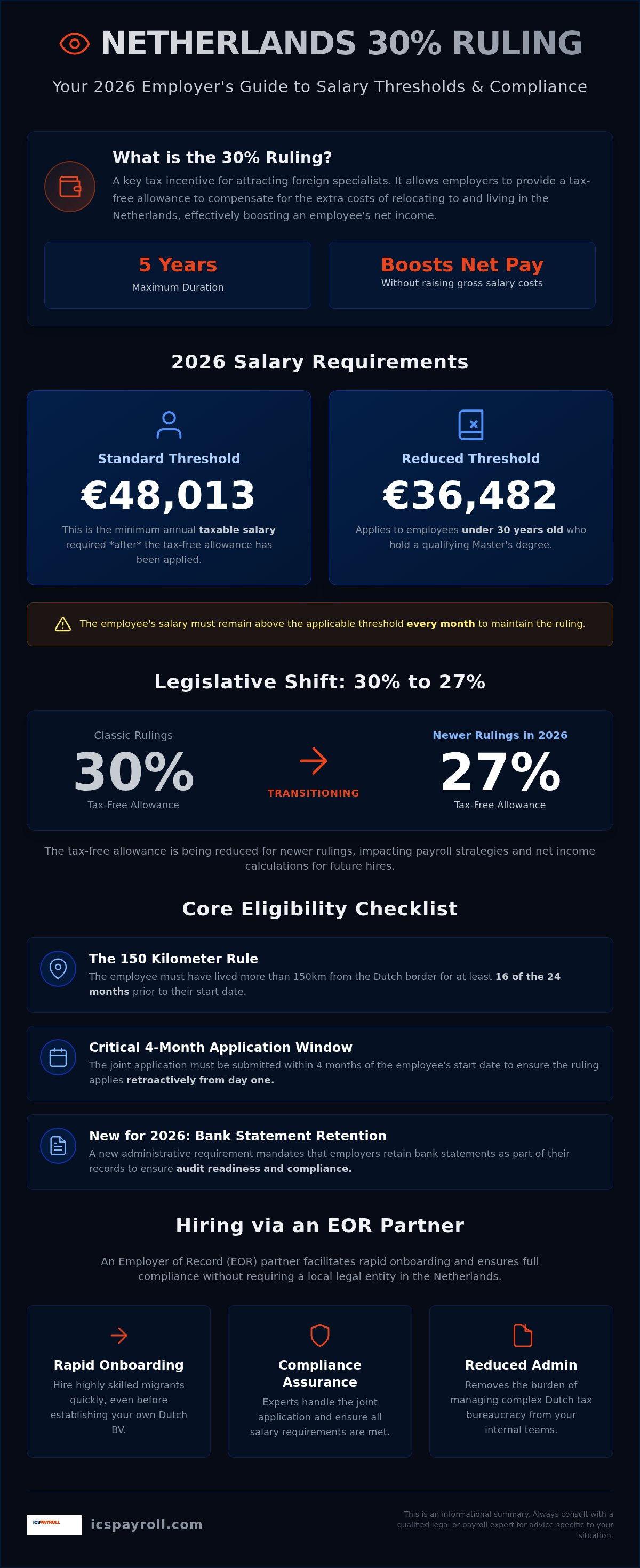
Compliance begins with meeting the strict financial benchmarks set by the Dutch authorities. For the 2026 tax year, the standard annual taxable salary threshold is EUR 48,013. This figure represents the taxable amount after the tax-free allowance has been deducted. It's vital to remember that this isn't just a target; it's a hard floor for eligibility. If an employee's salary dips below this level at any point during the year, the ruling may be revoked retroactively. For a deeper dive into these figures, consult our 30% Ruling Salary Requirements for 2026 reference guide.
A reduced threshold of EUR 36,482 applies specifically to employees under the age of 30 who hold a qualifying Master degree. This lower entry point encourages the recruitment of young, high-potential specialists. However, employers must verify these figures against the Social Security salary (SV-loon) on every monthly payslip. The SV-loon is the basis for Dutch social security contributions and serves as the official metric for the Tax Administration. Managing an EOR and 30% ruling netherlands structure ensures that these monthly checks are automated and accurate, protecting your business from accidental non-compliance. You can request a tailored quotation to see how these thresholds impact your specific hiring budget.
The 150 Kilometer Rule
The 30% ruling is reserved for "incoming employees" who lived at a significant distance from the Netherlands before their start date. To qualify, an individual must have resided more than 150 kilometers from the Dutch border for at least 16 out of the 24 months prior to their first working day. This geographic requirement is a frequent point of confusion. It effectively excludes most candidates living in Belgium and significant portions of western Germany or northern France. For precise details on how the distance is measured, refer to the official Belastingdienst 150km rule page. Documentation proving prior residence, such as utility bills or rental agreements, must be kept on file for at least five years.
Scarcity and Specific Expertise
The legal foundation of the ruling is the possession of specific expertise that is scarce within the Dutch labor market. In practice, the Dutch Tax Administration generally assumes this expertise exists if the mandatory salary thresholds are met. The higher pay is seen as market proof of the candidate's specialized value. While this makes the process predictable for most corporate roles, certain exceptions exist. For example, scientific researchers and doctors in training may qualify regardless of their salary level, provided they meet other institutional criteria. Utilizing an EOR and 30% ruling netherlands partner helps you navigate these edge cases without risking your corporate standing with the IND or the tax office.
The 2026 Transition: Moving from 30% to 27%
Recent legislative updates have fundamentally adjusted the tax-free percentage for rulings granted after specific transition dates. While the 30% rate was a long-standing fixture of the Dutch labor market, employers must now carefully distinguish between legacy 30% rulings and new applications subject to the upcoming 27% rate. The 2026 Fact Sheet confirms that the phase-out of the higher percentage is proceeding as planned, requiring companies to prepare their payroll systems for a dual-track environment. This transition period means different employees may be on different rates depending on their start date and previous ruling status. It's a critical point of compliance that requires meticulous record-keeping and clear communication with your workforce. Furthermore, expats are now taxed as full residents on worldwide savings and investments, which marks a departure from the generous exemptions of previous years.
Impact on Net Salary Calculations
The reduction to 27% necessitates an immediate recalculation of the payroll factor for all upcoming hires and future budget cycles. Employers shouldn't assume that old salary templates or recruitment calculators are still valid for 2026 and 2027 projections. When negotiating with international talent, it's vital to present net salary projections based on the confirmed 27% rate to avoid over-promising take-home pay. We recommend that companies update their standard employment contracts to include clauses that reflect the potential for future legislative rate adjustments. This proactive approach protects the employer if further changes occur during the employee's five-year term. For a full breakdown of these requirements, refer to our 30% Ruling Eligibility Criteria for 2026. Partnering with an EOR and 30% ruling netherlands provider allows you to outsource these complex calculations to local experts who monitor every legislative shift in real-time.
Abolition of Partial Non-Resident Status
The abolition of partial non-resident status is a landmark change that takes full effect for new applicants in the 2026 landscape. In previous years, 30% ruling holders could opt to be treated as non-resident taxpayers for Box 2 and Box 3 income, effectively shielding their global assets from Dutch taxation. This benefit has been eliminated for new applicants, meaning all global income from savings, stocks, and property is now subject to standard Dutch tax rates. This change significantly impacts high-net-worth individuals and may influence their long-term relocation decisions. Employers must be prepared to discuss these implications during the recruitment phase to manage expectations. Detailed information on these changes can be found in the official government update on tax liability. Managing an EOR and 30% ruling netherlands arrangement through a specialized partner ensures that your employees receive accurate information regarding their residency status and tax obligations, which is essential for maintaining trust and retention.
Application Process and Timeline for Employers
Executing a successful relocation strategy requires a methodical approach to documentation and timing. The process involves four primary stages that must be completed with clinical precision to ensure both the visa and tax benefits are secured. First, you must collect the employee's original diplomas and proof of residence for the 24 months preceding their start date. This documentation forms the core of the application. Second, the formal 30% ruling application must be submitted to the Tax Administration within four months of the employee's first working day. Third, you should arrange the Highly Skilled Migrant visa via licensed partners to ensure expedited entry into the country. Finally, the process concludes when you receive the official beschikking (decision) from the Tax Administration, which confirms the employee's eligibility and the ruling's duration.
Managing an EOR and 30% ruling netherlands workflow simplifies these operational steps. By utilizing a structured onboarding process, you can avoid the administrative bottlenecks that often delay international hires. If you are ready to begin, you can request a tailored quotation to see how our expertise can accelerate your Dutch expansion.
The Four-Month Deadline
The four-month submission window is a non-negotiable compliance point. Applications filed within this timeframe allow the tax-free allowance to be applied retroactively from the employee's first day of work. If you submit the application after this window, the ruling only applies from the first day of the month following the month of application. This results in a permanent loss of tax benefits for the initial months of employment, which can cause significant frustration for the employee. For a detailed breakdown of the necessary paperwork, consult our 30% Ruling Application Guide. Meticulous tracking of start dates is essential for maintaining this retroactive eligibility.
Expedited Processing via Partners
Speed is often the most critical factor for tech and engineering firms needing to fill urgent specialist roles. While standard IND processing for residence permits can take several months, applications arranged via licensed partners typically receive a decision within approximately 3 weeks. This expedited path is a significant advantage over the standard statutory period of 90 days. It allows your talent to relocate and begin contributing to your projects much faster. To facilitate this speed, ICSPayroll provides a tailored quotation within 24 hours. This rapid response ensures you can move from a candidate's acceptance to a filed application without unnecessary delays. Utilizing an EOR and 30% ruling netherlands solution provides the administrative infrastructure needed to maintain this pace while ensuring every legal standard is met.
Hiring via an EOR Partner in the Netherlands
Establishing a local Dutch BV is a time-consuming and expensive process that often delays market entry by months. Employer of Record (EOR) services offer a strategic alternative; they allow international companies to hire talent in the Netherlands immediately without a local legal entity. A local partner manages the entire employment lifecycle, from drafting compliant contracts to executing complex payroll runs. Most importantly, a specialized EOR and 30% ruling netherlands provider handles the 30% ruling application and HSM visa sponsorship arranged via licensed partners. This removes the administrative burden from your internal HR teams while ensuring full adherence to IND standards.
All employment costs are consolidated into one clear monthly invoice using a transparent payroll factor. This model provides budget certainty by aggregating gross salary, social premiums, and management fees. The payroll factor specifically covers the mandatory 15.2% pension contribution and the 8% holiday allowance required under Dutch labor law. By using this all-inclusive approach, you can accurately project the total cost of employment for every international specialist you bring into the Dutch market.
Compliance and Sickness Risk
One of the most significant advantages of using an EOR is the mitigation of sickness risk. Dutch law requires employers to continue paying a large portion of an employee's salary for up to two years during long-term illness. EOR services include comprehensive sickness risk coverage to protect your business from these unpredictable costs. Additionally, the partner manages all mandatory social security filings and employer premium payments, including AWf, Aof, and Zvw. For a complete overview of these obligations, read our Employer of Record Netherlands Pillar. This localized expertise ensures you don't fall foul of the strict Dutch Gatekeeper Act (Wet Verbetering Poortwachter).
Transparency in Pricing
The payroll factor model is designed to eliminate surprise charges and hidden administrative fees. It includes the management of the transition allowance, which is capped at EUR 102,000 for the 2026 tax year. This ensures that even if an employment relationship ends, the financial implications are managed within a predictable framework. Beyond the financial benefits, your workforce gains access to a professional online employee portal. This digital interface allows employees to track their payslips, view their 30% ruling status, and manage their contracts with ease. Leveraging an EOR and 30% ruling netherlands solution provides your international talent with a high-level corporate experience while you maintain focus on your core business objectives.
Securing Your Dutch Talent Strategy for 2026
Navigating the 2026 Dutch tax landscape requires a proactive approach to salary calibration and administrative precision. Meeting the €48,013 standard threshold and managing the transition to the 27% tax-free rate are essential for maintaining your competitive edge in the global talent market. By utilizing an EOR and 30% ruling netherlands partnership, you remove the complexity of local entity establishment while ensuring every IND and Belastingdienst requirement is met with clinical accuracy. It's a stabilizing force that allows you to focus on growth rather than bureaucracy.
Our model provides a transparent payroll factor that eliminates surprise costs; meanwhile, our licensed partners facilitate expedited HSM visa processing in approximately 3 weeks. We provide tailored quotations within 24 hours to help you move from candidate selection to onboarding at pace. Hire in the Netherlands with confidence and apply for the 30% ruling today to secure the specialized expertise your business needs to flourish. With the right administrative foundation, your international expansion can be both seamless and fully compliant.
Frequently Asked Questions
What is the minimum salary for the 30% ruling in 2026?
The standard annual taxable salary threshold for 2026 is €48,013. This figure represents the minimum taxable income required after the tax-free allowance has been deducted from the gross salary. Employers must ensure that the employee's taxable pay remains above this level throughout the year to maintain eligibility. If the salary dips below this floor due to unpaid leave or part-time work, the tax benefit is typically lost for that period.
Is the 30% ruling still 30% for new applicants in 2026?
Yes, the ruling remains at a maximum of 30% for the duration of the 2026 tax year. However, it is important to prepare for a scheduled legislative change on January 1, 2027. On that date, the maximum tax-free allowance will be reduced to 27% for all users for the remainder of their term. This adjustment applies to both existing ruling holders and new applicants who join during the 2026 transition period.
Can I apply for the 30% ruling if I hire a remote worker in the Netherlands?
You can only apply for the ruling if the remote worker relocates to the Netherlands specifically for the role. The candidate must meet the "incoming employee" criteria, which requires them to have lived more than 150 kilometers from the Dutch border for at least 16 out of the 24 months prior to hiring. If the worker is already a resident of the Netherlands when the recruitment process begins, they are generally ineligible for the scheme.
How long does the 30% ruling application process take?
The Dutch Tax Administration typically takes between 10 and 13 weeks to issue a formal decision on a 30% ruling application. While the processing time is significant, the benefit can be applied retroactively if the request is filed within four months of the employee's start date. Utilizing an EOR and 30% ruling netherlands partner ensures that all documentation is complete and accurate, which prevents administrative delays and protects retroactive tax benefits.
What happens to the 30% ruling if an employee changes employers?
The 30% ruling can be transferred to a new employer provided the employee continues to meet all salary and expertise requirements. The new employer must submit a joint application within three months of the previous employment contract ending. If this three-month window is missed, the ruling expires and cannot be reinstated. The new employer must also verify that the employee still qualifies as a highly skilled migrant under current 2026 regulations.
Does the 30% ruling apply to the holiday allowance?
Yes, the 30% ruling applies to the total gross salary, which includes the mandatory 8% holiday allowance and any qualifying bonuses. The employer calculates the tax-free portion based on the entire compensation package. However, the remaining taxable salary must still stay above the 2026 threshold of €48,013. This comprehensive application makes the ruling an effective tool for increasing the net take-home pay of international specialists without increasing the total employer cost.
Can an employer apply for the 30% ruling without a Dutch legal entity?
An employer cannot apply for the ruling directly without a registered Dutch legal entity or a local payroll presence. To solve this, many international firms use an EOR and 30% ruling netherlands solution. The EOR acts as the legal employer on record and manages the application via licensed partners. This allows foreign companies to hire Dutch-based talent and offer the 30% tax benefit without the overhead of incorporating a local BV.
What are the 2026 salary thresholds for highly skilled migrants under 30?
For 2026, the gross monthly salary threshold for a highly skilled migrant under the age of 30 is €4,357, excluding the 8% holiday allowance. If the employee also holds a qualifying Master degree, the 30% ruling taxable salary threshold is reduced to €36,497 per year. These lower entry points are specifically designed to help Dutch companies attract young, high-potential specialists from the global market while maintaining full compliance with IND standards.

Article by
Joost Hubregtse
Joost Hubregtse is Director of ICS Staffing & Payroll B.V., the wholly owned subsidiary of Intercompany Solutions behind ICS Payroll. He is responsible for Employer of Record and Dutch payroll services: employment contracts, wage tax and social security filings, holiday allowance, pension, sick leave and CAO compliance, with onboarding possible within 48 hours.
Frequently Asked Questions
The standard annual taxable salary threshold for 2026 is EUR 48,013. This figure represents the minimum taxable income required after the tax-free allowance has been applied. You must verify this amount against the Social Security salary (SV-loon) on the monthly payslip to maintain compliance. If the taxable salary falls below this benchmark at any point during the year, the tax facility may be revoked. Detailed requirements are available on the Belastingdienst website.
New applicants in 2026 still receive a 30 percent tax-free allowance for the duration of the year. However, legislative updates confirm that this rate will drop to a flat 27 percent starting January 1, 2027. Employers should update employment contracts now to reflect this upcoming transition. This ensures that both the organization and the employee are prepared for the scheduled reduction in net take-home pay. Legacy rulings granted before specific dates follow different transitional rules.
You can apply for the ruling if the remote worker relocates to the Netherlands from a distance of more than 150 kilometers from the Dutch border. The employee must be recruited from abroad specifically for the role. Utilizing an EOR and 30% ruling netherlands strategy through licensed partners allows you to hire these remote specialists compliantly without a local entity. The worker must meet all standard salary and expertise criteria to qualify for the facility.
The Tax Administration typically issues a decision within eight to ten weeks after submission. However, the initial preparation and visa sponsorship phases are much faster when arranged via licensed partners. For example, an HSM visa can be processed in approximately three weeks. It is critical to submit the application within four months of the employee's first working day to ensure the benefit applies retroactively to the start date. Delaying the submission results in a loss of savings.
The ruling can be transferred to a new employer if the employee finds a new role within three months of their previous contract ending. The new employer must submit a new joint application to the Tax Administration. Both parties must still meet the 2026 salary thresholds and expertise requirements. If the gap between jobs exceeds three months, the facility expires permanently and cannot be reactivated for that specific stay in the Netherlands according to current regulations.
The 30 percent tax-free allowance applies to the entire gross salary, which includes the mandatory 8 percent holiday allowance. It also covers taxable bonuses and other benefits in kind. Employers must ensure the remaining 70 percent of the total income still meets the standard 2026 threshold of EUR 48,013. Precision in these calculations is essential to maintain compliance and avoid retroactive tax liabilities during a Belastingdienst audit of the company payroll records.
An employer cannot apply directly for the tax facility without a Dutch legal entity or a permanent establishment. However, you can achieve this by using an EOR and 30% ruling netherlands solution. Through this model, the EOR acts as the legal employer of record via licensed partners. This allows your business to hire talent and facilitate the tax facility without the administrative burden of incorporating a local Dutch BV or managing complex local payroll and insurance filings.
Highly skilled migrants under the age of 30 who hold a qualifying Master's degree from a recognized international institution face a reduced threshold of EUR 36,497. This lower benchmark makes it easier for companies to recruit younger specialists for innovative roles. Once the employee turns 30, they must immediately meet the standard 2026 threshold of EUR 48,013 to retain the benefit. You can verify degree eligibility through official IND resources to ensure the reduced rate applies correctly. Joost Hubregtse, Payroll Director Joost Hubregtse is the Payroll Director at ICSPayroll with over 15 years of experience in Dutch labor law and international mobility. He is a specialist in complex payroll engineering, 30% ruling compliance, and cross border employment structures for global entities entering the Dutch market. Reviewed by Joost Hubregtse, Payroll Director on August 24, 2026.