30% Ruling Salary Requirements for 2026: A Reference Guide for Employers
By Joost Hubregtse, Director, ICS Staffing & Payroll
All blog posts are reviewed and fact checked by our labour law lawyer Zishan Hussain and our director. Editorial standards
Relying on outdated payroll figures for your international hires is a direct path to non-compliance and costly tax audits. You likely understand that the 30% tax facility, officially renamed the expat scheme (expatregeling), is a vital tool for attracting global talent to the Netherlands. However, the distinction between gross compensation and the mandatory taxable salary often creates significant administrative friction for even the most experienced HR teams. Miscalculating the 30% ruling salary requirements for 2026 can lead to the retroactive loss of the benefit and unexpected financial liabilities for your organization.
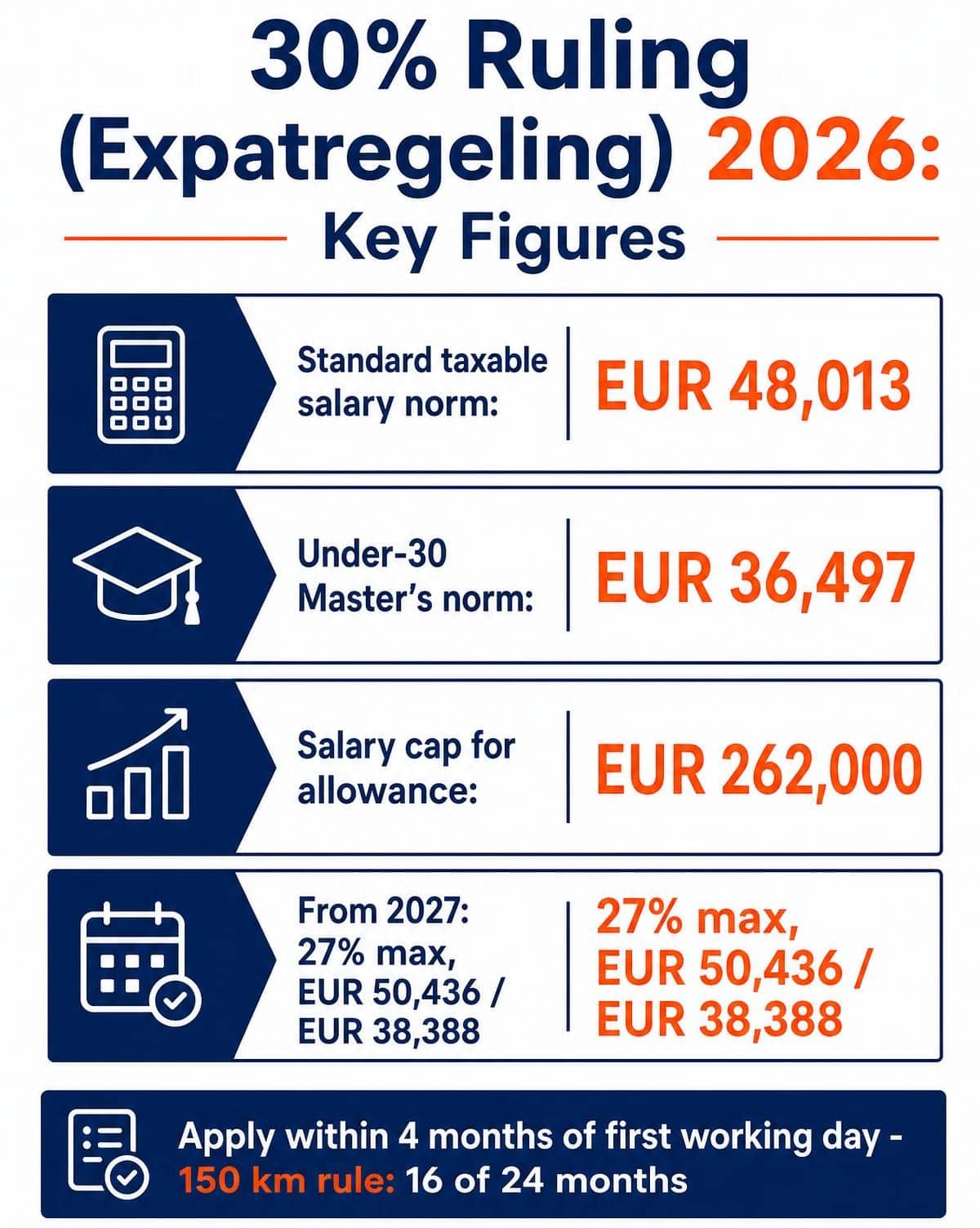
We recognize the pressure to remain competitive while navigating the complexities of the 150km rule and evolving Dutch tax thresholds. By mastering the 2026 standards, you can secure this facility for your employees with certainty and eliminate the risk of retroactive corrections. This guide provides a definitive breakdown of the EUR 48,013 standard taxable threshold, the specific EUR 36,497 requirement for Master's graduates under the age of 30, the EUR 262,000 salary cap, and the essential compliance steps for Dutch employers to ensure a successful application process.
Key Takeaways
- Identify the 2026 taxable salary thresholds of EUR 48,013 for standard hires and EUR 36,497 for Master's graduates under the age of 30, up from EUR 46,660 and EUR 35,468 in 2025.
- Learn how to structure gross compensation packages so the taxable remainder satisfies the 30% ruling salary requirements after the tax-free allowance is applied, and note the cap: the allowance can only be calculated over salary up to EUR 262,000 in 2026.
- Understand that the salary norm must be met on a continuous basis; falling below it causes the ruling to lapse with retroactive effect to the start of the calendar year.
- Prepare for 1 January 2027, when the maximum tax-free percentage drops to 27% and the salary norms rise to (at least) EUR 50,436 and EUR 38,388, subject to final indexation and transitional rules.
- Explore how an Employer of Record model streamlines the application process and facilitates rapid onboarding through local payroll expertise, with immigration sponsorship arranged via a licensed partner.
Understanding the 30% Tax Facility in the 2026 Dutch Labor Market
The 30% ruling serves as a vital instrument for Dutch enterprises seeking to attract international expertise. It functions as a tax-free reimbursement for the additional expenses incurred by employees moving to the Netherlands, commonly referred to as extraterritorial costs. By utilizing this facility, an employer can pay a tax-free allowance of up to 30% of the salary (including the allowance) for a maximum period of five years. Alternatively, the employer may reimburse the actual, substantiated extraterritorial costs; this choice must be made in the first payroll period of each calendar year. The scheme is strictly regulated to ensure it benefits employees with expertise that is scarce on the Dutch labour market.
To qualify for the facility in 2026, an employee must have a taxable annual salary of more than EUR 48,013, measured after the tax-free allowance is applied. This figure is the floor for standard applicants. Accuracy in these calculations is paramount, because if the taxable salary ends the year below this threshold, the ruling lapses with retroactive effect to the beginning of that calendar year (or the start date of the ruling) and the decision is withdrawn. It's not enough to simply offer a high gross salary; the remaining taxable portion must consistently meet the 2026 norm.
The Strategic Importance of the Expat Scheme
Attracting global talent in the 2026 labor market requires more than a competitive job title. The 30% ruling provides a significant financial edge for both the employer and the employee. It reduces the total cost of employment for the company while maintaining a high net income for the specialist, making Dutch offers more attractive compared to other European hubs. Employers should, however, inform employees of two trade-offs: the tax-free allowance does not count toward the pensionable base or benefit calculations, and since 1 January 2025 new ruling holders can no longer opt for partial non-resident taxpayer status, meaning Box 2 and Box 3 income is taxable in the Netherlands (employees who applied the old ruling in the final payroll period of 2023 retain the option through 31 December 2026 under transitional law). While ICSPayroll manages the payroll administration, immigration sponsorship is arranged via our licensed partner to ensure full legal alignment for your international staff.
Key 2026 Regulatory Changes to Note
The regulatory landscape for 2026 requires attention on several fronts. First, the salary norms have been indexed upward from the 2025 levels. Second, employers should already be planning for 1 January 2027, when the maximum tax-free percentage is reduced from 30% to 27% and the salary norms increase to (at least) EUR 50,436 for standard hires and EUR 38,388 for young Master's graduates, subject to final indexation; transitional rules apply depending on when the ruling was first granted, and employees who applied the ruling before 2024 retain the 30% regime for the full term of their decision.
Third, on false self-employment: the Belastingdienst resumed active enforcement of the Wet DBA on 1 January 2025, ending the long-standing enforcement moratorium. The proposed VBAR legislation, intended to clarify the assessment of working relationships and introduce a legal presumption of employment below a set hourly rate, has not entered into force; the government has since shifted course and is preparing separate legislation on the position of the self-employed. Until new legislation applies, engagements with contractors are assessed and enforced under existing law, and anyone benefiting from the 30% ruling must in any case be in a genuine employment relationship subject to Dutch wage tax.
Finally, all payroll structures must respect the statutory minimum hourly wage: EUR 14.71 for the first half of 2026 and EUR 14.99 from 1 July 2026, as the rate is indexed twice per year. The 150km rule remains a strict eligibility criterion, requiring employees to have lived more than 150 kilometers from the Dutch border for at least 16 of the 24 months prior to their first Dutch working day. Maintaining these standards requires meticulous record-keeping: payroll and fiscal records must be retained for the mandatory 7-year fiscal retention period.
Official 2026 Salary Thresholds and Expertise Criteria
The salary norms for the 30% facility are indexed every year. For 2026, the standard annual taxable salary requirement is EUR 48,013, an increase from the 2025 threshold of EUR 46,660. Employers must ensure that the employee's salary, after the tax-free allowance is deducted, remains above this figure. In addition, since 2024 the ruling is capped: in 2026 the tax-free allowance may only be calculated over salary up to the WNT norm of EUR 262,000 (up from EUR 246,000 in 2025), which limits the maximum tax-free allowance to EUR 78,600 per year. Transitional rules apply to employees for whom the ruling was already applied in the final payroll period of 2022. If you're calculating a new hire's package, our team can provide a tailored quotation within 24 hours to ensure your offer is both competitive and compliant.
Specific exemptions exist in the academic and medical fields. Scientific researchers working at designated research institutions and medical specialists in training have no minimum salary requirement to qualify for the ruling. For all other sectors, meeting the salary norm is a non-negotiable prerequisite for approval by the Tax Administration.
The Under 30 Master Degree Exception
Young professionals under the age of 30 benefit from a reduced taxable threshold of EUR 36,497 in 2026, provided they hold a qualifying Master's degree, an increase from the EUR 35,468 required in 2025. Foreign degrees must be evaluated for equivalence with a Dutch academic Master's title through the Dutch international credential evaluation procedure (IDW), unless already accepted by the Tax Administration. It's vital to track the employee's age closely: from the first day of the month following the month in which the employee turns 30, the standard EUR 48,013 norm applies. Failure to adjust the payroll at that moment can cause the ruling to lapse retroactively.
Highly Skilled Migrants vs. 30% Ruling Thresholds
A frequent source of risk for international firms is the gap between the Highly Skilled Migrant (HSM) permit norms and the tax office requirements. The IND sets salary floors for residence permits, while the Tax Administration sets separate thresholds for the 30% ruling; the two systems operate independently. Meeting the IND requirement doesn't guarantee that a full 30% allowance is possible: a gross salary that satisfies the permit may still be too low to apply the full 30% while keeping the taxable remainder above EUR 48,013. In that case, only a partial (lower) tax-free percentage can be applied. To manage this complexity, immigration sponsorship is arranged via our licensed partner, ensuring both the permit and the tax ruling are handled with precision.
Calculating Taxable Salary: Gross Pay vs. 30% Ruling Eligibility
The 2026 threshold isn't based on the gross salary mentioned in the employment contract. It applies to the taxable salary after the tax-free allowance has been deducted, as assessed by the Tax and Customs Administration. To apply the full 30%, the taxable remainder (70% of the salary) must still exceed EUR 48,013, which in practice requires an annual salary of at least approximately EUR 68,590 (EUR 52,139 under the reduced norm). If the salary is lower but still above the threshold, the tax-free percentage must be reduced so the taxable remainder never drops below the legal floor. Note also the timing rules on the application itself: the employer must request the ruling from the Tax Administration within 4 months of the employee's first working day for it to apply retroactively from that day; later applications take effect only from the month following the request. The Tax Administration's statutory decision term is 8 weeks after receiving a complete application.
Accuracy matters for senior specialists as well. For 2026, the statutory transition payment on dismissal is capped at EUR 102,000 gross, or one year's salary if that is higher. While this payment isn't part of the monthly 30% ruling salary requirements test, it illustrates the scale of financial planning required for senior international staff. Employers must also account for the mandatory statutory holiday allowance of at least 8% of gross wages when structuring the total annual reward; this allowance forms part of the taxable wage used to satisfy the thresholds.
The Role of Bonuses and Benefits
Performance bonuses and commissions can help an employee meet the annual salary threshold, but they introduce volatility. If a specialist's base salary is near the limit, a missed bonus could push the annual taxable wage below the norm, causing retroactive loss of the ruling for that year. Fringe benefits also affect the calculation: the taxable addition for private use of a company car (bijtelling) counts toward taxable wage and can technically help meet the threshold, though it doesn't deliver the same net advantage as cash salary. We recommend maintaining a safety margin above the EUR 48,013 norm to prevent accidental disqualification.
Mandatory 8% Holiday Allowance Integration
The 8% holiday allowance is a statutory minimum under Dutch employment law, calculated over the employee's gross wage and typically paid as a lump sum in May or June. While it counts toward the annual taxable wage for the 30% ruling test, employers shouldn't rely on it as a temporary fix to bridge a salary gap: the salary norm is ultimately assessed over the calendar year, and structuring pay so the norm is only met through year-end catch-ups invites scrutiny. All payroll records, including allowance distributions, must be stored for the 7-year fiscal retention period to ensure audit readiness.
Compliance Risks: Maintaining Eligibility Throughout the Employment Term
Securing the tax decision is only the initial step. The salary norm must be satisfied continuously. If the employee's taxable wage for the year falls below the applicable threshold, the ruling lapses with retroactive effect to 1 January of that year (or the start date of the ruling if later), the decision is withdrawn, and it cannot be applied for the remainder of that employment. This risk is particularly high with part-time employment: the thresholds are absolute annual amounts and are not pro-rated, so reducing a full-time role to a four-day week can push the taxable remainder below the legal floor.
Periods of long-term sickness or unpaid leave also introduce compliance hurdles. Under Dutch law, employers must continue to pay at least 70% of the employee's wages during illness for up to 104 weeks; in the first year of illness this may not fall below the statutory minimum wage, and many collective labour agreements require 100% in the first year. Where the applicable percentage causes the taxable salary to fall below the 2026 norm, the employee's eligibility is jeopardized. Employers must track these fluctuations precisely and retain all payroll and tax records for the mandatory 7-year fiscal retention period.
The 150km Rule and Recruitment Outside the Netherlands
The 150km rule remains one of the most strictly enforced criteria by the Tax and Customs Administration. To qualify, a hire must have lived more than 150 kilometers from the Dutch border for at least 16 of the 24 months prior to their first Dutch working day. This geographic restriction effectively excludes most residents of Belgium and Luxembourg and parts of the German and French border regions. You must maintain clear documentation, such as residency records or utility bills, to prove the employee was genuinely recruited from abroad, and the recruitment must have taken place while the candidate still resided outside the Netherlands.
Changing Employers and the 3-month Rule
When a specialist moves to a new company, the ruling doesn't transfer automatically: the new employer must file a fresh request, and the gap between the end of the previous employment and the signing of the new contract may not exceed 3 months. If the gap is longer, the employee no longer qualifies as recruited from abroad and the remaining term is forfeited. The remaining duration of the original 5-year maximum carries over; the clock does not restart. A seamless transition is essential for protecting the employee's net income, and an EOR partner can ensure the new contract and application are compliant within the legal timeframe. For a fast and secure transition, you can request a 24-hour tailored quotation.
Strategic Implementation of the 30% Ruling via an EOR Partner
For international firms without a local entity, entering the Dutch market involves significant administrative complexity. Using an Employer of Record (EOR) model allows you to bypass the need for a local legal structure while ensuring full compliance with Dutch labor law. We manage the entire application process for the tax facility, ensuring the salary norms are met before the first payslip is issued, and that the request reaches the Tax Administration within the 4-month window for retroactive effect. By utilizing our established infrastructure, you receive a single monthly invoice covering gross salary, employer taxes, and management fees. For non-EU talent, immigration sponsorship is arranged via our licensed partner.
The EOR model acts as a protective bridge between your foreign entity and the IND and tax authorities. It reduces the risk of being classified as a "Permanent Establishment" while giving you control over the employee's daily activities. We handle the legal detail of the employment contract, including the maximum 2-month probation period for indefinite agreements and the "ketenregeling" rules for successive fixed-term contracts.
The ICSPayroll Compliance Framework
Our framework is built on precision and transparency. We perform monthly monitoring of taxable salary levels to prevent retroactive corrections by the Tax and Customs Administration, including tracking the under-30 norm switch and the EUR 262,000 cap for senior hires. This includes calculating mandatory employer contributions for the AWf and Aof social security funds accurately based on the applicable 2026 percentages. Employees gain direct access to a secure online portal for payslips and contracts. All payroll data is stored in accordance with the mandatory 7-year fiscal retention period required by the tax authorities and UWV administration rules.
Next Steps for International Employers
To begin your expansion into the Netherlands, we provide a 24-hour tailored quotation turnaround, outlining the exact costs of your specific hire, including the 8% holiday allowance and 2026 employer obligations. You can review our 2026 Fact Sheet with Joost Hubregtse, our Payroll Director, to align your compensation strategy with the latest requirements, including the 2027 reduction to 27% and the higher norms that will apply from that date. Once the service agreement is finalized, onboarding begins immediately, with transition payment accruals and pension obligations handled precisely.
Securing Your International Talent Strategy for 2026
Successfully managing international talent in the Netherlands requires precision in salary structuring, not just at application, but continuously throughout the employment term. By distinguishing between gross compensation and the mandatory taxable thresholds of EUR 48,013 and EUR 36,497, respecting the EUR 262,000 cap, and preparing for the 2027 changes, you protect your organization from retroactive tax corrections.
Joost Hubregtse, our Payroll Director, oversees our compliance standards, and immigration sponsorship is arranged via our licensed partner for a seamless onboarding experience. You can get a tailored 30% ruling compliance quote within 24 hours to secure your global hires with certainty.
Frequently Asked Questions
What is the exact 30% ruling salary requirement for 2026?
The standard annual taxable salary requirement for 2026 is more than EUR 48,013. For employees under 30 who hold a qualifying Master's degree, the threshold is more than EUR 36,497. These figures represent the taxable wage after the tax-free allowance is deducted, so the full 30% can only be applied from a salary of approximately EUR 68,590 (or EUR 52,139 under the reduced norm). The allowance is additionally capped at a salary of EUR 262,000 in 2026.
Does the 30% ruling apply to remote employees working for a Dutch company?
No. The facility compensates for the extraterritorial costs of moving to and living in the Netherlands. An employee working remotely from another country isn't incurring these costs. The employee must be employed by an employer that withholds Dutch wage tax and must actually come to work in the Netherlands.
Can I apply for the 30% ruling if I am already living in the Netherlands?
Generally not. The law requires you to be recruited from abroad, and specifically to have lived more than 150 kilometers from the Dutch border for at least 16 of the 24 months prior to your first working day. If you already established residency in the Netherlands before being recruited, you typically won't meet this requirement.
What happens to the 30% ruling if my salary drops below the threshold mid-year?
If your taxable annual wage falls below the applicable threshold, the ruling lapses with retroactive effect to 1 January of that year (or the start date of the ruling), and the decision is withdrawn. It cannot be reinstated for the same employment. This often occurs due to unpaid leave, long-term sickness, or a transition to part-time hours, so continuous monitoring is essential.
Is the 150km rule still applicable for the 30% ruling in 2026?
Yes. Applicants must prove they lived more than 150 kilometers from the Dutch border for at least 16 of the 24 months before their first working day. This effectively excludes candidates from Belgium, Luxembourg, and certain border regions of Germany and France. Supporting documentation should be retained for the 7-year fiscal retention period.
How long does the 30% ruling application process take with ICSPayroll?
We provide a tailored quotation within 24 hours of your request. The Tax Administration's statutory decision term is 8 weeks after receiving a complete application. Crucially, the request must be filed within 4 months of the first working day to apply retroactively from day one; we ensure payroll is set up correctly from the first month. If your hire also requires a residence permit, immigration sponsorship is arranged via our licensed partner.
Does the 30% ruling affect my pension build-up in the Netherlands?
Yes. Pension contributions and accruals are based on the taxable salary; the tax-free allowance doesn't count toward the pensionable base. The same applies to salary-linked social security benefits. While net take-home pay increases, long-term pension build-up will be lower than for an equivalent employee without the ruling. Note also that since 2025, new ruling holders can no longer opt for partial non-resident taxpayer status, so worldwide Box 2 and Box 3 income is taxable in the Netherlands.
Can part-time employees qualify for the 30% tax facility?
Yes, but the salary thresholds aren't pro-rated. A part-time specialist must still exceed the full annual taxable minimum of EUR 48,013, or EUR 36,497 under the reduced norm. If a reduced schedule pushes the taxable wage below these floors, the ruling lapses retroactively. The threshold is an absolute annual figure regardless of the employment percentage.
Sources and references
Every rule and figure above is traceable to the sources below: the exact statutory articles, the regulator pages that publish the amounts, the statistical datasets, and the specific court rulings that settle the point. Always check the current text for your own situation.
- Article 31a Wage Tax Act 1964, extraterritorial costs and the 30% ruling (now capped at 27%)
- Article 2.10 Income Tax Act 2001, the income tax bracket rates
- Article 7:610 Dutch Civil Code, definition of the employment contract
- Belastingdienst, the 30% facility for incoming employees: conditions and salary norms
- IND, required gross monthly salary amounts for 2026 per permit category
- Belastingdienst, payroll tax tables 2026 (white and green tables with the actual withholding percentages)
- CBS, Compensation of employees and employment by economic activity (national accounts dataset 84165ENG)
- CPB Netherlands Bureau for Economic Policy Analysis, wage and contract-cost projections
- Supreme Court 13 February 2026, ECLI:NL:HR:2026:247: art. 31a Wage Tax Act and the transitional rules on shortening the 30% ruling
- Supreme Court 24 March 2023, ECLI:NL:HR:2023:443 (Deliveroo): the test for qualifying a relationship as an employment contract under art. 7:610 BW

Article by
Joost Hubregtse
Joost Hubregtse is Director of ICS Staffing & Payroll B.V., the wholly owned subsidiary of Intercompany Solutions behind ICS Payroll. He is responsible for Employer of Record and Dutch payroll services: employment contracts, wage tax and social security filings, holiday allowance, pension, sick leave and CAO compliance, with onboarding possible within 48 hours.