30% Ruling Eligibility Criteria: The 2026 Compliance Checklist for Employers
By Joost Hubregtse, Director, ICS Staffing & Payroll
All blog posts are reviewed and fact checked by our labour law lawyer Zishan Hussain and our director. Editorial standards
A single filing error in a 30% ruling application can cost an international hire thousands of euros in lost take-home pay and damage your reputation as a reliable employer. The Dutch landscape for this facility has changed repeatedly since 2022, and several of the changes announced in earlier years were subsequently reversed before they ever took effect. Guidance written even eighteen months ago is frequently wrong today. Navigating the 30 percent ruling eligibility criteria requires precision on the current salary thresholds, the geographic requirements, and the cap that now applies to every employee without exception.
This article sets out the position as it actually stands for the 2026 payroll year, and flags what changes on 1 January 2027. We clarify the EUR 48,013 taxable salary norm, the 150-kilometre requirement, the EUR 262,000 remuneration cap that became universal this year, and the transition to a flat 27% next year. By working through this checklist you can determine eligibility for each candidate before you commit to a contract, and avoid the retroactive corrections that follow from applying a rule that no longer exists.
Key Takeaways
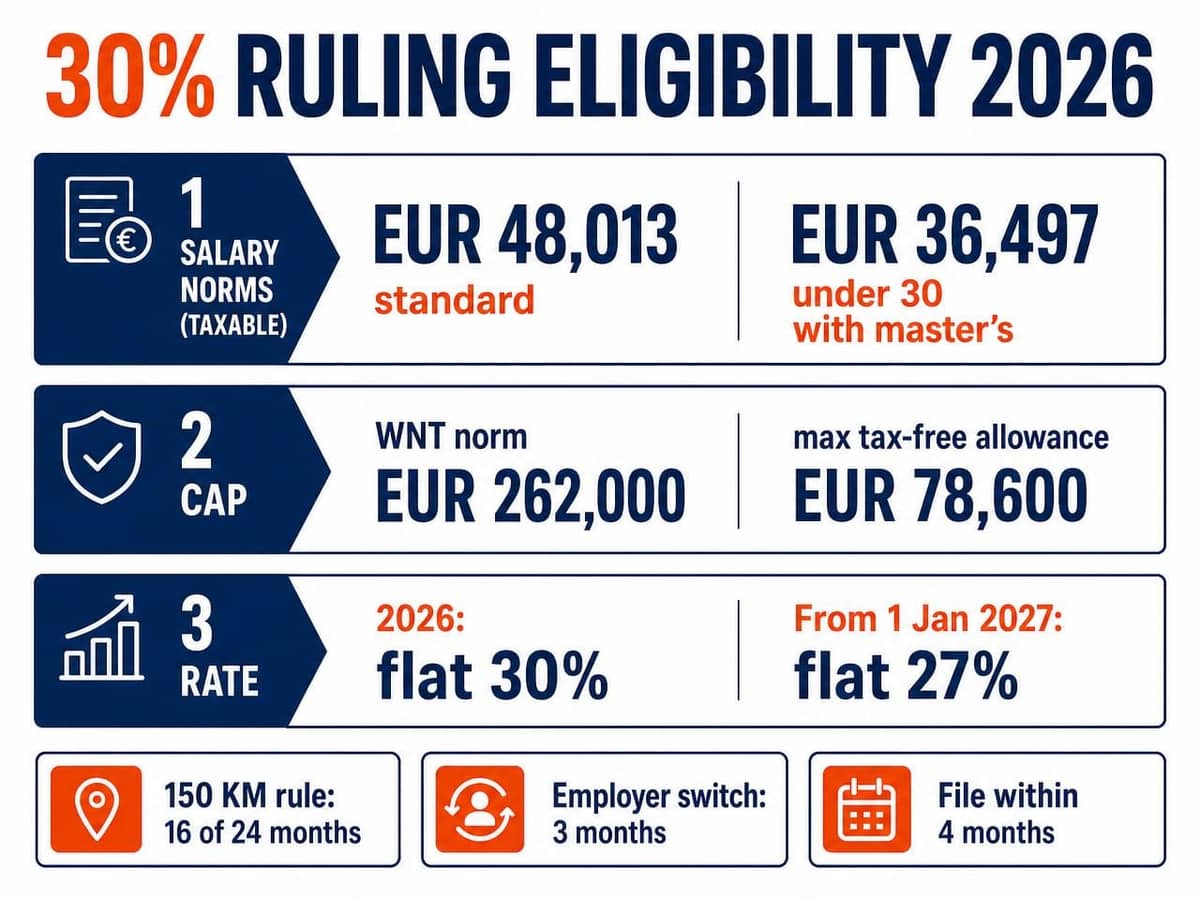
- The 2026 standard taxable salary norm is EUR 48,013, measured after the tax-free allowance has been deducted.
- The reduced norm for employees under 30 holding a qualifying master's degree is EUR 36,497 for 2026.
- There is no 30/20/10 phase-down. The tapering scheme announced in the 2024 Tax Plan was reversed before it was ever applied. For 2026 the exemption is a flat maximum of 30% for the full term.
- From 1 January 2027 the maximum drops to a flat 27% for the entire five-year period, and the salary norms increase, for employees who first used the facility from 1 January 2025 onward.
- Since 1 January 2026 the allowance is capped for every employee at 30% of the WNT (Balkenende) norm of EUR 262,000, giving a maximum tax-free allowance of EUR 78,600 for a full year. The transitional exemption from this cap has expired.
- The employee must have lived more than 150 kilometres from the Dutch border for more than 16 of the 24 months preceding their first working day.
- On an employer change, the gap between the end of the previous employment and the conclusion of the new contract must not exceed three months, and a joint application must be filed within four months of the new start date.
Understanding the 30% Ruling: A Strategic Advantage for Dutch Employers
The 30% ruling, referred to in current Belastingdienst materials as the expatregeling, or expat scheme, is a facility that allows an employer to reimburse extraterritorial costs on a flat-rate basis rather than against receipts. Extraterritorial costs are the additional expenses an employee incurs by living outside their country of origin: double housing costs, home-leave travel, higher cost of living, and similar. In 2026 the facility remains the principal tax instrument for attracting internationally recruited specialists to the Dutch labour market. Applied correctly, it allows an employer to offer a materially higher net salary without increasing gross wage expenditure.
Two points are often misunderstood. First, the employer is not obliged to pass the full 30% to the employee; the percentage is a ceiling, and the actual allowance is a matter for the employment contract. Second, the choice between the flat-rate allowance and reimbursement of actual extraterritorial costs must be made for each calendar year, in the first pay period of that year, and it binds you for the whole year.
The mechanics also trip people up. The allowance is a maximum of 30% of the wage including the allowance, which is 30/70 of the wage excluding it. On a taxable salary of EUR 50,000 excluding the allowance, the maximum tax-free allowance is EUR 21,428, not EUR 15,000.
Why Eligibility Monitoring is Critical for Compliance
Compliance is a continuing obligation, not a one-off filing. The Belastingdienst requires the salary norm to be met in every year of the term. If taxable income drops below the applicable norm, through unpaid leave, a reduction in hours, or a change in remuneration structure, the facility ceases to apply for that year, and once lost in this way it cannot be revived in a later year even if the salary recovers. The consequence is an incorrect wage tax return, a correction obligation, and a retroactive liability that sits with the employer.
There is one important protection: where the wage is lower because of parental leave, maternity leave, birth leave, supplementary birth leave, foster care leave or adoption leave, you assess the norm against the wage the employee would have received without that leave.
The 2026 Regulatory Landscape for International Hires
Three things distinguish 2026 from the years around it, and all three matter for planning.
The flat rate is 30%, and there is no taper. The 30/20/10 tapering scheme introduced by the 2024 Tax Plan was largely reversed by the 2025 Tax Plan at the request of both chambers of parliament, before it was ever applied in payroll practice. For 2025 and 2026 the maximum flat rate is 30% for all incoming employees.
The cap is now universal. Since 1 January 2026 the allowance may only be calculated over remuneration up to the WNT norm, set at EUR 262,000 for 2026. That produces a maximum tax-free allowance of EUR 78,600 for an employee who uses the facility for a full calendar year, pro-rated for partial years. The transitional relief that had exempted long-standing beneficiaries from this cap ended on 1 January 2026, so employees who were previously unaffected will see a change this year. Inform them before the first affected payslip.
2027 brings a step change. From 1 January 2027 the maximum flat rate falls to 27% for the whole 60-month term, and the salary norms increase, to EUR 50,436 and EUR 38,338 respectively, expressed in 2024 prices and indexed annually. This applies to employees who first used the facility from 1 January 2025 onward. Employees for whom the facility was applied in the final pay period of 2023 retain 30% and the existing norms under transitional law. If you are hiring in 2026, model the 2027 position now, because the employee's net pay will change during their term.
A separate development worth noting, though it concerns the classification of self-employed contractors rather than the expat scheme: the clarification component of the VBAR bill was withdrawn by nota van wijziging in March 2026. What survived and became law is the Wet invoering rechtsvermoeden van arbeidsovereenkomst op basis van uurtarief, which introduces a rebuttable presumption of employment where the hourly rate falls below the applicable threshold (approximately EUR 38 on the 1 January 2026 reference date, indexed annually). It enters into force on 31 December 2026. Organisations that mix international employees with contractors should review their contractor rates and working arrangements before that date, alongside the wider rules on employment law in the Netherlands for foreign employers.
Finally, one point relevant to income tax rather than payroll: the option of partial non-resident taxpayer status was abolished with effect from 2025. Employees who used the facility before 2024 may rely on it through their 2026 return at the latest under transitional law; the transitional regime ends on 1 January 2027.
Core Eligibility Criteria: The Five Pillars of the Expat Scheme
The eligibility conditions are legal requirements, not guidelines, and the Belastingdienst applies them strictly. Five conditions must all be satisfied.
- 1. Formal employment. The employee must be in a formal employment relationship with a Dutch withholding agent. This can be a Dutch entity or an Employer of Record arrangement acting as the formal employer and withholding agent.
- 2. Recruitment from abroad. The employee must have been recruited from another country, or seconded to a Dutch withholding agent from within an international group. In practice this means the recruitment and the conclusion of the employment relationship take place while the employee is still living abroad. Residents of Aruba, Curacao, Sint Maarten and the BES islands also count as recruited from abroad.
- 3. Specific expertise. The employee must possess expertise that is scarce or unavailable on the Dutch labour market. The salary norm functions as the statutory proxy for this test in the great majority of cases; a separate qualitative assessment applies only in the exempt categories described below.
- 4. Geographic distance. The employee must satisfy the 150-kilometre residence requirement in the 24 months before their first working day.
- 5. A valid decision. The employer and employee must file a joint application and hold a valid beschikking from the Belastingdienst. The application must be submitted within four months of the first working day for the facility to apply from day one. The Belastingdienst normally responds within eight weeks.
The Salary Threshold: 2026 Requirements and Calculations
For 2026 the standard taxable salary norm is EUR 48,013. This is the taxable annual wage remaining after the tax-free allowance has been deducted, which means the gross salary required to sustain a full 30% allowance is approximately EUR 68,590. If the gross salary is insufficient to leave EUR 48,013 taxable after the allowance, the employee does not meet the 30 percent ruling eligibility criteria, but note that you may still apply a reduced allowance, so long as the taxable remainder stays above the norm. Detailed figures are set out in our 30% ruling salary requirements reference guide.
The norm is indexed annually. Budget for an increase each January, and build a review point into your annual salary cycle for every employee on the facility.
The 150km Distance Rule and Prior Residency Restrictions
The employee must have lived at a distance of more than 150 kilometres from the Dutch border for more than two-thirds of the 24 months preceding the start of employment in the Netherlands, in practice more than 16 of those 24 months. Exactly 16 months does not satisfy the test. The distance is measured in a straight line from the nearest point of the Dutch land border, excluding Dutch territorial waters and the exclusive economic zone. In practical terms this excludes residents of Belgium and Luxembourg entirely, and residents of parts of Germany, France and the United Kingdom.
Separately, periods of prior residence or work in the Netherlands within the preceding 25 years are deducted from the maximum five-year term. There are statutory de minimis exceptions: periods of work totalling no more than 20 days per year, and private stays such as holidays or family visits totalling no more than six weeks per year or a single uninterrupted period of no more than three months, are disregarded. Ask candidates for a full 25-year history before you make an offer that assumes a five-year benefit; a prior assignment they have forgotten about can shorten the term materially.
Special Eligibility Categories: PhDs, Researchers, and Young Professionals
The Dutch system provides concessions for academic and medical roles where value is delivered ahead of peak earnings. These are integral parts of the eligibility framework rather than discretionary exceptions, but every candidate in a special category still requires a joint application and a valid decision.
For PhD holders, the residence requirement is applied with a specific flexibility: the 150-kilometre test is assessed over the 24 months preceding the start of the PhD research, rather than the 24 months preceding the subsequent employment. This provision applies only where the doctorate was obtained in the Netherlands and the employment begins within twelve months of completing the degree. Without it, researchers would be disqualified by the very fact of having lived in the Netherlands while studying.
Lower Salary Thresholds for Master Graduates Under 30
For 2026 the reduced taxable salary norm for employees under 30 who hold a Dutch academic master's degree, or an equivalent foreign degree, is EUR 36,497. As with the standard norm, this is the taxable figure after the allowance.
Two operational points. First, equivalence of foreign degrees must be established; assessment through Nuffic is the usual route. Second, the reduced norm applies up to and including the month in which the employee turns 30. From the month following their 30th birthday, the standard norm of EUR 48,013 applies. If the salary is not adjusted in time, the facility ceases to apply. Diarise every under-30 beneficiary's 30th birthday at the point of onboarding.
Exemptions for Scientific Research and Medical Training
No salary norm applies to employees engaged in scientific research or scientific education at a designated research institution, as defined by reference to the Aliens Decree 2000. This covers Dutch universities and recognised publicly funded research institutes. The same exemption applies to doctors in training to become specialists, where the training takes place at an institute designated by the Registratiecommissie Geneeskundig Specialisten (RGS). In both cases the salary hurdle is removed, but every other condition, including recruitment from abroad, the 150-kilometre test and the valid decision, must still be satisfied.
Eligibility Maintenance and Employment Changes
Securing the decision is the first phase, not the whole task. The 30 percent ruling eligibility criteria must be satisfied throughout the term, and career transitions must follow a precise sequence.
The Impact of Salary Fluctuations on Continued Eligibility
Assess the salary norm annually and after any change in remuneration or hours. If annual taxable salary falls below the applicable norm, the facility ceases to apply for that year and cannot be revived later. Two rules govern how the norm is measured, and they are frequently conflated:
- Partial calendar years are pro-rated. If employment starts or ends mid-year, the norm is reduced in proportion to the part of the year worked.
- Part-time hours are not pro-rated. A part-time employee must reach the full annual norm on their part-time salary. The requirement is not scaled down to reflect a reduced contract.
This distinction is the single most common source of failed part-time applications. Where a salary adjustment is agreed by addendum to maintain the norm, the payroll must actually reflect that addendum. If the recorded wage stays below the norm, the allowance has been paid free of tax without a basis, the returns filed for that year are incorrect, and a correction obligation follows.
Switching Employers: The Critical 3 Month Rule
When an employee moves to a new Dutch employer during the term, the facility can be continued, but the sequence is strict. The period between the end of the employment with the previous withholding agent and the conclusion of the employment contract with the new one must not exceed three months. Note that the trigger is the conclusion of the new contract, not the start date. The new employer must be a registered withholding agent for Dutch wage tax, must file a joint application with the employee, and must independently demonstrate that the employee still qualifies as an incoming employee. The facility is not transferred; a fresh decision is issued for the remaining term. For organisations hiring without a local legal entity, an Employer of Record in the Netherlands can act as that withholding agent.
Operational steps for a compliant transition:
- Step 1: Confirm the new employment contract is concluded within three months of the end date of the previous employment.
- Step 2: Re-verify that the taxable salary in the new role meets the applicable 2026 norm, EUR 48,013, or EUR 36,497 where the reduced norm still applies.
- Step 3: File a joint application with the Belastingdienst within four months of the first working day with the new employer, so the facility applies from day one.
- Step 4: Configure payroll for a flat 30% for 2026, subject to the EUR 262,000 remuneration cap, and record the original grant date so the remaining term and the 2027 transition are handled correctly.
Where an employee moves between entities within the same samenhangende groep inhoudingsplichtigen, a new application may not be required. Confirm the group's status before assuming either way. If you are onboarding a candidate who already holds the ruling, request a 30% ruling transfer assessment from ICSPayroll to secure their tax status without administrative delays.
Securing the 30% Ruling via ICSPayroll Expert Support
Management of the expat scheme forms part of our Dutch payroll and Employer of Record services. We handle the application end to end, from eligibility assessment before an offer is made through to the annual monitoring that keeps the facility intact. Our work includes the salary split calculation, the annual flat-rate-versus-actual-costs election, and the cap calculation now that it applies to every employee. Employment costs, social security contributions and tax-free allowances are consolidated into a single monthly invoice.
- Specialist review: Every application is reviewed internally before submission, with the aim of a first-time approval.
- Compliance monitoring: We track the applicable norm per employee, flag the 30th-birthday transition for under-30 beneficiaries, and prepare clients for the 2027 change to 27% and the raised norms.
- Administrative relief: We manage correspondence with the tax authorities, removing the burden from internal HR and finance teams.
- Current data: Our calculations use the applicable 2026 figures, including the minimum hourly wage of EUR 14.99 gross for employees aged 21 and over as from 1 July 2026, and the current social security parameters.
Streamlining the Application with Joost Hubregtse Team
The payroll department is led by Joost Hubregtse, Payroll Director, who works at the intersection of Dutch labour law and international tax practice. The team provides tailored quotations for new international hires within 24 hours, which allows recruitment teams to present a concrete net salary figure early in a negotiation.
To be clear about scope: we manage the payroll and wage tax components. Immigration sponsorship is arranged through our licensed partner, so that the tax facility and the residence permit are each handled by specialists. The two regimes are assessed separately and have different criteria, and a highly skilled migrant permit does not confer entitlement to the expat scheme, or vice versa.
Reviewed by: Joost Hubregtse, Director, ICS Staffing & Payroll. Legally reviewed by Zishan Hussain, labour law lawyer.
Last reviewed against current legislation: 28 July 2026
Integrating the Ruling into Compliant Dutch Payroll
A granted decision must be reflected correctly on the monthly payslip to remain valid. The tax-free allowance must be shown separately from the taxable salary, with the taxable remainder held above the applicable norm across the year. We also administer the statutory holiday allowance of at least 8% of gross wage, and the employer contributions, including AWf and Aof, which are employee insurance premiums administered in connection with UWV, and the Zvw employer contribution, which is a healthcare levy paid to the Health Insurance Fund rather than a UWV premium.
On retention: the payroll administration must be kept for seven years. Certain records, the copy of the identity document and the employee's data for wage taxes, must be kept for at least five full calendar years after the end of the employment, which can run beyond the seven-year term. We maintain both.
Secure Your Competitive Advantage in the 2026 Dutch Market
Applying the expat scheme correctly in 2026 comes down to a small number of figures and one date. The figures are EUR 48,013, EUR 36,497, and the EUR 262,000 cap that now applies to everyone. The date is 1 January 2027, when the rate falls to 27% and the norms rise for employees who first used the facility from 2025 onward. Add the 150-kilometre test, the three-month gap rule and the four-month filing window, and you have the whole compliance surface.
Our team can assess a specific candidate's eligibility and produce a net pay projection, including the 2027 position, within 24 hours. You can get a tailored 30% ruling quotation within 24 hours to confirm the eligibility and net take-home pay for your next candidate.
Frequently Asked Questions
What is the minimum salary for the 30% ruling in 2026?
The standard taxable salary norm for 2026 is EUR 48,013, the amount remaining after the tax-free allowance has been deducted. For employees under 30 with a qualifying academic master's degree, the reduced taxable norm is EUR 36,497. Both figures are indexed annually. From 1 January 2027 the norms increase, to EUR 50,436 and EUR 38,338 in 2024 prices, for employees who first used the facility from 1 January 2025 onward.
Is the allowance still 30% in 2026, or has it been reduced?
It is 30% in 2026. The 30/20/10 tapering scheme announced in the 2024 Tax Plan was reversed before it was ever applied, and a flat maximum of 30% applies for 2025 and 2026. From 1 January 2027 the maximum becomes a flat 27% for the entire five-year term. Employees for whom the facility was applied in the last pay period of 2023 keep 30% for their full term under transitional law.
Is there a cap on the tax-free allowance?
Yes. Since 1 January 2026 the allowance may only be calculated over remuneration up to the WNT norm, set at EUR 262,000 for 2026, giving a maximum tax-free allowance of EUR 78,600 for a full calendar year and a pro-rated amount for part-years. The transitional exemption from this cap expired on 1 January 2026, so it now applies to every beneficiary.
Can remote workers qualify for the Dutch 30% ruling?
An employee who remains resident outside the Netherlands and performs their work abroad does not qualify. The facility compensates the extraterritorial costs of relocating to and living in the Netherlands, so the employee must be recruited from abroad and relocate to perform their duties here. Limited working days abroad during a Dutch assignment are a separate question and depend on the facts.
What happens to the 30% ruling if I change employers?
The facility can continue if the new employment contract is concluded within three months of the end of the previous employment. The new employer must be a registered withholding agent, must file a joint application with the employee, and must again demonstrate that the employee qualifies as an incoming employee. File within four months of the new start date for the facility to apply from day one. If the three-month window is missed, the facility is lost.
Does the 150km rule apply to PhD graduates?
It does, but the assessment period is different. For someone who obtained their doctorate in the Netherlands, the 150-kilometre test is applied to the 24 months preceding the start of the PhD research rather than the employment. The employment must begin within twelve months of completing the degree.
How long does the 30% ruling last in 2026?
The maximum term is five years, or 60 months, counted from the first working day in the Netherlands. Periods of prior residence or work in the Netherlands in the preceding 25 years are deducted, subject to de minimis exceptions for limited working days and short private stays. There is no phase-down within the term: for 2026 the rate is a flat 30%, and from 2027 it is a flat 27% for the remainder of the term for those not covered by transitional law.
Does the 30% ruling apply to part-time employees?
Yes, provided the part-time salary itself reaches the full annual norm. The norm is not reduced to reflect part-time hours. It is pro-rated only where employment starts or ends partway through a calendar year. This distinction accounts for a large share of rejected part-time applications.
Can I apply for the 30% ruling retroactively?
The application must be filed within four months of the first working day for the facility to apply from day one. If it is filed later, the decision takes effect from the first day of the month following the month of application, and the benefit for the intervening period is permanently lost.
Do I need a Dutch BV to apply for the 30% ruling for my staff?
No. An Employer of Record can act as the formal employer and withholding agent and file the application on your behalf, which allows a foreign company to offer the facility without incorporating locally. Immigration sponsorship, where required, is arranged through our licensed partner.
Sources and references
Every rule and figure above is traceable to the sources below: the exact statutory articles, the regulator pages that publish the amounts, the statistical datasets, and the specific court rulings that settle the point. Always check the current text for your own situation.
- Article 31a Wage Tax Act 1964, extraterritorial costs and the 30% ruling (now capped at 27%)
- Article 2.10 Income Tax Act 2001, the income tax bracket rates
- Article 7:610 Dutch Civil Code, definition of the employment contract
- Belastingdienst, the 30% facility for incoming employees: conditions and salary norms
- IND, required gross monthly salary amounts for 2026 per permit category
- Belastingdienst, payroll tax tables 2026 (white and green tables with the actual withholding percentages)
- CBS, Compensation of employees and employment by economic activity (national accounts dataset 84165ENG)
- CPB Netherlands Bureau for Economic Policy Analysis, wage and contract-cost projections
- Supreme Court 13 February 2026, ECLI:NL:HR:2026:247: art. 31a Wage Tax Act and the transitional rules on shortening the 30% ruling
- Supreme Court 24 March 2023, ECLI:NL:HR:2023:443 (Deliveroo): the test for qualifying a relationship as an employment contract under art. 7:610 BW

Article by
Joost Hubregtse
Joost Hubregtse is Director of ICS Staffing & Payroll B.V., the wholly owned subsidiary of Intercompany Solutions behind ICS Payroll. He is responsible for Employer of Record and Dutch payroll services: employment contracts, wage tax and social security filings, holiday allowance, pension, sick leave and CAO compliance, with onboarding possible within 48 hours.

Frequently Asked Questions
The standard taxable salary norm for 2026 is EUR 48,013, the amount remaining after the tax-free allowance has been deducted. For employees under 30 with a qualifying academic master's degree, the reduced taxable norm is EUR 36,497. Both figures are indexed annually. From 1 January 2027 the norms increase, to EUR 50,436 and EUR 38,338 in 2024 prices, for employees who first used the facility from 1 January 2025 onward.
It is 30% in 2026. The 30/20/10 tapering scheme announced in the 2024 Tax Plan was reversed before it was ever applied, and a flat maximum of 30% applies for 2025 and 2026. From 1 January 2027 the maximum becomes a flat 27% for the entire five-year term. Employees for whom the facility was applied in the last pay period of 2023 keep 30% for their full term under transitional law.
Yes. Since 1 January 2026 the allowance may only be calculated over remuneration up to the WNT norm, set at EUR 262,000 for 2026, giving a maximum tax-free allowance of EUR 78,600 for a full calendar year and a pro-rated amount for part-years. The transitional exemption from this cap expired on 1 January 2026, so it now applies to every beneficiary.
An employee who remains resident outside the Netherlands and performs their work abroad does not qualify. The facility compensates the extraterritorial costs of relocating to and living in the Netherlands, so the employee must be recruited from abroad and relocate to perform their duties here. Limited working days abroad during a Dutch assignment are a separate question and depend on the facts.
The facility can continue if the new employment contract is concluded within three months of the end of the previous employment. The new employer must be a registered withholding agent, must file a joint application with the employee, and must again demonstrate that the employee qualifies as an incoming employee. File within four months of the new start date for the facility to apply from day one. If the three-month window is missed, the facility is lost.
It does, but the assessment period is different. For someone who obtained their doctorate in the Netherlands, the 150-kilometre test is applied to the 24 months preceding the start of the PhD research rather than the employment. The employment must begin within twelve months of completing the degree.
The maximum term is five years, or 60 months, counted from the first working day in the Netherlands. Periods of prior residence or work in the Netherlands in the preceding 25 years are deducted, subject to de minimis exceptions for limited working days and short private stays. There is no phase-down within the term: for 2026 the rate is a flat 30%, and from 2027 it is a flat 27% for the remainder of the term for those not covered by transitional law.
Yes, provided the part-time salary itself reaches the full annual norm. The norm is not reduced to reflect part-time hours. It is pro-rated only where employment starts or ends partway through a calendar year. This distinction accounts for a large share of rejected part-time applications.
The application must be filed within four months of the first working day for the facility to apply from day one. If it is filed later, the decision takes effect from the first day of the month following the month of application, and the benefit for the intervening period is permanently lost.
No. An Employer of Record can act as the formal employer and withholding agent and file the application on your behalf, which allows a foreign company to offer the facility without incorporating locally. Immigration sponsorship, where required, is arranged through our licensed partner.