Dutch Payroll for Tech Startups: Scaling in the 2026 Regulatory Landscape
By Joost Hubregtse, Director, ICS Staffing & Payroll
All blog posts are reviewed and fact checked by our labour law lawyer Zishan Hussain and our director. Editorial standards
By Joost Hubregtse, Payroll Director. Expert in Dutch labor law and international employment compliance. Reviewed on August 14, 2026.
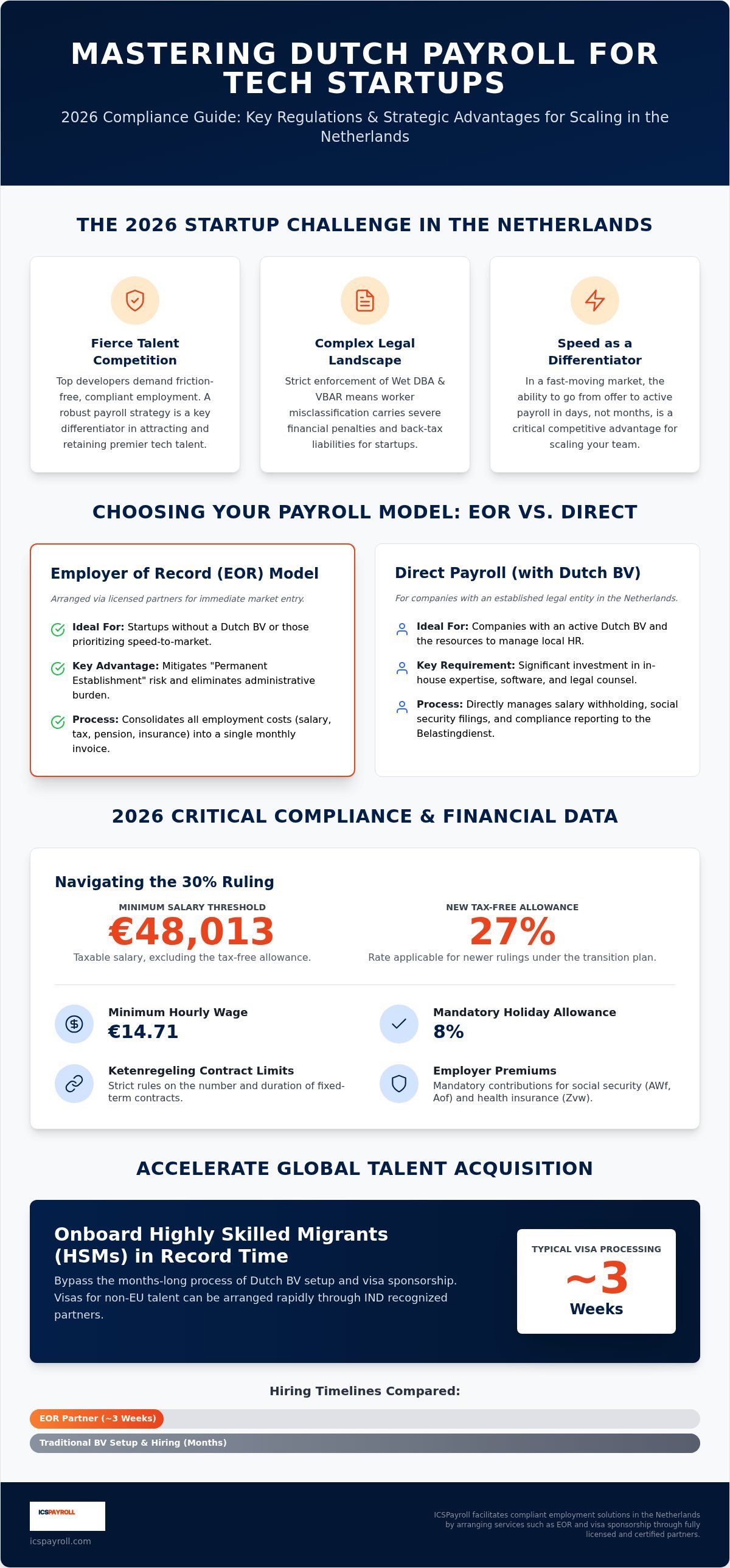
In 2026, a robust strategy for Dutch payroll for tech startups is your most aggressive talent acquisition tool rather than a back-office function. You already know that the competition for developers in the Netherlands is fierce. The administrative burden of local labor law often acts as a barrier to the speed your startup requires to scale. This guide demonstrates how to master your payroll obligations by navigating the 2026 reforms to the 30% ruling, new salary thresholds, and the enforcement of the Wet DBA. You'll learn to expand your team rapidly while maintaining full compliance with current tax and pension rates. We will examine the €48,013 salary threshold for 2026, the upcoming transition to a 27% tax-free rate, and the specific steps to onboard highly skilled migrants in weeks via licensed partners. By consolidating employment costs into a single monthly invoice, you can prioritize growth and product-market fit over complex bureaucracy.
Key Takeaways
- Understand how the 2026 regulatory environment impacts talent acquisition and why compliance is a competitive advantage for growing firms.
- Master the complexities of Dutch payroll for tech startups by identifying the differences between local payroll administration and the Employer of Record model.
- Navigate the updated 30% ruling requirements, including the new €48,013 salary threshold and the transition to a 27% tax-free allowance.
- Ensure full adherence to 2026 labor laws, such as the €14.71 minimum hourly wage and the strict Ketenregeling contract limits.
- Accelerate team expansion by arranging Highly Skilled Migrant visas through licensed partners in as little as three weeks.
The 2026 Landscape for Tech Startup Payroll in the Netherlands
The Dutch tech ecosystem continues to expand in 2026, yet the regulatory environment has reached a peak of complexity. For founders, managing Dutch payroll for tech startups is no longer just a financial calculation; it's a strategic necessity. The full enforcement of the Wet DBA and the implementation of the VBAR (Verduidelijking Beoordeling Arbeidsrelaties en Rechtsvermoeden) mean that the distinction between contractors and employees is strictly monitored. Startups that fail to classify workers correctly face significant back-tax liabilities and penalties. Success in this market requires a deep understanding of the Dutch tax system overview, where payroll taxes are integrated with national insurance premiums. Compliance is now a pillar of talent retention, as skilled workers prioritize the security of a correctly managed employment contract.
The Talent War and Remote Work Compliance
Top-tier developers expect a friction-free employment experience. They want more than just a high salary; they demand a compliant structure that protects their social security rights and 30% ruling eligibility. Startups often hire remote Dutch employees before establishing a local entity, which creates a risk of "Permanent Establishment." A taxable presence may be claimed by the Dutch tax authorities if this risk is not managed through a Dutch BV or a legal alternative. Utilizing a local payroll partner helps mitigate these liabilities. Specialized HR administration ensures that remote workers are integrated into the Dutch social security system without the need for the parent company to navigate the Belastingdienst alone. Both the employer and the employee gain the peace of mind necessary for long-term collaboration.
Hiring Speed as a Competitive Advantage
In a market where the best candidates receive multiple offers, speed is the ultimate differentiator. Tech startups often need to go from an offer letter to active payroll in a matter of days. Agility of this nature is only possible when you bypass the months-long process of setting up a Dutch BV. By utilizing an Employer of Record model, arranged via licensed partners, companies can start hiring immediately. International founders find that this approach removes the administrative friction of entering the Dutch market. Efficiency starts with transparency. Receiving a tailored quotation within 24 hours allows CFOs to forecast costs accurately. The process is further streamlined so that Highly Skilled Migrant (HSM) visas, arranged via licensed partners, are typically granted within three weeks. Every hire remains legally sound because this consolidated model covers:
- The mandatory 8% holiday allowance.
- Specific 2026 employer contributions for AWf and Aof premiums.
- Automated sickness risk management and pension contributions.
Choosing the Right Model: EOR vs. Local Payroll for Startups
Deciding how to manage Dutch payroll for tech startups requires a choice between two distinct operational models. For international founders, the primary question is whether they intend to incorporate a local Dutch BV immediately. If your priority is speed and market entry without a legal entity, the Employer of Record (EOR) model is the standard solution. This allows you to hire locally while avoiding the risk of a "Permanent Establishment" before you're ready. Conversely, if a Dutch BV is already active, direct payroll administration provides a streamlined way to manage salary withholding and social security contributions through your own entity.
When evaluating costs, startups should look beyond the monthly fee. The payroll factor pricing model is transparent and predictable. It often proves more cost-effective than building an internal HR department. Managing payroll internally requires significant investment in specialized software, legal counsel, and insurance brokers. By outsourcing, you shift the administrative burden to experts who ensure that every calculation, from social security premiums to the 8% holiday allowance, is accurate and compliant with the 2026 landscape.
The Employer of Record Advantage
The EOR model acts as the legal employer of your staff in the Netherlands. This structure removes the administrative burden from your parent company by consolidating all employment costs into one monthly invoice. This invoice covers gross salary, pension contributions, and mandatory social security premiums. A significant benefit is the management of sickness risk. In the Netherlands, employers are responsible for up to two years of sick pay and reintegration. An EOR, arranged via licensed partners, manages these complex legal obligations on your behalf. It's a reliable approach that provides total legal security for international firms.
Scaling with a Local Dutch Partner
Choosing a local expert over a generic global provider ensures that your team receives specialized support tailored to the specificities of the Dutch market. Local partners provide an online employee portal, which is a baseline expectation for modern tech teams. This portal allows employees to view payslips and manage holiday requests easily. You must also ensure that Critical Compliance: Minimum Wage standards are met. As of January 1, 2026, the statutory hourly minimum wage for employees aged 21 and over is €14.71. Beyond the hourly rate, you must account for the mandatory 8% holiday allowance and potential transition payments, which are capped at €102,000 in 2026. If you're unsure which model fits your current growth stage, you can request a tailored quotation to compare the operational impact of each approach.
Navigating the 30% Ruling and 2026 Salary Thresholds
The 30% ruling remains the most effective lever for Dutch payroll for tech startups looking to secure international engineering talent. It's a significant tax advantage that allows eligible employees to receive a portion of their gross salary tax-free. However, 2026 brings structural changes that require careful planning. The most notable shift is the abolition of the partial non-resident taxpayer status. Previously, expats could opt to be treated as non-residents for Box 2 and Box 3 taxes, effectively shielding foreign assets from Dutch taxation. This is no longer an option. ICSPayroll facilitates these applications to ensure both the employer and employee meet the strict eligibility criteria while maintaining full compliance with the updated tax code.
2026 Salary Requirements for Highly Skilled Migrants
To qualify for the 30% ruling, employees must meet specific taxable salary thresholds that are indexed annually. For 2026, the standard taxable salary must be at least €48,013 after the tax-free allowance is applied. There is a specific exception for younger professionals to help startups attract emerging talent. Employees under the age of 30 who hold a qualifying Master's degree are subject to a lower threshold of €36,497. You must monitor these figures closely; failing to meet the threshold in a single month can result in the permanent loss of the ruling for that employee. For the most current figures and detailed conditions, refer to the official belastingdienst.nl guidelines.
Managing the Transition to the 27% Rate
The 2026 landscape is defined by the transition from the traditional 30% benefit to a reduced rate. Under current legislative frameworks, new rulings in 2026 are subject to the 27% tax-free allowance rate as part of a broader standardization of expat benefits. This shift requires updated compensation planning for your incoming team members. For employees whose rulings were granted before 2024, transitional law may still apply, allowing them to retain the 30% rate for their remaining duration. Accurate "Loonaangifte" (payroll tax return) filings are essential to reflect these varying rates correctly across your workforce.
We ensure that your payroll administration accounts for the Balkenende norm cap, which limits the tax-free benefit to a maximum salary of €262,000 in 2026. Salaries exceeding this amount don't receive the tax-free allowance on the excess portion. This level of technical precision prevents costly audits and ensures that your international hires receive their expected net compensation without delay. Managing these nuances is a core component of Dutch payroll for tech startups that prioritize long-term stability and employee trust.
Critical Compliance: Minimum Wage and Labor Law Reforms
Maintaining compliance within the Dutch labor market is a non-negotiable requirement for sustainable growth. As of January 1, 2026, the statutory minimum hourly wage for employees aged 21 and over is €14.71. While tech salaries typically far exceed this floor, this figure remains the legal benchmark for all statutory payroll calculations. Beyond wages, you must strictly adhere to the "Ketenregeling." This regulation dictates that an employee can receive a maximum of three fixed-term contracts over a three-year period. Once these limits are reached, the contract automatically converts to a permanent agreement. Precision in your initial offer and subsequent renewals prevents unintended long-term liabilities.
Your employment agreements must also reflect the 2026 standards for probation periods and non-compete clauses. Recent reforms require employers to provide specific, written justifications for non-compete restrictions, often including a mandatory compensation component. If an employment relationship ends at the employer's initiative, the employee is generally entitled to a transition allowance (transitievergoeding). For 2026, this payment is capped at €102,000. Managing these details requires a high level of administrative precision to avoid the penalties associated with the Wet DBA and VBAR enforcement. Using a structured approach to Dutch payroll for tech startups ensures these legal nuances are handled before they become liabilities.
Mandatory Benefits and Employer Contributions
Dutch payroll for tech startups involves several mandatory costs beyond the gross salary. You're legally required to pay a holiday allowance of at least 8% of the annual gross salary. Additionally, most tech sectors require a robust pension scheme to remain competitive. A typical employer contribution is approximately 15.2% of the pensionable salary. Employers are also responsible for national insurance premiums, which include:
- AWf (General Unemployment Fund): Premiums that vary based on whether the contract is permanent or fixed-term.
- Aof (Disability Insurance Fund): Contributions that support the national disability insurance system.
- Zvw (Healthcare Insurance Act): A mandatory employer-paid percentage for the employee's healthcare coverage.
Sick Leave and Reintegration Guidance
The Netherlands has one of the most protective sick-leave policies in the world. If an employee falls ill, you're responsible for continuing their salary for up to two years. You must also follow the Gatekeeper Act (Wet Verbetering Poortwachter), which mandates specific reintegration steps and reporting deadlines. Failure to comply can lead to a third year of mandatory wage payments imposed by the UWV. An EOR, arranged via licensed partners, manages this entire process. They provide professional sick-leave support and handle the complex administrative requirements of the Gatekeeper Act on your behalf. This protective layer is essential for startups that don't have a dedicated local HR team. To ensure your contracts meet these 2026 standards, request a tailored quotation to see how we manage these risks for you.
Scaling Faster with ICSPayroll: The Local EOR Advantage
Scaling a tech venture requires moving at the speed of the market. You shouldn't be slowed down by the administrative friction of entity incorporation or the complexities of local labor law. ICSPayroll provides a structured, one-stop solution for Dutch payroll for tech startups that prioritizes both speed and legal security. Our operational setup is ready in days, allowing you to begin hiring in weeks rather than months. These EOR and payroll services, arranged via licensed partners, ensure every contract is fully compliant with the 2026 regulatory framework without the overhead of a Dutch BV.
Expedited Visa and Onboarding Support
Attracting non-Schengen talent is a critical component of growth for most Dutch tech firms. We manage the intricacies of the IND sponsorship process by arranging Highly Skilled Migrant (HSM) visas via licensed partners. These visas are typically granted within three weeks, providing your new hires with a predictable timeline. Our onboarding support includes providing a comprehensive employee handbook and locally compliant Dutch employment contracts that protect your interests. For a deeper look at these requirements, see our Expanding to the Netherlands: The 2026 Hiring and Compliance Guide. This ensures your international team members are integrated into the Dutch system with total precision from their first day.
The ICSPayroll Service Commitment
Transparency is the foundation of our partnership. We utilize a payroll factor pricing model to ensure there are no surprise charges or hidden administrative fees. You receive one consolidated monthly invoice that covers all employment costs, including pension, holiday allowance, and sickness risk management. This model is designed specifically for startup CFOs who need clear, predictable forecasting for Dutch payroll for tech startups. While our technology is advanced, our support remains human-led. You'll work directly with local Dutch payroll experts who understand the nuances of the 2026 landscape. To compare our approach with other providers, consult our Best Local Employer of Record (EOR) in the Netherlands: 2026 Buying Guide. We remove the administrative burden so you can focus on building your product and scaling your team.
Secure Your Growth in the 2026 Dutch Tech Market
Mastering Dutch payroll for tech startups in 2026 requires more than administrative accuracy; it demands a strategic approach to the latest tax reforms and labor regulations. You've seen how the new €48,013 salary threshold and the transition to the 27% tax-free rate impact your ability to attract international talent. By leveraging an Employer of Record model, you bypass the delays of entity incorporation and ensure full compliance with 2026 Dutch labor law from day one. This proactive stance protects your venture from the risks associated with the Wet DBA while providing the security your employees expect.
Our local expertise allows you to onboard highly skilled migrants with HSM visa processing, arranged via licensed partners, typically granted within three weeks. You'll benefit from a single consolidated monthly invoice that covers all employment costs, including social security, pension, and sickness risk management. This streamlined approach removes the administrative burden, allowing you to focus on your core product and team culture. You can request a tailored Dutch payroll quotation within 24 hours to start your expansion with confidence. We look forward to helping your startup thrive in the Netherlands.
Frequently Asked Questions
What is the salary threshold for the 30% ruling in the Netherlands for 2026?
The standard taxable salary threshold for the 30% ruling in 2026 is €48,013. For employees under the age of 30 who hold a qualifying Master's degree, the threshold is reduced to €36,497. These figures are indexed annually and must be met every month to maintain eligibility. Failing to meet these thresholds can result in the permanent loss of the tax benefit for the employee.
Can a tech startup hire in the Netherlands without a local legal entity?
Yes, a tech startup can hire in the Netherlands without a local legal entity by utilizing an Employer of Record (EOR). This model allows you to manage Dutch payroll for tech startups compliantly while the EOR acts as the legal employer for your staff. It's a strategic solution for international founders who want to avoid the administrative burden of incorporating a Dutch BV.
How long does it take to process a Highly Skilled Migrant (HSM) visa?
Highly Skilled Migrant (HSM) visas are typically processed within approximately three weeks when arranged via licensed partners. This expedited timeline is essential for tech startups competing in a fast-paced talent market. The process includes managing the recognized sponsor status and the necessary residence permit applications with the IND to ensure your international hires can begin working without delay.
What are the mandatory employer contributions for Dutch payroll in 2026?
Mandatory employer contributions include social security premiums such as AWf, Aof, and Zvw, alongside the statutory 8% holiday allowance. Most tech companies also provide a pension scheme, where employer contributions often average 15.2% of the pensionable salary. You must also account for sickness risk insurance and the transition allowance reserve. These costs are consolidated into a single monthly invoice for total financial clarity.
How does the 27% tax-free allowance work under the new 30% ruling rules?
Under the 2026 regulatory landscape, new applications for the tax ruling are subject to a 27% tax-free allowance rate. This shift is part of a legislative move to standardize expat benefits over time. While the rate has decreased from the original 30%, it remains a powerful tool for attracting global talent. Transitional law generally protects those whose rulings were granted before the 2024 reforms were implemented.
What is the transition allowance cap for Dutch employees in 2026?
The maximum transition allowance (transitievergoeding) for Dutch employees is capped at €102,000 in 2026. This statutory payment is generally required if an employment contract is terminated at the employer's initiative or not renewed after a fixed term. The specific amount is calculated based on the employee's gross monthly salary and their total duration of service within the company according to current labor law.
Is a pension scheme mandatory for tech startup employees in the Netherlands?
A pension scheme isn't a universal statutory requirement for all Dutch companies, but it's a competitive necessity in the tech sector. Many startups are also subject to sector-specific Collective Labor Agreements (CAOs) that mandate pension participation. Providing a robust pension plan is essential for attracting high-level developers who expect a comprehensive Dutch benefits package as part of their standard employment agreement.
How does ICSPayroll handle sick pay obligations for startups?
ICSPayroll manages the complex two-year sick pay obligation and the associated reintegration requirements mandated by the Gatekeeper Act. These services, arranged via licensed partners, ensure that your startup remains compliant with all UWV reporting deadlines and assessment procedures. By outsourcing this administrative burden, you mitigate the risk of wage sanctions and ensure that ill employees receive professional support during their recovery and reintegration process.

Article by
Joost Hubregtse
Joost Hubregtse is Director of ICS Staffing & Payroll B.V., the wholly owned subsidiary of Intercompany Solutions behind ICS Payroll. He is responsible for Employer of Record and Dutch payroll services: employment contracts, wage tax and social security filings, holiday allowance, pension, sick leave and CAO compliance, with onboarding possible within 48 hours.

Frequently Asked Questions
The standard taxable salary threshold for the 30% ruling in 2026 is €48,013. For employees under the age of 30 who hold a qualifying Master's degree, the threshold is reduced to €36,497. These figures are indexed annually and must be met every month to maintain eligibility. Failing to meet these thresholds can result in the permanent loss of the tax benefit for the employee.
Yes, a tech startup can hire in the Netherlands without a local legal entity by utilizing an Employer of Record (EOR). This model allows you to manage Dutch payroll for tech startups compliantly while the EOR acts as the legal employer for your staff. It's a strategic solution for international founders who want to avoid the administrative burden of incorporating a Dutch BV.
Highly Skilled Migrant (HSM) visas are typically processed within approximately three weeks when arranged via licensed partners. This expedited timeline is essential for tech startups competing in a fast-paced talent market. The process includes managing the recognized sponsor status and the necessary residence permit applications with the IND to ensure your international hires can begin working without delay.
Mandatory employer contributions include social security premiums such as AWf, Aof, and Zvw, alongside the statutory 8% holiday allowance. Most tech companies also provide a pension scheme, where employer contributions often average 15.2% of the pensionable salary. You must also account for sickness risk insurance and the transition allowance reserve. These costs are consolidated into a single monthly invoice for total financial clarity.
Under the 2026 regulatory landscape, new applications for the tax ruling are subject to a 27% tax-free allowance rate. This shift is part of a legislative move to standardize expat benefits over time. While the rate has decreased from the original 30%, it remains a powerful tool for attracting global talent. Transitional law generally protects those whose rulings were granted before the 2024 reforms were implemented.
The maximum transition allowance (transitievergoeding) for Dutch employees is capped at €102,000 in 2026. This statutory payment is generally required if an employment contract is terminated at the employer's initiative or not renewed after a fixed term. The specific amount is calculated based on the employee's gross monthly salary and their total duration of service within the company according to current labor law.
A pension scheme isn't a universal statutory requirement for all Dutch companies, but it's a competitive necessity in the tech sector. Many startups are also subject to sector-specific Collective Labor Agreements (CAOs) that mandate pension participation. Providing a robust pension plan is essential for attracting high-level developers who expect a comprehensive Dutch benefits package as part of their standard employment agreement.
ICSPayroll manages the complex two-year sick pay obligation and the associated reintegration requirements mandated by the Gatekeeper Act. These services, arranged via licensed partners, ensure that your startup remains compliant with all UWV reporting deadlines and assessment procedures. By outsourcing this administrative burden, you mitigate the risk of wage sanctions and ensure that ill employees receive professional support during their recovery and reintegration process.