Expanding to the Netherlands: The 2026 Hiring and Compliance Guide
By Joost Hubregtse, Director, ICS Staffing & Payroll
All blog posts are reviewed and fact checked by our labour law lawyer Zishan Hussain and our director. Editorial standards
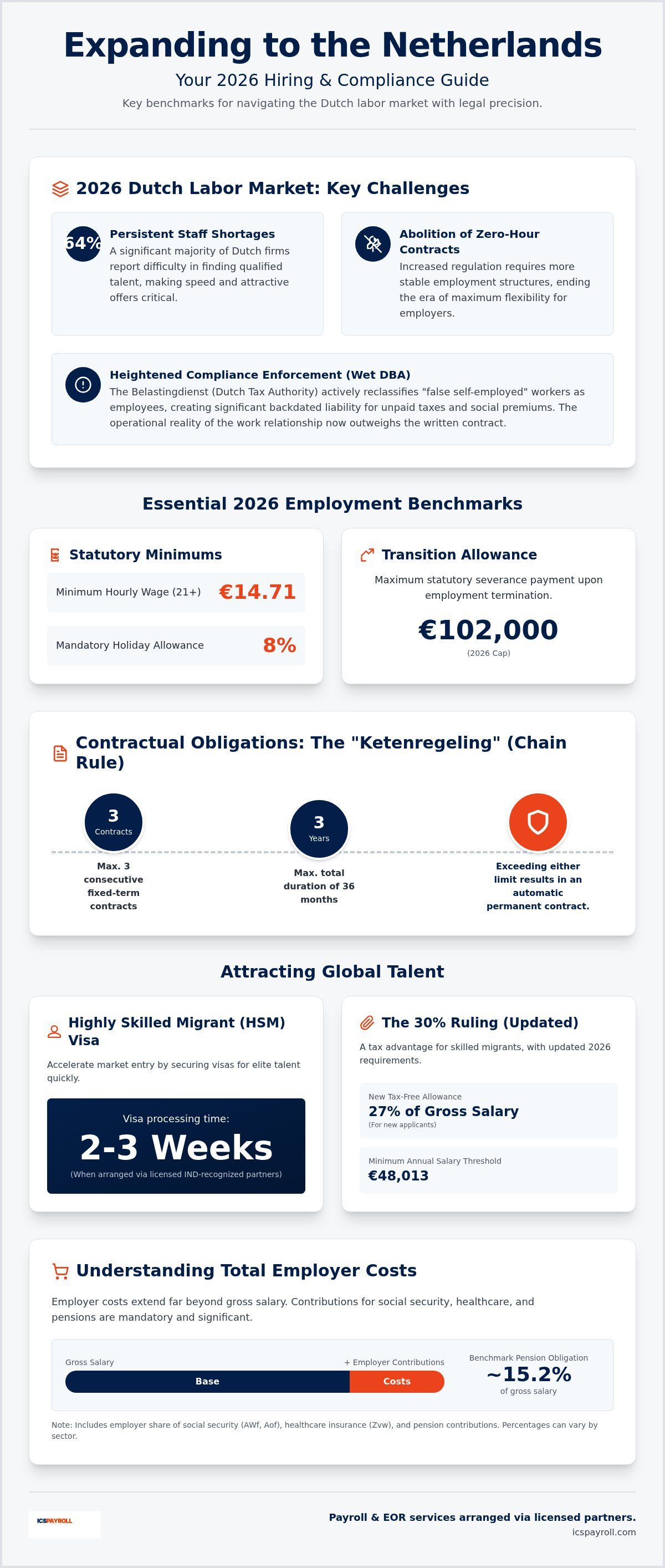
In 2026, 64% of Dutch firms are struggling with persistent staff shortages, yet the primary barrier to your expansion isn't finding talent; it's the escalating complexity of Dutch labor compliance. You recognize that the Netherlands offers a premier gateway to European markets, but the regulatory landscape has changed significantly. With the total abolition of zero-hour contracts and heightened enforcement against false self-employment under the Wet DBA, the risk of permanent establishment or legal penalties is a valid concern for any international board.
This expanding to Netherlands hiring guide provides the authoritative clarity required to navigate these shifts with confidence. We've synthesized the latest data to help you master the 2026 labor market, including the statutory minimum hourly wage of €14.71 and the updated 30% ruling salary threshold of €48,013. You'll learn how to attract elite talent through the Highly Skilled Migrant (HSM) scheme and secure visas in as little as three weeks through licensed partners. This guide details every essential employer cost and compliance milestone, ensuring your Dutch operations maintain total legal precision from day one.
Key Takeaways
- Understand the 2026 statutory minimum hourly wage of €14.71 and the mandatory 8% holiday allowance to ensure total payroll compliance.
- Use this expanding to Netherlands hiring guide to evaluate the risks of Permanent Establishment and determine if an EOR model or a local BV suits your entry strategy.
- Master the updated 30% ruling requirements, including the €48,013 salary threshold and the transition to a 27% tax-free allowance for new applicants.
- Accelerate your market entry by securing Highly Skilled Migrant (HSM) visas in as little as three weeks via our network of licensed partners.
- Streamline your financial planning with a transparent 'payroll factor' model that consolidates taxes, pensions, and insurance into one manageable monthly invoice.
Navigating the Dutch Labor Market in 2026
The Netherlands remains a premier European hub, bolstered by world-class digital infrastructure and a highly skilled, multilingual workforce. Within the broader Dutch economic landscape (primary source: Business.gov.nl, official government guidance for entrepreneurs), the country serves as a vital logistics and technology gateway. Despite these advantages, 2026 marks a turning point in labor market regulation. Compliance has transitioned from a secondary administrative task to the single most significant hurdle for foreign firms. The Belastingdienst now employs sophisticated data-matching systems to monitor foreign entities, ensuring that every individual performing work on Dutch soil is correctly registered and taxed. Ignoring these local nuances doesn't just risk administrative delays; it creates substantial financial exposure.
The 2026 Regulatory Landscape for Foreign Employers
Current legislative reforms have ended the era of regulatory leniency regarding flexible work. The enforcement of the Wet DBA and the new VBAR criteria require employers to prove that a working relationship is truly independent. If the Belastingdienst determines that "authority" and "embeddedness" exist within the role, they'll reclassify the worker as an employee. This results in immediate liability for unpaid payroll taxes and social premiums backdated to the start of the engagement. This expanding to Netherlands hiring guide emphasizes that distinguishing between employees and contractors is no longer a matter of contract wording but of daily operational reality. You're required to maintain meticulous records, as the Dutch system prioritizes the facts of the working relationship over the written agreement.
Why Speed to Market Matters for Global Competitiveness
Wait times for traditional Dutch BV incorporation and bank account setups can stall your market entry for months. For many international businesses, this delay is unacceptable when trying to secure top-tier talent in a market where 64% of firms report staff shortages. Agile employment models have become the standard for rapid expansion. By arranging EOR services through licensed partners, you can onboard staff in as little as two to three weeks. This model eliminates the need for immediate legal entity formation while ensuring that all statutory requirements, from the 8% holiday allowance to pension contributions, are handled correctly. An Employer of Record (EOR) serves as a specialized compliance bridge that manages the legal employer responsibilities while you retain direct management of your team's daily activities.
Dutch Employment Law: Essential 2026 Benchmarks
Setting up a compliant payroll requires precise adherence to statutory figures that are updated annually. For 2026, the statutory minimum hourly wage is fixed at €14.71 for employees aged 21 and older. You must also calculate the mandatory 8% holiday allowance, known as vakantiegeld, on top of the base gross salary. This payment is typically disbursed in May or June, though it accrues monthly from the start of employment. For those following this expanding to Netherlands hiring guide, these figures are non-negotiable baselines for every employment offer. Failure to meet these minimums can trigger immediate intervention from the Dutch Labor Authority.
Contractual Obligations and Employee Rights
The ketenregeling, or chain rule, remains a cornerstone of Dutch labor protection. Employers are limited to three consecutive fixed-term contracts over a maximum period of three years. The fourth contract, or any contract that extends the duration beyond 36 months, automatically converts into a permanent agreement. Probation periods are equally rigid; you can apply a one-month probation for fixed-term contracts longer than six months but less than two years, while permanent roles allow for a two-month probation. If an employment relationship ends, the employee is usually entitled to a transition allowance, which is capped at €102,000 for 2026. This legal framework is particularly important when applying for a Highly Skilled Migrant visa, as the IND requires proof of a compliant, written contract before approval.
Social Security and Employer Premiums
Employer costs in the Netherlands extend significantly beyond the gross salary. You're responsible for social security premiums including the AWf (Unemployment Fund) and Aof (Disability Fund), alongside the mandatory Zvw (Healthcare Insurance Act) contribution. While specific percentages can vary by sector, a standard benchmark for employer pension obligations is approximately 15.2% of the gross salary. One of the most significant risks for foreign employers is the two-year sick pay obligation. You're legally required to pay at least 70% of an employee's salary for up to 104 weeks if they become ill. Managing these variables effectively requires a robust Dutch payroll administration to avoid Belastingdienst audits and ensure long-term fiscal stability. It's vital to account for these "hidden" costs when calculating your total cost of employment for 2026.
Choosing Your Entry Model: EOR vs. Dutch BV
Selecting the appropriate legal structure is a critical decision for any international firm. While many businesses assume a local private limited company (BV) is the only path, the administrative burden of direct incorporation can be prohibitive for initial market entry. This expanding to Netherlands hiring guide highlights the growing risk of Permanent Establishment. If you hire remote Dutch staff without a local entity or a compliant intermediary, the Belastingdienst may determine that your business has a taxable presence in the country. This results in corporate tax liabilities. It creates complex audit trails that derail expansion. Comparing the upfront costs of BV formation against EOR service fees reveals that the latter often provides a more cost-effective, lower-risk starting point.
The Employer of Record (EOR) Advantage
Hiring without a local legal entity is made possible through an Employer of Record. By arranging these services via licensed partners, you delegate the technical complexities of Dutch employment to local experts. These partners manage all local tax filings, social security contributions, and mandatory insurances. This model effectively mitigates the risk of worker misclassification under the Wet DBA. You receive a single, consolidated monthly invoice. It covers all employment costs, including the 8% holiday allowance and pension premiums. It's a transparent approach that provides financial predictability. Information regarding permits and employing foreign staff can be found in the Official Dutch Government Business Guide.
When to Consider a Dutch BV
A Dutch BV remains the preferred choice for companies planning a significant, long-term physical presence or those requiring a local VAT number for trade. As you follow this expanding to Netherlands hiring guide, consider that this model demands a dedicated internal infrastructure to manage Loonaangifte (wage tax) filings. These filings must be submitted to the tax authorities with clinical precision to avoid penalties. You're also legally required to adhere to a seven-year record-keeping requirement for all administrative and payroll data. Managing these details independently requires significant local expertise. For many, the transition from an EOR model to a full BV occurs only after the local team reaches a specific headcount or revenue threshold. This ensures the administrative overhead is justified by the scale of operations.
Attracting Global Talent: The 30% Ruling and HSM Visas
Recruiting top-tier international professionals requires more than just a competitive base salary. In a market where 378,000 job vacancies remain unfilled, tax incentives and visa agility are your most powerful recruitment tools. This expanding to Netherlands hiring guide focuses on the two primary mechanisms for attracting global talent: the 30% ruling and the Highly Skilled Migrant (HSM) visa. Understanding the specific 2026 financial thresholds for these programs is essential for accurate budgeting and successful onboarding. Miscalculating these figures can lead to rejected visa applications or the loss of key candidates to competitors who provide better net-pay clarity.
30% Ruling Eligibility Criteria for 2026
The 30% ruling remains the most significant tax advantage for arriving expats. For the 2026 tax year, the standard annual taxable salary threshold is €48,013. A reduced threshold of €36,497 applies to employees under the age of 30 who hold a qualifying Master's degree. To qualify, the employee must have lived more than 150 kilometers from the Dutch border for at least 16 of the 24 months prior to their first working day. The 30% ruling reduces the employer's cost to company by allowing a portion of the salary to be paid as a tax-free reimbursement for extraterritorial costs. While the 30% rate is stable for 2026, you should prepare for the scheduled reduction to a 27% tax-free allowance starting January 1, 2027.
A critical change for 2026 is the total abolition of partial non-resident status. Previously, expats could opt to be treated as non-residents for tax purposes regarding their savings and investments. This is no longer an option. Employees will now be taxed on their worldwide assets in Box 2 and Box 3 from their first day of residency. This shift makes professional 30% ruling application assistance vital to ensure your international hires understand their full tax liability and maximize their remaining incentives.
Securing the Highly Skilled Migrant Visa
For talent recruited from outside the Schengen area, the Highly Skilled Migrant (HSM) visa is the standard path to residency. To qualify in 2026, the monthly gross salary (excluding holiday allowance) must meet specific IND benchmarks. These are €5,942 for employees aged 30 and older and €4,357 for those under 30. Recent graduates qualifying for the orientation year can be hired at a reduced criterion of €3,122 per month. Navigating the IND application process independently is often slow and administratively heavy for new entrants.
Expedited processing is a significant competitive advantage. By arranging visa sponsorship through licensed partners, you can secure HSM permits in roughly three weeks. This speed is crucial for maintaining momentum during rapid expansion. These partners act as the recognized sponsor, managing the legal filing while you retain full control over the employee's role and output. This model is particularly effective for employees moving from other EU countries who require a seamless transition of their residency and work rights to the Dutch system.
Executing Your Expansion with ICSPayroll
Successfully entering the Dutch market requires a partner that prioritizes speed without compromising on legal meticulousness. While traditional entity setup can take months, you can start your Dutch operations in weeks by arranging EOR services through our network of licensed partners. This expanding to Netherlands hiring guide has detailed the technical requirements of Dutch law; ICSPayroll provides the operational framework for seamless execution. Our team, led by Payroll Director Joost Hubregtse, ensures that every administrative detail is handled with clinical precision. We remove the burden of local bureaucracy so you can focus on your core business objectives.
We utilize a transparent 'payroll factor' model to eliminate financial ambiguity. You won't encounter hidden costs or separate bills for insurance and pension management. Instead, you receive one clear, consolidated monthly invoice. Your team gains access to a dedicated online employee portal. This interface allows staff to securely view their employment contracts and download monthly payslips. This digital-first approach provides the efficiency of modern technology while maintaining the accountability of human-led support.
Tailored Compliance Solutions for International Firms
Time is a critical asset during international expansion. We provide a tailored quotation within 24 hours of your initial inquiry. Once approved, our team drafts service agreements and compliant employment contracts within days. This rapid turnaround ensures your business achieves full Dutch labor law compliance from day one. We bridge the gap between your global strategy and local statutory requirements, ensuring every contract adheres to the specific 2026 benchmarks for wages and holiday allowances.
Scale Your Dutch Team with Confidence
Scaling a team involves managing complex human variables, particularly the Dutch two-year sick-leave obligation. We provide comprehensive sick-leave support and reintegration guidance to ensure you meet all legal requirements under the Gatekeeper Improvement Act. Our services include the provision of detailed HR administration and localized employee handbooks. You'll find that local EOR partners outperform global providers by offering deeper expertise in these specific Dutch regulations. With ICSPayroll, you gain a protective guardian for your Dutch operations, allowing you to grow your presence with total peace of mind.
Secure Your Competitive Advantage in the Netherlands
Mastering the Dutch labor market in 2026 requires a balance of operational speed and legal precision. This expanding to Netherlands hiring guide has detailed the essential benchmarks, from the €14.71 statutory minimum wage to the specific €48,013 salary requirement for the 30% ruling. You now understand the critical distinction between a permanent establishment and a compliant EOR model. These insights allow you to mitigate the risks of worker misclassification while positioning your business to attract elite global talent through the HSM scheme.
ICSPayroll acts as your local guardian, providing full 2026 Dutch compliance and a transparent payroll factor pricing model with no hidden costs. We facilitate Highly Skilled Migrant visa processing in approximately three weeks via our network of licensed partners. This streamlined approach removes the administrative burden, allowing your organization to focus on growth and market integration. It's time to transition from planning to execution with a partner that values transparency and speed.
Hire in the Netherlands with confidence - Get your 24-hour quote. Your expansion into the Dutch market is a significant strategic milestone; we're here to ensure it's a secure and efficient success.
Frequently Asked Questions
What is the minimum salary for the 30% ruling in the Netherlands in 2026?
The standard annual taxable salary threshold for the 30% ruling is €48,013 in 2026. For employees under the age of 30 who possess a qualifying Master's degree, a reduced threshold of €36,497 applies. These figures represent the minimum taxable salary required after the tax-free allowance is deducted. This expanding to Netherlands hiring guide notes that meeting these thresholds is a non-negotiable requirement for a successful application with the Belastingdienst.
Can I hire employees in the Netherlands without a local Dutch BV?
You can hire employees in the Netherlands without a local legal entity by utilizing an Employer of Record (EOR). This model allows you to onboard staff through a licensed partner who manages all local payroll, taxes, and social security obligations. It effectively mitigates the risk of creating a Permanent Establishment. While a Dutch BV is an alternative for long-term operations, the EOR model provides a faster and more compliant route for initial market entry.
How long does it take to get a Highly Skilled Migrant visa in 2026?
Securing a Highly Skilled Migrant (HSM) visa typically takes approximately three weeks when the application is submitted via a recognized sponsor. This expedited timeline is available through licensed EOR partners who handle the IND filing on your behalf. Standard applications from entities without recognized sponsor status can take significantly longer. Speed is a critical factor for maintaining momentum. We ensure all documentation meets IND standards to avoid administrative delays or permit rejections.
What is the mandatory holiday allowance for Dutch employees?
Every employee in the Netherlands is entitled to a mandatory statutory holiday allowance of 8% of their gross annual salary. This payment, known as vakantiegeld, is usually disbursed as a lump sum in May or June. It accrues from the first day of employment and must be explicitly stated in the employment contract. Failing to pay this allowance is a breach of Dutch labor law. It results in immediate penalties from the Dutch Labor Authority.
What are the employer social security contribution rates for 2026?
Employer social security contributions in 2026 include the AWf (Unemployment Fund), Aof (Disability Fund), and the Zvw (Healthcare Insurance Act) premium. While specific percentages vary by sector, employers should also budget for pension contributions, which average approximately 15.2% of the gross salary. These premiums are mandatory for all employees. Precise calculation of these costs is vital for accurate financial planning and maintaining total compliance with the Dutch tax and social security systems.
Is there a limit on temporary employment contracts in the Netherlands?
The ketenregeling, or chain rule, limits temporary employment to a maximum of three consecutive fixed-term contracts over a period of three years. The fourth contract, or any extension that exceeds the 36-month limit, automatically converts into a permanent agreement. A gap of more than six months between contracts resets this sequence. Understanding these limits is crucial for workforce planning. It prevents accidental permanent employment commitments that may not align with your current expansion strategy.
What happens if a Dutch employee falls ill for a long period?
If a Dutch employee falls ill, the employer is legally obligated to pay at least 70% of their salary for up to 104 weeks. You must also adhere to the Gatekeeper Improvement Act, which requires active participation in the employee's reintegration process. Managing this two-year liability is a significant administrative responsibility. It requires professional oversight to ensure all medical and legal milestones are met within the statutory deadlines to avoid further financial penalties.
Does the 30% ruling still apply to remote workers in 2026?
The 30% ruling does not apply to employees who work remotely from outside the Netherlands. Eligibility requires the employee to be a resident of the Netherlands and perform their duties locally. They must also meet the 150km distance rule at the time of their initial recruitment. Professional guidance ensures that your expanding to Netherlands hiring guide strategy remains compliant with Belastingdienst residency definitions. Remote work within the Netherlands is permitted provided all other criteria are met.
Sources and references
Every rule and figure above is traceable to the sources below: the exact statutory articles, the regulator pages that publish the amounts, the statistical datasets, and the specific court rulings that settle the point. Always check the current text for your own situation.
- Article 7:610 Dutch Civil Code, definition of the employment contract
- Article 7 Minimum Wage Act, entitlement to the statutory minimum wage
- Article 3 Corporate Income Tax Act 1969, foreign taxpayers with a Dutch permanent establishment
- KVK Netherlands Chamber of Commerce, registration and legal form requirements
- Belastingdienst, registering as an employer and obtaining a wage tax number
- IND, required gross monthly salary amounts for 2026 per permit category
- CBS, Compensation of employees and employment by economic activity (national accounts dataset 84165ENG)
- Eurostat, hourly labour cost levels by NACE activity (dataset lc_lci_lev), for cross-country comparison
- Supreme Court 24 March 2023, ECLI:NL:HR:2023:443 (Deliveroo): the test for qualifying a relationship as an employment contract under art. 7:610 BW
- Supreme Court 6 June 2025, ECLI:NL:HR:2025:850: profit attribution and permanent establishment under arts. 7 and 23 of the Netherlands-Belgium tax treaty

Article by
Joost Hubregtse
Joost Hubregtse is Director of ICS Staffing & Payroll B.V., the wholly owned subsidiary of Intercompany Solutions behind ICS Payroll. He is responsible for Employer of Record and Dutch payroll services: employment contracts, wage tax and social security filings, holiday allowance, pension, sick leave and CAO compliance, with onboarding possible within 48 hours.

Frequently Asked Questions
The standard annual taxable salary threshold for the 30% ruling is €48,013 in 2026. For employees under the age of 30 who possess a qualifying Master's degree, a reduced threshold of €36,497 applies. These figures represent the minimum taxable salary required after the tax-free allowance is deducted. This expanding to Netherlands hiring guide notes that meeting these thresholds is a non-negotiable requirement for a successful application with the Belastingdienst.
You can hire employees in the Netherlands without a local legal entity by utilizing an Employer of Record (EOR). This model allows you to onboard staff through a licensed partner who manages all local payroll, taxes, and social security obligations. It effectively mitigates the risk of creating a Permanent Establishment. While a Dutch BV is an alternative for long-term operations, the EOR model provides a faster and more compliant route for initial market entry.
Securing a Highly Skilled Migrant (HSM) visa typically takes approximately three weeks when the application is submitted via a recognized sponsor. This expedited timeline is available through licensed EOR partners who handle the IND filing on your behalf. Standard applications from entities without recognized sponsor status can take significantly longer. Speed is a critical factor for maintaining momentum. We ensure all documentation meets IND standards to avoid administrative delays or permit rejections.
Every employee in the Netherlands is entitled to a mandatory statutory holiday allowance of 8% of their gross annual salary. This payment, known as vakantiegeld, is usually disbursed as a lump sum in May or June. It accrues from the first day of employment and must be explicitly stated in the employment contract. Failing to pay this allowance is a breach of Dutch labor law. It results in immediate penalties from the Dutch Labor Authority.
Employer social security contributions in 2026 include the AWf (Unemployment Fund), Aof (Disability Fund), and the Zvw (Healthcare Insurance Act) premium. While specific percentages vary by sector, employers should also budget for pension contributions, which average approximately 15.2% of the gross salary. These premiums are mandatory for all employees. Precise calculation of these costs is vital for accurate financial planning and maintaining total compliance with the Dutch tax and social security systems.
The ketenregeling, or chain rule, limits temporary employment to a maximum of three consecutive fixed-term contracts over a period of three years. The fourth contract, or any extension that exceeds the 36-month limit, automatically converts into a permanent agreement. A gap of more than six months between contracts resets this sequence. Understanding these limits is crucial for workforce planning. It prevents accidental permanent employment commitments that may not align with your current expansion strategy.
If a Dutch employee falls ill, the employer is legally obligated to pay at least 70% of their salary for up to 104 weeks. You must also adhere to the Gatekeeper Improvement Act, which requires active participation in the employee's reintegration process. Managing this two-year liability is a significant administrative responsibility. It requires professional oversight to ensure all medical and legal milestones are met within the statutory deadlines to avoid further financial penalties.
The 30% ruling does not apply to employees who work remotely from outside the Netherlands. Eligibility requires the employee to be a resident of the Netherlands and perform their duties locally. They must also meet the 150km distance rule at the time of their initial recruitment. Professional guidance ensures that your expanding to Netherlands hiring guide strategy remains compliant with Belastingdienst residency definitions. Remote work within the Netherlands is permitted provided all other criteria are met.