
Travel Allowance in the Netherlands: Employer Guide for 2026
By Joost Hubregtse, Director, ICS Staffing & Payroll
All blog posts are reviewed and fact checked by our labour law lawyer Zishan Hussain and our director. Editorial standards
An administrative misstep in your mobility policy doesn't just frustrate employees; it can trigger a steep 80% final tax penalty from the Belastingdienst under the Work-Related Costs Scheme (WKR). Balancing the statutory EUR 0.25 per kilometer tax-free rate against pro-rata hybrid thresholds like the 128-day rule creates constant friction for growing teams. You're likely dealing with the administrative burden of cross-referencing transit modes, collective agreements, and strict bans on claiming home-working stipends on travel days. This travel allowance netherlands employer guide provides the operational clarity you need to eliminate payroll guesswork in 2026.
You'll discover exact statutory caps for personal vehicles, how to leverage 100% tax-free public transport cards, and the formula for calculating fixed monthly allowances without tracking daily receipts. We'll also explore how to automate compliance, whether you manage Dutch wage tax filings in-house or deploy an Employer of Record (EOR) to handle employment liabilities. Below is your complete roadmap to a seamless, audit-proof mobility program.
Key Takeaways
- Master the statutory tax-free cap of EUR 0.25 per kilometer across personal transit options with this travel allowance netherlands employer guide.
- Leverage targeted tax exemptions for public transport passes and corporate mobility cards to eliminate daily ticket reconciliation.
- Apply the 214-day norm and pro-rata 128-day threshold accurately to provide fixed monthly commuting allowances for hybrid staff.
- Protect your payroll from an 80% WKR final tax levy by maintaining compliant route records for the mandatory seven-year audit window.
- Determine whether to manage wage tax compliance internally or engage an Employer of Record to remove local administrative overhead.
Understanding Dutch Travel Allowance Rules and Tax-Free Caps
A Dutch travel allowance (reiskostenvergoeding) is an untaxed reimbursement provided by an employer to cover costs incurred by employees during work-related transit. The Dutch tax authority (Belastingdienst) sets strict statutory ceilings on untaxed amounts. Effective 1 January 2026, the statutory tax-free kilometer rate increased from EUR 0.23 to EUR 0.25 per kilometer. This policy change, codified in parliamentary tax legislation, applies equally across both daily commuting between home and work and operational business trips. Because employer-paid stipends interact directly with national rules on Taxation in the Netherlands, payroll departments must classify these expenses correctly to protect net compensation from arbitrary wage tax withholdings.
Under Dutch statutory employment law, employers have no universal legal obligation to pay a travel allowance. Offering a mileage reimbursement is an optional tax-free allowance rather than a baseline statutory mandate. Obligations arise solely through individual employment contracts, company policies, or binding collective arrangements. When establishing compliant internal structures, this travel allowance netherlands employer guide offers the operational criteria necessary to align corporate policy with Dutch tax codes.
Statutory Tax-Free Limits and Eligible Travel Modes
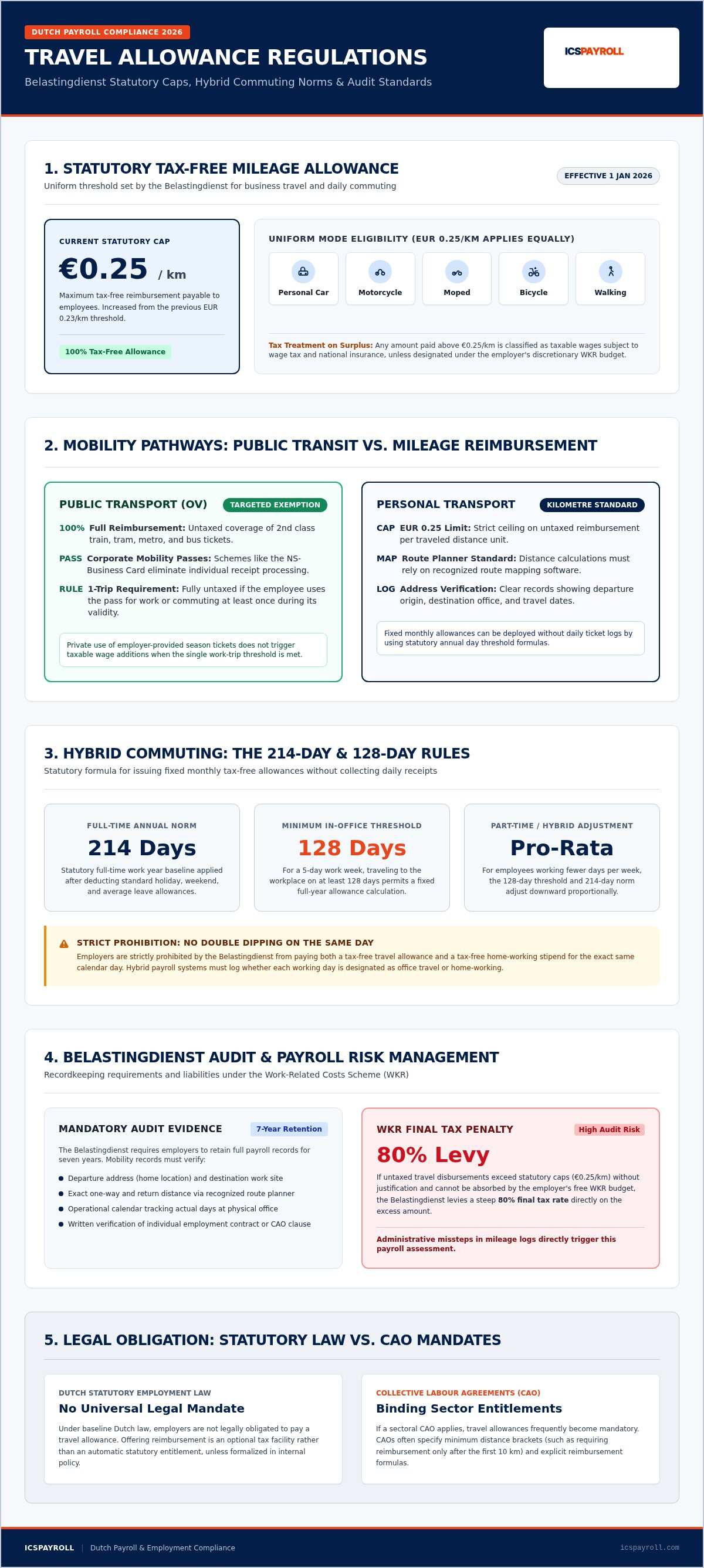
The EUR 0.25 per kilometer threshold applies uniformly regardless of how your employee travels. It covers personal motor vehicles, motorcycles, mopeds, bicycles, and walking. To defend these disbursements against a Belastingdienst audit, employers must maintain clear records proving:
- The physical departure location and work destination address.
- The exact distance calculated via a recognized route planner.
- The frequency of travel dates aligned with operational records.
Any reimbursement disbursed above the EUR 0.25 threshold is automatically classified as regular taxable wages. That surplus attracts wage tax and national insurance withholdings unless you allocate it to your discretionary payroll budget.
Mandatory Versus Discretionary Reimbursement Under Dutch Law
If your enterprise is not bound by a Collective Labour Agreement (CAO), you maintain complete contractual flexibility. You can decide whether to offer a travel allowance, determine eligible distance brackets, or set rates below the EUR 0.25 ceiling. However, if a sectoral CAO applies to your industry, travel allowances frequently transition into a mandatory employee entitlement.
Many industry-wide CAOs mandate explicit reimbursement schedules, such as fixed per-kilometer payments starting after a minimum 10-kilometer commute. When drafting employment agreements, international organizations must balance their standard benefit packages with local CAO mandates. Following this travel allowance netherlands employer guide ensures your employment contracts remain legally enforceable while maximizing available tax exemptions.
Reimbursement Options: Public Transport, Personal Vehicles, and the WKR
Dutch tax law offers two primary pathways for reimbursing commuting costs: repaying actual public transit expenses or issuing a per-kilometer allowance. While personal vehicle transit is capped at the untaxed rate of EUR 0.25 per kilometer, public transportation provides distinct tax advantages. Choosing the right mechanism depends on your workforce distribution, mobility habits, and payroll setup. Understanding these mechanisms through this travel allowance netherlands employer guide helps employers optimize tax efficiency without complicating monthly reporting.
Full Public Transport Reimbursement Mechanics
Employers can reimburse 100% of second-class train, tram, metro, and bus fares entirely tax-free under a targeted exemption (gerichte vrijstelling). You can reimburse individual journeys based on submitted ticket receipts or provide subscription cards directly. As outlined in the official Dutch travel allowance guidelines, corporate mobility solutions like the NS-Business Card significantly reduce administrative friction.
Under Dutch tax rules, an employer-provided public transport pass is fully exempt from wage tax as long as the employee uses it for work-related travel or commuting at least once during its validity period. You don't need to track the exact proportion of private versus business trips. This exemption eliminates individual receipt auditing entirely, making mobility passes the preferred option for regular office commuters.
Handling Allowances Above the Statutory Limit via the WKR
Employers frequently offer reimbursements higher than EUR 0.25 per kilometer to remain competitive. Any payment exceeding the statutory cap becomes regular, taxable wage income by default. That surplus requires mandatory deductions for wage tax and social security contributions.
Alternatively, you can designate the surplus mileage reimbursement as an untaxed benefit under the Work-Related Costs Scheme (werkkostenregeling or WKR). Employers utilize the WKR discretionary scope (vrije ruimte), which allows tax-free allowances up to 2.00% of the first EUR 400,000 of taxable wage bill, and 1.18% on the remaining balance. If your company exceeds this discretionary threshold during the fiscal year, you must pay an 80% final tax levy (eindheffing) on the excess amount.
Because unexpected WKR tax penalties severely impact operational budgets, accurate expense tracking is non-negotiable. Partnering with a specialized provider for Dutch payroll administration ensures your excess allowances are categorized properly, protecting your company from sudden year-end tax liabilities.
Calculating Commuting Allowances for Hybrid and Full-Time Staff
Managing daily mileage claims creates excessive administrative overhead for growing operations. To reduce this burden, the Belastingdienst permits employers to issue a fixed monthly reimbursement without requiring staff to log daily journeys. Understanding how these calculations function under modern hybrid schedules is a critical component of any travel allowance netherlands employer guide.
The 214-Day Rule and Fixed Commuting Allowance Formula
The standard Dutch calculation assumes a full-time employee works 214 days per calendar year, accounting for weekends, public holidays, and standard leave. Under the statutory 128-day rule, an employee who commutes to a fixed work location on at least 128 days annually qualifies for the full 214-day tax-free allowance. A fixed workplace is defined as any physical address visited at least 40 days per calendar year.
To determine the fixed monthly disbursement, apply this statutory formula:
- Formula: (Total daily round-trip kilometers x 214 days x EUR 0.25) / 12 months
For hybrid and part-time personnel, calculate the minimum travel requirements and allowance days pro rata:
- 4 days per week: Commute at least 103 days to receive an allowance based on 171.2 days.
- 3 days per week: Commute at least 77 days to receive an allowance based on 128.4 days.
- 2 days per week: Commute at least 52 days to receive an allowance based on 85.6 days.
- 1 day per week: Commute at least 26 days to receive an allowance based on 42.8 days.
Employers must conduct an annual audit before closing December payroll. If extended illness or altered working patterns cause an employee to miss their qualifying threshold, you must adjust the reimbursement to match actual days commuted.
Managing Travel Allowances Alongside the Home Working Allowance
Hybrid arrangements require strict adherence to the statutory concurrence rule (samenloop). For 2026, the tax-free home office allowance is EUR 2.45 per home-working day. Under Dutch tax legislation, an employer cannot grant both an untaxed commuting allowance and a tax-free home office allowance for the exact same calendar day.
When an employee divides their day between their home desk and the corporate office, payroll teams must designate which single exemption applies. The only exception occurs when an employee works from home but makes a dedicated, off-site business trip to visit an external client. Commuting allowances disbursed outside these statutory parameters lose their targeted exemption under the work-related costs scheme (WKR) and attract employer levies. Formalize agreed hybrid schedules in written employment contracts to establish verifiable audit trails.
Payroll Administration and Belastingdienst Audit Requirements
Every untaxed travel reimbursement issued to staff must be accurately processed through the periodic Dutch wage tax return (loonaangifte). Dutch tax law dictates that the loonaangifte must be submitted by the final calendar day of the month following the wage period. Untaxed travel payments are reported under specific targeted exemption codes rather than general gross wages. Operating within this travel allowance netherlands employer guide safeguards your company from retroactive assessments, interest penalties, and payroll corrections during formal tax reviews.
Required Payroll Records and Address Auditing
To defend untaxed mileage reimbursements against Belastingdienst audits, employers must retain verifiable proof of commuting distances. Tax inspectors inspect whether distance claims match physical realities. You must maintain an administrative audit file containing:
- Standardized route calculations, generated via an established tool like the ANWB route planner, documenting the quickest or standard route between the employee's residential address and the office.
- A signed employee declaration confirming their weekly commuting schedule, chosen transit modality, and usual working pattern.
- Updated residential documentation, reflecting immediate adjustments to the payroll schedule whenever an employee relocates or switches between office and home routines.
Under the statutory Dutch retention obligation (fiscale bewaarplicht), your organization must maintain these records, alongside expense claim slips and ticket receipts, for at least seven years.
Interaction with the 30% Ruling and Wage Tax Filings
Administering travel reimbursements for international talent requires extra precision when handling the 30% ruling. For 2026, the minimum taxable salary threshold is EUR 48,013 for standard employees, and EUR 36,497 for employees under 30 with an eligible master's degree. These statutory benchmarks represent taxable salary after the tax-free deduction. Securing the maximum 30% tax benefit requires an approximate gross salary of EUR 68,590.
Travel reimbursements operate independently of the 30% facility. Untaxed mileage allowances do not reduce your employee's taxable base for meeting the statutory salary norm, nor can they be rolled into the 30% calculation itself. Misclassifying travel expenses on the wage slip risks pulling the employee's taxable income below the statutory salary floor, which invalidates the 30% decision retroactively. Consult our guide to Dutch payroll administration to manage these interconnected wage tax returns without administrative missteps.
Managing intricate wage tax filings and expense rules shouldn't slow down your Dutch operations. Contact us today to request a tailored payroll proposal and ensure total wage tax compliance across your Netherlands workforce.
Executing Dutch Travel Benefits Compliantly with an Employer of Record
Administering local travel allowances without an incorporated Dutch entity exposes foreign enterprises to severe operational friction. Foreign companies lack direct access to the digital portals of the Belastingdienst, making local wage tax withholdings and targeted expense declarations difficult to manage. Operating through this travel allowance netherlands employer guide highlights an efficient alternative: utilizing a dedicated Employer of Record (EOR) to assume all statutory employment and tax compliance responsibilities.
Eliminating Compliance Exposure and Entity Overhead
Incorporating a Dutch BV requires roughly EUR 2,000 in upfront establishment expenses, paired with ongoing annual accounting and legal filing costs typically ranging from EUR 3,000 to EUR 8,000. For organizations hiring a small team or testing the Dutch market, these fixed corporate overheads are rarely justified. Engaging an EOR sidesteps corporate formation entirely while ensuring immediate compliance.
A professional EOR acts as the registered legal employer of your Dutch workforce. The EOR takes on full legal liability for wage tax withholdings, correct application of the 214-day rule, and strict compliance with the Work-Related Costs Scheme (WKR). This safeguards your business against misclassification penalties from the tax authorities and employee insurance agencies (UWV). Explore our guide on Employer of Record in the Netherlands to evaluate how this legal framework shields international operations.
Streamlined Payroll and Transparent Factor Pricing
Coordinating multiple benefit streams internally often strains international finance teams. An EOR unifies complex local labor costs into a predictable model. ICSPayroll consolidates monthly operations under a single, transparent payroll factor, bundling:
- Untaxed mileage claims and public transport allowances processed via compliant expense workflows.
- The mandatory 8% statutory holiday allowance accrued on gross wages.
- Standard employer pension contributions (typically 15.2%) alongside required social security and healthcare premiums.
- Sickness risk management and reintegration protocols governed by Dutch labor law.
Employees receive access to intuitive digital portals to log travel schedules, submit receipts, and review monthly payslips. Where cross-border mobility is needed, immigration sponsorship is arranged via our licensed partner with expedited processing in approximately three weeks. Operating across the country, this structure ensures your team stays compliant from day one. You can secure a tailored quotation within 24 hours through ICSPayroll to hire nationwide with total regulatory confidence.
Streamline Your Dutch Mobility Policy and Payroll Today
Managing mobility benefits shouldn't expose your enterprise to unexpected tax assessments or heavy administrative friction. Applying the statutory EUR 0.25 per kilometer rate, tracking pro-rata hybrid schedules under the 128-day rule, and avoiding the 80% WKR final levy requires continuous vigilance. Using this travel allowance netherlands employer guide ensures your business protects its bottom line while remaining fully compliant with Dutch tax authorities.
Instead of spending internal resources cross-checking route calculations and collective labour agreements, you can centralize your entire local employment operation. ICSPayroll delivers comprehensive Dutch compliance covering wage tax filings, pension distributions, and sickness risk administration under a single, transparent payroll factor. You receive a consolidated monthly invoice covering all employment and benefit costs, alongside a tailored quotation delivered within 24 hours of employee submission.
Ready to eliminate compliance exposure? Hire in the Netherlands with confidence and automate compliant travel reimbursements with ICSPayroll.
Frequently Asked Questions
Is an employer legally obligated to pay a travel allowance in the Netherlands?
No statutory provision in Dutch employment law obligates an employer to pay a travel allowance. Offering commuting reimbursements remains discretionary unless mandated by an applicable Collective Labour Agreement (CAO), an individual employment contract, or a binding company handbook. When a CAO applies to your sector, paying a specific reimbursement often becomes a mandatory legal entitlement.
What is the statutory tax-free kilometer allowance rate for employers in 2026?
The statutory tax-free limit is EUR 0.25 per kilometer for 2026. This rate applies uniformly across personal cars, motorcycles, bicycles, mopeds, and walking for both regular commuting and business trips. This travel allowance netherlands employer guide confirms that reimbursements up to this statutory cap remain completely exempt from Dutch wage taxes and national insurance withholdings.
How does the 214-day rule work for fixed commuting allowances?
The 214-day rule allows employers to disburse a fixed monthly travel reimbursement without logging individual daily trips. Under standard full-time schedules, employees who travel to a fixed workplace on at least 128 days per calendar year qualify for a fixed reimbursement calculated across 214 days. For part-time or hybrid arrangements, both day thresholds are applied pro rata.
Can an employee claim both a travel allowance and a home-working allowance on the same day?
Dutch tax law prohibits paying both a tax-free commuting allowance and a tax-free home office allowance for the exact same calendar day. Employers must choose which targeted exemption to apply if a worker splits their hours between home and the office. The only exception occurs when an employee works from home but undertakes an external business journey to visit a client.
What happens if an employer reimburses more than the tax-free kilometer limit?
Any reimbursement disbursed above the statutory EUR 0.25 per kilometer cap is treated as gross taxable wages by default. The excess amount triggers standard wage tax deductions and social security premiums. Alternatively, employers can allocate the surplus to their Work-Related Costs Scheme (WKR) discretionary margin, provided total allocations remain within the available annual threshold to avoid the 80% final tax levy.
How are public transport expenses reimbursed under Dutch wage tax rules?
Public transport expenses can be reimbursed 100% tax-free under a targeted wage tax exemption based on actual ticket receipts. Alternatively, employers can provide corporate mobility subscriptions, such as the NS-Business Card. When an employer provides or reimburses a transit card, it remains fully tax-free as long as the worker uses it for business transit or commuting at least once.
Does the travel allowance impact an employee eligibility for the 30% ruling?
Untaxed travel allowances operate separately from the 30% ruling and cannot be counted toward the statutory taxable salary criteria. For 2026, foreign hires must meet the taxable salary threshold of EUR 48,013, or EUR 36,497 for staff under 30 holding a master's degree. Misclassifying travel reimbursements risks lowering taxable compensation below these floors, jeopardizing the employee's 30% tax decision.
How does an Employer of Record manage travel reimbursements for remote workers in the Netherlands?
An Employer of Record (EOR) acts as the registered legal employer, administering compliant expense processing and monthly tax returns nationwide. This travel allowance netherlands employer guide highlights how an EOR validates journey logs, enforces 128-day thresholds, and applies proper WKR classifications. All approved travel reimbursements are consolidated alongside wages, pension contributions, and holiday pay into one transparent monthly invoice.

Article by
Joost Hubregtse
Joost Hubregtse is Director of ICS Staffing & Payroll B.V., the wholly owned subsidiary of Intercompany Solutions behind ICS Payroll. He is responsible for Employer of Record and Dutch payroll services: employment contracts, wage tax and social security filings, holiday allowance, pension, sick leave and CAO compliance, with onboarding possible within 48 hours.
Frequently Asked Questions
No statutory provision in Dutch employment law obligates an employer to pay a travel allowance. Offering commuting reimbursements remains discretionary unless mandated by an applicable Collective Labour Agreement (CAO), an individual employment contract, or a binding company handbook. When a CAO applies to your sector, paying a specific reimbursement often becomes a mandatory legal entitlement.
The statutory tax-free limit is EUR 0.25 per kilometer for 2026. This rate applies uniformly across personal cars, motorcycles, bicycles, mopeds, and walking for both regular commuting and business trips. This travel allowance netherlands employer guide confirms that reimbursements up to this statutory cap remain completely exempt from Dutch wage taxes and national insurance withholdings.
The 214-day rule allows employers to disburse a fixed monthly travel reimbursement without logging individual daily trips. Under standard full-time schedules, employees who travel to a fixed workplace on at least 128 days per calendar year qualify for a fixed reimbursement calculated across 214 days. For part-time or hybrid arrangements, both day thresholds are applied pro rata.
Dutch tax law prohibits paying both a tax-free commuting allowance and a tax-free home office allowance for the exact same calendar day. Employers must choose which targeted exemption to apply if a worker splits their hours between home and the office. The only exception occurs when an employee works from home but undertakes an external business journey to visit a client.
Any reimbursement disbursed above the statutory EUR 0.25 per kilometer cap is treated as gross taxable wages by default. The excess amount triggers standard wage tax deductions and social security premiums. Alternatively, employers can allocate the surplus to their Work-Related Costs Scheme (WKR) discretionary margin, provided total allocations remain within the available annual threshold to avoid the 80% final tax levy.
Public transport expenses can be reimbursed 100% tax-free under a targeted wage tax exemption based on actual ticket receipts. Alternatively, employers can provide corporate mobility subscriptions, such as the NS-Business Card. When an employer provides or reimburses a transit card, it remains fully tax-free as long as the worker uses it for business transit or commuting at least once.
Untaxed travel allowances operate separately from the 30% ruling and cannot be counted toward the statutory taxable salary criteria. For 2026, foreign hires must meet the taxable salary threshold of EUR 48,013, or EUR 36,497 for staff under 30 holding a master's degree. Misclassifying travel reimbursements risks lowering taxable compensation below these floors, jeopardizing the employee's 30% tax decision.
An Employer of Record (EOR) acts as the registered legal employer, administering compliant expense processing and monthly tax returns nationwide. This travel allowance netherlands employer guide highlights how an EOR validates journey logs, enforces 128-day thresholds, and applies proper WKR classifications. All approved travel reimbursements are consolidated alongside wages, pension contributions, and holiday pay into one transparent monthly invoice.