
Dutch Payroll Services for Foreign Companies: 2026 Guide
By Joost Hubregtse, Director, ICS Staffing & Payroll
All blog posts are reviewed and fact checked by our labour law lawyer Zishan Hussain and our director. Editorial standards
By Joost Hubregtse, Payroll Director. Reviewed by Joost Hubregtse, Payroll Director, on October 24, 2024.
Your expansion into the Netherlands shouldn't be stalled by the fear of permanent establishment risks or the complexity of local tax compliance. Many international firms find that managing Dutch labor laws, particularly the mandatory 15.2% pension contributions and the 104-week sick pay requirement, creates an overwhelming administrative burden. By leveraging dutch payroll services for foreign companies, you can bypass the need for a local BV and have your team operational in just a few weeks.
This 2026 guide offers a definitive roadmap for navigating the latest regulatory shifts with total confidence. You'll learn how to handle the updated 30% ruling salary thresholds, manage HSM visa sponsorship via licensed partners, and maintain transparent monthly costs. We provide the technical clarity you need to eliminate administrative friction, ensuring your transition into the Dutch market is both secure and efficient. From understanding the 2026 transition payment cap of EUR 102,000 to implementing a consolidated payroll factor, we cover the essentials for your international team's success.
Key Takeaways
- Mitigate Permanent Establishment risks by understanding the distinction between local payroll administration for Dutch BVs and EOR solutions for companies without a local entity.
- Learn how to evaluate dutch payroll services for foreign companies based on setup speed, direct local expertise, and the ability to consolidate all statutory costs.
- Navigate the 2026 requirements for the 30% ruling, including the EUR 48,013 taxable salary threshold and the updated rules for retroactive applications.
- Understand your mandatory employer obligations, including the 15.2% pension contribution, 8% holiday allowance, and the 104-week sick pay requirement under Dutch law.
- Discover how a consolidated payroll factor model simplifies international hiring by providing one transparent monthly invoice covering all taxes, social premiums, and insurance.
Navigating the Complexity of Dutch Employment for Foreign Entities
The Dutch labor market is governed by highly specific civil codes that prioritize employee protection above all else. For international businesses, this environment presents significant operational hurdles that go beyond simple tax filings. Direct hiring without a local entity often triggers Permanent Establishment (PE) risks. This status subjects foreign firms to local corporate income tax and complex payroll administration requirements that are difficult to manage from abroad. Utilizing dutch payroll services for foreign companies allows organizations to mitigate these risks while ensuring full compliance with the Belastingdienst and various social security funds.
The Burden of Statutory Benefits and Insurances
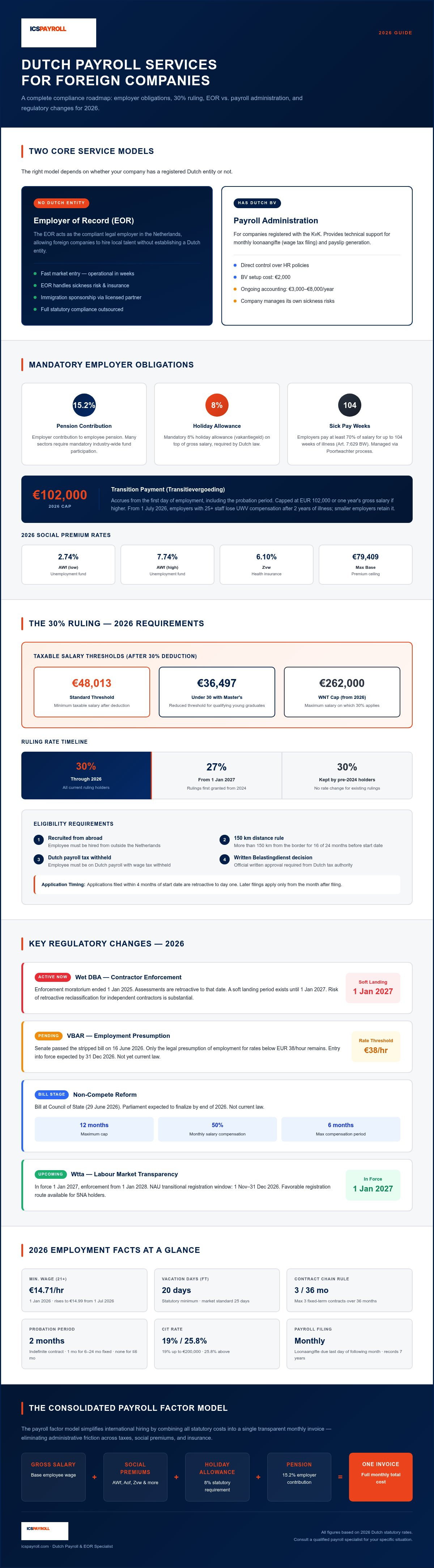
Dutch law mandates a suite of benefits that differ sharply from other European jurisdictions. Employers must provide an 8% holiday allowance and typically contribute 15.2% toward employee pensions. One of the most significant financial exposures is sick pay. Under Art. 7:629 BW, employers are responsible for paying at least 70% of an employee's salary for up to 104 weeks of illness. This two-year obligation requires meticulous management via the Poortwachter process to avoid third-year wage sanctions from the UWV. Additionally, the transition payment (transitievergoeding) accrues from the first day of employment, including the probation period. In 2026, this payment is capped at EUR 102,000 or one year's gross salary if higher. Many sectors also require participation in mandatory industry-wide pension funds, which adds another layer of contractual complexity for foreign firms.
Regulatory Changes Impacting Foreign Employers in 2026
The regulatory landscape continues to shift as we move through 2026. Enforcement of the Wet DBA is now fully active following the end of the moratorium on January 1, 2025. While a soft landing period for assessments exists until January 1, 2027, the risk of retroactive reclassification for independent contractors is substantial. The VBAR legislation, which introduces a legal presumption of employment for rates below EUR 38 per hour, is expected to enter into force by December 31, 2026, but it's not yet current law. Foreign employers must also prepare for pending non-compete reforms. The bill was at the Council of State on June 29, 2026, with parliament expected to finalize it by the end of the year. These changes will likely include a 12-month cap and mandatory financial compensation of 50% of the last monthly salary for every month the clause is invoked. Finally, new transparency requirements for gender pay gap reporting now demand detailed disclosures for larger entities operating in the Dutch market.
Defining Dutch Payroll Services: EOR vs. Payroll Administration
Selecting the right dutch payroll services for foreign companies requires a clear understanding of two distinct legal paths. Many international firms use the term "payroll" interchangeably, yet the legal implications vary significantly based on your corporate structure. The choice between standard administration and a full Employer of Record model depends on whether you intend to establish a local legal presence or remain an offshore entity. An Employer of Record (EOR) in the Netherlands acts as the compliant bridge for foreign companies to hire local talent without the overhead of a Dutch entity.
When evaluating dutch payroll services for foreign companies, the primary factor is your willingness to assume the legal risks associated with being a direct employer. For some, the control of a local subsidiary is paramount; for others, the speed and protection of an outsourced legal employer are more valuable. Your long-term strategy for market entry will dictate which model provides the most security.
When to Choose Dutch Payroll Administration
If your organization has already registered with the Kamer van Koophandel (KvK), you likely require payroll administration. This service is designed for companies that own a Dutch BV and need technical support for monthly loonaangifte (wage tax filing) and payslip generation. While this route offers direct control over HR policies, it requires the company to manage its own sickness risks and insurance obligations. It's a permanent solution for businesses committed to a long-term local presence that can justify the €3,000 to €8,000 annual accounting and filing costs associated with a local subsidiary.
When an Employer of Record (EOR) is Essential
For companies prioritizing speed and risk mitigation, EOR services are the standard. This model is necessary for hiring non-Schengen staff via HSM visas, which are arranged via licensed partners. The EOR acts as the legal employer, protecting the parent company from direct liability under Dutch labor law while providing a "one-stop" solution for contracts, payroll, and benefits. It effectively removes the administrative burden of local compliance. If you're testing the market or need to hire within weeks, you can explore our EOR solutions to streamline your entry. This approach bypasses the complexity of direct entity management while ensuring all statutory costs, such as the 15.2% pension contribution, are handled accurately from day one.
Comparing Local Specialists vs. Global Multi-Country Providers
When selecting dutch payroll services for foreign companies, the choice often boils down to a massive global platform or a dedicated local specialist. Many international firms are attracted to the "single pane of glass" promised by global Employer of Record (EOR) providers. However, these platforms rarely own their infrastructure in every country. Instead, they rely on third-party aggregators to handle local filings. This layer of separation often results in communication delays, higher costs, and a lack of nuanced understanding regarding Dutch labor standards.
Local specialists maintain direct relationships with the Belastingdienst and the IND. This proximity is vital for managing the Poortwachter process, which governs the 104-week sickness reintegration period. While a global provider might offer a generic HR dashboard, a local partner understands the specific documentation required to avoid UWV wage sanctions. They also provide direct expertise on sector-specific Collective Labor Agreements (CAOs), ensuring your contracts don't inadvertently violate mandatory industry pension or holiday requirements.
The Pitfalls of Global Aggregator Models
Global EORs frequently apply hidden markups to currency exchanges and management fees that fluctuate every month. These costs can quickly erode the budget of an international expansion. Beyond the financial impact, aggregators often struggle with the speed of Dutch immigration. While a local expert can facilitate HSM visa processing in approximately three weeks through their licensed partners, global firms often take much longer due to their reliance on external vendors. They frequently fail to account for specific Dutch CAO requirements, which can lead to legal disputes over equal pay or mandatory year-end bonuses.
Why Local Expertise Matters for the 30% Ruling
The 30% ruling is a primary reason for hiring in the Netherlands, but its complexity increased significantly in 2024 and 2026. Global providers often overlook the critical details of these reforms. For example, the 2026 standard taxable salary threshold is EUR 48,013, or EUR 36,497 for those under 30 with a master's degree. A local specialist ensures these norms are met after the deduction is applied, as failing this check can result in the ruling being revoked.
Local experts are also better equipped to manage the transition for rulings granted from 2024 onward. For these hires, the tax-free rate drops to 27% starting January 1, 2027. We also ensure your team is prepared for the abolition of partial non-resident taxpayer status, which expired on December 31, 2026, for new holders. Managing these specific tax nuances requires a level of precision that generalist multi-country providers simply don't provide.
Key Selection Criteria for Dutch Payroll Partners in 2026
Selecting a partner for dutch payroll services for foreign companies requires more than just comparing fee schedules. In 2026, the speed of market entry and the precision of tax applications are the primary benchmarks of quality. A reliable partner should enable you to start hiring in weeks rather than months. They must also provide a consolidated monthly invoice that reflects all statutory obligations, including the 15.2% pension and 8% holiday allowance. Transparency is vital; ensure the provider offers an online portal where both you and your employees can access payslips, annual statements, and contract data in real time.
Confirm that your prospective partner can facilitate HSM visa processing in approximately three weeks through their licensed partners. This speed is essential for securing non-EU talent in a competitive market. Furthermore, audit their approach to the 30% ruling. They must demonstrate a clear understanding of the 2026 taxable salary threshold of EUR 48,013 and the upcoming shift to a 27% rate for certain rulings in 2027. If you're ready to secure your Dutch team with a compliant partner, you can get a tailored quotation within 24 hours from our specialists.
Step 1: Assessing Compliance and Legal Security
Evaluating compliance begins with immigration and legal standing. You must confirm that the provider uses licensed partners for IND sponsorship. This is the only way to secure HSM visas for non-EU staff within the required timeframe. Additionally, audit their management of the "Ketenregeling". This rule limits employment to three consecutive contracts over 36 months. A failure here results in an automatic indefinite contract, which significantly increases your long-term liability. Your partner should also provide a dedicated point of contact for sick-leave support. They must guide you through the Poortwachter requirements to manage the 104-week payment obligation defined in Art. 7:629 BW, ensuring you avoid costly UWV wage sanctions.
Step 2: Analyzing the Cost Structure
Cost transparency is often the biggest pain point for international employers. Avoid providers that offer low base fees but add a complex list of separate charges for every interaction. Instead, look for a "Payroll Factor" model. This factor is applied to the gross salary to cover all social premiums, insurances, and administrative costs in one clear figure. Ensure your quotes explicitly include the 8% holiday allowance and the mandatory 15.2% pension contribution. You should also verify how they handle the transition allowance. In 2026, this payment is capped at EUR 102,000 or one year's gross salary if higher. A transparent partner will explain how this accrues from day one so there are no surprises during contract termination.
ICSPayroll: Simplified Compliance via the Payroll Factor Model
ICSPayroll provides a streamlined path for international businesses entering the Dutch market. We eliminate the friction of local bureaucracy by utilizing a transparent "payroll factor" model. This factor is a single multiplier applied to the gross salary, consolidating all statutory costs into one predictable monthly invoice. Unlike competitors who provide fragmented billing, our invoice covers the mandatory 8% holiday allowance, 15.2% pension contributions, social taxes, and comprehensive HR administration. This clarity allows you to manage your budget with absolute precision when utilizing dutch payroll services for foreign companies.
Speed is a core pillar of our service. We provide tailored quotations within 24 hours, enabling you to make informed decisions quickly. One of the primary advantages of our model is the ability to begin hiring even before a Dutch BV is established. For many firms, this removes the need for direct legal entity incorporation entirely. We function as a protective guardian for your local operations, ensuring every employment contract is fully compliant with 2026 standards from day one.
Expert Support for Highly Skilled Migrants
Attracting top tier global talent requires an efficient immigration process. We facilitate expedited HSM visa applications for non-Schengen staff, with processing typically completed in approximately three weeks. It's important to clarify that immigration sponsorship is arranged via our licensed partner. Beyond visas, our team provides full assistance with the 30% ruling application for eligible international hires. We ensure all 2026 taxable salary norms are met to secure this vital tax benefit for your team. For a deeper dive into these specific regulations, read our guide on The 30% Ruling in the Netherlands: A Comprehensive 2026 Employer Guide.
Comprehensive HR and Payroll Administration
Managing a remote team in a foreign jurisdiction shouldn't feel like a burden. Our platform provides both employers and employees with access to a secure online portal. This interface allows for real-time management of essential documents, including:
- Monthly payslips and annual tax statements
- Digital employment contracts and addendums
- Real time tracking of holiday balances and leave requests
We also address the most significant risk in Dutch labor law: long term sickness. Our service framework includes coverage for the mandatory two year sickness risk, ensuring your business is protected from the financial volatility of Art. 7:629 BW obligations. You can find more technical details in our Dutch Payroll Administration: The 2026 Complete Reference Guide. We handle the technical meticulousness so you can focus on your core business growth.
Accelerate Your Dutch Market Entry with Total Compliance
Expanding into the Netherlands in 2026 requires more than just administrative support; it demands a partner who understands the nuance of local labor law and tax optimization. By utilizing professional dutch payroll services for foreign companies, you eliminate the risks of permanent establishment and the administrative burden of managing 104-week sick pay or mandatory pension funds. Whether you choose a full Employer of Record model or standard payroll administration for your existing BV, the priority remains the same: security for your business and clarity for your employees.
Our local experts manage full Dutch compliance, including the critical 30% ruling applications and HSM visa processing. With our transparent payroll factor pricing, you receive one consolidated monthly invoice that covers all statutory costs. You don't have to wait months to build your international team. We provide the operational set-up in weeks, allowing you to focus on growth while we handle the legal meticulousness. This approach ensures your expansion is both rapid and legally sound.
Hire in the Netherlands with confidence: Get your tailored quote in 24 hours. We're ready to help your business thrive in the Dutch market.
Frequently Asked Questions
Can I hire employees in the Netherlands without a local legal entity?
You can hire employees in the Netherlands without a local legal entity by using an Employer of Record (EOR). This service allows your company to engage local talent while ICSPayroll acts as the legal employer of record. We handle all compliance, tax, and insurance obligations on your behalf. This approach is ideal for testing the market or starting operations quickly without the costs and administrative time required for a Dutch BV registration.
What are the 2026 salary requirements for the Dutch 30% ruling?
For 2026, the standard taxable salary threshold for the 30% ruling is EUR 48,013. For employees under the age of 30 who hold a master's degree, the taxable salary requirement is EUR 36,497. These figures represent the salary remaining after the 30% tax-free allowance has been deducted. It's vital to ensure gross salaries are high enough to meet these norms, typically requiring approximately EUR 68,590 to receive the full standard tax benefit.
How long does it take to get a Highly Skilled Migrant (HSM) visa?
The processing time for a Highly Skilled Migrant (HSM) visa is typically around three weeks through our expedited process. We arrange this immigration sponsorship via our licensed partners. This timeline is significantly faster than standard applications, allowing you to relocate and onboard international talent quickly. We manage the entire application alongside your dutch payroll services for foreign companies to ensure all legal requirements from the IND are met with absolute precision and security.
What is included in the ICSPayroll "payroll factor" pricing?
Our payroll factor pricing is a transparent model that consolidates all employment costs into one monthly invoice. It includes 8% holiday allowance, 15.2% pension contributions, and social security premiums. The factor also covers sickness risk for two years, transition allowance accrual, and HR administration. We include 30% ruling applications and access to our online employee portal within this single figure. This ensures there are no separate or hidden charges for your international team.
What is the Dutch holiday allowance and how is it calculated?
The Dutch holiday allowance, known locally as vakantiegeld, is a mandatory benefit equal to 8% of an employee's gross annual salary. It is typically accrued throughout the year and paid out in a lump sum, usually in May or June. This payment is designed to support the costs of summer vacation. When using dutch payroll services for foreign companies, this 8% is automatically calculated and included within the consolidated payroll factor to ensure full statutory compliance.
How are sickness and disability risks managed for Dutch employees?
Sickness risks are managed according to Article 7:629 BW, which requires employers to pay at least 70% of an employee's salary for up to 104 weeks of illness. We provide sickness risk coverage for up to two years as part of our service framework. Our team also provides reintegration guidance following the Wet Verbetering Poortwachter. This includes the mandatory analysis at week six and the action plan at week eight to avoid potential UWV wage sanctions.
What is the maximum transition allowance (transitievergoeding) in 2026?
In 2026, the maximum transition payment, or transitievergoeding, is capped at EUR 102,000 or one year's gross salary if that amount is higher. This allowance accrues from the first day of employment, including the probation period. It is payable to employees when their contract is terminated at the employer's initiative. We manage the accrual and administration of this allowance within our payroll factor to protect your firm from unexpected and significant termination costs.
How quickly can I start hiring staff in the Netherlands with an EOR?
You can begin hiring staff in the Netherlands in weeks rather than months when using our Employer of Record service. We provide tailored quotations within 24 hours of receiving your specific employee details. Service agreements and employment contracts are typically ready for signature within a few business days. This rapid setup allows your business to secure top talent and start operations immediately, even if your local Dutch BV is still in the process of being established.

Article by
Joost Hubregtse
Joost Hubregtse is Director of ICS Staffing & Payroll B.V., the wholly owned subsidiary of Intercompany Solutions behind ICS Payroll. He is responsible for Employer of Record and Dutch payroll services: employment contracts, wage tax and social security filings, holiday allowance, pension, sick leave and CAO compliance, with onboarding possible within 48 hours.
Frequently Asked Questions
You can hire employees in the Netherlands without a local legal entity by using an Employer of Record (EOR). This service allows your company to engage local talent while ICSPayroll acts as the legal employer of record. We handle all compliance, tax, and insurance obligations on your behalf. This approach is ideal for testing the market or starting operations quickly without the costs and administrative time required for a Dutch BV registration.
For 2026, the standard taxable salary threshold for the 30% ruling is EUR 48,013. For employees under the age of 30 who hold a master's degree, the taxable salary requirement is EUR 36,497. These figures represent the salary remaining after the 30% tax-free allowance has been deducted. It's vital to ensure gross salaries are high enough to meet these norms, typically requiring approximately EUR 68,590 to receive the full standard tax benefit.
The processing time for a Highly Skilled Migrant (HSM) visa is typically around three weeks through our expedited process. We arrange this immigration sponsorship via our licensed partners. This timeline is significantly faster than standard applications, allowing you to relocate and onboard international talent quickly. We manage the entire application alongside your dutch payroll services for foreign companies to ensure all legal requirements from the IND are met with absolute precision and security.
Our payroll factor pricing is a transparent model that consolidates all employment costs into one monthly invoice. It includes 8% holiday allowance, 15.2% pension contributions, and social security premiums. The factor also covers sickness risk for two years, transition allowance accrual, and HR administration. We include 30% ruling applications and access to our online employee portal within this single figure. This ensures there are no separate or hidden charges for your international team.
The Dutch holiday allowance, known locally as vakantiegeld, is a mandatory benefit equal to 8% of an employee's gross annual salary. It is typically accrued throughout the year and paid out in a lump sum, usually in May or June. This payment is designed to support the costs of summer vacation. When using dutch payroll services for foreign companies, this 8% is automatically calculated and included within the consolidated payroll factor to ensure full statutory compliance.
Sickness risks are managed according to Article 7:629 BW, which requires employers to pay at least 70% of an employee's salary for up to 104 weeks of illness. We provide sickness risk coverage for up to two years as part of our service framework. Our team also provides reintegration guidance following the Wet Verbetering Poortwachter. This includes the mandatory analysis at week six and the action plan at week eight to avoid potential UWV wage sanctions.
In 2026, the maximum transition payment, or transitievergoeding, is capped at EUR 102,000 or one year's gross salary if that amount is higher. This allowance accrues from the first day of employment, including the probation period. It is payable to employees when their contract is terminated at the employer's initiative. We manage the accrual and administration of this allowance within our payroll factor to protect your firm from unexpected and significant termination costs.
You can begin hiring staff in the Netherlands in weeks rather than months when using our Employer of Record service. We provide tailored quotations within 24 hours of receiving your specific employee details. Service agreements and employment contracts are typically ready for signature within a few business days. This rapid setup allows your business to secure top talent and start operations immediately, even if your local Dutch BV is still in the process of being established.