Best Local Employer of Record (EOR) in the Netherlands: 2026 Buying Guide
By Joost Hubregtse, Director, ICS Staffing & Payroll
All blog posts are reviewed and fact checked by our labour law lawyer Zishan Hussain and our director. Editorial standards
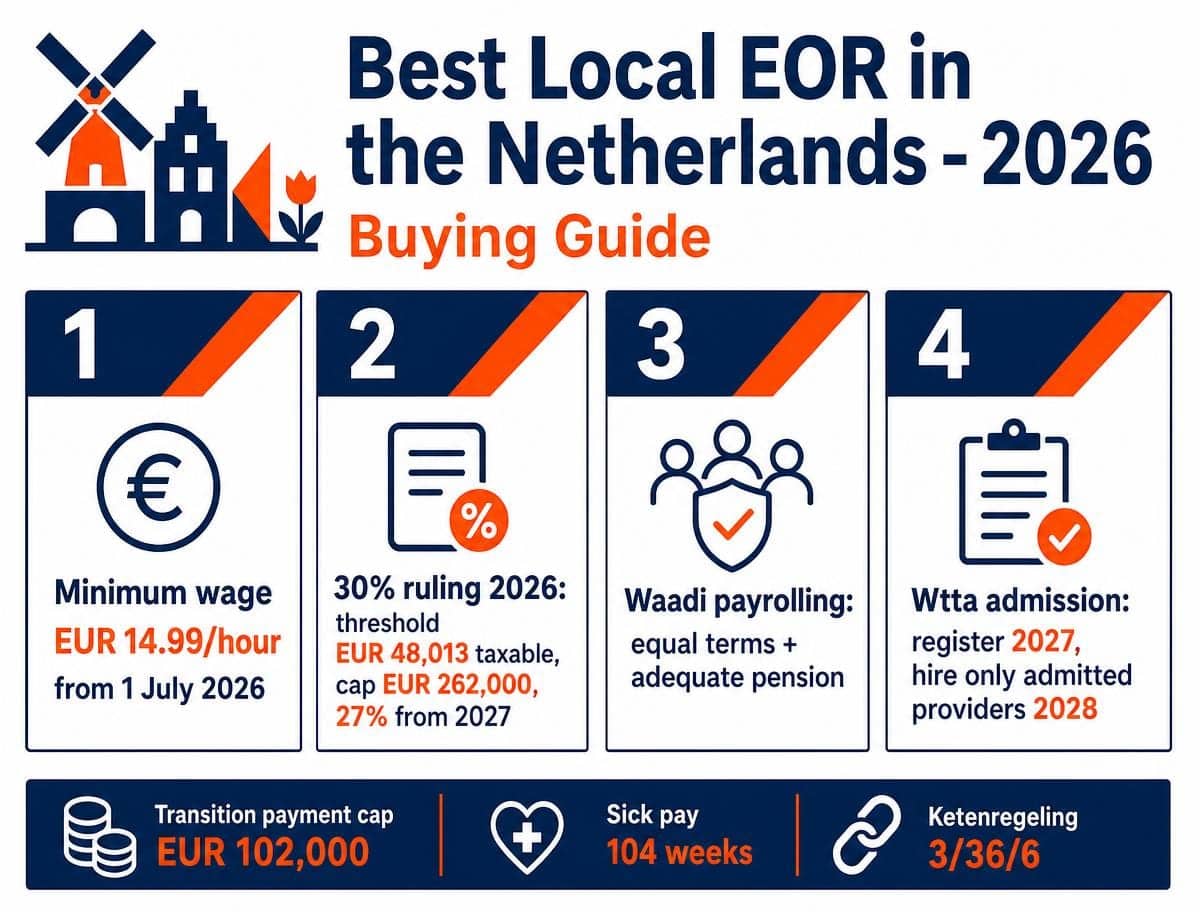
Relying on a global "one-size-fits-all" platform for your Dutch expansion in 2026 carries real regulatory and tax exposure. The Netherlands offers a world-class talent pool, but the administrative reality of the ketenregeling, continuing Wet DBA enforcement and, from 2027, a licensing regime for anyone who supplies staff makes hiring here a genuinely technical exercise. Managing the statutory minimum hourly wage of €14.99 (from 1 July 2026) alongside social security contributions requires more than a software interface.
You need a partner that removes the administrative burden while structuring your international hires correctly. This guide sets out what to look for in a local EOR partner in the Netherlands, and, just as importantly, what to ask them. We cover how local expertise supports 30% ruling applications against the 2026 taxable salary threshold of €48,013, how highly skilled migrant sponsorship actually works, and why the Dutch legal classification of an EOR arrangement (it is payrolling under the Waadi) determines what your people must be paid. We also address permanent establishment, chain liability for wage tax, and the new admission requirement that will decide which providers may lawfully operate from 2028.
Key Takeaways
- Know the 2026 baseline: a statutory minimum hourly wage of €14.99 from 1 July 2026, at least 8% holiday allowance, and a seven-year fiscal retention period for the payroll administration.
- Understand the 30% ruling as it stands in 2026: a €48,013 taxable salary threshold, a €262,000 cap on the basis, and a reduction to 27% with higher thresholds from 2027.
- Under Dutch law an EOR arrangement is payrolling: your workers are entitled to the same terms of employment as your own comparable staff, plus an adequate pension scheme.
- From 1 January 2027 providers who supply staff need admission under the Wtta; from 1 January 2028 you may only hire through admitted providers. Ask any prospective partner where they are in that process now.
- An EOR removes the need for your own Dutch entity for employment purposes, but it does not by itself eliminate corporate tax permanent establishment risk, and it does not remove your chain liability for wage tax.
What Defines the Best Local EOR in the Netherlands for 2026?
An Employer of Record (EOR) (primary source: Wet allocatie arbeidskrachten door intermediairs (Waadi), wetten.overheid.nl) acts as the formal, legal employer of your staff while you retain day-to-day operational direction. In Dutch legal terms this is terbeschikkingstelling van arbeidskrachten, the supply of workers, and, because the EOR does not perform an allocation function and cannot place the worker elsewhere without your consent, it is specifically payrolling within the meaning of the Wet allocatie arbeidskrachten door intermediairs (Waadi).
That classification is not a technicality. It is the single most important thing to understand before you buy, because it determines cost.
What payrolling status means for your costs
Under article 8a of the Waadi, an employee supplied to you under a payroll arrangement is entitled to at least the same terms of employment as your own employees in the same or equivalent roles: pay, allowances, leave entitlement, and any collective labour agreement (CAO) terms that apply in your business. If you have no comparable employees in the Netherlands, the benchmark becomes the terms customary in your sector. Separately, the payroll employer must provide an adequate pension scheme. A provider that quotes you a rate without asking what your comparable employees earn, whether a CAO applies to your activity, and what your pension arrangement looks like is not pricing the statutory position correctly. Expect that conversation early.
The 2027 admission requirement
The Wet toelating terbeschikkingstelling van arbeidskrachten (Wtta) introduces a mandatory admission regime for every business that supplies workers: temporary work agencies, secondment firms and payroll companies, including foreign providers operating in the Netherlands. The regime enters into force on 1 January 2027, and the Netherlands Labour Authority begins enforcement on 1 January 2028. From that date, hirers may only engage providers listed in the public register of admitted suppliers. The sequencing matters right now. Providers can register for the transitional arrangement with the Dutch supply-market authority between 1 November and 31 December 2026, with admission applications from 1 May to 30 June 2027. Businesses holding SNA certification on 30 June 2027 that apply in time are admitted initially on the strength of that certificate. A provider that has not started this process, or cannot tell you where it stands, is a provider you may not be able to use in 2028.
The Role of a Dutch EOR in Market Entry
Choosing a local EOR does allow you to start operations before a Dutch BV is incorporated, which is effective for market testing or a first key hire. Your partner manages the mandatory holiday allowance of at least 8%, applies the ketenregeling correctly, tracks statutory leave (at least four times the weekly working hours per year, so 20 days on a five-day week), and calculates transition payments, which accrue from the first day of employment in line with official government guidelines. One caution that global platforms rarely raise: using an EOR removes the need for a Dutch employing entity, but permanent establishment for corporate tax purposes is assessed on its own facts. If your activity in the Netherlands involves a fixed place of business, or someone habitually concluding contracts on your behalf, PE risk can arise regardless of who is on the employment contract. Treat that as a separate tax question and take advice on it.
Key Identifiers of a Premium Local Partner
The most reliable partners give you direct access to Dutch payroll specialists rather than a ticketing queue, particularly where sector CAOs govern working hours, pay scales and pension. Transparency is the other marker: a single consolidated invoice with the statutory employer charges, the unemployment fund (AWf), the disability fund (Aof), the Whk differentiated premium and the healthcare act contribution (Zvw), set out clearly, so you can see what is statutory cost and what is service fee. Finally, ask about chain liability. Under article 34 of the Invorderingswet 1990, a hirer can be held liable for wage tax and social security contributions that the supplier fails to remit to the Belastingdienst. A serious provider will explain how it mitigates that, typically through a blocked g-account, rather than telling you the risk does not exist.
Compliance Excellence: Navigating the 30% Ruling and Highly Skilled Migrant Sponsorship
Attracting international talent to the Netherlands requires a working command of both the expat tax facility and immigration sponsorship. Expanding into the Dutch market involves navigating the challenges of hiring international candidates, and errors in either area produce retroactive corrections. In the tax case, the correction lands on the employer.
Mastering the 30% Tax Ruling in 2026
For 2026 the facility (now formally the expatregeling) still allows up to 30% of salary including the allowance to be paid free of tax. The employee's taxable annual salary, measured after the exempt allowance, must exceed €48,013 in 2026. For employees under 30 holding a Dutch academic master's degree or a recognised equivalent, the threshold is €36,497. In practice this means a gross salary of roughly €68,590 for the standard threshold. The exemption is limited to the public sector pay norm, €262,000 for 2026, giving a maximum tax-free allowance of €78,600 for a full year. Transitional relief for employees who were already using the ruling before 2023 lapsed on 1 January 2026, so every beneficiary is now capped. If you have long-standing expat hires, their net position changed this year.
The employee must have lived more than 150 kilometres from the Dutch border for at least 16 of the 24 months before their first working day. The application must be filed within four months of the start of employment for the ruling to apply from day one; later applications take effect from the quarter of application. The maximum duration is 60 months, reduced by prior periods of work or residence in the Netherlands. From 1 January 2027 the percentage falls to a flat 27% for the full term, and the salary thresholds rise materially (announced as €50,436 standard and €38,388 for the under-30 master's category, subject to indexation). Employees for whom the ruling was already applied in 2024 keep the 30% rate and the current thresholds. Note also that the partial non-resident taxpayer election was abolished with effect from 2025, with transitional relief running only to the 2026 return. A pre-hire eligibility assessment is worth doing before the offer letter, not after: our team can provide a pre-hire compliance assessment.
Fast-Track HSM Visa Processing
A residence permit for a highly skilled migrant can only be applied for by an organisation that the Immigration and Naturalisation Service (IND) has recognised as a sponsor (erkend referent), and the recognised sponsor must be the employer. Where an EOR is used, that means the EOR itself is both the legal employer and the sponsor; the two cannot sensibly be split between different companies. ICS Staffing & Payroll B.V. is progressing its own IND recognition; where a client's timeline requires sponsorship before that is in place, we will tell you plainly and refer you to a recognised sponsor rather than describe someone else's licence as ours. Ask any provider to name its own registration in the IND's public register of recognised sponsors, and check it.
Two further points that responsible advisers raise. On processing time, the IND applies a target of two weeks for applications from recognised sponsors; the statutory decision period is three months. Anyone guaranteeing a fixed turnaround is describing a service ambition, not a legal entitlement. On policy direction, government policy is moving to restrict recognised sponsors from commercially supplying highly skilled migrants to third parties, with limited and temporary exception categories. If your model depends on sponsoring migrants through a supplier, build in the possibility that this route narrows. Salary criteria for the scheme are indexed each 1 January and differ for the 30-and-over, under-30 and scientific-research categories; always check the amounts current at the date of the application. You can find more details on maintaining legal standards in our article on Employer of Record Netherlands: The 2026 Guide to Compliant Hiring.
Local Specialist vs. Global Aggregator: A Comparison
Global aggregators typically operate as intermediaries. They lead with software, but frequently subcontract the actual legal employment to a local partner. That creates a gap between the party answering your compliance questions and the party carrying the legal risk. Ask who signs the employment contract, who is the withholding agent for wage tax, and who is registered in the Dutch trade register as supplying workers, a registration requirement under article 7a of the Waadi, breach of which is separately fineable.
Direct accountability matters most in long-term sickness. Dutch employers must continue paying wages for up to 104 weeks of illness, and if the Labour Authority's reintegration assessment finds the employer's efforts inadequate, UWV can extend that obligation by up to a further 52 weeks. Engaging a certified occupational health service or company doctor is a statutory duty, not an optional extra. Ask a prospective provider how sickness risk is priced, whether it is insured, and who bears the cost of a wage sanction.
Transparency and Accountability
You want named specialists who can give definitive answers on contract structure, CAO application and social security, particularly while Wet DBA enforcement continues. Every employment record should be retained in line with the statutory periods: seven years for the payroll administration as required by the Belastingdienst, five full calendar years after the end of employment for identity documents and wage tax data, and no longer than necessary for the remainder under the GDPR.
Cost Efficiency and Value
Many global platforms charge a percentage of gross salary, which becomes expensive for highly skilled migrants earning well above the 30% ruling threshold. A local specialist can usually quote a transparent per-employee fee. What should always be visible in the quote: gross salary, the statutory employer charges (AWf, Aof, Whk, Zvw), holiday allowance accrual, pension, and the reservation for the transition payment. Anything presented as "all-inclusive" without that breakdown is difficult to verify. For a deeper look at managing these costs, consult our Dutch Payroll Administration: The 2026 Complete Reference Guide.
Checklist for Evaluating a Dutch EOR Partner
Identifying the right local EOR partner requires a rigorous audit of operational and legal standards. Work through the following points before you sign anything.
- Admission status: Is the provider SNA-certified, and has it registered, or will it register between 1 November and 31 December 2026, for the Wtta transitional arrangement? Is it registered under article 7a Waadi as supplying workers?
- Equal treatment: How does the provider establish the terms your workers are entitled to under article 8a Waadi, and which pension scheme does it treat as adequate?
- Wage compliance: Does it calculate on the minimum hourly wage in force, €14.99 from 1 July 2026, and adjust automatically each 1 January and 1 July? Note there is no statutory minimum monthly, weekly or daily wage in the Netherlands; monthly pay follows contracted hours.
- Sickness and liability: How is the 104-week wage obligation covered, is the occupational health service arranged, and who carries the cost of a wage sanction of up to 52 additional weeks?
- Termination accuracy: Does it calculate the transition payment at one third of a month's gross salary per year of service, accruing from day one, capped at €102,000 in 2026 or one gross annual salary if that is higher, in line with UWV guidance?
- Contract chain: Does it track the ketenregeling, a maximum of three fixed-term contracts within 36 months with a six-month interval resetting the chain, subject to CAO derogation, and is it prepared for the changes coming under the Wet meer zekerheid flexwerkers?
- Probation: Does it apply the statutory limits: no probation for contracts of six months or less, a maximum of one month for fixed-term contracts of more than six months but less than two years, and a maximum of two months for contracts of two years or more and for indefinite contracts?
- Chain liability: Is a g-account offered, and how is your article 34 Invorderingswet exposure managed?
- Digital infrastructure: Is there an employee portal with payslips, annual statements and contracts?
- Insurance and standing: Professional indemnity cover, and a named contact who is accountable for the file.
Financial and Legal Due Diligence
A reliable partner adheres to the seven-year record retention period for the payroll administration, a non-negotiable requirement for Belastingdienst audits, and to the five-year period for identity and wage tax data after employment ends. It should also explain how it manages your exposure to statutory employer charges. For a detailed breakdown of these obligations, see our guide on Dutch Social Security for Employers: The Complete 2026 Compliance Reference.
Operational Readiness
Keep two pieces of legislation on your radar. The Wet meer zekerheid flexwerkers was adopted by the Senate on 7 July 2026. Most of it takes effect on 1 January 2028: the interval that resets the fixed-term contract chain extends from six months to three years, zero-hours contracts are replaced by bandwidth contracts with a maximum spread of 30% between minimum and maximum hours, and the most insecure phases of agency work are shortened. One element applies earlier, namely the requirement that supplied workers receive equivalent terms of employment, which takes effect on 31 December 2026. Separately, enforcement against false self-employment continues. Since 1 January 2025 the Tax Administration has been assessing again, and in 2026 it generally opens with a company visit rather than a books investigation and does not impose verzuimboetes; payroll tax assessments do not reach back before 1 January 2025, with a phased build-up of enforcement to 2030. The clarification part of the Vbar bill was withdrawn in 2026 and is being replaced by a separate Zelfstandigenwet; the legal presumption of employment below an hourly rate of approximately €38 is proceeding. If part of your Dutch workforce is engaged as self-employed contractors, this is the area to review, and you can contact our team for a compliance audit.
Why ICSPayroll Is a Strong Local EOR Partner for the Netherlands
We take a human-led approach. Led by Joost Hubregtse, our team keeps direct oversight of every employment contract and wage tax filing, with our labour law lawyer reviewing contract templates and CAO application.
Our one-invoice model consolidates statutory obligations, the AWf, Aof, Whk and Zvw contributions, holiday allowance accrual, pension and the transition payment reservation, into a single monthly transaction, with each component itemised so you can see the statutory cost separately from our fee. We benchmark article 8a Waadi terms against your own comparable staff before we quote, so the price you see is the price the law produces. We are preparing for the Wtta admission regime on the published timetable and will confirm our registration status to clients in writing as each milestone passes.
Tailored Solutions for International Businesses
You can begin operations in the Netherlands within weeks, before your own Dutch BV is established, with us acting as the legal employer and handling HR administration. We manage 30% ruling applications end to end, including the four-month filing deadline and the 2026 threshold of €48,013 taxable salary after the exemption, and we will tell you in advance where an employee's package will not clear the threshold. All records are kept for the seven-year retention period required by the Belastingdienst.
Get Started with Your Dutch Expansion
We aim to return a tailored quotation within one business day, with a clear breakdown of costs and employer obligations. Where an arrangement carries residual risk you should know about, such as permanent establishment, chain liability or sickness exposure, we set it out rather than describe the service as risk-free. You can request a tailored EOR quotation for the Netherlands at any time.
Secure Your Dutch Expansion with Local Expertise
Navigating the Dutch labour market in 2026 means understanding the ketenregeling, the 30% ruling thresholds, the equal treatment rules that apply to supplied workers, and the licensing regime arriving in 2027. A global platform is unlikely to raise the last two before you sign. By prioritising local expertise you get a provider who does, and who keeps you aligned with the current requirements of the Belastingdienst.
Our team provides the stability needed for measured growth: 30% ruling application support, correct payrolling treatment under the Waadi, and a clear statement of where sponsorship must run through a recognised sponsor.
Get a tailored EOR quotation for the Netherlands within one business day
Frequently Asked Questions
What is the minimum wage in the Netherlands for 2026?
The statutory gross minimum hourly wage for employees aged 21 and over is €14.99 from 1 July 2026, having been €14.71 from 1 January 2026. Since 1 January 2024 there are no statutory minimum monthly, weekly or daily wages; monthly pay depends on hours worked. The rate is indexed every 1 January and 1 July, and lower rates apply to employees aged 15 to 20.
How does the 30% ruling work for employees hired via an EOR?
The EOR, as the legal employer, files the application with the Tax Administration and implements the exemption in payroll. It verifies the 150-kilometre condition and the salary threshold, and must file within four months of the start date for the ruling to run from day one. Once granted, the tax-free allowance is shown on the monthly payslip.
What are the salary requirements for the 30% ruling in 2026?
The taxable annual salary after the exemption must exceed €48,013, which corresponds to a gross salary of roughly €68,590. For employees under 30 with a qualifying academic master's degree the threshold is €36,497. The exemption is calculated on a basis capped at €262,000, giving a maximum tax-free allowance of €78,600 for a full year. From 2027 the percentage falls to 27% and the thresholds rise.
Can I hire employees in the Netherlands without a local entity?
Yes. An EOR acts as the legal employer and handles payroll, wage tax and social security. Be aware that this is payrolling under the Waadi, so the equal treatment and adequate pension rules apply, and that it does not by itself resolve corporate tax permanent establishment questions.
What is the Ketenregeling rule for Dutch employment contracts?
Successive fixed-term contracts convert into an indefinite contract after three contracts or after 36 months, whichever comes first. An interval of more than six months currently resets the chain; a CAO may vary the rules. Under legislation adopted in July 2026, that interval extends to three years from 1 January 2028.
How long does it take to get an HSM visa for a new hire?
The IND applies a target of two weeks for applications from recognised sponsors, against a statutory decision period of three months. The employer must itself be a recognised sponsor. Timelines are targets rather than guarantees, and depend on a complete application.
What is the holiday allowance requirement in the Netherlands?
At least 8% of gross annual wages, usually paid in May or June, with the payment date set by contract or CAO. A CAO may provide otherwise, provided total remuneration is at least 108% of the minimum wage. Where an employee earns more than three times the minimum wage, a lower allowance or none at all can be agreed in writing.
How is sick pay managed for employees in the Netherlands?
The employer pays at least 70% of wages for up to 104 weeks, subject to the statutory maximum daily wage; in the first 52 weeks the payment may not fall below the applicable minimum wage, and that top-up does not apply in the second year. Most CAOs provide 100% in the first year. Employers must engage occupational health support and meet reintegration obligations; where UWV finds those efforts inadequate, the wage obligation can be extended by up to 52 weeks.
Sources and references
Every rule and figure above is traceable to the sources below: the exact statutory articles, the regulator pages that publish the amounts, the statistical datasets, and the specific court rulings that settle the point. Always check the current text for your own situation.
- Article 7:692 Dutch Civil Code, the statutory definition of payrolling
- Article 7:690 Dutch Civil Code, the agency work (uitzend) contract
- Article 8 Waadi, equal pay for hired-in workers (loonverhoudingsnorm)
- Stichting Normering Arbeid, the NEN 4400-1 register of audited payroll and staffing companies
- Belastingdienst, low and high AWf unemployment contribution rates and when each applies
- Netherlands Labour Authority, enforcement, inspections and penalty policy
- CBS, Compensation of employees and employment by economic activity (national accounts dataset 84165ENG)
- Eurostat, hourly labour cost levels by NACE activity (dataset lc_lci_lev), for cross-country comparison
- Supreme Court 11 April 2025, ECLI:NL:HR:2025:543: the agency work contract of art. 7:690 BW in a triangular platform-work relationship
- Supreme Court 21 November 2025, ECLI:NL:HR:2025:1733: misuse of successive agency contracts under art. 5(5) Directive 2008/104/EC and the Waadi

Article by
Joost Hubregtse
Joost Hubregtse is Director of ICS Staffing & Payroll B.V., the wholly owned subsidiary of Intercompany Solutions behind ICS Payroll. He is responsible for Employer of Record and Dutch payroll services: employment contracts, wage tax and social security filings, holiday allowance, pension, sick leave and CAO compliance, with onboarding possible within 48 hours.

Frequently Asked Questions
The statutory gross minimum hourly wage for employees aged 21 and over is €14.99 from 1 July 2026, having been €14.71 from 1 January 2026. Since 1 January 2024 there are no statutory minimum monthly, weekly or daily wages; monthly pay depends on hours worked. The rate is indexed every 1 January and 1 July, and lower rates apply to employees aged 15 to 20.
The EOR, as the legal employer, files the application with the Tax Administration and implements the exemption in payroll. It verifies the 150-kilometre condition and the salary threshold, and must file within four months of the start date for the ruling to run from day one. Once granted, the tax-free allowance is shown on the monthly payslip.
The taxable annual salary after the exemption must exceed €48,013, which corresponds to a gross salary of roughly €68,590. For employees under 30 with a qualifying academic master's degree the threshold is €36,497. The exemption is calculated on a basis capped at €262,000, giving a maximum tax-free allowance of €78,600 for a full year. From 2027 the percentage falls to 27% and the thresholds rise.
Yes. An EOR acts as the legal employer and handles payroll, wage tax and social security. Be aware that this is payrolling under the Waadi, so the equal treatment and adequate pension rules apply, and that it does not by itself resolve corporate tax permanent establishment questions.
Successive fixed-term contracts convert into an indefinite contract after three contracts or after 36 months, whichever comes first. An interval of more than six months currently resets the chain; a CAO may vary the rules. Under legislation adopted in July 2026, that interval extends to three years from 1 January 2028.
The IND applies a target of two weeks for applications from recognised sponsors, against a statutory decision period of three months. The employer must itself be a recognised sponsor. Timelines are targets rather than guarantees, and depend on a complete application.
At least 8% of gross annual wages, usually paid in May or June, with the payment date set by contract or CAO. A CAO may provide otherwise, provided total remuneration is at least 108% of the minimum wage. Where an employee earns more than three times the minimum wage, a lower allowance or none at all can be agreed in writing.
The employer pays at least 70% of wages for up to 104 weeks, subject to the statutory maximum daily wage; in the first 52 weeks the payment may not fall below the applicable minimum wage, and that top-up does not apply in the second year. Most CAOs provide 100% in the first year. Employers must engage occupational health support and meet reintegration obligations; where UWV finds those efforts inadequate, the wage obligation can be extended by up to 52 weeks.