Dutch Social Security for Employers: The Complete 2026 Compliance Reference
By Joost Hubregtse, Director, ICS Staffing & Payroll
All blog posts are reviewed and fact checked by our labour law lawyer Zishan Hussain and our director. Editorial standards
Miscalculating Dutch social security by even a fraction of a percent can trigger a Belastingdienst correction that disrupts an entire European expansion budget. International firms consistently struggle with the technical divide between national insurance and employee insurance, and with the fact that several of the governing rates change every January while the minimum wage changes twice a year. You need more than a general overview; you need a reference that states the 2026 figures precisely and separates what is in force today from what takes effect in 2027 and 2028.
This guide sets out the 2026 contribution landscape, including the AWf, Aof, Whk and Zvw rates required for accurate payroll administration. It covers the July 2026 statutory minimum wage increase to €14.99 per hour, the 30% ruling thresholds and their scheduled reduction, the seven-year record-retention mandate, and two pieces of legislation that will reshape Dutch payroll and staffing: the Wtta admission regime and the Wet meer zekerheid flexwerkers.
Key Takeaways
- Understand the dual structure of the Dutch system by distinguishing between employee-paid national insurance (volksverzekeringen) and employer-paid employee insurance (werknemersverzekeringen).
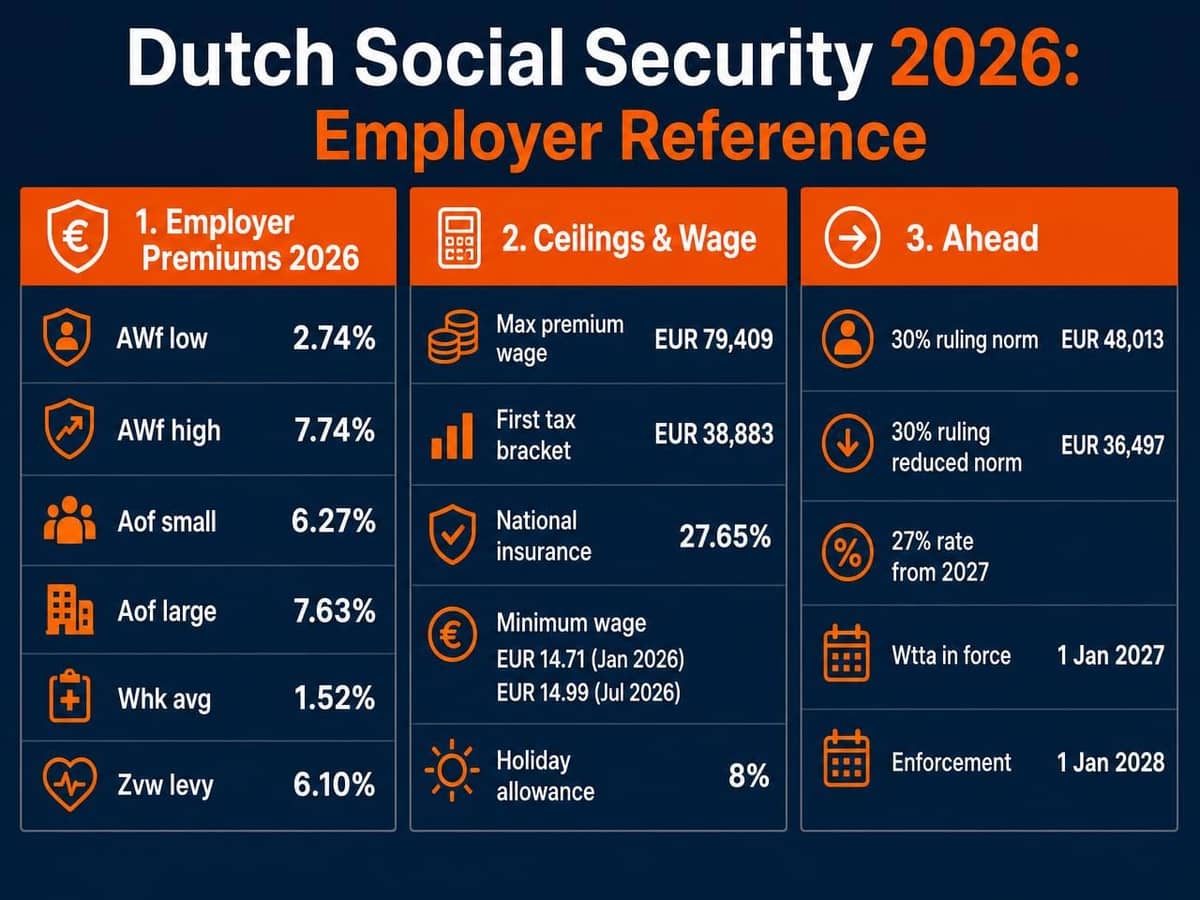
- Apply the correct 2026 rates: AWf 2.74% or 7.74%, Aof 6.27% or 7.63%, an individually set Whk premium (2026 average 1.52%), and the Zvw employer levy of 6.10%.
- Note that the maximum premium wage and Zvw contribution wage rose to €79,409 for 2026, and that national insurance is levied only over the first income tax bracket of €38,883.
- Budget for the 2026 minimum wage increases to €14.71 and €14.99 per hour, and for the 8% holiday allowance that sits on top of them.
- Recognise that the 104-week wage obligation during illness derives from Article 7:629 of the Dutch Civil Code, not from the Sickness Benefits Act.
- Prepare for the Wtta admission requirement, which enters into force on 1 January 2027 with enforcement from 1 January 2028, and for the Wet meer zekerheid flexwerkers.
The Dutch Social Security Landscape: A 2026 Framework for Employers
The Dutch social security framework (primary source: Wet financiering sociale verzekeringen (Wfsv), wetten.overheid.nl) protects residents and employees against the financial consequences of illness, disability, unemployment and old age. It relies on a dual funding model in which both employer and employee contribute to different sets of funds. For international organisations, understanding which side of that divide each premium falls on is a prerequisite for accurate cost modelling and for managing Dutch employment contracts.
Compliance is governed by two central authorities. The Belastingdienst (Tax and Customs Administration) collects all payroll taxes and social insurance premiums through the monthly loonaangifte. The UWV (Employee Insurance Agency) administers the benefit side of the system, assessing and paying unemployment (WW) and disability (WIA) benefits and issuing the sector data that feeds into certain premium calculations.
Insurance is compulsory for employees. Self-employed professionals are not outside the system altogether: as Dutch residents they are compulsorily insured under the national insurance schemes and pay the income-dependent Zvw contribution themselves. What they fall outside of is the employee insurance schemes, which is why they carry no statutory entitlement to WW or WIA and typically arrange private disability cover. Legislation introducing a mandatory disability insurance for the self-employed is in preparation and should be monitored.
National Insurance vs. Employee Insurance Schemes
The Dutch social insurance schemes separate social security into two categories.
National insurance (volksverzekeringen) covers every legal resident of the Netherlands regardless of employment status. Premiums are withheld from the employee's gross salary by the employer and remitted with the payroll tax return. They fund the General Old Age Pensions Act (AOW), the General Surviving Relatives Act (Anw) and the Long-term Care Act (Wlz).
Employee insurance (werknemersverzekeringen) applies only to those in an employment relationship. These premiums are paid by the employer on top of the gross wage and are not deducted from the employee. They fund the Unemployment Insurance Act (WW), the Work and Income according to Labour Capacity Act (WIA) and the Sickness Benefits Act (ZW).
The distinction matters commercially: national insurance is an employee cost that the employer administers, while employee insurance is a genuine employer overhead that must be built into your total cost of employment. Many international firms partner with a payroll specialist to keep that split accurate from the first payroll run.
Deemed Employment and Social Security Obligations
Misclassification remains a significant exposure for foreign firms. Under the Wet DBA, the Belastingdienst assesses whether a contractor is in reality an employee. Since the Supreme Court's Deliveroo judgment of 24 March 2023, that assessment is holistic: the relationship of authority is one factor among several, alongside the nature and duration of the work, whether the worker is embedded in the organisation, and the degree to which the worker genuinely operates as an entrepreneur. No single element is decisive.
The enforcement position has moved in stages. The enforcement moratorium was lifted on 1 January 2025, and additional assessments (naheffingen) can be imposed with retroactive effect to that date. For 2025 a full "soft landing" applied, under which no penalties were imposed. From 1 January 2026 that soft landing has been only partially extended: vergrijpboetes, which require intent or gross negligence, can now be imposed, while verzuimboetes are not expected to return before 1 January 2027. Inspections in 2026 generally begin with a company visit rather than an immediate books examination.
The legislative picture has also changed. The clarification component of the Wet VBAR has been withdrawn and is to be replaced by a separate Zelfstandigenwet, while the legal presumption of employment below a defined hourly rate continues as a distinct proposal. Employers should treat any commentary that still describes the VBAR as the coming framework as out of date.
Where a reclassification occurs, the consequences are immediate: the hiring party becomes liable for retroactive payroll taxes and social insurance premiums, with interest. All social security records, including proof of premium payments and employee data, must be retained under the statutory retention regime described below.
Employer-Paid Employee Insurance: WW, WIA, and ZW Obligations
Employer-paid premiums represent the bulk of non-wage labour costs in the Netherlands. They are not uniform: rates vary by contract type, by employer size and, for the Whk, by the individual employer's own claims history.
The 2026 employer-paid rates are as follows.
| Premium | 2026 rate |
|---|---|
| AWf (WW) low - permanent | 2.74% |
| AWf (WW) high - flexible | 7.74% |
| Aof - small employers | 6.27% |
| Aof - large employers | 7.63% |
| Whk (WGA + ZW-flex) | Individually set; 2026 average 1.52% |
| Zvw employer levy | 6.10% |
| Childcare allowance surcharge | 0.50% |
All of these are calculated over the wage up to the maximum premium wage of €79,409 per year for 2026 (€305.41 per day), up from €75,864 in 2025. Public sector employers pay the Ufo premium of 0.68% instead of AWf.
In aggregate, a small employer with permanent staff should budget roughly 17% on top of gross salary; a large employer with flexible contracts will sit meaningfully higher. Pension contributions, holiday allowance and any CAO-mandated funds sit on top of that figure. Government guidance on salaries tax and social insurance contributions sets out the statutory basis.
AWf Premiums and the Ketenregeling Impact
The Dutch government uses a differentiated AWf premium to encourage permanent employment. The high rate is fixed by statute at exactly five percentage points above the low rate, which for 2026 produces 2.74% and 7.74%.
To apply the low rate you need a written employment contract for an indefinite period that is not an on-call (oproep) arrangement. The signed contract must be present in your payroll administration; an unsigned or missing contract means the high rate applies, and the Belastingdienst can correct retroactively. The low rate also applies in three further situations: written BBL apprenticeship agreements, employees under 21 with no more than 48 paid hours per four-week period or 52 hours per month, and the AWf premium levied over benefit payments.
One revision rule is frequently overlooked. If an employee on a permanent contract for fewer than 35 hours per week is paid for more than 30% more hours over the calendar year than contractually agreed, the high rate applies retroactively for that entire year. Structural overtime on part-time permanent contracts is therefore a real cost risk for any Dutch payroll administration.
Contract chain management (the ketenregeling) interacts with this directly. Currently, a maximum of three consecutive fixed-term contracts is permitted within 36 months, after which the next contract becomes indefinite, and a break of more than six months resets the chain. Those rules are changing, as set out further below.
Disability Insurance (Aof) and Whk Calculations
The Aof (Arbeidsongeschiktheidsfonds) is a differentiated premium: small employers, defined as those with a wage bill up to 25 times the average premium-liable wage bill, pay 6.27% in 2026, while other employers pay 7.63%. The Aof funds IVA, WAO, WAZ, WAZO and ZW benefits, and WGA benefits only from the eleventh year onward.
The first ten years of WGA benefits and the ZW-flex risk are funded through the Whk (Werkhervattingskas), which is why the Whk sits alongside the Aof rather than duplicating it. The Whk is set per employer. Small employers pay a purely sectoral rate, large employers a fully individually differentiated rate based on their own benefit history, and medium-sized employers a weighted combination of the two. The Belastingdienst issues each employer a decision or notification setting out its Whk components before the start of the year; there is a six-week objection window from the date of that decision. Employers may also choose to bear the WGA and ZW-flex risk themselves as an eigenrisicodrager, in which case the corresponding Whk components are nil.
A point of terminology that causes recurring confusion: the ZW is the safety net for workers who fall ill without an employer to pay them, for example agency workers in certain phases, employees whose fixed-term contract ends during illness, and workers covered by a no-risk policy. It is not the source of the employer's obligation to continue paying wages during sickness. That obligation comes from Article 7:629 of the Dutch Civil Code, and it works as follows:
- The employer pays at least 70% of the wage for up to 104 weeks.
- During the first 52 weeks, the amount may not fall below the applicable statutory minimum wage.
- The obligation is capped at the maximum daily wage under the Wfsv, so it does not scale indefinitely with salary.
- The 104-week period can be extended by up to 52 weeks if the UWV finds the employer's reintegration efforts inadequate.
Many collective agreements and individual contracts improve on the statutory floor, commonly 100% in year one and 70% in year two. Reintegration obligations under the Wet verbetering poortwachter run in parallel throughout.
Employee-Paid National Insurance and Healthcare (Zvw)
While the previous section covered genuine employer costs, the employer also acts as the collection agent for national insurance, which is withheld from the employee's gross wage. The legal liability for correct withholding rests entirely with the employer even though the economic burden sits with the employee.
For 2026 the combined national insurance rate is 27.65%, made up of:
| Scheme | 2026 rate |
|---|---|
| AOW (old age pension) | 17.90% |
| Anw (surviving relatives) | 0.10% |
| Wlz (long-term care) | 9.65% |
| Total | 27.65% |
Critically, national insurance is levied only over the first income tax bracket, which for 2026 runs up to €38,883. There is no separate national insurance ceiling above that figure. The €79,409 maximum premium wage applies to the employee insurance premiums and the Zvw contribution, not to national insurance.
For context, the 2026 box 1 structure for those below state pension age is 35.75% up to €38,883, 37.56% from €38,883 to €78,426, and 49.50% above that. Only the first bracket contains national insurance; the higher brackets are pure income tax, which is why the step from the first to the second bracket is comparatively small.
AOW, ANW, and WLZ: The Withholding Process
AOW withholding ceases once an employee reaches state pension age, at which point the first-bracket rate drops accordingly. Tracking that date per employee is essential; failure to stop withholding results in overpayment that must then be reclaimed.
For internationally mobile staff, the starting point is not the Dutch rules but the coordination rules. Within the EU, EEA and Switzerland, Regulation 883/2004 determines which member state's legislation applies, evidenced by an A1 certificate. Outside that group, a bilateral social security treaty may apply. Where another state's legislation applies, no Dutch national insurance is withheld even though Dutch wage tax may still be due. Establishing the correct position before the first payroll run is considerably cheaper than correcting it afterwards.
The Zvw Employer Contribution for 2026
The Health Insurance Act (Zvw) income-dependent contribution comes in two forms. For employees, the employer pays a werkgeversheffing of 6.10% in 2026, down from 6.51% in 2025. This is an employer levy: it is not deducted from the employee's salary. Where the person is not insured for the employee insurance schemes, a director-major shareholder for example, the lower rate of 4.85% applies and is borne by the individual.
Both are calculated over the contribution wage up to a maximum of €79,409 for 2026, the same ceiling as the maximum premium wage.
Certain categories, including some interns and workers covered by an applicable international social security instrument, fall outside the levy. The Zvw base also picks up taxable benefits in kind: the addition for private use of a company car, for instance, forms part of the contribution wage.
The 30% ruling reduces this base. Because up to 30% of the salary can be designated as a tax-free allowance for extraterritorial costs, the taxable base for both national insurance and the Zvw levy falls accordingly. The employee's insurance coverage is unaffected; only the base over which contributions are calculated changes.
2026 Financial Data: Minimum Wage, Salary Norms, and Compliance
The Dutch statutory minimum wage has been calculated exclusively on an hourly basis since 1 January 2024. There are no longer statutory minimum monthly, weekly or daily amounts; the monthly figure simply follows from the contractual number of hours.
| Date | Statutory minimum hourly wage (21+) |
|---|---|
| 1 January 2026 | €14.71 |
| 1 July 2026 | €14.99 |
Lower minimum youth wages apply to employees aged 15 to 20, and separate rates apply to BBL apprentices. Indexation occurs on 1 January and 1 July each year, and salaries must be adjusted from those dates.
On top of gross salary, the statutory 8% holiday allowance applies. It is calculated over the gross annual wage, is normally paid in May or June, and is due on termination for the accrued portion. The statutory obligation is capped at three times the minimum wage, though most CAOs and contracts extend it. Holiday allowance forms part of the wage for both national insurance and employee insurance purposes, which is why the May payment produces a spike in that month's premium liability.
Administrative diligence is a legal requirement rather than an operational preference. Payroll and social security records must be kept for seven years under the general fiscal retention obligation. Two qualifications apply. First, copies of identity documents and the employee's payroll tax data must be retained for five years after the end of the calendar year in which the employment ends, a different clock from the seven-year rule. Second, the retention obligation is a floor for tax purposes, not a licence to keep everything indefinitely; personal data that is not covered by a statutory retention period must be deleted once it is no longer necessary under the GDPR. Digital storage is acceptable provided records remain accessible and legible for inspection.
30% Ruling and Social Security Interactions
The 30% ruling, now increasingly referred to as the expat scheme, remains available in 2026 at the full 30%. The salary norms for 2026 are:
| Norm | 2026 amount |
|---|---|
| Standard salary norm | €48,013 |
| Reduced norm, under 30 with a qualifying master's degree | €36,497 |
| Cap on the salary over which the ruling may be applied (WNT norm) | €262,000 |
These are taxable salary figures, meaning the salary that remains after the tax-free allowance has been applied. If the taxable salary would fall below the norm, the allowance must be reduced so that the norm is still met. The reduced norm requires the degree to be evaluated by the Dutch IDW or approved in advance by the Belastingdienst.
Two changes deserve attention now rather than later.
First, the cap at the WNT norm applies to every beneficiary from 1 January 2026. The transitional relief that shielded employees who held the ruling in December 2022 expired on that date, so some long-standing beneficiaries will see their allowance capped for the first time in the 2026 payroll year.
Second, from 1 January 2027 the maximum tax-free reimbursement falls from 30% to a flat 27% for the full duration of the ruling, and the salary norms increase. Which regime applies depends on when the ruling started:
| Ruling first applied | 2026 | 2027 onward |
|---|---|---|
| On or before 31 December 2023 | 30%, current norms | 30%, current norms |
| During 2024 | 30%, current norms | 27%, current norms |
| From 1 January 2025 | 30%, current norms | 27%, increased norms |
Employers recruiting internationally in the second half of 2026 should model the 2027 position at the offer stage, since a package that clears the 2026 norm may not clear the 2027 one.
Upcoming Changes: The Wtta and the Wet Meer Zekerheid Flexwerkers
Two statutes will materially change how staff are supplied and how flexible contracts are structured. Neither is yet in force, and both have fixed dates.
The Wtta (Wet toelating terbeschikkingstelling van arbeidskrachten) introduces a mandatory admission regime for any business that makes workers available to a third party under that third party's direction. It applies to temporary employment agencies, secondment firms, payroll providers and foreign suppliers alike; what matters is the factual arrangement rather than the contractual label. The key dates and requirements are:
- 1 November to 31 December 2026: registration window for the transitional arrangement, with the Nederlandse Autoriteit Uitleenmarkt (NAU).
- 1 January 2027: the Act enters into force and the standards framework applies.
- 1 May to 30 June 2027: window to submit a full admission application.
- 1 January 2028: enforcement by the Netherlands Labour Authority begins. From that date, hirers may only engage suppliers listed in the public register, and both parties face penalties if they do not.
Admission requires a valid VOG, a financial security deposit of €100,000 (reduced to €50,000 for start-ups), and demonstrable compliance with the standards framework covering employment, social security and tax law. A limited exemption exists where supply revenues stay below both 10% of the wage bill and €5 million per year.
The Wet meer zekerheid flexwerkers was adopted by the Tweede Kamer on 12 May 2026 and by the Eerste Kamer on 7 July 2026. Its components take effect on different dates:
- 31 December 2026: the requirement of equivalent terms and conditions for agency workers.
- 1 January 2028 (earliest): the zero-hours contract is replaced by a bandbreedtecontract, in which the maximum number of hours may not exceed 130% of the guaranteed minimum, with exceptions for pupils, students and those of state pension age. The ketenregeling interruption period extends from six months to 36 months, closing the revolving-door construction, while the maximum of three fixed-term contracts remains. The maximum duration of the agency work phases is also shortened.
Employers relying on on-call arrangements or on short chains of fixed-term contracts should map their exposure during 2027 rather than in the implementation year.
Transition Payments and Pension Contributions
Termination costs belong in the same budget. The transition payment accrues from the first day of employment, including during probation, at one third of the gross monthly salary per full year of service. For 2026 it is capped at €102,000 gross, or one gross annual salary if that is higher.
The payment is due in principle whenever the employment ends at the employer's initiative, including where a fixed-term contract is not renewed, and also where the employee resigns as a result of seriously culpable conduct by the employer. It is not due where the employee resigns without cause, or where dismissal follows the employee's own seriously culpable conduct. Where termination is arranged by settlement agreement, no statutory transition payment arises, though it usually serves as the negotiating benchmark.
Separately from statutory social security, you must determine whether your activities fall under a mandatory industry-wide pension fund (bedrijfstakpensioenfonds). Participation is compulsory where the fund's scope applies, and the contribution rates are set by the fund, not by statute. Retroactive enrolment following an audit is a familiar and expensive outcome for foreign employers who assumed the question was optional.
Probation periods are also worth setting correctly at the outset: a maximum of two months for indefinite contracts and fixed-term contracts of two years or more, one month for fixed-term contracts of six months or more but under two years, and no probation period at all for contracts of six months or less.
Managing Compliance: Why a Local EOR Partner is Essential
There is a persistent misconception that a foreign company running Dutch payroll directly thereby creates a permanent establishment. It does not. A foreign entity can register with the Belastingdienst as a withholding agent for Dutch wage tax without that registration in itself creating a permanent establishment. Whether a permanent establishment exists is a separate question, determined by the applicable tax treaty and Dutch corporate tax law, and turns on whether there is a fixed place of business at the company's disposal or a dependent agent habitually concluding contracts.
What is true is that engaging a local employer of record removes the administrative burden and consolidates the obligations. ICSPayroll acts as the legal employer in the Netherlands, taking responsibility for withholding wage tax and national insurance, remitting employee insurance premiums and the Zvw levy, and maintaining compliant records. Employer costs, including AWf, Aof, Whk and Zvw, are consolidated into a single monthly invoice, which makes the total cost of employment visible in advance rather than reconstructed afterwards. That is the practical reason many foreign firms outsource your Dutch payroll administration from day one.
It should also be stated plainly that an EOR does not resolve permanent establishment risk arising from the client's own activity in the Netherlands. If your staff perform functions that themselves constitute a fixed place of business, or conclude contracts on your behalf, that exposure exists regardless of who administers the payroll. Any provider suggesting otherwise is overselling.
Our service includes HR administration and an employee portal through which staff can access payslips and contracts. Payroll and insurance records are maintained for the statutory retention periods described above.
Mitigating Risk with an EOR Model
The EOR model is well suited to managing the ketenregeling, which currently limits the chain to three fixed-term contracts within 36 months, and to preparing for the changes taking effect from 2028.
The most significant financial risk we absorb is long-term illness. Under Article 7:629 of the Dutch Civil Code the employer must continue paying at least 70% of the wage for up to 104 weeks, subject to a minimum wage floor in the first 52 weeks and a ceiling at the maximum daily wage, and must actively manage reintegration under the Wet verbetering poortwachter. Failure to meet those reintegration obligations can extend the payment period by a further year. ICSPayroll carries this obligation as legal employer and coordinates with the UWV throughout.
As a supplier of personnel, ICS Staffing & Payroll B.V. is itself within the scope of the Wtta and is preparing for admission on the timeline set out above. We would encourage any client engaging a Dutch payroll or staffing provider to ask that provider directly about its Wtta position, because from 1 January 2028 hirers who work with non-admitted suppliers are exposed to penalties in their own right.
Your Partner for Dutch Market Entry
Immigration requires a more careful explanation than it is usually given. For a highly skilled migrant residence permit, the recognised sponsor (erkend referent) must be the entity that employs the worker and pays the salary. It is not possible to combine an unrelated party as recognised sponsor with a different entity as legal employer.
In practice this means one of two structures. Either the client itself obtains recognised sponsor status and employs the worker directly, or the worker is employed by an entity that holds recognised sponsor status. We will advise on which route fits your situation and coordinate the process accordingly; we do not present sponsorship and employment as separable when they are not.
On timelines, the IND applies a target of two weeks for deciding a residence permit application submitted by a recognised sponsor, against a statutory decision period of 90 days. The two-week figure is a service target and not a guarantee. Applications for recognised sponsor status itself take considerably longer, up to 90 days and sometimes more where additional questions arise.
Securing Your Dutch Payroll Compliance for 2026
The foundation of a compliant Dutch payroll is knowing which premiums are withheld from the employee, which are genuine employer costs, and which ceiling applies to each. National insurance at 27.65% is withheld from the employee and levied only over the first bracket of €38,883. Employee insurance premiums and the 6.10% Zvw levy are employer costs, calculated up to €79,409.
Beyond the rates, 2026 is a year for forward planning. The 30% ruling drops to 27% in 2027 with higher salary norms. The Wtta admission window opens in November 2026 and enforcement follows in January 2028. The Wet meer zekerheid flexwerkers reshapes on-call and fixed-term contracting from 2028, with the agency worker provisions arriving at the end of this year.
Getting the current figures right is the minimum. Building the 2027 and 2028 changes into contracts you are signing today is what actually protects the budget.
Secure your Dutch compliance with a tailored payroll quote from ICSPayroll. We look forward to supporting your business growth in the Netherlands.
Frequently Asked Questions
What are the employer social security rates in the Netherlands for 2026?
Employers pay the Zvw levy at 6.10%, the AWf unemployment premium at 2.74% for qualifying permanent contracts or 7.74% for flexible contracts, the Aof disability premium at 6.27% for small employers or 7.63% for large employers, an individually set Whk premium averaging 1.52%, and a 0.50% childcare surcharge. All are calculated up to a maximum wage of €79,409. In total this adds roughly 17% to 19% to gross salary, before pension contributions.
Is the 8% holiday allowance subject to social security contributions?
Yes. Holiday allowance forms part of the gross wage and is included in the calculation base for both national insurance and employee insurance premiums. Because it is usually paid in a single instalment in May or June, it produces a corresponding increase in that month's premium liability.
Do foreign employers have to pay Dutch social security for remote workers?
Where an employee lives and works in the Netherlands, Dutch social security generally applies. Within the EU, EEA and Switzerland, Regulation 883/2004 determines the competent state and an A1 certificate evidences the position. A foreign employer can meet Dutch obligations either by registering directly as a withholding agent or by using an employer of record. Registering as a withholding agent does not, by itself, create a permanent establishment.
What is the difference between the low and high AWf premium?
The low rate of 2.74% applies to written contracts for an indefinite period that are not on-call arrangements, and to certain BBL apprenticeships and young employees with limited hours. The high rate is fixed by law at exactly five percentage points higher, at 7.74%, and applies to fixed-term and flexible contracts. Note that structural overtime exceeding 30% on part-time permanent contracts of under 35 hours triggers retroactive application of the high rate.
How long must an employer keep social security and payroll records in the Netherlands?
Payroll and social security records must be retained for seven years under the general fiscal retention obligation. Copies of identity documents and the employee's payroll tax data must be kept for five years after the end of the calendar year in which employment ends. Digital storage is acceptable provided records remain accessible for inspection. Data not covered by a statutory retention period must be deleted once it is no longer necessary.
What happens if an employee falls ill for a long period in the Netherlands?
Under Article 7:629 of the Dutch Civil Code the employer must continue paying at least 70% of the wage for up to 104 weeks. During the first 52 weeks the amount may not fall below the statutory minimum wage, and throughout the period the obligation is capped at the maximum daily wage. Reintegration must be actively managed under the Wet verbetering poortwachter; inadequate efforts can extend the obligation by up to a further 52 weeks. The Sickness Benefits Act is a separate safety net for workers without an employer, not the source of this obligation.
Are pension contributions part of the mandatory social security system?
No. Pension obligations sit outside the statutory social security system but may still be compulsory through an industry-wide pension fund. Whether such a fund applies depends on the nature of your activities, and enrolment can be enforced retroactively.
Can the 30% ruling be applied to social security contributions?
The ruling reduces the taxable base over which national insurance and the Zvw contribution are calculated, because up to 30% of the salary is designated as a tax-free allowance. Coverage under the schemes is unaffected. For 2026 the taxable salary after the allowance must remain above €48,013, or €36,497 for employees under 30 with a qualifying master's degree. From 2027 the percentage falls to 27% and the norms increase.
Does an employer of record remove permanent establishment risk?
Not by itself. An EOR removes the need to establish a local entity for employment purposes and takes on the legal employer obligations. Whether your activities in the Netherlands constitute a permanent establishment is determined separately, under the applicable tax treaty and Dutch corporate tax law, by reference to what your people actually do.
Sources and references
Every rule and figure above is traceable to the sources below: the exact statutory articles, the regulator pages that publish the amounts, the statistical datasets, and the specific court rulings that settle the point. Always check the current text for your own situation.
- Article 9 Wfsv, employer-paid social insurance contributions
- Article 27 Wfsv, differentiated Whk contribution per employer
- Article 29 Sickness Benefits Act, UWV sickness benefit for employees without an employer
- Belastingdienst, low and high AWf unemployment contribution rates and when each applies
- UWV, maximum daily wage 2026 used to cap sickness and WIA benefits
- UWV, sickness, reintegration obligations and the WIA application in week 93
- CBS, Compensation of employees and employment by economic activity (national accounts dataset 84165ENG)
- Eurostat, hourly labour cost levels by NACE activity (dataset lc_lci_lev), for cross-country comparison
- Supreme Court 18 February 2022, ECLI:NL:HR:2022:282: qualification of a management agreement and the resulting employee insurance contribution liability
- Supreme Court 27 May 2022, ECLI:NL:HR:2022:772: insured-status decisions for employee insurance under art. 59(3) Wfsv

Article by
Joost Hubregtse
Joost Hubregtse is Director of ICS Staffing & Payroll B.V., the wholly owned subsidiary of Intercompany Solutions behind ICS Payroll. He is responsible for Employer of Record and Dutch payroll services: employment contracts, wage tax and social security filings, holiday allowance, pension, sick leave and CAO compliance, with onboarding possible within 48 hours.