
Cost of Hiring an Employee in the Netherlands: The 2026 Employer Guide
By Joost Hubregtse, Director, ICS Staffing & Payroll
All blog posts are reviewed and fact checked by our labour law lawyer Zishan Hussain and our director. Editorial standards
By Joost Hubregtse, Payroll Director
Joost Hubregtse is Payroll Director at ICSPayroll, the Dutch payroll and EOR specialist of Intercompany Solutions. A career payroll specialist and former Head of Payroll, he oversees wage tax filings, 30% ruling applications, and employment compliance for international employers.
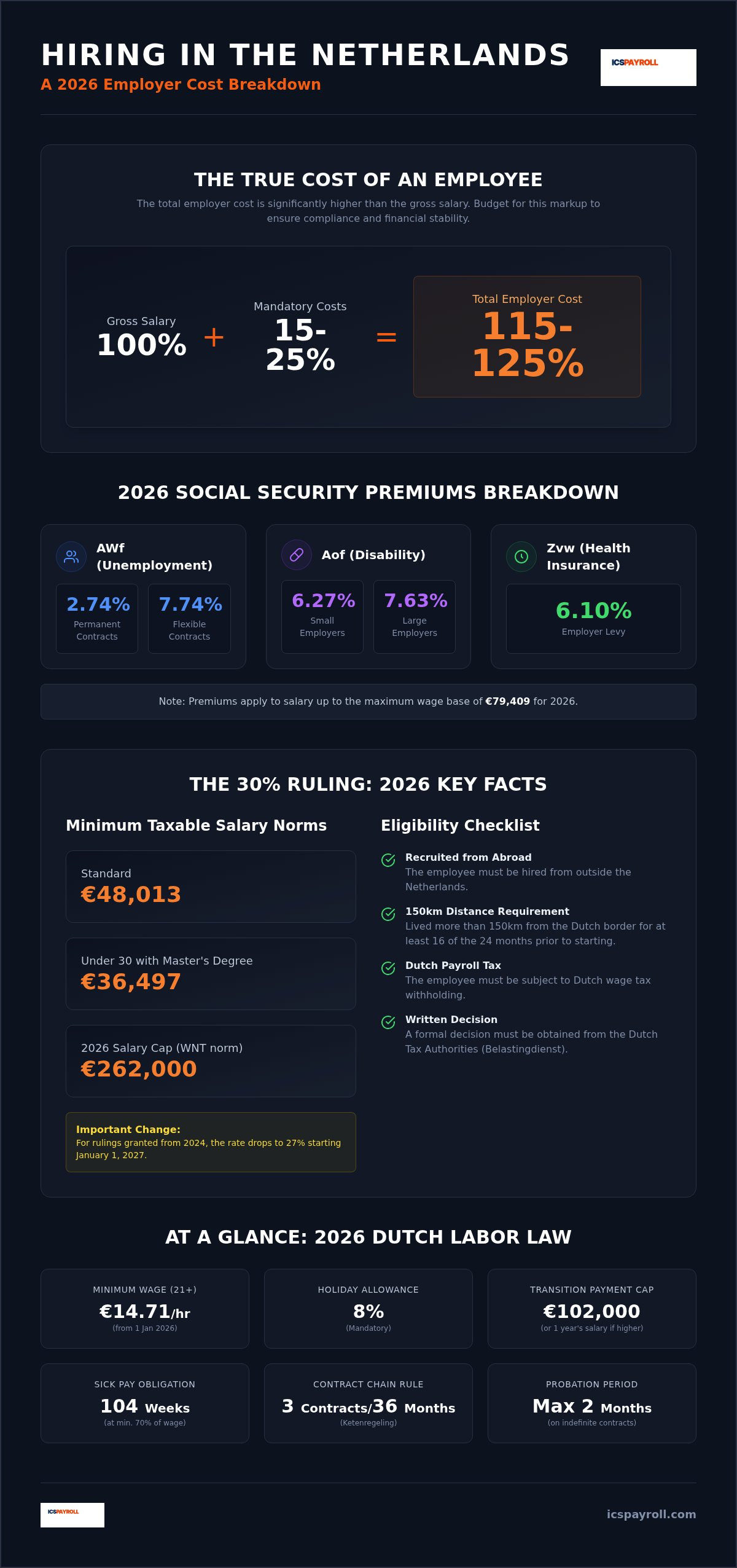
The actual cost of hiring an employee in the Netherlands typically ranges between 115% and 125% of the gross salary once all mandatory employer contributions are finalized. For many international firms, this overhead represents a significant budgetary variable that is often misunderstood. Successfully managing the cost of hiring an employee in the Netherlands involves balancing statutory social security premiums, a mandatory 8% holiday allowance, and the technical nuances of the 30% ruling.
Calculating these figures accurately is essential for maintaining compliance with the Belastingdienst and ensuring long-term financial stability. This 2026 guide removes the administrative burden by providing a transparent breakdown of every employer obligation. You'll gain a clear percentage multiplier for budgeting, an explanation of the updated 30% ruling salary norms, and a strategy to hire local talent without the need for a Dutch legal entity. We provide the technical certainty required to expand your operations with total peace of mind.
Key Takeaways
- Calculate the total cost of hiring an employee in netherlands by identifying the 15% to 25% markup on gross salary required for statutory contributions.
- Breakdown mandatory employer social security costs for 2026, including the 6.10% Zvw levy and specific premiums for the AWf and Aof funds.
- Apply the 2026 salary norms for the 30% ruling to attract international talent while maintaining strict compliance with Dutch tax authorities.
- Compare the overhead of incorporating a Dutch BV against the speed and security of an Employer of Record model to avoid Permanent Establishment risks.
- Streamline your budgeting process by consolidating holiday allowance, pension, and insurance costs into a single, predictable monthly invoice.
Calculating the Total Cost of Employment in the Netherlands
The Total Cost of Employment (TCOE) represents the complete financial commitment an employer makes to a worker beyond the figure listed on an employment contract. In the Dutch market, this calculation is far more complex than simply adding a fixed percentage for taxes. It includes mandatory social insurance, health levies, and specific labor law requirements that vary based on the industry and contract type. For international businesses, understanding the true cost of hiring an employee in netherlands requires a shift from viewing gross salary as the final expense to seeing it as the foundation of a much larger financial pyramid.
Most experienced financial officers use a baseline multiplier of 130% to 140% of the gross salary when budgeting for Dutch staff. This range provides a necessary buffer for statutory contributions, mandatory benefits, and administrative overhead. Failing to budget for this gap often leads to significant compliance risks or unexpected quarterly deficits. While the gross salary is the most visible number, the actual cost of hiring an employee in netherlands is heavily influenced by the social protections that define the local labor market.
The 2026 Dutch Minimum Wage Standards
The Netherlands utilizes a statutory hourly minimum wage system that is updated twice per year. As of 1 January 2026, the rate for employees aged 21 and over is set at EUR 14.71 per hour. This rate is scheduled for a mid-year adjustment, rising to EUR 14.99 per hour on 1 July 2026. These hourly rates translate directly into monthly budget requirements. For a standard 40-hour work week, the initial 2026 monthly gross minimum wage is approximately EUR 2,549.73. When the July increase takes effect, that monthly baseline climbs to roughly EUR 2,598.27. Employers must monitor these dates closely to ensure payroll systems remain compliant with Dutch law.
Gross Salary vs. Total Employer Cost
A common pitfall for foreign companies is ignoring the mandatory 8% holiday allowance. This is not a discretionary bonus; it's a legal requirement calculated on the employee's gross annual salary. Most employers pay this in a lump sum in May or June, though it can be distributed monthly if specified in the contract. Another critical factor is the transition payment (transitievergoeding), which accrues from the first day of employment, including the probation period. The 2026 cap for this payment is EUR 102,000, or one year's gross salary if higher. Additionally, contributions to the Dutch pension system often add another 15.2% to the employer's burden. These elements confirm that budgeting must account for much more than just the base pay.
Mandatory Employer Contributions and Social Security
The Dutch social security system is a robust network funded primarily through employer contributions. While the previous section established the baseline cost of hiring an employee in netherlands using a broad multiplier, a granular look at social insurance is required for fiscal precision. These premiums are not static; they are determined by the nature of the employment contract and the size of your workforce. Accurate reporting is essential to avoid retroactive assessments from the Dutch Tax Administration.
Detailed Breakdown of Social Premiums for 2026
The Belastingdienst oversees the collection of several key funds that protect the workforce against unemployment and disability. The AWf (Unemployment Fund) is bifurcated to incentivize stability; permanent contracts are taxed at 2.74%, while flexible or fixed-term arrangements incur a 7.74% rate. Additionally, the Aof (Disability Fund) differentiates between small employers (6.27%) and large employers (7.63%). For 2026, the employer levy for the Health Insurance Act (Zvw) is set at 6.10%. It is important to note that these percentages only apply to salary up to the maximum premium wage base of EUR 79,409. Income exceeding this threshold is not subject to these specific employer premiums.
Sickness Risk and Reintegration Obligations
Managing the cost of hiring an employee in netherlands also involves preparing for long-term illness. Under Art. 7:629 BW, an employer must continue to pay at least 70% of an employee's wages for up to 104 weeks if they are unable to work. This obligation includes a mandatory floor of the minimum wage during the first year. Beyond the salary continuation, you must also navigate the Poortwachter (Gatekeeper) requirements. This involves a formal reintegration analysis by week 6 and a concrete action plan by week 8. Failure to comply can lead to significant sanctions from the UWV, including an extension of the salary payment duty to a third year.
ICSPayroll helps international businesses mitigate these risks through our consolidated payroll model. By incorporating sickness risk coverage and reintegration support into a single service, we remove the administrative complexity of Dutch labor law. You can outsource Dutch payroll management to ensure your operations remain fully compliant without the need for internal legal specialists. This approach provides a predictable financial structure for your expansion, allowing you to focus on growth while we handle the technicalities of social security filings.
The 30% Ruling: Impact on Costs and Salary Norms
The 30% ruling remains the most effective tool for managing the cost of hiring an employee in netherlands when recruiting specialized international talent. This fiscal incentive allows employers to provide a tax-free allowance of up to 30% of the gross salary. It effectively reduces the employee's taxable income while significantly increasing their net take-home pay. For the business, this often facilitates a more competitive offer without a proportional increase in the total employer's burden. It's a strategic advantage that stabilizes recruitment budgets for high-demand roles.
Eligibility Criteria for the 30% Tax Advantage
Strict eligibility requirements apply to ensure the ruling supports genuine international recruitment. The candidate must be recruited from abroad and have resided more than 150 kilometers from the Dutch border for at least 16 of the 24 months preceding their start date. Timing is critical for financial planning. You must file the application with the Belastingdienst within four months of the employee's start date to ensure the benefit is retroactive to the first day of work. Filings submitted after this window only become effective from the month following the application, resulting in lost tax savings for the initial months.
For 2026, specific taxable salary norms dictate the level of benefit available. Standard hires must maintain a taxable salary of at least EUR 48,013 after the deduction. Employees under 30 with a recognized Master's degree benefit from a lower threshold of EUR 36,497. It's important to understand that these figures represent the taxable base; to utilize the full 30% allowance, a gross salary of approximately EUR 68,590 is typically required. High-earning executives are also subject to the WNT cap, which limits the tax-free allowance to a maximum salary base of EUR 262,000 as of 1 January 2026.
Strategic Cost Savings for Employers
Leveraging the 30% ruling correctly allows you to offer superior net results while controlling the cost of hiring an employee in netherlands. However, you must maintain a clear distinction between tax benefits and immigration status. While immigration sponsorship is arranged via our licensed partner, the 30% ruling is a separate fiscal decision granted solely by the Dutch Tax Administration. Professional oversight is required to manage the transition in 2027. For rulings first granted from 2024 onwards, the tax-free rate will drop to 27% on 1 January 2027. Pre-2024 holders are exempt from this reduction, meaning your long-term payroll strategy must account for these differing cohorts to ensure continued compliance and employee satisfaction.
Strategic Comparison: Dutch BV vs. Employer of Record
Expanding into the Dutch market requires a clear choice between legal independence and operational speed. This decision fundamentally alters the cost of hiring an employee in netherlands. While establishing a local entity offers total control, the administrative and fiscal overhead is substantial. For many international firms, the Employer of Record (EOR) model provides a faster, more predictable path to market entry without the burden of local incorporation.
Overhead and Compliance Risks of a Local Entity
A Dutch BV is a resident taxpayer, which eliminates the risk of a foreign company being classified as having a Permanent Establishment (PE). However, this status comes with significant financial and regulatory obligations. Setting up a BV requires an initial investment of approximately EUR 2,000. Ongoing costs for accounting, annual filings, and legal maintenance typically range from EUR 3,000 to 8,000 per year. Beyond these service fees, you must manage Corporate Income Tax (CIT) rates: 19% on taxable profits up to EUR 200,000 and 25.8% on everything above that threshold.
The administrative burden doesn't stop at corporate taxes. You're responsible for the loonaangifte (wage tax filing), which is due on the last day of every month. Drafting localized employment contracts and employee handbooks that comply with Dutch labor reforms requires specialized legal counsel. These invisible costs can add several thousand euros to your initial budget. Managing these tasks internally often distracts from core business goals and increases the risk of non-compliance with the Belastingdienst.
The EOR Alternative: Efficiency and Predictability
EOR services offer a streamlined alternative that eliminates the need for local incorporation. You can hire talent in weeks rather than months. This model consolidates the cost of hiring an employee in netherlands into a single service fee. This fee covers the mandatory 8% holiday allowance and ensures the transition payment accrues correctly from day one. It removes the need to track complex social premiums or manage the 15.2% pension contribution standard independently.
By using an EOR, you transfer the burden of sickness risk and HR administration to a local expert. This provides total cost transparency, as all employer burdens are reflected in a single monthly invoice. You don't have to worry about the specific nuances of Dutch labor law or the technicalities of the 30% ruling application process. The EOR handles these complexities, allowing you to scale your team with total peace of mind.
If you want to avoid the delays and overhead of legal entity incorporation, you can request a tailored Dutch EOR quotation to see how our payroll factor model simplifies your international expansion.
Streamlining Dutch Hiring Costs with ICSPayroll
Managing the cost of hiring an employee in netherlands requires a shift from fragmented administration to a consolidated financial model. ICSPayroll utilizes a proprietary "Payroll Factor" model designed to eliminate the complexity of Dutch labor law. Instead of tracking dozens of individual premiums and accruals, you receive one monthly invoice based on a transparent multiplier of the gross salary. This model provides the technical certainty needed for accurate global budgeting while removing the administrative burden from your internal HR team.
Transparent Pricing: No Surprises, No Separate Charges
The payroll factor is an all-inclusive figure. It covers the mandatory 8% holiday allowance, the 15.2% pension contribution standard, and all employer social security premiums discussed in previous sections. This model also absorbs the financial risk of sickness. If an employee falls ill, the costs associated with the 104-week salary continuation and the mandatory Poortwachter reintegration support are managed within the service. You gain a single point of contact for all compliance matters, from wage tax filings to 30% ruling applications.
Your team also gains access to a secure online employee portal. This digital interface allows workers to access their payslips and employment contracts independently, reducing the volume of routine HR inquiries. This human-centric approach ensures that while the technology handles the processing speed, a dedicated expert remains accountable for the meticulous legal standards required by the Belastingdienst. You receive a stabilization of your costs without the faceless nature of large-scale outsourcing firms.
Next Steps for Hiring in the Netherlands
Speed is a critical advantage in the modern talent market. While establishing a Dutch BV can take months of legal preparation, our EOR model allows for operational setup in just a few weeks. If your expansion requires international talent, immigration sponsorship is arranged via our licensed partner. This collaboration enables expedited HSM visa processing with a typical timeline of approximately three weeks. This ensures your key staff can begin their roles without the typical delays associated with cross-border hiring.
You can begin your expansion by requesting a tailored quotation. We provide a complete breakdown of the cost of hiring an employee in netherlands within 24 hours of your inquiry. This rapid response allows you to move from curiosity to confidence with clinical precision. Once the quotation is approved, we handle the entire onboarding process, ensuring full compliance with Dutch resident taxpayer requirements from day one. You can focus on your core business objectives while we manage the technicalities of the Dutch payroll system.
Hire in the Netherlands with confidence with ICSPayroll
Accelerating Your Dutch Expansion with Technical Certainty
Mastering the cost of hiring an employee in netherlands is a prerequisite for successful international expansion. You now have the technical framework to calculate the 130% to 140% multiplier required for a compliant Dutch budget. By accounting for the 15.2% pension standard and the tiered social premiums of 2026, you protect your organization from unforeseen fiscal liabilities. Whether you choose to establish a local BV or leverage the speed of an Employer of Record, compliance with the Belastingdienst remains your primary objective.
ICSPayroll provides the stabilization your business needs to enter this market with confidence. We consolidate all social security, holiday allowance, and sickness risk into one clear monthly invoice; there are no surprises or hidden administrative fees. This ensures you maintain full Dutch payroll tax and 30% ruling compliance while your operational set-up is finalized in weeks. It's the most efficient way to secure top talent without the delays of entity incorporation.
Get a Tailored Dutch Hiring Quotation Within 24 Hours and take the first step toward a seamless and secure Dutch operation. We look forward to supporting your growth in the Netherlands.
Frequently Asked Questions
What is the total employer cost on top of a gross salary in the Netherlands?
The total employer cost typically ranges from 115% to 125% of the gross salary. This percentage includes statutory social security premiums, the mandatory 8% holiday allowance, and pension contributions. When calculating the cost of hiring an employee in netherlands, you must also factor in the accrual of the transition payment and insurance for sickness risks. Using a consolidated payroll model ensures these variables are managed under a single, predictable monthly invoice.
How much is the mandatory holiday allowance in the Netherlands for 2026?
The statutory holiday allowance is 8% of the employee's gross annual salary. Most employers distribute this as a lump sum in May or June, though alternative monthly payments can be arranged in the employment contract. This allowance is a legal requirement for all employees, including those on fixed-term or part-time contracts. It forms a core component of the total cost of hiring an employee in netherlands and must be budgeted for from day one.
What are the salary requirements for the 30% ruling in 2026?
For 2026, the standard taxable salary norm is €48,013 after the tax-free deduction. Employees under the age of 30 who hold a recognized Master's degree have a lower taxable threshold of €36,497. To qualify for the full 30% allowance, a gross salary of approximately €68,590 is generally required. These norms are strictly enforced by the Belastingdienst and are separate from the requirements for immigration sponsorship arranged via our licensed partner.
Is a pension scheme mandatory for employees in the Netherlands?
While not every sector has a mandatory industry-wide fund, providing a market-compliant pension is a standard requirement for attracting and retaining international talent. A typical employer contribution is 15.2% of the gross salary. ICSPayroll includes this 15.2% contribution within our consolidated payroll factor to ensure your benefits package remains competitive and fully compliant with Dutch labor standards. This removes the administrative burden of managing multiple private pension providers independently.
How long does it take to hire an employee in the Netherlands without a BV?
You can hire staff in weeks, not months, by utilizing an Employer of Record (EOR) service. This model allows you to employ Dutch-based talent without establishing a local legal entity. Operational set-up is finalized in weeks, and tailored quotations are provided within 24 hours. For non-Schengen staff, expedited Highly Skilled Migrant (HSM) visa processing is arranged via our licensed partner, with most permits typically granted within approximately three weeks.
What is the maximum transition payment in the Netherlands for 2026?
The statutory transition payment is capped at €102,000 for 2026, or one year's gross salary if that amount is higher. This payment accrues from the first day of employment and is mandatory for all contract terminations initiated by the employer. Managing this accrual is essential for long-term budgeting and risk mitigation. Our payroll model incorporates transition allowance management to ensure these funds are accurately accounted for throughout the duration of the employment relationship.
How does sick pay work for employers in the Netherlands?
Dutch employers are legally required to pay at least 70% of an employee's salary for up to 104 weeks during illness. In the first year, this payment cannot fall below the statutory minimum wage. Employers must also comply with the Poortwachter Act, which requires formal reintegration plans starting from week 8 of illness. ICSPayroll absorbs this sickness risk and manages all reintegration support, protecting your business from the financial impact of long-term absenteeism.
What is a payroll factor and how does it simplify hiring costs?
A payroll factor is a transparent multiplier applied to an employee's gross salary to consolidate all employer costs into one monthly invoice. This single figure covers the 8% holiday allowance, 15.2% pension, social security premiums, and sickness risk insurance. It also includes HR administration and access to an online employee portal. This model eliminates surprise charges and simplifies global budgeting by providing a clear, predictable cost structure for your Dutch operations.

Article by
Joost Hubregtse
Joost Hubregtse is Director of ICS Staffing & Payroll B.V., the wholly owned subsidiary of Intercompany Solutions behind ICS Payroll. He is responsible for Employer of Record and Dutch payroll services: employment contracts, wage tax and social security filings, holiday allowance, pension, sick leave and CAO compliance, with onboarding possible within 48 hours.
Frequently Asked Questions
The total employer cost typically ranges from 115% to 125% of the gross salary. This percentage includes statutory social security premiums, the mandatory 8% holiday allowance, and pension contributions. When calculating the cost of hiring an employee in netherlands, you must also factor in the accrual of the transition payment and insurance for sickness risks. Using a consolidated payroll model ensures these variables are managed under a single, predictable monthly invoice.
The statutory holiday allowance is 8% of the employee's gross annual salary. Most employers distribute this as a lump sum in May or June, though alternative monthly payments can be arranged in the employment contract. This allowance is a legal requirement for all employees, including those on fixed-term or part-time contracts. It forms a core component of the total cost of hiring an employee in netherlands and must be budgeted for from day one.
For 2026, the standard taxable salary norm is €48,013 after the tax-free deduction. Employees under the age of 30 who hold a recognized Master's degree have a lower taxable threshold of €36,497. To qualify for the full 30% allowance, a gross salary of approximately €68,590 is generally required. These norms are strictly enforced by the Belastingdienst and are separate from the requirements for immigration sponsorship arranged via our licensed partner.
While not every sector has a mandatory industry-wide fund, providing a market-compliant pension is a standard requirement for attracting and retaining international talent. A typical employer contribution is 15.2% of the gross salary. ICSPayroll includes this 15.2% contribution within our consolidated payroll factor to ensure your benefits package remains competitive and fully compliant with Dutch labor standards. This removes the administrative burden of managing multiple private pension providers independently.
You can hire staff in weeks, not months, by utilizing an Employer of Record (EOR) service. This model allows you to employ Dutch-based talent without establishing a local legal entity. Operational set-up is finalized in weeks, and tailored quotations are provided within 24 hours. For non-Schengen staff, expedited Highly Skilled Migrant (HSM) visa processing is arranged via our licensed partner, with most permits typically granted within approximately three weeks.
The statutory transition payment is capped at €102,000 for 2026, or one year's gross salary if that amount is higher. This payment accrues from the first day of employment and is mandatory for all contract terminations initiated by the employer. Managing this accrual is essential for long-term budgeting and risk mitigation. Our payroll model incorporates transition allowance management to ensure these funds are accurately accounted for throughout the duration of the employment relationship.
Dutch employers are legally required to pay at least 70% of an employee's salary for up to 104 weeks during illness. In the first year, this payment cannot fall below the statutory minimum wage. Employers must also comply with the Poortwachter Act, which requires formal reintegration plans starting from week 8 of illness. ICSPayroll absorbs this sickness risk and manages all reintegration support, protecting your business from the financial impact of long-term absenteeism.
A payroll factor is a transparent multiplier applied to an employee's gross salary to consolidate all employer costs into one monthly invoice. This single figure covers the 8% holiday allowance, 15.2% pension, social security premiums, and sickness risk insurance. It also includes HR administration and access to an online employee portal. This model eliminates surprise charges and simplifies global budgeting by providing a clear, predictable cost structure for your Dutch operations.