
How to Calculate Total Cost of Employment in Netherlands: 2026 Employer Guide
By Joost Hubregtse, Director, ICS Staffing & Payroll
All blog posts are reviewed and fact checked by our labour law lawyer Zishan Hussain and our director. Editorial standards
Budgeting for a Dutch hire based solely on agreed gross salary is the fastest way to derail an international hiring plan. Between statutory holiday allowances, mandatory employee insurances, and capped social contribution bases, your true employer liability routinely runs 20% to 35% above base compensation. If you don't account for these rules upfront, statutory surcharges will quickly inflate your operating overhead. Knowing how to calculate total cost of employment in netherlands is essential for forecasting margins accurately while remaining fully compliant with local labor authorities.
Managing Dutch labor standards shouldn't feel like financial guesswork, yet balancing variable unemployment contributions, health insurance levies, and pension requirements often creates major administrative friction. This guide details the exact mathematical formulas for 2026, breaking down mandatory employer social premiums, the statutory 8% holiday allowance, and long-term liabilities like the two-year sick pay mandate. We will walk step by step through the employer cost model so you can build precise hiring budgets and choose the most cost-efficient route for your business.
Key Takeaways
- Dutch hiring liabilities typically range between 125% and 135% of gross base salary once statutory contributions and benefits are factored into payroll.
- Mastering how to calculate total cost of employment in netherlands requires layering the mandatory 8% holiday allowance with employer social taxes capped at EUR 79,409 for 2026.
- Statutory employee insurances demand variable contributions, including differentiated unemployment premiums and disability fund allocations based on company parameters.
- Long-term liabilities like the statutory two-year sick pay mandate and industry-standard pension schemes must be budgeted upfront to prevent cash-flow shocks.
- Evaluating direct Dutch entity incorporation against an Employer of Record model reveals the most cost-effective structure for international hiring operations.
Deconstructing Gross Salary and Mandatory Dutch Allowances
Base salary represents only the foundation of total employment remuneration in the Netherlands. Foreign employers often assume that negotiated annual pay equals their primary financial liability, but local legislation enforces additional statutory layers directly on top of gross wages. Total Dutch employment cost is defined as the gross base pay plus mandatory statutory allowances, employer-paid social premiums, mandatory pension contributions, and accrued reserves for leave and severance liabilities. Understanding these separate legal layers is the first critical step in learning how to calculate total cost of employment in netherlands without sustaining unexpected balance-sheet corrections.
Statutory wage floors shift biannually across the country. According to official figures published on business.gov.nl, the Dutch statutory minimum wage for workers aged 21 and older stands at EUR 14.71 per hour effective 1 January 2026, rising to EUR 14.99 per hour on 1 July 2026. Because Dutch wage structures incorporate employee-paid national insurance (volksverzekeringen) within personal income taxes, employers must clearly differentiate between employee deductions and the separate mandatory surcharges they must fund directly, as documented in this Dutch tax system overview.
The 8 Percent Statutory Holiday Allowance (Vakantiegeld)
Dutch labor law requires an 8 percent statutory holiday allowance calculated directly against the employee's gross annual base compensation. Employers must budget for this liability across every payroll cycle, either accruing the balance monthly or dispersing it as a traditional lump sum in May. It applies across all standard employment agreements unless an applicable Collective Labor Agreement (CAO) explicitly provides alternate compensation provisions exceeding statutory baselines. When evaluating how to calculate total cost of employment in netherlands, this allowance immediately expands baseline remuneration by a factor of 1.08 before any social security charges are assessed.
Statutory Minimums and Contractual Paid Leave Obligations
Paid time off introduces a separate operational cost that employers must absorb through maintained payroll during non-productive periods. Statutory regulations establish clear benchmarks for vacation leave:
- Statutory minimum vacation allowance: Equals 4 times the agreed weekly working hours, providing exactly 20 paid leave days annually for a standard 40-hour workweek.
- Prevailing market standards: Competitive commercial offers in the Netherlands typically grant 25 paid vacation days per year.
- Rollover and forfeiture parameters: Statutory days expire six months after the calendar year in which they were accrued, while non-statutory days carry a five-year statutory expiration window.
Employer Social Security Contributions and Statutory Premiums in 2026
Dutch employers fund mandatory employee insurances (werknemersverzekeringen) covering unemployment, disability, and national healthcare. These statutory levies are assessed directly against the employee's gross remuneration up to a legally designated income threshold. As confirmed in the official Staatscourant notices for 2026, the maximum annual premium wage base is capped at EUR 79,409. Earnings beyond this statutory ceiling don't accrue additional social premiums, which creates an effective taper on the overall tax burden for higher-earning professionals, as analyzed in the OECD Taxing Wages report. Knowing this cap is vital when determining how to calculate total cost of employment in netherlands for executive and technical talent.
Failing to account for fund differentiations leads to inaccurate budget projections. Detailed monthly deadlines for these remittances are outlined in our reference guide on Dutch payroll administration.
Unemployment and Disability Funds (AWf and Aof)
Contributions toward statutory safety nets depend heavily on employment contract structure and enterprise payroll scale:
- General Unemployment Fund (AWf): Assessed at a low rate of 2.74% or a high rate of 7.74%. The favorable 2.74% rate applies strictly to written, indefinite-term employment agreements with fixed working hours. Temporary contracts, verbal arrangements, and on-call arrangements trigger the 7.74% high rate immediately.
- Work Disability Fund (Aof): Levied at 6.27% for small businesses (total enterprise wage bill up to 25 times the average employee wage) and 7.63% for large organizations.
- Return to Work Fund (Whk): An employer-differentiated premium covering sickness and disability reserves, featuring a national calculation benchmark average of 1.52% for 2026.
Healthcare Insurance Act Contribution (Zvw)
The Dutch Health Insurance Act requires an employer levy (Zvw) fixed at 6.10% for 2026. Employers remit this contribution monthly through the unified wage return (loonaangifte) directly to the Dutch tax office (Belastingdienst). Like disability and unemployment charges, the Zvw levy applies strictly up to the EUR 79,409 maximum premium base.
Combined social insurance contributions typically add 17% to 19% in overhead on eligible salaries below the cap. Managing these variable percentages across changing payroll rosters requires meticulous oversight. Partnering with a dedicated specialist like ICSPayroll ensures every social security percentage is applied accurately without triggering tax recalculations or compliance penalties.
Mandatory Secondary Benefits, Sickness Liabilities, and Hidden Reserves
Statutory payroll taxes cover only part of your legal exposure. In the Netherlands, secondary benefits, occupational retirement provisions, and employee health liabilities add substantial commitments that directly impact your monthly cash flow. Standard market practice typically requires supplementary pension coverage, where company contributions commonly average 15.2% of pensionable salary (gross pay minus the statutory state pension franchise). When determining how to calculate total cost of employment in netherlands, omitting mandatory sickness reserves or statutory severance rules will lead to major budget shortfalls.
Dutch employment protection laws strictly restrict unilateral terminations and demand long-term employer funding during health crises. International leadership teams should consult our detailed guide on employment law Netherlands for foreign employers to align internal hiring policies with Dutch statutory standards.
The 104-Week Statutory Sick Pay Obligation (Art. 7:629 BW)
Under article 7:629 of the Dutch Civil Code (BW), employers must continue paying at least 70% of an employee's salary for up to 104 weeks (two full years) during illness. During the initial 52 weeks, the disbursed amount cannot fall below the statutory minimum wage. Simultaneously, the Gatekeeper Improvement Act (Wet verbetering poortwachter) imposes rigid procedural duties:
- Week 6 problem analysis: Mandatory occupational health evaluation conducted via a certified health and safety service (Arbodienst).
- Week 8 plan of action: Formal reintegration plan agreed between employer and employee.
- Reintegration tracks: Active internal placement (Track 1) or external labor market placement (Track 2), with failure carrying up to a 52-week wage sanction from the UWV.
Most foreign businesses purchase commercial sickness insurance (ziekteverzuimverzekering) to cushion this heavy cash exposure.
Statutory Transition Compensation (Transitievergoeding)
Dismissal laws mandate severance pay known as the transitievergoeding according to official rules on rijksoverheid.nl. Key legal benchmarks include:
- Day-one accrual: Accrues immediately upon hire, calculated as one-third of a month's gross salary per year of service, including statutory probation periods.
- Statutory limits: Capped at EUR 102,000 for 2026, or one full annual gross salary if the employee's regular compensation exceeds that threshold.
- Illness compensation shift: Effective 1 July 2026, enterprises employing 25 or more staff lose UWV reimbursement for transition payments made following two years of employee illness; smaller businesses retain access to this subsidy.
Workplace Expenses Scheme (WKR) and Secondary Allowances
The Werkkostenregeling (WKR) lets employers disburse tax-free allowances for home office setups, mobile devices, and business-related commuting costs without triggering payroll taxes. Factoring these structured allowances alongside your 15.2% pension accrual provides an accurate view of true personnel expenditures across the Netherlands.
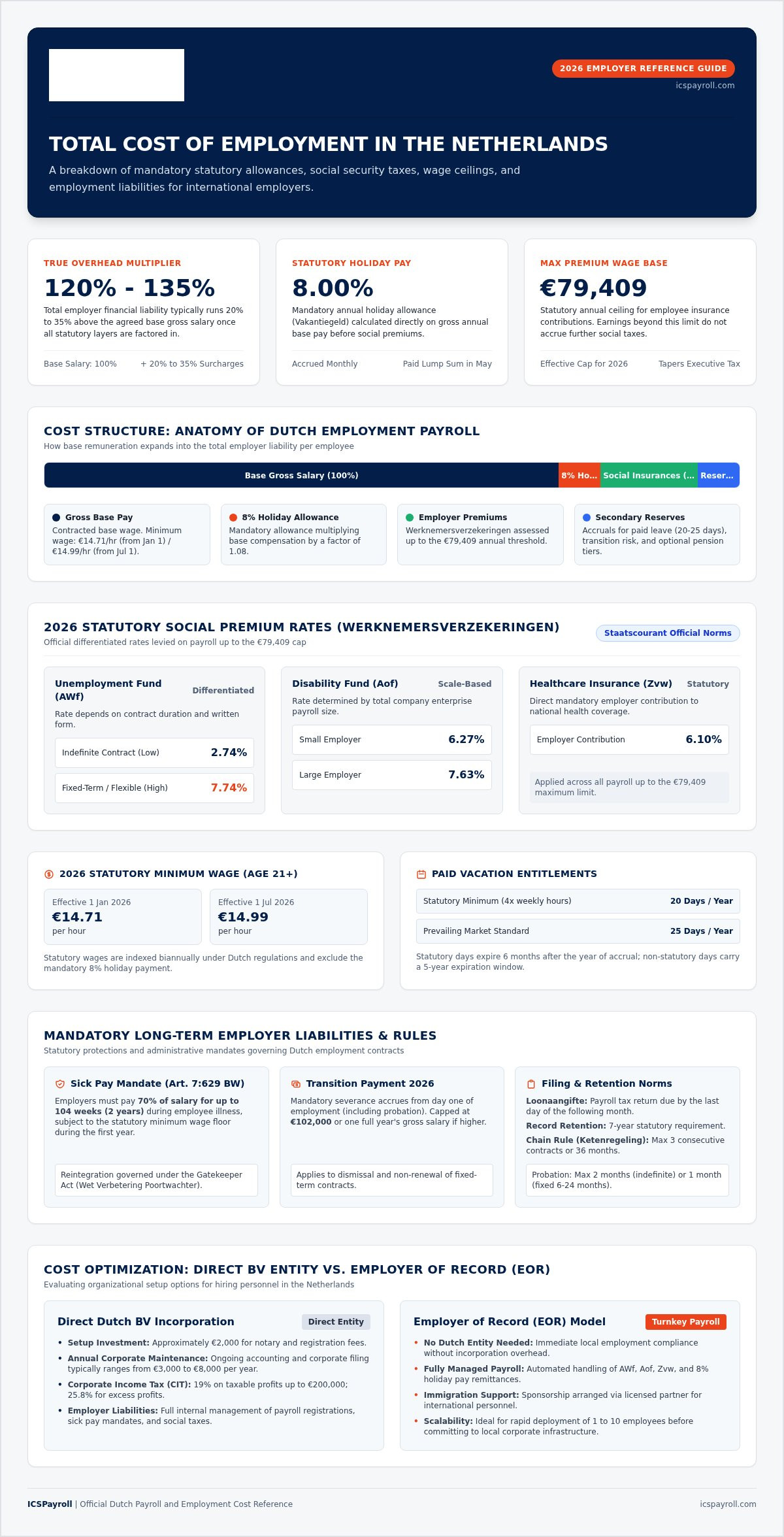
Step-by-Step Formula: How to Calculate Total Cost of Employment in Netherlands
Accurate financial modeling demands a methodical approach that aggregates direct pay, statutory markups, capped taxes, and contingency reserves. As a practical rule of thumb, an employer's true annual liability ranges between 1.25 and 1.35 times the worker's base gross salary. The standard mathematical relationship follows this sequence:
Total Cost = Gross Base Salary + Holiday Allowance (8%) + Capped Social Premiums + Pension Accrual (15.2%) + Sickness and Severance Reserves
Applying this model methodically eliminates financial surprises when planning expansion budgets.
The Comprehensive Dutch Employment Cost Calculation Formula
Building an accurate balance sheet requires four sequential steps when determining how to calculate total cost of employment in netherlands:
- Step 1: Gross Base Salary: Confirm the contractual base annual wage, ensuring it meets statutory hourly minimums.
- Step 2: Holiday Allowance (Vakantiegeld): Multiply the base gross salary by 8% (salary × 0.08). This establishes total gross remuneration.
- Step 3: Employer Social Security Premiums: Calculate AWf (2.74% permanent or 7.74% flexible), Aof (6.27% small or 7.63% large), Zvw (6.10%), and Whk (averaging 1.52%). Apply these rates exclusively to earnings up to the EUR 79,409 statutory ceiling. Any salary above this amount carries 0% social insurance levies.
- Step 4: Pension and Reserves: Apply the sectoral pension rate (averaging 15.2% on pensionable salary) and add accruals for sick pay coverage and transitievergoeding liabilities.
The 30 Percent Ruling Impact on Total Remuneration Costs
Recruiting international talent alters gross-to-net dynamics through the expat tax facility. According to Belastingdienst regulations, the 30% ruling exempts up to 30% of gross earnings from Dutch wage tax. However, statutory salary minimums apply:
- Standard taxable floor: The employee's taxable salary after the deduction must remain at least EUR 48,013 in 2026.
- Scientific and Master's criteria: Employees under age 30 holding a qualifying master's degree require a taxable salary floor of EUR 36,497.
- Full benefit gross threshold: Capturing the complete 30% deduction requires an annual gross salary of approximately EUR 68,590.
- Statutory limits and tapering: The benefit is capped at the WNT norm of EUR 262,000 for 2026. Furthermore, rulings issued from 2024 onward decrease to a 27% tax-free reimbursement rate starting 1 January 2027.
To align executive packages with these complex compensation rules, review our comprehensive employer guide on the 30 ruling netherlands. If you need immediate clarity on upcoming hires, request a tailored Dutch cost calculation from ICSPayroll to receive a fully itemized budget breakdown within 24 hours.
Cost Optimization: Direct Dutch BV Incorporation vs. Employer of Record (EOR)
Foreign businesses establishing a footprint in the Netherlands face a critical structural decision: incorporate a local private limited company (Besloten Vennootschap or BV) or partner with a specialized Employer of Record (EOR). Beyond the statutory wage formulas, entity infrastructure introduces fixed corporate overhead that substantially alters your operational bottom line. Evaluating these structural expenses alongside statutory payroll burdens shows how to calculate total cost of employment in netherlands from a true enterprise perspective.
The True Overhead of Establishing a Dutch BV
Direct incorporation provides full local presence, but requires substantial capital, operational setup, and ongoing administrative governance:
- Formation and maintenance expenses: Establishing a Dutch BV incurs roughly EUR 2,000 in upfront notary, translation, and Chamber of Commerce (KvK) formation fees. Ongoing annual corporate accounting, annual report publication, and corporate tax return filings typically demand between EUR 3,000 and EUR 8,000 annually.
- Corporate taxation: As a Dutch resident taxpayer, a BV faces corporate income tax rates of 19% on taxable profits up to EUR 200,000 and 25.8% on profits exceeding that threshold. Conversely, foreign entities operating without an entity risk unintended permanent establishment exposure.
- Direct vendor commitments: Direct employers must independently negotiate mandatory contracts with a certified occupational health service (Arbodienst), industry pension funds, and commercial insurers to cover sickness exposure.
The Transparent Payroll Factor Model with an EOR
For organizations deploying lean teams or testing the Dutch market, an Employer of Record removes legal formation hurdles by acting as the registered legal employer. EOR services deploy a transparent payroll factor applied directly to the agreed gross compensation, consolidating all employment liabilities into a single monthly invoice.
This consolidated factor unifies the 8% holiday allowance, standard 15.2% pension accrual, capped social security premiums, and comprehensive sickness coverage without requiring separate insurance policies. It also covers transition fee reserves, end-to-end wage tax returns, and comprehensive 30% ruling administration. When international relocation is necessary, immigration sponsorship is arranged via our licensed partner, enabling recognized sponsor visa processing in approximately three weeks.
Evaluating this turnkey model against direct operational setup costs helps growing firms scale safely. Explore deployment timelines and compliance frameworks in our dedicated guide to choosing an Employer of Record Netherlands.
Scale Your Dutch Team with Complete Cost Certainty
Accurate headcount forecasting requires accounting for mandatory surcharges, from the 8% holiday allowance to capped employee insurances and two-year sick pay reserves. Relying strictly on gross salary figures leaves international employers exposed to significant budget overruns. Mastering how to calculate total cost of employment in netherlands ensures your expansion plans remain financially sound, fully compliant, and free from administrative surprises.
Instead of absorbing EUR 2,000 in incorporation fees and ongoing corporate maintenance of EUR 3,000 to EUR 8,000 annually, an Employer of Record model streamlines your expansion. You can compliantly onboard personnel in weeks under a consolidated single monthly invoice that covers all statutory allowances, pension accruals, and required insurances. Calculate your Dutch employment costs with ICSPayroll to receive a tailored quotation within 24 hours of submitting your candidate details, giving your organization immediate clarity and total confidence in the Dutch market.
Frequently Asked Questions
How much does an employee in the Netherlands cost on top of gross salary?
An employee in the Netherlands typically costs between 25% and 35% on top of agreed gross base pay. This overhead includes the mandatory 8% holiday allowance, statutory employee insurance premiums (AWf, Aof, Zvw), pension accruals averaging 15.2%, and mandatory sickness reserves. Mastering how to calculate total cost of employment in netherlands ensures your operational budget captures these statutory surcharges accurately rather than underestimating true employment overhead.
Is the 8 percent holiday allowance mandatory for all Dutch employees?
Yes, the 8% holiday allowance is a statutory requirement under Dutch employment law for all standard contracts. Employers must disburse this amount either as an annual lump sum, traditionally in May, or accrued and paid monthly on payroll. The only legal exemption occurs if an applicable Collective Labor Agreement (CAO) explicitly provides an alternate compensation structure that meets or exceeds the legal baseline.
What is the maximum social security premium base in the Netherlands for 2026?
For 2026, the maximum annual premium wage base is capped at EUR 79,409. Employer-paid employee insurances, such as the AWf unemployment fund, Aof disability levy, and Zvw healthcare contribution, apply solely to gross earnings up to this limit. Compensation exceeding EUR 79,409 incurs zero statutory social insurance levies, effectively reducing the incremental percentage cost for higher-salaried professional personnel.
What happens if an employee falls sick for an extended period in the Netherlands?
Under article 7:629 of the Dutch Civil Code, employers must continue paying at least 70% of an employee's salary for up to 104 weeks of illness. The disbursement cannot drop below the statutory minimum wage during the first year. Employers must also strictly follow statutory reintegration protocols under the Gatekeeper Improvement Act, prompting most international businesses to secure commercial sickness insurance to mitigate this financial exposure.
Can an employer cap or avoid pension contributions in the Netherlands?
Employers cannot avoid pension contributions if their industry falls under a mandatory industry-wide pension fund (BPF) via an applicable Collective Labor Agreement. In non-mandatory sectors, employers have flexibility in establishing voluntary company pension schemes. However, offering a competitive corporate retirement plan averaging around 15.2% of pensionable salary remains standard practice to attract and retain skilled talent across the Dutch labor market.
How does the 30 percent ruling affect total employment costs for employers?
The 30% ruling functions primarily as a tax exemption for eligible expat talent, reducing Dutch wage tax withholding on up to 30% of their gross earnings. While it doesn't decrease employer-paid social premiums directly, it enhances your net compensation offering without inflating the base salary budget. Knowing how to calculate total cost of employment in netherlands alongside the ruling helps balance competitive international recruitment packages with statutory salary floors.
Is establishing a Dutch BV required to employ someone compliantly in the Netherlands?
No, establishing a Dutch BV isn't required to hire workers compliantly. Instead of spending EUR 2,000 on formation and EUR 3,000 to EUR 8,000 on annual corporate accounting, businesses can utilize an Employer of Record (EOR). An EOR acts as the legal employer, managing payroll taxes, pensions, and local compliance under a consolidated monthly invoice, enabling organizations to begin operations in weeks.

Article by
Joost Hubregtse
Joost Hubregtse is Director of ICS Staffing & Payroll B.V., the wholly owned subsidiary of Intercompany Solutions behind ICS Payroll. He is responsible for Employer of Record and Dutch payroll services: employment contracts, wage tax and social security filings, holiday allowance, pension, sick leave and CAO compliance, with onboarding possible within 48 hours.
Frequently Asked Questions
An employee in the Netherlands typically costs between 25% and 35% on top of agreed gross base pay. This overhead includes the mandatory 8% holiday allowance, statutory employee insurance premiums (AWf, Aof, Zvw), pension accruals averaging 15.2%, and mandatory sickness reserves. Mastering how to calculate total cost of employment in netherlands ensures your operational budget captures these statutory surcharges accurately rather than underestimating true employment overhead.
Yes, the 8% holiday allowance is a statutory requirement under Dutch employment law for all standard contracts. Employers must disburse this amount either as an annual lump sum, traditionally in May, or accrued and paid monthly on payroll. The only legal exemption occurs if an applicable Collective Labor Agreement (CAO) explicitly provides an alternate compensation structure that meets or exceeds the legal baseline.
For 2026, the maximum annual premium wage base is capped at EUR 79,409. Employer-paid employee insurances, such as the AWf unemployment fund, Aof disability levy, and Zvw healthcare contribution, apply solely to gross earnings up to this limit. Compensation exceeding EUR 79,409 incurs zero statutory social insurance levies, effectively reducing the incremental percentage cost for higher-salaried professional personnel.
Under article 7:629 of the Dutch Civil Code, employers must continue paying at least 70% of an employee's salary for up to 104 weeks of illness. The disbursement cannot drop below the statutory minimum wage during the first year. Employers must also strictly follow statutory reintegration protocols under the Gatekeeper Improvement Act, prompting most international businesses to secure commercial sickness insurance to mitigate this financial exposure.
Employers cannot avoid pension contributions if their industry falls under a mandatory industry-wide pension fund (BPF) via an applicable Collective Labor Agreement. In non-mandatory sectors, employers have flexibility in establishing voluntary company pension schemes. However, offering a competitive corporate retirement plan averaging around 15.2% of pensionable salary remains standard practice to attract and retain skilled talent across the Dutch labor market.
The 30% ruling functions primarily as a tax exemption for eligible expat talent, reducing Dutch wage tax withholding on up to 30% of their gross earnings. While it doesn't decrease employer-paid social premiums directly, it enhances your net compensation offering without inflating the base salary budget. Knowing how to calculate total cost of employment in netherlands alongside the ruling helps balance competitive international recruitment packages with statutory salary floors.
No, establishing a Dutch BV isn't required to hire workers compliantly. Instead of spending EUR 2,000 on formation and EUR 3,000 to EUR 8,000 on annual corporate accounting, businesses can utilize an Employer of Record (EOR). An EOR acts as the legal employer, managing payroll taxes, pensions, and local compliance under a consolidated monthly invoice, enabling organizations to begin operations in weeks.