PEO Services in the Netherlands: The 2026 Guide to Compliant Hiring
By Joost Hubregtse, Director, ICS Staffing & Payroll
All blog posts are reviewed and fact checked by our labour law lawyer Zishan Hussain and our director. Editorial standards
Choosing between an EOR and a PEO structure for the Netherlands is not an administrative detail. It determines who carries the wage-tax withholding obligation, who bears up to 104 weeks of sick pay, and who is exposed when the Belastingdienst reassesses a working relationship. The Dutch talent pool is world-class; the compliance surface around it is unforgiving, and 2026 is the year two significant reforms move from proposal to certainty.
This guide sets out what actually applies. It covers the 2026 salary thresholds for the expat scheme (still widely called the 30% ruling), how holiday allowance and sick pay really work once the statutory caps are applied, the current state of Wet DBA enforcement, and the two laws, the Wtta and the Wet meer zekerheid flexwerkers, that will reshape how you contract for flexible labour from 2027 and 2028. Where a rule is commonly oversimplified in the market, we say so.
Key Takeaways
- Compare the EOR, PEO and local Dutch BV routes on the basis of who becomes the legal employer, not on marketing labels. Dutch law recognises employership, payrolling and the provision of personnel under the Waadi, and has no statutory concept of co-employment.
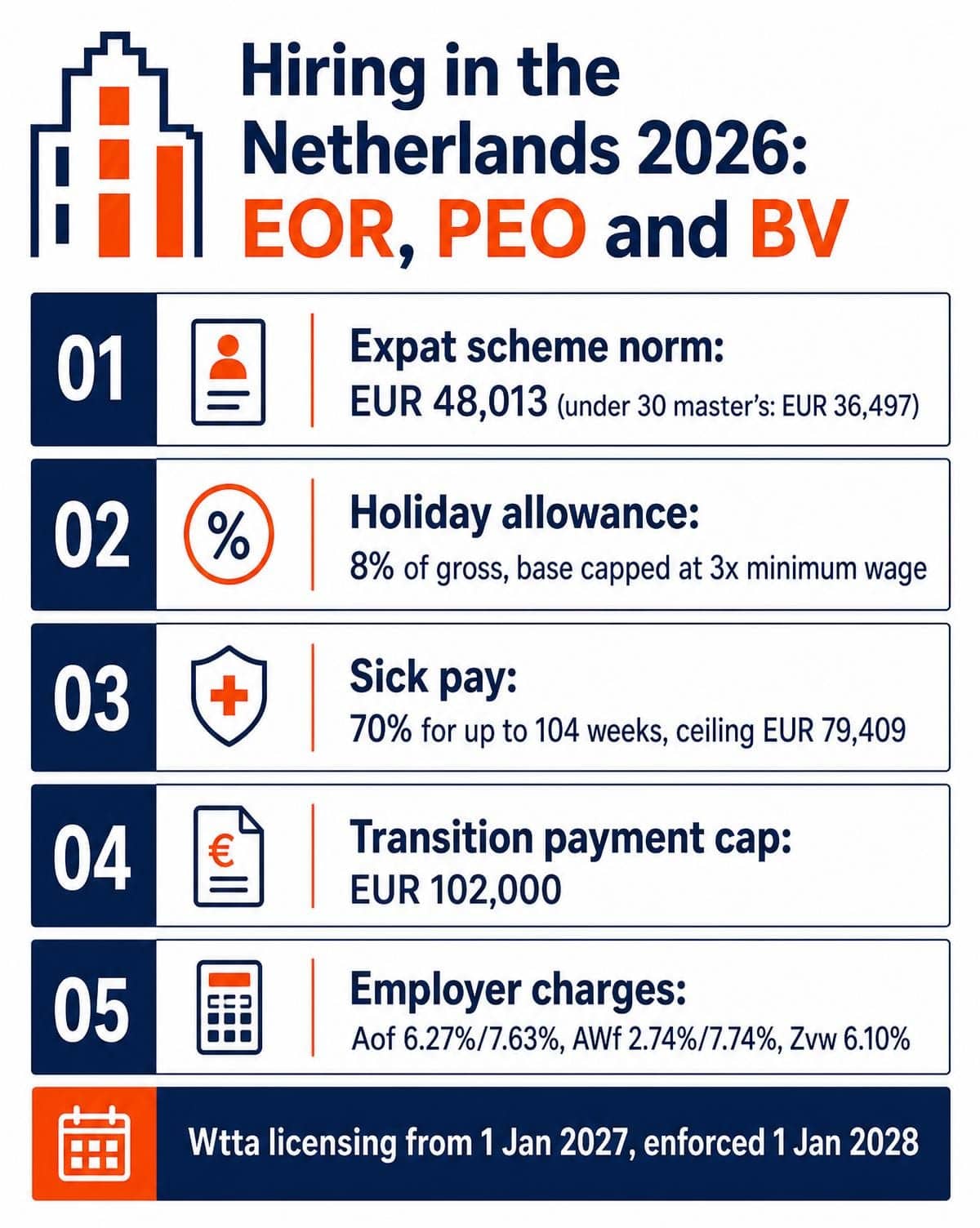
- The 2026 income norm for the expat scheme is EUR 48,013 in taxable salary after the exemption, or EUR 36,497 for employees under 30 holding an academic master's degree. Both figures change again on 1 January 2027, when the exemption itself drops to 27%.
- Holiday allowance is at least 8% of gross wages, but the statutory calculation base is capped at three times the minimum wage, and above that ceiling employer and employee may agree otherwise in writing.
- Statutory sick pay is 70% of wages for up to 104 weeks, capped at the maximum daily wage, with a minimum-wage floor in the first 52 weeks only. Figures above 70% come from a CAO or contract, not from law.
- Enforcement against false self-employment resumed on 1 January 2025. In 2026 the Belastingdienst can impose vergrijpboetes where intent or gross negligence is established, though verzuimboetes remain suspended for this year.
- From 1 January 2027 the Wtta introduces a licensing regime for anyone supplying personnel in the Netherlands. From 1 January 2028, hirers may only contract with licensed suppliers. Suppliers wishing to use the transitional arrangement must register between 1 November and 31 December 2026.
- Using an EOR removes your need to incorporate and to act as withholding agent. It does not, by itself, eliminate permanent establishment risk, which depends on what your people do in the Netherlands.
Understanding PEO Services in the Netherlands for 2026
A Professional Employer Organization gives a company access to HR, payroll and compliance infrastructure without building it internally. The term itself is imported from the United States, and it is worth being precise about what it means here: Dutch law does not recognise co-employment as a legal status. An employee has one employer for the purposes of the Dutch Civil Code, the Wage Tax Act and the social insurance schemes. What is marketed in the Netherlands as a PEO is, in legal terms, either an administrative outsourcing arrangement sitting under your own employership, or it is payrolling and the provision of personnel governed by the Waadi.
That distinction is not academic. It determines who withholds wage tax, who is liable to the employee for continued payment during illness, and who must be licensed. In an outsourced-administration model, your Dutch entity remains the employer and carries every employer obligation; the provider carries out the administration. In an Employer of Record model, the provider becomes the legal employer and carries those obligations in the first instance, subject to whatever recharge is agreed in the service contract, which in practice is where sick-pay and severance cost usually lands back with the client. Read that clause carefully in any proposal you receive, including ours.
The Legal Framework: Dutch Civil Code and CAOs
Employment relationships are governed by Book 7 of the Dutch Civil Code. Probationary periods are a good illustration of how easily a summary can mislead. No probation clause is permitted at all in a contract of six months or shorter, and any such clause is void in its entirety. A fixed-term contract longer than six months but shorter than two years permits a maximum of one month. A fixed-term contract of two years or more, and a contract for an indefinite period, permit a maximum of two months. The clause must be in writing and must be identical for both parties.
Beyond the Civil Code, many sectors are covered by a Collective Labour Agreement, or CAO. Where a CAO has been declared universally binding, it applies whether or not you are a member of the signatory employers' association, and it can set pay scales, working time, pension participation and notice arrangements that override statutory defaults. Establishing which CAO applies to a given role is one of the first questions any competent Dutch payroll partner should be asking you, and it is a recurring source of underpayment claims when it is skipped.
PEO vs. EOR: Which Model Fits Your Expansion Strategy?
Speed to market is the practical differentiator. Under an EOR, the provider is the legal employer, so hiring can begin without a Dutch entity, a notarial deed, a bank account or a Belastingdienst registration in your own name. Under the outsourced-administration model usually labelled PEO, you need an entity that is already registered as an employer in the Netherlands.
One clarification is worth making plainly, because the market frequently overstates it. An EOR transfers the employment relationship and the withholding obligation. It does not determine whether your company has a permanent establishment in the Netherlands for corporate income tax purposes. Permanent establishment turns on whether you have a fixed place of business here, or a person habitually concluding contracts on your behalf. A country manager or an enterprise sales lead employed through an EOR can still create a taxable presence for the principal. Where the workforce is engaged in preparatory or auxiliary activity, such as remote engineering, back-office support or research, the risk is usually low. Where it is revenue-generating and client-facing, it needs a specific assessment rather than a reassurance. We give that assessment before onboarding, not after.
Comparing Hiring Models: PEO vs. EOR vs. Local Dutch BV
An EOR can typically place a compliant hire within two to four weeks for EU nationals. Incorporating a Dutch BV normally takes considerably longer once notarial execution, bank onboarding and tax registrations are counted, and it commits you to annual accounts, corporate income tax filings and ongoing governance.
On cost, a PEO or EOR arrangement carries a monthly service fee. A local entity carries fixed costs, such as accountancy, corporate secretarial and legal support, that are largely independent of headcount. For teams below roughly ten employees, the service fee is usually the cheaper route. Above twenty, the entity generally wins on unit cost, and the decision shifts to whether you want the permanence.
On risk, the material items are the continued payment of wages during illness for up to 104 weeks, the statutory dismissal regime requiring UWV or court authorisation for a unilateral termination, and the transition payment. Under an EOR the provider carries these obligations toward the employee. Whether it carries them economically depends entirely on the contract. A provider that tells you it absorbs two years of sick pay at no incremental cost is either mispricing or not describing its own terms accurately.
Scalability runs in both directions. Many organisations start with an EOR to test the market and migrate to their own BV once headcount stabilises. A competent partner should be able to transfer employment relationships to your entity without a break in service or a reset of accrued rights.
When to Choose a PEO or EOR Solution
These models suit market entry, remote engineering teams, and situations where a hire is needed before an entity exists. They are also the practical route for companies that want to employ non-EU nationals but are not themselves recognised sponsors with the IND, with an important condition, set out below.
The Local Entity (Dutch BV) Alternative
A Dutch BV gives direct control and is generally more economical above roughly twenty employees. It requires share capital, notarial incorporation, and ongoing filing obligations, and it makes you the withholding agent with all that follows: correct application of the Aof, Whk, AWf, Zvw and Wko charges, the seven-year retention of the wage administration, and direct exposure to any reassessment. Where a client moves in this direction, we support the transition from EOR to in-house payroll so that nothing lapses in the handover.
Critical Compliance: 2026 Labour Law and the Expat Scheme
False self-employment and the state of enforcement
The enforcement moratorium under the Wet DBA ended on 1 January 2025. Since that date the Belastingdienst can impose additional wage-tax assessments where a relationship is reclassified as employment, though it may not look back further than 1 January 2025.
2025 was a penalty-free transition year. 2026 is a partially extended transition. In practice this means three things. The Belastingdienst normally begins with a company visit rather than a full audit. No verzuimboetes, the penalties for non-culpable error, are imposed during 2026. But since 1 January 2026 the Belastingdienst can again impose vergrijpboetes where intent or gross negligence is established, and those penalties are calculated on the tax not paid, so they scale quickly with payroll. From 2027 the remaining transitional elements fall away, with a phased normalisation running to 2030.
On the legislative side, the clarification limb of the Vbar bill was withdrawn in April 2026. What remains of that bill is the presumption of employment for workers below a defined hourly rate, which the government has undertaken to bring into force at speed. A separate Zelfstandigenwet is in preparation, currently anticipated no earlier than 2028. Until then, classification is assessed against the existing statutory framework as developed in case law, including the Supreme Court's Deliveroo judgment.
Engaging a genuine employee through a contractor construction is the exposure this creates. An employment relationship, correctly documented from the outset, removes it.
The Expat Scheme, formerly the 30% Ruling
For 2026 the standard income norm is a taxable annual salary of EUR 48,013, measured after the targeted exemption has been applied. For employees under 30 holding a Dutch academic master's degree or a recognised foreign equivalent, the reduced norm is EUR 36,497, applicable up to and including the month in which they turn 30; from the following month the standard norm applies.
Three further points are routinely missed. First, the maximum tax-free allowance in 2026 is EUR 78,600, reached at a salary of EUR 262,000, the WNT ceiling, and the transitional relief that shielded older rulings from that cap expired on 1 January 2026. Second, the ruling runs for a maximum of 60 months, reduced by prior periods of residence or work in the Netherlands. Third, the application must be filed jointly by employer and employee, and filing late limits retroactive effect.
Applicants must also satisfy the distance condition: residence more than 150 kilometres from the Dutch border for more than 16 of the 24 months preceding the first working day in the Netherlands.
Plan for 2027. From 1 January 2027 the exemption percentage falls from 30% to 27%, and the income norms rise materially, with transitional protection for employees who were already within the scheme under the earlier rules. Anyone modelling a five-year package on today's numbers should model the step change as well.
Mandatory Employee Benefits and Employer Charges
- Minimum wage. Since 1 January 2024 the Netherlands applies a statutory minimum hourly wage; there are no fixed statutory monthly, weekly or daily minima. For employees of 21 and over it was EUR 14.71 per hour from 1 January 2026 and rose to EUR 14.99 per hour on 1 July 2026. Reduced youth rates apply from 15 to 20. A CAO may set a higher floor.
- Holiday allowance. The statutory entitlement is at least 8% of gross wages. The nuance that matters for the salary bands most of our clients hire in: the statutory calculation base is capped at three times the minimum wage, and where an employee earns above that threshold, employer and employee may agree in writing to a reduced allowance or none at all. A CAO may also derogate, provided that wages plus allowance total at least 108% of the minimum wage. Payment is due by June unless a different month is agreed in writing, and at least once per calendar year; on termination, accrued allowance is settled in the final payment.
- Continued payment during illness. The statutory obligation is 70% of wages for up to 104 weeks, limited to the maximum daily wage, in 2026 a premium wage ceiling of EUR 79,409 per year. In the first 52 weeks the amount may not fall below the applicable minimum wage; in the second year that floor no longer applies. Payment of 100% in the first year is common but derives from the CAO or the individual contract, not from statute. Note also that where UWV judges reintegration efforts inadequate, it can impose a wage sanction extending the obligation by up to a further 52 weeks. This is the single largest unhedged liability in Dutch employment, and it is the reason the risk allocation clause in an EOR contract deserves as much attention as the fee.
- Transition payment. The transitievergoeding accrues from the first day of employment at one third of a gross monthly salary per full year of service. For 2026 it is capped at EUR 102,000, or one gross annual salary where that is higher.
- Employer charges. For 2026 the principal components are the Arbeidsongeschiktheidsfonds contribution (Aof) at 6.27% for small employers and 7.63% for others; the Werkhervattingskas (Whk), differentiated per employer and averaging in the region of 1.5%; the unemployment fund contribution (AWf) at 2.74% for written indefinite non-on-call contracts and 7.74% otherwise; the employer's healthcare levy under the Zvw at 6.10%; and the childcare surcharge at 0.50%. Each of these is calculated up to the EUR 79,409 premium wage ceiling, a point that materially reduces the marginal cost of higher-paid hires. Adding holiday allowance and, where applicable, pension, total employer cost typically lands 20% to 30% above gross salary, with the position for a specific role depending on contract type, sector and CAO.
What Changes in 2027 and 2028
Two reforms adopted in 2026 should be in your planning now.
The Wtta, licensing for suppliers of personnel. The Wet toelating terbeschikkingstelling van arbeidskrachten enters into force on 1 January 2027, following the Royal Decree of 24 June 2026. It introduces a mandatory admission regime, administered by the Nederlandse Autoriteit Uitleenmarkt, for any business that supplies personnel to a third party under that party's supervision: temporary employment agencies, secondment firms, payroll companies and EORs, including those established outside the Netherlands. Admission requires a certificate of good conduct for legal entities, demonstrated compliance with the normative framework, and a security deposit of EUR 100,000, with a staged EUR 50,000 arrangement for new entrants. Certain long-established suppliers are exempt from the deposit.
The dates that matter to you: suppliers intending to rely on the transitional arrangement must register between 1 November and 31 December 2026; admission applications run from 1 May to 30 June 2027; and the Labour Authority begins enforcement on 1 January 2028, from which point hirers may only contract with admitted suppliers and face penalties if they do not. When you evaluate a payroll partner during 2026, ask directly whether they have registered and where they stand in the process. It is a stronger signal than any certificate mark.
The Wet meer zekerheid flexwerkers. Adopted by the Senate on 7 July 2026. Its most significant provisions take effect on 1 January 2028: the interruption period that breaks the chain of fixed-term contracts extends from six months to three years, closing the revolving-door construction; zero-hours contracts are replaced by a bandwidth contract in which the maximum may not exceed 130% of the agreed minimum hours; and the agency-work phase system is shortened. Exceptions remain for students and school pupils working up to 16 hours per week, who keep the six-month interruption, and for seasonal work at three months. One element arrives sooner: equal terms of employment for agency workers takes effect on 31 December 2026.
Until 2028, the current chain rule continues to apply: a maximum of three fixed-term contracts within 36 months, after which a further contract, or an overrun of the 36-month period, converts the relationship to one of indefinite duration. If your contracting strategy currently relies on a six-month gap, it has a defined shelf life.
Selecting the Right Partner: A 2026 Checklist
Local accountability. Many global platforms operate as aggregators, subcontracting Dutch payroll to a local agency. That layer creates delay and ambiguity about who is answerable when something goes wrong. Ask who the legal employer is on the contract, and who holds the Dutch payroll tax number.
Waadi registration and Wtta readiness. Any party supplying personnel must have the provision of personnel registered as a business activity in the Commercial Register. Failure exposes both supplier and hirer to penalties. On top of that, ask about Wtta registration status and timing.
Financial reliability and hirer's liability. SNA registration against NEN 4400-1 is a meaningful indicator that a supplier's payroll tax and social security remittances are audited. Be precise about what it does, though: as a hirer you can be held liable for the payroll taxes and VAT owed by the party supplying your workers, known as inlenersaansprakelijkheid. Certification alone does not indemnify you. Indemnification depends on the supplier's registration combined with payment of the relevant portion of each invoice into a blocked g-account, and on meeting the prescribed administrative conditions. Ask whether a g-account is available and how invoices are structured.
Invoice transparency. You should receive a single monthly invoice separating gross salary, the 8% holiday allowance reservation, each employer charge by name, and the service fee.
Immigration. Under the Aliens Act, the residence permit for a highly skilled migrant can only be applied for by a recognised sponsor, and the recognised sponsor must be the employer holding the employment contract. This is worth stating clearly because the market often blurs it: sponsorship cannot be delegated to a third party while a different entity remains the legal employer. If a provider presents itself as your EOR and simultaneously as arranging sponsorship "through a partner," ask which entity signs the employment contract. Only one answer is compatible with IND requirements. To be explicit about our own position: ICS Staffing & Payroll B.V. does not hold recognised sponsor status, so highly skilled migrant placements are structured with our licensed partner as the legal employer and recognised sponsor, while we handle the Dutch payroll and compliance administration. For hires that do not require sponsorship, ICS Staffing & Payroll B.V. is the legal employer.
For 2026 the gross monthly salary thresholds are EUR 5,942 for highly skilled migrants aged 30 and over, EUR 4,357 for those under 30, and EUR 3,122 under the reduced criterion for recent graduates and orientation-year holders. All are exclusive of the 8% holiday allowance, and only fixed contractual cash salary counts; bonuses and variable pay do not. Note two 2026 tightenings: recognised sponsors must retain bank statements evidencing salary payment, and the IND conducts unannounced audits. Changes affecting the employment relationship must be reported within four weeks.
Assessing Local Expertise and Response Times
Expect a tailored quotation within one business day, and expect your provider to identify the applicable CAO before quoting. A named account contact who can answer a question about wage sanctions or chain rules without escalating is a reasonable requirement.
Data Security and Record Retention
The wage administration is subject to a seven-year fiscal retention period. Certain items, the copy identity document and the employee's data for payroll taxes, must be kept for five full calendar years after the end of employment. That is not, however, a licence to retain everything for seven years. The GDPR requires personal data to be kept no longer than necessary, and personnel file material outside the fiscal scope should generally be deleted sooner; recruitment data sooner still. A provider that applies a blanket seven-year rule to all employee records is not GDPR compliant, whatever its privacy page says. Employees must also receive an annual wage statement, the jaaropgave.
Why ICSPayroll Is Your Strategic Partner in the Netherlands
Compliance in the Dutch market is a question of getting a series of unglamorous details right: the correct CAO, the correct AWf rate for the contract type, the holiday allowance base calculated with the statutory cap applied, the expat scheme filed within four months of the start date. We handle those details as our core work rather than as an add-on to a software platform.
You receive one monthly invoice with each cost component named and calculated, so that you can reconcile it. There is no aggregation layer between you and the Dutch payroll: ICS Staffing & Payroll B.V. is a Dutch company, registered here, answerable here.
On the expat scheme, we assess eligibility before the contract is signed rather than after, model the 2027 change into multi-year packages, and file within the deadline that preserves full retroactive effect.
The ICSPayroll Difference: Local Specialist vs. Global Generalist
You have direct access to a named payroll director and to Dutch employment law expertise, not a ticket queue. We provide employee handbooks reflecting current Dutch law, and we will tell you when a proposed structure carries classification or permanent establishment risk, including when the answer is that you should incorporate rather than use us.
Get Started with Your Dutch Expansion
We provide a written quotation with a full cost breakdown within one business day. Onboarding runs through a GDPR-compliant portal for contracts and payslips. For EU nationals, employment can begin as soon as the contract is signed and the BSN is confirmed. For non-EU nationals requiring a highly skilled migrant permit, build in additional time for the permit decision, MVV collection where applicable, municipal registration and BSN issuance; a recognised sponsor route is fast by international standards but is not a three-week guarantee.
Secure Your Dutch Expansion for 2026
The right structure depends on facts specific to your situation: how many people, doing what, for how long, and whether their activity creates a taxable presence. An EOR removes the entity requirement and the withholding obligation. It does not remove every risk, and no provider should tell you otherwise.
What we can tell you is what applies: EUR 48,013 as the 2026 expat scheme threshold, 8% holiday allowance subject to the statutory cap, 70% sick pay for up to 104 weeks within the daily wage ceiling, EUR 102,000 as the transition payment maximum, and a licensing regime for suppliers of personnel arriving on 1 January 2027. Plan against those numbers and you will not be surprised.
Request a tailored Dutch employment cost quotation within one business day.
Frequently Asked Questions
What is the difference between a PEO and an EOR in the Netherlands?
An Employer of Record becomes the legal employer, which allows you to hire without a Dutch entity. What is marketed as a PEO in the Netherlands is administrative outsourcing sitting beneath your own employership, and it therefore requires you to be registered here as an employer. Dutch law does not recognise co-employment as a status; there is one legal employer for the purposes of the Civil Code, wage tax and social insurance.
Does using an EOR remove permanent establishment risk?
No. It removes the need to incorporate and the obligation to act as withholding agent. Permanent establishment depends on whether you have a fixed place of business in the Netherlands or a person habitually concluding contracts on your behalf. Client-facing, revenue-generating roles warrant a specific assessment.
What are the 2026 salary requirements for the expat scheme?
A taxable salary of EUR 48,013 after the exemption is applied, or EUR 36,497 for employees under 30 with an academic master's degree, applicable up to and including the month they turn 30. The maximum tax-free allowance is EUR 78,600, reached at a salary of EUR 262,000. The distance condition also applies. From 1 January 2027 the exemption falls to 27% and the norms increase.
How much is holiday allowance, and is it always 8%?
At least 8% of gross wages, with the statutory calculation base capped at three times the minimum wage. Above that threshold, employer and employee may agree in writing to a lower amount or none. A CAO may set a higher percentage, or derogate provided wages plus allowance reach 108% of the minimum wage. Payment is due by June unless another month is agreed in writing.
How much sick pay must an employer actually pay?
70% of wages for up to 104 weeks, limited to the maximum daily wage, with a minimum-wage floor in the first 52 weeks only. Higher percentages come from a CAO or contract. UWV can extend the obligation by up to 52 further weeks where reintegration efforts are found inadequate.
Can a payroll provider arrange highly skilled migrant sponsorship on my behalf?
Only if the sponsoring entity is the legal employer. The IND requires the recognised sponsor to hold the employment contract. Where a provider acts as your EOR, that provider must itself be a recognised sponsor; where a partner sponsors, the partner is the employer.
What is the chain rule, and is it changing?
Currently a maximum of three fixed-term contracts within 36 months, after which the relationship becomes indefinite, with the count restarting after a six-month interruption. Under the Wet meer zekerheid flexwerkers, adopted on 7 July 2026, that interruption extends to three years from 1 January 2028, with exceptions for students working up to 16 hours weekly and for seasonal work.
What is the Wtta and does it affect me as a hirer?
The Wtta introduces mandatory licensing for suppliers of personnel from 1 January 2027, enforced from 1 January 2028. From that date, hirers may only contract with licensed suppliers and face penalties otherwise. Suppliers using the transitional arrangement must register between 1 November and 31 December 2026.
What are employer social security contributions in 2026?
The principal charges are the Aof at 6.27% or 7.63% depending on employer size, the differentiated Whk averaging around 1.5%, the AWf at 2.74% or 7.74% depending on contract type, the Zvw employer levy at 6.10%, and the childcare surcharge at 0.50%, each calculated up to a premium wage ceiling of EUR 79,409. With holiday allowance and pension, total employer cost is generally 20% to 30% above gross.
Is enforcement against false self-employment active in 2026?
Yes. The moratorium ended on 1 January 2025 and additional assessments can be raised for periods from that date. During 2026 the Belastingdienst normally opens with a company visit and does not impose verzuimboetes, but it can impose vergrijpboetes where intent or gross negligence is established.
Sources and references
Every rule and figure above is traceable to the sources below: the exact statutory articles, the regulator pages that publish the amounts, the statistical datasets, and the specific court rulings that settle the point. Always check the current text for your own situation.
- Article 7:692 Dutch Civil Code, the statutory definition of payrolling
- Article 7:690 Dutch Civil Code, the agency work (uitzend) contract
- Article 8 Waadi, equal pay for hired-in workers (loonverhoudingsnorm)
- Stichting Normering Arbeid, the NEN 4400-1 register of audited payroll and staffing companies
- Belastingdienst, low and high AWf unemployment contribution rates and when each applies
- Netherlands Labour Authority, enforcement, inspections and penalty policy
- CBS, Compensation of employees and employment by economic activity (national accounts dataset 84165ENG)
- Eurostat, hourly labour cost levels by NACE activity (dataset lc_lci_lev), for cross-country comparison
- Supreme Court 11 April 2025, ECLI:NL:HR:2025:543: the agency work contract of art. 7:690 BW in a triangular platform-work relationship
- Supreme Court 21 November 2025, ECLI:NL:HR:2025:1733: misuse of successive agency contracts under art. 5(5) Directive 2008/104/EC and the Waadi

Article by
Joost Hubregtse
Joost Hubregtse is Director of ICS Staffing & Payroll B.V., the wholly owned subsidiary of Intercompany Solutions behind ICS Payroll. He is responsible for Employer of Record and Dutch payroll services: employment contracts, wage tax and social security filings, holiday allowance, pension, sick leave and CAO compliance, with onboarding possible within 48 hours.