
How to Manage Statutory Severance Pay in the Netherlands: A 2026 Employer Guide
By Joost Hubregtse, Director, ICS Staffing & Payroll
All blog posts are reviewed and fact checked by our labour law lawyer Zishan Hussain and our director. Editorial standards
A Dutch dismissal can create a transition allowance liability from an employee’s first day, including during probation. For 2026, the statutory maximum is €102,000, or one year’s gross salary if that is higher. Employers should plan for this cost rather than treating it as a final payroll adjustment. See the Dutch government’s transition payment guidance.
Budgeting can be complex because the calculation depends on qualifying salary components and exact service dates. Long-term illness also requires careful planning. From 1 July 2026, employers with 25 or more staff can no longer claim UWV compensation for the transition payment after two years of illness. Smaller employers may still apply if eligible. Check the UWV compensation guidance for the applicable conditions.
This guide explains how to calculate the allowance, determine when it may be due, and manage the compliance steps involved in dismissal and long-term illness. A consistent process, supported by accurate payroll and absence records, helps employers plan costs and check their obligations.
By Joost Hubregtse, Payroll Director
Joost Hubregtse is Payroll Director at ICSPayroll, the Dutch payroll and EOR specialist of Intercompany Solutions. A career payroll specialist and former Head of Payroll, he oversees wage tax filings, 30% ruling applications, and employment compliance for international employers.
Reviewed by Joost Hubregtse, Payroll Director, on 25 September 2026.
Key Takeaways
- Understand how the Dutch transition allowance supports an employee’s move to new work or training, and when an employer may have to pay it.
- Check the salary components and employment dates used in the calculation to estimate dismissal costs more accurately.
- Understand how fixed-term contract endings and mutual termination agreements affect statutory severance pay netherlands obligations.
- Plan for the 104-week sick-pay period and the transition payment responsibilities that may follow long-term illness.
- See how an EOR and a transparent payroll factor can help manage allowance accrual and consolidate payroll costs into one monthly invoice.
Understanding the Transitievergoeding: The Dutch Statutory Severance Framework
The transitievergoeding, or transition allowance, is a statutory payment that may be due when an employer initiates the end of an employment contract. It is intended to help the employee move into new work or training. The Dutch government’s guidance on the transition payment explains the entitlement and calculation framework.
Accrual begins on the employee’s first day of work, including during probation. There is no minimum length of service before accrual starts. An employee may qualify when an employer ends a permanent contract or chooses not to renew a fixed-term contract. Accrual does not mean that every departure results in payment. Entitlement depends on how employment ends and whether an exception applies.
Eligibility Criteria for Statutory Severance
As a general rule, the allowance is due when the employer takes the initiative to end the employment relationship. This can include an employer-led dismissal or the non-renewal of a fixed-term contract. An employee who resigns voluntarily will generally not receive the statutory payment, although an exception may apply if the employer is seriously culpable.
If the parties use a settlement agreement, the payment is negotiated as part of that agreement. The statutory formula does not automatically determine the settlement amount. Before agreeing terms, assess any potential statutory entitlement and document the agreed payment and other exit terms clearly.
Legal Basis in the Dutch Civil Code
The principal legal provision is Article 7:673 of the Dutch Civil Code (Burgerlijk Wetboek). Dismissal procedures depend on the reason for termination. The UWV handles applications for dismissal on economic grounds or after long-term incapacity for work. Other dismissal cases may be brought before the subdistrict court.
The UWV assesses applications within its role in the relevant dismissal procedure. It does not determine every termination route or replace the employer’s responsibility to establish whether a transition payment is due. Confirm the applicable route and record the decision as part of the offboarding process.
Calculation Guide: Determining the Transition Allowance in 2026
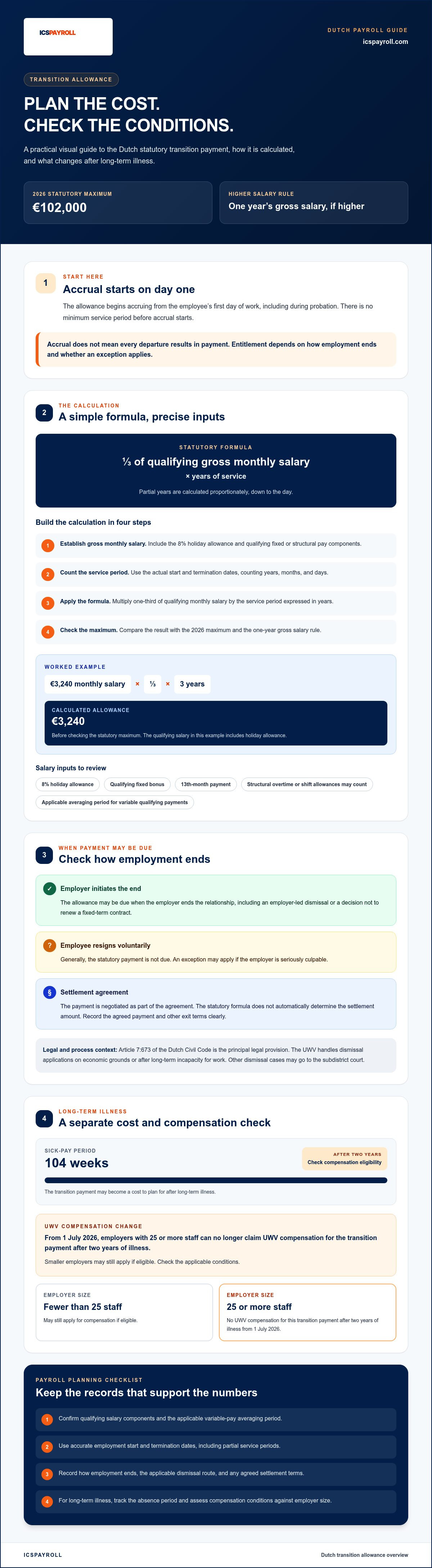
Accurate calculation starts with the right salary base and employment period. For statutory severance pay netherlands budgeting, check qualifying salary components and use the employee’s actual start and termination dates. The statutory formula is one-third of the gross monthly salary for each year of service. Partial years are calculated proportionally, down to the day.
- Step 1: Establish gross monthly salary. Include the 8% holiday allowance and qualifying fixed or structural pay components.
- Step 2: Calculate service duration. Count employment from the start date to the termination date in years, months, and days.
- Step 3: Apply the formula. Multiply one-third of the qualifying monthly salary by the service period expressed in years.
- Step 4: Apply the cap. Compare the result with the 2026 maximum and the one-year salary rule.
For example, if qualifying gross monthly salary is €3,240, including holiday allowance, and the employee has completed three years of service, the calculation is €3,240 × ⅓ × 3, producing an allowance of €3,240 before checking the cap. For an incomplete year, include the proportional period rather than treating it as a full year.
What to Include in the Calculation Base
Don’t calculate from base salary alone. Add the 8% holiday allowance and qualifying fixed components, such as a fixed bonus or 13th-month payment. Structural overtime and shift allowances may also count. For variable qualifying payments, use the applicable averaging period. The UWV’s transition payment calculation guidance explains the relevant rules, including the 12-month reference for structural variable pay.
Separate remuneration from reimbursements. Genuine expense reimbursements are generally not salary components for this calculation. Review payroll records and payment descriptions to distinguish reimbursed business expenses from recurring compensation. A useful check is to compare each payment with its payroll code and the reason it was paid, rather than assuming that every recurring item belongs in the calculation base.
The 2026 Statutory Cap and Limits
In 2026, the statutory maximum is €102,000. If the employee’s gross annual salary is higher than that amount, the maximum is one year of gross salary instead. This limit applies to the statutory calculation, not to a separately negotiated settlement. Employers assessing statutory severance pay netherlands liabilities should calculate the entitlement first, then check which limit applies.
Retain the salary-component breakdown, service dates, and calculation so the amount can be checked later. Consistent payroll administration can help track accrual and account for it in monthly costs. An EOR arrangement can also incorporate transition allowance accrual into a consolidated monthly invoice. Review Dutch payroll and EOR support if you need help managing these calculations and related compliance.
Legal Obligations and Exemptions: When You Must Pay
The statutory payment depends on how employment ends, not simply on whether both parties agree to end the working relationship. An employer-led dismissal or non-renewal can trigger a transition payment. A settlement agreement records negotiated terms, so the statutory formula does not automatically determine the agreed amount. The Dutch government’s guidance on the transition payment explains the general entitlement rules.
Mutual Consent and Settlement Agreements (VSO)
A termination agreement, known as a vaststellingsovereenkomst (VSO), can set out an agreed exit payment that differs from the statutory calculation. Employers should assess the employee’s potential statutory entitlement before making an offer, then state the agreed payment and other terms clearly. Employees have a statutory reflection period after signing. Under Article 7:670b of the Dutch Civil Code, that period is 14 days, or 21 days if the agreement does not inform the employee of the right to withdraw in writing.
For broader context, see this guide to employment law in the Netherlands for foreign employers.
Fixed-Term Contracts, Retirement, and the Ketenregeling
If an employer lets a fixed-term contract expire without renewal, the employee may be entitled to the transition payment. Reaching the statutory pension age is generally an exception. Check the reason employment ends and the applicable rules rather than assuming that expiry or retirement automatically creates a payment obligation.
The ketenregeling limits successive temporary contracts to three contracts within 36 months, subject to applicable exceptions. If the relationship crosses those limits, the contract may become indefinite. This affects the employment relationship and the route for ending it, but it does not remove transition-payment rights that may arise later when the employer ends employment or declines to renew.
Insolvency, Small-Employer Relief, and Late Payment
Bankruptcy, suspension of payment, and statutory debt restructuring can affect an employer’s obligations under specific rules. These are not general exemptions simply because a business is small or facing financial pressure. Small-employer relief is limited and conditional, so confirm whether a specific scheme applies before relying on it. Reimbursement arrangements, where available, are separate from the employee’s entitlement.
Late payment can lead to a claim for the unpaid amount and statutory interest. Article 7:686a of the Dutch Civil Code sets out relevant claim rules and time limits for employment matters. Confirm the applicable deadline, document the calculation and payment, and address disputed amounts promptly to reduce the risk of a further compliance issue.
Managing Dismissal and Severance for Long-Term Illness
Long-term sickness creates two separate employer responsibilities: continued sick pay and reintegration, followed potentially by a transition payment if employment ends. Under Article 7:629 of the Dutch Civil Code, employers generally pay at least 70% of wages during sickness for up to 104 weeks, with a minimum-wage floor in the first year. The transition payment is a separate obligation. If the employer terminates the contract after the 104-week period, the employee may still be entitled to it. The rules on UWV compensation for transition payments after long-term incapacity affect reimbursement to the employer, not the employee’s entitlement.
Reintegration duties under the Wet verbetering poortwachter run alongside sick-pay obligations. Employers and employees must follow the prescribed reintegration process, including an analysis of the employee’s situation by week six and a plan of action by week eight. If returning to work with the current employer is not feasible, reintegration may require a second track. Inadequate reintegration efforts can lead to a UWV wage-sanction extension into a third year.
The July 2026 Rule Change for Large Employers
From 1 July 2026, employers with 25 or more staff can no longer obtain UWV compensation for the transition payment following dismissal after two years of illness. Employers with fewer than 25 staff may still apply, subject to the scheme’s conditions. The change concerns reimbursement, not the obligation to pay an eligible employee. Large employers should budget for the full payment rather than assume it will be recovered.
For long-term disability planning, track the employee’s absence dates, reintegration progress, the potential end of the 104-week period, and any resulting transition-payment liability. These records help keep two different processes clear: meeting reintegration duties and assessing whether a payment is due when employment ends. Delaying or ending employment does not replace proper reintegration management or determine the employee’s statutory rights.
UWV Compensation Procedure for Small Employers
Eligible smaller employers can apply to the UWV for compensation after paying the transition allowance. Keep the termination documents, payroll and payment records, and records that show the amount paid. Maintain the reintegration file as well, including the problem analysis, plan of action, and documented steps taken under the Wet verbetering poortwachter. Check the UWV portal for current application requirements and supporting documents before filing.
Accurate absence records and payroll calculations help employers manage statutory severance pay in the Netherlands without overlooking either the employee’s rights or the applicable reimbursement route. Discuss Dutch payroll and EOR support for sick-leave and transition-payment compliance.
Navigating Dutch Severance Compliance with an EOR Partner
Managing statutory severance pay in the Netherlands involves more than calculating a final amount. Employers need to track accrual from the start of employment, maintain accurate payroll records, and apply the rules correctly when a contract ends. An Employer of Record (EOR) can centralise employment and payroll processes for workers employed through its Dutch arrangement.
With an EOR, the provider is the employee’s formal employer and handles agreed employment administration, including transition allowance calculations and payroll compliance. The precise allocation of costs and responsibilities depends on the EOR agreement, so review how it addresses dismissal decisions, the allowance, and reimbursement between the parties. An EOR does not remove the statutory payment. It provides a structured way to manage the obligation and plan for it.
Accrual, Invoicing, and Cost Planning
Because the allowance accrues from day one, the cost can build throughout employment rather than appearing only at offboarding. ICSPayroll’s payroll factor includes transition allowance accrual in a consolidated monthly invoice. This gives employers a clearer view of employment costs over time and can reduce the risk of an unexpected amount at termination. The invoice model supports planning, but the final amount still depends on the employee’s salary components, length of service, and applicable statutory rules.
For businesses comparing employment models, understanding how an EOR supports compliant hiring is essential. Before engaging a provider, confirm what its payroll reporting shows, how accrued amounts are reconciled, and which party is responsible for decisions and payments during offboarding.
Compliance and Reintegration Support
Consistent payroll records make it easier to verify salary inputs, service dates, and accrued allowance when employment ends. For long-term illness, sick-pay and reintegration processes must also be managed alongside any potential transition payment. An EOR can provide payroll administration and guidance on sick-leave support and reintegration. Confirm how responsibilities are divided and what documentation must be supplied.
Keep statutory severance separate from other compliance risks. For example, penalties under the Foreign Nationals Employment Act relate to employing foreign nationals without the required authorisation, not to an incorrect transition-payment calculation. Highly Skilled Migrant visa applications and the 30% ruling are separate matters and do not determine severance entitlement.
ICSPayroll manages transition allowance calculations and accrual as part of its EOR service. Contact ICSPayroll to discuss Dutch EOR and payroll support for employment administration and offboarding compliance.
Plan Dutch Offboarding with Greater Confidence
Managing statutory severance pay in the Netherlands starts with consistent planning: track allowance accrual from the first day, calculate it using the correct salary and service period, and confirm whether the way employment ends creates an entitlement. Long-term illness adds another layer because reintegration duties and the transition payment are separate obligations.
An EOR arrangement can bring payroll administration and transition allowance accrual into a consolidated monthly invoice, giving employers clearer visibility of employment costs. Confirm how the provider’s agreement assigns responsibilities, especially for termination decisions and payment obligations. Dutch payroll and employment compliance support can also help keep offboarding records and processes organised.
Put a clear process in place before a dismissal arises. Discuss Dutch EOR and payroll support with ICSPayroll to understand how transition allowance calculations and accrual can be managed as part of your employment setup. With accurate records and informed support, you can approach Dutch employment decisions with greater confidence.
Managing statutory severance pay Netherlands compliance with an EOR
Navigating the complex landscape of Dutch labor law can present significant challenges for international businesses, particularly when terminating an employment contract. When you hire talent remotely without establishing a local legal entity, partnering with an Employer of Record (EOR) like ICSPayroll provides a streamlined solution to ensure full compliance. An experienced EOR assumes local legal responsibility, managing payroll, tax withholdings, and mandatory termination payouts on your behalf. Regarding the statutory severance pay netherlands regulations, your EOR provider ensures that transition payments are calculated accurately based on tenure and current legislative caps, mitigating the risk of costly legal disputes and safeguarding your organization against non-compliance penalties.
Frequently Asked Questions
What is the maximum statutory severance pay in the Netherlands for 2026?
The 2026 maximum is €102,000, unless one year of the employee’s gross salary is higher. In that case, the higher one-year salary amount sets the limit. For a statutory severance pay netherlands estimate, calculate the employee’s entitlement first, then apply the relevant limit. This statutory maximum doesn’t prevent an employer and employee from agreeing to a higher amount in a settlement agreement.
Do I have to pay severance if an employee resigns voluntarily?
Generally, no. The transition allowance is usually due when the employer initiates the termination or decides not to renew a fixed-term contract, rather than when an employee resigns voluntarily. An exception may apply if the employer is seriously culpable for the resignation. Review the circumstances and record why employment ended. A payment may still be agreed as part of a separate negotiated exit, even when statutory entitlement doesn’t apply.
Does the transition allowance apply during the probation period?
Yes. Accrual begins on the first day of employment, including during probation, and there’s no minimum service period before it starts. If the employer ends employment during probation, the employee may be entitled to a proportionate payment, depending on the circumstances and any applicable exception. Use the actual start and termination dates and the relevant salary components to assess the amount rather than assuming brief service means no liability.
How does the July 2026 rule change affect sick leave severance compensation?
From 1 July 2026, employers with 25 or more staff can no longer claim UWV compensation for a transition payment made after dismissal following two years of illness. Smaller employers may still apply if they meet the conditions. The change concerns the employer’s ability to recover the payment, not the employee’s entitlement. Check the UWV compensation guidance for application details.
Is the 8% holiday allowance included when calculating severance pay?
Yes. The calculation includes the 8% holiday allowance in the qualifying gross monthly salary. Depending on the pay arrangement, qualifying fixed bonuses and structural overtime or shift allowances may also affect the calculation base. Keep records that distinguish regular remuneration from expense reimbursements. This component-level review helps payroll teams avoid relying on base salary alone when preparing a termination calculation.
What happens if I fail to pay the transition allowance on time?
An employee may pursue an unpaid transition allowance through the legal process, and delay can create additional financial and administrative exposure. The applicable payment deadline and claim time limit depend on the circumstances, so confirm them promptly for the termination route involved. Record the calculation, payment date, and any communication about a disputed amount. Addressing a shortfall quickly can help prevent an avoidable dispute from escalating.
Can I deduct training costs from the statutory severance payment?
Some training costs may qualify for deduction, but employers can’t simply subtract any course or development expense from the payment. The cost and training must meet the applicable legal conditions, and certain training required for the employee’s role may not be deductible. Before reducing the amount, check the rules and any relevant agreement, then keep clear records of the costs and calculation.
Is statutory severance pay taxable for the employee in the Netherlands?
Yes. The transition payment is generally treated as taxable employment income, and payroll tax is normally withheld when the employer pays it. For employers reviewing statutory severance pay netherlands tax treatment, the practical step is to process and report the payment through payroll rather than treating it as a tax-free reimbursement. The employee’s final tax position depends on their individual circumstances and annual tax return.

Article by
Joost Hubregtse
Joost Hubregtse is Director of ICS Staffing & Payroll B.V., the wholly owned subsidiary of Intercompany Solutions behind ICS Payroll. He is responsible for Employer of Record and Dutch payroll services: employment contracts, wage tax and social security filings, holiday allowance, pension, sick leave and CAO compliance, with onboarding possible within 48 hours.
Frequently Asked Questions
The 2026 maximum is €102,000, unless one year of the employee’s gross salary is higher. In that case, the higher one-year salary amount sets the limit. For a statutory severance pay netherlands estimate, calculate the employee’s entitlement first, then apply the relevant limit. This statutory maximum doesn’t prevent an employer and employee from agreeing to a higher amount in a settlement agreement.
Generally, no. The transition allowance is usually due when the employer initiates the termination or decides not to renew a fixed-term contract, rather than when an employee resigns voluntarily. An exception may apply if the employer is seriously culpable for the resignation. Review the circumstances and record why employment ended. A payment may still be agreed as part of a separate negotiated exit, even when statutory entitlement doesn’t apply.
Yes. Accrual begins on the first day of employment, including during probation, and there’s no minimum service period before it starts. If the employer ends employment during probation, the employee may be entitled to a proportionate payment, depending on the circumstances and any applicable exception. Use the actual start and termination dates and the relevant salary components to assess the amount rather than assuming brief service means no liability.
From 1 July 2026, employers with 25 or more staff can no longer claim UWV compensation for a transition payment made after dismissal following two years of illness. Smaller employers may still apply if they meet the conditions. The change concerns the employer’s ability to recover the payment, not the employee’s entitlement. Check the UWV compensation guidance for application details.
Yes. The calculation includes the 8% holiday allowance in the qualifying gross monthly salary. Depending on the pay arrangement, qualifying fixed bonuses and structural overtime or shift allowances may also affect the calculation base. Keep records that distinguish regular remuneration from expense reimbursements. This component-level review helps payroll teams avoid relying on base salary alone when preparing a termination calculation.
An employee may pursue an unpaid transition allowance through the legal process, and delay can create additional financial and administrative exposure. The applicable payment deadline and claim time limit depend on the circumstances, so confirm them promptly for the termination route involved. Record the calculation, payment date, and any communication about a disputed amount. Addressing a shortfall quickly can help prevent an avoidable dispute from escalating.
Some training costs may qualify for deduction, but employers can’t simply subtract any course or development expense from the payment. The cost and training must meet the applicable legal conditions, and certain training required for the employee’s role may not be deductible. Before reducing the amount, check the rules and any relevant agreement, then keep clear records of the costs and calculation.
Yes. The transition payment is generally treated as taxable employment income, and payroll tax is normally withheld when the employer pays it. For employers reviewing statutory severance pay netherlands tax treatment, the practical step is to process and report the payment through payroll rather than treating it as a tax-free reimbursement. The employee’s final tax position depends on their individual circumstances and annual tax return.