
Dutch Workplace Safety (Arbowet): 2026 Employer Guide
By Joost Hubregtse, Director, ICS Staffing & Payroll
All blog posts are reviewed and fact checked by our labour law lawyer Zishan Hussain and our director. Editorial standards
Workplace safety compliance is a prevention cycle, not a one-time paperwork exercise. Understanding dutch workplace safety regulations (Arbowet) means turning legal duties into clear procedures, current records and regular follow-up, not simply filing a risk assessment and moving on.
Employers know they must protect their workforce. The challenge is applying the requirements, keeping records aligned with changing work and clarifying responsibilities when an Employer of Record is involved. Using an EOR doesn’t automatically transfer or remove workplace safety duties. Clarify the roles of the EOR, the company directing the work and any relevant advisers.
This guide explains the core Arbowet framework and practical steps employers should review, including risk assessments, action plans, employee information and occupational health support. It also covers which records and working arrangements to check when using an EOR, and when to seek official guidance or specialist advice.
By Joost Hubregtse, Payroll Director. Joost Hubregtse is Payroll Director at ICSPayroll, the Dutch payroll and EOR specialist of Intercompany Solutions. A career payroll specialist and former Head of Payroll, he oversees wage tax filings, 30% ruling applications, and employment compliance for international employers.
Reviewed by Joost Hubregtse, Payroll Director, on 27 September 2026.
Key Takeaways
- Understand how the Arbowet framework and the Arbobesluit fit together, and check which rules apply to your work.
- Use dutch workplace safety regulations (Arbowet) as the basis for a repeatable process: assess risks, document actions, implement controls and review when work changes.
- When using an EOR, distinguish employment administration from responsibilities for daily work, premises, equipment and procedures.
- Before onboarding or changing work, assign owners for safety actions and keep records of risk assessments, controls, worker communication and reviews.
- Seek official guidance or qualified specialist advice when workplace risks or responsibilities remain uncertain.
What the Arbowet means for employers in the Netherlands
The Dutch Working Conditions Act, known as the Arbowet, sets the general framework for protecting health and safety at work. It takes a preventive approach: employers identify work-related risks and take appropriate steps to reduce them. The Dutch government’s Working Conditions Act guidance explains the framework. For international businesses, understanding dutch workplace safety regulations (Arbowet) starts with assessing the actual work and workplace, not relying on a generic policy.
Arbowet and Arbobesluit: how the rules fit together
The Arbowet establishes the broad legal framework. The Arbobesluit, or Working Conditions Decree, contains more detailed rules within that framework. They are related, but not interchangeable: the Act sets the foundation, while the Decree elaborates on particular working conditions. Consult the official Dutch government guidance on working conditions to check which requirements apply to your activities and workplace.
This distinction matters in practice. A general safety policy may describe an employer’s approach, but it doesn’t confirm that the measures fit the work or meet relevant detailed requirements. Identify the rules that apply to your activities and seek specialist advice if their interpretation is unclear.
Which employers and workplaces should review the rules?
International businesses with people working in the Netherlands should review the Dutch framework when planning and managing that work. Relevant risks depend on the tasks, equipment, work location and working conditions. An office-based role, for example, may involve different hazards and controls from work in a production environment. A single checklist cannot determine the right controls for every workplace.
Start by describing what employees actually do, where they do it and what equipment or processes they use. Then assess the risks and decide what measures are appropriate. Revisit the assessment when work or workplace conditions change rather than assuming an existing policy remains suitable.
This section provides general information, not legal advice for a particular employer or workplace. Applicable duties and controls can depend on the specific arrangement and risks. Confirm current requirements through official Dutch government guidance, and consult a qualified adviser when the facts or legal interpretation are uncertain.
How Dutch workplace safety regulations (Arbowet) work in practice
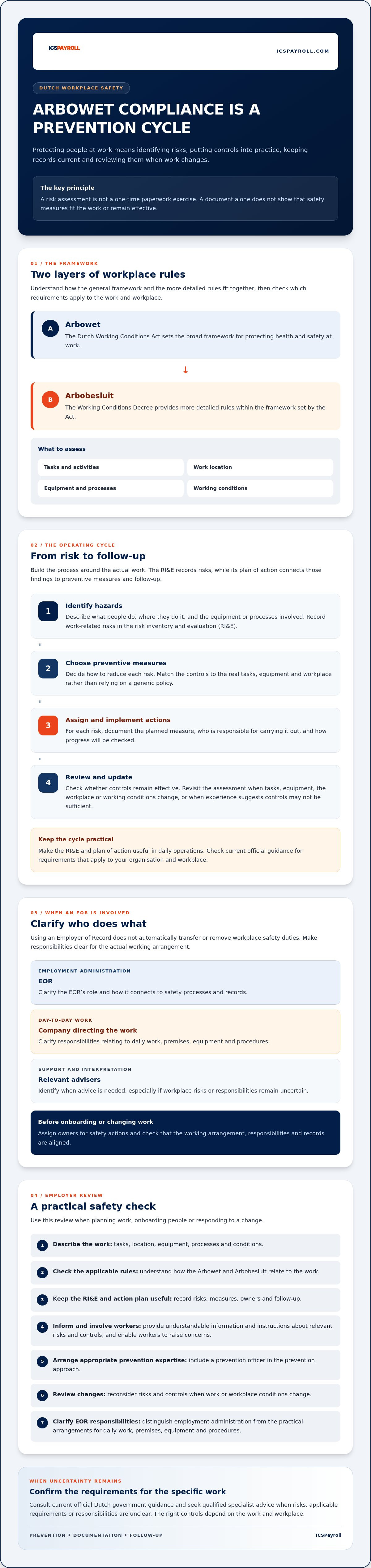
Arbowet compliance works best as a continuing prevention cycle: identify hazards, decide how to control them, put the controls into practice and check whether they remain effective. A document alone isn’t enough. If tasks, equipment or the workplace change, consider whether the assessment and safety measures need updating.
RI&E and the plan of action
The risk inventory and evaluation, or RI&E, records health and safety risks associated with work. Its plan of action connects those findings to preventive measures and follow-up. The Dutch government’s Working Conditions Act guidance explains the general employer framework. Check current official guidance for the RI&E requirements that apply to your organisation and workplace.
Make the documents useful in daily operations. For each identified risk, record the planned measure, who is responsible for carrying it out and how progress will be checked. For example, if an assessment identifies a risk linked to equipment, specify the required control and who will confirm it is in place. Review the assessment when work changes or experience suggests existing controls may not be sufficient. Don’t assume a fixed review schedule or an exemption applies without checking current rules.
Prevention, worker involvement, and occupational health
Employers should arrange appropriate prevention expertise, including a prevention officer, and ensure workers receive understandable information and instructions about relevant risks and controls. Involve workers so they can raise practical concerns, such as a procedure that’s difficult to follow. Confirm how prevention and worker participation requirements apply to your organisation instead of assuming one arrangement fits every employer.
For occupational health support, consult current official Dutch guidance to establish which arrangements apply. Check how employees can access the relevant support, and don’t treat payroll or employment administration as a substitute for occupational health expertise.
For a practical review, keep the RI&E, plan of action, assigned owners, worker communications, evidence that controls were implemented and notes from subsequent reviews together. This makes it easier to track open actions and respond when conditions change. Seek official guidance or qualified specialist advice when the scope of dutch workplace safety regulations (Arbowet) is unclear.
Where employment administration is handled separately from workplace safety, document how the parties coordinate. Businesses reviewing Dutch payroll and EOR support can clarify which employment processes sit with their provider and which safety actions need to be managed at the workplace.
Does using an EOR remove Arbowet responsibilities?
No. An Employer of Record agreement shouldn’t be treated as a blanket transfer or removal of workplace safety responsibilities. The Dutch government’s guidance on the Working Conditions Act sets out the employer framework, but how duties apply in an EOR arrangement depends on the work, the workplace and the parties’ actual roles. Contract wording matters, but it doesn’t replace an assessment of how work is managed in practice.
Separate employment administration from operational control. The EOR may be the formal employer, while another organisation directs daily tasks or controls the premises and equipment. Roles can overlap, so don’t rely only on job titles or the service agreement. For dutch workplace safety regulations (Arbowet), the practical question is who can identify and address each risk where the work takes place.
Clarify employer and workplace responsibilities
Before work begins, map the parties involved and assign an owner for each safety process. Record who assesses task-specific risks, communicates work instructions, provides training, arranges protective measures and maintains equipment. Also specify who workers should contact to report a hazard or incident, and how the concern will be escalated and followed up.
Use the RI&E and its plan of action as a reference point, where applicable. Check that the assessment reflects the employee’s actual tasks and worksite, and that each agreed measure has a named owner. If responsibilities overlap or no party clearly owns a control, resolve the gap before work starts. Ask a qualified Dutch adviser to review uncertain arrangements. An agreement between organisations shouldn’t be treated as a definitive legal assessment.
What an EOR can and cannot clarify
ICSPayroll provides Netherlands-focused Employer of Record and Dutch payroll administration, supporting employment and payroll processes. It isn’t a workplace safety consultancy. Payroll, HR administration and employment documentation don’t replace a workplace-specific risk assessment or the practical safety measures needed for the work.
For clarity, align the EOR agreement and workplace procedures on safety instructions, training, protective measures, incident reporting and communication with the employee. Confirm that the people named in those processes can carry out their assigned actions. Employers assessing their employment setup can review an Employer of Record arrangement in the Netherlands, while obtaining separate, qualified advice on safety responsibilities where needed.
A practical Arbowet review checklist for employers
Use this review before onboarding someone into a Dutch workplace and whenever tasks, equipment or work conditions change. It turns dutch workplace safety regulations (Arbowet) into assigned, traceable actions. The checklist supports preparation, but doesn’t replace a workplace-specific risk assessment, official guidance or qualified legal and safety advice.
Before work starts: establish risks and ownership
Describe the role as it will be carried out, not just as it appears in the job description. Note the work location, tasks, equipment and foreseeable hazards. Compare those details with the existing risk inventory and evaluation (RI&E) to check that it reflects the actual work and current conditions. If it doesn’t, identify what needs review before relying on it.
For every relevant risk, confirm who implements the control and how the employee will receive clear instructions. Use the table to locate evidence and identify the responsible person. These are operational owners to confirm, not a legal allocation that automatically applies to every employer.
| Review area | Evidence to locate | Owner to confirm |
|---|---|---|
| Role and workplace risks | Role and task description, worksite details, relevant RI&E | Person responsible for the risk assessment |
| Preventive controls | Plan of Action, control records, equipment or protective measure procedures | Person responsible for implementing each measure |
| Instructions and communication | Safety instructions, training or briefing records, employee guidance | Person providing and updating instructions |
| Reporting and follow-up | Hazard and incident reporting route, action log, review notes | Contact receiving reports and tracking actions |
During employment: communicate, monitor, and review
Keep procedures accessible and understandable to the workers expected to follow them. Confirm employees know how to raise a hazard, work-related incident or change in conditions, and who will respond. Record the report, the action taken, outstanding steps and the date or trigger for follow-up. A process is useful only if people can use it and someone checks that open actions are completed.
Review the RI&E and controls when work changes or monitoring suggests a measure may not be working as intended. For the general employer framework, consult the Dutch government’s Working Conditions Act guidance. Verify specific requirements, including any conditions or exemptions, against current official guidance and the facts of your workplace.
For employment and payroll administration alongside this review, discuss Dutch payroll and EOR support. Confirm workplace-specific safety assessment and advice separately with the appropriate workplace professionals.
Next steps for compliant Dutch hiring and workplace safety
Turn your review into a short action plan before work begins. First, check relevant rules against current Dutch government guidance. Next, assign an owner for each safety measure and make sure that person has the authority and resources to act. Document the controls, explain them to employees and set a process to review them when tasks or workplace conditions change. The Dutch government’s Working Conditions Act guidance is a starting point for understanding the employer framework.
Keep the record practical: note the risk, agreed measure, responsible person, how employees are informed and how completion or follow-up will be recorded. This creates a clear handover between hiring, workplace operations and ongoing review. It can also reveal unresolved questions before they become gaps in day-to-day procedures.
When to seek specialist workplace safety advice
Ask a qualified Dutch workplace safety specialist to assess complex hazards, review a serious incident or help resolve disputed responsibilities. Seek advice before work starts if the parties can’t agree who will assess a risk or implement a control. For statutory information and relevant reporting routes, check current official government guidance rather than relying on a general checklist.
Payroll and employment administration don’t replace a workplace-specific risk assessment or advice from a safety professional. If a legal duty or exemption is unclear, confirm it with an adviser who can consider the actual work, workplace and contractual arrangement.
Where Dutch EOR and payroll support may fit
An Employer of Record can support Dutch employment administration for an international employer. ICSPayroll provides Netherlands-focused EOR, payroll and HR administration. These services support employment processes, but they don’t make ICSPayroll a workplace safety consultancy or determine which party must manage a particular workplace risk. Clarify those responsibilities with the relevant workplace operators and qualified advisers.
For dutch workplace safety regulations (Arbowet), keep the safety plan and employment administration connected but distinct. Make sure the employee’s instructions, reporting route and assigned safety contacts are clear, even when more than one organisation is involved.
If you’re planning to hire in the Netherlands and need employment administration support, discuss Dutch EOR and payroll support with ICSPayroll. Confirm workplace safety advice and risk assessments separately with the appropriate specialist.
Make Dutch workplace safety part of your hiring process
Strong safety practice is built through repeatable action. Assess risks based on the work people actually perform, document controls and ownership, and review the arrangements when tasks or workplace conditions change. That’s the practical foundation for managing dutch workplace safety regulations (Arbowet).
An EOR can support employment administration, but using one doesn’t automatically remove or transfer every workplace safety responsibility. Make the division of roles clear, keep employees informed and seek qualified Dutch advice when risks or legal responsibilities remain uncertain.
ICSPayroll provides Netherlands-focused Employer of Record services, Dutch payroll administration and HR support for international employers. These services support employment administration, not workplace safety assessments or certification. If you’re planning Dutch hiring and want to discuss the employment and payroll side, discuss Dutch employment and payroll support with ICSPayroll. Contact ICSPayroll to discuss Dutch EOR and payroll support, and confirm workplace safety advice and risk assessments separately with the appropriate specialist.
Frequently Asked Questions
What is the Arbowet in the Netherlands?
The Arbowet is the Netherlands’ central framework for working conditions and workplace health and safety. It sets out the general approach employers must take to protect workers and prevent harm. The Dutch government’s Working Conditions Act guidance is a useful starting point. In practice, dutch workplace safety regulations (Arbowet) require employers to consider risks arising from their work and take appropriate preventive measures.
Is an RI&E mandatory for every Dutch employer?
Generally, employers in the Netherlands must have a risk inventory and evaluation (RI&E) that identifies workplace risks and sets out actions to address them. The plan of action should connect identified risks to measures and follow-up. Some rules or limited exceptions may depend on the employer’s circumstances, so don’t assume an exemption applies. Check the current official RI&E guidance and seek advice if your situation is unclear.
What is the difference between the Arbowet and the Arbobesluit?
The Arbowet is the primary working-conditions Act, establishing the broad framework for workplace health and safety. The Arbobesluit, or Working Conditions Decree, contains more detailed rules under that framework. They are connected, but not interchangeable. Identify which detailed provisions apply to your work rather than relying on the Act’s general principles alone. Use current official Dutch guidance to check how specific rules relate to your workplace.
Does an Employer of Record take over workplace safety responsibilities in the Netherlands?
No. Using an Employer of Record (EOR) doesn’t automatically transfer or remove every workplace safety responsibility. The EOR may handle employment administration, while another organisation directs daily work or controls the premises, equipment or procedures. The actual allocation depends on the arrangement and workplace facts. Document who assesses risks, gives instructions, implements controls and handles reports, then ask a qualified Dutch adviser to review unclear or overlapping duties.
Who is responsible for workplace safety when an employee works at a client site?
Responsibility can’t be determined solely by the employee’s work location or the EOR agreement. Identify the formal employer, the organisation directing daily tasks and the party operating the workplace. Then clarify who assesses task-specific risks, maintains equipment, communicates safety instructions and acts on reported hazards. Applicable duties depend on the law and the actual working arrangement. If the parties’ roles overlap or remain uncertain, seek qualified Dutch advice before work begins.
When should an employer review its Dutch workplace risk assessment?
Review the risk assessment when work changes, such as when tasks, equipment, processes or workplace conditions are altered. Also revisit it if an incident or experience with existing controls suggests the assessment may no longer reflect actual risks. Keep a record of what changed, which controls were reconsidered and who owns follow-up. Don’t rely on a fixed review interval or assume an old assessment remains suitable without checking current requirements and workplace circumstances.
What should an employer do after a workplace accident in the Netherlands?
Act promptly to address immediate danger and provide appropriate assistance. Record what happened, inform the relevant workplace contacts and review whether existing controls need to change. Serious work accidents must be reported immediately to the Dutch Labour Authority. Check the official government guidance on workplace accidents for reporting instructions and current requirements. Record the response and follow-up, and seek specialist advice if the incident or reporting duty is unclear.

Article by
Joost Hubregtse
Joost Hubregtse is Director of ICS Staffing & Payroll B.V., the wholly owned subsidiary of Intercompany Solutions behind ICS Payroll. He is responsible for Employer of Record and Dutch payroll services: employment contracts, wage tax and social security filings, holiday allowance, pension, sick leave and CAO compliance, with onboarding possible within 48 hours.
Frequently Asked Questions
International businesses with people working in the Netherlands should review the Dutch framework when planning and managing that work. Relevant risks depend on the tasks, equipment, work location and working conditions. An office-based role, for example, may involve different hazards and controls from work in a production environment. A single checklist cannot determine the right controls for every workplace. Start by describing what employees actually do, where they do it and what equipment or processes they use. Then assess the risks and decide what measures are appropriate. Revisit the assessment when work or workplace conditions change rather than assuming an existing policy remains suitable. This section provides general information, not legal advice for a particular employer or workplace. Applicable duties and controls can depend on the specific arrangement and risks. Confirm current requirements through official Dutch government guidance, and consult a qualified adviser when the facts or legal interpretation are uncertain. Arbowet compliance works best as a continuing prevention cycle: identify hazards, decide how to control them, put the controls into practice and check whether they remain effective. A document alone isn’t enough. If tasks, equipment or the workplace change, consider whether the assessment and safety measures need updating.
The Arbowet is the Netherlands’ central framework for working conditions and workplace health and safety. It sets out the general approach employers must take to protect workers and prevent harm. The Dutch government’s Working Conditions Act guidance is a useful starting point. In practice, dutch workplace safety regulations (Arbowet) require employers to consider risks arising from their work and take appropriate preventive measures.
Generally, employers in the Netherlands must have a risk inventory and evaluation (RI&E) that identifies workplace risks and sets out actions to address them. The plan of action should connect identified risks to measures and follow-up. Some rules or limited exceptions may depend on the employer’s circumstances, so don’t assume an exemption applies. Check the current official RI&E guidance and seek advice if your situation is unclear.
The Arbowet is the primary working-conditions Act, establishing the broad framework for workplace health and safety. The Arbobesluit, or Working Conditions Decree, contains more detailed rules under that framework. They are connected, but not interchangeable. Identify which detailed provisions apply to your work rather than relying on the Act’s general principles alone. Use current official Dutch guidance to check how specific rules relate to your workplace.
No. Using an Employer of Record (EOR) doesn’t automatically transfer or remove every workplace safety responsibility. The EOR may handle employment administration, while another organisation directs daily work or controls the premises, equipment or procedures. The actual allocation depends on the arrangement and workplace facts. Document who assesses risks, gives instructions, implements controls and handles reports, then ask a qualified Dutch adviser to review unclear or overlapping duties.
Responsibility can’t be determined solely by the employee’s work location or the EOR agreement. Identify the formal employer, the organisation directing daily tasks and the party operating the workplace. Then clarify who assesses task-specific risks, maintains equipment, communicates safety instructions and acts on reported hazards. Applicable duties depend on the law and the actual working arrangement. If the parties’ roles overlap or remain uncertain, seek qualified Dutch advice before work begins.
Review the risk assessment when work changes, such as when tasks, equipment, processes or workplace conditions are altered. Also revisit it if an incident or experience with existing controls suggests the assessment may no longer reflect actual risks. Keep a record of what changed, which controls were reconsidered and who owns follow-up. Don’t rely on a fixed review interval or assume an old assessment remains suitable without checking current requirements and workplace circumstances.
Act promptly to address immediate danger and provide appropriate assistance. Record what happened, inform the relevant workplace contacts and review whether existing controls need to change. Serious work accidents must be reported immediately to the Dutch Labour Authority. Check the official government guidance on workplace accidents for reporting instructions and current requirements. Record the response and follow-up, and seek specialist advice if the incident or reporting duty is unclear.