
Dutch Employee Screening: Checks and Legal Limits
By Joost Hubregtse, Director, ICS Staffing & Payroll
All blog posts are reviewed and fact checked by our labour law lawyer Zishan Hussain and our director. Editorial standards
A background check is not permission to investigate a candidate without limits. Dutch employee screening and background checks must focus on information relevant to the role and comply with privacy rules. Employers may verify identity, education and employment history, and request a Certificate of Conduct (VOG) when the position justifies it.
Screening can help employers assess qualifications and risks related to a role, but each check needs a clear purpose and appropriate limits. Criminal records, health information and online activity each raise different considerations.
This article explains what employers in the Netherlands can verify, when a VOG may be relevant and how legal limits shape screening. It also covers qualification and integrity checks, helping you distinguish a proportionate hiring process from an intrusive one.
Key Takeaways
- Match each check to the role’s actual requirements, including the qualifications and work history that matter.
- A Certificate of Conduct (VOG) can help assess whether a candidate’s judicial background is relevant to a position.
- References and online information need the same role-focused approach as formal checks: collect only what is relevant.
- Privacy rules shape what employers can examine, how they handle screening data, and how long they retain it.
- Use proportionate screening to assess integrity while avoiding unnecessary intrusion into a candidate’s private life.
Education and qualification verification
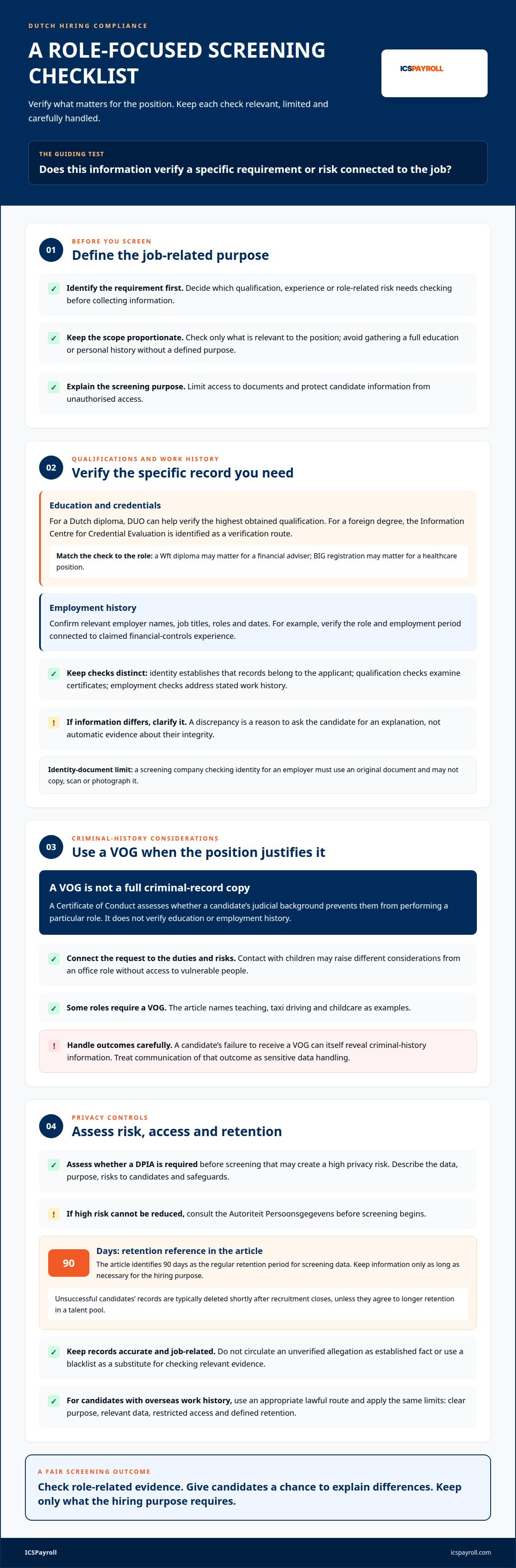
Qualification checks establish whether a candidate has the credentials required for a specific position. In the Netherlands, an education check can verify an applicant’s highest obtained diploma through the DUO database. The check should match the role: a Wft diploma may be relevant when hiring a financial adviser, while a healthcare position may require checking BIG registration. Identify the qualification that matters before collecting documents.
Degree verification compares a candidate’s stated education with their certificate and the issuing institution. For a Dutch diploma, the DUO database can help verify the highest qualification. For a foreign degree, the Information Centre for Credential Evaluation is identified as a route for certificate verification. Focus on credentials that meet the role’s actual requirements, rather than collecting a full education history without a defined purpose.
Employment-history verification adds context to a résumé. Confirm relevant roles, employer names, job titles and dates using information connected to the position. For example, if a candidate lists experience operating financial controls, verify the relevant role and employment period. Treat a discrepancy as a reason to clarify the record, not as automatic evidence about the candidate’s integrity.
Keep identity, education and employment checks distinct. Identity verification establishes that records belong to the applicant; qualification verification examines certificates; employment verification addresses stated work history. A screening company checking identity for an employer must use an original document and may not copy, scan or photograph it. Separating the checks limits information collection to what each purpose requires.
A Certificate of Conduct, or VOG, addresses a different question from a diploma or reference check: whether a candidate’s judicial background prevents them from performing a role. Employers may request one when the position justifies it, but it does not verify qualifications or employment history. A financial role, for instance, may call for a Wft diploma check; that credential check and a VOG serve different purposes.
Screening must also protect candidate information. According to the European Union, more serious infringements under the GDPR can result in a fine of up to €20 million or 4% of a firm's worldwide annual revenue from the preceding financial year, whichever is higher. That consequence reinforces the need to handle certificates and verification records carefully.
For a clear process, define the position-related requirement, identify the record that can verify it and document the result. If a certificate or employment date differs from the application, give the candidate an opportunity to explain. This keeps verification focused on role-related evidence and supports a fair assessment of qualifications and integrity.
Can employers check criminal records in the Netherlands?
Dutch employers generally cannot obtain a candidate’s criminal record directly. A Certificate of Conduct (VOG) is the relevant route for assessing whether a person’s judicial background prevents them from performing a particular role. Employers may request a VOG where justified by the position, and some jobs, including teaching, taxi driving and childcare, legally require one. The certificate is not a full copy of someone’s criminal record.
A VOG request should relate to the duties and risks of the position. A role involving contact with children, for example, raises different considerations from an office position without access to vulnerable people. A candidate’s failure to receive a VOG can itself reveal criminal-history information. Communicating that outcome therefore involves exchanging criminal data and requires careful handling and a clear, role-related purpose.
The General Data Protection Regulation (GDPR) and the Dutch GDPR Implementation Act (UAVG) govern how employers handle screening information. According to the European Union, Article 88 of the GDPR is a rule employers must follow when handling employee personal data for background checks. Employers should limit collection to information relevant to the role, explain the screening purpose, and protect each document from unauthorised access.
A data protection impact assessment (DPIA) is important when screening may create a high privacy risk. Employers must assess whether a DPIA is required before starting the checks. If the assessment identifies a high risk that cannot be reduced, the employer must consult the Autoriteit Persoonsgegevens before screening begins. The assessment should describe the data involved, the purpose, the risks to candidates and the safeguards applied.
Retention also needs a defined limit. Screening information should be kept only as long as necessary for the hiring purpose. Unsuccessful candidates’ records are typically deleted shortly after recruitment closes, unless they agree to longer retention in a talent pool. A 90-day period is identified as the regular retention period for screening data. Employers should document when the hiring process closes and remove records that no longer serve its purpose.
Blacklists require particular care. The Autoriteit Persoonsgegevens, the Dutch Data Protection Authority, oversees personal-data protection. Employers should not treat a list of alleged concerns as a substitute for checking relevant evidence. Records about candidates must be accurate, job-related and handled under applicable privacy rules. For example, do not circulate an unverified allegation between hiring teams as established fact.
For international candidates or Dutch employees who have worked abroad, employers may need to assess the relevant period abroad through an appropriate lawful screening route. The same principles apply: define the purpose, collect only relevant personal data, restrict access and set a retention period. These controls help assess role-related risks without turning a criminal-history check into an unrestricted investigation.
What is background screening in the Netherlands?
Background screening checks information relevant to an applicant’s suitability for a specific role. A well-designed process for Dutch employee screening and background checks connects each check to a clear hiring purpose.
Before screening, employers must tell candidates its purpose, what information they will examine and why it matters to the position. They should communicate the results afterwards. Employers may ask for permission before checks begin, but consent may not provide a valid GDPR legal basis in employment, because the relationship can make it difficult to give consent freely under the General Data Protection Regulation.
Candidate References and Online Information
Reference and online checks compare an applicant’s job-related claims with information from people familiar with their work and relevant public sources. A reference may clarify responsibilities or experience described in an application. Review online information for a defined hiring purpose, not to explore unrelated personal interests. A public professional profile may clarify a stated role, while private posts about unrelated matters may have no bearing on it.
Candidate Consent and Transparency
Transparency means explaining the screening’s purpose, scope, information sources and relevance before collecting information. Tell candidates whether checks involve references, public online information or a VOG, and explain how findings will be used. Request permission before checks begin, but do not treat permission as a replacement for a lawful basis. Because employment involves an imbalance of power, consent may not be freely given.
Clear communication gives applicants a chance to address apparent discrepancies. If a reference describes a different job title from the application, share the relevant finding and invite an explanation before drawing conclusions. Keep the exchange focused on the position and record the outcome accurately. Do not reject a candidate solely because information from one source appears different.
VOG Applications and Private Background Check Costs
VOG application and private-check costs depend on the application route and checks included; no single amount applies to every case. A VOG is a Certificate of Conduct, while private screening from providers like Elevated Background Checks may involve separate checks, such as references or employment history. The role and scope determine which checks are relevant, so their costs are not interchangeable.
A blacklist is not a shortcut for reviewing applications. Employers should assess information about a candidate’s conduct against reliable sources and the role’s requirements. An outdated entry, an allegation or mistaken identity could unfairly affect an applicant. Treat each entry as information requiring context, rather than proof of a criminal record or unsuitability. The Autoriteit Persoonsgegevens oversees personal-data protection in the Netherlands.
For each application, define the purpose, then select relevant sources and checks. A finance role may call for a reference about financial responsibilities, while work involving vulnerable people may make a VOG relevant. These principles guide Dutch employee screening and background checks, keeping decisions focused on evidence connected to the work rather than an unrestricted review of a candidate’s personal life.
Financial, social and online integrity checks
Integrity checks examine information connected to a role’s duties, rather than treating every online detail as evidence of character. In the Netherlands, the General Data Protection Regulation (GDPR) requires employers to process personal data for a defined purpose. Financial checks, public-profile reviews and social media searches each involve different information, so assess them separately.
Financial checks need a clear connection to the position. Reviewing credit history may be justified for a financial role with relevant responsibilities, but may be disproportionate for a non-financial job. Access to financial decisions may make a limited check relevant; an office role without such duties does not provide the same rationale. Let the hiring purpose determine what information you consider.
Social media screening involves reviewing online material about an applicant for information relevant to the role. Before reviewing a profile, define what the check is meant to establish, such as a public professional claim connected to the position. Do not turn a social media search into a broad review of private interests, family life or unrelated opinions. These details may say little about the applicant’s ability to do the work.
Public availability does not automatically make information suitable for hiring decisions. Separate facts connected to the role from personal information with no clear bearing on it. A public professional profile may clarify a candidate’s stated experience, while a post about a private hobby usually offers no evidence about work conduct. Record the relevant finding and its source, rather than retaining an entire profile.
Apply the same discipline to online information found through a search engine. A result may concern someone with a similar name, contain outdated claims or lack context. Confirm that it relates to the applicant before considering it, and give the candidate a chance to respond to any material discrepancy. A search result alone is not proof of misconduct or poor integrity.
For each proposed check, hiring teams can use a short assessment:
- State the specific hiring purpose and the position it relates to.
- Choose sources that can provide relevant information for that purpose.
- Exclude unrelated personal details from the assessment record.
- Document the finding, its source and how it relates to the role.
This process helps distinguish evidence from assumption. A financial-history concern may matter for a role with financial responsibilities, while an unrelated social media post should not decide a candidate’s suitability. Consistent criteria also help hiring teams assess applicants fairly across positions. Under general data protection principles, limiting checks to relevant information supports a more controlled integrity review and reduces unnecessary collection of personal data.
Legal limits on Dutch employee background checks
In the Netherlands, employers may verify identity, education, employment history and role-related qualifications, and request a VOG where justified. Unlawful screening can breach data-protection requirements and expose an employer to regulatory enforcement.
Permitted Pre-Employment Checks
Permitted checks must be necessary for a defined hiring purpose and proportionate to the position. An employer may verify a candidate’s diploma for a role requiring that qualification, or request a Verklaring Omtrent het Gedrag (VOG) when the risks of the role justify it.
Employers may also check employment history and identity, provided the information is relevant. A credit-history check may suit a financial position but be excessive for unrelated work. Consider whether workplace safeguards, such as separating approval powers, can address a risk without collecting additional personal data.
Data protection rules apply in the Netherlands even when an employer uses screening methods familiar from other countries. The employer must have a legitimate interest or legal obligation, and screening must be necessary for its stated purpose. Information should be sufficient and relevant, not excessive. Give candidates advance notice explaining the purpose, scope and relevance of the checks, and communicate the results afterwards.
Health information has a separate boundary. During recruitment, employers must not ask candidates about their health or illnesses. Medical questions may arise only through a pre-employment medical examination. A general interview question about a candidate’s medical history is not acceptable simply because the role has demanding duties.
Identity checks also have specific limits. A screening company verifying identity for an employer must use an original document and must not copy, scan or photograph it. Employers conducting checks for clients may also need a permit under the Dutch Private Security Organisations and Detective Agencies Act. These requirements affect how screening is arranged and identity records are handled.
Consequences of Unlawful Employee Screening
Unlawful screening can lead to intervention by the Autoriteit Persoonsgegevens, the Dutch Data Protection Authority, and consequences under data-protection law. The European Union’s GDPR framework includes administrative fines for serious infringements. Employers may also face complaints and damage to candidates’ trust if they collect irrelevant information or use it unfairly.
For example, requesting health details during an ordinary interview or using unrelated online information in a hiring decision can exceed a legitimate screening purpose. A documented process helps show why each check was needed, what information it covered and how the employer protected it.
The practical test is straightforward: connect every check to a role requirement, use the least intrusive suitable method and explain the process to candidates. If organisational controls can manage a risk without screening, consider that alternative. This keeps hiring decisions focused on qualifications, conduct and responsibilities rather than unrestricted access to personal data.
ICSPayroll: Dutch Payroll Administration
ICSPayroll supports international employers with Dutch Payroll Administration when they need to manage employment and payroll obligations in the Netherlands. Screening decisions remain tied to the role, while accurate payroll administration helps carry the employment relationship forward after a candidate is hired.
For a company hiring in the Netherlands without its own local employment structure, ICSPayroll’s Employer of Record (EOR) service provides a route to employ staff locally. International employees who may qualify for the 30% ruling can also receive support with the application process. These services address payroll and employment administration, not candidate sourcing or the screening decision itself.
If you’re planning to hire in the Netherlands and need support with payroll or employment administration, contact ICSPayroll to discuss your requirements.
Build a consistent screening process for your next hire
Put a documented screening framework in place before the next vacancy opens. Define who selects checks, who reviews findings and how decisions are recorded. A consistent process helps hiring teams apply the same role-based approach across departments while adapting checks to each position. It also gives candidates a clearer understanding of what to expect. For organizations looking to modernize talent acquisition alongside structured verification, specialized employment services such as BlueBridge Group Placement Corp can help streamline recruitment and candidate evaluation.
For international employers, Dutch employee screening and background checks should form part of a broader plan for employing and supporting staff in the Netherlands. Aligning hiring procedures with local payroll and employment administration can help teams move from candidate selection into employment with fewer process gaps.
If you’re preparing to hire in the Netherlands and want support with the employment arrangements that follow screening, contact ICSPayroll to discuss your requirements. A clear process gives your team a practical foundation for its next hiring decision.
Frequently Asked Questions
Do Dutch companies do background checks?
Yes. Dutch companies use background checks, although screening is not a universal legal requirement for every vacancy. It is common in areas such as finance, healthcare, education and government, where roles can involve confidential information or public responsibilities. For example, an employer recruiting an accounts employee might verify relevant credentials and employment details. A role with fewer specific risks may call for fewer checks.
How do employers approach employment background checks?
Employers typically match each check to the position and the information needed for a hiring decision. A hiring team might confirm a candidate’s stated role with a former employer, then assess any discrepancy in context before deciding. A sound process assigns responsibility for reviewing results, limits access to people involved in hiring and records how information affected the decision. This makes separate checks easier to manage consistently.
How long does a VOG take?
Straightforward VOG applications in the Netherlands are usually processed within a few weeks. Employers should communicate the certificate requirement early, particularly if a role cannot begin without it. A VOG concerns whether a candidate’s judicial background prevents them from performing the relevant work; it is not a copy of a full criminal record. Including the application in recruitment planning can help avoid unexpected onboarding delays.
Is a VOG mandatory for all jobs?
No. A VOG is not mandatory for every job in the Netherlands, although some roles legally require one. Teaching, taxi driving and childcare are examples of work for which a certificate may be mandatory. Where the law requires a VOG, hiring someone without it is prohibited. For other positions, connect any request to the role’s responsibilities and risks.
Why conduct a background check during a job application process?
A role-related check can help an employer assess whether application details support the position’s requirements. Verifying a qualification, for example, may establish that an applicant has the credential needed for a regulated responsibility. A reference can clarify the scope of previous duties. The purpose is to inform a hiring decision with relevant evidence, not to investigate a candidate’s private life or collect information without a clear reason.
What employee background checks are legal in the Netherlands?
Employers may check identity, education and employment history, and request a VOG when the position justifies it. A financial check may be relevant to work involving financial responsibilities, but excessive for an unrelated role. Keep screening proportionate, consider less intrusive ways to manage risk and avoid requesting personal information unrelated to the work.
What GDPR and Dutch privacy rules apply to employee screening?
The GDPR and the Dutch GDPR Implementation Act (UAVG) govern employee-screening data. Employers need a clear purpose and must limit collection to relevant information. A high-risk screening process may require a data protection impact assessment; if high risk remains after mitigation, the Autoriteit Persoonsgegevens must be consulted before screening begins. Protect records and delete them when they are no longer needed.
When can a Dutch employer request a Certificate of Conduct (VOG)?
An employer can request a VOG when the certificate is relevant to the position and its responsibilities. For example, work involving children or passengers can make a candidate’s judicial background pertinent to the job. Some occupations, including teaching, taxi driving and childcare, legally require a VOG. The request should relate to the role, and the certificate should not be treated as a general record of every aspect of a candidate’s past.

Article by
Joost Hubregtse
Joost Hubregtse is Director of ICS Staffing & Payroll B.V., the wholly owned subsidiary of Intercompany Solutions behind ICS Payroll. He is responsible for Employer of Record and Dutch payroll services: employment contracts, wage tax and social security filings, holiday allowance, pension, sick leave and CAO compliance, with onboarding possible within 48 hours.
Frequently Asked Questions
Yes. Dutch companies use background checks, although screening is not a universal legal requirement for every vacancy. It is common in areas such as finance, healthcare, education and government, where roles can involve confidential information or public responsibilities. For example, an employer recruiting an accounts employee might verify relevant credentials and employment details. A role with fewer specific risks may call for fewer checks.
Employers typically match each check to the position and the information needed for a hiring decision. A hiring team might confirm a candidate’s stated role with a former employer, then assess any discrepancy in context before deciding. A sound process assigns responsibility for reviewing results, limits access to people involved in hiring and records how information affected the decision. This makes separate checks easier to manage consistently.
Straightforward VOG applications in the Netherlands are usually processed within a few weeks. Employers should communicate the certificate requirement early, particularly if a role cannot begin without it. A VOG concerns whether a candidate’s judicial background prevents them from performing the relevant work; it is not a copy of a full criminal record. Including the application in recruitment planning can help avoid unexpected onboarding delays.
No. A VOG is not mandatory for every job in the Netherlands, although some roles legally require one. Teaching, taxi driving and childcare are examples of work for which a certificate may be mandatory. Where the law requires a VOG, hiring someone without it is prohibited. For other positions, connect any request to the role’s responsibilities and risks.
A role-related check can help an employer assess whether application details support the position’s requirements. Verifying a qualification, for example, may establish that an applicant has the credential needed for a regulated responsibility. A reference can clarify the scope of previous duties. The purpose is to inform a hiring decision with relevant evidence, not to investigate a candidate’s private life or collect information without a clear reason.
Employers may check identity, education and employment history, and request a VOG when the position justifies it. A financial check may be relevant to work involving financial responsibilities, but excessive for an unrelated role. Keep screening proportionate, consider less intrusive ways to manage risk and avoid requesting personal information unrelated to the work.
The GDPR and the Dutch GDPR Implementation Act (UAVG) govern employee-screening data. Employers need a clear purpose and must limit collection to relevant information. A high-risk screening process may require a data protection impact assessment; if high risk remains after mitigation, the Autoriteit Persoonsgegevens must be consulted before screening begins. Protect records and delete them when they are no longer needed.
An employer can request a VOG when the certificate is relevant to the position and its responsibilities. For example, work involving children or passengers can make a candidate’s judicial background pertinent to the job. Some occupations, including teaching, taxi driving and childcare, legally require a VOG. The request should relate to the role, and the certificate should not be treated as a general record of every aspect of a candidate’s past.