
EOR vs Subsidiary in the Netherlands: Compare Hiring and Compliance
By Joost Hubregtse, Director, ICS Staffing & Payroll
All blog posts are reviewed and fact checked by our labour law lawyer Zishan Hussain and our director. Editorial standards
A Dutch subsidiary isn’t the only way to hire in the Netherlands. The EOR versus subsidiary decision comes down to whether you need your own local company or can hire through an existing Dutch employer.
Both options involve Dutch payroll and employment compliance, but they assign employer responsibilities differently. With an EOR, another entity is the legal employer, so you can hire without setting up a Dutch entity. A subsidiary gives your business its own local entity and a direct employment structure.
This comparison explains how EOR, a Dutch subsidiary, payrolling and PEO differ in payroll administration, compliance and employer responsibilities. It also clarifies which responsibilities remain with your business, including those related to day-to-day working conditions, to help you choose a structure that fits your hiring plans in the Netherlands.
Key Takeaways
- Choose an EOR to hire through an existing Dutch employer, or a subsidiary when your business needs its own local entity.
- Compare EOR, payrolling and PEO by who employs the worker, administers payroll and carries employment responsibilities.
- Separate formal employer duties from your ongoing role in working conditions, sickness support and employee performance.
- Factor payroll administration and compliance obligations into your decision, not just the structure used to hire.
- Use your hiring plans and desired level of local presence to decide which route best fits your Netherlands operations.
What is an Employer of Record in the Netherlands?
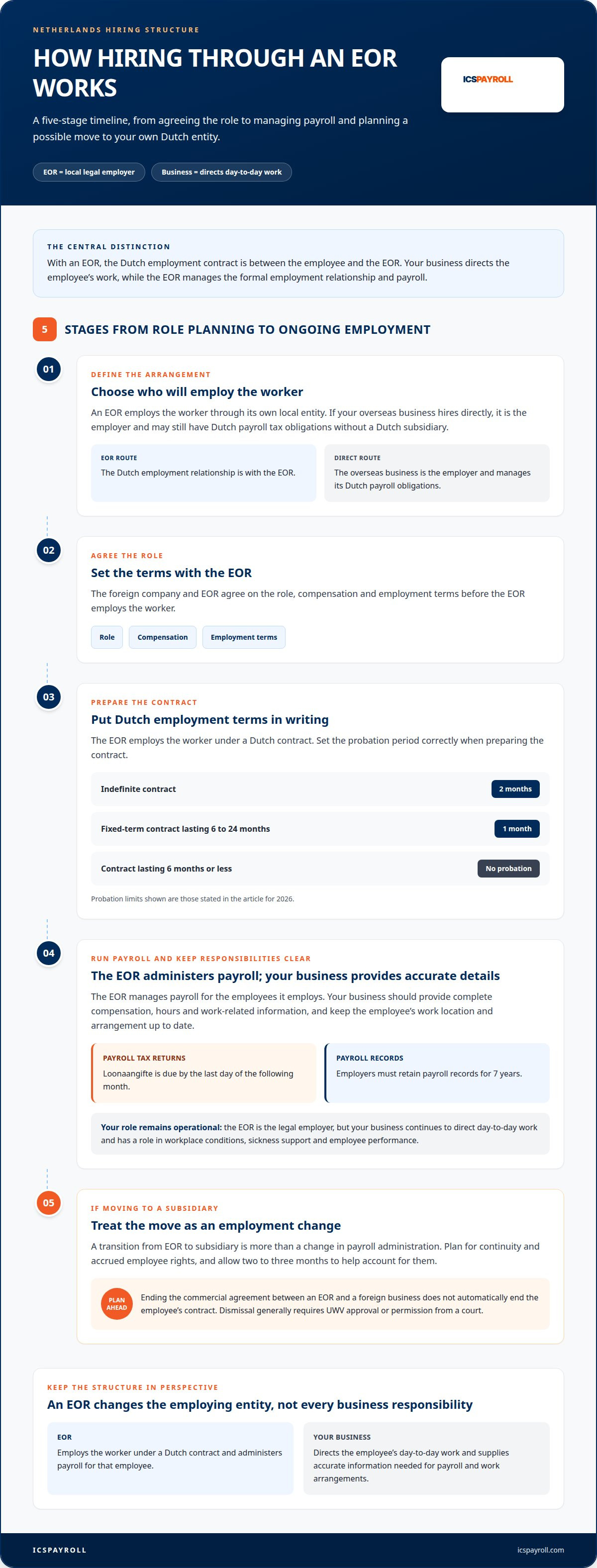
An Employer of Record (EOR) employs a worker in the Netherlands through its own local entity. The foreign business directs the work, while the EOR manages the formal employment relationship and payroll.
EOR and Direct Foreign Employment
With an EOR, the Dutch employment contract is between the employee and the EOR. With direct foreign employment, the overseas business is the employer, and may still have Dutch payroll tax obligations even without a Dutch subsidiary. The distinction changes the employing entity, not the foreign business’s practical role in managing the employee’s work.
For example, a company hiring one Netherlands-based specialist can use an EOR without setting up its own local entity. A foreign employer hiring directly must manage its Dutch payroll obligations. In either case, the business needs clear agreements on responsibilities, payroll information and the employee’s working arrangements.
Hiring Through an EOR
Hiring through an EOR starts with the foreign company and EOR agreeing on the role, compensation and employment terms. The EOR then employs the worker under a Dutch contract and administers payroll. Unlike direct foreign employment, the local employment relationship is with the EOR, while the business continues to direct the employee’s day-to-day work.
Payrolling is a related but distinct arrangement. Under Dutch payrolling rules, workers receive the relevant employment conditions available to comparable employees of the hirer, including pension and other secondary conditions. The EOR or payroll arrangement should reflect how the parties actually work, not just the label in a commercial agreement.
Dutch employment contracts must be in writing, according to Business.gov.nl’s employment-contract guidance. The 2026 probation limits are two months for indefinite contracts, one month for fixed-term contracts lasting six to 24 months, and none for contracts lasting six months or less, according to Business.gov.nl’s probation-period guidance. These terms need to be set correctly when the contract is prepared.
Notice periods depend on service length. According to the Government of the Netherlands’ notice-period guidance, an employer’s statutory notice period is one month for an employee with less than five years of service. Ending the commercial agreement between an EOR and a foreign business does not automatically end the employee’s contract. Dismissal generally requires UWV approval or permission from a court, as explained in the Government of the Netherlands’ guidance.
Plan a transition from EOR to subsidiary as an employment change, not simply a switch in payroll administration. Allowing two to three months can help account for continuity and accrued employee rights. The EOR’s employment responsibilities also do not transfer the foreign business’s responsibility for workplace conditions. An EOR defines the legal employer; it does not remove the hirer’s operational role.
EOR and BV payroll administration and compliance responsibilities
An EOR and a Dutch BV can both support compliant payroll, but the responsible entity differs. This affects who administers payroll, maintains records and handles employer obligations.
EOR and BV Administration
With an EOR, the EOR is the employer and manages payroll for the employees it employs. A Dutch BV employs staff directly, so the company must organize payroll processes and maintain the required employment records. A BV is a Dutch resident taxpayer, not a permanent establishment. The EOR arrangement changes the employment structure but does not automatically resolve every tax question for the foreign business.
In either structure, payroll needs accurate salary, hours and employee details. Dutch payroll tax returns, known as loonaangifte, are due by the last day of the following month, according to the Dutch Tax and Customs Administration’s payroll tax return guidance. Employers must retain payroll records for seven years under its business records guidance. A BV coordinates these tasks within its own administration; an EOR handles them for the employees it employs.
Payroll Taxes and Social Security
An EOR processes payroll tax withholding and employer contributions for its employees, while a BV’s payroll administration covers its direct employees. Both structures must account for Dutch social security obligations and report payroll information accurately. A business using an EOR still needs to provide complete compensation and work-related details, as errors in this information can affect payroll calculations and filings.
Cross-border work adds another layer. When an employee works in multiple countries, tax, social security, employment rules and immigration permission may all be affected. Before payroll begins, define the employee’s work location and arrangement, then keep those details up to date as the role changes.
Permanent Establishment Concerns
Using an EOR does not, by itself, determine whether a foreign company’s activities create a taxable presence in the Netherlands. Payroll registration and permanent-establishment analysis are separate questions. A foreign business can have Dutch payroll tax obligations without forming a subsidiary, while a Dutch BV is a local legal entity and resident taxpayer.
Assess the business activity, not just the employment contract. For example, an EOR may employ a Dutch-based worker, but the foreign company’s operations still matter for tax analysis. The employment structure alone cannot establish whether those activities create a taxable presence.
Risk and Cost Trade-Offs
An EOR handles payroll administration as the employing entity, but a hirer can still face liability for unpaid payroll taxes in relevant staff-supply arrangements. Payrolling also carries specific obligations: qualifying workers are entitled to relevant employment conditions available to comparable employees of the hirer, including pension and other secondary conditions. The label alone does not remove these risks.
A BV requires the business to organize its own payroll administration, while an EOR centralizes employment and payroll tasks for the workers it employs. Compare the ongoing administration and responsibilities each structure involves, rather than treating the EOR fee as the only cost or compliance factor.
Holiday pay must also be included in payroll planning. According to the Government of the Netherlands’ holiday allowance guidance, employees are entitled to holiday allowance of at least 8% of gross salary annually. Payroll administration should record the allowance and reflect the agreed payment arrangement, whether employment is through an EOR or a Dutch BV.
Client responsibilities for working conditions, sickness and performance
An EOR may sign the Dutch employment contract, but the business directs the employee’s daily work. This distinction matters for workplace conditions, sickness support and performance management. Being the contractual employer does not remove the hirer’s responsibility for the working environment it controls.
For working conditions, the hirer should share the employee’s role, work location and practical risks with the EOR. If the employee works at the hirer’s office or uses its equipment, the hirer manages the conditions there. The EOR’s employment records and the company’s operational procedures should support the same safe, workable arrangement.
Dutch sickness rules also require coordinated action. Under Article 7:629 of the Dutch Civil Code, salary during illness is at least 70% for up to 104 weeks, with a minimum-wage floor in the first year. The EOR administers employment and salary matters, while the hirer remains involved in the employee’s work and practical reintegration.
The Gatekeeper Improvement Act, known as Wet verbetering poortwachter, sets out reintegration steps, as explained in UWV’s employer guidance. An analysis of the employee’s situation is expected in week 6, followed by a plan of action in week 8. If return to the original role is not feasible, a second-track process may apply. Dutch employees are legally entitled to holiday allowance equal to at least 8% of gross annual salary. In some cases, UWV can impose a third-year sanction for shortcomings in reintegration.
Performance management remains a day-to-day responsibility. The hirer sets objectives, gives feedback and documents work-related concerns. If performance issues could lead to dismissal, the EOR must be involved because it is the formal employer. The employment contract, documented expectations and applicable Dutch employment law shape the process; ending a commercial service agreement does not itself dismiss an employee.
A PEO differs from an EOR because it shares some legal and financial employment liabilities with the client. This makes it especially important to define responsibilities. The client manages operational supervision, while the PEO supports employment administration under their agreement. Neither label replaces clear ownership of sickness reporting, salary information, workplace arrangements and performance records.
For an EOR arrangement, establish a practical reporting process before the employee starts. The employee should know whom to notify about illness, while the hirer and EOR coordinate salary administration and reintegration information. Monthly payroll depends on timely, accurate updates. Clear records also help both parties track agreed actions without confusing the EOR’s formal employer role with the hirer’s workplace responsibilities.
Hiring in the Netherlands without a local entity
A foreign business can hire in the Netherlands without first incorporating a Dutch subsidiary. The main options are using an Employer of Record (EOR) or employing staff directly through the foreign business. The choice affects who signs the employment contract, manages payroll administration and establishes local infrastructure.
An EOR employs the worker through its own Dutch entity, while the foreign business directs the employee’s daily work. An EOR can typically support hiring within days to one or two weeks, whereas setting up an entity, completing tax registration and opening a bank account can take several weeks. The shorter route can suit a company testing the Dutch market or hiring a small initial team.
Direct employment through a foreign business is also possible without forming a Dutch subsidiary. However, the foreign employer can still have Dutch payroll tax obligations. It needs an appropriate payroll arrangement and must meet Dutch employment requirements, even without a local company. An EOR changes the employing entity; it does not automatically remove every tax or operational obligation facing the foreign business.
For a BV, the client’s 2026 guidance gives a setup cost of €2,000 and typical ongoing accounting and filing costs of EUR 3,000-8,000/year all-in. Those figures are separate from employment costs and payroll administration. An EOR avoids the need to establish the hiring company’s own Dutch entity, but the service has its own commercial fee. The right comparison considers the full structure, rather than incorporation costs alone.
Team size and operating plans can guide the decision. An EOR is often presented as a fit for teams of 1 to 20 employees, while a BV may become more economical for 15 to 20 employees maintained for three or more years. These are planning indicators, not automatic thresholds. A company expecting sustained Dutch operations may value its own entity, while a limited or exploratory hiring plan may favor an EOR structure.
Before hiring, define who will sign the employment contract, process salary payments and maintain payroll records. With an EOR, the foreign business provides the employee’s agreed role and compensation details; the EOR employs the worker and manages local payroll. With direct foreign employment, the foreign employer must arrange payroll administration and meet the obligations that apply to its employees.
Immigration permission is separate from the choice of entity. For employees who need immigration sponsorship, immigration sponsorship is arranged via our licensed partner. An EOR or Dutch BV does not, by itself, establish that a worker has permission to work. The practical takeaway is straightforward: choose an EOR to start hiring without forming your own Dutch entity, and consider a BV when a lasting local presence and larger team justify the administration.
What Dutch legal and tax obligations apply to an EOR versus a subsidiary?
The legal structure determines which entity employs staff and carries local filing duties. An EOR remains the employer for the workers it hires; a Dutch BV employs its own staff and has company-level obligations. Neither structure removes the need to assess the foreign business’s activities and tax position in the Netherlands.
A BV requires incorporation through a notarial deed and registration with the Dutch Chamber of Commerce, or KVK. Once established, it must file annual financial statements and keep its UBO information current. The BV is a Dutch resident taxpayer, not a permanent establishment. A permanent-establishment question instead concerns whether a foreign entity’s Dutch activities create a taxable presence without a local entity.
Corporate income tax is another BV-level consideration. Under the 2026 Fact Sheet, the Dutch rates are 19% on profits up to €200,000 and 25.8% on profits above that threshold. These rates concern taxable company profits, not employee payroll. An EOR’s employment arrangement does not by itself determine whether the foreign business has a taxable presence in the Netherlands.
Payroll duties also depend on the employment arrangement. A BV employing staff must arrange Dutch employer registration and payroll filings for those employees. A foreign business can have Dutch payroll tax obligations without forming a subsidiary. An EOR administers payroll for employees it employs, but the hiring business should still provide accurate employee and compensation information. Each party’s responsibilities should be clear in the employment and commercial agreements.
Employment law applies to the employment relationship, not only to the entity’s tax status. Dutch law includes the Dutch Civil Code, individual employment contracts and, where applicable, a collective labour agreement. Employers must account for statutory transition payments when employment ends. For 2026, the maximum is €102,000, or one year’s gross salary if higher. An EOR arrangement does not remove the need to handle termination under the applicable rules.
Workforce size can trigger additional governance duties. According to the Social and Economic Council of the Netherlands (SER), Dutch companies with 50 or more employees must establish a works council. The obligation applies to a company’s workforce, so the employment structure and headcount should be considered together when planning expansion.
For cross-border hiring, assess three separate areas: the employing entity, payroll-tax obligations and whether business activities create a taxable presence. Discuss Dutch EOR and payroll administration when you need support managing the employment and payroll side of that assessment.
ICSPayroll
ICSPayroll helps international businesses manage Dutch employment through its Employer of Record (EOR) service and Dutch Payroll. For companies comparing an EOR with a subsidiary, the right support depends on whether they need a local employer for their team or payroll administration for employees they already employ.
For eligible international employees, the 30% Ruling Application can also form part of the payroll process. The relevant choice depends on your hiring structure, who employs the workers and which administration you need handled. Contact ICSPayroll to discuss your Dutch employment and payroll requirements.
Set a clear direction for Dutch hiring
The EOR-versus-subsidiary decision in the Netherlands is also a choice about the operating model you want to build. Consider how your hiring plans, day-to-day management and intended local presence fit together. A structure that works for an initial hire may not suit a business planning a lasting local operation, so treat the decision as part of your wider market-entry plan.
Before settling on a route, bring your business priorities into one discussion: where employees will work, how their roles will be managed and what payroll support you need. This gives the conversation a practical focus and helps connect the hiring structure to your compliance and administration requirements.
ICSPayroll can help you consider the Dutch employment and payroll arrangements that fit your plans. Contact ICSPayroll to discuss your options and take the next step with a clearer direction for hiring in the Netherlands.
Frequently Asked Questions
How does an EOR work?
An EOR employs a worker locally while the client company directs the employee’s work. The EOR prepares the employment arrangement and administers payroll and related employer obligations. For example, a foreign company hiring a Netherlands-based specialist can use this structure without employing that person through its own Dutch subsidiary. The parties should define who provides payroll information, manages daily work and handles employment decisions.
Does an EOR remove permanent-establishment risk?
No. Using an EOR does not, by itself, determine whether a foreign company’s Dutch activities create a taxable presence. The employment arrangement and the company’s business activity are separate considerations. For example, an EOR may employ a local worker, but the foreign company’s actual operations still matter. Assess the activities and tax position independently rather than treating an EOR agreement as an answer to every tax question.
How do you choose an Employer of Record provider in the Netherlands?
Choose a provider whose employment and payroll responsibilities fit your hiring arrangement. Clarify who employs the worker, processes payroll, handles tax filings and communicates about employment changes. Also establish how the provider coordinates with your managers on work information and employee records. For Netherlands-based hiring, ICSPayroll provides EOR services, Dutch Payroll Administration and 30% Ruling Application support, each addressing a different part of the employment setup.
What if you want to hire foreigners?
First distinguish nationality and residence from permission to work. Non-EU hires may need immigration permission, and sponsorship is arranged via our licensed partner. Immigration sponsorship is separate from the 30% ruling, which is a tax facility administered by the Belastingdienst for eligible employees recruited from abroad. The hiring structure does not itself establish work authorization or tax-facility eligibility, so treat immigration and payroll processes as related but distinct.
What is the difference between an Employer of Record (EOR) and a subsidiary in the Netherlands?
An EOR employs staff through its Dutch entity, while a subsidiary is your company’s own Dutch legal entity and can employ staff directly. The EOR route places the employment contract with the EOR; the subsidiary route places it with your local company. The EOR-versus-subsidiary decision in the Netherlands therefore depends on whether you need a local employer arrangement or want to build your own entity and administration.
How much does an EOR cost in the Netherlands compared with setting up and running a subsidiary?
There is no single cost comparison for every hiring plan. An EOR service fee depends on the agreement and scope, while a subsidiary involves incorporation and ongoing company administration alongside employment costs. Compare the total cost of each structure, including payroll, employer contributions, accounting and filings. Team size, operating duration and the level of local administration you need all affect which model is more economical.
What timeline and information should you expect when establishing a Dutch subsidiary with professional support?
The timeline depends on incorporation, document preparation, registrations and operational setup. The process generally involves preparing company and ownership details, completing incorporation through a notary, registering the entity with KVK and arranging tax and payroll administration. Plan for each dependency rather than assuming incorporation alone makes the company ready to employ staff. ICSPayroll supports Dutch employment and payroll, not direct legal-entity incorporation.
How do Dutch payroll taxes, social security contributions, and benefits compare under an EOR and subsidiary?
Dutch rules depend on the employment and payroll arrangement, not simply on whether a worker is hired through an EOR or a subsidiary. An EOR administers payroll for employees it employs; a subsidiary handles payroll for its own employees. In either case, payroll must account for applicable taxes, social security contributions and employment benefits. The business should also provide accurate salary and employee information for every payroll period.

Article by
Joost Hubregtse
Joost Hubregtse is Director of ICS Staffing & Payroll B.V., the wholly owned subsidiary of Intercompany Solutions behind ICS Payroll. He is responsible for Employer of Record and Dutch payroll services: employment contracts, wage tax and social security filings, holiday allowance, pension, sick leave and CAO compliance, with onboarding possible within 48 hours.
Frequently Asked Questions
An EOR employs a worker locally while the client company directs the employee’s work. The EOR prepares the employment arrangement and administers payroll and related employer obligations. For example, a foreign company hiring a Netherlands-based specialist can use this structure without employing that person through its own Dutch subsidiary. The parties should define who provides payroll information, manages daily work and handles employment decisions.
No. Using an EOR does not, by itself, determine whether a foreign company’s Dutch activities create a taxable presence. The employment arrangement and the company’s business activity are separate considerations. For example, an EOR may employ a local worker, but the foreign company’s actual operations still matter. Assess the activities and tax position independently rather than treating an EOR agreement as an answer to every tax question.
Choose a provider whose employment and payroll responsibilities fit your hiring arrangement. Clarify who employs the worker, processes payroll, handles tax filings and communicates about employment changes. Also establish how the provider coordinates with your managers on work information and employee records. For Netherlands-based hiring, ICSPayroll provides EOR services, Dutch Payroll Administration and 30% Ruling Application support, each addressing a different part of the employment setup.
First distinguish nationality and residence from permission to work. Non-EU hires may need immigration permission, and sponsorship is arranged via our licensed partner. Immigration sponsorship is separate from the 30% ruling, which is a tax facility administered by the Belastingdienst for eligible employees recruited from abroad. The hiring structure does not itself establish work authorization or tax-facility eligibility, so treat immigration and payroll processes as related but distinct.
An EOR employs staff through its Dutch entity, while a subsidiary is your company’s own Dutch legal entity and can employ staff directly. The EOR route places the employment contract with the EOR; the subsidiary route places it with your local company. The EOR-versus-subsidiary decision in the Netherlands therefore depends on whether you need a local employer arrangement or want to build your own entity and administration.
There is no single cost comparison for every hiring plan. An EOR service fee depends on the agreement and scope, while a subsidiary involves incorporation and ongoing company administration alongside employment costs. Compare the total cost of each structure, including payroll, employer contributions, accounting and filings. Team size, operating duration and the level of local administration you need all affect which model is more economical.
The timeline depends on incorporation, document preparation, registrations and operational setup. The process generally involves preparing company and ownership details, completing incorporation through a notary, registering the entity with KVK and arranging tax and payroll administration. Plan for each dependency rather than assuming incorporation alone makes the company ready to employ staff. ICSPayroll supports Dutch employment and payroll, not direct legal-entity incorporation.
Dutch rules depend on the employment and payroll arrangement, not simply on whether a worker is hired through an EOR or a subsidiary. An EOR administers payroll for employees it employs; a subsidiary handles payroll for its own employees. In either case, payroll must account for applicable taxes, social security contributions and employment benefits. The business should also provide accurate salary and employee information for every payroll period.